tow MERCEDES-BENZ GL 2014 User Guide
[x] Cancel search | Manufacturer: MERCEDES-BENZ, Model Year: 2014, Model line: GL, Model: MERCEDES-BENZ GL 2014Pages: 462, PDF Size: 8.98 MB
Page 30 of 462
GWARNING
If you connect equipment to the diagnostics
connection in the vehicle, it may affect the
operation of the vehicle systems. As a result,
the operating safety of the vehicle could be
affected. There is a risk of an accident.
Do not connect any equipment to a
diagnostics connection in the vehicle.
GWARNING
Objects in the driver's footwell can restrict the
pedal travel or obstruct a depressed pedal.
The operating and road safety of the vehicle
is jeopardized. There is a risk of an accident.
Make sure that all objects in the vehicle are
stowed correctly, and that they cannot enter
the driver's footwell. Install the floormats
securely and as specified in order to ensure
sufficient clearance for the pedals. Do not use
loose floormats and do not place floormats on
top of one another.
!If the engine is switched off and
equipment on the diagnostics connection
is used, the starter battery may discharge.
Connecting equipment to the diagnostics
connection can lead to emissions monitoring
information being reset, for example. This
may lead to the vehicle failing to meet the
requirements of the next emissions test
during the main inspection.
Qualified specialist workshop
An authorized Mercedes-Benz Center is a
qualified specialist workshop. It has the
necessary specialist knowledge, tools and
qualifications to correctly carry out the work
required on your vehicle. This is especially the
case for work relevant to safety.
Observe the notes in the Maintenance
Booklet.
Always have the following work carried out at
an authorized Mercedes-Benz Center:
Rwork relevant to safety
Rservice and maintenance work
Rrepair work
Ralterations, installation work and
modifications
Rwork on electronic components
Correct use
If you remove any warning stickers, you or
others could fail to recognize certain dangers.
Leave warning stickers in position.
Observe the following information when
driving your vehicle:
Rthe safety notes in this manual
Rthe Technical Data section in this manual
Rtraffic rules and regulations
Rlaws and safety standards pertaining to
motor vehicles
Problems with your vehicle
If you should experience a problem with your
vehicle, particularly one that you believe may
affect its safe operation, we urge you to
contact an authorized Mercedes-Benz Center
immediately to have the problem diagnosed
and rectified. If the problem is not resolved to
your satisfaction, please discuss the problem
again with a Mercedes-Benz Center or
contact us at one of the following addresses.
In the USA
Customer Assistance Center
Mercedes-Benz USA, LLC
One Mercedes Drive
Montvale, NJ 07645-0350
In Canada
Customer Relations Department
Mercedes-Benz Canada, Inc.
98 Vanderhoof Avenue
Toronto, Ontario M4G 4C9
28Introduction
Page 48 of 462
bags to provide their supplemental
protection.
In the event of other types of impacts and
impacts below air bag deployment
thresholds, the air bags will not deploy. The
driver and passenger will then be protected
to the extent possible by a properly fastened
seat belt. A properly fastened seat belt is also
needed to provide the best possible
protection in a rollover.
Air bags provide additional protection; they
are not, however, a substitute for seat belts.
All vehicle occupants must fasten their seat
belts regardless of whether your vehicle is
equipped with air bags or not.
It is important for your safety and that of your
passenger to have deployed air bags replaced
and to have any malfunctioning air bags
repaired. This will help to make sure the air
bags continue to perform their protective
function for the vehicle occupants in the
event of a crash.
iAfter an air bag has been deployed, have
the vehicle towed to the nearest qualified
specialist workshop, even if your vehicle is
ready to drive.
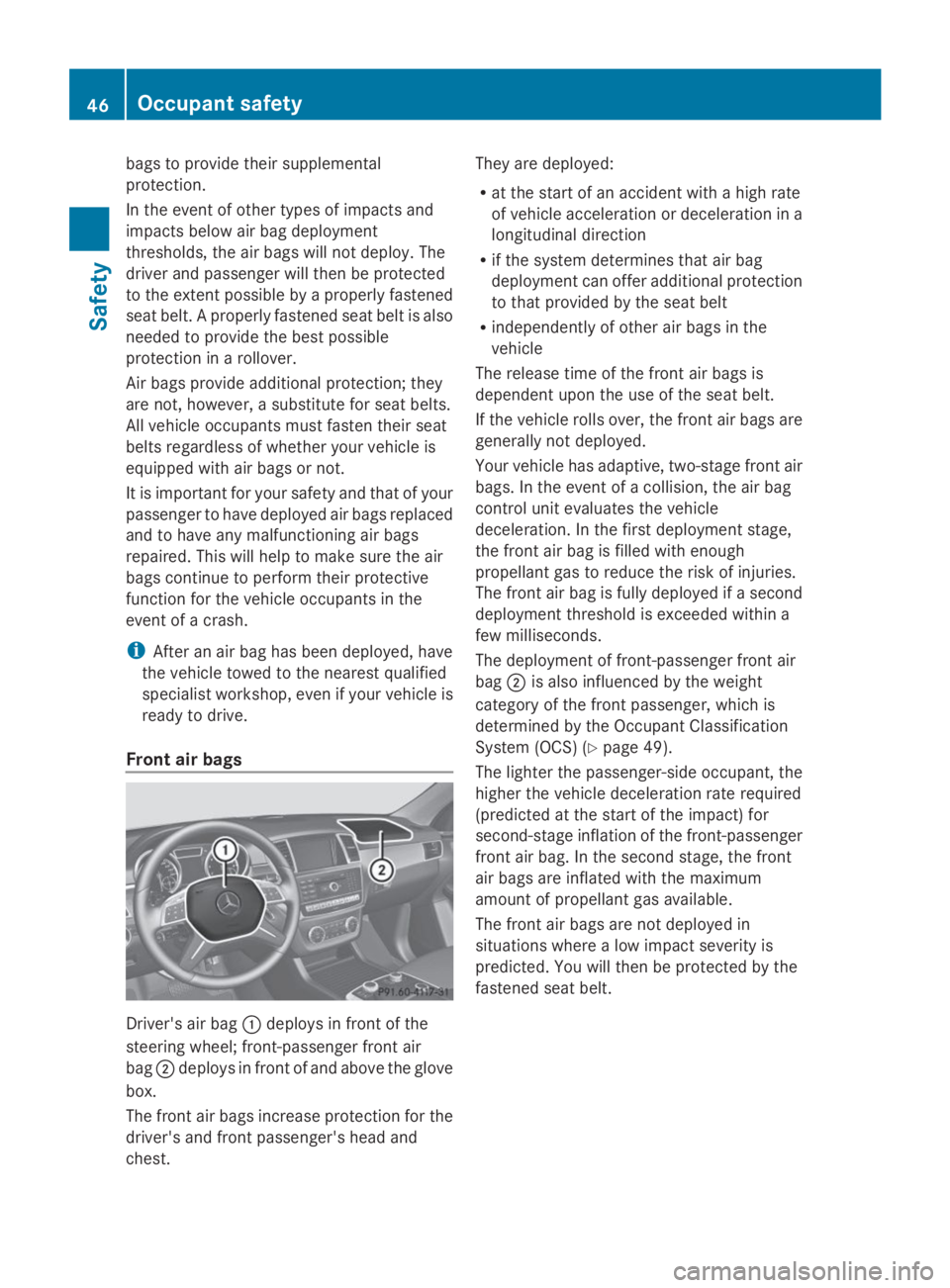
Front air bags
Driver's air bagCdeploys in front of the
steering wheel; front-passenger front air
bagDdeploys in front of and above the glove
box.
The front air bags increase protection for the
driver's and front passenger's head and
chest.
They are deployed:
Rat the start of an accident with a high rate
of vehicle acceleration or deceleration in a
longitudinal direction
Rif the system determines that air bag
deployment can offer additional protection
to that provided by the seat belt
Rindependently of other air bags in the
vehicle
The release time of the front air bags is
dependent upon the use of the seat belt.
If the vehicle rolls over, the front air bags are
generally not deployed.
Your vehicle has adaptive, two-stage front air
bags. In the event of a collision, the air bag
control unit evaluates the vehicle
deceleration. In the first deployment stage,
the front air bag is filled with enough
propellant gas to reduce the risk of injuries.
The front air bag is fully deployed if a second
deployment threshold is exceeded within a
few milliseconds.
The deployment of front-passenger front air
bagDis also influenced by the weight
category of the front passenger, which is
determined by the Occupant Classification
System (OCS) (Ypage 49).
The lighter the passenger-side occupant, the
higher the vehicle deceleration rate required
(predicted at the start of the impact) for
second-stage inflation of the front-passenger
front air bag. In the second stage, the front
air bags are inflated with the maximum
amount of propellant gas available.
The front air bags are not deployed in
situations where a low impact severity is
predicted. You will then be protected by the
fastened seat belt.
46Occupant safety
Safety
Page 61 of 462
and
Rif a vehicle speed of 15 mph (25 km/h) is
exceeded, thevseat belt warning lamp
begins to flash. A warning tone also sounds
with increasing intensity for a maximum of
60 seconds or until the driver or front
passenger have fastened their seat belts.
If the driver/front passenger unfasten their
seat belt while the vehicle is in motion, the
vseat belt warning lamp lights up and a
warning tone sounds again.
The warning tone ceases even if the driver or
front-passenger seat belt has still not been
fastened after 60 seconds. Thevseat belt
warning lamp stops flashing but remains
illuminated.
After the vehicle comes to a standstill, the
warning tone is reactivated. Thevseat
belt warning lamp flashes again if the vehicle
speed exceeds 15 mph (25 km/h).
Thevseat belt warning lamp only goes
out if:
Rboth the driver and the front passenger
have fastened their seat belts.
or
Rthe vehicle is stationary and a door is open.
iFor more information on thevseat
belt warning lamp, see "Warning and
indicator lamps in the instrument cluster,
seat belts" (Ypage 324).
Emergency Tensioning Devices, seat
belt force limiters
GWARNING
Pyrotechnic Emergency Tensioning Devices
that have been deployed are no longer
operational and are unable to perform their
intended protective function. This poses an
increased risk of injury or even fatal injury.
Therefore, have pyrotechnic Emergency
Tensioning Devices which have been
triggered immediately replaced at a qualified
specialist workshop.
!If the front-passenger seat is not
occupied, do not engage the seat belt
tongue in the buckle on the front-
passenger seat. Otherwise, the Emergency
Tensioning Device could be triggered in the
event of an accident.
iVehicles with PRE-SAFE®: an electric
motor is used by PRE-SAFE®to trigger the
tightening of the seat belt in hazardous
situations. This procedure is reversible.
The seat belts on the following seats have
Emergency Tensioning Devices and seat belt
force limiters:
Rdriver's and front-passenger seat
Rthe outer seats in the second row
Rthe seats in the third row
The ETDs tighten the seat belts in an accident,
pulling them close against the body.
The ETDs do not correct incorrect seat
positions or incorrectly fastened seat belts.
The ETDs do not pull vehicle occupants back
towards the backrest.
If the seat belt is also equipped with a seat
belt force limiter and this is triggered, the
force exerted by the seat belt on the vehicle
occupant is reduced.
The seat belt force limiters for the front seats
are synchronized with the front air bags,
which absorb part of the deceleration force.
This results in the force exerted on the
occupant being distributed over a greater
area.
The ETDs can only be activated when:
Rthe ignition is switched on
Rthe restraint systems are operational; see
"SRS warning lamp" (Ypage 43)
Rthe belt tongue is engaged in the buckle on
each of the lap-shoulder belts in the front
The Emergency Tensioning Devices on the
outside seats in the second row and on the
seats in the third row are triggered
independently of the lock status of the seat
belts.
Occupant safety59
Safety
Z
Page 90 of 462
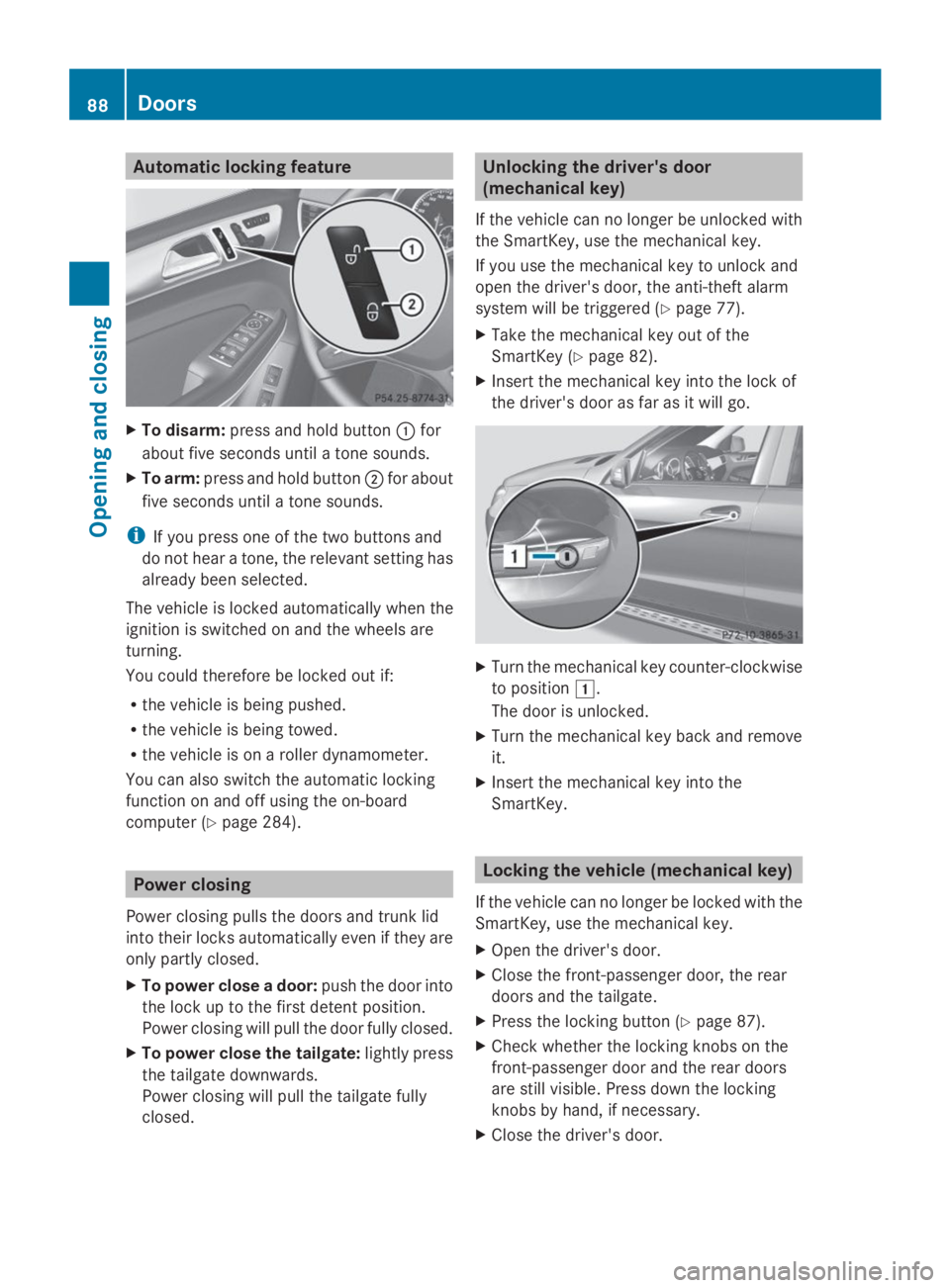
Automatic locking feature
XTo disarm:press and hold buttonCfor
about five seconds until a tone sounds.
XTo arm:press and hold buttonDfor about
five seconds until a tone sounds.
iIf you press one of the two buttons and
do not hear a tone, the relevant setting has
already been selected.
The vehicle is locked automatically when the
ignition is switched on and the wheels are
turning.
You could therefore be locked out if:
Rthe vehicle is being pushed.
Rthe vehicle is being towed.
Rthe vehicle is on a roller dynamometer.
You can also switch the automatic locking
function on and off using the on-board
computer (Ypage 284).
Power closing
Power closing pulls the doors and trunk lid
into their locks automatically even if they are
only partly closed.
XTo power close a door:push the door into
the lock up to the first detent position.
Power closing will pull the door fully closed.
XTo power close the tailgate:lightly press
the tailgate downwards.
Power closing will pull the tailgate fully
closed.
Unlocking the driver's door
(mechanical key)
If the vehicle can no longer be unlocked with
the SmartKey, use the mechanical key.
If you use the mechanical key to unlock and
open the driver's door, the anti-theft alarm
system will be triggered (Ypage 77).
XTake the mechanical key out of the
SmartKey (Ypage 82).
XInsert the mechanical key into the lock of
the driver's door as far as it will go.
XTurn the mechanical key counter-clockwise
to positionG.
The door is unlocked.
XTurn the mechanical key back and remove
it.
XInsert the mechanical key into the
SmartKey.
Locking the vehicle (mechanical key)
If the vehicle can no longer be locked with the
SmartKey, use the mechanical key.
XOpen the driver's door.
XClose the front-passenger door, the rear
doors and the tailgate.
XPress the locking button (Ypage 87).
XCheck whether the locking knobs on the
front-passenger door and the rear doors
are still visible. Press down the locking
knobs by hand, if necessary.
XClose the driver's door.
88Doors
Opening and closing
Page 167 of 462
Useful information............................166
Notes on breaking-in a new vehicle 166
Driving...............................................166
Automatic transmission...................173
Refueling............................................182
Parking...............................................188
Driving tips........................................191
Driving systems................................201
Towing a trailer.................................263
165
Driving and parking
Page 176 of 462
![MERCEDES-BENZ GL 2014 User Guide ]Park position with parking lock
^Reverse gear
\\Neutral
[Drive
XPush the DIRECT SELECT lever in the
direction of arrowP.
iThe automatic transmission shifts into
park positionPautomatically:
Rif y](/img/4/59076/w960_59076-175.png "MERCEDES-BENZ GL 2014 User Guide ]Park position with parking lock
^Reverse gear
\\Neutral
[Drive
XPush the DIRECT SELECT lever in the
direction of arrowP.
iThe automatic transmission shifts into
park positionPautomatically:
Rif y")
]Park position with parking lock
^Reverse gear
\\Neutral
[Drive
XPush the DIRECT SELECT lever in the
direction of arrowP.
iThe automatic transmission shifts into
park positionPautomatically:
Rif you open the driver's door while the
vehicle is stationary in transmission
positionDorR
Rif you open the door while traveling at
very low speeds in transmission position
DorR
Engaging park position P automatically
Park positionPis automatically engaged if:
Ryou switch off the engine using the
SmartKey and remove the SmartKey.
Ryou switch off the engine using the Start/
Stop button and open one of the front
doors.
Rthe HOLD (Ypage 216) or DISTRONIC
PLUS (Ypage 203) function brake your
vehicle until it is stationary and at least one
of the following conditions is fulfilled:
-there is a system malfunction.
-the vehicle is on a steep uphill or downhill
gradient. The electric parking brake is
then also applied.
Engaging reverse gear R
!Only shift the automatic transmission to
Rwhen the vehicle is stationary.
XWhen the vehicle is stationary, depress the
brake pedal.
XPush the DIRECT SELECT lever up past the
first point of resistance.
Shifting to neutral N
GWARNING
If children are left unsupervised in the vehicle,
they could:
Ropen the doors, thus endangering other
people or road users.
Rget out and disrupt traffic.
Roperate the vehicle's equipment.
Additionally, children could set the vehicle in
motion if, for example, they:
Rrelease the parking brake.
Rshifting the automatic transmission out of
park positionP
RStart the engine.
There is a risk of an accident and injury.
When leaving the vehicle, always take the
SmartKey with you and lock the vehicle. Never
leave children or animals unattended in the
vehicle. Always keep the SmartKey out of
reach of children.
XWhen the vehicle is stationary, depress the
brake pedal.
XPush the DIRECT SELECT lever up or down
to the first point of resistance.
If the engine has been switched off, the
automatic transmission automatically shifts
toN.
If you want the automatic transmission to
remain in neutralN, e.g. when having the
vehicle cleaned in an automatic car wash with
a towing system, observe the following notes:
174Automatic transmission
Driving and parking
Page 178 of 462
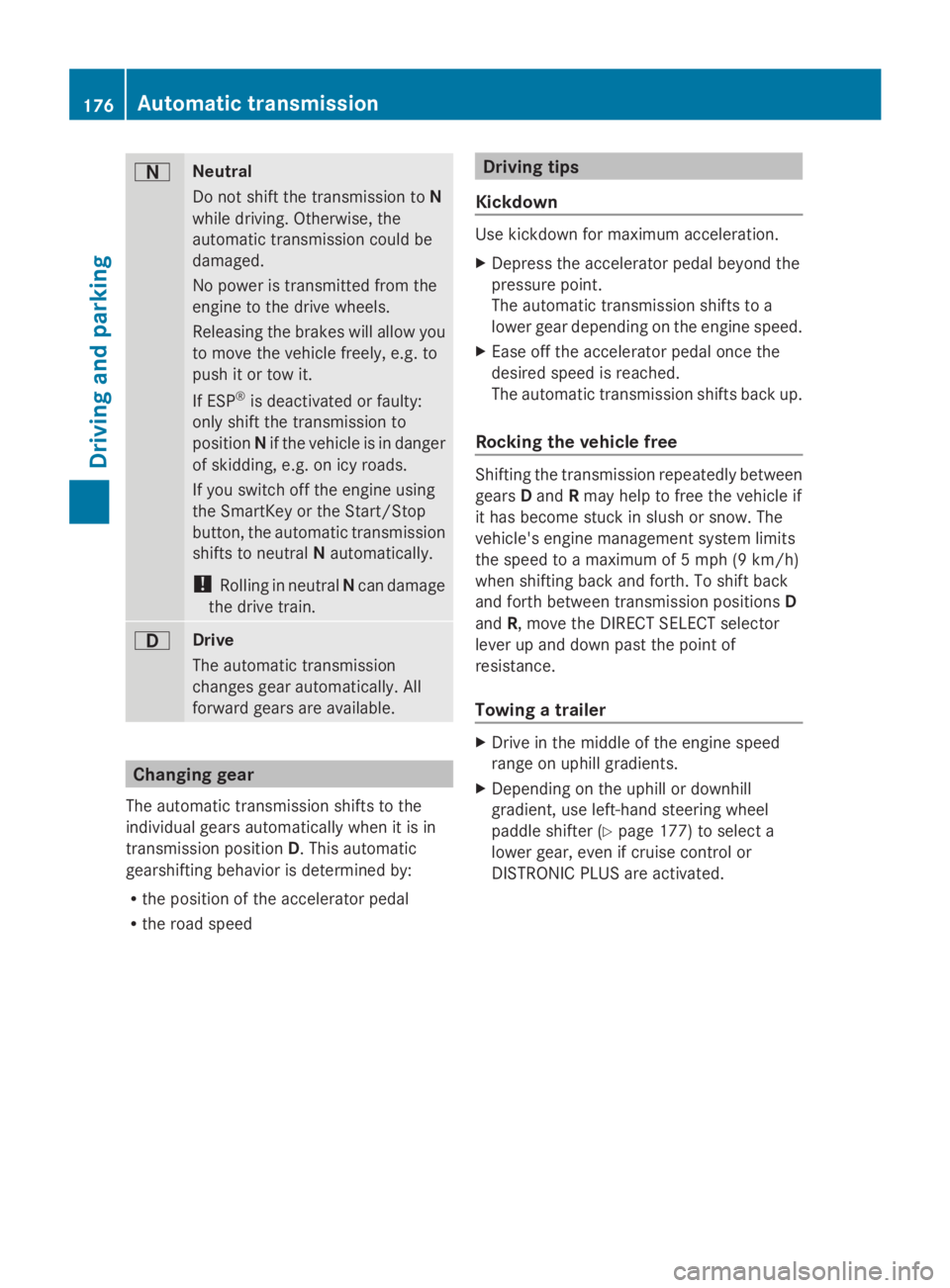
DNeutral
Do not shift the transmission toN
while driving. Otherwise, the
automatic transmission could be
damaged.
No power is transmitted from the
engine to the drive wheels.
Releasing the brakes will allow you
to move the vehicle freely, e.g. to
push it or tow it.
If ESP®is deactivated or faulty:
only shift the transmission to
positionNif the vehicle is in danger
of skidding, e.g. on icy roads.
If you switch off the engine using
the SmartKey or the Start/Stop
button, the automatic transmission
shifts to neutralNautomatically.
!Rolling in neutralNcan damage
the drive train.
:Drive
The automatic transmission
changes gear automatically. All
forward gears are available.
Changing gear
The automatic transmission shifts to the
individual gears automatically when it is in
transmission positionD. This automatic
gearshifting behavior is determined by:
Rthe position of the accelerator pedal
Rthe road speed
Driving tips
Kickdown
Use kickdown for maximum acceleration.
XDepress the accelerator pedal beyond the
pressure point.
The automatic transmission shifts to a
lower gear depending on the engine speed.
XEase off the accelerator pedal once the
desired speed is reached.
The automatic transmission shifts back up.
Rocking the vehicle free
Shifting the transmission repeatedly between
gearsDandRmay help to free the vehicle if
it has become stuck in slush or snow. The
vehicle's engine management system limits
the speed to a maximum of 5 mph (9 km/h)
when shifting back and forth. To shift back
and forth between transmission positionsD
andR, move the DIRECT SELECT selector
lever up and down past the point of
resistance.
Towing a trailer
XDrive in the middle of the engine speed
range on uphill gradients.
XDepending on the uphill or downhill
gradient, use left-hand steering wheel
paddle shifter (Ypage 177) to select a
lower gear, even if cruise control or
DISTRONIC PLUS are activated.
176Automatic transmission
Driving an d parking
Page 184 of 462
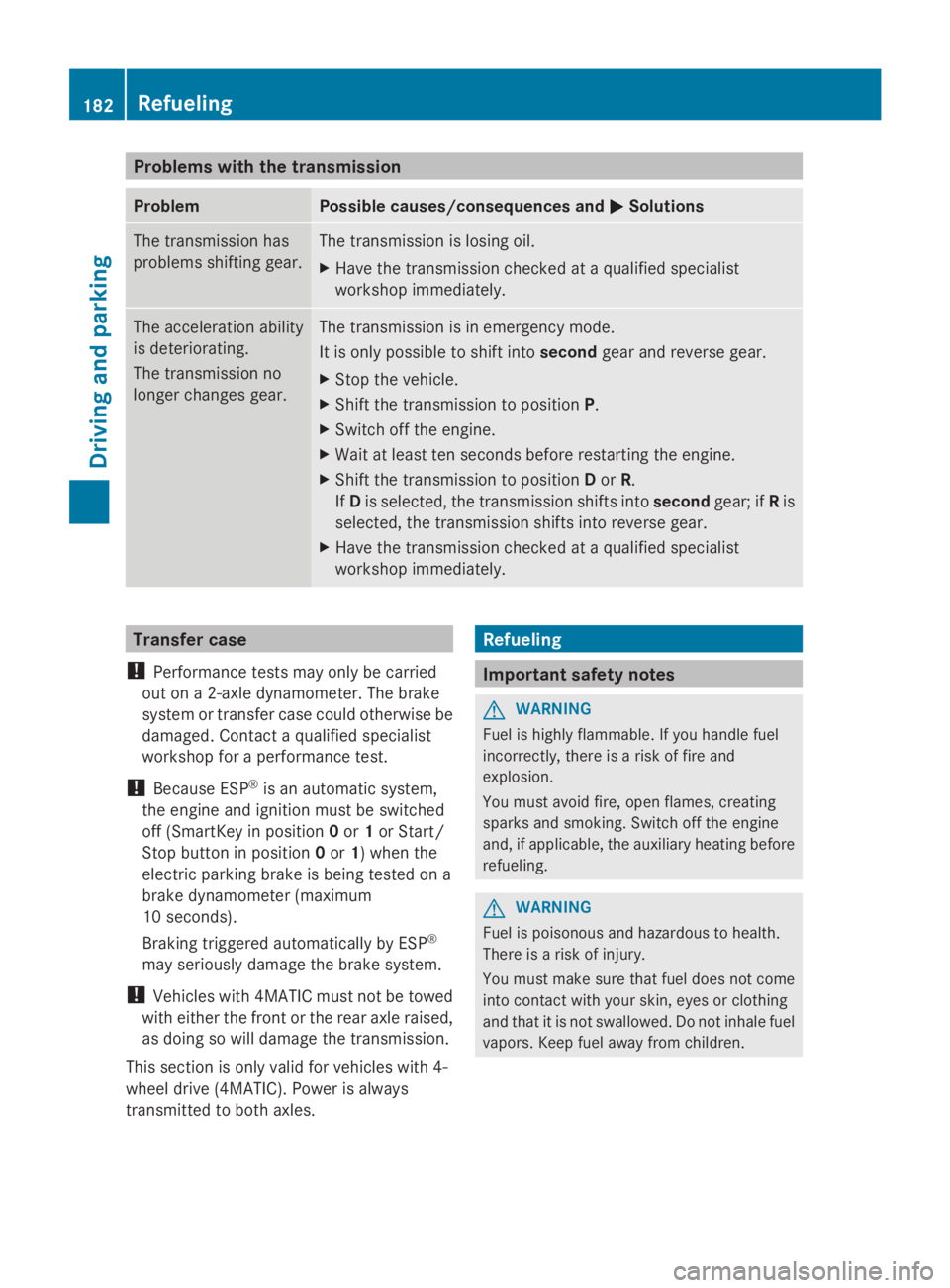
Problems with the transmission
ProblemPossible causes/consequences andPPSolutions
The transmission has
problems shifting gear.
The transmission is losing oil.
XHave the transmission checked at a qualified specialist
workshop immediately.
The acceleration ability
is deteriorating.
The transmission no
longer changes gear.
The transmission is in emergency mode.
It is only possible to shift intosecondgear and reverse gear.
XStop the vehicle.
XShift the transmission to positionP.
XSwitch off the engine.
XWait at least ten seconds before restarting the engine.
XShift the transmission to positionDorR.
IfDis selected, the transmission shifts intosecondgear; ifRis
selected, the transmission shifts into reverse gear.
XHave the transmission checked at a qualified specialist
workshop immediately.
Transfer case
!Performance tests may only be carried
out on a 2-axle dynamometer. The brake
system or transfer case could otherwise be
damaged. Contact a qualified specialist
workshop for a performance test.
!Because ESP®is an automatic system,
the engine and ignition must be switched
off (SmartKey in position0or1or Start/
Stop button in position0or1) when the
electric parking brake is being tested on a
brake dynamometer (maximum
10 seconds).
Braking triggered automatically by ESP®
may seriously damage the brake system.
!Vehicles with 4MATIC must not be towed
with either the front or the rear axle raised,
as doing so will damage the transmission.
This section is only valid for vehicles with 4-
wheel drive (4MATIC). Power is always
transmitted to both axles.
Refueling
Important safety notes
GWARNING
Fuel is highly flammable. If you handle fuel
incorrectly, there is a risk of fire and
explosion.
You must avoid fire, open flames, creating
sparks and smoking. Switch off the engine
and, if applicable, the auxiliary heating before
refueling.
GWARNING
Fuel is poisonous and hazardous to health.
There is a risk of injury.
You must make sure that fuel does not come
into contact with your skin, eyes or clothing
and that it is not swallowed. Do not inhale fuel
vapors. Keep fuel away from children.
182Refueling
Driving and parking
Page 190 of 462
XPress DEF refill bottleCtowards the filler
neck.
The DEF tank is filled. This may take up to
one minute.
iWhen DEF refill bottleCis no longer
pressed, filling stops and the bottle may be
taken off again after being only partially
emptied.
XRelease DEF refill bottleC.
XTurn DEF refill bottleCcounter-clockwise
and remove it.
XScrew the protective cap onto DEF refill
bottleCagain.
DEF refill bottles can be obtained at many gas
stations or at an authorized Mercedes-Benz
Center. Refill bottles without a threaded cap
do not provide overfill protection. DEF may
leak if overfilled. Mercedes Benz offers
special refill bottles with a threaded seal.
These are available at any authorized
Mercedes-Benz Center.
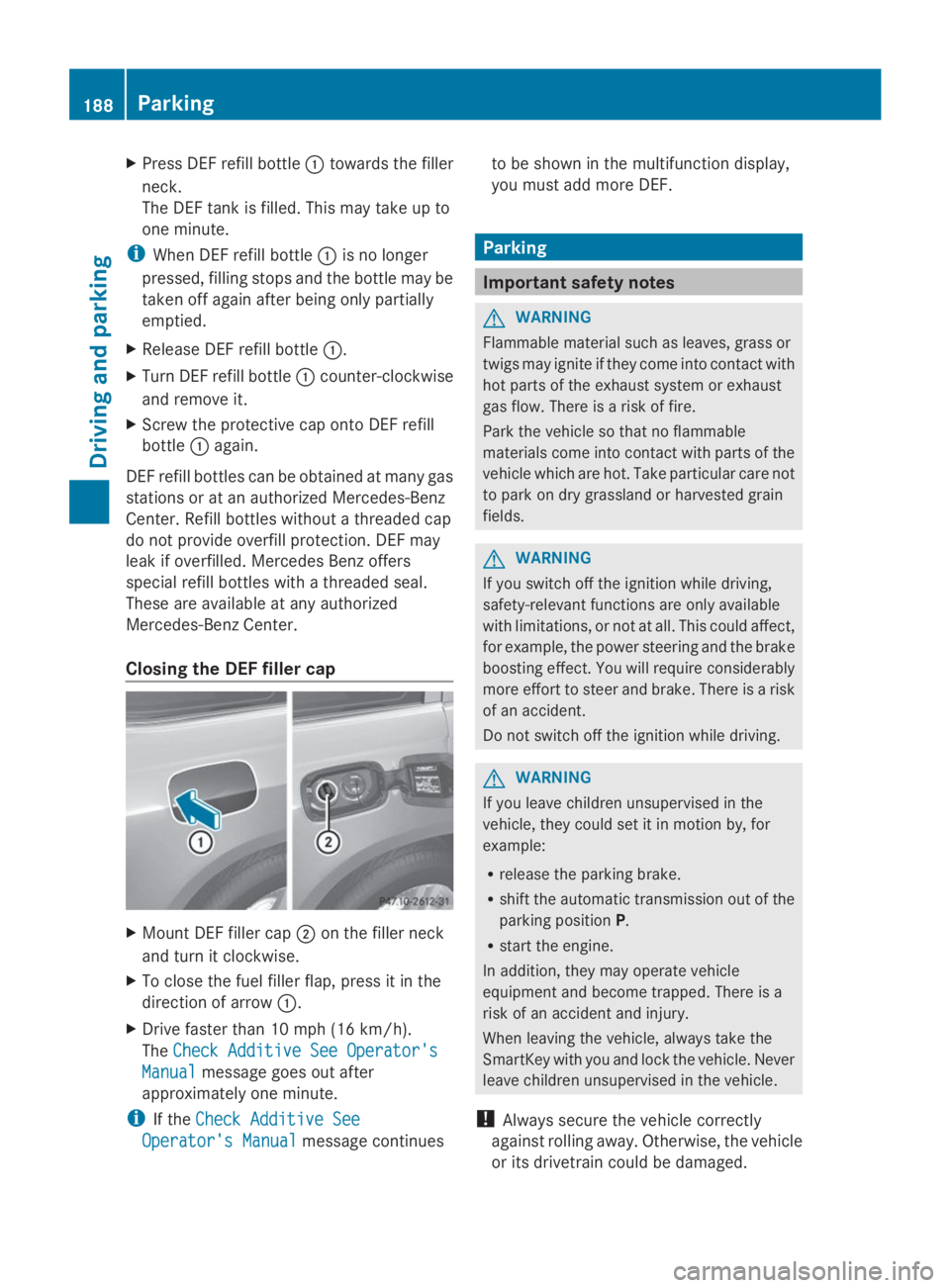
Closing the DEF filler cap
XMount DEF filler capDon the filler neck
and turn it clockwise.
XTo close the fuel filler flap, press it in the
direction of arrowC.
XDrive faster than 10 mph (16 km/h).
TheCheck Additive See Operator'sCheck Additive See Operator's
ManualManualmessage goes out after
approximately one minute.
iIf theCheck Additive SeeCheck Additive See
Operator's ManualOperator's Manualmessage continues
to be shown in the multifunction display,
you must add more DEF.
Parking
Important safety notes
GWARNING
Flammable material such as leaves, grass or
twigs may ignite if they come into contact with
hot parts of the exhaust system or exhaust
gas flow. There is a risk of fire.
Park the vehicle so that no flammable
materials come into contact with parts of the
vehicle which are hot. Take particular care not
to park on dry grassland or harvested grain
fields.
GWARNING
If you switch off the ignition while driving,
safety-relevant functions are only available
with limitations, or not at all. This could affect,
for example, the power steering and the brake
boosting effect. You will require considerably
more effort to steer and brake. There is a risk
of an accident.
Do not switch off the ignition while driving.
GWARNING
If you leave children unsupervised in the
vehicle, they could set it in motion by, for
example:
Rrelease the parking brake.
Rshift the automatic transmission out of the
parking positionP.
Rstart the engine.
In addition, they may operate vehicle
equipment and become trapped. There is a
risk of an accident and injury.
When leaving the vehicle, always take the
SmartKey with you and lock the vehicle. Never
leave children unsupervised in the vehicle.
!Always secure the vehicle correctly
against rolling away. Otherwise, the vehicle
or its drivetrain could be damaged.
188Parking
Driving and parking
Page 191 of 462
To ensure that the vehicle is secured against
rolling away unintentionally:
Rthe electric parking brake must be applied.
Rthe transmission must be in positionPand
the SmartKey must be removed from the
ignition lock.
Rthe front wheels must be turned towards
the curb on steep uphill or downhill
gradients.
Rthe empty vehicle must be secured at the
front axle with a wheel chock or similar, for
example, on uphill or downhill gradients.
Ra laden vehicle must also be secured at the
rear axle with a wheel chock or similar, for
example, on uphill or downhill gradients.
Switching off the engine
Important safety notes
GWARNING
The automatic transmission switches to
neutral positionNwhen you switch off the
engine. The vehicle may roll away. There is a
risk of an accident.
After switching off the engine, always switch
to parking positionP. Prevent the parked
vehicle from rolling away by applying the
parking brake.
Using the SmartKey
XApply the electric parking brake.
XShift the transmission to positionP.
XTurn the SmartKey to position0in the
ignition lock and remove it.
The immobilizer is activated.
iIf you turn off the engine with the
SmartKey and then remove it from the
ignition lock or open a front door, the
automatic transmission shifts toP
automatically.
If you shift the automatic transmission to
Nbefore switching off the engine, the
automatic transmission remains inNeven
if a door is opened.
Using KEYLESS-GO
XApply the electric parking brake.
XShift the transmission to positionP.
XPress the Start/Stop button (Ypage 167).
The engine stops and all the indicator
lamps in the instrument cluster go out.
iIf you turn off the engine with the Start/
Stop button, the automatic transmission
shifts toN. If you then open one of the front
doors, the automatic transmission shifts to
P.
iIn the event of an emergency, the engine
can be turned off while the vehicle is in
motion by pressing and holding the Start/
Stop button for three seconds.
Electric parking brake
General notes
GWARNING
If you leave children unsupervised in the
vehicle, they could set it in motion by, for
example:
Rrelease the parking brake.
Rshift the automatic transmission out of the
parking positionP.
Rstart the engine.
In addition, they may operate vehicle
equipment and become trapped. There is a
risk of an accident and injury.
When leaving the vehicle, always take the
SmartKey with you and lock the vehicle. Never
leave children unsupervised in the vehicle.
Parking189
Driving and parking
Z