ESP MERCEDES-BENZ GL 2016 Owners Manual
[x] Cancel search | Manufacturer: MERCEDES-BENZ, Model Year: 2016, Model line: GL, Model: MERCEDES-BENZ GL 2016Pages: 462, PDF Size: 12.66 MB
Page 418 of 462
Loading the vehicle
Instruction labels for tires and loads
G WARNING
Overloaded tires can overheat, causing a
blowout. Overloaded tires can also impair the
steering and driving characteristics and lead
to brake failure. There is a risk of accident.
Observe the load rating of the tires. The load
rating must be at least half of the GAWR of
your vehicle. Never overload the tires by
exceeding the maximum load.
Two instruction labels on your vehicle show
the maximum possible load.
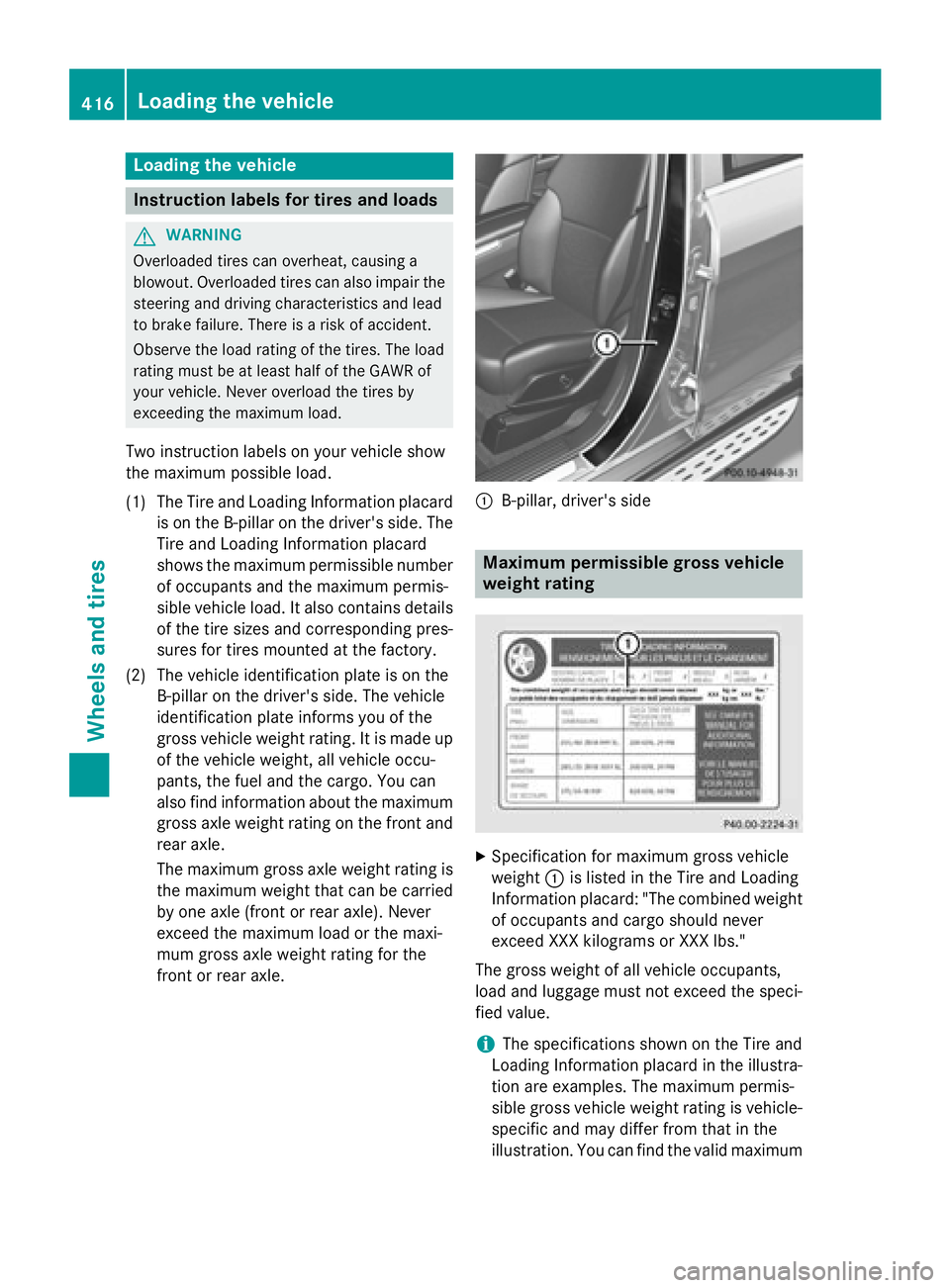
(1) The Tire and Loading Information placard
is on the B-pillar on the driver's side. The
Tire and Loading Information placard
shows the maximum permissible number
of occupants and the maximum permis-
sible vehicle load. It also contains details
of the tire sizes and corresponding pres-
sures for tires mounted at the factory.
(2) The vehicle identification plate is on the
B-pillar on the driver's side. The vehicle
identification plate informs you of the
gross vehicle weight rating. It is made up
of the vehicle weight, all vehicle occu-
pants, the fuel and the cargo. You can
also find information about the maximum
gross axle weight rating on the front and
rear axle.
The maximum gross axle weight rating is
the maximum weight that can be carried
by one axle (front or rear axle). Never
exceed the maximum load or the maxi-
mum gross axle weight rating for the
front or rear axle. C
B-pillar, driver's side
Maximum permissible gross vehicle
weight rating
X
Specification for maximum gross vehicle
weight C is listed in the Tire and Loading
Information placard: "The combined weight
of occupants and cargo should never
exceed XXX kilograms or XXX lbs."
The gross weight of all vehicle occupants,
load and luggage must not exceed the speci-
fied value.
i The specifications shown on the Tire and
Loading Information placard in the illustra-
tion are examples. The maximum permis-
sible gross vehicle weight rating is vehicle-
specific and may differ from that in the
illustration. You can find the valid maximum416
Loading the vehicle
Wheels and tires
Page 425 of 462
All-weather tires and winter tires
Index Speed ra ting
Q M+S 2
up to 100 mph (160 km/h)
T M+S 2
up to 118 mph (190 km/h)
H M+S 2
up to 130 mph (210 km/h)
V M+S 2
up to 149 mph (240 km/h)
i Not all tires with the M+S marking provide
the driv ing characteristics of winter tires. In
addit ion to the M+S marking, winter tires
also have the M snowflake symbol on
the tire wall. Tires wit h this marking fulfill
the requirements of the Rubber Manufac-
turers Association (RMA) and the Rubber
Association of Canada (RAC) regarding the
tire traction on snow. They have been espe-
cial ly developed for driving on snow.
An electron ic speed limiter prevents your
veh icle from exceeding the fol lowin g speeds:R
All veh icle s (except AMG vehicles):
130 mph (210 km/h) R
AMG veh icle s: 155 mph (250 km/h)R
AMG veh icle s wit h increased top speed:
174 mph (280 km/h)
The speed rating of tires mounted at the fac-
tory may be higher than the maximum speed
that the electronic speed limiter permits.
Make sure that your tires have the required
speed rating, e.g. when buying new tires. The
required speed rating for your vehicle can be
found in the "Tires" section ( Y
page 432).
Further information about reading tire data
can be obtained from any qualified specialist
worksho p. Load index
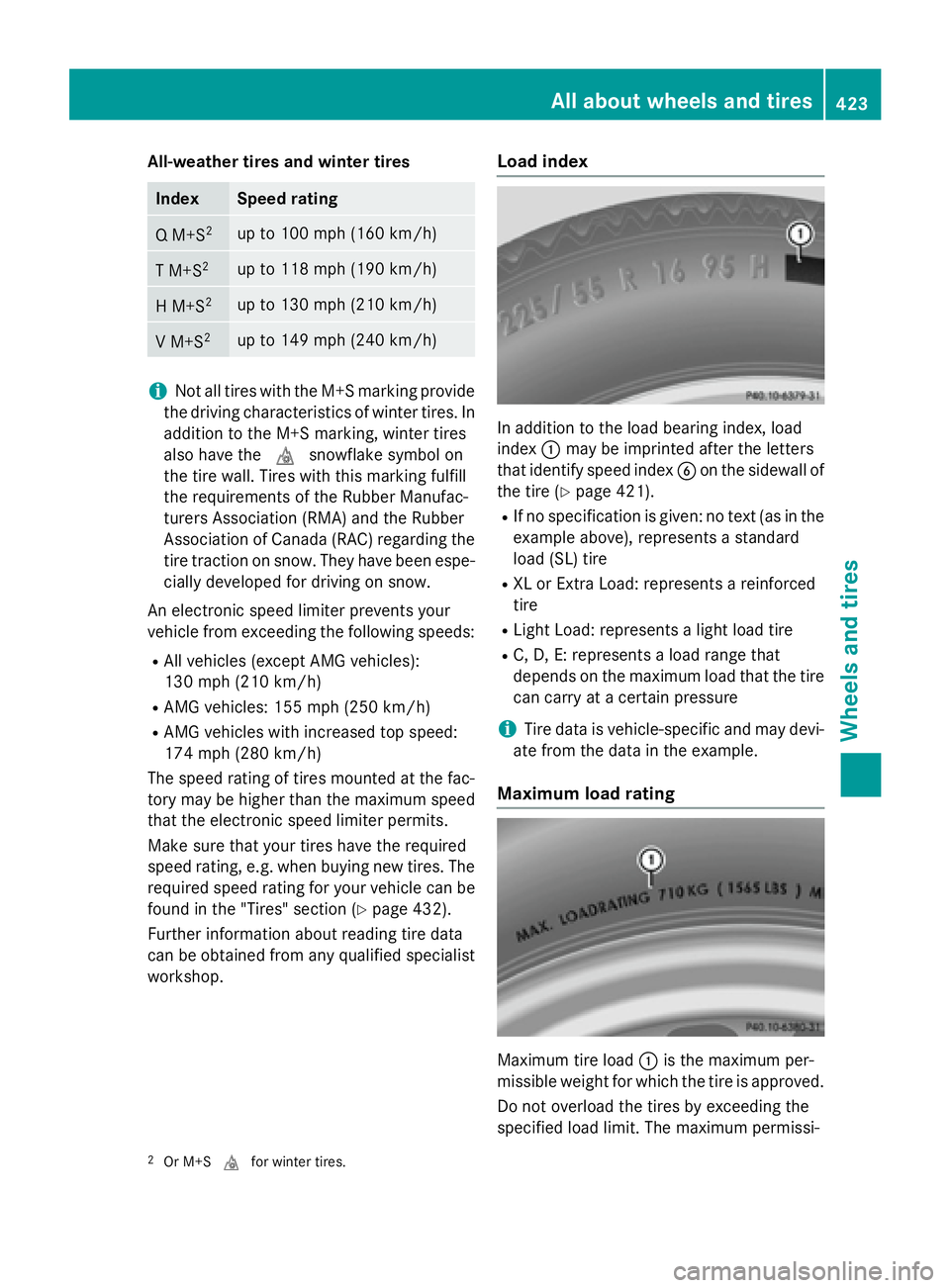
In addition to the load bearing index, load
index C may be imprinted after the letters
that identify speed index
Page 433 of 462
Mounting a new wheel
G WARNING
Oiled or greased wheel bolts or damaged
wheel bolts/hub threads can cause the wheel
bolts to come loose. As a result, you could
lose a wheel while driving. There is a risk of
accident.
Never oil or grease wheel bolts. In the event of
damage to the threads, contact a qualified
specialist workshop immediately. Have the
damaged wheel bolts or hub threads
replaced/renewed. Do not continue driving.
G WARNING
If you tighten the wheel bolts or wheel nuts
when the vehicle is raised, the jack could tip
over. There is a risk of injury.
Only tighten the wheel bolts or wheel nuts
when the vehicle is on the ground.
! To prevent damage to the paintwork, hold
the wheel securely against the wheel hub
while screwing in the first wheel bolt.
Always pay attention to the instructions and
safety notes in the "Changing a wheel" sec-
tion ( Y
page 427).
Only use wheel bolts that have been designed
for the wheel and the vehicle. For safety rea-
sons, Mercedes-Benz recommends that you
only use wheel bolts which have been
approved for Mercedes-Benz vehicles and the
respective wheel.
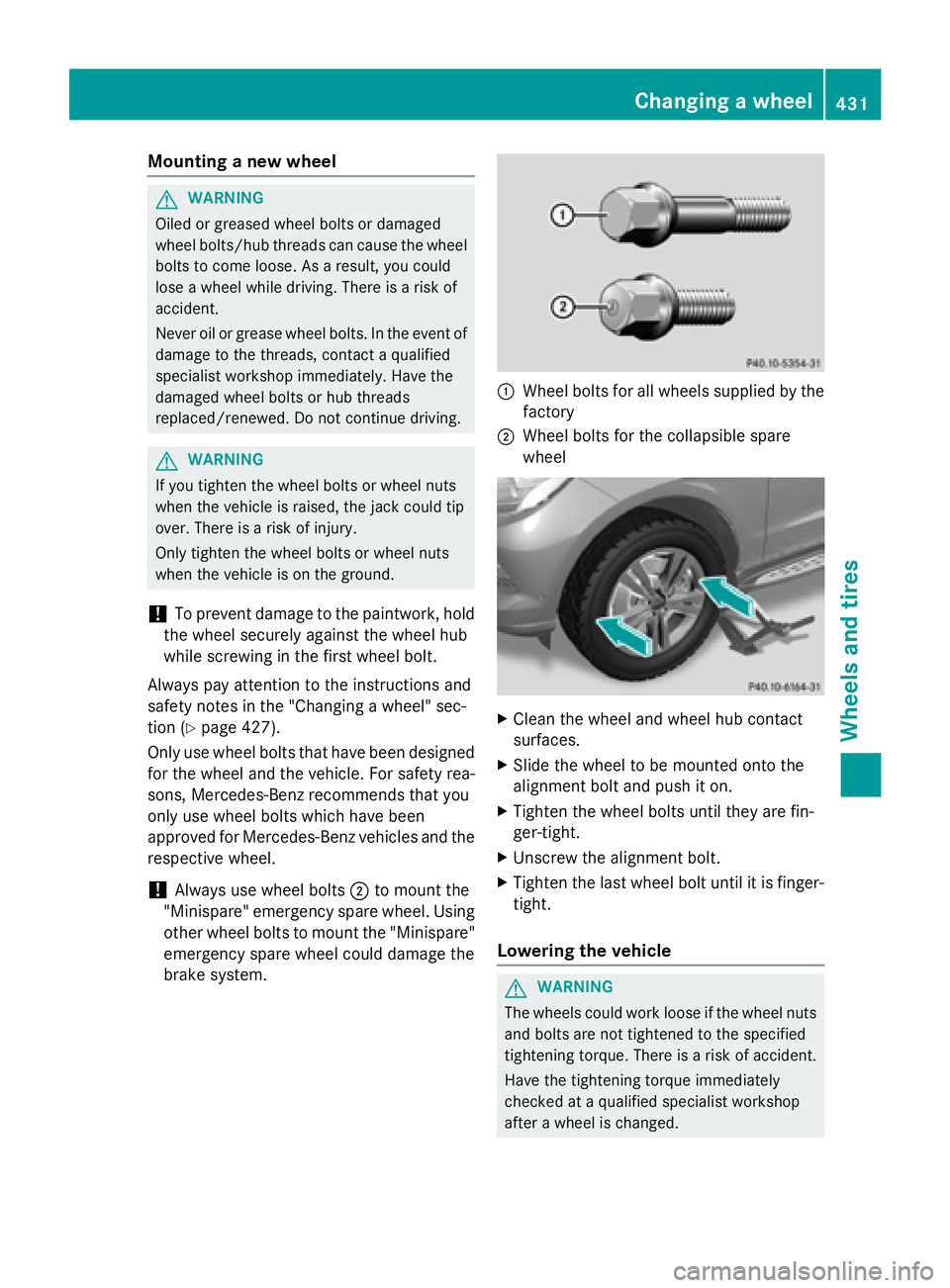
! Always use wheel bolts D to mount the
"Minispare" emergency spare wheel. Using
other wheel bolts to mount the "Minispare"
emergency spare wheel could damage the
brake system. C
Wheel bolts for all wheels supplied by the
factory D
Wheel bolts for the collapsible spare
wheel
X
Clean the wheel and wheel hub contact
surfaces. X
Slide the wheel to be mounted onto the
alignment bolt and push it on. X
Tighten the wheel bolts until they are fin-
ger-tight. X
Unscrew the alignment bolt. X
Tighten the last wheel bolt until it is finger-
tight.
Lowering the vehicle
G WARNING
The wheels could work loose if the wheel nuts
and bolts are not tightened to the specified
tightening torque. There is a risk of accident.
Have the tightening torque immediately
checked at a qualified specialist workshop
after a wheel is changed.Changing a wheel 431
Wheels and tires Z
Page 435 of 462
The recommended pressures for various
operating conditions can be found: R
on the Tire and Loading Information placard
with the recommended tire pressures on
the B-pillar on the driver's side R
in the tire pressure table on the inside of the
fuel filler flap
Observe the notes on recommended tire
pressures under various operating conditions
( Y
page 408).
Check tire pressures regularly, and only when
the tires are cold. Comply with the mainte-
nance recommendations of the tire manufac-
turer in the vehicle document wallet.
Notes on the vehicle equipment – always
equip the vehicle with: R
tires of the same size across an axle (left
and right) R
the same type of tires at a given time (sum-
mer tires, winter tires, MOExtended tires)
Vehicles equipped with MOExtended tires are
not equipped with a TIREFIT kit at the factory.
It is therefore recommended that you addi-
tionally equip your vehicle with a TIREFIT kit if
you mount tires that do not feature run-flat
properties, e.g. winter tires. A TIREFIT kit may
be obtained from a qualified specialist work-
shop.
i Not all wheel and tire combinations are
available at the factory for all countries.
i The following pages contain information
on approved wheel rims and tire sizes for
equipping your vehicle with winter tires.
Winter tires are not available at the factory
as standard equipment or optional extras.
If you want to equip your vehicle with
approved winter tires, it may be necessary
to obtain wheel rims in the corresponding
size. The size of the approved winter tires
may differ from the standard tires. This is
dependent on the model and the equip-
ment installed at the factory.
The tires and wheel rims, as well as further
information, can be obtained at a qualified
specialist workshop. Wheel and tire combinations 433
Wheels and tires Z
Page 440 of 462
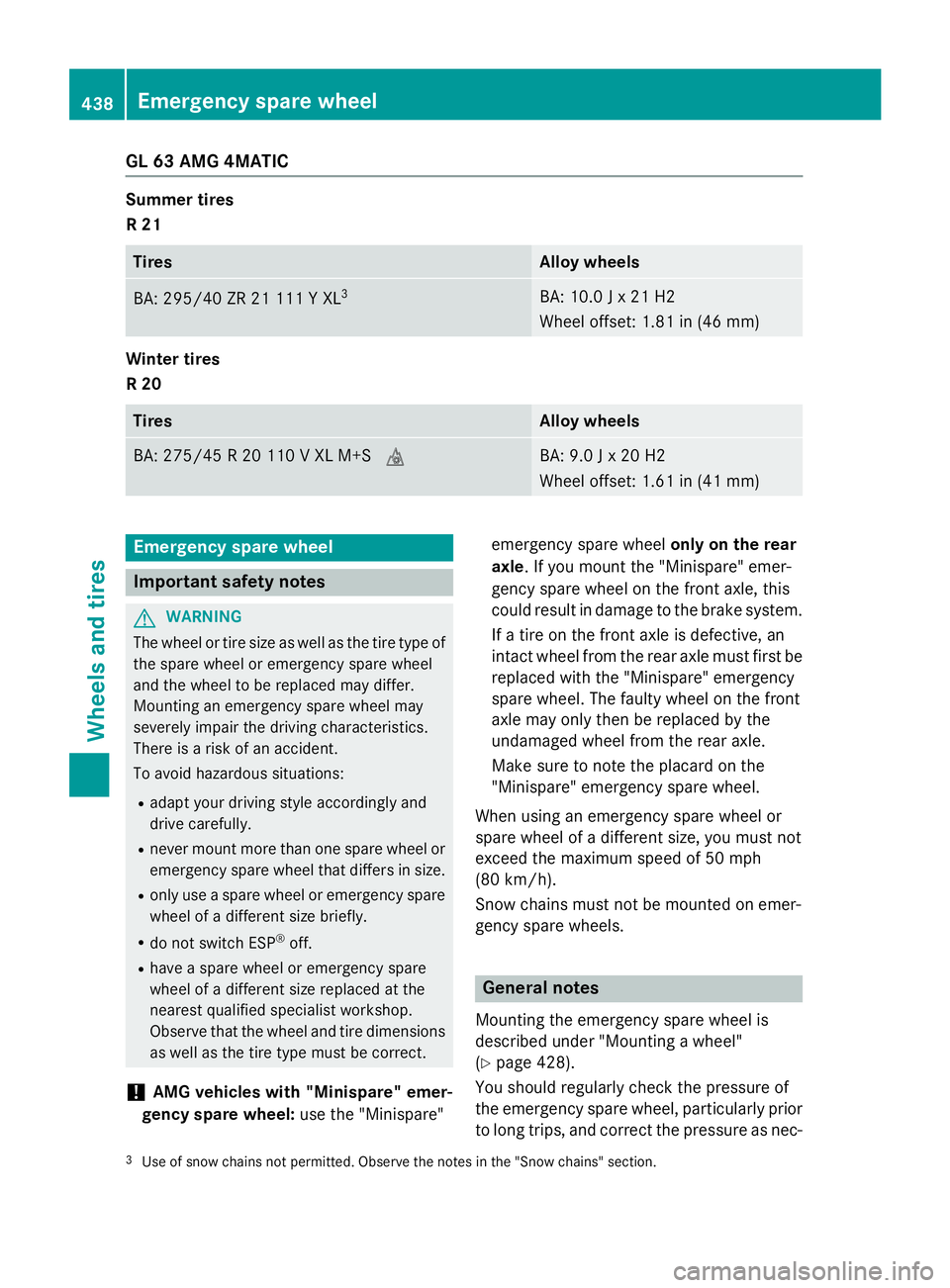
GL 63 AMG 4MATIC Summer tires
R 21
Tires Alloy wheels
BA: 295/40 ZR 21 111 Y XL 3
BA: 10.0 J x 21 H2
Wheel offset: 1.81 in (46 mm)
Winter tires
R 20
Tires Alloy wheels
BA: 275/45 R 20 110 V XL M+S M BA: 9.0 J x 20 H2
Wheel offset: 1.61 in (41 mm)
Emergency spare wheel
Important safety notes
G WARNING
The wheel or tire size as well as the tire type of
the spare wheel or emergency spare wheel
and the wheel to be replaced may differ.
Mounting an emergency spare wheel may
severely impair the driving characteristics.
There is a risk of an accident.
To avoid hazardous situations: R
adapt your driving style accordingly and
drive carefully. R
never mount more than one spare wheel or
emergency spare wheel that differs in size. R
only use a spare wheel or emergency spare
wheel of a different size briefly. R
do not switch ESP ®
off.R
have a spare wheel or emergency spare
wheel of a different size replaced at the
nearest qualified specialist workshop.
Observe that the wheel and tire dimensions
as well as the tire type must be correct.
! AMG vehicles with "Minispare" emer-
gency spare wheel: use the "Minispare" emergency spare wheel only on the rear
axle . If you mount the "Minispare" emer-
gency spare wheel on the front axle, this
could result in damage to the brake system.
If a tire on the front axle is defective, an
intact wheel from the rear axle must first be
replaced with the "Minispare" emergency
spare wheel. The faulty wheel on the front
axle may only then be replaced by the
undamaged wheel from the rear axle.
Make sure to note the placard on the
"Minispare" emergency spare wheel.
When using an emergency spare wheel or
spare wheel of a different size, you must not
exceed the maximum speed of 50 mph
(80 km/h).
Snow chains must not be mounted on emer-
gency spare wheels.
General notes
Mounting the emergency spare wheel is
described under "Mounting a wheel"
( Y
page 428).
You should regularly check the pressure of
the emergency spare wheel, particularly prior
to long trips, and correct the pressure as nec-3
Use of snow chains not permitted. Observe the notes in the "Snow chains" section.438
Emergency spare wheel
Wheels and tires
Page 447 of 462
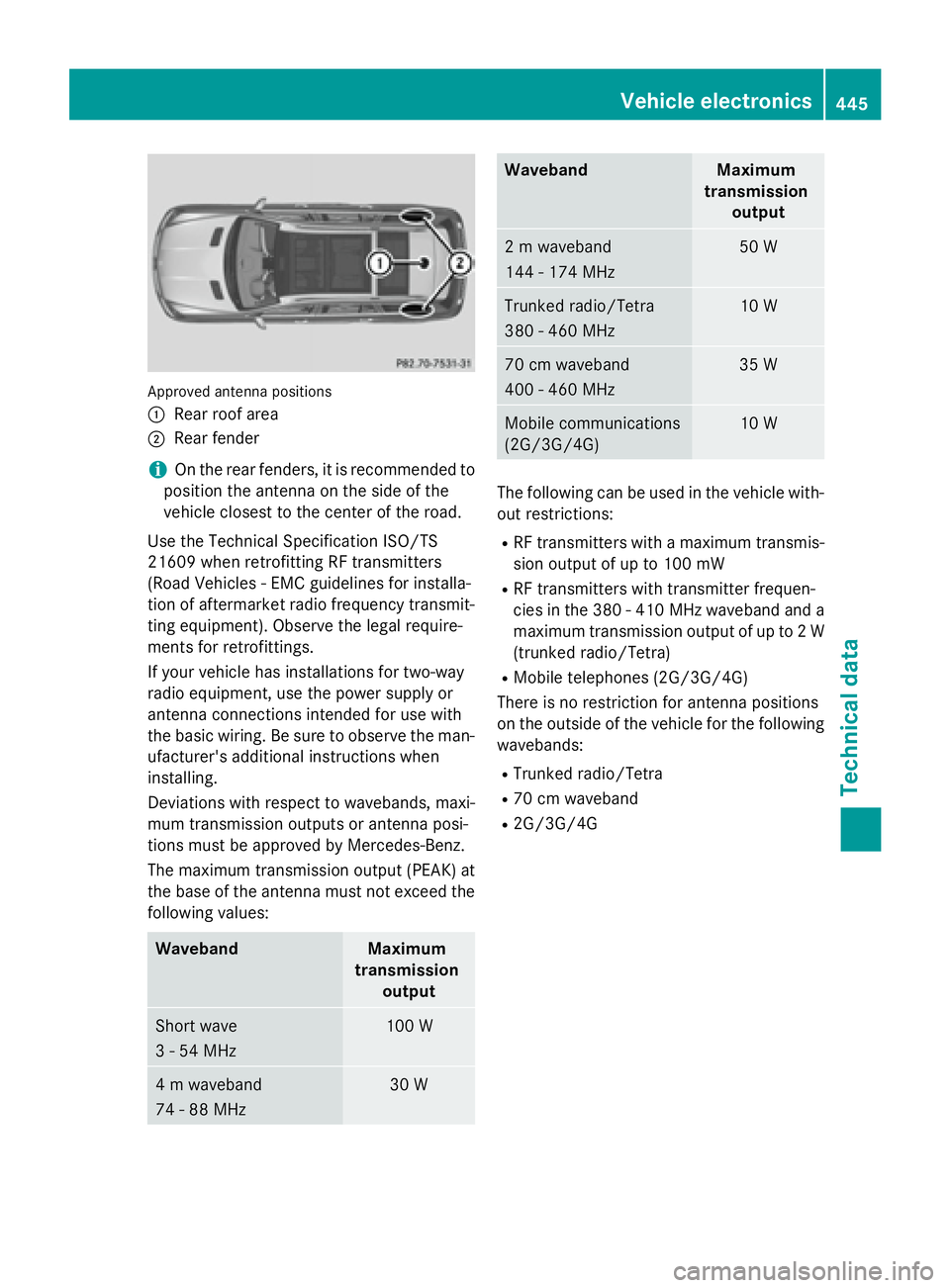
Approved antenna positions
C
Rear roof areaD
Rear fender
i On the rear fenders, it is recommended to
position the antenna on the side of the
vehicle closest to the center of the road.
Use the Technical Specification ISO/TS
21609 when retrofitting RF transmitters
(Road Vehicles - EMC guidelines for installa-
tion of aftermarket radio frequency transmit-
ting equipment). Observe the legal require-
ments for retrofittings.
If your vehicle has installations for two-way
radio equipment, use the power supply or
antenna connections intended for use with
the basic wiring. Be sure to observe the man-
ufacturer's additional instructions when
installing.
Deviations with respect to wavebands, maxi-
mum transmission outputs or antenna posi-
tions must be approved by Mercedes-Benz.
The maximum transmission output (PEAK) at
the base of the antenna must not exceed the
following values:
Waveband Maximum
transmission
output
Short wave
3 - 54 MHz 100 W
4 m waveband
74 - 88 MHz 30 W Waveband Maximum
transmission
output
2 m waveband
144 - 174 MHz 50 W
Trunked radio/Tetra
380 - 460 MHz 10 W
70 cm waveband
400 - 460 MHz 35 W
Mobile communications
(2G/3G/4G) 10 W
The following can be used in the vehicle with-
out restrictions: R
RF transmitters with a maximum transmis-
sion output of up to 100 mW R
RF transmitters with transmitter frequen-
cies in the 380 - 410 MHz waveband and a
maximum transmission output of up to 2 W
(trunked radio/Tetra) R
Mobile telephones (2G/3G/4G)
There is no restriction for antenna positions
on the outside of the vehicle for the following
wavebands: R
Trunked radio/Tetra R
70 cm waveband R
2G/3G/4GVehicle electronics 445
Technical data Z
Page 452 of 462
Low outside temperatures
i Diesel fuel with improved cold flow prop-
erties is available during the winter months.
Further information about fuel properties
can be obtained from oil companies, e.g. at
gas stations.
DEF
Important safety notes Comply with the important safety notes for
service products when handling DEF
( Y
page 447).
DEF is a water-soluble fluid for the exhaust
gas aftertreatment of diesel engines. It is: R
not poisonous R
colorless and odorless R
not flammable
When you open the DEF container, small
amounts of ammonia vapor may be released.
Ammonia vapors have a pungent odor and are
particularly irritating to the skin, to mucous
membranes and to the eyes. You may expe-
rience a burning sensation in your eyes, nose
and throat. Coughing and watering of the
eyes are possible.
Do not inhale ammonia vapors. Fill the DEF
tank only in well-ventilated areas.
Low outside temperatures
DEF freezes at a temperature of approx-
imately 12 ‡( -11 †). The vehicle is delivered
from the factory equipped with a DEF pre-
heating system. Winter operation can thus be
guaranteed even at temperatures below 12 ‡
(-11 †).
Additives
! Only use DEF in accordance with ISO
22241. Do not use additives with DEF and
do not dilute DEF with water. This may
destroy the BlueTEC exhaust gas after-
treatment system. Purity
! Impurities in DEF (e.g. due to other ser-
vice products, cleaning agents or dust) lead
to: R
increased emission values R
damage to the catalytic converter R
engine damage R
malfunctions in the BlueTEC exhaust gas
aftertreatment system
Assuring the purity of DEF is particularly
important with respect to avoiding malfunc-
tions in the BlueTEC exhaust gas aftertreat-
ment system.
If DEF is pumped out of the DEF tank, e.g.
during repair work, it must not be returned to
the tank. The purity of the fluid can no longer
be guaranteed.
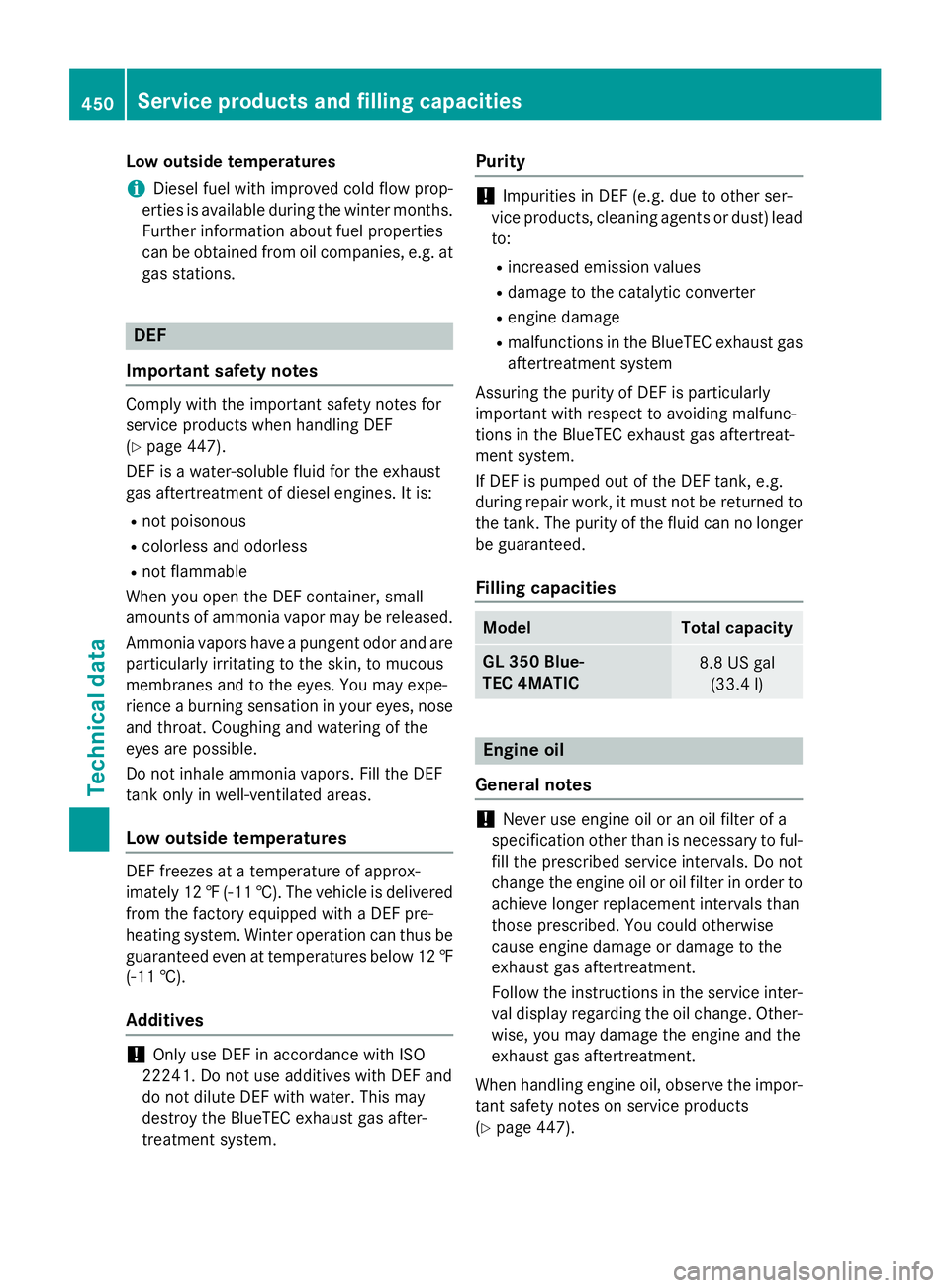
Filling capacities
Model Total capacity
GL 350 Blue-
TEC 4MATIC 8.8 US gal
(33.4 l)
Engine oil
General notes
! Never use engine oil or an oil filter of a
specification other than is necessary to ful-
fill the prescribed service intervals. Do not
change the engine oil or oil filter in order to
achieve longer replacement intervals than
those prescribed. You could otherwise
cause engine damage or damage to the
exhaust gas aftertreatment.
Follow the instructions in the service inter-
val display regarding the oil change. Other-
wise, you may damage the engine and the
exhaust gas aftertreatment.
When handling engine oil, observe the impor-
tant safety notes on service products
( Y
page 447).450
Service products and filling capacities
Technical data