tow MERCEDES-BENZ GL 2016 User Guide
[x] Cancel search | Manufacturer: MERCEDES-BENZ, Model Year: 2016, Model line: GL, Model: MERCEDES-BENZ GL 2016Pages: 462, PDF Size: 12.66 MB
Page 30 of 462
worked components. In particular, systems
relevant to safety could also be affected. As a
result, these may no longer function as inten-
ded and/or jeopardize the operating safety of
the vehicle. There is an increased risk of an
accident and injury.
Never tamper with the wiring as well as elec-
tronic components or their software. You
should have all work to electrical and elec-
tronic equipment carried out at a qualified
specialist workshop.
! There is a risk of damage to the vehicle if: R
the vehicle becomes stuck, e.g. on a high
curb or an unpaved road R
you drive too fast over an obstacle, e.g. a
curb or a hole in the road R
a heavy object strikes the undercarriage
or parts of the chassis
In situations like this, the body, the under-
carriage, chassis parts, wheels or tires
could be damaged without the damage
being visible. Components damaged in this
way can unexpectedly fail or, in the case of
an accident, no longer withstand the strain
they are designed to.
If the underbody paneling is damaged,
combustible materials such as leaves,
grass or twigs can gather between the
underbody and the underbody paneling. If
these materials come in contact with hot
parts of the exhaust system, they can catch
fire.
In such situations, have the vehicle
checked and repaired immediately at a
qualified specialist workshop. If on con-
tinuing your journey you notice that driving
safety is impaired, pull over and stop the
vehicle immediate ly,
paying attention to
road and traffic conditions. In such cases,
consult a qualified specialist workshop. Declarations of conformity
Vehicle components which receive
and/or transmit radio waves USA: "The wireless devices of this vehicle
comply with Part 15 of the FCC Rules. Oper-
ation is subject to the following two condi-
tions: 1) These devices may not cause harm-
ful interference, and 2) These devices must
accept any interference received, including
interference that may cause undesired oper-
ation. Changes or modifications not expressly
approved by the party responsible for com-
pliance could void the user’s authority to
operate the equipment."
Canada: "The wireless devices of this vehicle
comply with Industry Canada license-exempt
RSS standard(s). Operation is subject to the
following two conditions: (1) These devices
may not cause interference, and (2) These
devices must accept any interference, includ-
ing interference that may cause undesired
operation of the device."
Diagnostics connection
The diagnostics connection is only intended
for the connection of diagnostic equipment at
a qualified specialist workshop.
G WARNING
If you connect equipment to the diagnostics
connection in the vehicle, it may affect the
operation of the vehicle systems. As a result,
the operating safety of the vehicle could be
affected. There is a risk of an accident.
Do not connect any equipment to a diagnos-
tics connection in the vehicle.
G WARNING
Objects in the driver's footwell can restrict the
pedal travel or obstruct a depressed pedal.
The operating and road safety of the vehicle is
jeopardized. There is a risk of an accident.
Make sure that all objects in the vehicle are
stowed correctly, and that they cannot enter28
Introduction
Page 51 of 462
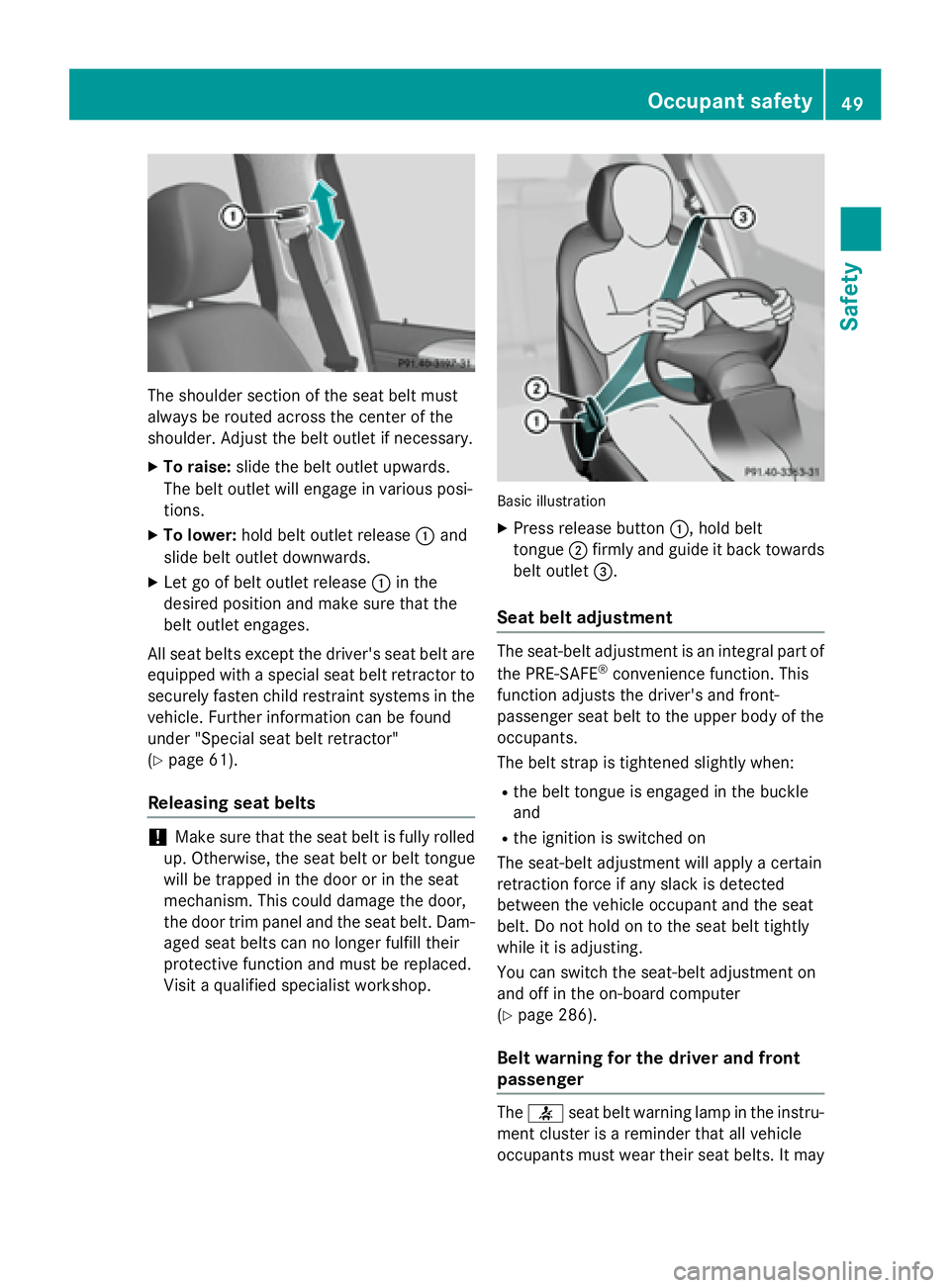
The shoulder section of the seat belt must
always be routed across the center of the
shoulder. Adjust the belt outlet if necessary. X
To raise: slide the belt outlet upwards.
The belt outlet will engage in various posi-
tions. X
To lower: hold belt outlet release C and
slide belt outlet downwards. X
Let go of belt outlet release C in the
desired position and make sure that the
belt outlet engages.
All seat belts except the driver's seat belt are
equipped with a special seat belt retractor to
securely fasten child restraint systems in the
vehicle. Further information can be found
under "Special seat belt retractor"
( Y
page 61).
Releasing seat belts
! Make sure that the seat belt is fully rolled
up. Otherwise, the seat belt or belt tongue
will be trapped in the door or in the seat
mechanism. This could damage the door,
the door trim panel and the seat belt. Dam-
aged seat belts can no longer fulfill their
protective function and must be replaced.
Visit a qualified specialist workshop. Basic illustration X
Press release button C , hold belt
tongue D firmly and guide it back towards
belt outlet
Page 60 of 462
Deployment of Emergency Tensioning
Device s an d air bags
Important safet y notes
G WARNING
The air bag parts are hot after an air bag has
bee n deployed . There is a ris k of injury.
Do no t touch th e air bag parts . Hav e a
deployed air bag replaced at a qualified spe -
cialis t workshop as soo n as possible.
G WARNING
A deployed air bag no longer offers any pro -
tection and canno t provid e th e intended pro -
tection in an accident. There is an increase d
ris k of injury.
Hav e th e vehicle towed to a qualified special-
ist workshop in order to hav e a deployed air
bag replaced.
It is important fo r your safet y and that of your
passenger to hav e deployed air bags replaced
and to hav e any malfunctionin g air bags
repaired. Thi s will hel p to mak e sur e th e air
bags continue to perform their protective
function fo r th e vehicle occupant s in th e
event of a crash .
G WARNING
Pyrotechnic Emergency Tensioning Devices
that hav e bee n deployed are no longer opera-
tional and are unable to perform their inten-
ded protective function . Thi s poses an
increase d ris k of injury or eve n fatal injury.
Therefore, hav e pyrotechni c Emergency Ten -
sioning Devices whic h hav e bee n triggere d
immediately replaced at a qualified specialis t
workshop .
An electric moto r is used by PRE-SAF E ®
to
trigger th e tightenin g of th e seat belt in haz -
ardous situations. Thi s procedur e is reversi-
ble.
If Emergency Tensioning Devices are trig-
gered or air bags are deployed , you will hear a
bang, and a small amount of powder may also be released. The u restrain t system warn -
in g lamp lights up.
Only in rar e cases will th e ban g affec t your
hearing. The powder that is release d gener-
ally doe s no t constitute a health hazard , but it
may caus e short-term breathin g difficulties in
people wit h asthm a or other respirator y prob-
lems. To avoid this, you may wish to get out of
th e vehicle or ope n th e windows as soo n as it
is saf e to do so.
Ai r bags and pyrotechni c Emergency Tension-
in g Devices (ETDs) contain perchlorat e mate-
rial , whic h may require special handlin g a nd
re gard fo r th e environment. National guide-
lines mus t be observed durin g disposal. In
California, see www.dtsc.ca.gov/
HazardousWaste/Perchlorate/
index.cfm .
Method of operation Durin g th e first stage of a collision , th e
restrain t system contro l uni t evaluates impor -
tant physical dat a relatin g to vehicle deceler -
ation or acceleration , suc h as:R
duration R
direction R
intensit y
Based on th e evaluation of this data, th e
restrain t system contro l uni t triggers th e
Emergency Tensioning Devices durin g a fron -
ta l or rea r collision .
An Emergency Tensioning Devic e can only be
triggered, if: R
th e ignition is switched on R
th e component s of th e restrain t system are
operational; see "Restrain t system warnin g
lamp " ( Y
page 45) R
th e belt tongue is engage d in th e buckl e on
th e respective front-passenger seat
The Emergency Tensioning Devices in th e
rea r compartmen t are triggere d independ -
entl y of th e loc k status of th e seat belts.
If th e restrain t system contro l uni t detects a
more severe accident, further component s of58
Occupant safety
Safety
Page 64 of 462
Stop the vehicle immediately, paying atten-
tion to road and traffic conditions. Reactivate
the special seat belt retractor and secure the
child restraint system properly.
All seat belts in the vehicle, except the driv-
er's seat belt, are equipped with a special seat
belt retractor. When activated, the special
seat belt retractor ensures that the seat belt
cannot slacken once the child seat is secured.
Installing a child restraint system: X
Make sure you observe the child restraint
system manufacturer's installation instruc-
tions. X
Pull the seat belt smoothly from the belt
outlet. X
Engage seat belt tongue in belt buckle.
Activating the special seat belt retractor: X
Pull the seat belt out fully and let the inertia
reel retract it again.
While the seat belt is retracting, you should
hear a ratcheting sound. The special seat
belt retractor is enabled. X
Push the child restraint system down so
that the seat belt is tight and does not
loosen.
Removing the child restraint system and
deactivating the special seat belt retractor: X
Make sure you observe the child restraint
system manufacturer's installation instruc-
tions. X
Press the release button of the seat belt
buckle and guide the seat belt tongue back
towards the belt sash guide.
The special seat belt retractor is deactiva-
te d .
Child restraint system
The use of seat belts and child restraint sys-
tems is required by law in: R
all 50 states R
the U.S. territories R
the District of Columbia R
all Canadian provinces
If you install a rearward-facing child restraint
system on the center rear seat, the rear arm
rest must be folded back as far as possible.
You can obtain further information about the
correct child restraint system from any
authorized Mercedes-Benz Center.
G WARNING
If the child restraint system is installed incor-
rectly on a suitable seat, it cannot protect as
intended. The child cannot then be restrained
in the event of an accident, heavy braking or
sudden changes of direction. There is an
increased risk of injury, possibly even fatal.
Make sure that you observe the child restraint
system manufacturer's installation instruc-
tions and the notes on use. Please ensure,
that the base of the child restraint system is
always resting completely on the seat cush-
ion. Never place objects, e.g. cushions, under
or behind the child restraint system. Only use
child restraint systems with the original cover
designed for them. Only replace damaged
covers with genuine covers.
G WARNING
If the child restraint system is installed incor-
rectly or is not secured, it can come loose in
the event of an accident, heavy braking or a
sudden change in direction. The child
restraint system could be thrown about, strik-
ing vehicle occupants. There is an increased
risk of injury, possibly even fatal.
Always install child restraint systems prop-
erly, even if they are not being used. Make
sure that you observe the child restraint sys-
tem manufacturer's installation instructions.
You will find further information on stowing
objects, luggage or loads under "Loading
guidelines" ( Y
page 340).
G WARNING
Child restraint systems or their securing sys-
tems which have been damaged or subjected62
Children in the vehicle
Safety
Page 94 of 462
You could therefore be locked out if: R
the vehicle is being pushed. R
the vehicle is being towed. R
the vehicle is on a roller dynamometer.
You can also switch the automatic locking
function on and off using the on-board com-
puter ( Y
page 285).
Power closingPower closing pulls the doors and trunk lid
into their locks automatically even if they are
only partly closed. X
To power close a door: push the door into
the lock up to the first detent position.
Power closing will pull the door fully closed. X
To power close the tailgate: lightly press
the tailgate downwards.
Power closing will pull the tailgate fully
closed.
Unlocking the driver's door (mechan-
ical key)
If the vehicle can no longer be locked or
unlocked with the SmartKey or KEYLESS-GO,
use the mechanical key.
If you use the mechanical key to unlock and
open the driver's door, the anti-theft alarm
system will be triggered ( Y
page 78).X
Take the mechanical key out of the Smart-
Key ( Y
page 85).X
Insert the mechanical key into the lock of
the driver's door as far as it will go. X
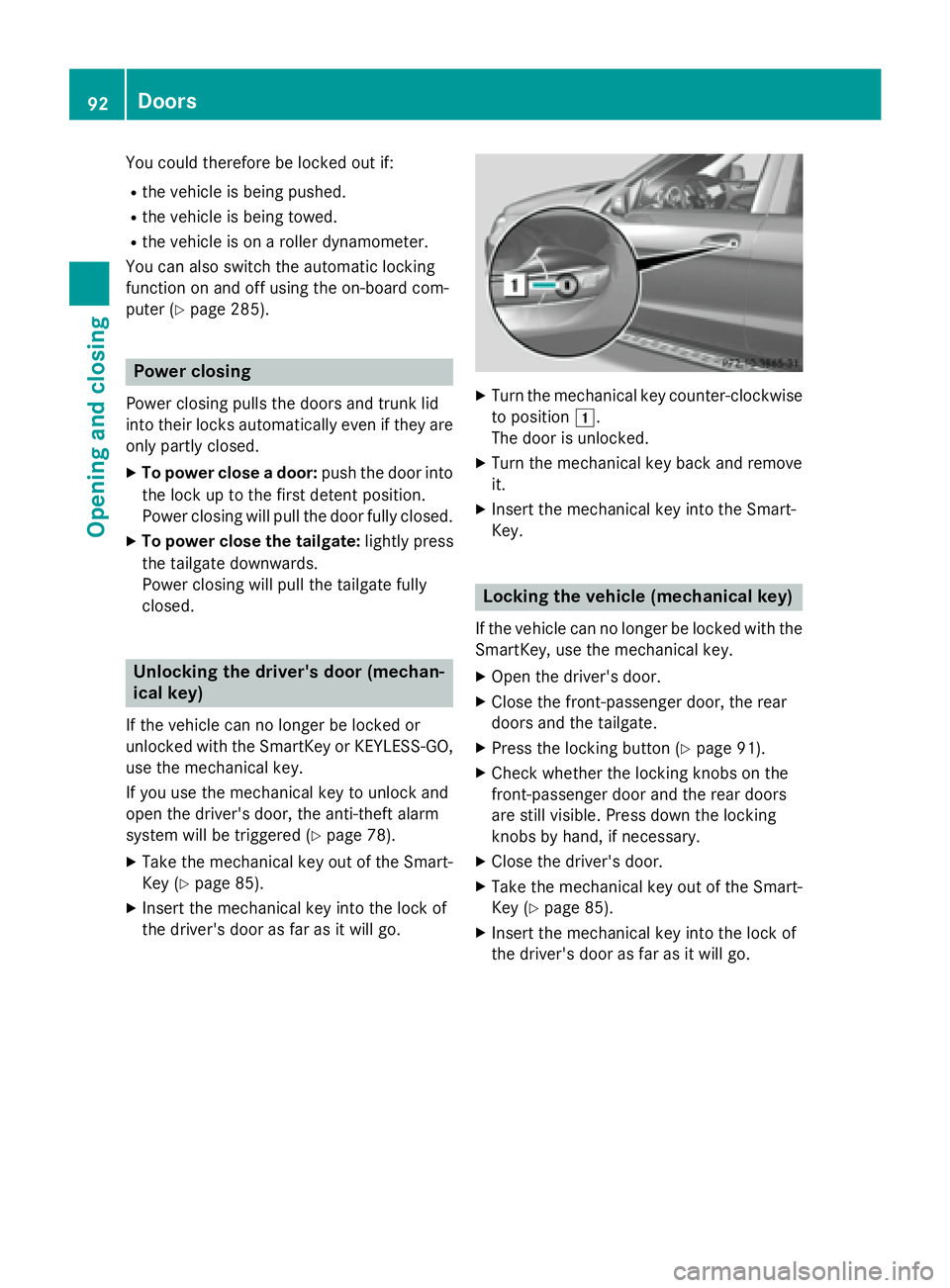
Turn the mechanical key counter-clockwise
to position G .
The door is unlocked. X
Turn the mechanical key back and remove
it. X
Insert the mechanical key into the Smart-
Key.
Locking the vehicle (mechanical key) If the vehicle can no longer be locked with the
SmartKey, use the mechanical key. X
Open the driver's door. X
Close the front-passenger door, the rear
doors and the tailgate. X
Press the locking button ( Y
page 91).X
Check whether the locking knobs on the
front-passenger door and the rear doors
are still visible. Press down the locking
knobs by hand, if necessary. X
Close the driver's door. X
Take the mechanical key out of the Smart-
Key ( Y
page 85). X
Insert the mechanical key into the lock of
the driver's door as far as it will go.92
Doors
Opening and closing
Page 134 of 462
X
To switch on: turn the light switch to ` .
The green ` indicator lamp in the instru-
ment cluster lights up.
Standing lamps
Switching on the standing lamps ensures the
corresponding side of the vehicle is illumina-
ted. X
To switch on the standing lamps: the
SmartKey is not in the ignition lock or it is in
position 0 .X
Turn the light switch to c (left-hand side
of the vehicle) or d (right-hand side of
the vehicle).
Vehicles towing a trailer: both the right and
left standing lamps (tail lamps) are always
illuminated on the trailer.
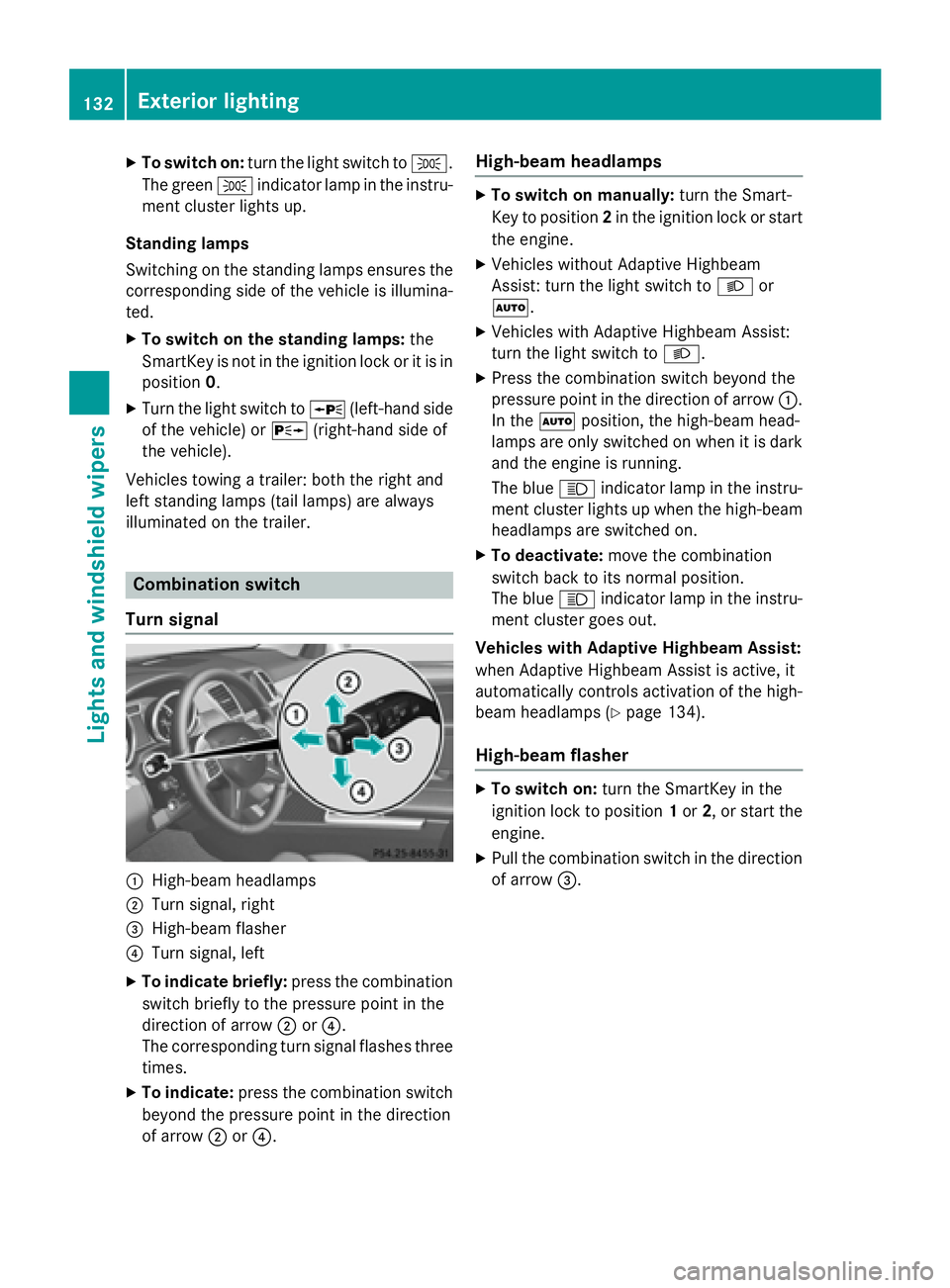
Combination switch
Turn signal
C
High-beam headlampsD
Turn signal, right
Page 165 of 462
Useful information ............................ 164
Notes on breaking-in a new vehi-
cle ....................................................... 164
Driving ............................................... 164
Automatic transmission ................... 173
Refueling ............................................ 182
Parking ............................................... 189
Driving tips ........................................ 192
Driving systems ................................ 202
Towing a trailer ................................. 263 163
Driving and parking
Page 177 of 462
Shifting to neutral N
G WARNING
If children are left unsupervised in the vehicle,
they could: R
open the doors, thus endangering other
people or road users. R
get out and disrupt traffic. R
operate the vehicle's equipment.
Additionally, children could set the vehicle in
motion if, for example, they: R
release the parking brake. R
shifting the automatic transmission out of
park position PR
Start the engine.
There is a risk of an accident and injury.
When leaving the vehicle, always take the
SmartKey with you and lock the vehicle. Never
leave children or animals unattended in the
vehicle. Always keep the SmartKey out of
reach of children. X
If the transmission is in position D or R :
push the DIRECT SELECT lever up or down
to the first point of resistance. X
If the transmission is in position P : depress
the brake pedal and push the DIRECT
SELECT lever up or down to the first point of
resistance.
If you switch the engine off with the trans-
mission in position R or D , the automatic
transmission shifts to N automatically.
With the SmartKey: if you then open the
driver's door or the front-passenger door or
remove the SmartKey from the ignition, the
automatic transmission shifts to P automati-
cally.
With the Start/Stop button: if you then
open the driver's door or the front-passenger
door, the automatic transmission shifts to P
automatically.
If you want the automatic transmission to
remain in neutral N , e.g. when having the vehicle cleaned in an automatic car wash with
a towing system:
Using the SmartKey: X
Switch on the ignition. X
Depress the brake pedal and keep it
depressed. X
Shift to neutral N . X
Release the brake pedal. X
Release the electric parking brake. X
Switch off the ignition and leave the Smart-
Key in the ignition lock.
With the Start/Stop button: X
Remove the Start/Stop button from the
ignition lock. X
Insert the SmartKey into the ignition lock. X
Switch on the ignition. X
Depress the brake pedal and keep it
depressed. X
Shift to neutral N . X
Release the brake pedal. X
Release the electric parking brake. X
Switch off the ignition and leave the Smart-
Key in the ignition lock.
Engaging drive position D X
If the transmission is in position R or N :
push the DIRECT SELECT lever down past
the first point of resistance. X
If the transmission is in position P : depress
the brake pedal and push the DIRECT
SELECT lever down past the first point of
resistance.Automatic transmission 175
Driving and parking Z
Page 178 of 462
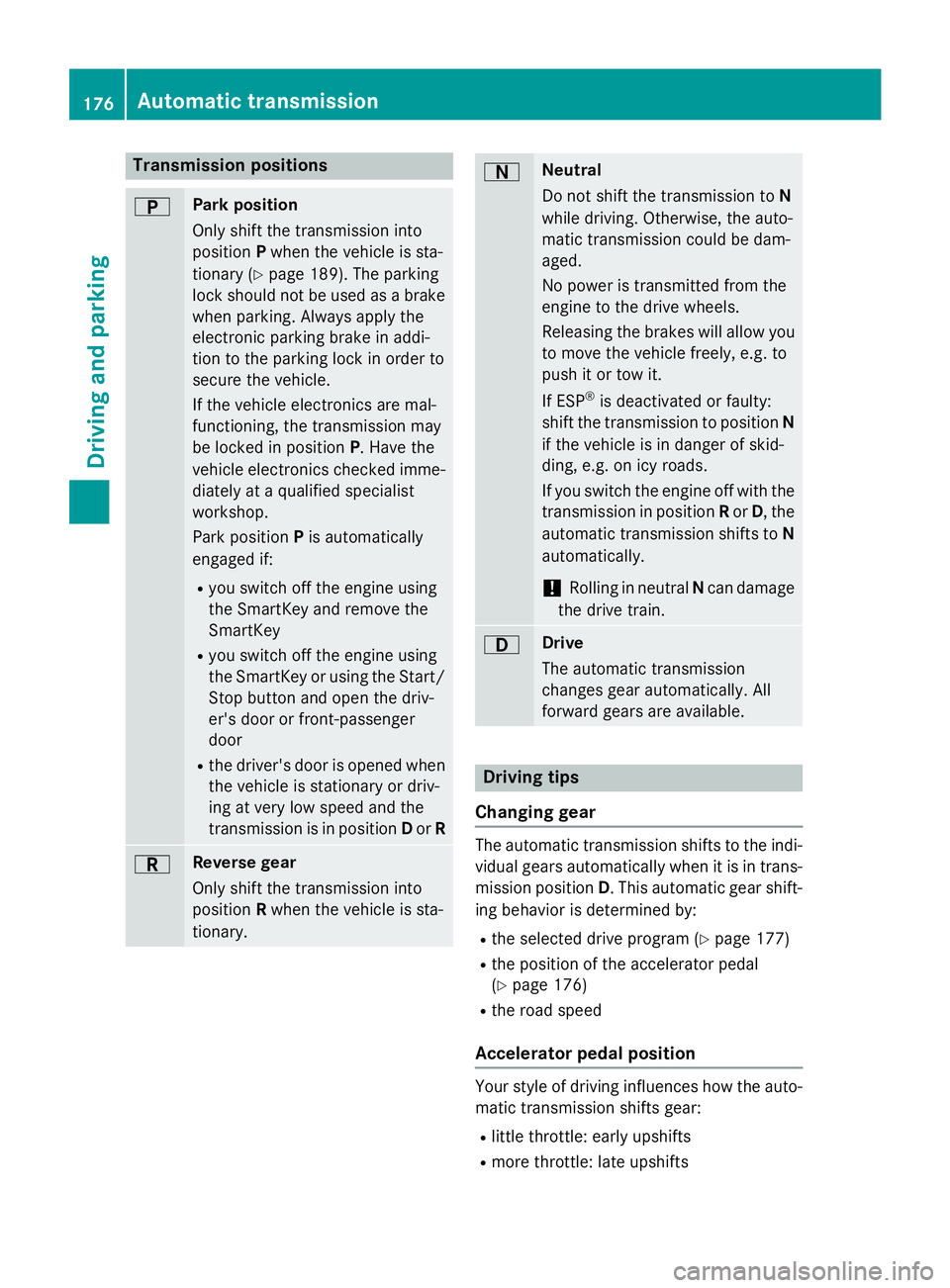
Transmission positions E Park position
Only shift the transmission into
position P when the vehicle is sta-
tionary ( Y
page 189). The parking
lock should not be used as a brake
when parking. Always apply the
electronic parking brake in addi-
tion to the parking lock in order to
secure the vehicle.
If the vehicle electronics are mal-
functioning, the transmission may
be locked in position P . Have the
vehicle electronics checked imme-
diately at a qualified specialist
workshop.
Park position P is automatically
engaged if: R
you switch off the engine using
the SmartKey and remove the
SmartKey R
you switch off the engine using
the SmartKey or using the Start/
Stop button and open the driv-
er's door or front-passenger
door R
the driver's door is opened when
the vehicle is stationary or driv-
ing at very low speed and the
transmission is in position D or R
F Reverse gear
Only shift the transmission into
position R when the vehicle is sta-
tionary. D Neutral
Do not shift the transmission to N
while driving. Otherwise, the auto-
matic transmission could be dam-
aged.
No power is transmitted from the
engine to the drive wheels.
Releasing the brakes will allow you
to move the vehicle freely, e.g. to
push it or tow it.
If ESP ®
is deactivated or faulty:
shift the transmission to position N
if the vehicle is in danger of skid-
ding, e.g. on icy roads.
If you switch the engine off with the
transmission in position R or D , the
automatic transmission shifts to N
automatically.
! Rolling in neutral N can damage
the drive train.
: Drive
The automatic transmission
changes gear automatically. All
forward gears are available.
Driving tips
Changing gear
The automatic transmission shifts to the indi-
vidual gears automatically when it is in trans-
mission position D . This automatic gear shift-
ing behavior is determined by: R
the selected drive program ( Y
page 177)R
the position of the accelerator pedal
( Y
page 176) R
the road speed
Accelerator pedal position
Your style of driving influences how the auto-
matic transmission shifts gear: R
little throttle: early upshifts R
more throttle: late upshifts176
Automatic transmission
Driving an d parking
Page 179 of 462
Kickdown Use kickdown for maximum acceleration .X
Depress th e accelerato r pedal beyon d th e
pressur e point.
The automatic transmission shifts to a
lower gear depending on th e engin e speed.X
Eas e off th e accelerato r pedal once th e
desired spee d is reached.
The automatic transmission shifts bac k up.
Rocking the vehicle free Shifting th e transmission repeatedly between
gear s D and R may help to free th e vehicl e if it
has become stuck in slus h or snow. The vehi-
cle's engin e managemen t system limits th e
spee d to a maximum of 5 mph (9 km/h) when
shifting bac k and forth . To shif t bac k and forth
between transmission position s D and R ,
mov e th e DIRECT SELECT lever up and down
past th e poin t of resistance.
Towing a trailer X
Drive in th e middle of th e engin e spee d
range on uphill gradients .X
Dependin g on th e uphill or downhill gradi-
ent, use left-han d steering whee l paddle
shifte r ( Y
page 178) to select a lower gear ,
eve n if cruise control or DISTRONI C PLU S
are activated.
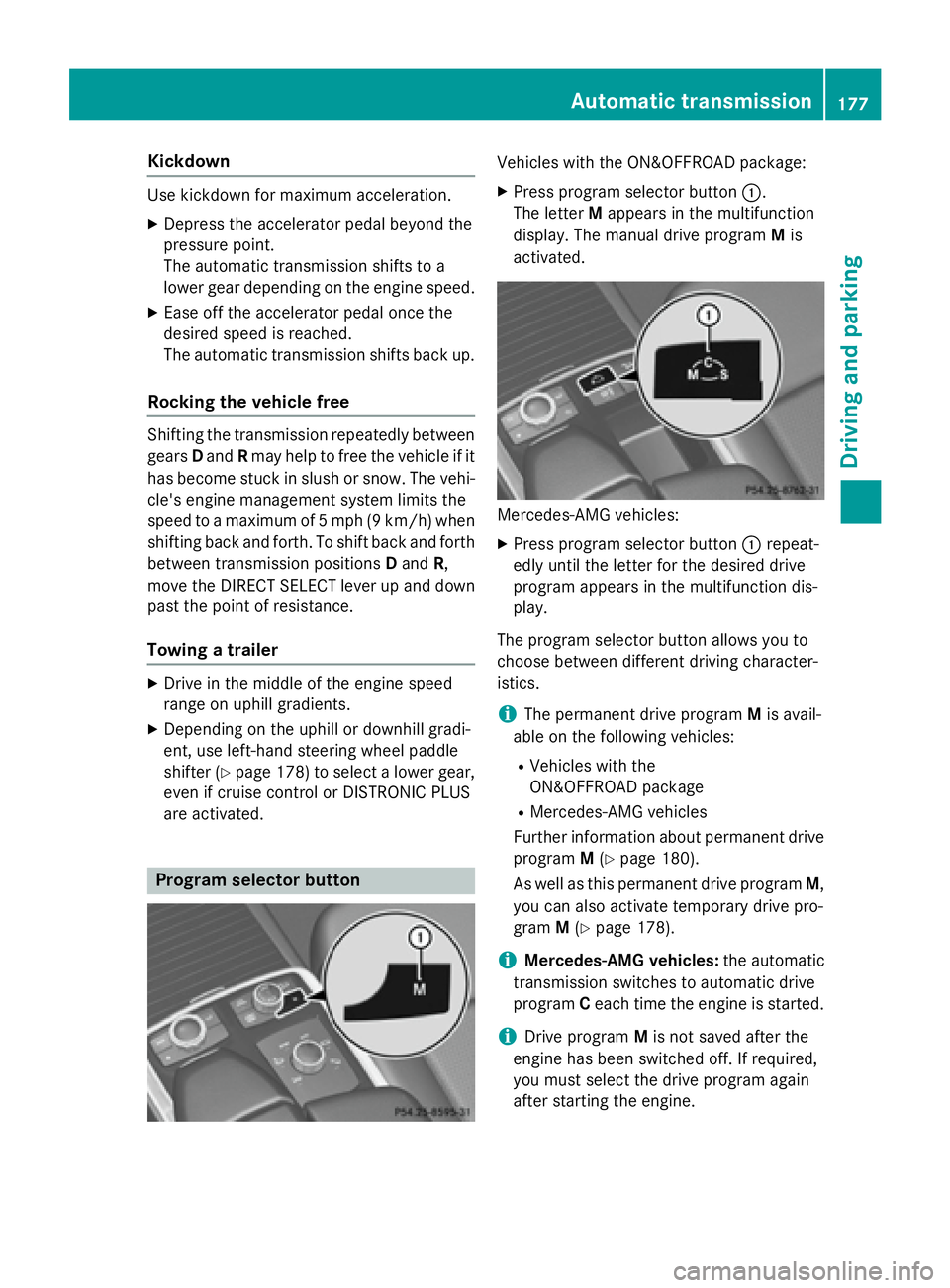
Program select or button Vehicles wit h th e ON& OFFROAD package: X
Press program selector butto n C .
The lette r M appear s in th e multifunction
display. The manual drive program M is
activated.
Mercedes-AM G vehicles: X
Pre ss program selector butto n C repeat -
edly until th e lette r for th e desired drive
program appear s in th e multifunction dis-
play.
The program selector butto n allows you to
choos e between differen t drivin g character-
istics .
i The permanen t drive program M is avail -
able on th e followin g vehicles: R
Vehicles wit h th e
ON& OF FROAD packag e R
Mercedes-AM G vehicles
Further information about permanen t drive
program M ( Y
page 180).
As well as this permanen t drive program M ,
you can also activat e temporar y drive pro -
gram M ( Y
page 178).
i Mercedes-AMG veh icles: th e automatic
transmission switches to automatic drive
program C eac h time th e engin e is started.
i Drive program M is no t saved after th e
engin e has been switched off . If required,
you mus t select th e drive program again
after st artin g th e engine.Automatic transmission 17 7
Driving an d parking Z