tailgate MERCEDES-BENZ GL-Class 2013 X166 Owner's Guide
[x] Cancel search | Manufacturer: MERCEDES-BENZ, Model Year: 2013, Model line: GL-Class, Model: MERCEDES-BENZ GL-Class 2013 X166Pages: 454, PDF Size: 6.31 MB
Page 319 of 454
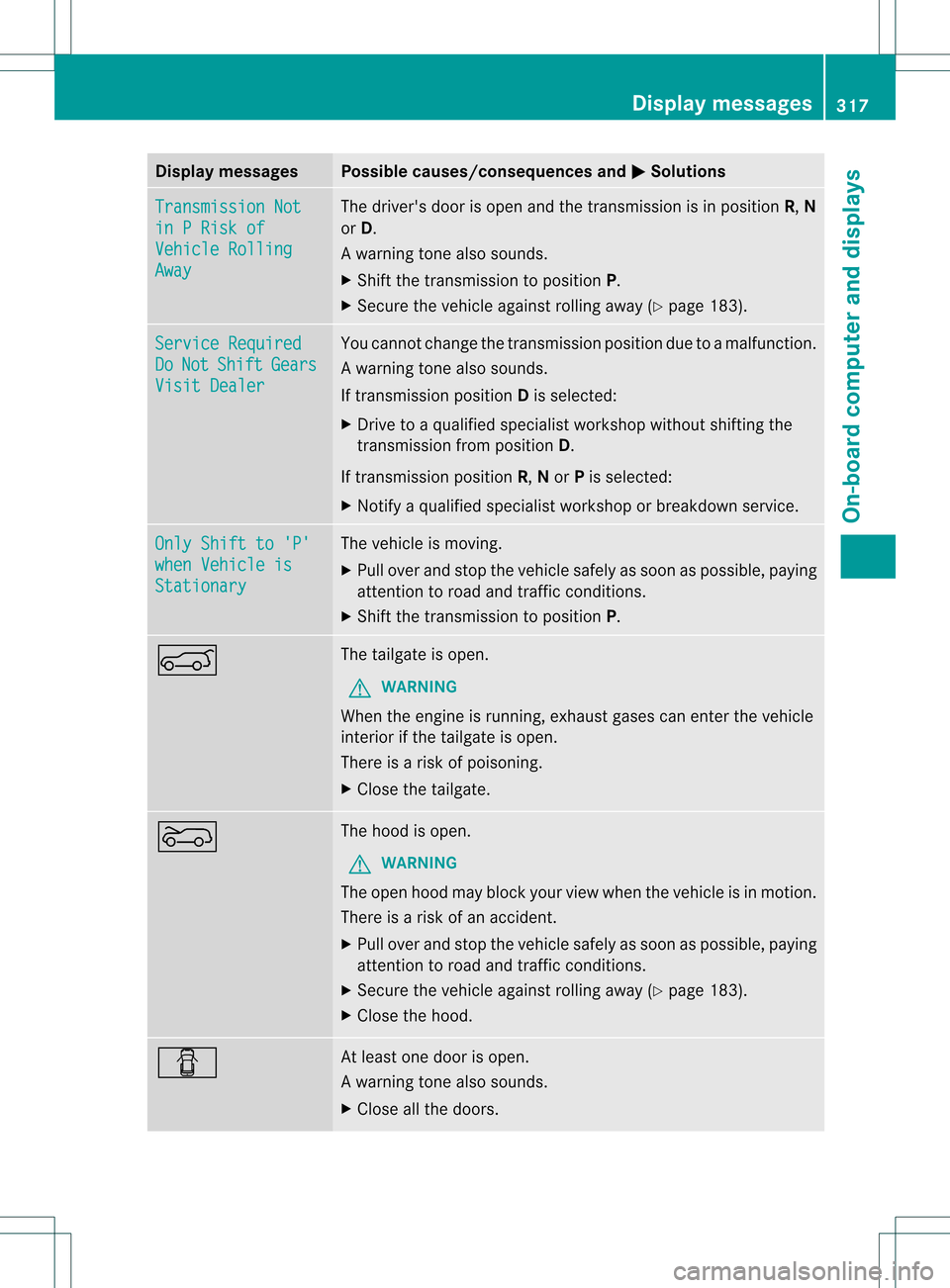
Display messages Possible causes/consequences and
0001 Solutions
Transmission Not
in P Risk of
Vehicle Rolling
Away The driver's doo
ris open and the transmission is in position R,N
or D.
Aw arning tone also sounds.
X Shift the transmission to position P.
X Secure the vehicle against rolling away ( Ypage 183). Service Required
Do Not Shift Gears
Visit Dealer You canno
tchange the transmission position due to a malfunction.
Aw arning tone also sounds.
If transmission position Dis selected:
X Drive to a qualified specialist workshop without shifting the
transmission from position D.
If transmission position R,Nor Pis selected:
X Notify a qualified specialist workshop or breakdown service. Only Shift to 'P'
when Vehicle is
Stationary The vehicle is moving.
X
Pull ove rand stop the vehicle safely as soo nas possible, paying
attention to road and traffic conditions.
X Shift the transmission to position P.0006 The tailgate is open.
G WARNING
When the engine is running, exhaust gases can enter the vehicle
interior if the tailgate is open.
There is a risk of poisoning.
X Close the tailgate. 0007 The hood is open.
G WARNING
The open hood may block your view when the vehicle is in motion.
There is a risk of an accident.
X Pull over and stop the vehicle safely as soon as possible, paying
attention to road and traffic conditions.
X Secure the vehicle against rolling away (Y page 183).
X Close the hood. 0003 At least one door is open.
Aw
arning tone also sounds.
X Close all the doors. Display messages
317On-board computer and displays Z
Page 338 of 454
Useful information
i This Operator's Manual describes all
models and all standard and optional
equipment of your vehicle available at the
time of publication of the Operator's
Manual. Country-specific differences are
possible. Please note that your vehicle may
not be equipped with all features
described. This also applies to safety-
related systems and functions.
i Read the information on qualified
specialist workshops: (Y page 28).Stowage areas
Loading guidelines
G
WARNING
If objects, luggage or loads are not secured or
not secured sufficiently, they could slip, tip
over or be flung around and thereby hit vehicle
occupants. There is a risk of injury,
particularly in the even tofsudden braking or
a sudde nchange in direction.
Always store objects so that they cannot be
flung around. Secure objects, luggage or
loads against slipping or tipping before the
journey. G
WARNING
Combustion engines emit poisonous exhaust
gases such as carbon monoxide. If the tailgate
is open when the engine is running,
particularly if the vehicle is moving, exhaust
fumes could enter the passenger
compartment. There is a risk of poisoning.
Turn off the engine before opening the
tailgate. Never drive with the tailgate open.
The gross vehicle weight (GVW) is the vehicle
weight including fuel, vehicle tool kit, spare
wheel, installed accessories, vehicle
occupants and luggage/cargo.
The gross load limit and the gross vehicle
weight rating (GVWR) for your vehicle must never be exceeded. The gross load limit and
the GVWR are specified on the vehicle
identification plate on the B-pillar of the
driver's door (Y
page 412).
The load must also be distributed so that the
weight on each axle never exceeds the gross
axle weight rating (GAWR) for the front and
rear axles. The specifications for GVWR and
GAWR are on the vehicle identification plate
on the B-pillar of the driver's door
(Y page 412).
Observe the notes on the loading the vehicle
(Y page 412).
The handling characteristics of a laden
vehicle are dependent on the distribution of
the load within the vehicle. For this reason,
you should observe the following notes when
transporting a load:
R Never exceed the maximum permissible
gross vehicle weight or the gross axle
weight rating of the vehicle (including
occupants).
R The cargo compartment is the preferred
place to carry objects.
R Position heavy loads as far forwards as
possible and as low down in the cargo
compartmenta s possible.
R The load must not protrude above the
upper edge of the seat backrests.
R Always place the load against the rear or
front seat backrests. Make sure that the
seat backrests are securely locked into
place.
R Always place the load behind unoccupied
seats if possible.
R Use the cargo tie down rings and the parcel
nets to transport loads and luggage.
R Use cargo tie-down rings and fastening
materials appropriate for the weight and
size of the load.
R Hook in the cargo net when loading.
R Secure the load with sufficiently strong and
wear-resistant tie-downs. pad sharp edges
for protection. 336
Stowage areasStowage and features
Page 345 of 454

X
To extend: pull the cargo compartment
cove rback by grab handle 0002and clip it
into retainers 0003on the left and right.
X To retract: unhook the cargo compartment
cover from left-hand and right-hand
retainers 0003.
X Guide cargo compartment cover forwards
by grab handle 0002until it is completely
rolled up. Coat hooks on the tailgate
0002
Coat hook Stowage well under the cargo
compartment floor
G
WARNING
If you drive when the cargo compartmen tfloor
is open, objects could be flung around, thus
striking vehicle occupants. There is a risk of
injury, particularly in the even tofsudden
braking or a sudde nchange in direction.
Always close the cargo compartmentf loor
before a journey. The TIREFIT kit, tire-change tool kit, etc. are
located in the stowage compartment.
X
To open: holding the ribbing, press
handle 0002downwards 0003.
Handle 0002folds up.
X Swing the cargo compartment floor
upwards using handle 0002until it rests
against the cargo compartment cover. X
Fold out hook 0021on the underside of the
cargo compartmen tfloor in the direction of
the arrow. Stowage areas
343Stowage and features Z
Page 346 of 454

X
Attach hook 0021to the cargo
compartment's uppe rseal 0020.
X To close: detach hook 0021from the cargo
compartment's upper seal 0020.
X Fasten hook 0021to the bracket on the
underside of the cargo compartment floor.
X Fold the trunk floor down.
X Press the cargo compartment floor
down 0003until it engages. 0004
Cargo compartment floor unlocked
0005 Cargo compartment floor locked
The cargo compartment floor can be locked
and unlocked using the mechanical key. Roof carrier
Important safety notes G
WARNING
When you load the roof, the center of gravity
of the vehicle rises and the driving
characteristics change. If you exceed the
maximum roof load, the driving
characteristics, as well as steering and
braking, will be greatly impaired. There is a
risk of an accident.
Never exceed the maximum roof load and
adjust your driving style.
! Mercedes-Benz recommends that you
only use roof carriers that have been tested
and approved for Mercedes-Benzv ehicles.
This helps to preven tdamage to the
vehicle. Positio
nthe load on the roof carrier in such
a way that the vehicle will not sustain
damage even when it is in motion.
Depending on the vehicle equipment,
ensure that when the roof carrier is
installed you can:
R raise the sliding sunroof fully
R open the panorama roof with power tilt/
sliding panel fully
R open the tailgate fully
The maximum roof load is 220 lbs(100 kg).
Attaching the roof carrier X
Secure the roof carrier to roof rails 0002. In
doing so, observe the manufacturer's
installation instructions. Features
Cup holder
Important safety notes G
WARNING
If objects in the passenger compartment are
stowed incorrectly, they can slide or be
thrown around and hit vehicle occupants.
There is a risk of injury, particularly in the
event of sudden braking or a sudden change
in direction. 344
FeaturesStowage and features
Page 384 of 454
Useful information
i This Operator's Manual describes all
models and all standard and optional
equipment of your vehicle available at the
time of publication of the Operator's
Manual. Country-specific differences are
possible. Please note that your vehicle may
not be equipped with all features
described. This also applies to safety-
related systems and functions.
i Read the information on qualified
specialist workshops: (Y page 28).Where will I find...?
First-aid kit
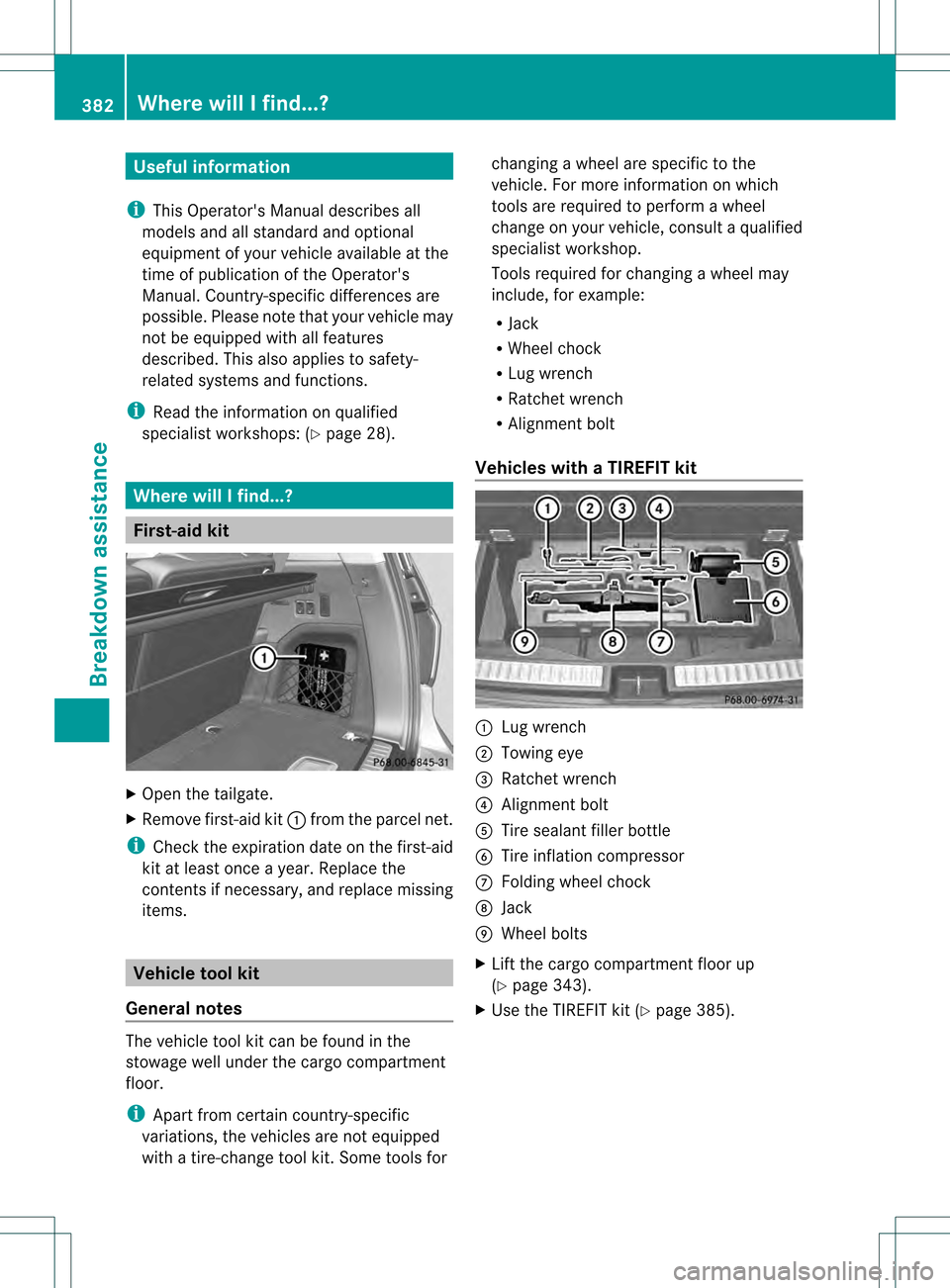
X
Open the tailgate.
X Remove first-aid kit 0002from the parcel net.
i Check the expiration date on the first-aid
kit at least once a year. Replace the
contents if necessary, and replace missing
items. Vehicle tool kit
General notes The vehicle tool kit can be found in the
stowage well under the cargo compartment
floor.
i
Apart from certain country-specific
variations, the vehicles are not equipped
with a tire-change tool kit .Some tools for changing a wheel are specific to the
vehicle. For more information on which
tools are required to perform a wheel
change on your vehicle, consult a qualified
specialist workshop.
Tools required for changing
awheel may
include, for example:
R Jack
R Wheel chock
R Lug wrench
R Ratchet wrench
R Alignment bolt
Vehicles with aTIREFIT kit 0002
Lug wrench
0003 Towing eye
0021 Ratchet wrench
0020 Alignmen tbolt
001E Tire sealant filler bottle
001F Tire inflation compressor
0013 Folding wheel chock
0014 Jack
0015 Wheel bolts
X Lift the cargo compartment floor up
(Y page 343).
X Use the TIREFIT kit (Y page 385).382
Where will I find...?Breakdown assistance
Page 428 of 454

R
the jack must be placed on a firm, flat and
non-slip surface. On a loose surface, a
large, load-bearing underlay must be used.
On a slippery surface, a non-slip underlay
must be used, e.g .rubber mats.
R do no tuse wooden blocks or similar
objects as a jack underlay.O therwise, the
jack will not be able to achieve its load-
bearing capacity due to the restricted
height.
R make sure tha tthe distance between the
underside of the tires and the ground does
not exceed 1.2 in (3 cm).
R never place your hands and feet under the
raised vehicle.
R never lie under the raised vehicle.
R never start the engine when the vehicle is
raised.
R never open or close a door or the tailgate
when the vehicle is raised.
R make sure that no persons are present in
the vehicle when the vehicle is raised. X
Using lug wrench 0002, loosen the bolts on
the wheel you wish to change by about one
full turn. Do not unscrew the bolts
completely. The jacking points are located just behind the
front wheel housings and just in front of the
rear wheel housings (arrows).
X Take the ratchet wrench out of the vehicle
tool kit and place it on the hexagon nut of
the jack so that the letters AUFare visible. 0003
Jacking points
0021 Jack
0020 Crank
X Position jack 0021at jacking point 0003.
The alignment bolt on the jack must be
inserted into the intended jacking point
hole. 426
Changing
awheelWheels and tires
Page 437 of 454
An emergency spare wheel may also be
mounted against the direction of rotation.
Observe the time restrictio nonuse as well as
the speed limitation specified on the
emergency spare wheel.
Replace the tires after six years at the latest,
regardless of wear. This also applies to the
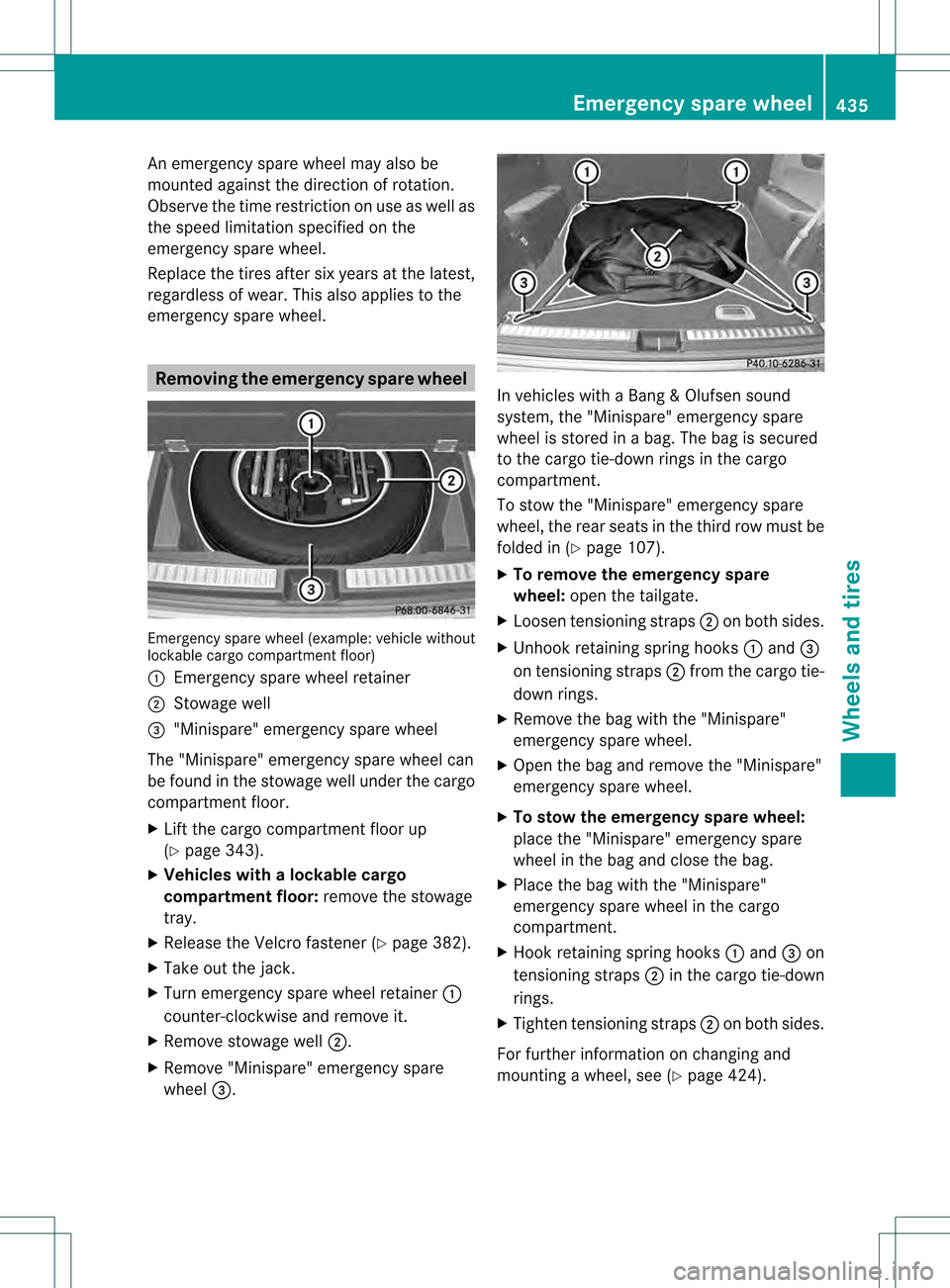
emergency spare wheel. Removing the emergency spare wheel
Emergency spare wheel (example: vehicle without
lockable cargo compartment floor)
0002
Emergency spare wheel retainer
0003 Stowage well
0021 "Minispare" emergency spare wheel
The "Minispare" emergency spare wheel can
be found in the stowage well under the cargo
compartment floor.
X Lift the cargo compartment floor up
(Y page 343).
X Vehicles with alockable cargo
compartment floor: remove the stowage
tray.
X Release the Velcro fastene r(Ypage 382).
X Take out the jack.
X Turn emergency spare wheel retainer 0002
counter-clockwise and remove it.
X Remove stowage well 0003.
X Remove "Minispare" emergency spare
wheel 0021. In vehicles with a Bang
&Olufsen sound
system, the "Minispare" emergency spare
wheel is stored in a bag. The bag is secured
to the cargo tie-down rings in the cargo
compartment.
To stow the "Minispare" emergency spare
wheel, the rear seats in the third row must be
folded in (Y page 107).
X To remove the emergency spare
wheel: open the tailgate.
X Loosen tensioning straps 0003on both sides.
X Unhook retaining spring hooks 0002and 0021
on tensioning straps 0003fromt he cargo tie-
down rings.
X Remove the bag with the "Minispare"
emergency spare wheel.
X Open the bag and remove the "Minispare"
emergency spare wheel.
X To stow the emergency spare wheel:
place the "Minispare" emergency spare
wheel in the bag and close the bag.
X Place the bag with the "Minispare"
emergency spare wheel in the cargo
compartment.
X Hook retaining spring hooks 0002and 0021on
tensioning straps 0003in the cargo tie-down
rings.
X Tighten tensioning straps 0003on both sides.
For further information on changing and
mounting a wheel, see (Y page 424). Emergency spare wheel
435Wheels and tires Z