width MERCEDES-BENZ GL-Class 2014 X166 User Guide
[x] Cancel search | Manufacturer: MERCEDES-BENZ, Model Year: 2014, Model line: GL-Class, Model: MERCEDES-BENZ GL-Class 2014 X166Pages: 462, PDF Size: 32.46 MB
Page 424 of 462
ratio is calculated by dividing the tire width by
the tire height.
Tire code: tire code=specifies the tire type.
"R" represents radial tires; "D" represents
diagonal tires; "B" represents diagonal radial
tires.
Optionally, tires with a maximum speed of
over 149 mph (240 km/h) may have "ZR" in
the size description, depending on the
manufacturer (e.g. 245/40 ZR 18).
Rim diameter: rim diameter?is the
diameter of the bead seat, not the diameter
of the rim flange. The rim diameter is
specified in inches (in).
Load-bearing index: load-bearing indexA
is a numerical code that specifies the
maximum load-bearing capacity of a tire.
Do not overload the tires by exceeding the
specified load limit. The maximum
permissible load can be found on the
vehicle's Tire and Loading Information
placard on the B-pillar on the driver's side
(Y page 415).
Example:
Load-bearing index 91 indicates a maximum
load of 1,356 lb (615 kg) that the tires can
bear. For further information on the maximum
tire load in kilograms and lbs, see
(Y page 423).
For further information on the load bearing
index, see "Load index" (Y page 423).
Speed rating: speed ratingBspecifies the
approved maximum speed of the tire.
i Tire data is vehicle-specific and may
deviate from the data in the example.
Regardless of the speed rating, always
observe the speed limits. Drive carefully and
adapt your driving style to the traffic
conditions.
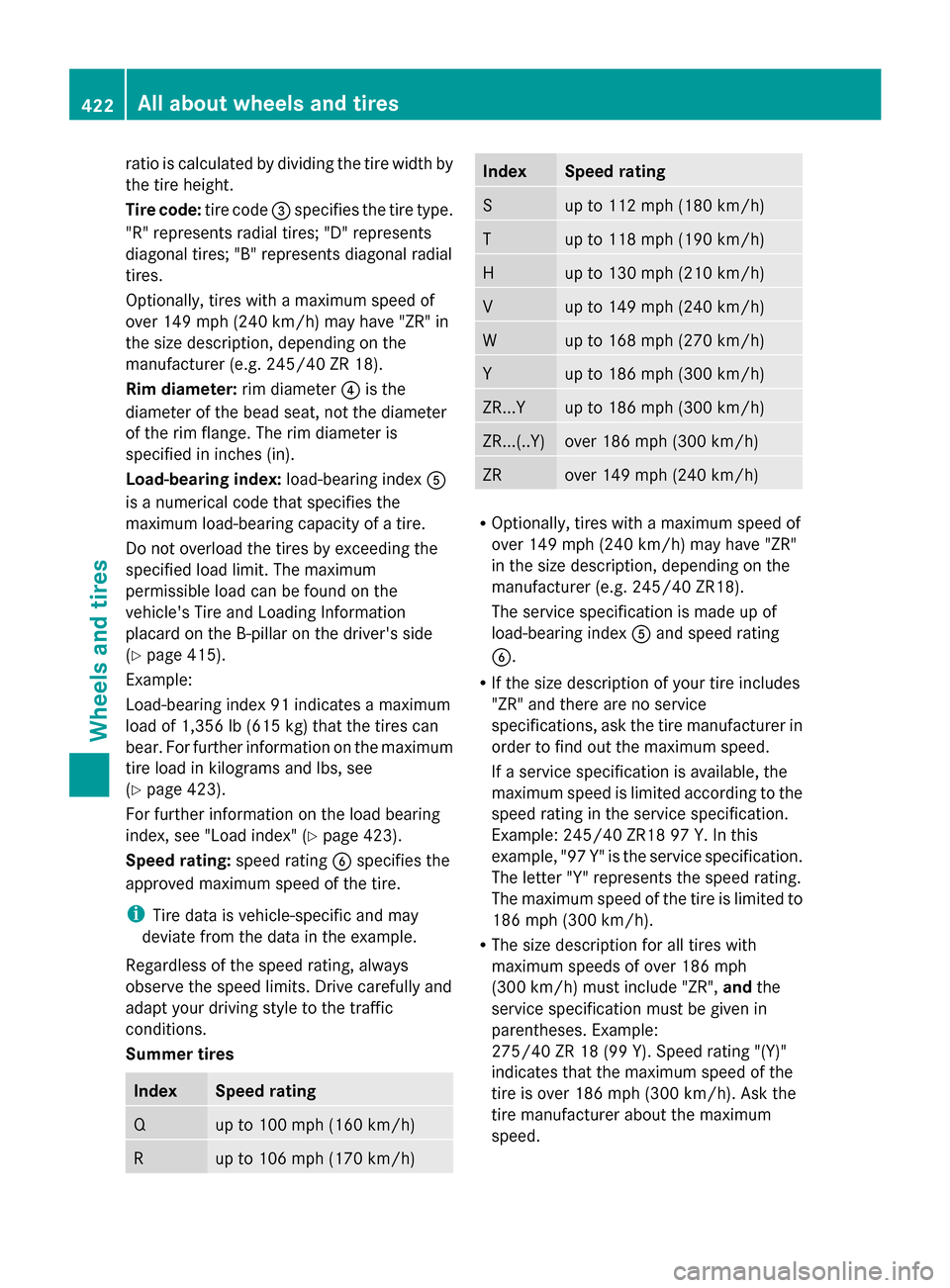
Summer tires Index Speed rating
Q up to 100 mph (160 km/h)
R up to 106 mph (170 km/h) Index Speed rating
S up to 112 mph (180 km/h)
T up to 118 mph (190 km/h)
H up to 130 mph (210 km/h)
V up to 149 mph (240 km/h)
W up to 168 mph (270 km/h)
Y up to 186 mph (300 km/h)
ZR...Y up to 186 mph (300 km/h)
ZR...(..Y) over 186 mph (300 km/h)
ZR over 149 mph (240 km/h)
R
Optionally, tires with a maximum speed of
over 149 mph (240 km/h) may have "ZR"
in the size description, depending on the
manufacturer (e.g. 245/40 ZR18).
The service specification is made up of
load-bearing index Aand speed rating
B.
R If the size description of your tire includes
"ZR" and there are no service
specifications, ask the tire manufacturer in
order to find out the maximum speed.
If a service specification is available, the
maximum speed is limited according to the
speed rating in the service specification.
Example: 245/40 ZR18 97 Y.In this
example, "97 Y" is the service specification.
The letter "Y" represents the speed rating.
The maximum speed of the tire is limited to
186 mph (300 km/h).
R The size description for all tires with
maximum speeds of over 186 mph
(300 km/h) must include "ZR", andthe
service specification must be given in
parentheses. Example:
275/40 ZR 18 (99 Y). Speed rating "(Y)"
indicates that the maximum speed of the
tire is over 186 mph (300 km/h). Ask the
tire manufacturer about the maximum
speed. 422
All about wheels and tiresWheels and tires
Page 428 of 462
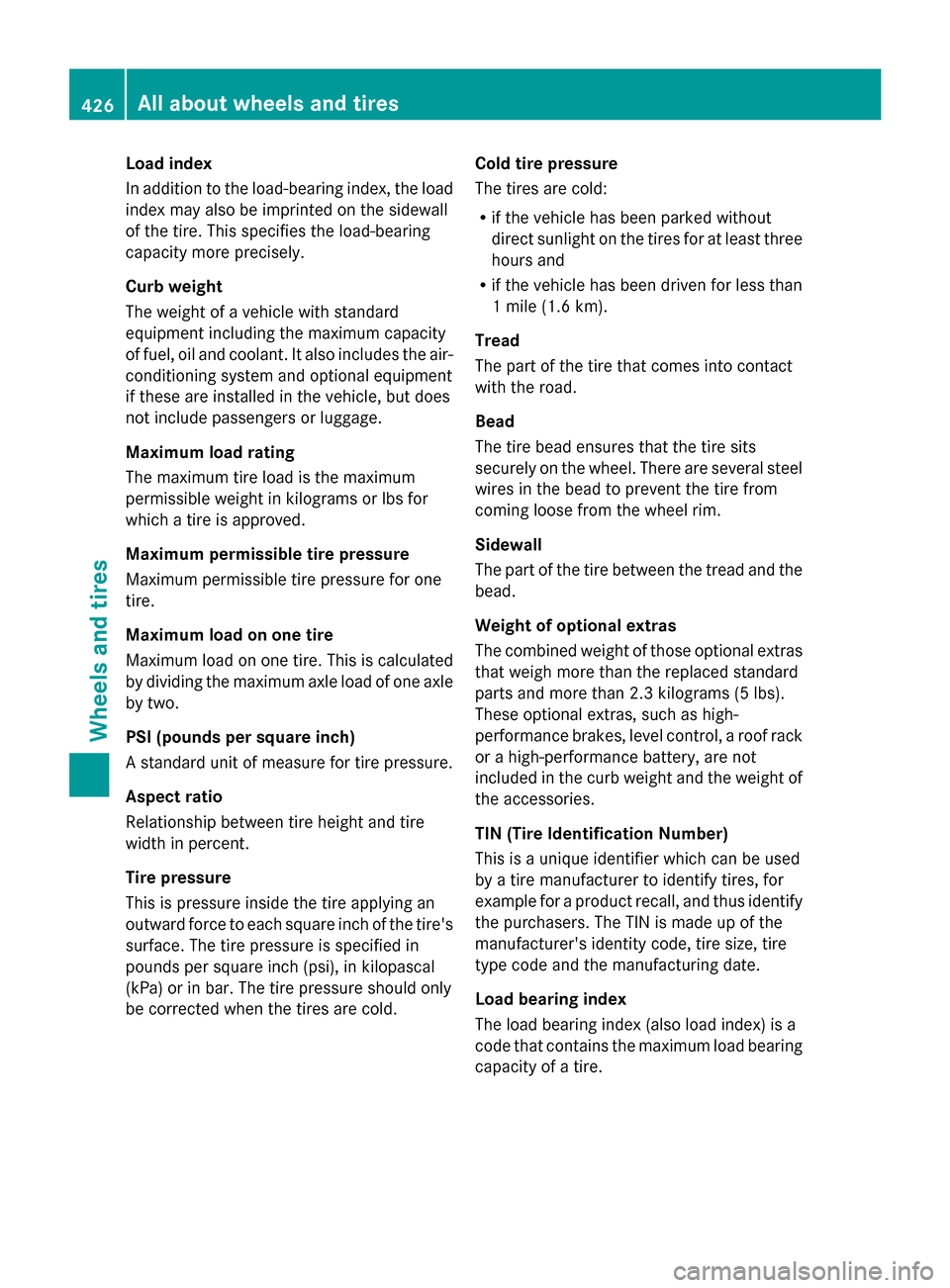
Load index
In addition to the load-bearing index, the load
index may also be imprinted on the sidewall
of the tire. This specifies the load-bearing
capacity more precisely.
Curb weight
The weight of a vehicle with standard
equipment including the maximum capacity
of fuel, oil and coolant. It also includes the air-
conditioning system and optional equipment
if these are installed in the vehicle, but does
not include passengers or luggage.
Maximum load rating
The maximum tire load is the maximum
permissible weight in kilograms or lbs for
which a tire is approved.
Maximum permissible tire pressure
Maximum permissible tire pressure for one
tire.
Maximum load on one tire
Maximum load on one tire. This is calculated
by dividing the maximum axle load of one axle
by two.
PSI (pounds per square inch)
A standard unit of measure for tire pressure.
Aspect ratio
Relationship between tire height and tire
width in percent.
Tire pressure
This is pressure inside the tire applying an
outward force to each square inch of the tire's
surface. The tire pressure is specified in
pounds per square inch (psi), in kilopascal
(kPa) or in bar. The tire pressure should only
be corrected when the tires are cold. Cold tire pressure
The tires are cold:
R
if the vehicle has been parked without
direct sunlight on the tires for at least three
hours and
R if the vehicle has been driven for less than
1 mile (1.6 km).
Tread
The part of the tire that comes into contact
with the road.
Bead
The tire bead ensures that the tire sits
securely on the wheel. There are several steel
wires in the bead to prevent the tire from
coming loose from the wheel rim.
Sidewall
The part of the tire between the tread and the
bead.
Weight of optional extras
The combined weight of those optional extras
that weigh more than the replaced standard
parts and more than 2.3 kilograms (5 lbs).
These optional extras, such as high-
performance brakes, level control, a roof rack
or a high-performance battery, are not
included in the curb weight and the weight of
the accessories.
TIN (Tire Identification Number)
This is a unique identifier which can be used
by a tire manufacturer to identify tires, for
example for a product recall, and thus identify
the purchasers. The TIN is made up of the
manufacturer's identity code, tire size, tire
type code and the manufacturing date.
Load bearing index
The load bearing index (also load index) is a
code that contains the maximum load bearing
capacity of a tire. 426
All about wheels and tiresWheels and tires
Page 455 of 462
Vehicle data
General notes
Please note that for the specified vehicle
data:
R the heights specified may vary as a result
of:
- tires
- load
- condition of the suspension
- optional equipment
R optional equipment reduces the maximum
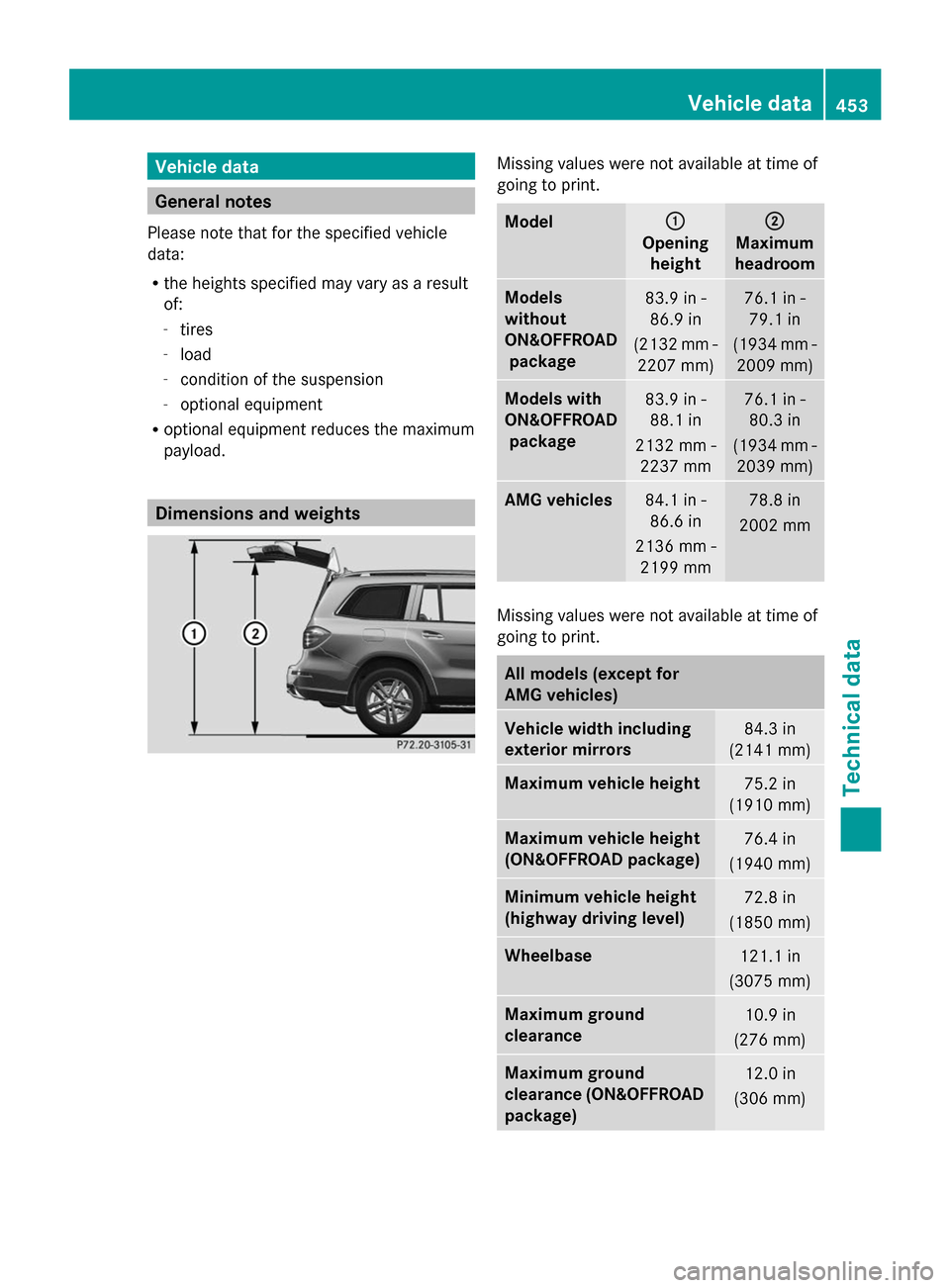
payload. Dimensions and weights Missing values were not available at time of
going to print.
Model : :
Opening height ;
;
Maximum
headroom Models
without
ON&OFFROAD
package 83.9 in -
86.9 in
(2132 mm - 2207 mm) 76.1 in -
79.1 in
(1934 mm - 2009 mm) Models with
ON&OFFROAD
package 83.9 in -
88.1 in
2132 mm - 2237 mm 76.1 in -
80.3 in
(1934 mm - 2039 mm) AMG vehicles
84.1 in -
86.6 in
2136 mm - 2199 mm 78.8 in
2002 mm Missing values were not available at time of
going to print.
All models (except for
AMG vehicles)
Vehicle width including
exterior mirrors
84.3 in
(2141 mm) Maximum vehicle height
75.2 in
(1910 mm) Maximum vehicle height
(ON&OFFROAD package)
76.4 in
(1940 mm) Minimum vehicle height
(highway driving level)
72.8 in
(1850 mm) Wheelbase
121.1 in
(3075 mm) Maximum ground
clearance
10.9 in
(276 mm) Maximum ground
clearance (ON&OFFROAD
package)
12.0 in
(306 mm) Vehicle data
453Technical data Z
Page 456 of 462
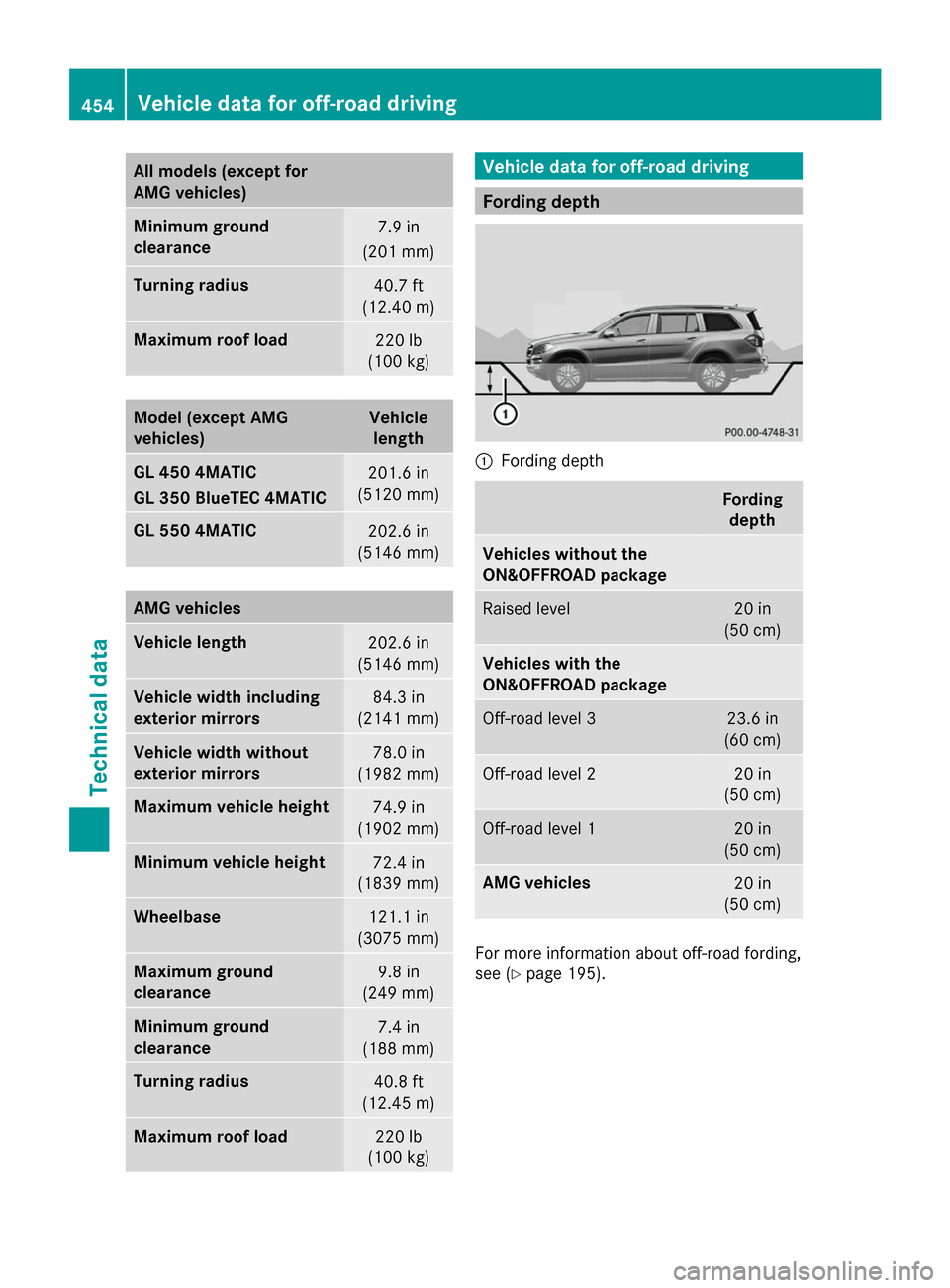
All models (except for
AMG vehicles)
Minimum ground
clearance
7.9 in
(201 mm) Turning radius
40.7 ft
(12.40 m) Maximum roof load
220 lb
(100 kg) Model (except AMG
vehicles) Vehicle
length GL 450 4MATIC
GL 350 BlueTEC 4MATIC
201.6 in
(5120 mm) GL 550 4MATIC
202.6 in
(5146 mm) AMG vehicles
Vehicle length
202.6 in
(5146 mm) Vehicle width including
exterior mirrors
84.3 in
(2141 mm) Vehicle width without
exterior mirrors
78.0 in
(1982 mm) Maximum vehicle height
74.9 in
(1902 mm) Minimum vehicle height
72.4 in
(1839 mm) Wheelbase
121.1 in
(3075 mm) Maximum ground
clearance
9.8 in
(249 mm) Minimum ground
clearance
7.4 in
(188 mm) Turning radius
40.8 ft
(12.45 m) Maximum roof load
220 lb
(100 kg) Vehicle data for off-road driving
Fording depth
:
Fording depth Fording
depth Vehicles without the
ON&OFFROAD package
Raised level 20 in
(50 cm) Vehicles with the
ON&OFFROAD package
Off-road level 3 23.6 in
(60 cm) Off-road level 2 20 in
(50 cm) Off-road level 1 20 in
(50 cm) AMG vehicles
20 in
(50 cm) For more information about off-road fording,
see (Y
page 195). 454
Vehicle data for off-road drivingTechnical data