brake MERCEDES-BENZ GL-Class 2016 X166 Owner's Manual
[x] Cancel search | Manufacturer: MERCEDES-BENZ, Model Year: 2016, Model line: GL-Class, Model: MERCEDES-BENZ GL-Class 2016 X166Pages: 462, PDF Size: 10.44 MB
Page 433 of 462
Mounting a new wheel
GWARNING
Oiled or greased wheel bolts or damaged
wheel bolts/hub threads can cause the wheel bolts to come loose. As a result, you could
lose a wheel while driving. There is a risk of
accident.
Never oil or grease wheel bolts. In the event of
damage to the threads, contact a qualified
specialist workshop immediately. Have the
damaged wheel bolts or hub threads
replaced/renewed. Do not continue driving.
GWARNING
If you tighten the wheel bolts or wheel nuts
when the vehicle is raised, the jack could tip
over. There is a risk of injury.
Only tighten the wheel bolts or wheel nuts
when the vehicle is on the ground.
!To prevent damage to the paintwork, hold
the wheel securely against the wheel hub
while screwing in the first wheel bolt.
Always pay attention to the instructions and
safety notes in the "Changing a wheel" sec-
tion (
Ypage 427).
Only use wheel bolts that have been designed
for the wheel and the vehicle. For safety rea-
sons, Mercedes-Benz recommends that you
only use wheel bolts which have been
approved for Mercedes-Benz vehicles and the respective wheel.
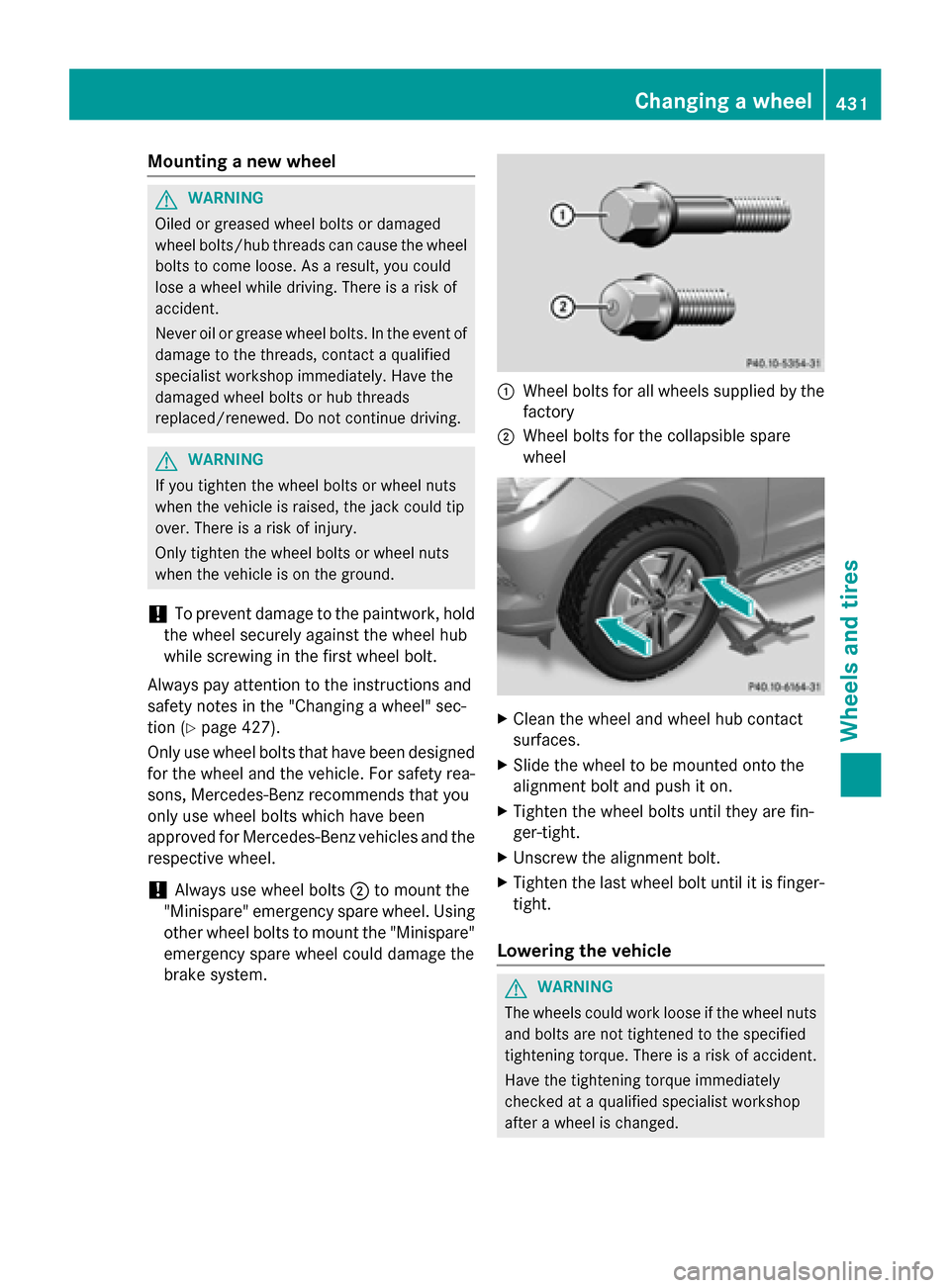
!Always use wheel bolts ;to mount the
"Minispare" emergency spare wheel. Using
other wheel bolts to mount the "Minispare"
emergency spare wheel could damage the
brake system.
:Wheel bolts for all wheels supplied by the
factory
;Wheel bolts for the collapsible spare
wheel
XClean the wheel and wheel hub contact
surfaces.
XSlide the wheel to be mounted onto the
alignment bolt and push it on.
XTighten the wheel bolts until they are fin-
ger-tight.
XUnscrew the alignment bolt.
XTighten the last wheel bolt until it is finger-
tight.
Lowering the vehicle
GWARNING
The wheels could work loose if the wheel nuts and bolts are not tightened to the specified
tightening torque. There is a risk of accident.
Have the tightening torque immediately
checked at a qualified specialist workshop
after a wheel is changed.
Changing a wheel431
Wheels and tires
Z
Page 440 of 462
GL 63 AMG 4MATIC
Summer tires
R 21
TiresAlloy wheels
BA: 295/40 ZR 21 111 Y XL3BA: 10.0 J x 21 H2
Wheel offset: 1.81 in (46 mm)
Winter tires
R 20
TiresAlloy wheels
BA: 275/45 R 20 110 V XL M+SiBA: 9.0 J x 20 H2
Wheel offset: 1.61 in (41 mm)
Emergency spare wheel
Important safety notes
GWARNING
The wheel or tire size as well as the tire type of the spare wheel or emergency spare wheel
and the wheel to be replaced may differ.
Mounting an emergency spare wheel may
severely impair the driving characteristics.
There is a risk of an accident.
To avoid hazardous situations:
Radapt your driving style accordingly and
drive carefully.
Rnever mount more than one spare wheel or
emergency spare wheel that differs in size.
Ronly use a spare wheel or emergency spare
wheel of a different size briefly.
Rdo not switch ESP®off.
Rhave a spare wheel or emergency spare
wheel of a different size replaced at the
nearest qualified specialist workshop.
Observe that the wheel and tire dimensions
as well as the tire type must be correct.
!AMG vehicles with "Minispare" emer-
gency spare wheel: use the "Minispare" emergency spare wheel
only on the rear
axle . If you mount the "Minispare" emer-
gency spare wheel on the front axle, this
could result in damage to the brake system.
If a tire on the front axle is defective, an
intact wheel from the rear axle must first be
replaced with the "Minispare" emergency
spare wheel. The faulty wheel on the front
axle may only then be replaced by the
undamaged wheel from the rear axle.
Make sure to note the placard on the
"Minispare" emergency spare wheel.
When using an emergency spare wheel or
spare wheel of a different size, you must not
exceed the maximum speed of 50 mph
(80 km/h).
Snow chains must not be mounted on emer-
gency spare wheels.
General notes
Mounting the emergency spare wheel is
described under "Mounting a wheel"
(
Ypage 428).
You should regularly check the pressure of
the emergency spare wheel, particularly prior
to long trips, and correct the pressure as nec-
3Use of snow chains not permitted. Observe the notes in the "Snow chains" section.
438Emergency spare wheel
Wheels and tires
Page 449 of 462
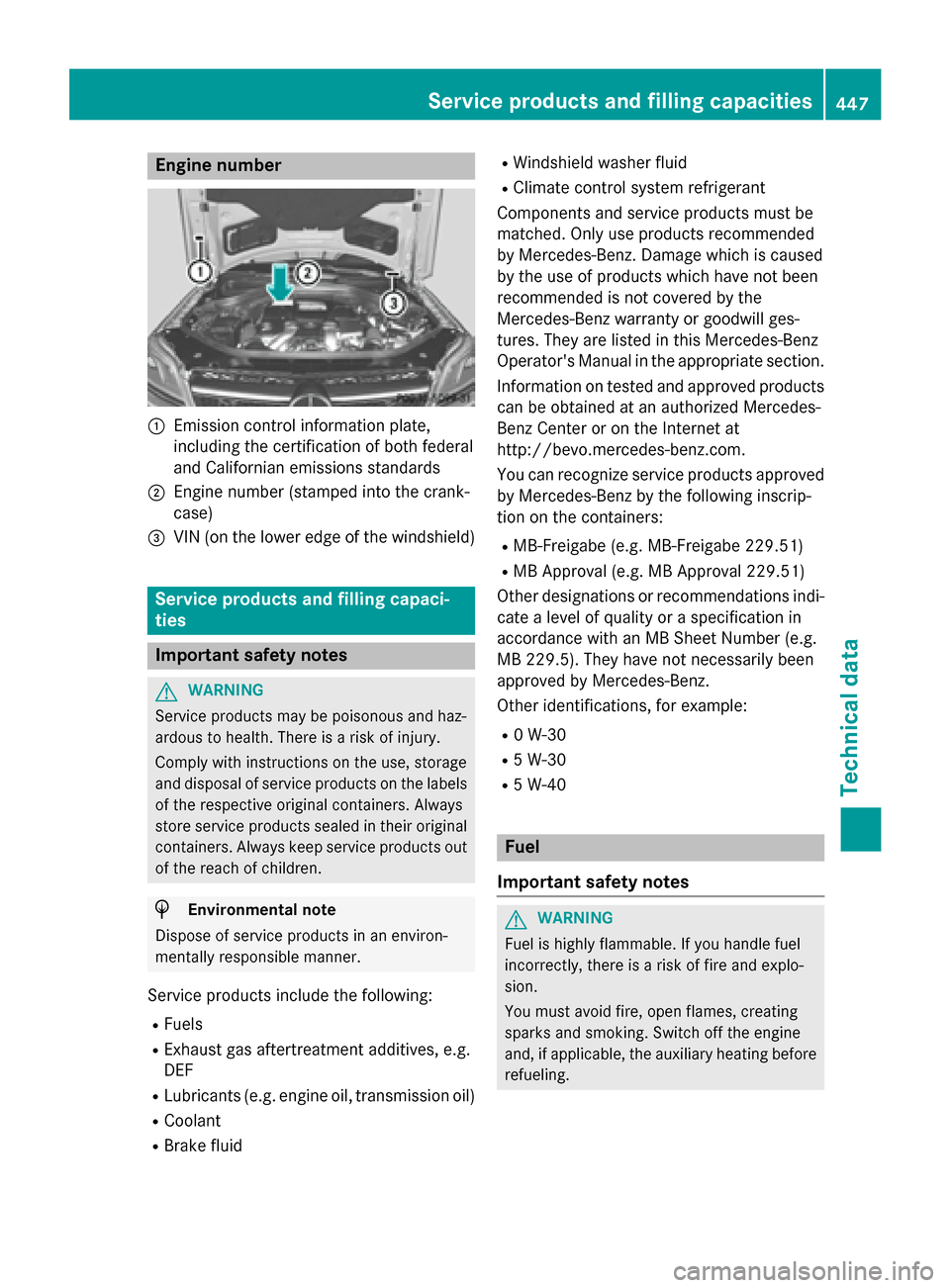
Engine number
:Emission control information plate,
including the certification of both federal
and Californian emissions standards
;Engine number (stamped into the crank-
case)
=VIN (on the lower edge of the windshield)
Service products and filling capaci-
ties
Important safety notes
GWARNING
Service products may be poisonous and haz-
ardous to health. There is a risk of injury.
Comply with instructions on the use, storage
and disposal of service products on the labels
of the respective original containers. Always
store service products sealed in their original
containers. Always keep service products out
of the reach of children.
HEnvironmental note
Dispose of service products in an environ-
mentally responsible manner.
Service products include the following:
RFuels
RExhaust gas aftertreatment additives, e.g.
DEF
RLubricants (e.g. engine oil, transmission oil)
RCoolant
RBrake fluid
RWindshield washer fluid
RClimate control system refrigerant
Components and service products must be
matched. Only use products recommended
by Mercedes-Benz. Damage which is caused
by the use of products which have not been
recommended is not covered by the
Mercedes-Benz warranty or goodwill ges-
tures. They are listed in this Mercedes-Benz
Operator's Manual in the appropriate section.
Information on tested and approved products
can be obtained at an authorized Mercedes-
Benz Center or on the Internet at
http://bevo.mercedes-benz.com.
You can recognize service products approved
by Mercedes-Benz by the following inscrip-
tion on the containers:
RMB-Freigabe (e.g. MB-Freigabe 229.51)
RMB Approval (e.g. MB Approval 229.51)
Other designations or recommendations indi-
cate a level of quality or a specification in
accordance with an MB Sheet Number (e.g.
MB 229.5). They have not necessarily been
approved by Mercedes-Benz.
Other identifications, for example:
R0 W-30
R5 W-30
R5 W-40
Fuel
Important safety notes
GWARNING
Fuel is highly flammable. If you handle fuel
incorrectly, there is a risk of fire and explo-
sion.
You must avoid fire, open flames, creating
sparks and smoking. Switch off the engine
and, if applicable, the auxiliary heating before refueling.
Service products and filling capacities447
Technical data
Z
Page 453 of 462
The engine oils are matched to the perform-
ance of Mercedes-Benz engines and service
intervals. You should therefore only use
engine oils and oil filters that are approved for
vehicles with maintenance systems.
For a list of approved engine oils and oil filters,
consult an authorized Mercedes-Benz Cen-
ter. Or visit the website
http://bevo.mercedes-benz.com.
The table shows which engine oils have been
approved for your vehicle.
Gasoline enginesMB Approval
All models229.5
Diesel enginesMB Approval
GL 350 Blue-
TEC 4MATIC228.51,
229.31,
229.51, 229.52
Mercedes-AMG vehicles: use only
SAE 0W-40 or SAE 5W-40 engine oils.
iMB approval is indicated on the oil con-
tainers.
Filling capacities
The following values refer to an oil change
including the oil filter.
Missing values were not available at time of
going to print.
ModelCapacity
GL 350 Blue-
TEC 4MATIC8.5 US qt (8.0 l)
GL 450
GL 450 4MATIC7.4 US qt (7.0l)
GL 550 4MATIC9.0 US qt (8.5l)
Mercedes‑AMG
vehicles
Additives
!Do not use any additives in the engine oil.
This could damage the engine.
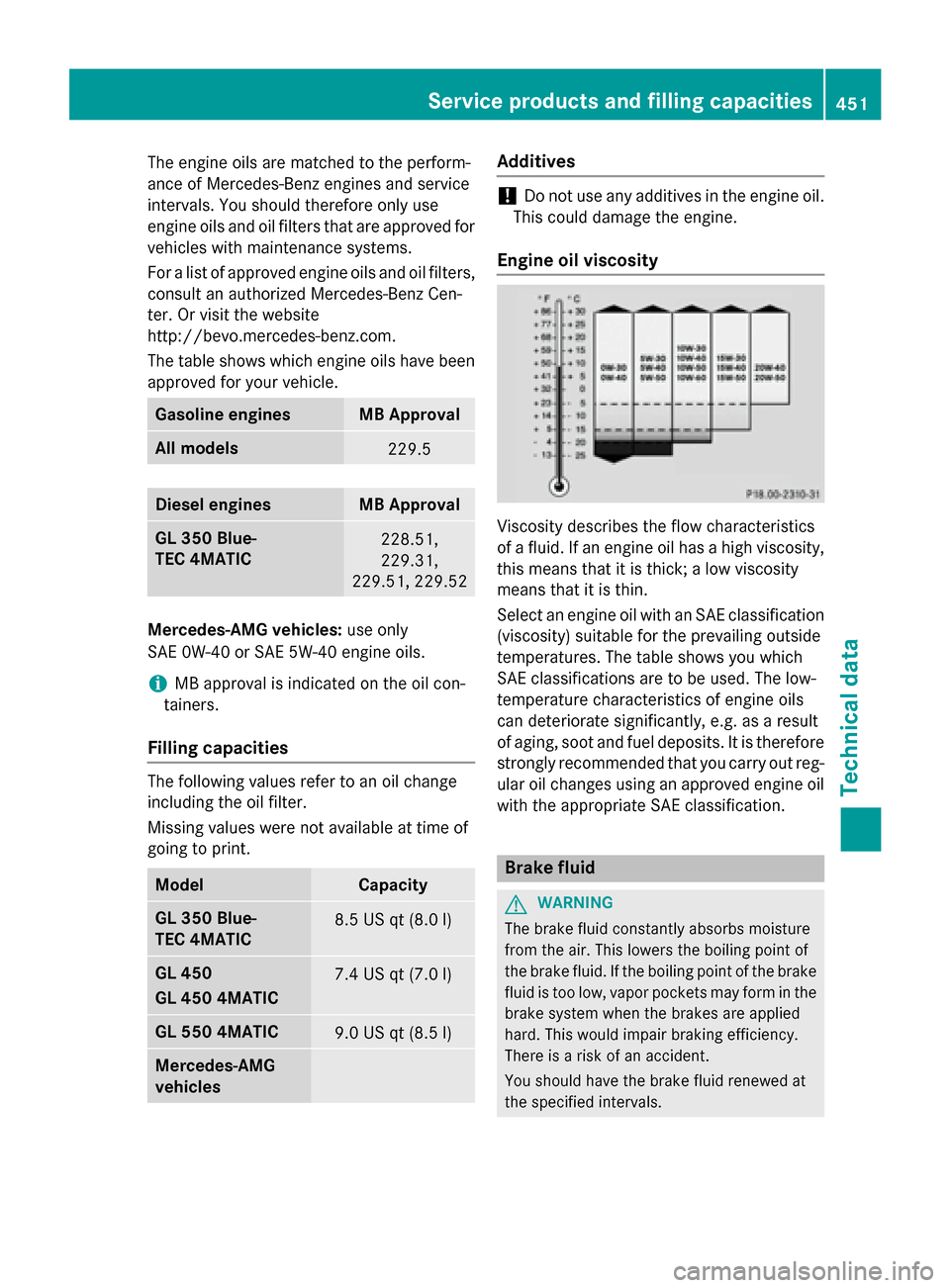
Engine oil viscosity
Viscosity describes the flow characteristics
of a fluid. If an engine oil has a high viscosity,
this means that it is thick; a low viscosity
means that it is thin.
Select an engine oil with an SAE classification
(viscosity) suitable for the prevailing outside
temperatures. The table shows you which
SAE classifications are to be used. The low-
temperature characteristics of engine oils
can deteriorate significantly, e.g. as a result
of aging, soot and fuel deposits. It is therefore
strongly recommended that you carry out reg-
ular oil changes using an approved engine oil
with the appropriate SAE classification.
Brake fluid
GWARNING
The brake fluid constantly absorbs moisture
from the air. This lowers the boiling point of
the brake fluid. If the boiling point of the brake
fluid is too low, vapor pockets may form in the
brake system when the brakes are applied
hard. This would impair braking efficiency.
There is a risk of an accident.
You should have the brake fluid renewed at
the specified intervals.
Service products and filling capacities451
Technical data
Z
Page 454 of 462
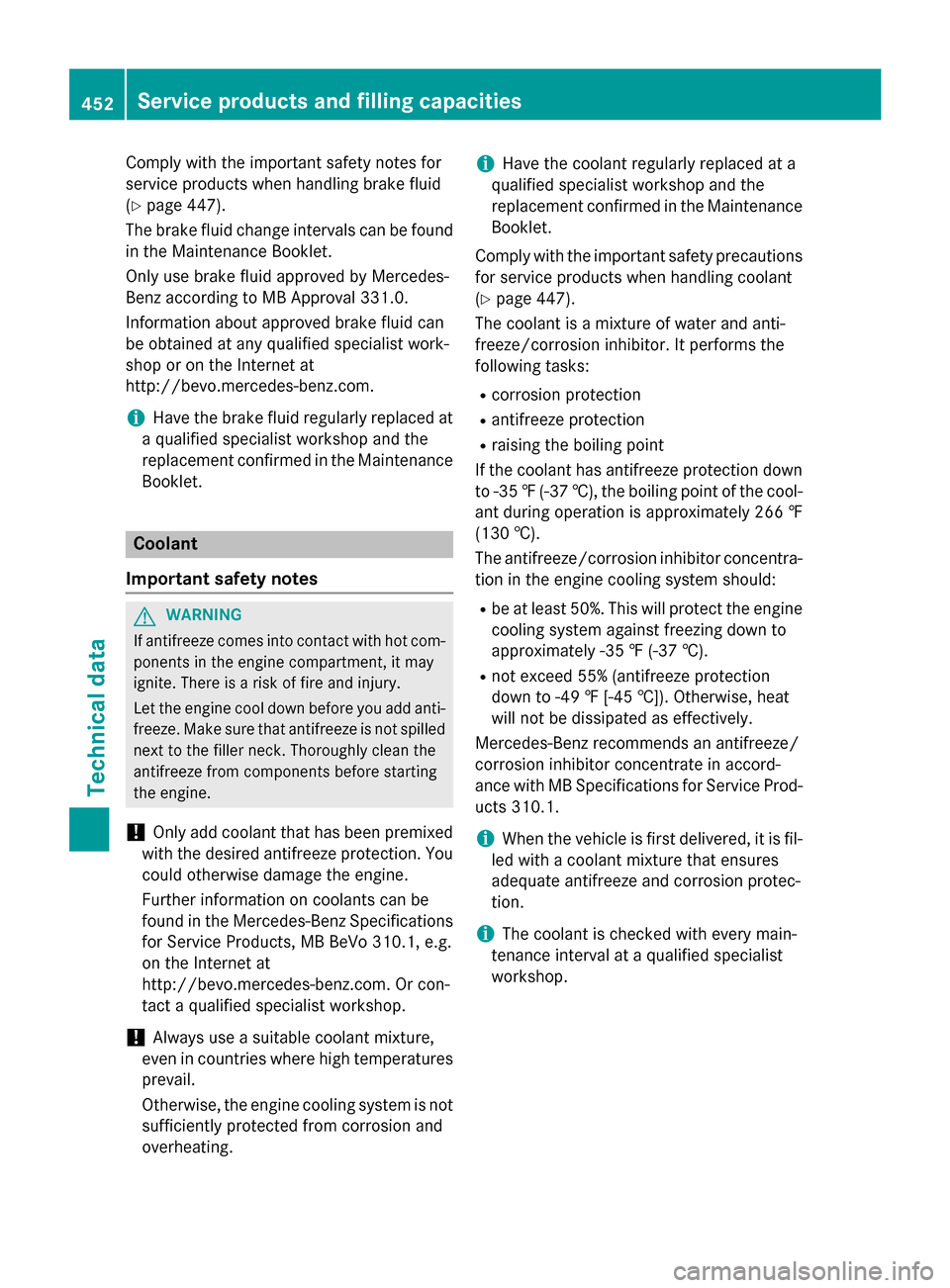
Comply with the important safety notes for
service products when handlin g brake fluid
(
Ypage 447).
The brake fluid change intervals can befound
in the Maintenance Booklet.
Only use brake fluid approved byMercedes-
Benz according to MB Approval 331.0.
In formation about approved brake fluid can
be obtained at any qualified specialist work-
shop or on the Internet at
http:/ /bevo.mercedes-benz.co m.
iHave the brake fluid regularly replaced at
a qualified specialist workshop and the
replacement confirmed in the Maintenance
Booklet.
Coolant
Important safety notes
GWARNING
If antifreeze comes into contact with hot com- ponents in the engine compartment, it may
ignite. There is a risk of fire and injury.
Let the engine cool down before you add anti-
freeze. Make sure that antifreeze is not spilled
next to the filler neck. Thoroughly clean the
antifreeze from components before starting
the engine.
!Only add coolant that has been premixed
with the desired antifreeze protection. You
could otherwise damage the engine.
Further information on coolants can be
found in the Mercedes-Benz Specifications
for Service Products, MB BeVo 310.1, e.g.
on the Internet at
http://bevo.mercedes-benz.com. Or con-
tact a qualified specialist workshop.
!Always use a suitable coolant mixture,
even in countries where high temperatures
prevail.
Otherwise, the engine cooling system is not
sufficiently protected from corrosion and
overheating.
iHave the coolant regularly replaced at a
qualified specialist workshop and the
replacement confirmed in the Maintenance
Booklet.
Comply with the important safety precautions
for service products when handling coolant
(
Ypage 447).
The coolant is a mixture of water and anti-
freeze/corrosion inhibitor. It performs the
following tasks:
Rcorrosion protection
Rantifreeze protection
Rraising the boiling point
If the coolant has antifreeze protection down
to -35 ‡(-37 †), the boiling point of the cool-
ant during operation is approximately 266 ‡
(130 †).
The antifreeze/corrosion inhibitor concentra -
ti
on in the engine cooling system should:
Rbe at least 50%. This will protect the engine
cooling system against freezing down to
approximately -35 ‡ (-37 †).
Rnot exceed 55% (antifreeze protection
down to -49‡[-45 †]). Other wise, heat
will not be dissipated as effectively.
Mercedes-Benz recommends an antifreeze/
corrosion inhibitor concentrate in accord-
ance with MB Specifications for Service Prod-
ucts 310.1.
iWhen the vehicle is first delivered, it is fil-
led with a coolant mixture that ensures
adequate antifreeze and corrosion protec-
tion.
iThe coolant is checked with every main-
tenance interval at a qualified specialist
workshop.
452Service products and filling capacities
Technical data
Page 459 of 462
Vehicles with the ON&OFFROAD package:
the maximum gradient climbing ability is
100% when the LOW RANGE off-road gear is
selected.
Vehicles without the ON&OFFROAD pack-
age:the maximum gradient climbing ability is
80%.
Accelerate carefully and make sure that the
wheels do not spin when driving on steep ter-
rain.
iIf the load on the front axle is reduced
when pulling away on a steep uphill slope,
the front wheels have a tendency to spin.
4ETS recognizes this and brakes the
wheels accordingly. The rear wheel torque
is increased, making it easier to drive off.
For further information about the maximum
gradient climbing ability, see (
Ypage 202).
Trailer tow hitch
Mounting dimensions
!
If you have a trailer tow hitch retrofitted,
changes to the cooling system and drive
train may be necessary, depending on the
vehicle type.
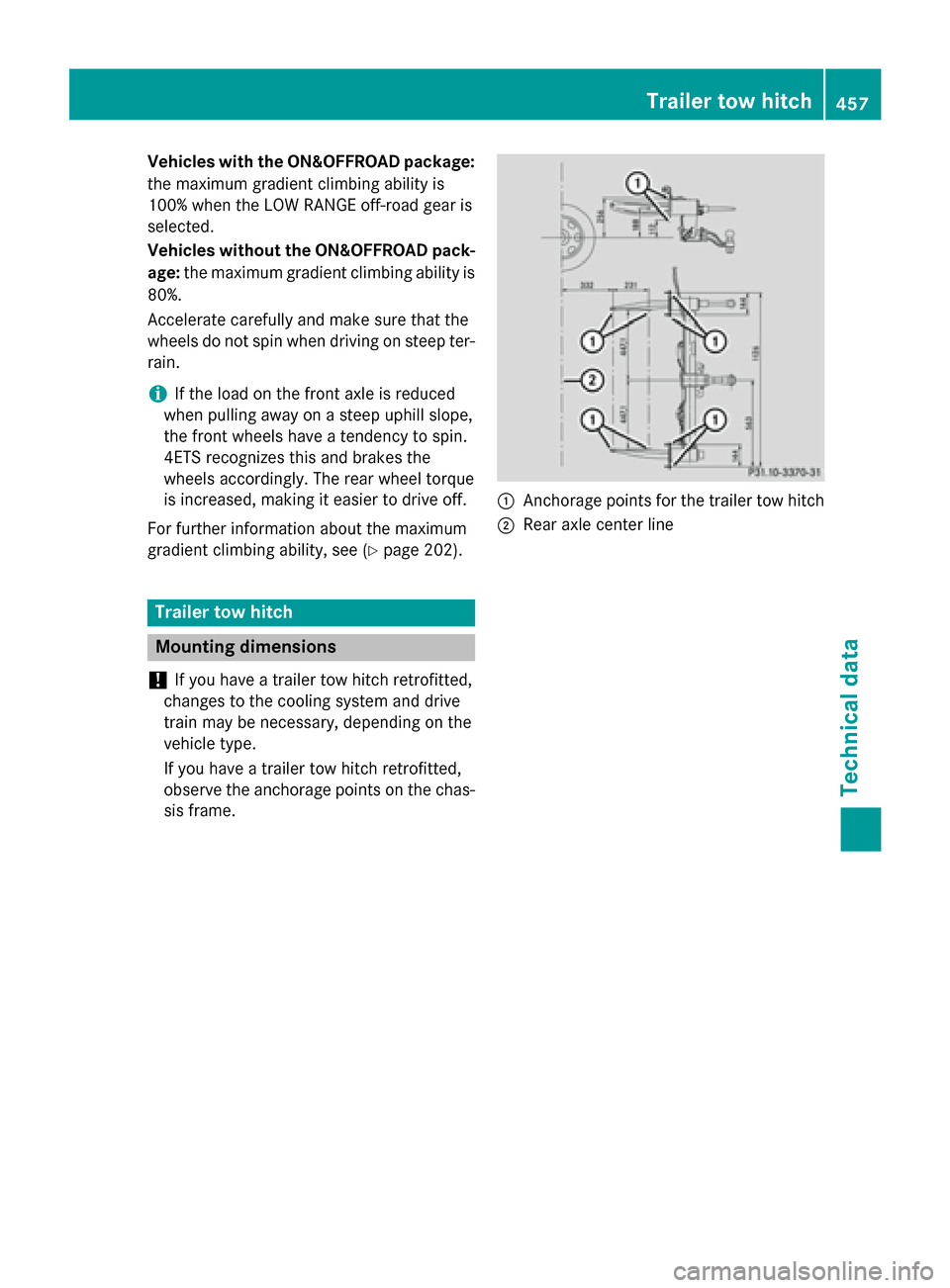
If you have a trailer tow hitch retrofitted,
observe the anchorage points on the chas-
sis frame.
:Anchorage points for the trailer tow hitch
;Rear axle center line
Trailer tow hitch457
Technical data
Z
Page 460 of 462
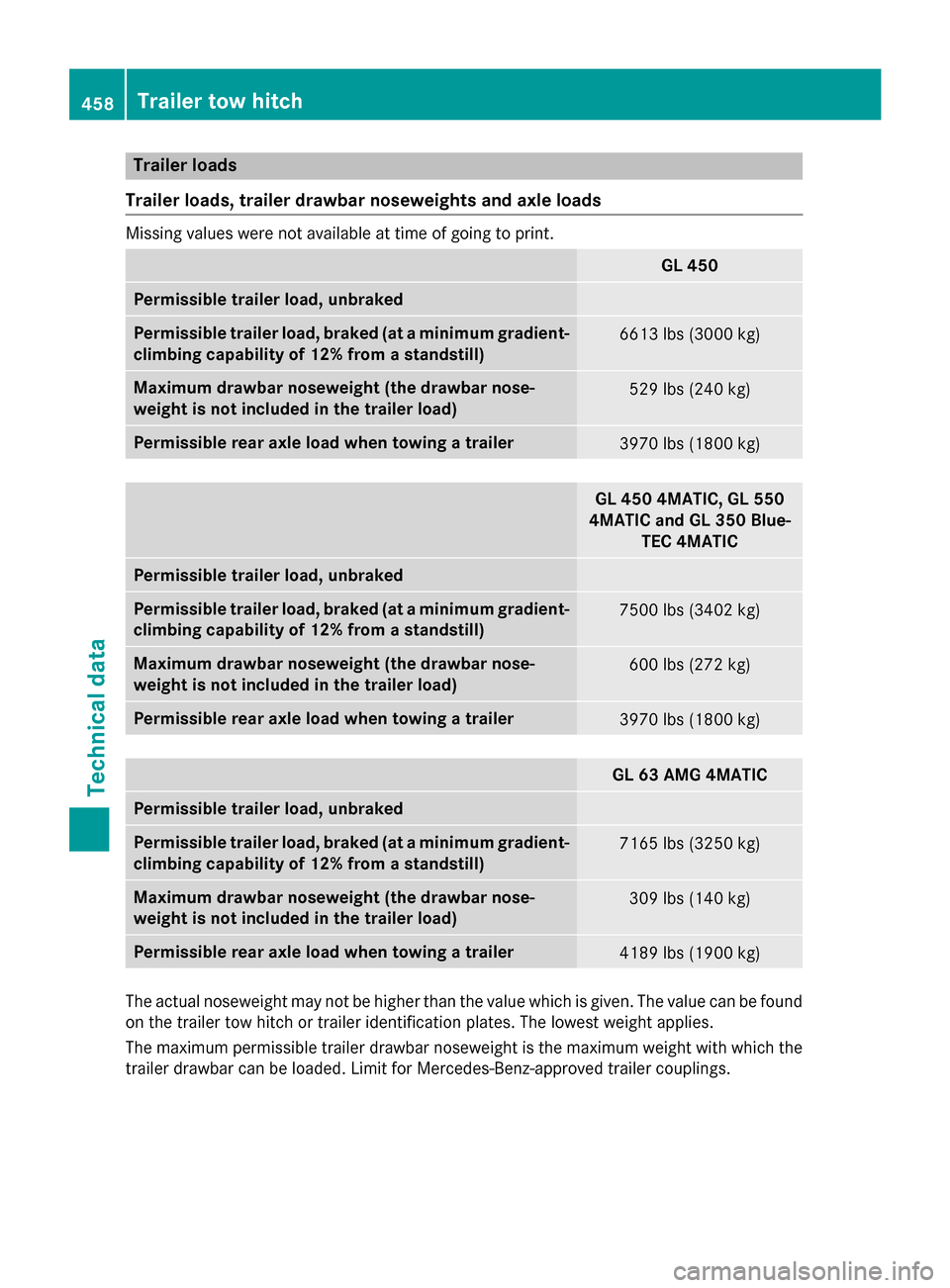
Trailer loads
Trailer loads, trailer drawbar noseweights and axle loads
Missing values were not available at time of going to print.
GL 450
Permissible trailer load, unbraked
Permissible trailer load, braked (at a minimum gradient-
climbing capability of 12% from a standstill)6613 lbs (3000 kg)
Maximum drawbar noseweight (the drawbar nose-
weight is not included in the trailer load)529 lbs (240 kg)
Permissible rear axle load when towing a trailer3970 lbs (1800 kg)
GL 450 4MATIC, GL 550
4MATIC and GL 350 Blue- TEC 4MATIC
Permissible trailer load, unbraked
Permissible trailer load, braked (at a minimum gradient-
climbing capability of 12% from a standstill)7500 lbs (3402 kg)
Maximum drawbar noseweight (the drawbar nose-
weight is not included in the trailer load)600 lbs (272 kg)
Permissible rear axle load when towing a trailer3970 lbs (1800 kg)
GL 63 AMG 4MATIC
Permissible trailer load, unbraked
Permissible trailer load, braked (at a minimum gradient-
climbing capability of 12% from a standstill)7165 lbs (3250 kg)
Maximum drawbar noseweight (the drawbar nose-
weight is not included in the trailer load)309 lbs (140 kg)
Permissible rear axle load when towing a trailer4189 lbs (1900 kg)
The actual noseweight may not be higher than the value which is given. The value can be found
on the trailer tow hitch or trailer identification plates. The lowest weight applies.
The maximum permissible trailer drawbar noseweight is the maximum weight with which the
trailer drawbar can be loaded. Limit for Mercedes-Benz-approved trailer couplings.
458Trailer tow hitch
Technical data