light MERCEDES-BENZ GL SUV 2009 User Guide
[x] Cancel search | Manufacturer: MERCEDES-BENZ, Model Year: 2009, Model line: GL SUV, Model: MERCEDES-BENZ GL SUV 2009Pages: 309, PDF Size: 10.27 MB
Page 27 of 309
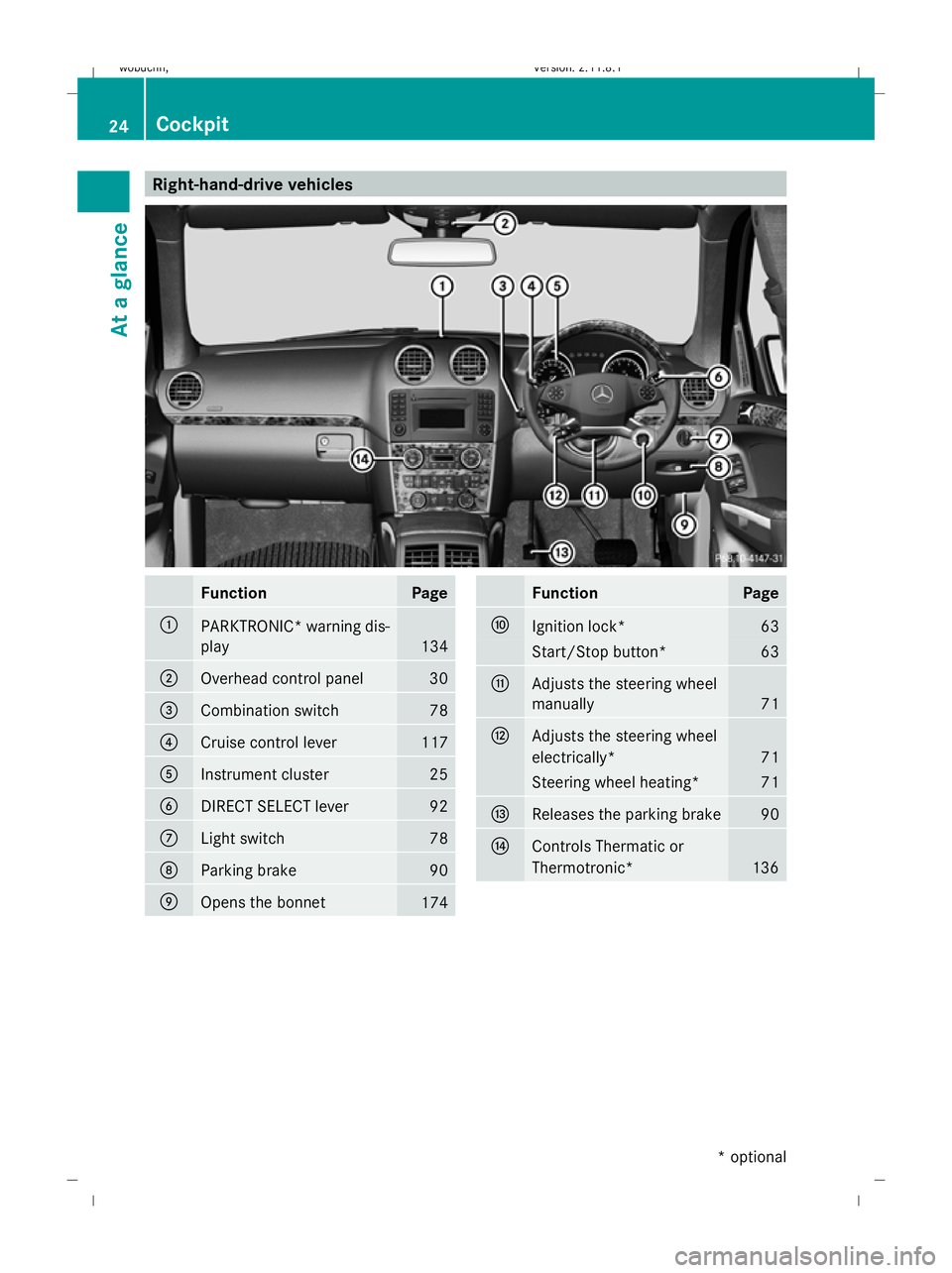
Right-hand-drive vehicles
Function Page
:
PARKTRONIC
*warning dis-
play 134
;
Overhead control panel 30
=
Combination switch 78
?
Cruise control lever 117
A
Instrument cluster 25
B
DIRECT SELECT lever 92
C
Light switch 78
D
Parking brake 90
E
Opens the bonnet
174 Function Page
F
Ignition lock* 63
Start/Stop button* 63
G
Adjusts the steering wheel
manually
71
H
Adjusts the steering wheel
electrically*
71
Steering wheel heating* 71
I
Releases the parking brake 90
J
Controls Thermatic or
Thermotronic*
13624
CockpitAt a glance
* optional
X164_AKB; 2; 3, en-GB
wobuchh,
Version: 2.11.8.1 2009-03-31T14:14:58+02:00 - Seite 24
Dateiname: 6515431202_buchblock.pdf; erzeugt am 01. Apr 2009 00:16:35; WK
Page 28 of 309
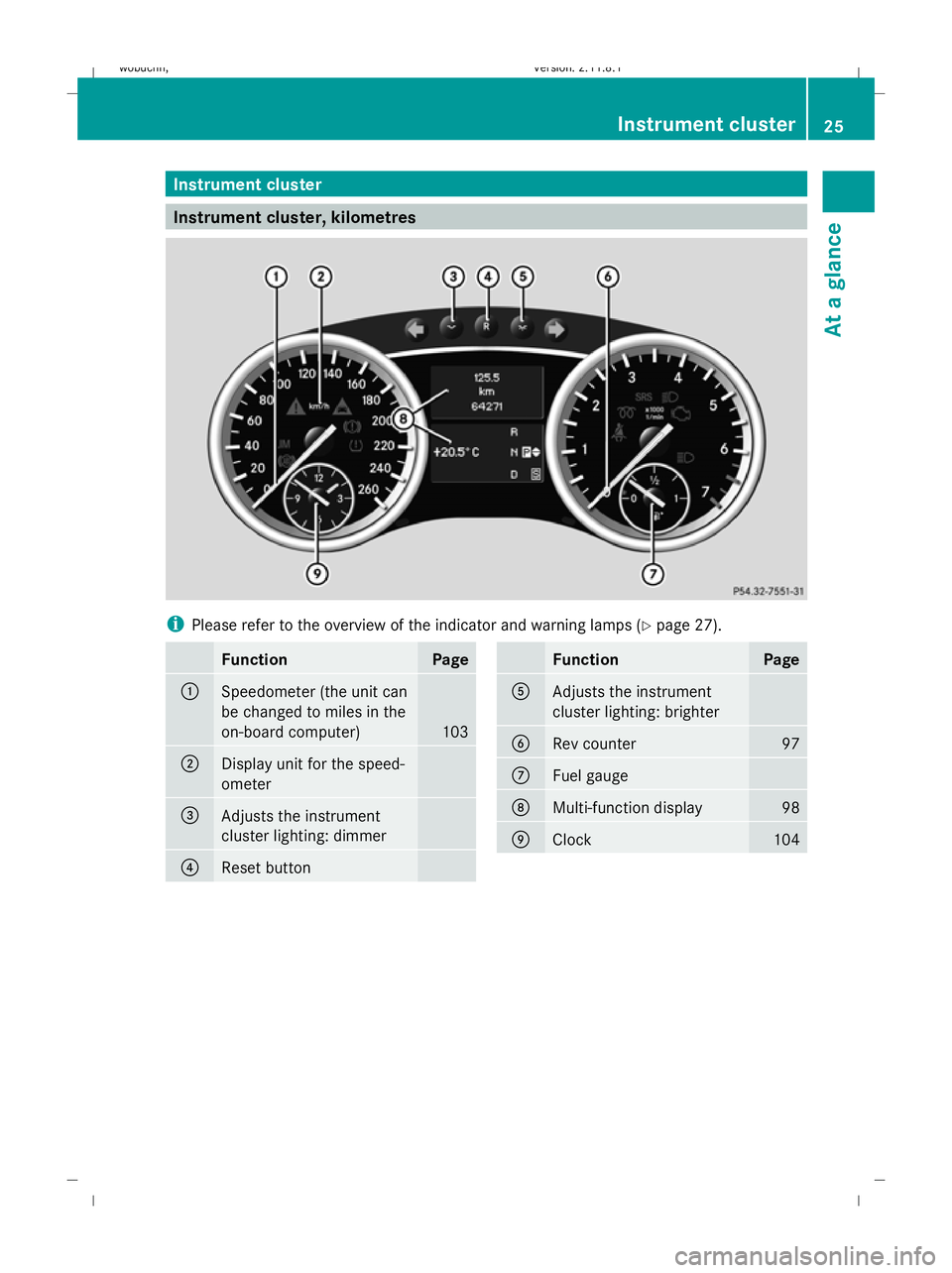
Instrument cluster
Instrument cluster, kilometres
i
Please refer to the overview of the indicator and warning lamps ( Ypage 27). Function Page
:
Speedometer (the unit can
be changed to miles in the
on-board computer)
103
;
Display unit for the speed-
ometer
=
Adjusts the instrument
cluster lighting: dimmer
?
Reset button Function Page
A
Adjusts the instrument
cluster lighting: brighter
B
Rev counter 97
C
Fuel gauge
D
Multi-function display 98
E
Clock 104Instrument cluster
25At a glance
X164_AKB; 2; 3, en-GB
wobuchh, Version: 2.11.8.1 2009-03-31T14:14:58+02:00 - Seite 25 Z
Dateiname: 6515431202_buchblock.pdf; erzeugt am 01. Apr 2009 00:16:35; WK
Page 29 of 309
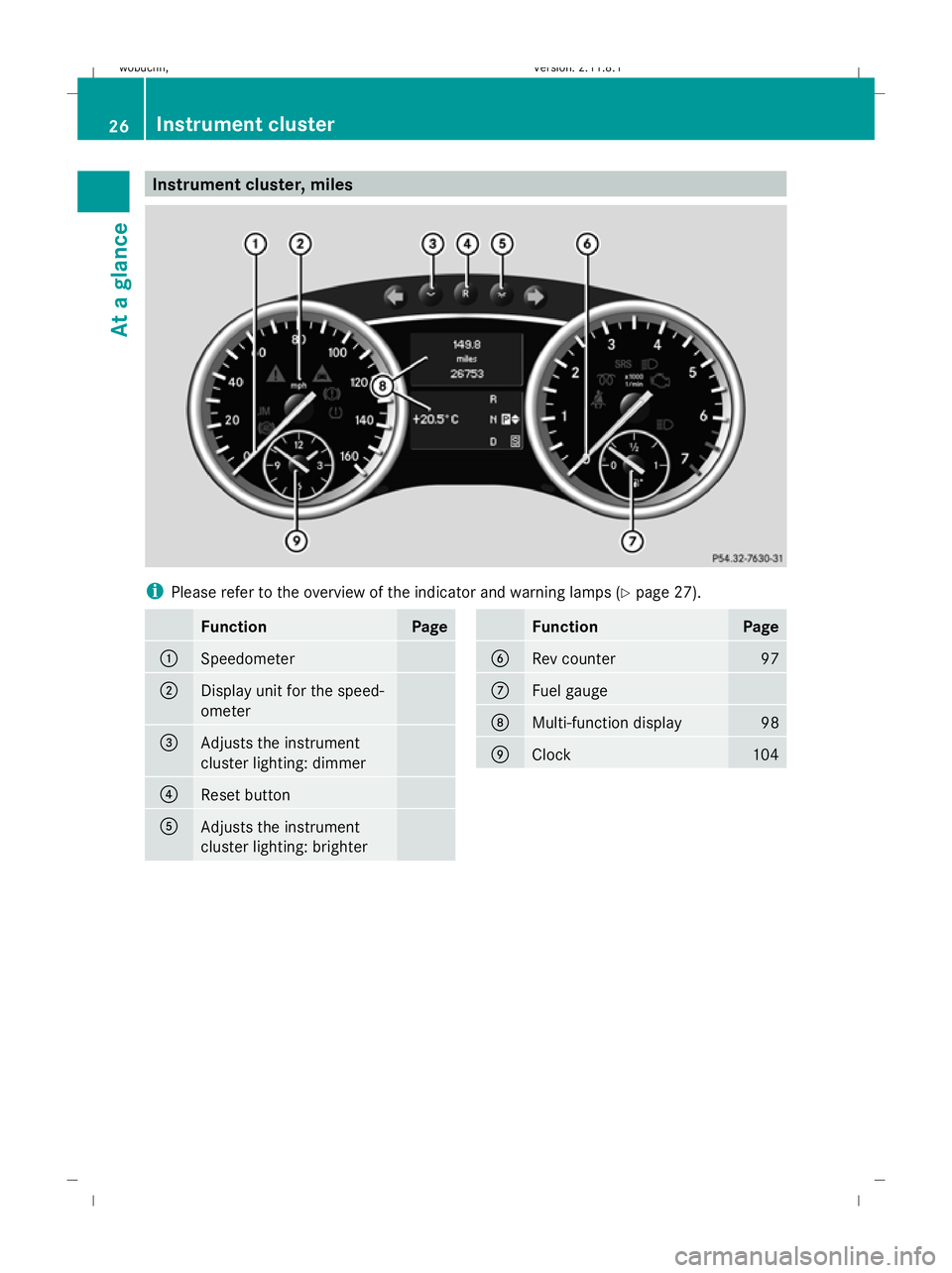
Instrument cluster, miles
i
Please refer to the overview of the indicator and warning lamps ( Ypage 27). Function Page
:
Speedometer
;
Display unit for the speed-
ometer
=
Adjusts the instrument
cluster lighting: dimmer
?
Reset button
A
Adjusts the instrument
cluster lighting: brighter Function Page
B
Rev counter 97
C
Fuel gauge
D
Multi-function display 98
E
Clock 10426
Instrument clusterAt a glance
X164_AKB; 2; 3, en-GB
wobuchh,
Version: 2.11.8.1 2009-03-31T14:14:58+02:00 - Seite 26
Dateiname: 6515431202_buchblock.pdf; erzeugt am 01. Apr 2009 00:16:36; WK
Page 30 of 309
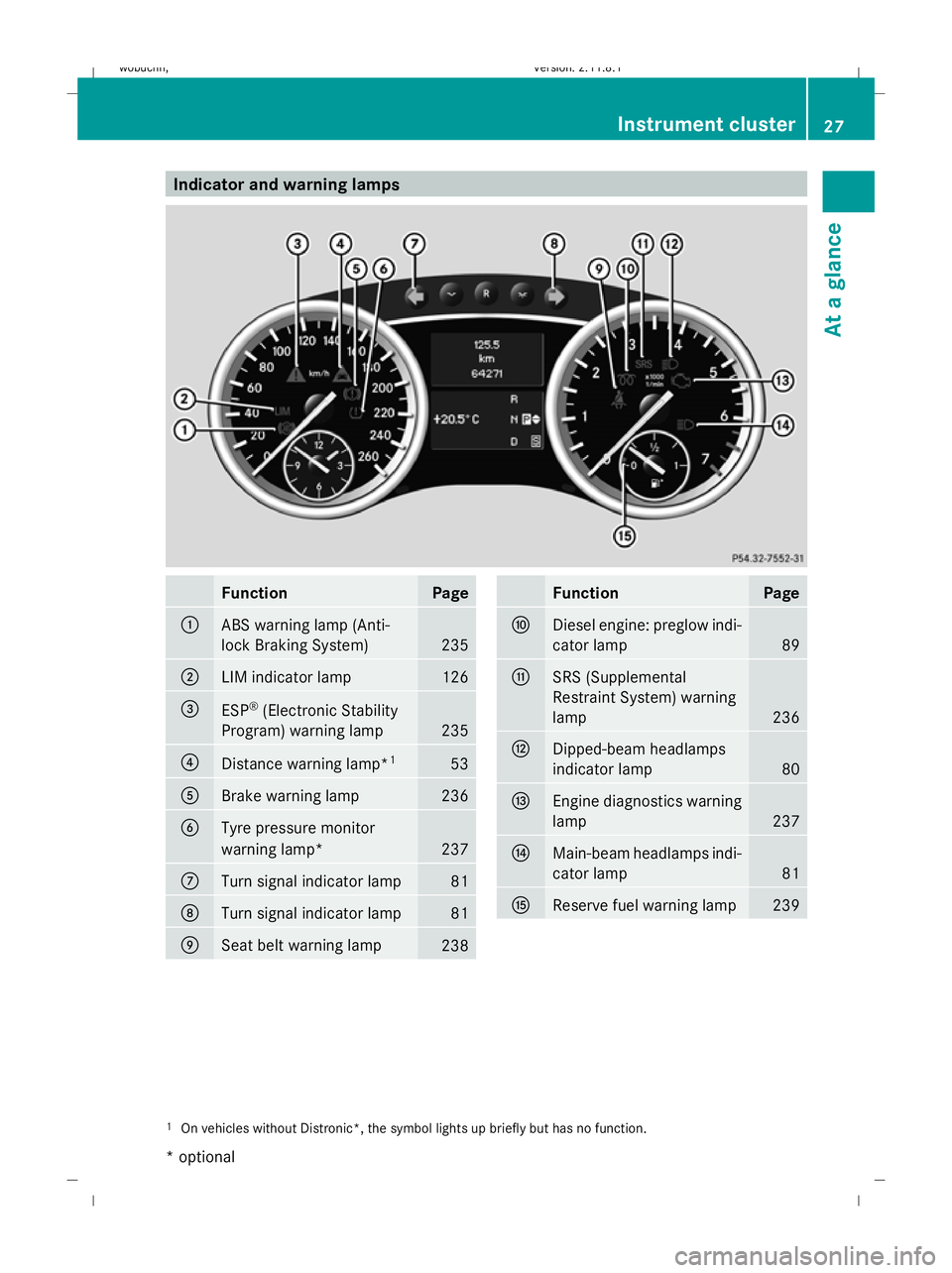
Indicator and warning lamps
Function Page
:
ABS warning lamp (Anti-
lock Braking System)
235
;
LIM indicator lamp 126
=
ESP
®
(Electronic Stability
Program) warning lamp 235
?
Distance warning lamp*
1 53
A
Brake warning lamp 236
B
Tyre pressure monitor
warning lamp*
237
C
Turn signal indicator lamp 81
D
Turn signal indicator lamp 81
E
Seat belt warning lamp
238 Function Page
F
Diesel engine: preglow indi-
cator lamp
89
G
SRS (Supplemental
Restraint System) warning
lamp 236
H
Dipped-beam headlamps
indicator lamp 80
I
Engine diagnostics warning
lamp 237
J
Main-beam headlamps indi-
cator lamp 81
K
Reserve fuel warning lamp 239
1
On vehicles without Distronic*, the symbol lights up briefly but has no function. Instrument cluster
27At a glance
* optional
X164_AKB; 2; 3, en-GB
wobuchh,
Version: 2.11.8.1 2009-03-31T14:14:58+02:00 - Seite 27 Z
Dateiname: 6515431202_buchblock.pdf; erzeugt am 01. Apr 2009 00:16:37; WK
Page 32 of 309
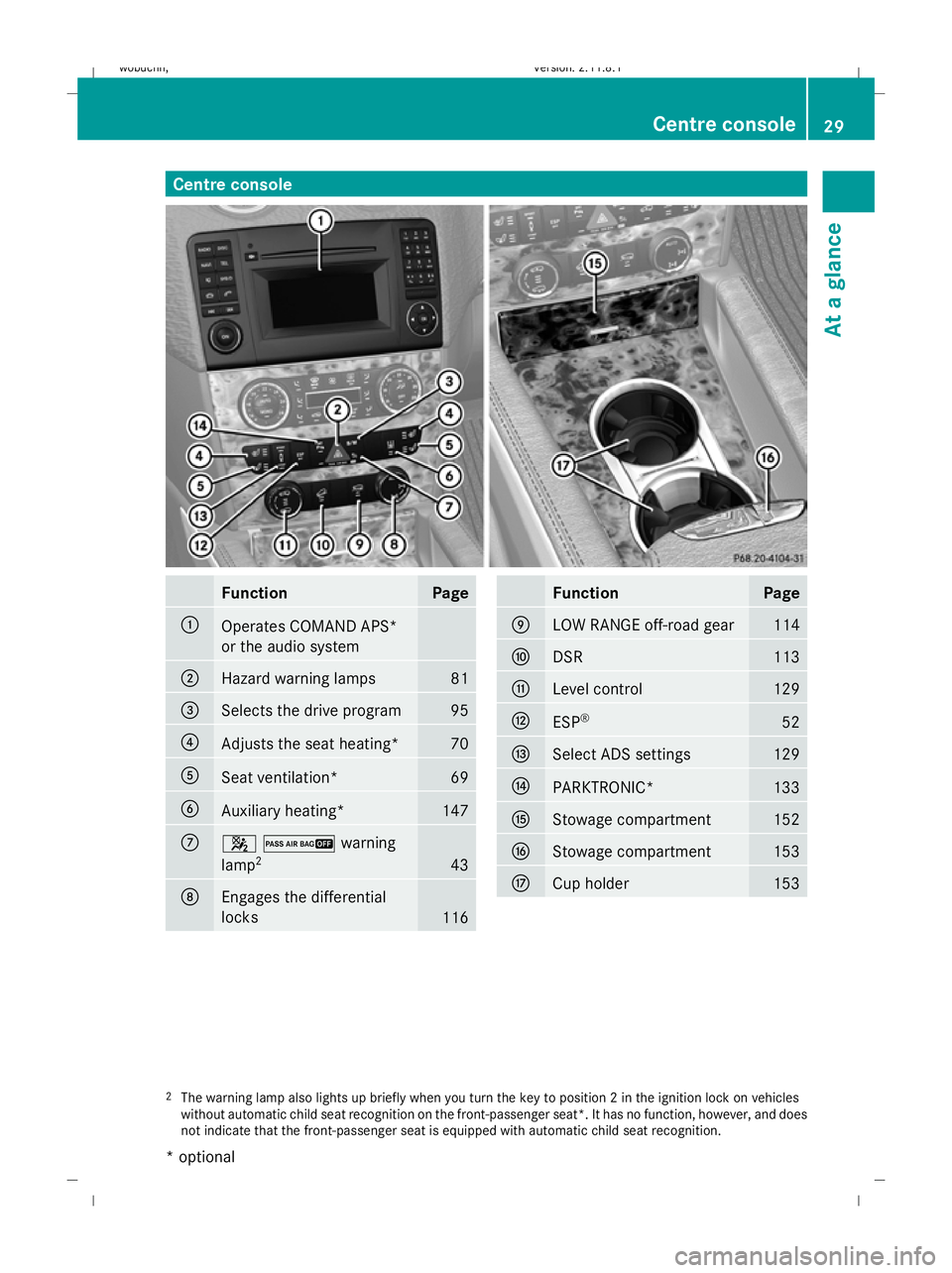
Centre console
Function Page
:
Operates COMAND APS*
or the audio system
;
Hazard warning lamps 81
=
Selects the drive program 95
?
Adjusts the seat heating* 70
A
Seat ventilation* 69
B
Auxiliary heating* 147
C
42warning
lamp
2 43
D
Engages the differential
locks
116 Function Page
E
LOW RANGE off-road gear 114
F
DSR 113
G
Level control 129
H
ESP
® 52
I
Select ADS settings 129
J
PARKTRONIC* 133
K
Stowage compartment 152
L
Stowage compartment 153
M
Cup holder 153
2
The warning lamp also lights up briefly when you turn the key to position 2 in the ignition lock on vehicles
without automatic child seat recognition on the front-passenger seat*. It has no function, however, and does
not indicate that the front-passenger seat is equipped with automatic child seat recognition. Centre console
29At a glance
* optional
X164_AKB; 2; 3, en-GB
wobuchh,
Version: 2.11.8.1 2009-03-31T14:14:58+02:00 - Seite 29 Z
Dateiname: 6515431202_buchblock.pdf; erzeugt am 01. Apr 2009 00:16:40; WK
Page 33 of 309
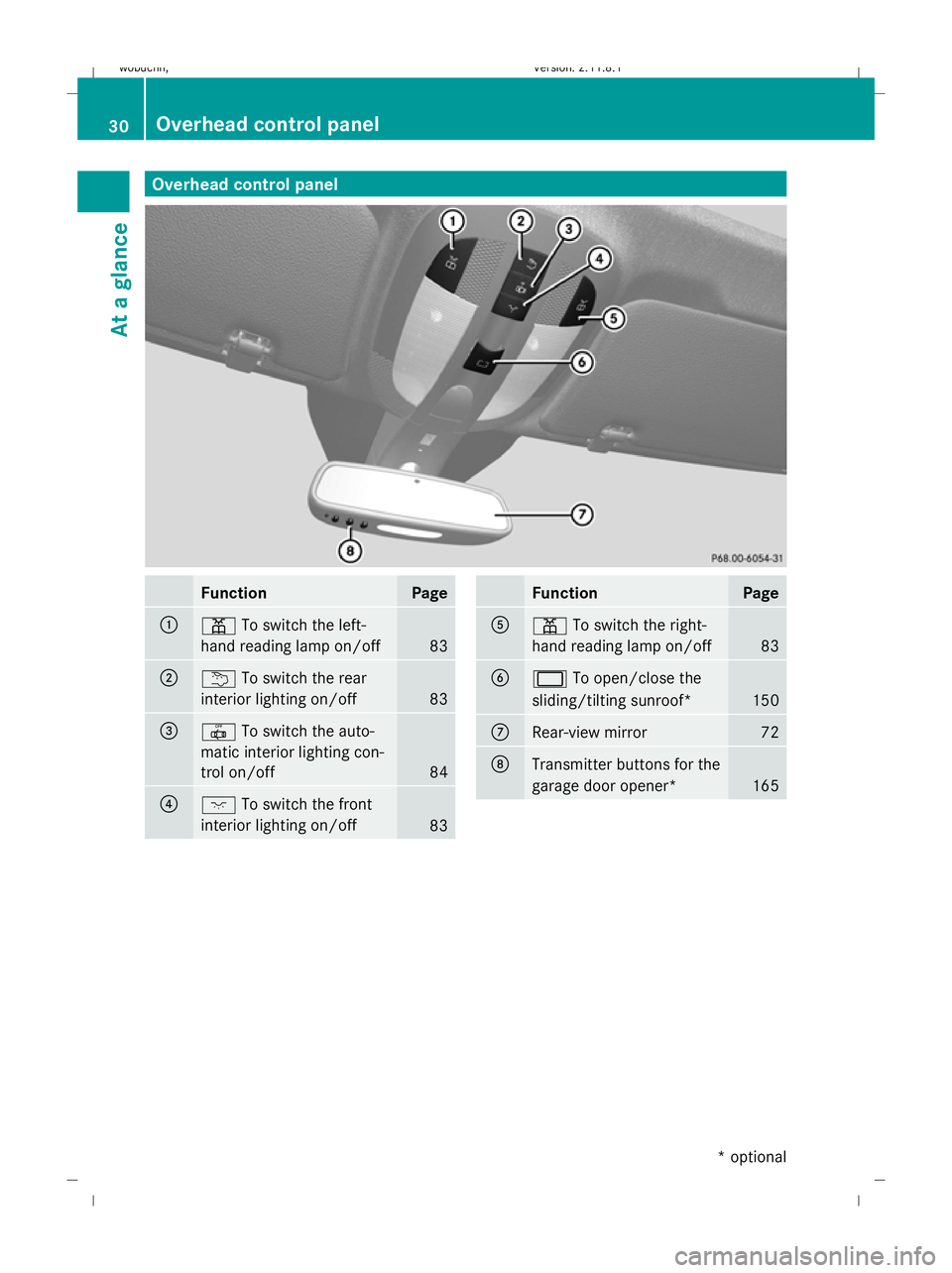
Overhead control panel
Function Page
:
p
To switch the left-
hand reading lamp on/off 83
;
u
To switch the rear
interior lighting on/off 83
=
|
To switch the auto-
matic interior lighting con-
trol on/off 84
?
c
To switch the front
interior lighting on/off 83 Function Page
A
p
To switch the right-
hand reading lamp on/off 83
B
2
To open/close the
sliding/tilting sunroof* 150
C
Rear-view mirror 72
D
Transmitter buttons for the
garage door opener*
16530
Overhead control panelAt a glance
* optional
X164_AKB; 2; 3, en-GB
wobuchh,
Version: 2.11.8.1 2009-03-31T14:14:58+02:00 - Seite 30
Dateiname: 6515431202_buchblock.pdf; erzeugt am 01. Apr 2009 00:16:41; WK
Page 38 of 309
Never tamper with electronic components
and their software.
SRS (Supplemental Restraint System)
The SRS reduces the risk of occupants com-
ing into contact with the vehicle's interior in
the event of an accident. It can also reduce
the forces to which occupants are subjected
during an accident.
The SRS consists of:
R The + warning lamp
R belt tensioners
R belt force limiters
R airbags
The + + warning lamp The SRS functions are checked regularly
when you turn on the ignition and when the
engine is running. Therefore, malfunctions
can be detected in good time.
The
+ warning lamp in the instrument
cluster lights up when the ignition is switched
on. It goes out no later than a few seconds
after the engine is started. G
Risk of injury
If SRS is malfunctioning, individual systems
may be activated unintentionally or not be
deployed in the event of an accident with
heavy braking.
A malfunction has occurred if the +warn-
ing lamp:
R does not light up when you switch on the
ignition
R does not go out after the engine has been
running for a few seconds
R lights up again once the engine is running
In this case, have SRS checked immediately
at a qualified specialist workshop. Triggering of belt tensioners, belt force
limiters and airbags In the event of a collision, the airbag control
unit evaluates important physical data such
as duration, direction and force of the vehicle
deceleration or acceleration. Based on the
evaluation of this data and in the event of lon-
gitudinal deceleration in a collision, the airbag
control unit pre-emptively triggers the belt
tensioners, depending on the rate of deceler-
ation, in the first stage.
i
The front belt tensioners can only be trig-
gered if the belt tongue is correctly
engaged in the seat belt buckle.
The front airbags are only deployed if there is
an even higher rate of vehicle deceleration in
a longitudinal direction.
Your vehicle has adaptive, dual stage front
airbags. When the first activation threshold is
reached, the front airbag is filled with enough
propellant gas to reduce the risk of injuries.
The front airbag is only fully inflated if a sec-
ond threshold is reached within a few milli-
seconds, due to the control unit having detec-
ted further deceleration.
Criteria for triggering belt tensioners and
airbags
In the first stage of a collision, the airbag con-
trol unit evaluates the duration and direction
of vehicle acceleration or deceleration in
order to determine whether it is necessary to
trigger the belt tensioner and/or airbag.
The belt tensioner and airbag triggering
thresholds are variable and are adapted to the
rate of deceleration of the vehicle. This proc-
ess is pre-emptive in nature as the airbag
must be deployed during – and not at the end
of – the collision.
i Airbags are not deployed in all types of
accidents. They are controlled by complex
sensor technology and evaluation logic.
This process is pre-emptive in nature as
airbag deployment must take place during
the impact and must be adapted to provide Occupant safety
35Safety
X164_AKB; 2; 3, en-GB
wobuchh,V ersion: 2.11.8.1
2009-03-31T14:14:58+02:00 - Seite 35 Z
Dateiname: 6515431202_buchblock.pdf; erzeugt am 01. Apr 2009 00:16:43; WK
Page 40 of 309
affect your hearing. The powder that escapes
does not generally constitute a health hazard.
The + warning lamp lights up.
i If the belt buckle tensioners have been
triggered on the front seats, the buckle will
be pulled down and will be almost flush with
the upper edge of the seat. The +warn-
ing lamp comes on. G
Risk of injury
The belt buckle tensioners on the front seats
only function if the belt buckles can be pulled
down without obstruction. They must not be
restricted in any way. For this reason, do not
hold the belt buckles and do not place any
objects under the belt buckles. Otherwise, the
tensioning of the belt by the buckle is restric-
ted or will not function and will not provide
any additional protection. G
Risk of injury
If the seat belt tensioners have been trig-
gered, they provide no additional protection
in the event of another accident. Therefore,
have belt tensioners which have been trig-
gered replaced at a qualified specialist work-
shop.
Comply with safety regulations when dispos-
ing of belt tensioners. Any Mercedes-Benz
Service Centre can provide details of these
regulations.
Airbags Airbag deployment slows down and restricts
the movement of the vehicle occupant.
If the airbags are deployed, you will hear a
bang and a small amount of powder may also
be released. Only in rare cases will the bang
affect your hearing. The powder that escapes
does not generally constitute a health hazard.
The + warning lamp lights up.
The SRS/AIRBAG identification indicates the
location of the airbags. G
Risk of injury
Airbags provide additional protection; they
are not, however, a substitute for seat belts.
Observe the following notes to reduce the risk
of serious or even fatal injury if an airbag is
deployed:
R all vehicle occupants ― in particular, preg-
nant women ― must wear their seat belt
correctly at all times and lean back against
the backrest, which should be positioned
as close to the vertical as possible. The
head restraint must support the back of the
head at about eye level.
R always secure children less than 1.50 m tall
or under 12 years of age in suitable child
restraint systems.
R all vehicle occupants must select a seat
position that is as far away from the airbag
as possible. The driver's seat position must
allow the vehicle to be driven safely. The
driver's chest should be as far away from
the middle of the driver's front airbag cover
as possible.
R move the front-passenger seat as far back
as possible, especially if a child is secured
in a child restraint system on the seat.
R vehicle occupants – in particular, children
– must not lean their head into the area of
the window in which the sidebag/window-
bag is deployed.
R rearward-facing child restraint systems
must not be fitted to the front-passenger
seat unless the front-passenger front air-
bag has been disabled. The front-passenger
front airbag of a vehicle fitted with auto-
matic child seat recognition* is only disa-
bled when a child restraint system with
automatic child seat recognition is fitted to
the front-passenger seat. The 4
PASSENGER AIRBAG OFF warning lamp
must be continuously lit.
If the front-passenger seat of your vehicle
does not have automatic child seat recog- Occupant safety
37Safety
* optional
X164_AKB; 2; 3, en-GB
wobuchh,
Version: 2.11.8.1 2009-03-31T14:14:58+02:00 - Seite 37 Z
Dateiname: 6515431202_buchblock.pdf; erzeugt am 01. Apr 2009 00:16:44; WK
Page 43 of 309
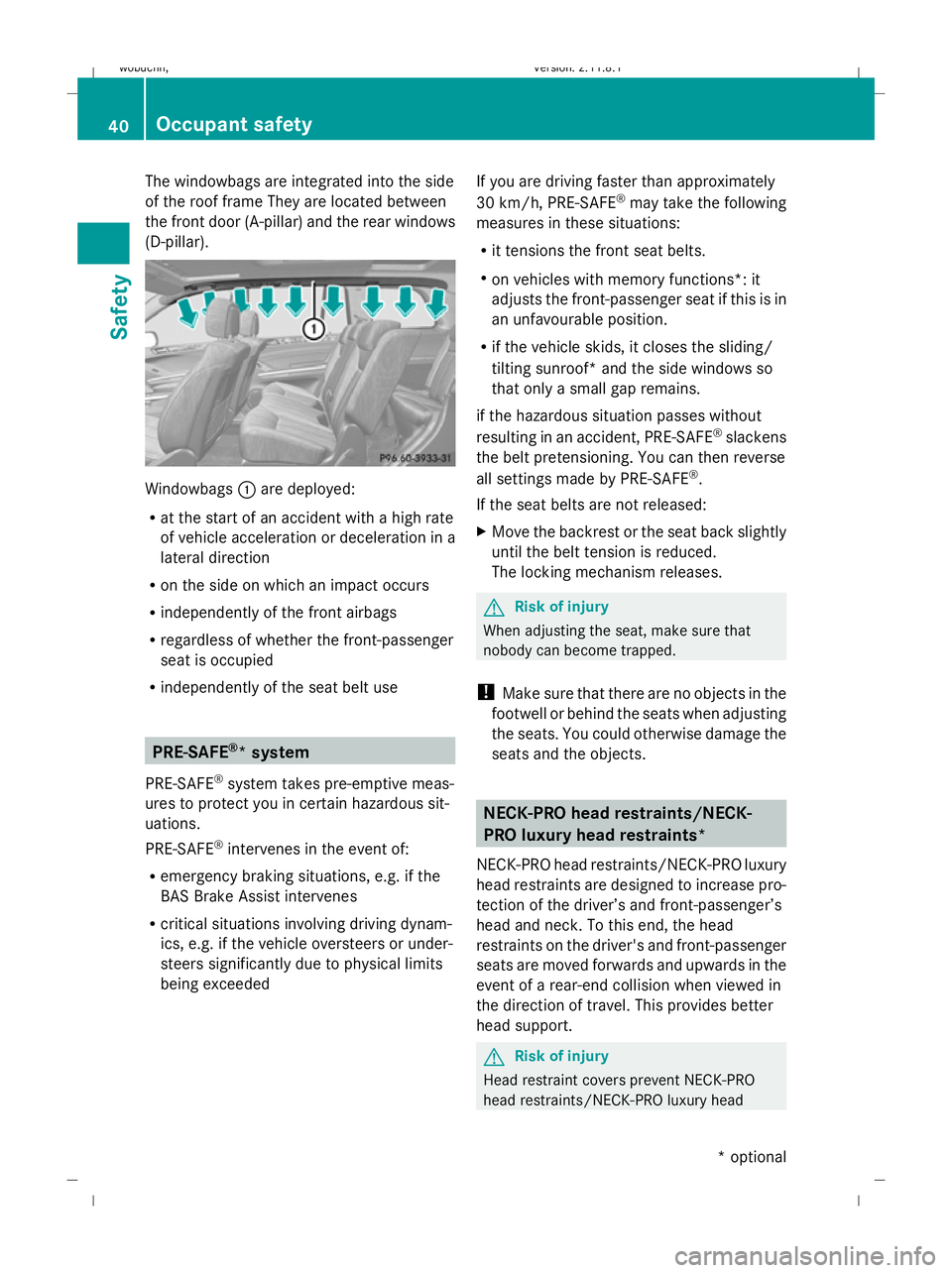
The windowbags are integrated into the side
of the roof frame They are located between
the front door (A-pillar) and the rear windows
(D-pillar). Windowbags
:are deployed:
R at the start of an accident with a high rate
of vehicle acceleration or deceleration in a
lateral direction
R on the side on which an impact occurs
R independently of the front airbags
R regardless of whether the front-passenger
seat is occupied
R independently of the seat belt use PRE-SAFE
®
* system
PRE-SAFE ®
system takes pre-emptive meas-
ures to protect you in certain hazardous sit-
uations.
PRE-SAFE ®
intervenes in the event of:
R emergency braking situations, e.g. if the
BAS Brake Assist intervenes
R critical situations involving driving dynam-
ics, e.g. if the vehicle oversteers or under-
steers significantly due to physical limits
being exceeded If you are driving faster than approximately
30 km/h,
PRE-SAFE®
may take the following
measures in these situations:
R it tensions the front seat belts.
R on vehicles with memory functions*: it
adjusts the front-passenger seat if this is in
an unfavourable position.
R if the vehicle skids, it closes the sliding/
tilting sunroof* and the side windows so
that only a small gap remains.
if the hazardous situation passes without
resulting in an accident, PRE-SAFE ®
slackens
the belt pretensioning. You can then reverse
all settings made by PRE-SAFE ®
.
If the seat belts are not released:
X Move the backrest or the seat back slightly
until the belt tension is reduced.
The locking mechanism releases. G
Risk of injury
When adjusting the seat, make sure that
nobody can become trapped.
! Make sure that there are no objects in the
footwell or behind the seats when adjusting
the seats. You could otherwise damage the
seats and the objects. NECK-PRO head restraints/NECK-
PRO luxury head restraints*
NECK-PRO head restraints/NECK-PRO luxury
head restraints are designed to increase pro-
tection of the driver’s and front-passenger’s
head and neck. To this end, the head
restraints on the driver's and front-passenger
seats are moved forwards and upwards in the
event of a rear-end collision when viewed in
the direction of travel. This provides better
head support. G
Risk of injury
Head restraint covers prevent NECK-PRO
head restraints/NECK-PRO luxury head 40
Occupant safetySafety
* optional
X164_AKB; 2; 3, en-GB
wobuchh,
Version: 2.11.8.1 2009-03-31T14:14:58+02:00 - Seite 40
Dateiname: 6515431202_buchblock.pdf; erzeugt am 01. Apr 2009 00:16:45; WK
Page 44 of 309
restraints from triggering properly. The NECK-
PRO head restraints/NECK-PRO luxury head
restraints can therefore not provide the inten-
ded protection. Do not use head restraint cov-
ers.
If NECK-PRO head restraints/NECK-PRO
luxury head restraints have been triggered in
an accident, you must reset the head
restraints on the driver’s and front-passenger
seat (Y page 252). Head restraints that have
been triggered are tilted forwards. Children in the vehicle
If a child is travelling in your vehicle, secure
the child using a child restraint system which
is appropriate to the size and age of the child
and is recommended for Mercedes-Benz
vehicles. You should fit the restraint system
to a suitable rear seat. Ensure that the child
is secured throughout the trip.
You can obtain information about the correct
child restraint system from any Mercedes-
Benz Service Centre.
i It is advisable to use Mercedes-Benz care
products to clean child restraint systems.
Information about this can be obtained
from any Mercedes-Benz Service Centre. G
Risk of injury
Do not leave children unsupervised in the
vehicle, even if they are secured in a child
restraint system. Children could injure them-
selves on parts of the vehicle. They could also
be seriously or even fatally injured by pro-
longed exposure to extreme heat or cold.
Do not expose the child restraint system to
direct sunlight. Parts of the child restraint sys-
tem could heat up and the child could burn
herself/himself on them.
If a child opens a door, the child or other per-
sons could be injured as a result. The child
could get out and be injured in the process or
be injured by a passing vehicle. G
Risk of injury
An unsecured or an incorrectly positioned
load increases the risk of injury for the child
and all other occupants, during:
R an accident
R a braking manoeuvre
R a sudden change of direction
Do not carry heavy or hard objects inside the
vehicle unless they are secured. You will find
further information under "Loading guide-
lines" in the index.
Child restraint systems Mercedes-Benz recommends that you only
use the child restraint systems listed on
(Y
page 46). G
Risk of injury
To reduce the risk of serious or even fatal
injury to the child in the event of a sudden
change in direction, braking or an accident:
R children less than 1.50 m tall and under
twelve years of age must always be secured
in special child restraint systems on a suit-
able vehicle seat. This is necessary
because the seat belts are not designed for
children of this size.
R do not secure children less than 1.50 m tall
or under twelve years of age on the front-
passenger seat. Exception: the child is
secured in a vehicle with automatic child
seat recognition on the front-passenger
seat* and is secured in a child restraint
system with automatic child seat recogni-
tion.
R if you secure a forward-facing child
restraint system to the front-passenger
seat, you must move the front-passenger
seat as far back as possible.
R children must never travel sitting on the lap
of another occupant. Due to the forces
occurring in the event of a sudden change
of direction, heavy braking or an accident, Occupant safety
41Safety
* optional
X164_AKB; 2; 3, en-GB
wobuchh,
Version: 2.11.8.1 2009-03-31T14:14:58+02:00 - Seite 41 Z
Dateiname: 6515431202_buchblock.pdf; erzeugt am 01. Apr 2009 00:16:45; WK