tailgate MERCEDES-BENZ GL SUV 2009 Owner's Manual
[x] Cancel search | Manufacturer: MERCEDES-BENZ, Model Year: 2009, Model line: GL SUV, Model: MERCEDES-BENZ GL SUV 2009Pages: 309, PDF Size: 10.27 MB
Page 222 of 309
Display messages
Possible causes/consequences and
X
X Solutions Cruise
control - - - km/h A condition for activating cruise control has not been met.
X
Activate ESP ®
(Y page 52)
X If conditions permit, drive faster than 30 km/h and store
the speed (Y page 117). Symbol messages
G
Risk of accident and injury
The operating safety of your vehicle could be compromised if service work is carried out improp-
erly. You could lose control of the vehicle and cause an accident. Safety systems may also not
be able to protect you or others as intended.
Always have maintenance work carried out at a qualified specialist workshop. The workshop must
have the necessary specialist knowledge and tools to carry out the work required. Mercedes-
Benz recommends that you use a Mercedes-Benz Service Centre for this purpose. In particular,
work relevant to safety or on safety-related systems must be carried out at a qualified specialist
workshop. Display messages
Possible causes/consequences and
X
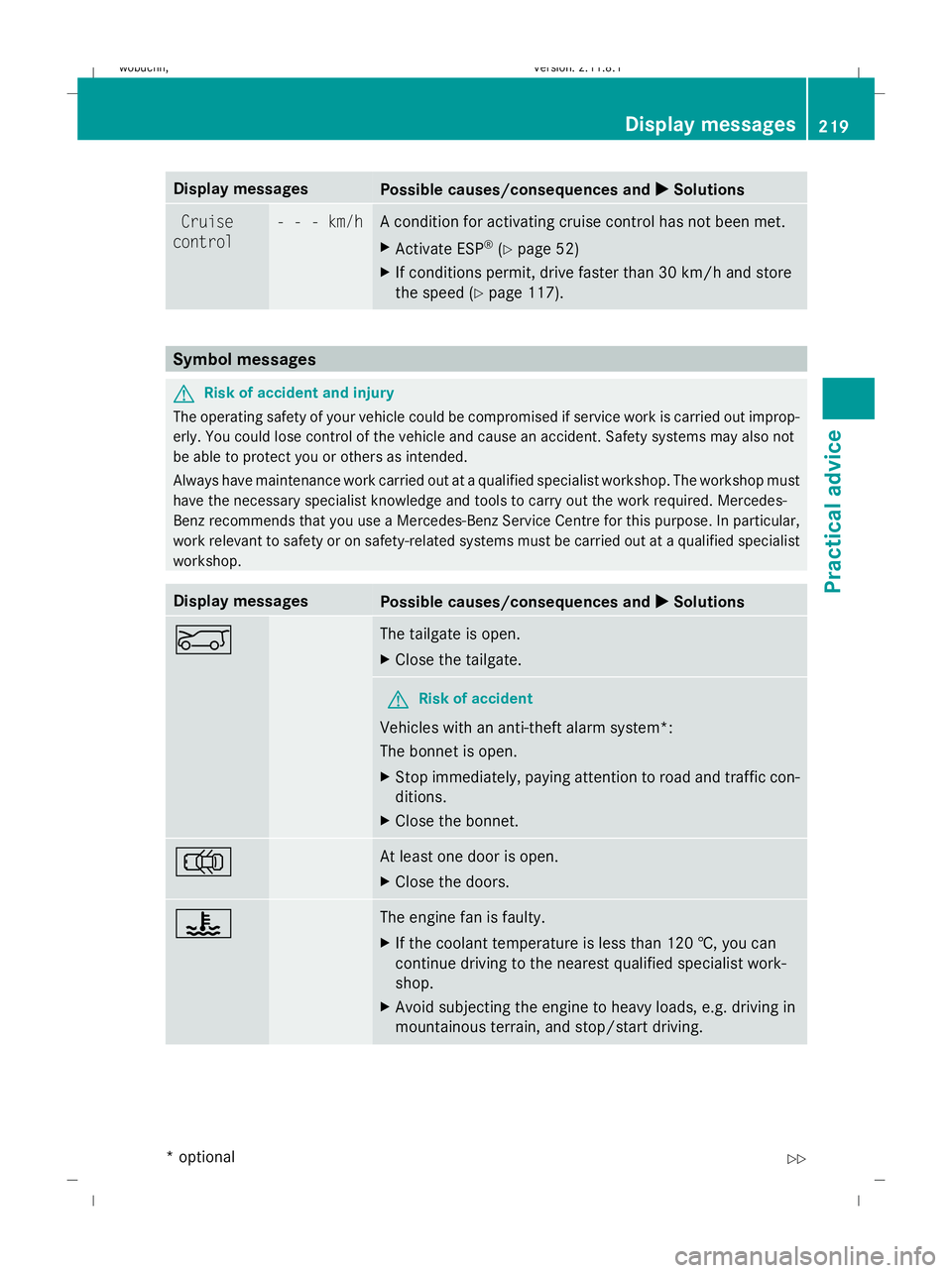
X Solutions E The tailgate is open.
X
Close the tailgate. G
Risk of accident
Vehicles with an anti-theft alarm system*:
The bonnet is open.
X Stop immediately, paying attention to road and traffic con-
ditions.
X Close the bonnet. ; At least one door is open.
X
Close the doors. ? The engine fan is faulty.
X
If the coolant temperature is less than 120 †, you can
continue driving to the nearest qualified specialist work-
shop.
X Avoid subjecting the engine to heavy loads, e.g. driving in
mountainous terrain, and stop/start driving. Display
messages
219Practical advice
* optional
X164_AKB; 2; 3, en-GB
wobuchh
,V ersion: 2.11.8.1
2009-03-31T14:14:58+02:00 - Seite 219 Z
Dateiname: 6515431202_buchblock.pdf; erzeugt am 01. Apr 2009 00:17:59; WK
Page 244 of 309
Fuel and fuel tank
Problem
Possible causes/consequences and
X
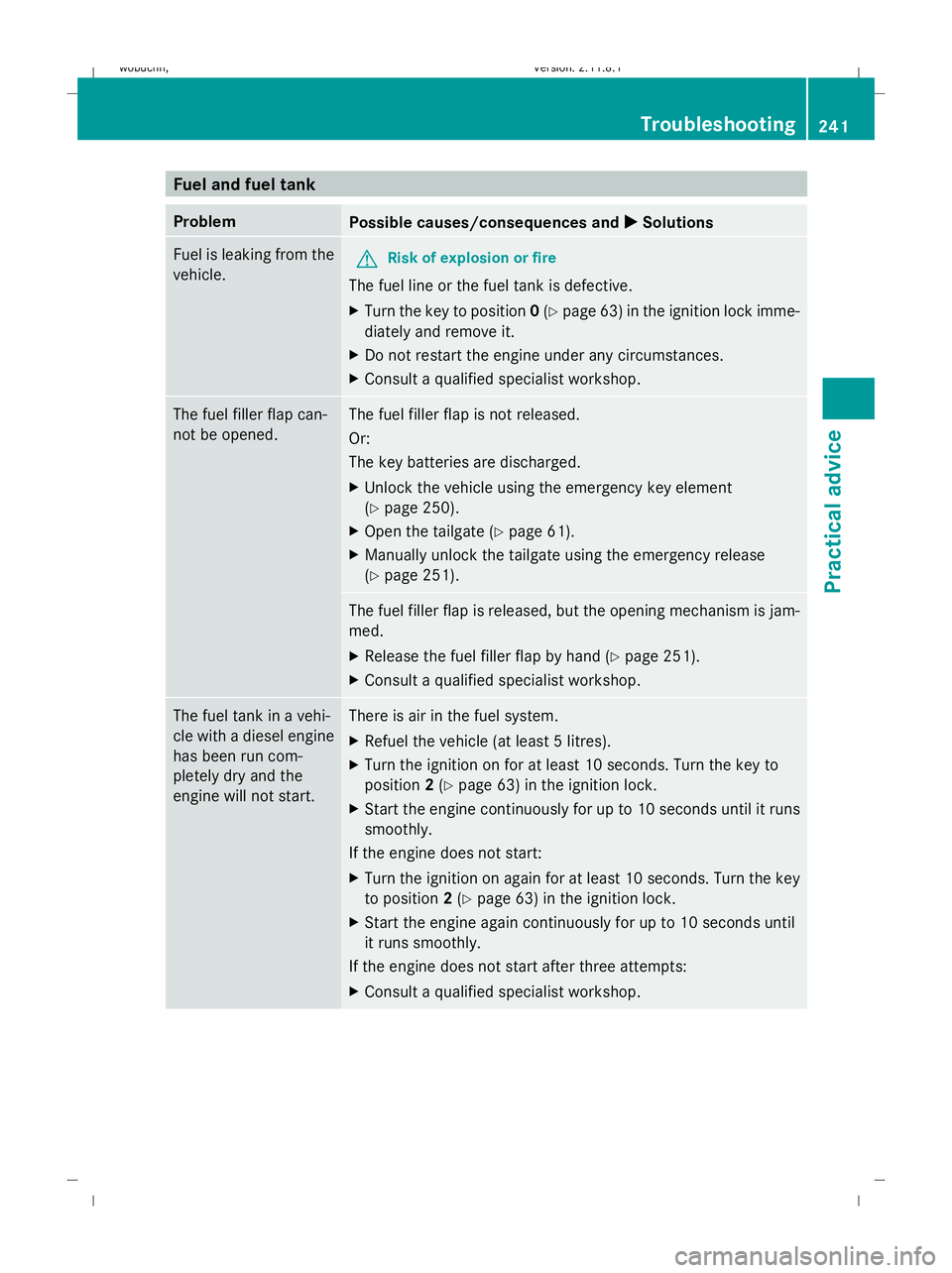
X Solutions Fuel is leaking from the
vehicle.
G
Risk of explosion or fire
The fuel line or the fuel tank is defective.
X Turn the key to position 0(Y page 63 )in the ignition lock imme-
diately and remove it.
X Do not restart the engine under any circumstances.
X Consult a qualified specialist workshop. The fuel filler flap can-
not be opened. The fuel filler flap is not released.
Or:
The key batteries are discharged.
X Unlock the vehicle using the emergency key element
(Y page 250).
X Open the tailgate (Y page 61).
X Manually unlock the tailgate using the emergency release
(Y page 251). The fuel filler flap is released, but the opening mechanism is jam-
med.
X
Release the fuel filler flap by hand (Y page 251).
X Consult a qualified specialist workshop. The fuel tank in a vehi-
cle with a diesel engine
has been run com-
pletely dry and the
engine will not start. There is air in the fuel system.
X
Refuel the vehicle (at least 5 litres).
X Turn the ignition on for at least 10 seconds. Turn the key to
position 2(Y page 63) in the ignition lock.
X Start the engine continuously for up to 10 seconds until it runs
smoothly.
If the engine does not start:
X Turn the ignition on again for at least 10 seconds. Turn the key
to position 2(Y page 63) in the ignition lock.
X Start the engine again continuously for up to 10 seconds until
it runs smoothly.
If the engine does not start after three attempts:
X Consult a qualified specialist workshop. Troubleshooting
241Practical advice
X164_AKB; 2; 3, en-GB
wobuchh,V ersion: 2.11.8.1
2009-03-31T14:14:58+02:00 - Seite 241 Z
Dateiname: 6515431202_buchblock.pdf; erzeugt am 01. Apr 2009 00:18:02; WK
Page 254 of 309
The door is unlocked.
X Turn the emergency key element back and
remove it.
X Pull the door handle again. Locking the vehicle
If the vehicle can no longer be unlocked cen-
trally with the key or KEYLESS GO*:
X Close the front-passenger door, the rear
door on the front-passenger side and the
tailgate.
X Open the driver’s door and the rear door on
the driver’s side.
X Press the locking button on the driver’s
door (Y page 59).
The locking knobs in the front-passenger
door and in the rear doors drop down.
X Press the locking knobs in the front-
passenger door and in the rear doors down
manually, if necessary.
X Close the driver's door from the outside.
X Press down the locking knob of the driver's
door by reaching in through the open rear
door.
i Make sure that you have the vehicle key
on your person and that it is not left in the
vehicle.
X Close the rear door on the driver’s side.
X Check whether the doors and the tailgate
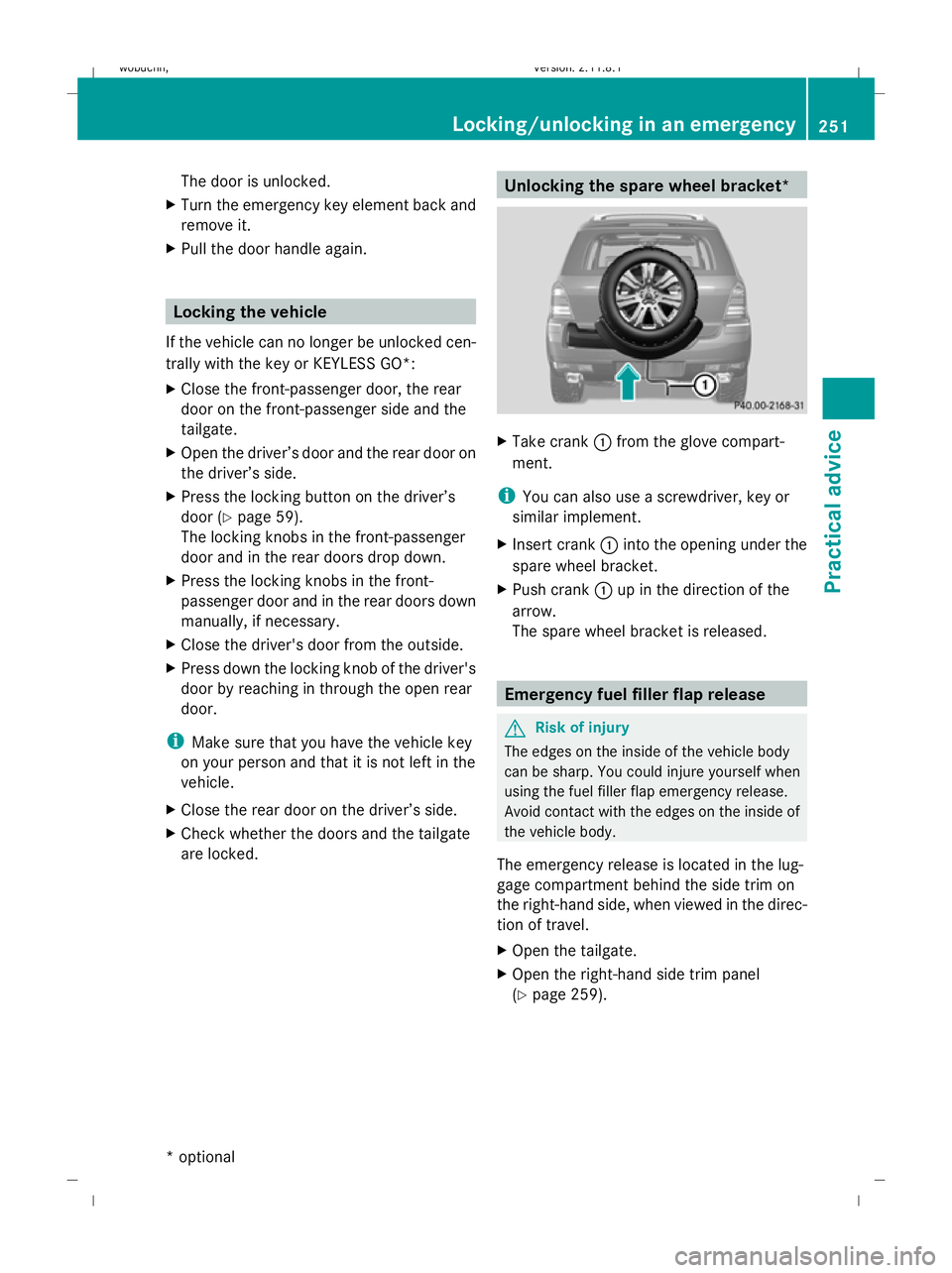
are locked. Unlocking the spare wheel bracket*
X
Take crank :from the glove compart-
ment.
i You can also use a screwdriver, key or
similar implement.
X Insert crank :into the opening under the
spare wheel bracket.
X Push crank :up in the direction of the
arrow.
The spare wheel bracket is released. Emergency fuel filler flap release
G
Risk of injury
The edges on the inside of the vehicle body
can be sharp. You could injure yourself when
using the fuel filler flap emergency release.
Avoid contact with the edges on the inside of
the vehicle body.
The emergency release is located in the lug-
gage compartment behind the side trim on
the right-hand side, when viewed in the direc-
tion of travel.
X Open the tailgate.
X Open the right-hand side trim panel
(Y page 259). Locking/unlocking in an emergency
251Practical advice
* optional
X164_AKB; 2; 3, en-GB
wobuchh,
Version: 2.11.8.1 2009-03-31T14:14:58+02:00 - Seite 251 Z
Dateiname: 6515431202_buchblock.pdf; erzeugt am 01. Apr 2009 00:18:03; WK
Page 264 of 309
X
Switch off the lights.
X Open the tailgate.
X Remove screws :.
X Remove licence plate lamp.
X Replace the bulb.
X Insert licence plate lamp.
X Replace and tighten screws :.Replacing the wiper blades
Windscreen wiper blades
G
Risk of accident
The windscreen will no longer be wiped prop-
erly if the wiper blades are worn. This could
prevent you from observing the traffic condi-
tions, thereby causing an accident. Replace
the wiper blades twice a year, ideally in spring
and autumn. G
Risk of accident
The wiper arms could start moving and cause
an injury if you leave the windscreen wipers
switched on.
Remove the key from the ignition lock before
replacing the wiper blades.
! To avoid damaging the windscreen wiper
blades, make sure that you touch only the
wiper arm of the windscreen wiper.
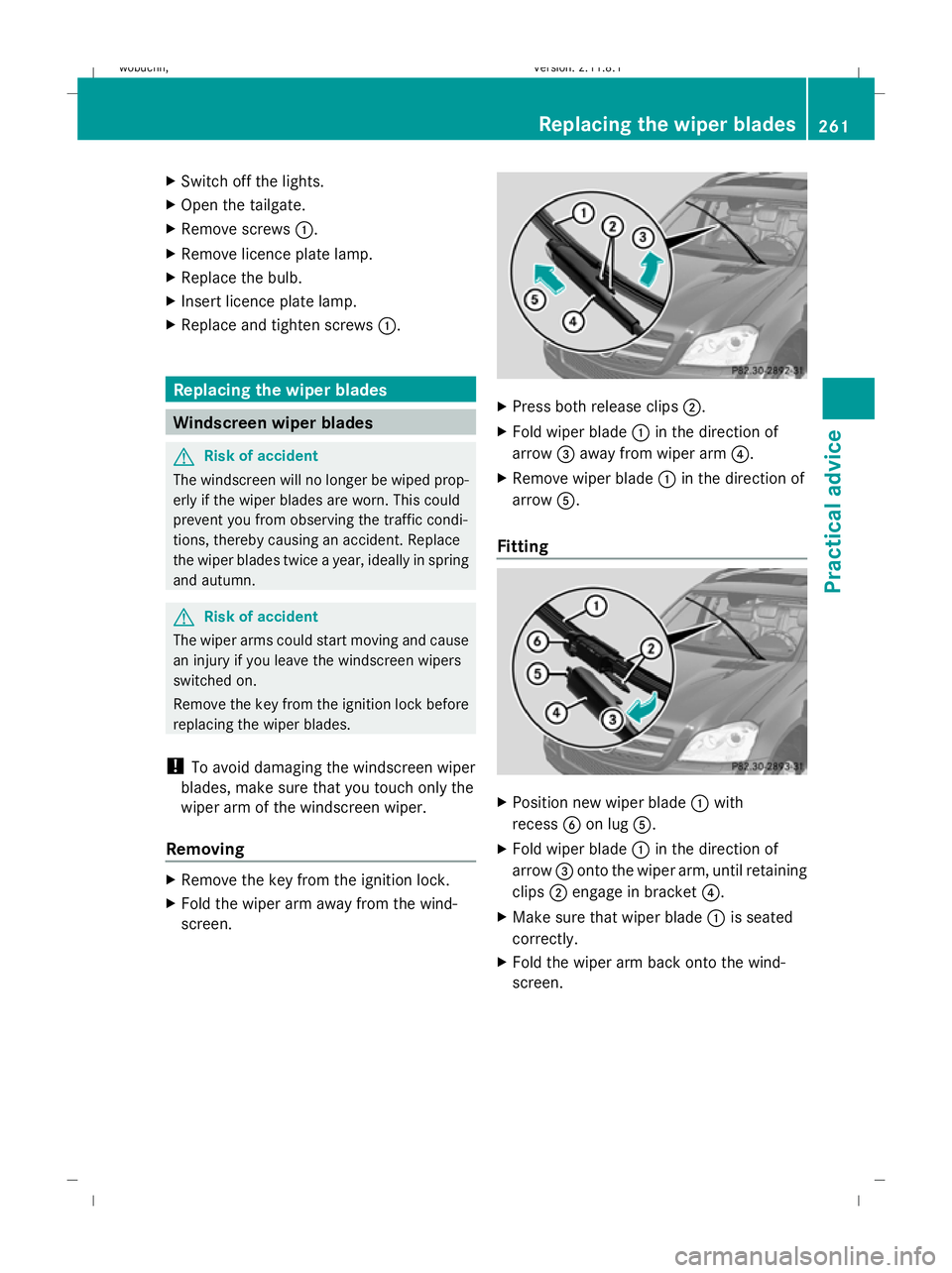
Removing X
Remove the key from the ignition lock.
X Fold the wiper arm away from the wind-
screen. X
Press both release clips ;.
X Fold wiper blade :in the direction of
arrow =away from wiper arm ?.
X Remove wiper blade :in the direction of
arrow A.
Fitting X
Position new wiper blade :with
recess Bon lug A.
X Fold wiper blade :in the direction of
arrow =onto the wiper arm, until retaining
clips ;engage in bracket ?.
X Make sure that wiper blade :is seated
correctly.
X Fold the wiper arm back onto the wind-
screen. Replacing the wiper blades
261Practical advice
X164_AKB; 2; 3, en-GB
wobuchh, Version: 2.11.8.1 2009-03-31T14:14:58+02:00 - Seite 261 Z
Dateiname: 6515431202_buchblock.pdf; erzeugt am 01. Apr 2009 00:18:08; WK
Page 272 of 309
X
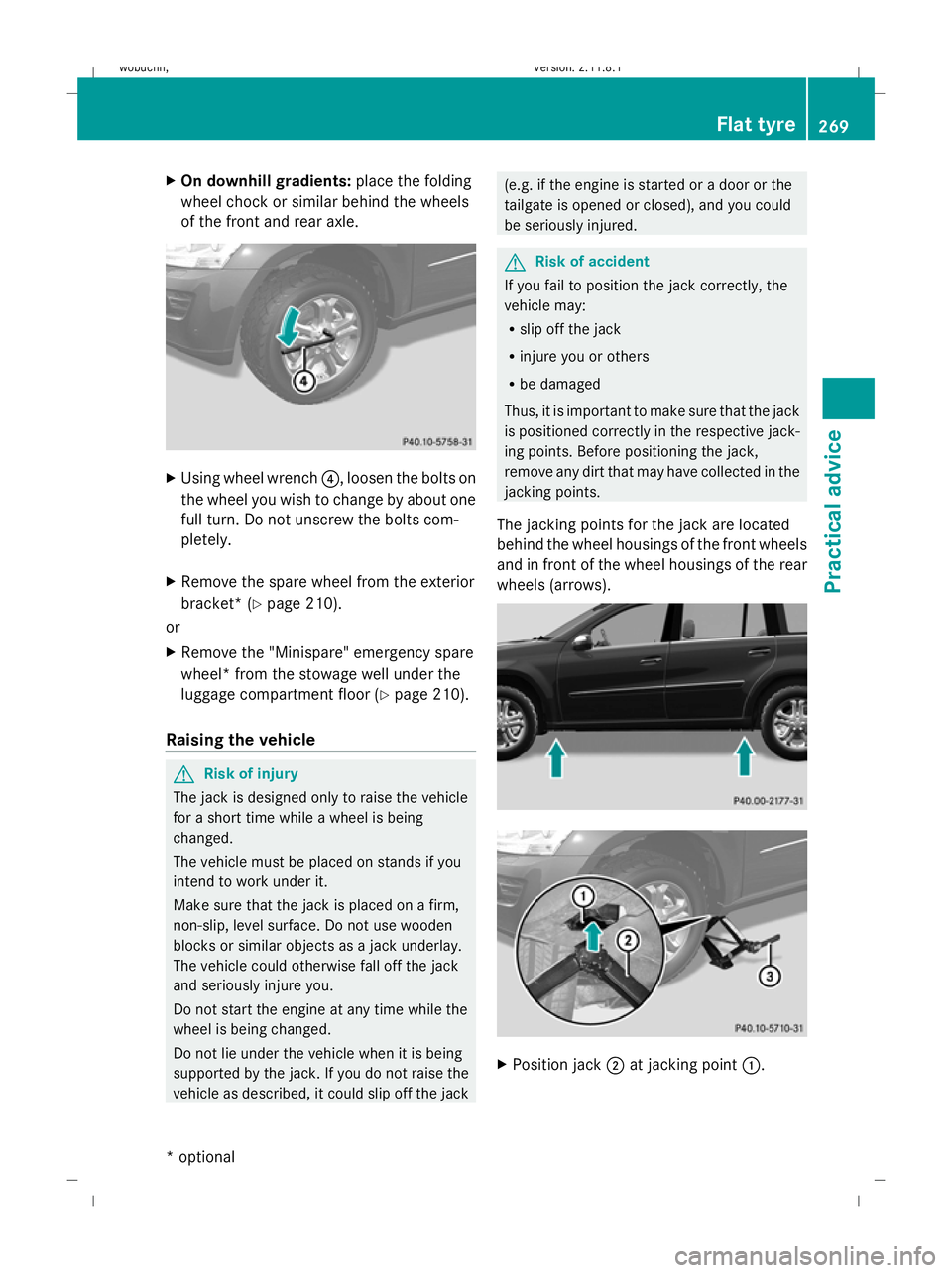
On downhill gradients: place the folding
wheel chock or similar behind the wheels
of the front and rear axle. X
Using wheel wrench ?, loosen the bolts on
the wheel you wish to change by about one
full turn. Do not unscrew the bolts com-
pletely.
X Remove the spare wheel from the exterior
bracket* (Y page 210).
or
X Remove the "Minispare" emergency spare
wheel* from the stowage well under the
luggage compartment floor (Y page 210).
Raising the vehicle G
Risk of injury
The jack is designed only to raise the vehicle
for a short time while a wheel is being
changed.
The vehicle must be placed on stands if you
intend to work under it.
Make sure that the jack is placed on a firm,
non-slip, level surface. Do not use wooden
blocks or similar objects as a jack underlay.
The vehicle could otherwise fall off the jack
and seriously injure you.
Do not start the engine at any time while the
wheel is being changed.
Do not lie under the vehicle when it is being
supported by the jack. If you do not raise the
vehicle as described, it could slip off the jack (e.g. if the engine is started or a door or the
tailgate is opened or closed), and you could
be seriously injured.
G
Risk of accident
If you fail to position the jack correctly, the
vehicle may:
R slip off the jack
R injure you or others
R be damaged
Thus, it is important to make sure that the jack
is positioned correctly in the respective jack-
ing points. Before positioning the jack,
remove any dirt that may have collected in the
jacking points.
The jacking points for the jack are located
behind the wheel housings of the front wheels
and in front of the wheel housings of the rear
wheels (arrows). X
Position jack ;at jacking point :. Flat tyre
269Practical advice
* optional
X164_AKB; 2; 3, en-GB
wobuchh,
Version: 2.11.8.1 2009-03-31T14:14:58+02:00 - Seite 269 Z
Dateiname: 6515431202_buchblock.pdf; erzeugt am 01. Apr 2009 00:18:12; WK
Page 284 of 309
Before changing a fuse
X Park the vehicle.
X Switch off all electrical consumers.
X Remove the key from the ignition lock. Dashboard fuse boxes
!
Do not use a pointed object such as a
screwdriver to open the cover in the dash-
board. You could damage the dashboard or
the cover.
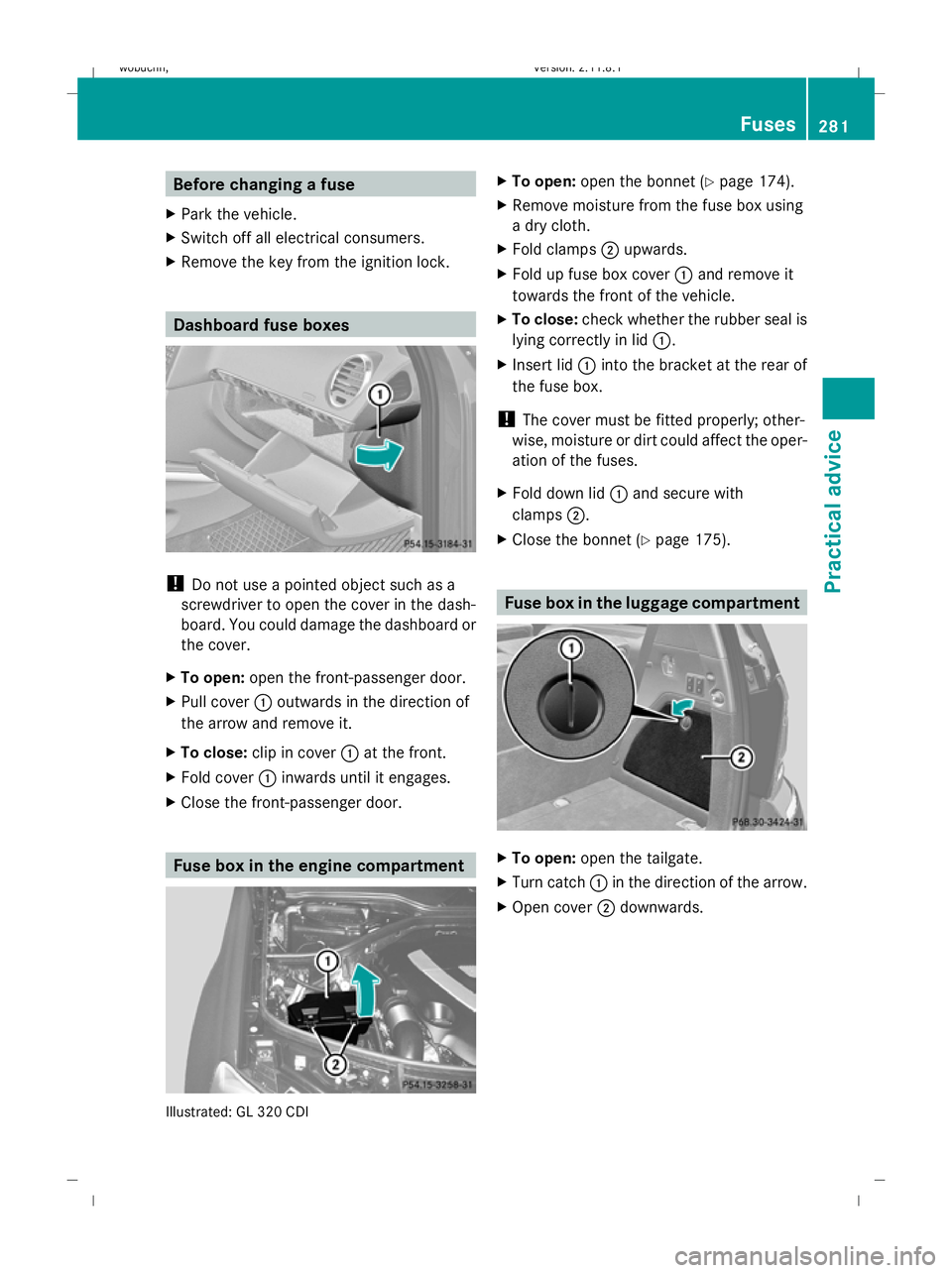
X To open: open the front-passenger door.
X Pull cover :outwards in the direction of
the arrow and remove it.
X To close: clip in cover :at the front.
X Fold cover :inwards until it engages.
X Close the front-passenger door. Fuse box in the engine compartment
Illustrated: GL 320 CDI X
To open: open the bonnet (Y page 174).
X Remove moisture from the fuse box using
a dry cloth.
X Fold clamps ;upwards.
X Fold up fuse box cover :and remove it
towards the front of the vehicle.
X To close: check whether the rubber seal is
lying correctly in lid :.
X Insert lid :into the bracket at the rear of
the fuse box.
! The cover must be fitted properly; other-
wise, moisture or dirt could affect the oper-
ation of the fuses.
X Fold down lid :and secure with
clamps ;.
X Close the bonnet (Y page 175). Fuse box in the luggage compartment
X
To open: open the tailgate.
X Turn catch :in the direction of the arrow.
X Open cover ;downwards. Fuses
281Practical advice
X164_AKB; 2; 3, en-GB
wobuchh, Version: 2.11.8.1 2009-03-31T14:14:58+02:00 - Seite 281 Z
Dateiname: 6515431202_buchblock.pdf; erzeugt am 01. Apr 2009 00:18:21; WK
Page 286 of 309
Notes on the technical data
.............284
Genuine Mercedes-Benz parts .........284
Vehicle electronics ...........................284
Vehicle identification plates ............286
Service products and capacities .....287
Vehicle data, GL 450 4MATIC ..........292
Vehicle data, GL 500 4MATIC ..........292
Vehicle data, GL 350 CDI 4MATIC
BlueEFFICIENCY ................................ 293
Vehicle data, GL 350 BlueTEC .........293
Vehicle data, GL 450 CDI 4MATIC ...294
Tailgate opening dimensions ...........295
Tyres and wheels .............................. 295
Trailer coupling* ............................... 297
Frequencies for garage door open-
ers* .................................................... 298 283Technical data
X164_AKB; 2; 3, en-GB
wobuchh,
Version: 2.11.8.1 2009-03-31T14:14:58+02:00 - Seite 283
Dateiname: 6515431202_buchblock.pdf; erzeugt am 01. Apr 2009 00:18:22; WK
Page 298 of 309
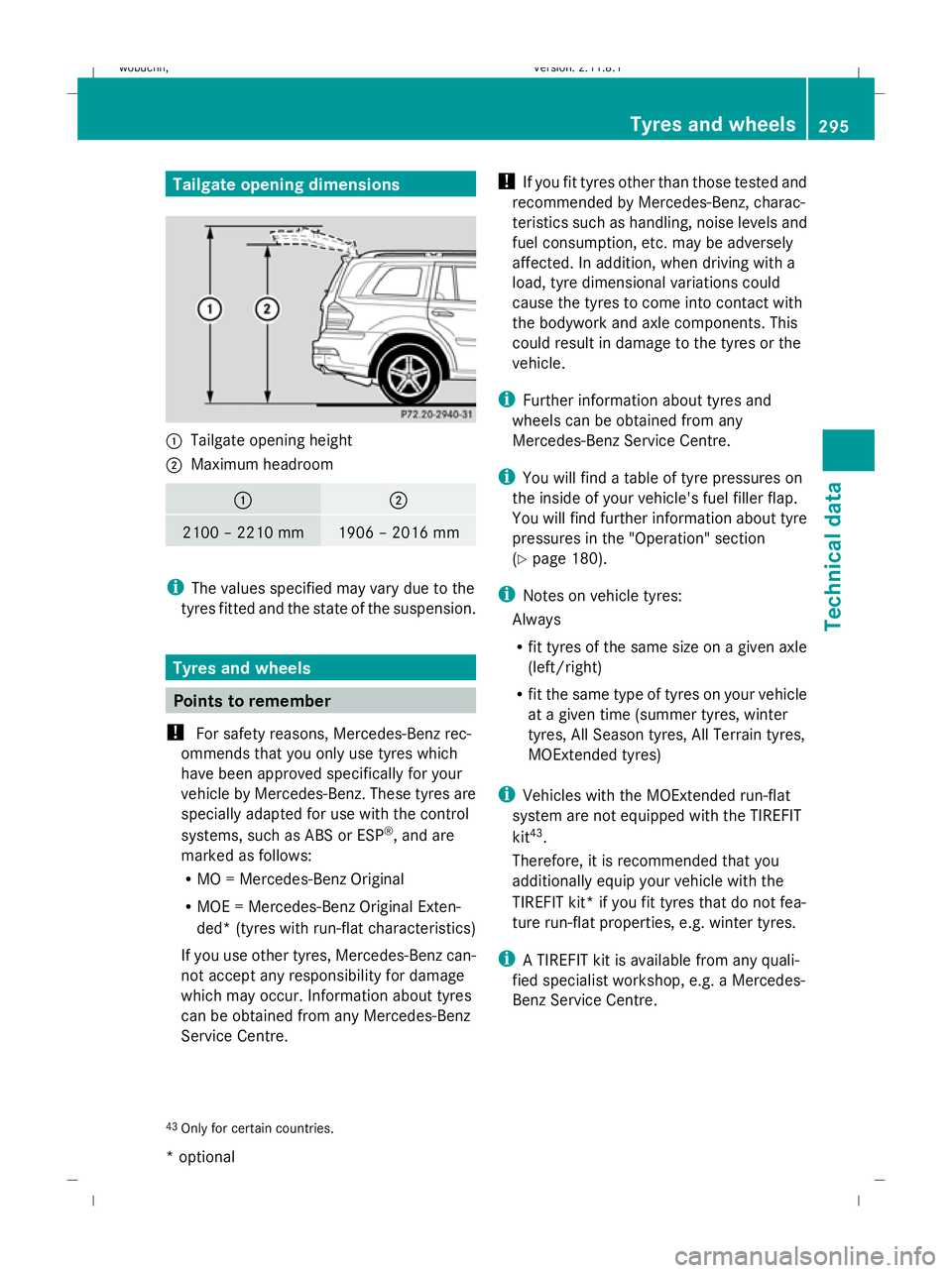
Tailgate opening dimensions
:
Tailgate opening height
; Maximum headroom : ;
2100 – 2210 mm 1906 – 2016 mm
i
The values specified may vary due to the
tyres fitted and the state of the suspension. Tyres and wheels
Points to remember
! For safety reasons, Mercedes-Benz rec-
ommends that you only use tyres which
have been approved specifically for your
vehicle by Mercedes-Benz. These tyres are
specially adapted for use with the control
systems, such as ABS or ESP ®
, and are
marked as follows:
R MO = Mercedes-Benz Original
R MOE = Mercedes-Benz Original Exten-
ded* (tyres with run-flat characteristics)
If you use other tyres, Mercedes-Benz can-
not accept any responsibility for damage
which may occur. Information about tyres
can be obtained from any Mercedes-Benz
Service Centre. !
If you fit tyres other than those tested and
recommended by Mercedes-Benz, charac-
teristics such as handling, noise levels and
fuel consumption, etc. may be adversely
affected. In addition, when driving with a
load, tyre dimensional variations could
cause the tyres to come into contact with
the bodywork and axle components. This
could result in damage to the tyres or the
vehicle.
i Further information about tyres and
wheels can be obtained from any
Mercedes-Benz Service Centre.
i You will find a table of tyre pressures on
the inside of your vehicle's fuel filler flap.
You will find further information about tyre
pressures in the "Operation" section
(Y page 180).
i Notes on vehicle tyres:
Always
R fit tyres of the same size on a given axle
(left/right)
R fit the same type of tyres on your vehicle
at a given time (summer tyres, winter
tyres, All Season tyres, All Terrain tyres,
MOExtended tyres)
i Vehicles with the MOExtended run-flat
system are not equipped with the TIREFIT
kit 43
.
Therefore, it is recommended that you
additionally equip your vehicle with the
TIREFIT kit* if you fit tyres that do not fea-
ture run-flat properties, e.g. winter tyres.
i A TIREFIT kit is available from any quali-
fied specialist workshop, e.g. a Mercedes-
Benz Service Centre.
43 Only for certain countries. Tyres and
wheels
295Technical da ta
* optional
X164_AKB; 2; 3, en-GB
wobuchh
,V ersion: 2.11.8.1
2009-03-31T14:14:58+02:00 - Seite 295 Z
Dateiname: 6515431202_buchblock.pdf; erzeugt am 01. Apr 2009 00:18:26; WK