light MERCEDES-BENZ GL SUV 2012 User Guide
[x] Cancel search | Manufacturer: MERCEDES-BENZ, Model Year: 2012, Model line: GL SUV, Model: MERCEDES-BENZ GL SUV 2012Pages: 441, PDF Size: 10.66 MB
Page 33 of 441
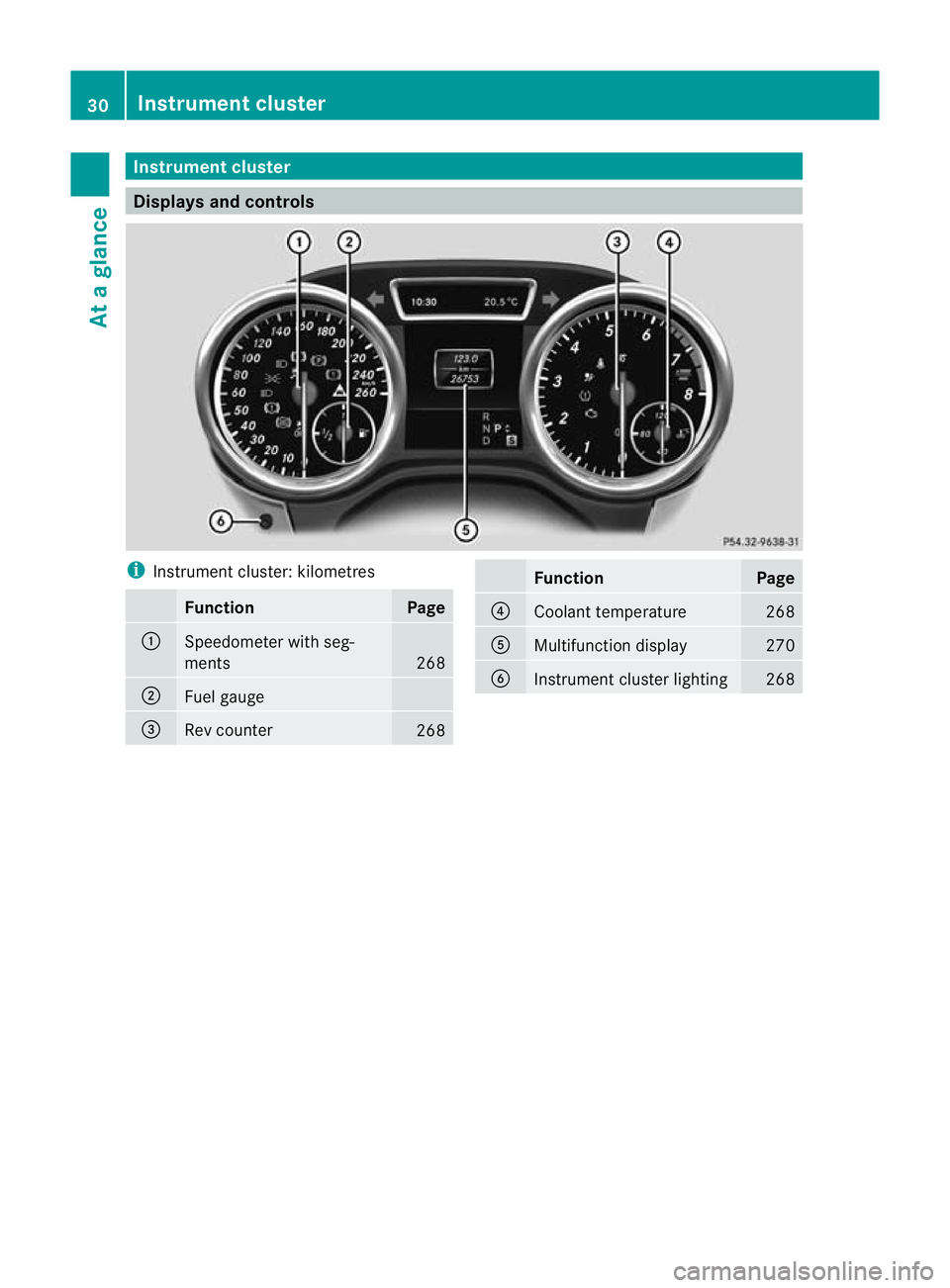
Instrument cluster
Displa
ysand controls i
Instrumen tcluster: kilometres Function Page
:
Speedometer with seg-
ments
268
;
Fuel gauge
=
Rev counter
268 Function Page
?
Coolant temperature 268
A
Multifunction display 270
B
Instrument cluster lighting 26830
Instrument clusterAt
ag lance
Page 34 of 441
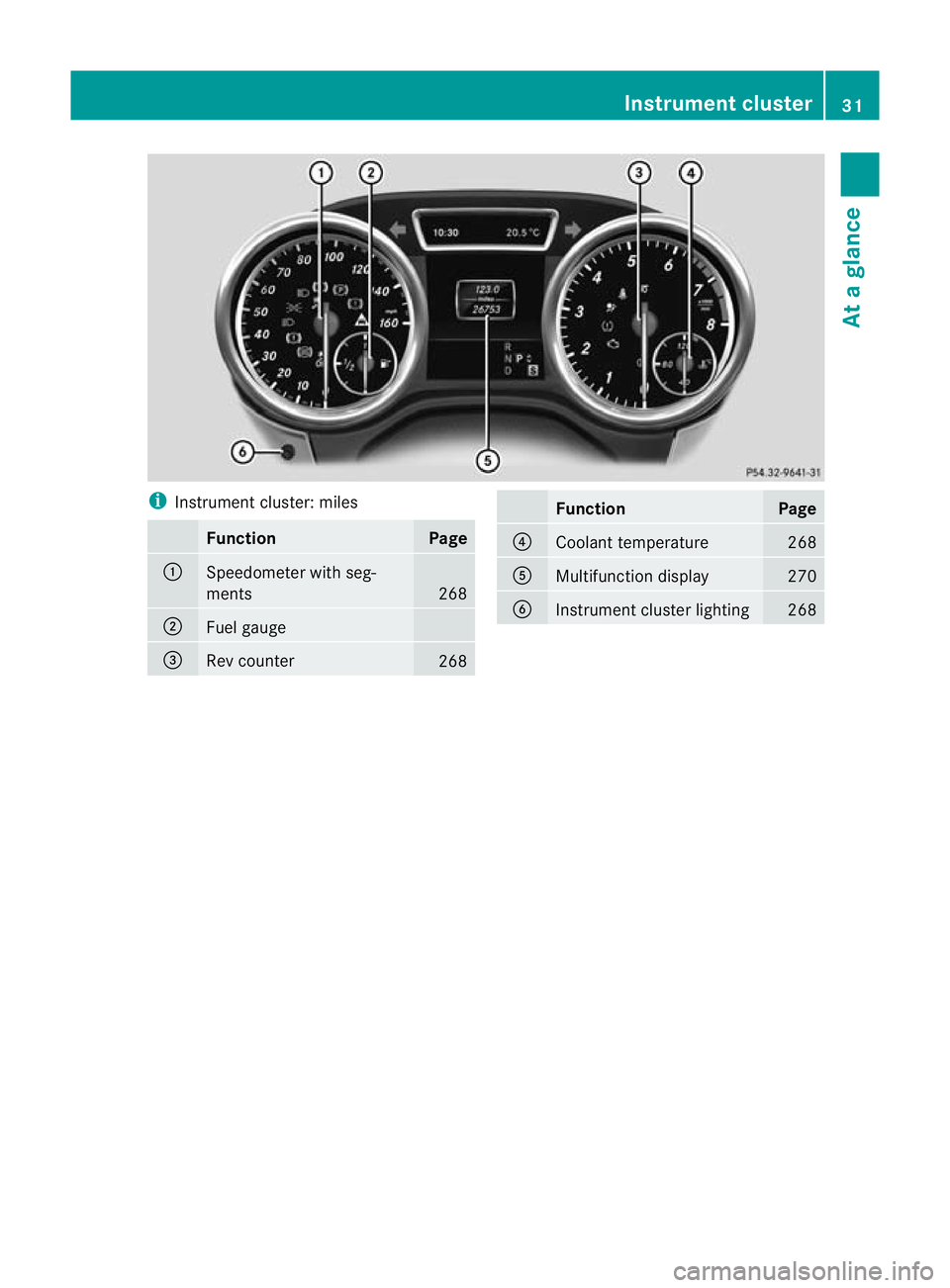
i
Instrument cluster: miles Fun
ction Page
:
Speedometer with seg-
ments
268
;
Fuel gauge
=
Rev counter
268 Function Page
?
Coo
lant temperature 268
A
Multifunction dis
play 270
B
Instrument cluster lighting 268Instrument cluster
31Atag lance
Page 38 of 441
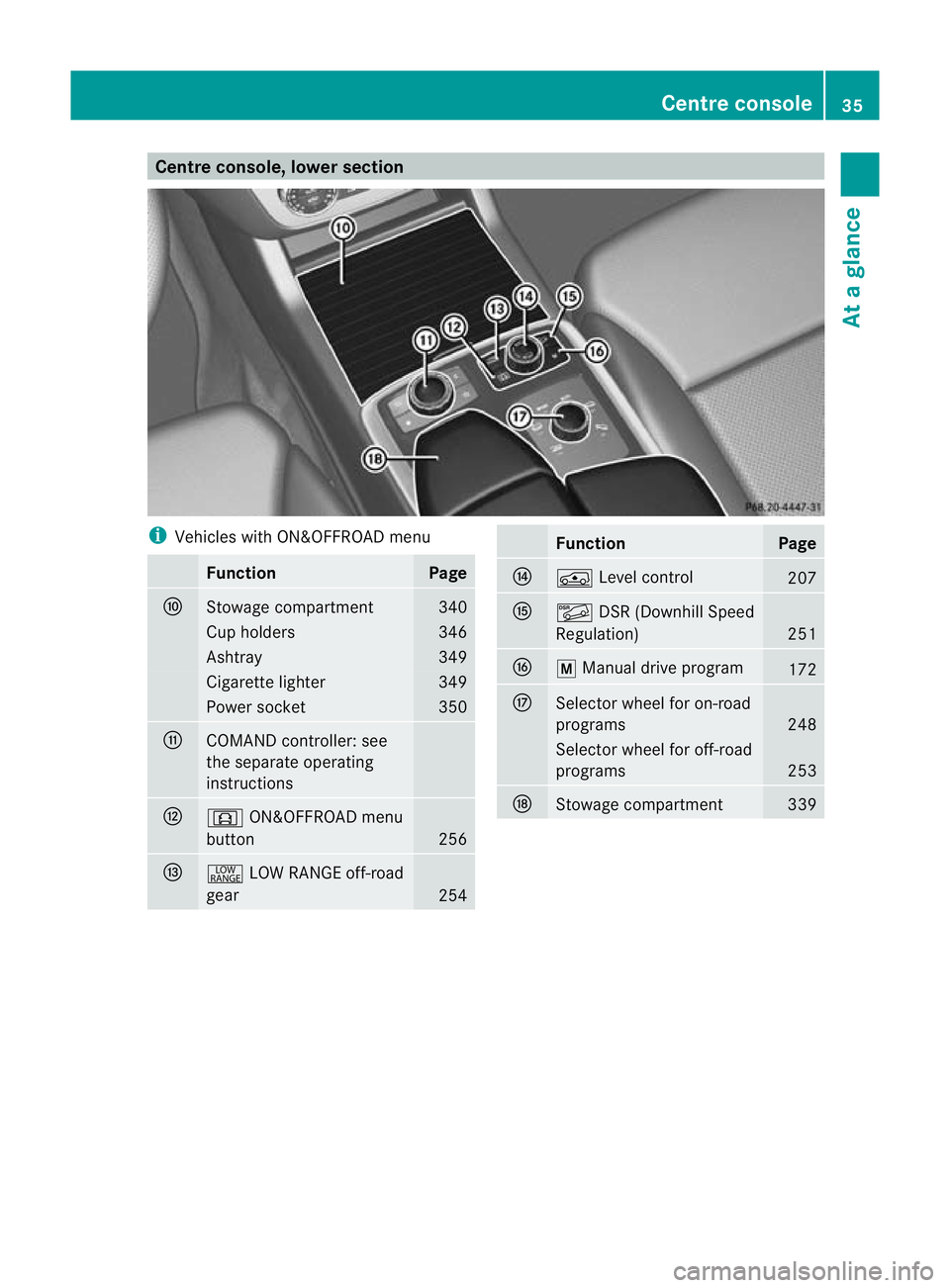
Centre console, lower section
i
Vehicle swithO N&OFFROAD menu Function Page
F
Stowag
ecompartment 340
Cu
ph olders 346
Ashtray 349
Cigar
ettelighter 349
Power socket 350
G
COMAND controller: see
th
es eparate operating
instructions H
d
ON&OFFROAD menu
button 256
I
+
LOW RANGE off-road
gear 254 Func
tion Page
J
Á
Level control 207
K
Ã
DSR(Do wnhill Speed
Regulation) 251
L
p
Manual driv eprogram 172
M
Selec
torw heel for on-road
progra ms 248
Selector whee
lfor off-road
progra ms 253
N
Stowag
ecompartment 339Ce
ntre console
35Atag lance
Page 39 of 441
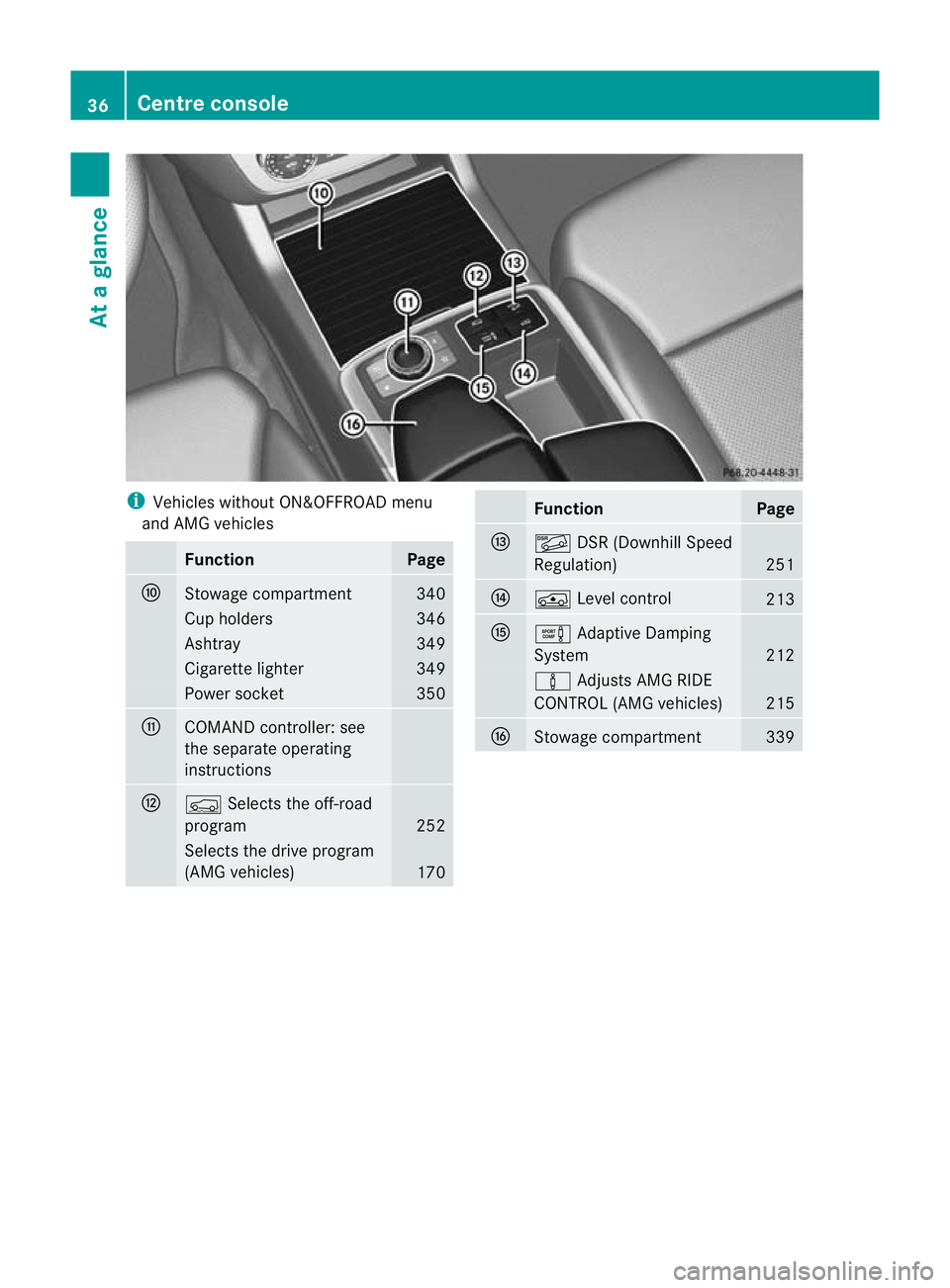
i
Vehicles withou tON&OFFROAD menu
and AM Gvehicles Function Page
F
Stowage compartment 340
Cup holders 346
Ashtray 349
Cigarette lighter 349
Power socket 350
G
COMAN
Dcontroller :see
the separate operating
instructions H
Ç
Selects the off-road
program 252
Selects the driv
eprogram
(AM Gvehicles) 170 Function Page
I
Ã
DSR (Downhil lSpeed
Regulation) 251
J
Á
Level cont rol 213
K
e
Adaptive Damping
System 212
à
Adjusts AMG RIDE
CONTROL (AM Gvehicles) 215
L
Stowage compartment 33936
Centre consoleAt
ag lance
Page 40 of 441
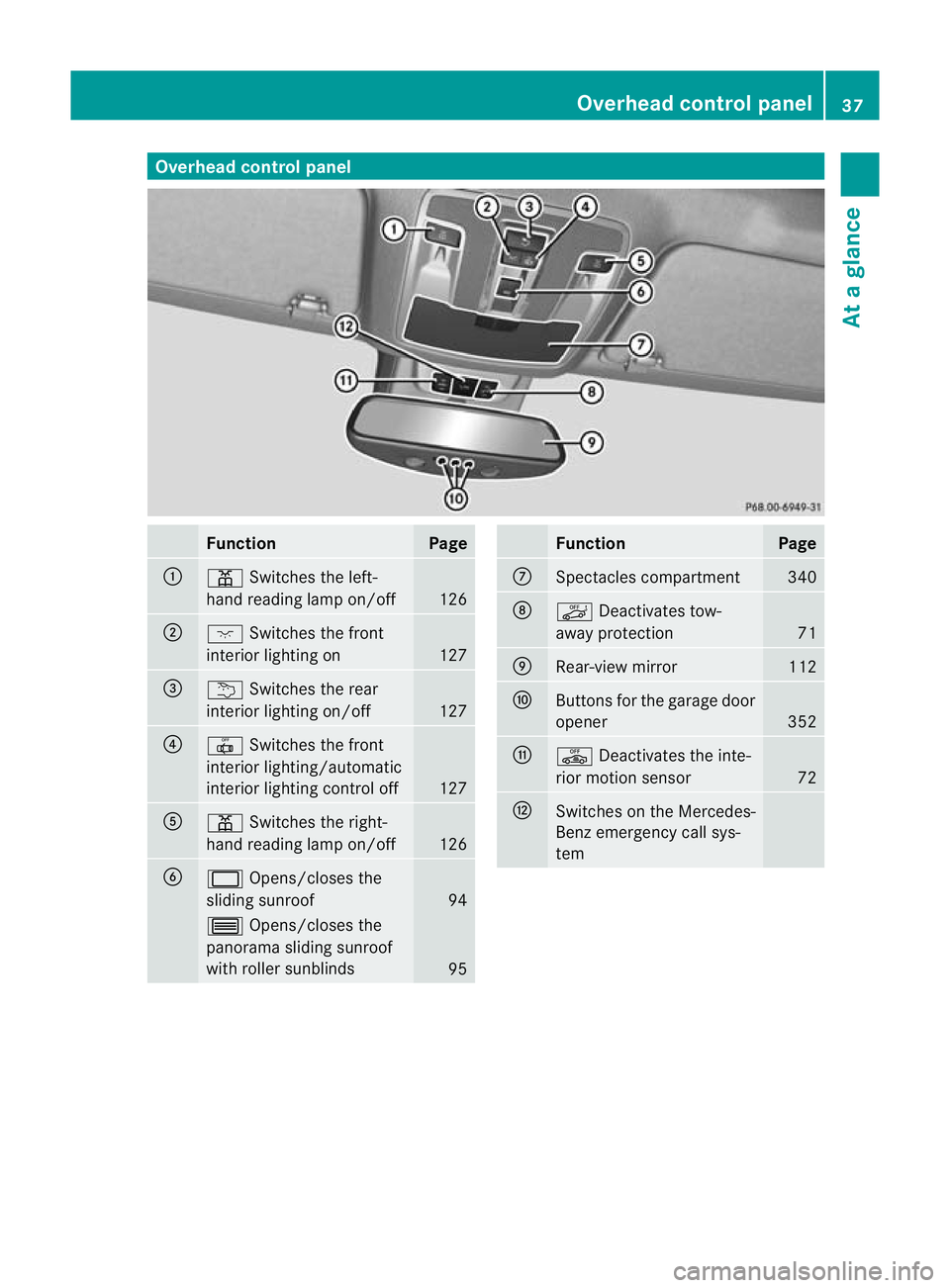
Overhea
dcontrol panel Function Page
:
p
Switche sthe left-
han dreadin glamp on/off 126
;
c
Switches the front
interior lighting on 127
=
u
Switches the rear
interior lighting on/off 127
?
|
Switches the front
interior lighting/automatic
interior lighting control off 127
A
p
Switches the right-
hand readin glamp on/off 126
B
2
Opens/close sthe
slidin gsunroof 94
3
Opens/close sthe
pano rama sliding sunroof
with rolle rsunblinds 95 Function Page
C
Spectacles compartment 340
D
ë
Deactivates tow-
away protection 71
E
Rear-view mirror 112
F
Button
sfor the garage door
opener 352
G
ê
Deactivates the inte-
rior motion sensor 72
H
Switches on the Mercedes-
Ben
zemergenc ycall sys-
tem Ov
erhead control panel
37Atag lance
Page 44 of 441
SRS (Supplementa
lRestraint System)
Introduction SRS consist
sof:
R theS RS warning lamp6
R airbags
R the airbag control unit with crash sensors
R belt tensio ners forthe front seat belts and
the outer seat belts in the rear
R belt force limiters
SRS reduce sthe risk of occupants coming
int oc ontact with the vehicle' sinterior in the
event of an accident. It can also reduce the
forces to which occupant sare subjecte ddur-
ing an accident.
SRS warning lamp G
WARNING
If SRS is malfunctioning, individual systems
may be triggered unintentionally or might not
be triggered in the event of an accident with
ah igh rate of vehicle deceleration.
Am alfunction has occurred if:
R the 6 SRS warning lamp does not light
up when the ignition is switched on.
R the engine is running and the 6SRS
warning lamp does not go out after afew
seconds.
R the engine is running and the 6SRS
warning lamp lights up again.
In this case, have SRS checked immediately
at aq ualified specialist workshop.
SRS functions are checked regularly when
you switch on the ignitio nand whe nthe
engin eisrunning. Therefore, malfunctions
can be detected in good time.
The 6 SRS warning lamp in the instrument
cluster lights up when the ignition is switched
on. It goes out no later than afew seconds
after the engine is started. Triggering of belt tensioners, belt force
limiters and airbags During the first stage of
acollision ,the airbag
con trol unit evaluates important physical
data relatin gtovehicle deceleration or accel-
eration, such as:
R duration
R direction
R magnitude
Based on the evaluation of this data, the air-
bag control unit pre-emptively triggers the
belt tensioners in the first stage.
If there is an even higher rat eofvehicle decel-
eration or acceleration in alongitudinal direc-
tion ,the front airbags ar ealso deployed.
Your vehicle has adaptive, two-stage front air-
bags. The airbag control unit evaluates vehi-
cle deceleration or acceleration in the event
of ac ollision .Inthe first deploymen tstage,
the front airbag is filled with enoug hpropel-
lan tgas to reduce the risk of injuries. The
front airbag is fully deploye difasecond
deployment threshold is reached within afew
milliseconds.
The belt tensioner and airbag triggering
thresholds are variable and are adapted to the
rat eofd eceleration or acceleration of the
vehicle. This process is pre-emptive in nature.
The triggerin gprocess mus ttake place in
good time at the start of the collision.
The rate of vehicle deceleration or accelera-
tion and the direction of the force are essen-
tially determined by:
R the distribution of forces during the colli-
sion
R the collisio nangle
R the deformation characteris tics of the vehi-
cle
R the characteris tics of the object with which
the vehicle has collided
Factors which can only be seen and measured
after acollision has occurred do not play a
decisive role in the deployment of an airbag, Occupant safety
41Safety Z
Page 46 of 441
R
do not lean forwards, e.g. over the cover of
the driver's/front-passenger fron tairbag,
particularly when the vehicle is in motion.
R do not put your feet on the dashboard.
R only hold the steering wheel on the outside.
This allows the airbag to be fully deployed.
You could be injured if the airbag is
deployed and you are holding the inside of
the steering wheel.
R do not lean on the doors from inside the
vehicle.
R make sure that ther eare no people ,ani-
mals or obje ctsb etween the vehicle occu-
pants and the area where the airbags are
deployed.
R do not place any objects between the seat
back rest and the door.
R do not hang any har dobjects, e.g. coat
hangers ,onthe gra bhandles or coat hooks.
R do not attac haccessories ,e.g. cup holders,
to the doors.
It is not possible to rule out arisk of injury
being caused by an airbag, due to the high
speed at which the airbag must be deployed. G
WARNING
Airbag functionality can only be assured if the
following parts are not covered and no badges
or stickers are attached to them:
R padded steering wheel boss
R kneebag cover below the steering column
R front-passenger airbag cover
R outer side of seat bolsters G
WARNING
When an airbag deploys, asmall amount of
powder is released. Th epowder may cause
short-term breathin gdifficulties to persons
sufferin gfrom asthma or other pulmonary
conditions.
In order to prevent potentia lbreathing diffi-
culties, you should leave th evehicle as soon
as it is safe to do so. You can also open the
window to allow fresh air to enter the vehicle interior
.The powder does not constitute a
healt hhazard and does not indicat ethat there
is af ire in the vehicle. G
WARNING
The airbag parts are hot after the airbag has
been deployed. Do not touch them as you
could burn yourself.
Have the airbags replaced at aqualified spe-
cialist workshop. Otherwise, occupants are
not protected by the airbags in the event of
another accident.
Airbag deployment slow sdown and restric ts
the movement of the vehicle occupant.
If the airbags are deployed ,you will hear a
bang and asmall amount of powder may also
be released. Only in rare cases will th ebang
affect your hearing. The powde rthat is
released generally does not constitute a
healt hhazard. The 6SRS warning lamp
lights up.
The airbag installation location sare identified
by th eAIRBAG symbol.
Front airbags !
Do no tplace heavy objects on the front-
passenger seat. The system may then
detec tthat the seat is occupied and if there
is an accident ,the restraint system sonthe
front-passenger side could be deployed.
Hav erestraint system sthat hav ebeen trig-
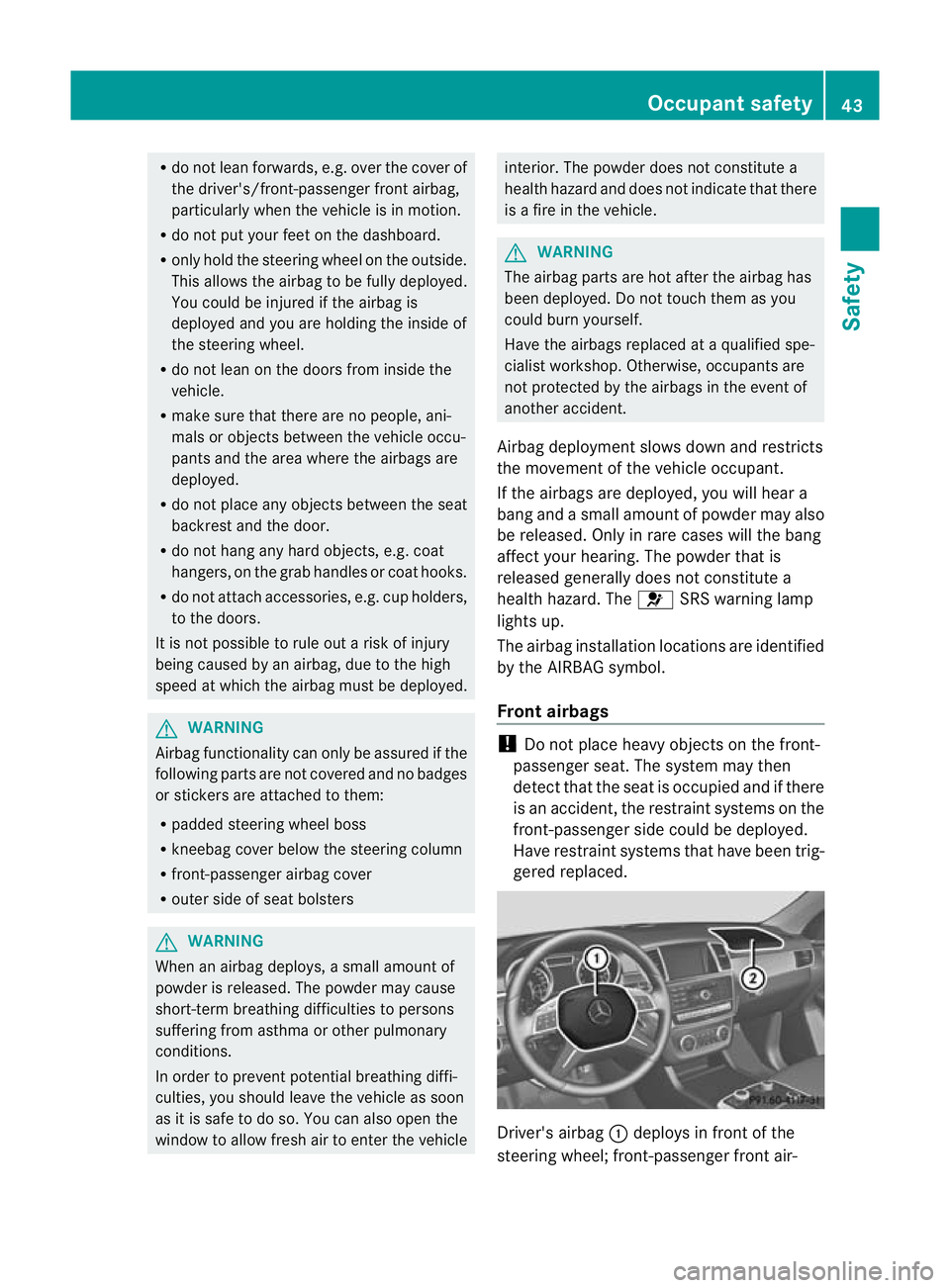
gered replaced. Driver's airbag
:deploys in front of the
steerin gwheel; front-passenger front air- Occupant safety
43Safety Z
Page 47 of 441
bag
;deploys in fron tofand above the glove
compartment.
The front airbags incre aseprotection for the
driver's and front-passenger's hea dand
chest.
The yare deployed:
R at th estart of an accident with ahigh rate
of vehicl eacceleratio nordeceleration in a
longitudina ldirection
R if the system determines that airbag
deployment can offer additional protection
to that provided by the seat belt
R depending on whether the seat belt is being
used
R independently of other airbags in the vehi-
cle
If the vehicle overturns, the fron tairbags are
generally not deployed. The fron tairbags are
deployed if the system detec tshigh vehi cle
deceleration in alongitudinal direction.
Vehicles with au tomatic child seat recog-
nition in th efront-passenger seat: the
fr ont-passenge rairbag is only activated if the
system determines that the fron t-passenger
seat is occupied. The 4PASSENGE RAIR-
BA GO FF indi cator lamp on the centr econ-
sole does not light up (Y page 52).
If ac hild restraint system is fitted on the fr ont-
pa ssenger seat and the 4PASSENGER
AIRB AGOFF indicato rlam pint he centr econ-
sol ed oesn ot light up:
R ac hild restraint system withou tatrans-
ponder for automatic child seat recognition
is fitted, or
R ac hild rest raint system with atransponder
for automatic child seat recognition is not
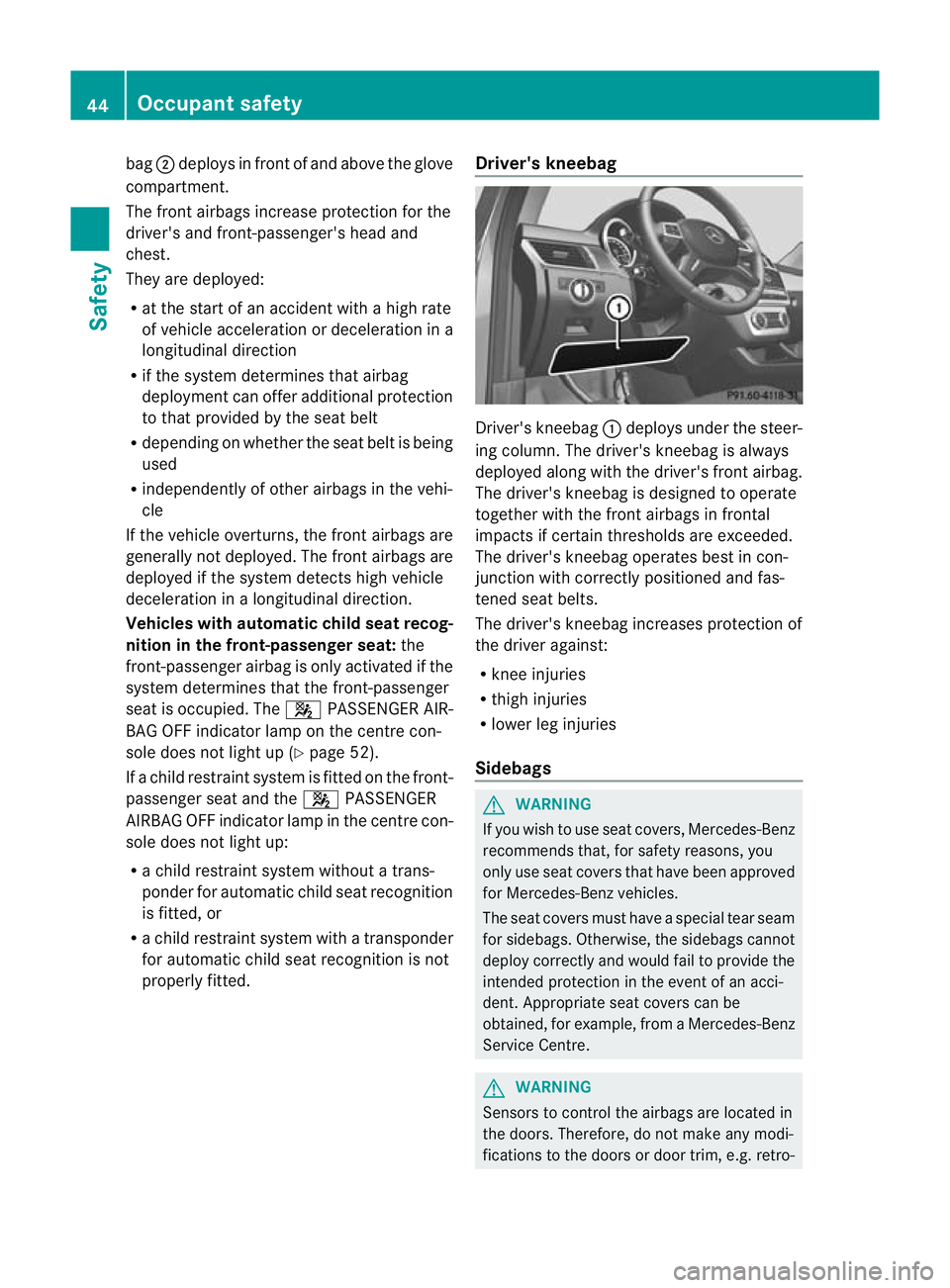
properly fitted. Driver's kneebag Driver'
skneebag :deploys under the steer-
ing column. The driver's kneebag is always
deploye dalong with the driver's front airbag.
The driver's kneebag is designed to operate
together with the front airbags in frontal
impact sifcertain thresholds are exceeded.
The driver' skneebag operates bes tincon-
jun ction with correctly positioned and fas-
tened seat belts.
The driver's kneebag increases protection of
the driver against:
R knee injuries
R thigh injuries
R lower leg injuries
Sidebags G
WARNING
If you wish to use seat covers, Mercedes-Benz
recommends that, for safety reasons, you
only use seat cover sthat hav ebeen approved
for Mercedes-Benz vehicles.
The seat covers must have aspecial tear seam
for sidebags. Otherwise, the sidebags cannot
deploy correctly and would fail to provide the
intended protection in the event of an acci-
dent. Appropriate seat cover scan be
obtained, for example, from aMercedes-Benz
Servic eCentre. G
WARNING
Sensor stocontrol the airbags are located in
the doors. Therefore, do not mak eany modi-
fications to the doors or doo rtrim, e.g .retro- 44
Occupant safetySafety
Page 49 of 441
the seat back. There is
arisk thatthe seats
and/or the objec ts could be damaged.
PRE-SAFE ®
takes pre-emptive measures to
protect occupants in certain hazardous sit-
uations.
PRE-SAFE ®
intervenes:
R if BAS activates, e.g. in emergency braking
situations
R if BAS PLUS intervenes powerfull y—on
vehicles wit hDISTRONIC PLUS
R if, on vehicles with DISTRONIC PLUS, the
radar sensor system detects an imminent
dang er of collision in cer tain situations
R in critical drivin gsituations, e.g. when phys-
ical limits are exceeded and the vehicle
understeers or oversteers severely
PRE-SAFE ®
takes the following measures
depending on the hazardous situation detec-
ted:
R the front seat belts are pre-tensioned.
R vehicles with the memor yfunction: the
front-passenger seat is adjusted if it is in an
unfavourable position.
R vehicles with amulticontour seat: the air
pressure in the side bolsters of the back-
rest is increased.
R if the vehicle skids ,the slidin gsunroof/
panorama sliding sunroof and the side win-
dows are closed so that only asmall gap
remains.
If th ehazardous situation passe swithout
resulting in an accident ,PRE-SAFE ®
slackens
the belt pretensioning. On vehicles with mul-
ticontour seats ,the air pressur einthe side
bolster sisreduced again. All settings made
by PRE- SAFE®
can the nbereversed.
If the seat belts are not released:
X Move the backrest or seat back slightly, but
only when the vehicle is stationary.
The belt pretensioning is reduced and the
locki ng mech anism is released.
More information about seat belt adjustment,
ac onvenien ce function integ rated into PRE- SAFE
®
,c an be found in the "Seat belt adjust-
ment "section (Y page 48). Seat belts
Important safety notes G
WARNING
As eat belt which is not worn correctly, or
which has not been engaged in the seat belt
buckle correctly, can notp rovide th eintended
level of protection. Under certain circumstan-
ces, this could cause severe or even fatal inju-
ries in the event of an accident.
Therefore, make sure that all occupants —in
particular ,pregnant women —wear their seat
belts cor rectly at all times.
R Th es eat belt must fit snugly on your body
and must not be twisted.Therefore, avoid
wearing bulky clothing, e.g. awinter coat.
The shoulder section of the belt must be
routed across the centre of your shoulder
—onnoa ccount acros syour nec korunder
your arm —and pulled tight against your
uppe rbody. The lap belt must always pass
across your lap as low down as possible, i.e.
over your hip join ts—n ot across your abdo-
men .Ifn ecessary, push the seat belt
slightly downwards and adjust it by pulling
it in the direction the seat belt retracts.
R Do not rout ethe seat belt strap over sharp
or fragile objec ts.P lease make sure that
such object sare not on or in your clothing,
e.g .spectacles, pens or keys etc. The seat
belt strap could become damaged and tear
durin gana ccident and you or other vehicle
occupants coul dbeinjured.
R Only one person should use each sea tbelt
at any one time. Children must never travel
sittin gont he lap of another occupan t.The
child will not be secured in the even tofan
accident ,heavy braking or sudden change
of direction .This ma yresult in the child or
other occupants being seriously or fatally
injured. 46
Occupant safetySafety
Page 51 of 441
Sea
tbelt adjustment The seat-belt adjustment func
tion adjusts the
driver's and front-passenger seat belt to the
upper body of the occupants.
The belt strap is tighte neds lightly when:
R you engage the belt tongue in the belt
buckle and you then turn the key to position
2in the ignition lock.
R the key is in position 2in the ignition lock
and you then engage the belt tongue in the
buckle.
The seat-belt adjustment will apply acertain
tightening force if any slack is detected
between the occupant and the seat belt. Do
not hold on to the seat belt tightly while it is
adjusting. You can switch the seat-belt
adjustmen tonand off in the on-board com-
puter (Y page285).
Th es eat-belt adjustmen tisani ntegral part of
the PRE-SAFE ®
convenience function. More
information abou tPRE-SAFE ®
can be found
under "PRE-SAFE ®
(preventative occupant
protection)" (Y page 45).
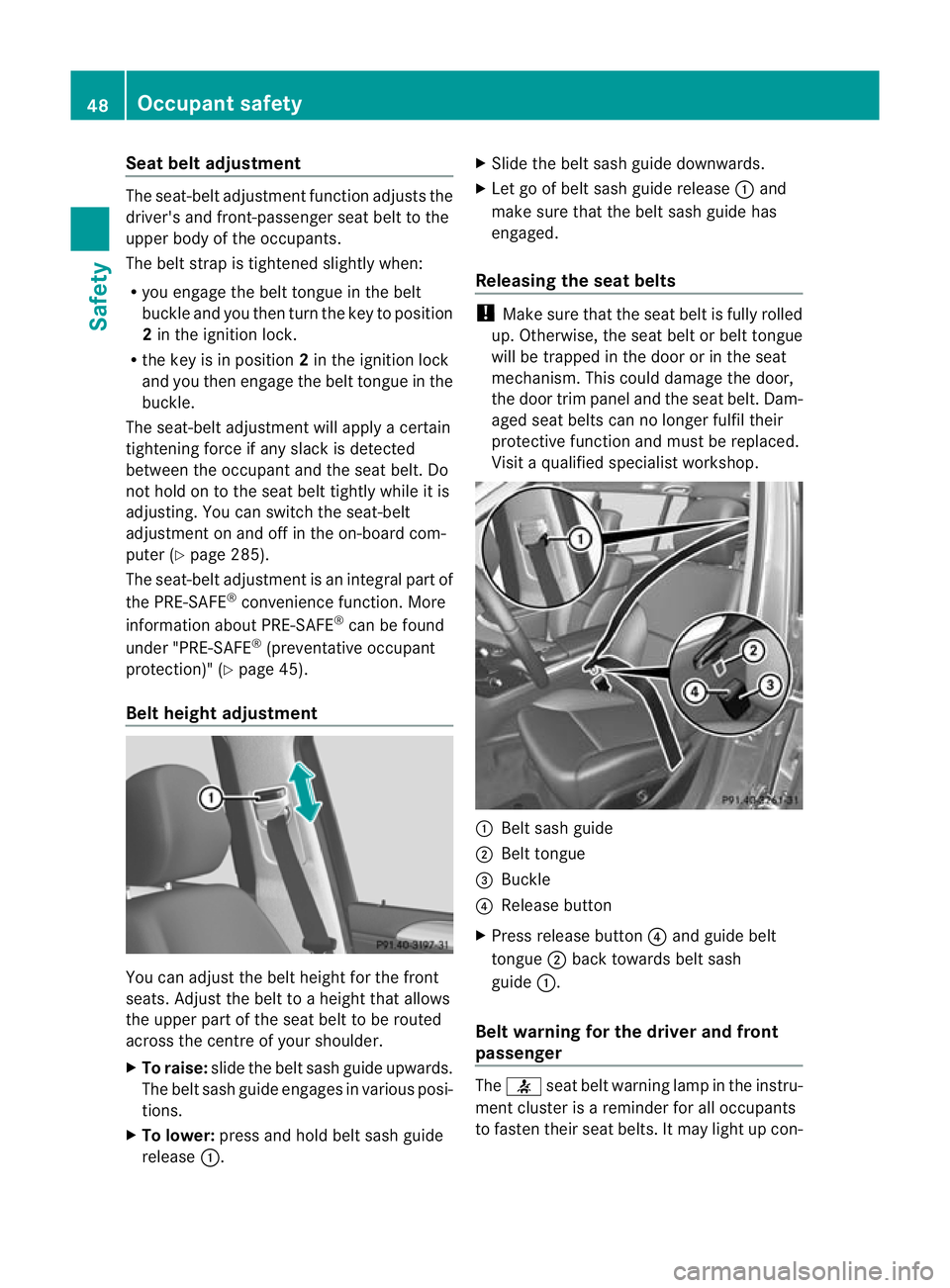
Belt height adjustment You can adjust the belt height for the front
seats
.Adjust the belt to aheight that allows
the upper part of the seat belt to be routed
across the centre of your shoulder.
X To raise: slide the belt sash guide upwards.
The belt sash guide engages in various posi-
tions.
X To lower: press and hold belt sash guide
release :. X
Slide the belt sash guide downwards.
X Let go of belt sash guide release :and
mak esure that the belt sash guide has
engaged.
Releasing the seat belts !
Make sure that the seat belt is fully rolled
up. Otherwise, the seat belt or belt tongue
will be trapped in the door or in the seat
mechanism. This could damage the door,
the door trim panel and the seat belt. Dam-
aged seat belts can no longer fulfil their
protective function and must be replaced.
Visit aqualified specialist workshop. :
Belt sash guide
; Belt tongue
= Buckle
? Release button
X Press release button ?and guide belt
tongue ;back towards belt sash
guide :.
Belt warning for the driver and front
passenger The
7 seat belt warning lamp in the instru-
ment cluster is areminder for all occupants
to fasten their seat belts. It may light up con- 48
Occupant safetySafety