service MERCEDES-BENZ GL SUV 2012 User Guide
[x] Cancel search | Manufacturer: MERCEDES-BENZ, Model Year: 2012, Model line: GL SUV, Model: MERCEDES-BENZ GL SUV 2012Pages: 441, PDF Size: 10.66 MB
Page 28 of 441
functions in systems wh
ichh ave not been
modified .Malfunctions such as these can
seriously jeopardise the vehicle' soperating
safety and therefore your own safety.
You shoul dthere fore have all work and mod-
ifi ca tions to electronic component scarried
out at aqualified specialist workshop. Declarations of conformity
Wireless vehicle components The followin
ginformation applies to all com-
ponent softhe vehicle and the COMAN Dsys-
tem which receiv eand/or transmit radio
waves:
The component softhis vehicle whic hreceive
and/or transmit radi owaves are compliant
with the basic requirements and other rele-
vant provisions of Directive 1999/5/EC. You
can obtain further information from any
Mercedes-Benz Servic eCentre.
Electromagnetic compatibility The electromagneti
ccompatibility of the vehi-
cle components has been checked and certi-
fied according to the currently valid version
of Directive 72/245/EE Corthe equivalent
ECE Regulation ECE-R 10. Diagnostics connection
G
WARNING
If you connec tequipment to adiagnostics
connection, it can affect the operation of the
vehicle systems. This could compromis ethe
operating safety of your vehicle while driving.
There is arisk of an accident.
Do not connect any equipment to adiagnos-
tics connection. G
WARNING
Loose equipment or cables hanging from a
device which are connected to adiagnostic
connection could impede pedal clearan ce. The equipment or cables could get caught
between the pedals when driving and braking
suddenly
.This coul dimpair th efunction of the
pedals .There is arisk of accident.
Do not attac hany equipment or cable sinthe
driver's footwell.
! If the engin eiss witched off and equip-
ment on the diagnostics connection is
used, the starter batter ymay discharge.
The diagnostics con nection is only intended
for the connection of diagnostic equipmen tat
aq ualified specialist workshop.
Connecting equipmen ttothe diagnostics
con nectio ncan lead to emissions monitoring
information being reset, for example. This
may lead to the vehicle failing to meet the
requirements of the next emissions test dur-
ing the main inspection. Qualified specialist workshop
Aq ualified specialist workshop has the nec-
essary special skills, tools and qualifications
to cor rectly carry out any necessary work on
your vehicle. This particularly applies to work
relevan ttosafety.
Observe the notes in the Servic eBooklet.
Always have the following work carried out at
aq ualified specialist workshop:
R work relevant to safety
R service and maintenance work
R repair work
R modifications, installations and conver-
sions
R work on electronic components
Mercedes-Benz recommends that you use a
Mercedes-Benz Servic eCentre. Vehicle registration
Mercedes-Benz may ask its Servic eCentres
to carry out technical inspections on cer tain Introduction
25 Z
Page 29 of 441
vehicles
.The quality or safety of the vehicle
is improved as aresult of the inspection.
Mercedes-Ben zcan only inform you about
vehicl echeck sifith as yourregistra tion data.
It is possible that your vehicle has not yet
been registered in your nam einthe following
cases:
R if your vehicle was not purchase datan
authorised specialis tdealer.
R if your vehicle has not yet been examined
at aM ercedes-Benz Ser vice Centre.
It is advisabl etoregister your vehicle with a
Mercedes-Benz Ser vice Centre.
Inform Mercedes-Benz as soo naspossible
about any change in address or vehicleown-
ership. Correct use
G
WARNING
Variou swarning sticker sare affixed to your
vehicle. Thei rpurpose is to draw your atten-
tion, and the attention of others, to various
dangers. Therefore, do not remove any warn-
ing stickers unless the sticker clearly states
that you may do so.
If you remove the warning stickers, you or
others could be injured by failing to recognise
certain dangers.
Observe the following information when driv-
ing your vehicle:
R the safety notes in this manual
R the Technical Data section in this manual
R traffic rules and regulations
R laws and safety standards pertainin gto
motor vehicles Implie
dwarranty
! Follo wthe instructions in this manual
about the proper operation of your vehicle
as well as about possible vehicle damage.
Damage to your vehicle that arises from culpable contravention
sagainst these
instructions ar enot covered either by
Mercedes-Ben zimplie dwarrant yorbythe
New or Used-Vehicle Warranty. Data stored in th
evehicle Fault data
Components which are critical for vehicle
operation are equipped with fault data mem-
ories as standard. There are also data storage
devices which recor dhow vehicle compo-
nents have reacted in cer tain drivin gsitua-
tion s(e.g. airbag deployment or ESP ®
inter-
ven tion).
This data is used exclusively to:
R assist in the rec tificatio noffaults and
defects
R help Mercedes -Benz optimise and develop
vehicle fun ctions
The data cannot be used to trac ethe vehicle's
movements.
When your vehicle is serviced by Mercedes-
Ben z,this technical information can be read
out from the fault memory. Thi sisperformed
by authorised employees of the Mercedes-
Benz service network using special diagnos-
tic computers.
Af teraf ault has been rectified, the informa-
tion is deleted from the memory. Other mem-
ory data is constantly overwritten. Other devices tha
tstore data
Depe nding on the equipment level, your vehi-
cle may featur ecommunication sand/or
entertainment systems (e.g .navigation devi-
ces, telephone systems). Thes eallow you to
save and edit data required for the operation
of the respective device.
Fur ther information on operation (e.g. on
deletin gdata) can be found in the separate
operating instructions. 26
Introduction
Page 43 of 441
Usefu
linfor mati on
i This Owner's Manual describes all mod-
els, series and optional equipment for your
vehicle that were available at the time of
going to press. National variation sare pos-
sible. Note that your vehicl emay not be
equippe dwith all of the function sdescri-
bed. This is also the case for system sand
functions relevant to safety.
i Read the information on qualified special-
ist workshops: (Y page25). Occupan
tsafety Impo
rtantsafety notes G
WARNING
If service work is not carrie dout correctly, the
operatin gsafet yofyour vehicle may be affec-
ted. This coul dcause you to lose contro lof
your vehicle and cause an accident. More-
over, the safety syste ms maynolonger be
able to protect you or other sastheya re
designed to do.
Always have se rvicew ork carried out at a
qualified specialist workshop. G
WARNING
Modification stoorwork performed incor-
rectly on th efollowin gpartsc an result in the
restraint system snot functioning as in tended:
R ther estraint system, consisting of seat
belt sand their anchorage poi nts,belt ten-
sioners ,belt force limi ters and airbags
R the wiri ng
R networked ele ctronicsystems
Airbags and belt tensioners could fail to
deploy or be triggered in an accident despite
the deceleration for cebeing sufficien ttotrig-
ge rthe systems, or coul dbetriggered unin-
ten tionally. For this reason, never mak eany
modifications to the restraint systems.
Therefore, you must not tamper with elec-
tronic compone ntsort heir software. The seat belts, together with SRS (Supple-
men
talR estraint System), are complemen-
tary, co-ordinated restraint systems
(Y page 41). They reduc ethe risk of injury
in specific ,pre-defined types of accident sit-
uations and thereby increas eoccupant
safety. However, seat belts and airbags gen-
erall ydon ot protect against objec tspene-
tratin gthe vehicle from the outside.
To ensur ethat the restraint system scan
deliver their full potential protection, make
sure that:
R the seat and head restraint are adjusted
properly (Y page 100).
R the seat belt has been fastened properly
(Y page 47).
R the airbags can inflate unrestricted if
deployed (Y page 42).
R the steering wheel is adjusted properly
(Y page 100).
R the restraint systems have not been modi-
fied.
An airbag increases the protection of vehicle
occupant swearing aseat belt. However, air-
bags are only an additional restraint system
which complemen ts,b ut does not replace,
the seat belt. All vehicle occupant smust wear
their seat belt correctly at all times, even if
the vehicle is equipped with airbags. The air-
bags are not deployed in all types of acci-
dents. For example, if the protective capacity
of correctly fastened seat belts is not
increased by deploying the airbags, the air-
bags will not deploy.
Airbag deployment only provides increased
protection if the seat belt is worn correctly.
First ,the seat belt helps to keep the vehicle
occupan tinthe best position in relation to the
airbag. Second, in ahead-on collision ,for
example, the seat belt prevent sthe vehicle
occupan tfrom being propelled toward sthe
point of impact. 40
Occupant safetySafety
Page 54 of 441
G
WARNING
Do not le avec hildren unsupervised in the
vehicle, even if they ar esecur edinac hild
restraint system .They could injur ethem-
selv eson parts of the vehicle. They could also
be seriously or even fatally injure dbypro-
longe dexpos uretoe xtreme hea torcold.
Do not expose the child restraint system to
direct sunlight. Part softhe chil drestraint sys-
tem could heat up and the child could burn
herself/himself on them.
If ac hild opens adoor, the child or other per-
sons coul dbeinjured as aresult. They could
get out and injure themselves or be injured by
ap assing vehicle.
Observe the general notes on the HOLD func-
tion, which can be found under the same key-
word. G
WARNING
Unsecured or incorrectly positioned loads
increase the risk of injury for children and all
other occupant sinthe even tof:
R an accident
R sudden braking
R as udden change of direction
Do not transpor theavy or hard objects in the
vehicle interior unless they are secured. You
will fin dfurther information under "Loading
guidelines" in the index.
If ac hild is travellin ginyour vehicle, secure
the child using achild restraint system that is
recommended for Mercedes-Ben zvehicles.
The child restraint system must be appropri-
ate to the age, weight and size of the child.
You should preferabl yfit the child restraint
system to asuitable rear seat. Make sure that
the child is secured for the trip.
Mercedes -Benz recommends that you use
the listed child restraint systems
(Y page 58). You can obtain further infor-
mation about the cor rect chil drestraint sys-
tem from any Mercedes-Benz Ser vice Centre. i
It is advisabl etou se Mercedes-Ben zcare
product stoclean child restraint systems.
You can obtain information about this at
any Mercedes-Benz Service Centre.
Child restraint system on the front-
passenger seat G
WAR
NING
If the front-passenge rairbag is not disabled:
R ac hild secured in achild rest raint system
on the front-passenger seat could be seri-
ously and even fatally injured by the front-
passenger airbag deploying. This is espe-
cially arisk if the child is in the immediate
vicinit yofthe front-passenger airbag when
it deploys.
R never secur eachild on the front-passenger
seat in arearward-facing child restraint sys-
tem. Only secur earearward-facing child
restraint system on asuitable rear seat.
R alway smove the front-passenger seat to
the rearmost position if you secur eachild
in af orward-facing child rest raint system
on the front-passenger seat.
The front-passenger airbag is not disabled:
R on vehicles without automatic child seat
recognition on the front-passenger seat
R in vehicles with automatic child seat rec-
ognition in the front-passenger seat, if no
special child restraint system with trans-
ponders for automatic child seat recogni-
tion in the front-passenger seat has been
fitted
R on vehicles with automatic child seat rec-
ognition on the front-passenger seat, if the
PASSENGER AIRB AGOFF indicator lamp
4 is not lit.
To make you aware of this danger, acorre-
spondin gwarning sticker has been affixed on
the dashboard and on both sides of the sun
visor on the front-passenger side.
Information about recommended child
restraint systems is available at any
Mercedes-Benz Service Centre. Children in th
evehicle
51Safety Z
Page 131 of 441
A
p To switc hthe right-hand fron tread-
ing lam pon/off
B To switch the automati cinterior lighting
control on
X To switch on the front interior lighting:
set the switch to the cpositio n.
X To switch off the interior lighting: set the
switch to the |positio nor(if the door
is closed) to the centre position.
X To switch the rear interior lighting on/
off: press the ubutton.
X To switch the reading lamp son/off:
press the pbutton. Crash-responsive emergency lighting
The interior lightin gisa ctivated automatically
if the vehicle is involved in an accident.
X To switch off the crash-responsive
emergenc ylighting: press the hazard
warning lamp button.
or
X Lock and then unlock the vehicle using the
key. Replacing bulbs
Important safet
ynotes
Xenon bulbs G
DANGER
Xenon bulbs are under high voltage. If you
touch the electrical contact sofaxenon bulb,
you could suffer an electric shock and be seri-
ously or even fatally inju red. For this reason,
do not remove the cover of xenon bulbs.
Do not change the xenon bulbs yourself, but
have them replaced at aqualified workshop.
If your vehicle is equipped with xenon bulbs,
you can recognise this by the following :the
con eoflight from the xenon bulbs moves
from the top to the bottom and back again
when you start the engine. For this to be observed, the lights must be switched on
before starting the engine.
Bulbs and lamps are an important aspect of
vehicle safety. You must therefore make sure
that these function correctly at all times.
Hav
ethe headlamp setting checked regularly.
Other bulbs G
WARNING
Bulbs and lamps can be ver yhot. You should
therefore allow them to cool down befor eyou
change them .Otherwise, you could be burned
if you touch them.
Keep bulbs out of the reach of children .Oth-
erwise, the ycould damage the bulbs, for
example, and inj uret hemselves.
Never use abulbw hich ha sbeend ropped.
Suc hab ulbm ay break or even explode and
injure you.
Haloge nbulbs are pressurised and can
explode when you change them ,particularly
if they are ver yhot.Y ou should therefor ewear
eye protec tion and gloves when you are
changing them.
There are bulbs other than the xenon bulbs
that you can notreplace. Replace only the
bulbs listed (Y page 129). Hav ethe bulbs that
you can notreplace yourself changed at a
qualified specialist workshop.
If you require assistanc echanging bulbs, con-
sult aqualified specialist workshop.
Do not touch the glass tube of new bulbs with
your bare hands. Even minor contamination
can burn into the glass surface and reduce
the service life of the bulbs .Always use alint-
free cloth or only touch the base of the bulb
when fitting.
Only use bulbs of the correc ttype.
If the new bulb still does not light up, consult
aq ualified specialist workshop.
Bulbs and lamps are an importan taspect of
vehicle safety .You must therefor emake sure
that these function correctly at all times.
Have the headlamp setting checked regularly. 128
Replacing bulbsLights and windscree
nwipers
Page 133 of 441
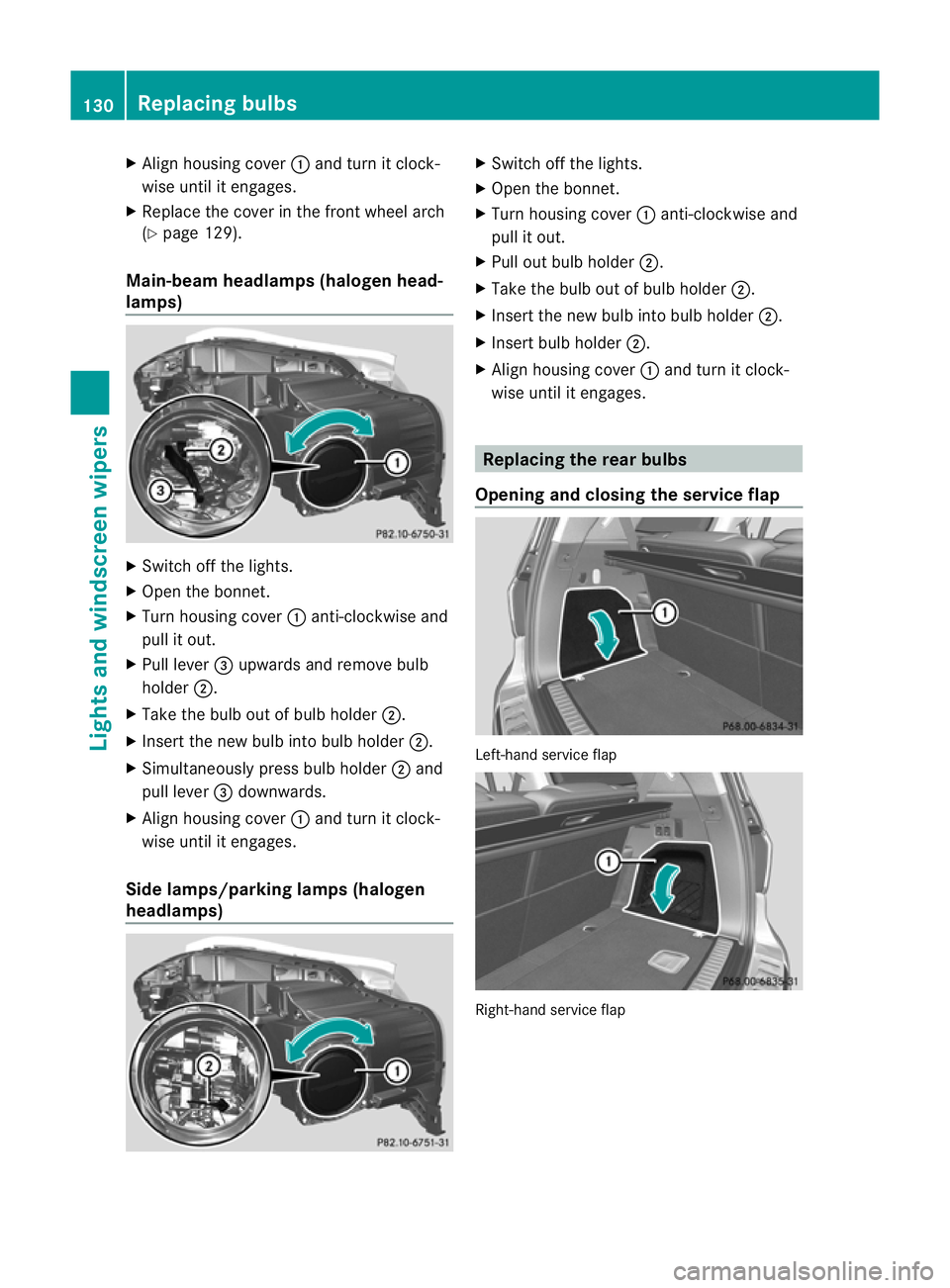
X
Align housing cover :and turn it clock-
wise unti litengages.
X Replace the cove rinthe front wheel arch
(Y page 129).
Main-beam headla mps(halogen head-
lamps) X
Switch off the lights.
X Open the bonnet.
X Turn housing cover :anti-clockwise and
pull it out.
X Pull lever =upwards and remov ebulb
holder ;.
X Take the bulb out of bulb holder ;.
X Insert the new bulb into bulb holder ;.
X Simultaneously press bulb holder ;and
pull lever =downwards.
X Align housing cover :and turn it clock-
wise until it engages.
Side lamps/parking lamps (halogen
headlamps) X
Switch off the lights.
X Open the bonnet.
X Turn housing cover :anti-clockwise and
pull it out.
X Pull out bulb holder ;.
X Take the bulb out of bulb holder ;.
X Insert the new bulb into bulb holder ;.
X Insert bulb holder ;.
X Align housing cover :and turn it clock-
wise until it engages. Replacing the rear bulbs
Openin gand closing th eservice flap Left
-hand service flap Right-hand service flap130
Replacin
gbulbsLight sand windscreen wipers
Page 134 of 441
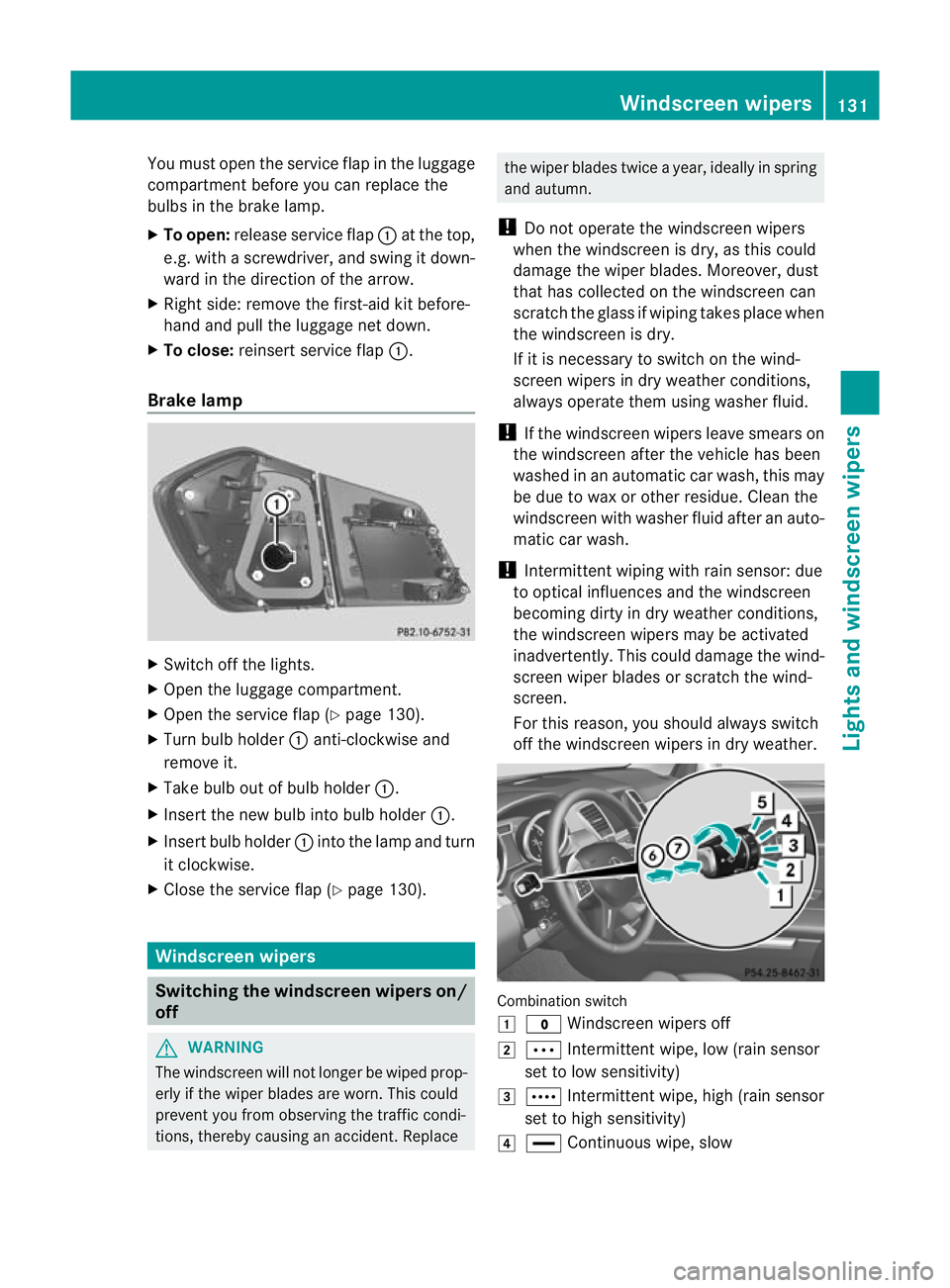
You must open the service flap in the luggage
compartmen
tbefor eyou can replac ethe
bulbs in the bra kelamp.
X To open: release service flap :at the top,
e.g. with ascrewdriver, and swing it down-
ward in the dire ction of the arrow.
X Right side: remove the first -aid kit before-
hand and pull the luggage net down.
X To close: reinsert service flap :.
Brake lamp X
Switch off the lights.
X Open the luggage compartment.
X Open the service flap (Y page 130).
X Turn bulb holder :anti-clockwise and
remove it.
X Take bulb out of bulb holder :.
X Insert the new bulb int obulb holder :.
X Insert bulb holder :intothe lamp and turn
it clockwise.
X Close th eservic eflap (Y page 130). Windscree
nwipers Switchin
gthe windscreen wiper son/
off G
WA
RNING
The windscree nwill not longer be wiped prop-
erly if the wiper blades are worn .This could
prevent you from observing the traffic condi-
tions, thereby causing an accident .Replace the wiper blades twic
eayear, ideally in spring
and autumn.
! Do not operate the windscreen wipers
when the windscreen is dry, as this could
damage the wiper blades. Moreover ,dust
that has collected on the windscreen can
scratc hthe glass if wipin gtakes place when
the windscreen is dry.
If it is necessary to switch on the wind-
screen wipers in dry weather conditions,
always operate them using washe rfluid.
! If the windscreen wipers leave smears on
the windscreen after the vehicle has been
washed in an automatic car wash, this may
be due to wax or other residue. Clean the
windscreen with washer fluid after an auto-
matic car wash.
! Intermit tentwiping with rain sensor: due
to optical influences and the windscreen
becoming dirty in dry weather conditions,
the windscreen wipers may be activated
inadvertently. This could damage the wind-
screen wiper blades or scratc hthe wind-
screen.
For this reason, you should always switch
off the windscreen wiper sind ry weather. Combinatio
nswitch
1 $ Windscreen wipers off
2 Ä Intermittent wipe, low (rain sensor
set to low sensitivity)
3 Å Intermittent wipe, high (rain sensor
set to high sensitivity)
4 ° Continuous wipe, slow Windscreen wipers
131Lights and windscreen wipers Z
Page 170 of 441
Problem Possible causes/consequences and
M Solutions
The coolant tempera-
tur
ed isplay is showing
more than 120 †. The
coolant warnin glamp
may also be lit and a
warning tone may
sound. The coolant level is too low. The coolant is too hot and the engine
is no longer being cooled sufficiently.
X
Stop as soon as possible and allow the engine and the coolant
to cool down.
X Check the coolant level (Y page 363). Observe the warning
notes as you do so and top up the coolant if necessary. If the coolant level is correct
,the radiator fa nmay be faulty. The
coolant is too hot and the engine is no longer being cooled suffi-
ciently.
X At coolant temperatures under 120 †, drive on to the nearest
qualified specialis tworkshop, e.g. to aMercedes-Benz Service
Centre.
X Avoid heavy loads on the engine as you do so, e.g. driving in
mountainous terrai nand stop-start traffic. Automatic transmission
Important safety notes
G
WARNING
If the engine speed is above the idling speed
and you engag etrans mission position Dor
R,t he vehicle coul dpull away suddenly. There
is ar isk of an accident.
When engaging transmission position Dor R,
always firmly depress the brake pedal and do
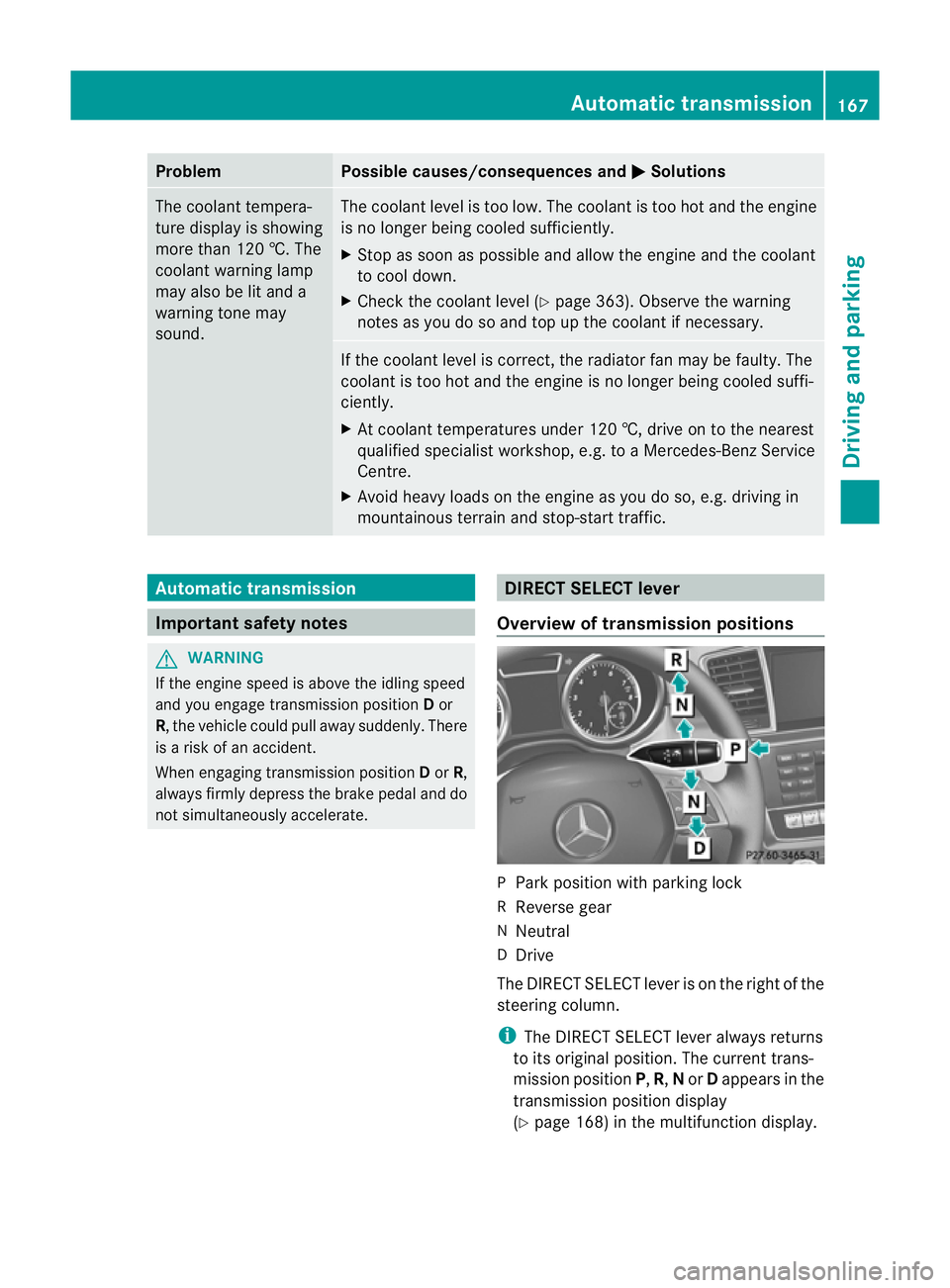
not simultaneously accelerate. DIRECT SELECT lever
Overview of transmissio npositions P
Park position with parking lock
R Reverse gear
N Neutral
D Drive
The DIRECT SELECT leve risonthe right of the
steering column.
i The DIREC TSELECT lever always returns
to its origina lposition .The curren ttrans-
mission position P,R, Nor Dappe arsint he
transmission position display
(Y page 168) in the multifunction display. Automa
tict ran smission
167Driving and pa rking Z
Page 181 of 441
AdBlue
®
(BlueTEC vehicles only)
Important notes on use To function properly, BlueTE
Cexhaust gas
aftertreatmen tmust be operate dwitht he
reduc inga gen tAdBlue ®
.
When the supply of AdBlue ®
is almost used
up, the Refill AdBlue See Owner's Man‐
ual message is shown in the multifunction
display.
When the AdBlue ®
supply drops to amini-
mum ,the Refill AdBlue No star tinXXXX km message is show
ninthe multifunc-
tion display.
If the Refill AdBlue No star tinXXXX km message is show
ninthe multifunction dis-
play ,you can still drive the vehicle over the
distance shown. If AdBlue ®
is not topped up,
you will subsequen tlybe unable to start the
engine.R efill the AdBlue ®
tank or have the
AdBlue ®
tank refilled at aqualified specialist
workshop. If the Refill AdBlue Eng. star
tnot possible message appears in
th em ultifunction display and the engine does
not start ,you must top up with at least 3. 8l
of AdBlue ®
(approximately 2AdBlue ®
refill
bottles).
i If you driv ethe vehicle faster than
15 km /h,the Refill AdBlue Se eOwn‐ er's Manual message goes ou
tafter
approximately one minute.
If th eoutside temperature is lower than
Ò11 †, it may be difficult to top up. If
AdBlue ®
is frozen and there is an activ ewarn-
ing indicator, topping up may not be possible.
Park the vehicle in awarm place, e.g. in a
garage, until AdBlue ®
has become liquid
again. Topping up is then possible again.
Alternatively, have the AdBlue ®
tank refilled
at aq ualified specialist workshop.
Further information about BlueTEC exhaust
gas aftertreatment and about AdBlue ®
can
be obtained from any Mercedes-Benz Service
Centre. Importan
tsafety notes on the refilling
procedure AdBlue
®
is aw ater-solubl efluid for the
exhaust gas aftertreatment of diesel engines.
It is:
R not poisonous
R colourless and odourless
R not flammable
When you open the AdBlue ®
container ,small
amounts of ammonia vapou rmay be
released.
Ammonia vapours have apungent odour and
are particularly irritating to the skin, to
mucous membranes and to the eyes. You may
experienc eaburnin gsensation in your eyes,
nose and throat. Coughing and waterin gof
the eyes are possible.
Do not inhale any ammonia vapours that may
be released. Fill the AdBlue ®
tank only in well-
ventilated areas.
AdBlue ®
must not come into contact with
your skin, eyes or clothing and must not be
swallowed .Keep AdBlue ®
away from chil-
dren.
If you or other person scome int ocontact with
AdBlue ®
,o bserv ethe following:
R Rinse AdBlue ®
from your skin immediately
with soap and water.
R If AdBlue ®
comes int ocontact with your
eyes, immediately rinse them thoroughly
with clea nwater. Seek medical attention
immediately.
R If AdBlue ®
has been swallowed, rinse your
mouth out immediately. Drin kplent yof
water .Seek medical attention immedi-
ately.
R Change out of clothing contaminated with
AdBlue ®
immediately.
! Only use AdBlue ®
in accordanc ewith
ISO 22241. Do not mix any additives with
AdBlue ®
,a nd do not dilute AdBlue ®
with
water. Thi smay destroy the BlueTEC
exhaust gas aftertreatmen tsystem. 178
RefuellingDriving and parking
Page 184 of 441
take
noff ag aina fter be ingo nly partially
emptied.
X Releas eAdBlue ®
refil lbottle :.
X Tur nAdBlue ®
refil lbottle :anti-clockwise
and remove it.
X Screw the protective cap onto AdBlue ®
refill bottle :again.
AdBlue ®
refill bottles can be obtained at many
fil ling stations or at aMercedes-Benz Ser vice
Centre. Refil lbottles withou tathreaded seal
offer no protection agains toverfilling.
AdBlue ®
may leak ou tasaresult of overfilling.
Mercedes Ben zoffers special refi llbottles
with athrea deds eal. Thes eare avail able at
any Mercedes-Benz Service Centre.
Closin gthe AdBlue ®
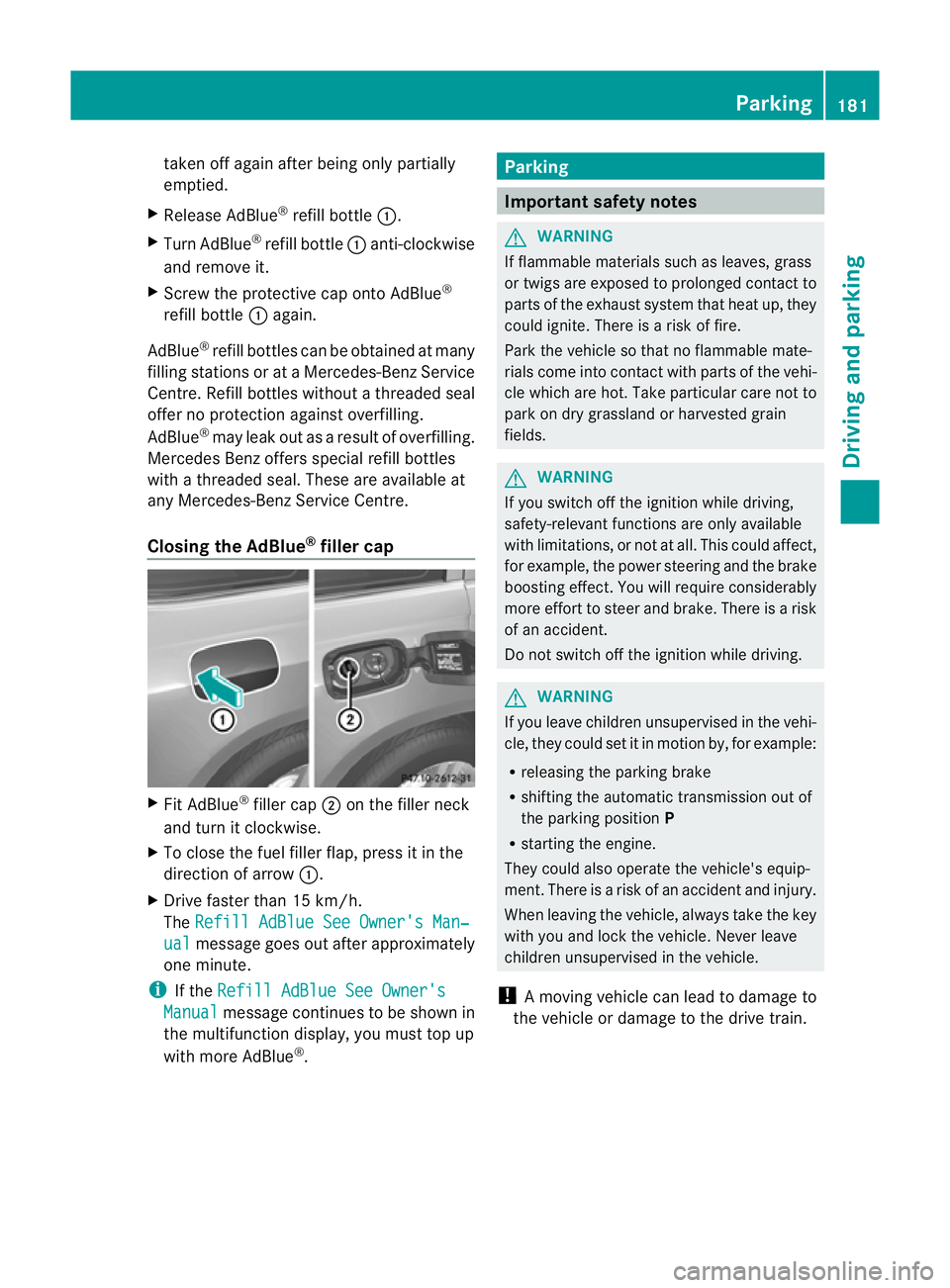
fil lerc ap X
Fit AdBl ue®
filler cap ;on th efiller neck
and turn it clockwise.
X To close the fuel filler flap, press it in the
direction of arrow :.
X Driv efaster than 15 km/h.
The Refill AdBlue Se eOwner' sMan‐ ual message goes ou
tafter approximately
one minute.
i If the Refill AdBlue See Owner's Manual message continues to be show
nin
the multifunctio ndisplay, you must top up
with mor eAdBlue ®
. Parking
Important safety notes
G
WAR
NING
If flammable materials such as leaves ,grass
or twigs are exposed to prolo nged contac tto
part soft he exhaust system that heat up, they
coul dignite. There is arisk of fire.
Park the vehicle so that no flammable mate-
rials come int ocontac twith parts of the vehi-
cle which are hot. Take particular care not to
park on dry grassland or harvested grain
fields. G
WARNING
If you switch off the ignition while driving,
safety-relevan tfunctions are only available
with lim itations, or not at all .This coul daffect,
for example, the powe rsteering and the brake
boosting effect .You will require considerably
mor eeffort to steer and brake. There is arisk
of an accident.
Do not switch off the ignition while driving. G
WARNING
If you leave children unsupervised in the vehi-
cle, they could set it in motion by, for example:
R releasing the parking brake
R shifting the automatic transmission out of
the parking position P
R starting the engine.
They could also operate the vehicle's equip-
ment .There is arisk of an accident and injury.
When leaving the vehicle, always take the key
with you and lock the vehicle. Never leave
children unsupervised in the vehicle.
! Am ovin gvehicle can lead to damage to
the vehicle or damage to the driv etrain. Parking
181Driving and parking Z