ESP MERCEDES-BENZ GL SUV 2012 Owner's Manual
[x] Cancel search | Manufacturer: MERCEDES-BENZ, Model Year: 2012, Model line: GL SUV, Model: MERCEDES-BENZ GL SUV 2012Pages: 441, PDF Size: 10.66 MB
Page 69 of 441
ESP
®
(Electronic Stability Program)
Important safety notes i
Observ ethe "Important safety notes "sec-
tio n(Ypage 61). G
WARNING
If ESP ®
is mal functioning, ESP ®
is unable to
stabilis ethe vehicle. In addition, othe rdriving
safety systems are switche doff. This increa-
se st he risk of skiddi ngand an accident.
Driv eonc arefully. Have ESP ®
checked at a
qualified specialis tworkshop.
! Only operat ethe vehicle for amaximum
of ten seconds on abrake dynamometer.
Switch off th eignition.
Application of the brakes by ESP ®
ma yoth-
erwise destroy the brake system.
! Afunction or performanc etest should
only be carried out on atwin-axle dyna-
mometer .Before you operate th evehicle
on such adynamometer, pleas econsult a
qualified workshop. You coul dotherwise
damage the drive train or the brake system.
ESP ®
is deactivated if the åwarning lamp
in the instrument cluster lights up continu-
ousl ywhen the engin eisrunning.
If the ÷ warning lamp and the åwarn-
ing lamp are lit continuously, ESP ®
is not
available due to amalfunction.
Observe the information on warning lamps
(Y page 329 )and display message swhich
ma ybes hown in the inst rument cluster
(Y page 291).
If ESP ®
detects that th evehicle is deviating
from the direction desired by the driver, one
or mor ewheels ar ebrake dtos tabilise the
vehicle .The engin eoutput is also modified to
keep the vehicle on the desired course within
physical limits. ESP ®
assists the driver when
pulling away on wet or slippery roads. ESP ®
can also stabilise the vehicle during braking.
If ESP ®
intervenes, the ÷ESP®
warning
lamp flashes in the instrument cluster. If ESP
®
intervenes:
X Do not deactivate ESP ®
under any circum-
stances.
X When pulling away ,only depress the accel-
erator pedal as far as is necessary.
X Adapt your driving style to suit the prevail-
ing road and weather condi tions.
i Only use wheels with the recommended
tyr es izes. Only then will ESP ®
func tion
properly.
4ETS (Electronic Traction System) Traction con
trol is par tofESP®
.
Tractio ncontrol brakes the drive wheels indi-
vidually if they spin. This enables you to pull
away and accelerate on slipper ysurfaces, for
example if the road surface is slippery on one
side .Ina ddition, mor edrive torqu eistrans-
ferre dtot he wheel or wheels with traction.
Traction con trol remains active if you deacti-
vate ESP ®
.
In appropriate drivin gsituations, activate the
off-road program:
X Vehicles without the ON&OFFROAD pack-
age (Y page 252)
X Vehicles with the ON&OFFROAD package
(Y page 253)
Off- road 4ETS (Electronic Traction Sys-
tem) A4
ETS syste mspecifically suited to off -road
ter rain is activated automatically onc ethe off-
roa dprogram is acti vated on:
R Vehicle swithout the ON&OFFROA Dpack-
age (Y page 252)
R Vehicles with the ON&OFFROAD package
(Y page 253) 66
Driving safety systemsSafety
Page 70 of 441
Deactivating/activating ESP
®G
WARNING
If you deactivat eESP®
,E SP ®
no longer sta-
bilises the vehicle. There is an increased risk
of skidding and an accident.
Only deactivat eESP®
in th esituation sdescri-
bed in th efollowing. X
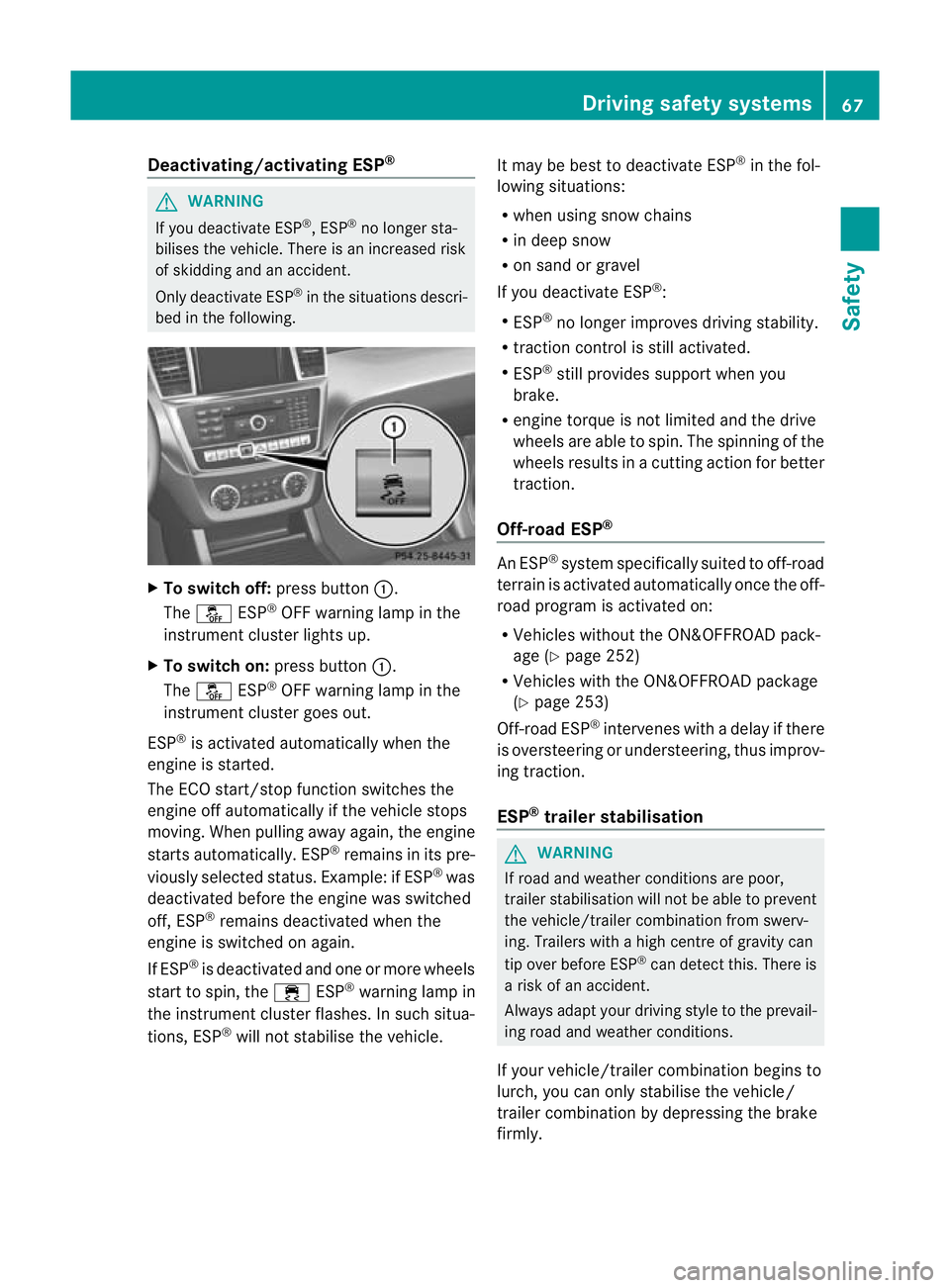
To switch off: press button:.
The å ESP®
OF Fw arnin glamp in the
instrumen tcluster lights up.
X To switch on: press button:.
The å ESP®
OFF warnin glamp in the
instrumen tcluster goes out.
ESP ®
is activated automatically when the
engin eisstarted.
The ECO start/stop fun ction switches the
engin eoff automaticall yifthe vehi cles tops
moving. When pulling away again, the engine
start sautomatically. ESP ®
remain sinits pre-
viousl yselected status. Example: if ESP ®
was
deactiva tedb efor ethe engine was switched
off ,ESP ®
remains deactivated when the
engine is switched on again.
If ESP ®
is deactivated and one or more wheels
start to spin, the ÷ESP®
warning lamp in
th ei nstrumen tcluster flashes. In such situa-
tions, ESP ®
will not stabilise th evehicle. It may be best to deact
ivateESP®
in the fol-
lowing situations:
R when using sno wchains
R in deep snow
R on sand or gravel
If you deactivate ESP ®
:
R ESP ®
no longe rimproves driving stab ility.
R traction control is still activated.
R ESP ®
still provides support when you
brake.
R engine torque is not limited and the drive
wheels are abl etospin. The spinnin gofthe
wheels resu ltsinac utting action for better
traction.
Off-roa dESP® An ESP
®
syste mspecif icall ys uited to off-road
terrain is activated automatically once the off-
road progra misactivate don:
R Vehicles without the ON&OFFROAD pack-
age (Y page252)
R Vehicles wit hthe ON&OFFROAD package
(Y page 253)
Off-road ESP ®
intervenes with adelay if there
is oversteerin gorundersteering ,thus improv-
ing traction.
ESP ®
trailer stabilisation G
WARNING
If roa dand weather conditions are poor,
trailer stabilis ation will not be able to prevent
the vehicle/trailer combination from swerv-
ing. Trailers with ahigh centre of gravit ycan
tip over before ESP ®
can detect this. There is
ar isk of an accident.
Always adap tyour driving style to the prevail-
ing road and weather conditions.
If your vehicle/trailer combination begins to
lurch, you can only stabilise the vehicle/
trailer combination by depressin gthe brake
firmly. Driving safety systems
67Safety Z
Page 71 of 441
In this situation, ESP
®
assist syou and can
detec tifthe vehicle/trailer combination
begins to lurch. ESP ®
slows the vehicle down
by brakin gand limiting the engine outp ut until
the vehicle/trailer combinatio nhas stabi-
lised.
Trailer stabilisation is active above speeds of
about 60 km/h.
Trailer stabilisation does not work if ESP ®
is
deactivated or disabled because of amal-
function.
Crosswin dAssist Strong crosswinds can cause your vehicle to
deviate from astraight course. The crosswind
driving assistance function integrated into
ESP ®
significantly reduces thes eeffects.
ESP ®
intervene sautomatically according to
the direction and intensity of the crosswinds
affecting your vehicle.
When driving on straight roads or gentle
bends ,your vehicle is kept safel yonc ourse
by astabilising brake intervention.
Crosswind driving assistance is active above
av ehicle speed of 80 km /h.
Crosswind driving assistance does not work
if ESP ®
is deactivated or disabled because of
am alfunction. EBD (electronic brake force distribu-
tion)
i Observe the "Importan tsafety notes" sec-
tion (Y page 61). G
WARNING
If EBD has malfunctioned, the rear wheels can
still lock, e.g. under full braking. This increa-
ses the risk of skidding and an accident.
You should therefor eadapt your driving style
to the different handling characteristics. Have
the brak esystem checked at aqualified spe-
cialist workshop. Observe information regarding indicator and
warning lamps (Y
page 327) as well as dis-
play messages (Y page 293).
EBD monitors and controls the brake pres-
sure on the rear wheels to improve driving
stability while braking. ADAPTIVE BRAKE
ADAPTIVE BRAKE enhances braking safety
and offers increased braking comfort. In addi-
tion to the braking function, ADAPTIVE BRAKE
also has the HOLD function (Y page 211) and
hill start assist (Y page 162). PRE-SAFE
®
Brake
i Observe the "Important safety notes" sec-
tion (Y page 61).
PRE-SAFE ®
Brake is only available in vehicles
with DISTRONIC PLUS.
PRE-SAFE ®
Brake can help you to minimise
the risk of acollision with avehicle in front or
reduc ethe effect sofsuchacollision .IfPRE-
SAFE ®
Brake has detected arisk of collision,
you will be warned visually and acoustically
as well as by automatic braking. PRE-SAFE ®
Brake cannot prevent acollision withou tyour
interven tion.
This func tion will issue awarning if:
R at speeds of around 30 km/ horm ore over
several seconds, the distance maintained
to the vehicle travellin ginfront is insuffi-
cient.
The · distance warning lamp then lights
up in th einstrument cluster.
R at as peed of approximately 7km/h or
high er,y ou ver yquickly approach avehicle
in front.
An intermittent warning tone will then
sound and the ·distance warning lamp
will light up in the instrumen tcluster. 68
Driving safety systemsSafety
Page 72 of 441
X
Brake immediatel yinorder to increas ethe
distanc efrom th evehicle in front.
or
X Take evasive actio nprovided it is safe to do
so.
From aspeed of approxim ately 7km/h ,ifthe
driver and passengers hav efastened their
seat belts, PRE-SAFE ®
Brake can brake the
vehicl eautom atically at speeds up to approx-
imatel y200 km/h.
Due to the nature of the sy stem, particu larly
comp licate ddriving conditions may cause
unneces sary warnings or th eunneces sary
interventi onof PRE-SAFE ®
Brake.
You can stop PRE-SAFE ®
Brake interventi on
at any time by:
R depressing the accelerato rpedal further
R activa ting kickdown
R releasing the brake pedal.
The braking action of PRE-SAFE ®
Brak eis
ended automatically if:
R you manoeuvr etoavoidthe obstacle.
R ther eisnol onger any danger of arear-end
collision.
R ther eisnol onger an obstacle detected in
fron tofy our vehicle.
If you have activa tedD SR (Y page 25 1)PRE-
SAFE ®
Brak eisa lso deactiva ted.
With the help of the rada rsensor system,
PRE- SAFE ®
Brake can detect obstacles that
are in front of your vehicle for an extended
period of time.
At speed suptoapproximately 70 km/h, PRE-
SAFE ®
Brak ecan also detect stationary
obstacles such as stopped or parked vehi-
cles.
If you approach an obstacle and PRE-SAFE ®
Brak edetects arisk of acollision ,the system
will aler tyou both visually and acoustically .If
you do not brake or take evasive action, the
syste mwill warn you by automatically braking
the vehicle gently. If ther eisanincreased risk
of collision, preventativ epassenger protec-
tion measures (PRE-SAFE ®
)a re activated (Y
page 45). If, at speeds ove r30km/h, arisk
of collision remains and you do not brake,
take evasive action or significantly acceler-
ate, automatic brakin gmay be performed up
to alevel of automatic emergency braking.
Automatic emergency brakin gisnot per-
formed until immediately prior to an accident
that can no longer be avoided. G
WARNING
PRE- SAFE®
Brake wil linitiall ybrake your vehi-
cle by apartial application of the brakes if a
danger of collisio nisd etected. There may be
ac ollision unless you also brake. Automatic
emergency brakin gcannot preven tacolli-
sion. There is arisk of an accident.
Always apply the brakes yourself and try to
take evasive action. G
WARNING
PRE-SAFE ®
Brak ecannot alway sclearly iden-
tify objects and complex traf ficc onditions.
In these cases, PRE- SAFE®
Brake may:
R give an unnecessary warning and then
brake the vehicle
R neithe rgive awarning nor intervene
There is arisk of an accident.
Always pay particular attention to the traf fic
situation and be ready to brake, especiall yif
PRE- SAFE®
Brake warns you. Terminate the
intervention in anon-critical driving situation.
In particular, the detection of obstacles can
be impaired if ther eis:
R dir tont he sensor soranything els ecover-
ing the sensors
R snow or heav yrain
R interference by other radar sources
R the possibility of strong radar reflections,
for example, in multi-storey car parks
R an arrow vehicle travellin ginfront, e.g .a
motorcycle
R av ehicle travellin ginfront on adifferent
line Drivin
gsafety systems
69Safety Z
Page 73 of 441
G
WARNING
PRE-SAFE ®
Brake does not react:
R to people or animals
R to oncoming vehicles
R to crossing traffic
R when cornering
As aresult, PRE-SAFE ®
Brake may neither
give warnings nor intervene in all critical sit-
uations. There is arisk of an accident.
Always pay caref ulattention to the traffic sit-
uation and be read ytobrake.
In order to maintai nthe appropriate distance
to the vehicle in front and thus preven tacol-
lision, you must apply the brake syourself.
X To activate/deactiva te:activate or deac-
tivate PRE-SAFE ®
Brake in the on-board
computer (Y page 278).
When PRE-SAFE ®
Brake is activated, the
Ä symbol appears in multifunction dis-
play ,asl ong as the HOL Dfunction is deac-
tivated (Y page 211). On vehicles with the
Active Parking Assis tdriving system, the
Ä symbo lisdisplayed when position P
is engaged or you are drivin gfaster than
35 km/h.
For PRE-SAFE ®
Brake to assis tyou when driv-
ing, the radar sensor system must be
switched on (Y page 283) and be opera-
tional.
The radar sensor system is switched off auto-
matically in the vicinit yofradio telescope
facilities in the following vehicles:
R vehicles with COMAND Online and naviga-
tion
R vehicles with Audio 20 and Becker ®
MAP
PILOT
Becker ®
MAP PILOT must be connected;
see the separate operating instructions. The radar senso
rsystem must be switched off
using the on-board computer in the vicinity of
radio telescope facilities in the following vehi-
cles:
R vehicles without COMAND Online and nav-
igation
R vehicles without Audio 20 and Becker ®
MAP PILOT
R vehicles for Australia
For information on switching off the radar
sensor syste musing the on-boar dcomputer,
see (Y page 283).
Following damage to the front end of the vehi-
cle, have the configuration and operation of
the radar sensor schecked at aqualified spe-
cialist workshop. This also applies to colli-
sions at slow speeds where there is no visible
damage to the front of the vehicle. STEER CONTROL
i Observe the "Important safety notes" sec-
tion (Y page 61).
STEE RCONTROL helps you by transmittin ga
noticeable steering force to the steering
wheel in the direction require dfor vehicle
stabilisation.
This steering suppor tisprovide dinparticular
if:
R both right wheel sorboth left wheels ar eon
aw et or slippery road surface when you
brake.
R the vehicle starts to skid.
If there is an ESP ®
malfunction ,you will not
receive any steering suppor tfrom STEER
CONTROL. Powe rsteering will ,however, con-
tinue to func tion. 70
Driving safety systemsSafety
Page 82 of 441
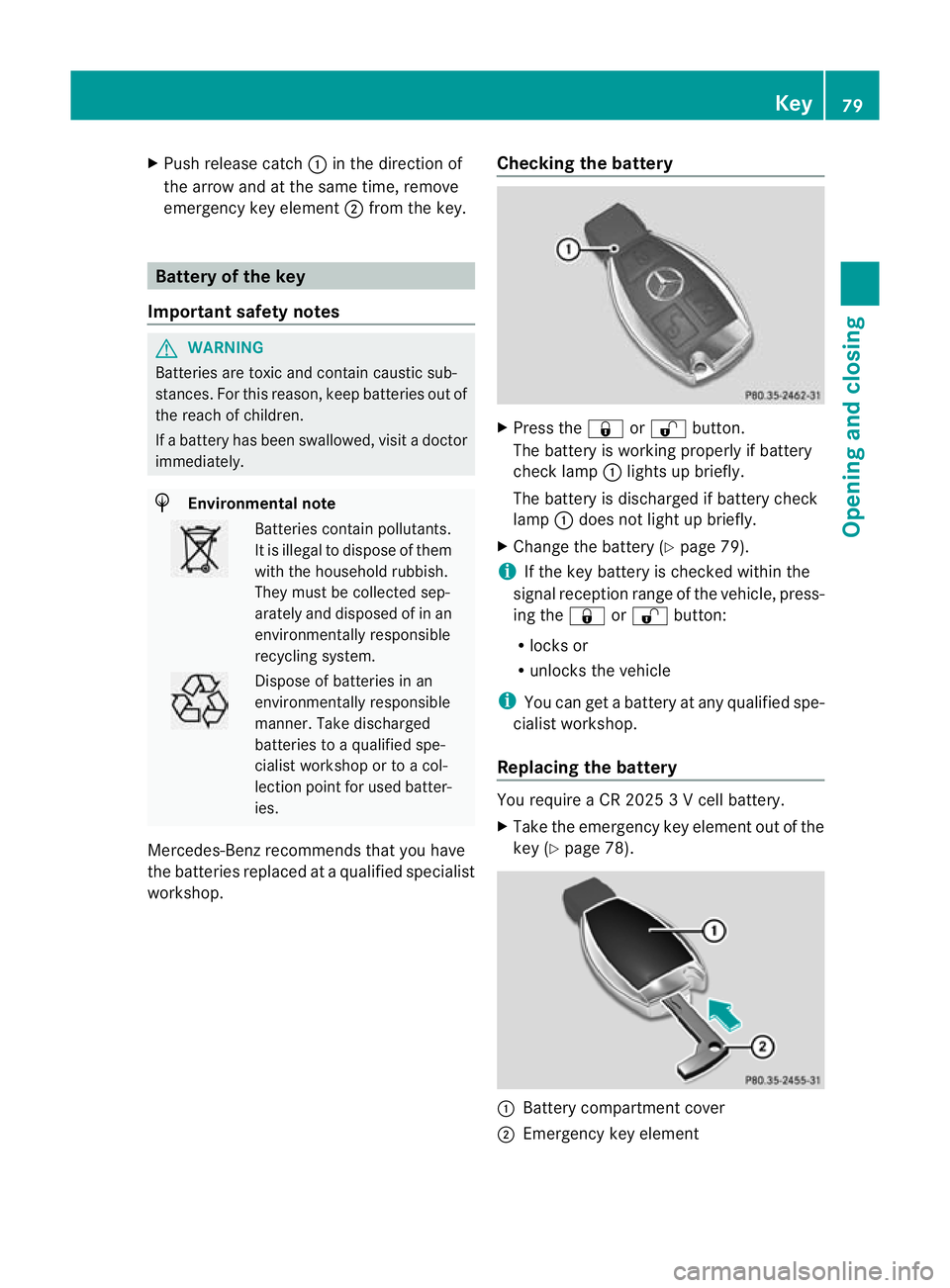
X
Push release cat ch: in the direction of
the arrow and at the same time, remove
emergenc ykey element ;from the key. Ba
ttery of the key
Important safety notes G
WARNING
Batteries are toxic and contain caustic sub-
stances. For this reason, keep batteries out of
the reach of children.
If ab attery has been swallowed, visit adoctor
immediately. H
Environment
alnote Bat
teri es contain pollutants.
It is illegal to dispose of them
with the household rubbish.
They must be collec teds ep-
arately and disposed of in an
environmen tally responsible
recycling system. Dispose of batteries in an
environmentally responsible
manner
.Take discharged
batteries to aqualified spe-
cialist workshop or to acol-
lection point for used batter-
ies.
Mercedes-Benz recommends that you have
the batteries replaced at aqualified specialist
workshop. Checking the battery X
Press the &or% button.
The battery is working properly if battery
check lamp :lights up briefly.
The battery is discharge difbattery check
lamp :does not light up briefly.
X Change the battery (Y page 79).
i If the key battery is checked within the
signal reception range of the vehicle, press-
ing the &or% button:
R locks or
R unlocks the vehicle
i You can get abattery at any qualified spe-
cialist workshop.
Replacing the battery You require
aCR20253Vc ell battery.
X Take the emergenc ykey elemen tout of the
key (Y page 78). :
Battery compartment cover
; Emergency key element Key
79Openin gand closing Z
Page 92 of 441
Side windows
Important safety notes
G
WARNING
Mak esure that nobody can become trapped
between the side window and the door frame
when aside window is opened. Do not touch
or lean against the side window during the
opening procedure. You could become trap-
ped between the side window and the door
frame as the side window moves down. If
there is arisk of becoming trapped, release
the switch or pull the switch upwards to close
the side window again. G
WARNING
Make sure that nobody can become trapped
as you close aside window. If there is arisk
of becoming trapped, release the switch or
press it again to open the side window again. G
WARNING
Children may injur ethemselves if they open
or close the side windows.
Never leav echildren unsupervised in the vehi-
cle. Always tak ethe key with you when leaving
the vehicle, even if you ar eonly leaving it for
as hort time. G
WARNING
Do not leav echildren unsupervised in the
vehicle, even if they ar esecured in achild
restraint system .The children could:
R be seriously or even fatall yinjured on parts
of the vehicle
R be seriously or even fatally injured by pro-
longed exposure to extremely hig hor
extremely low temperatures
If children open adoor, they could:
R seriously or even fatally injure other people
R get out of the vehicle and injure them-
selves, or be seriously or even fatally
injure dbya passing vehicle
Activat ethe child-proof locks/override fea-
tur eifc hildren ar etravelling in th evehicle. They could otherwise open doors or side win-
dows while the vehicle is in motion and
thereby injure themselves or others.
Opening and closin
gthe side win-
dows
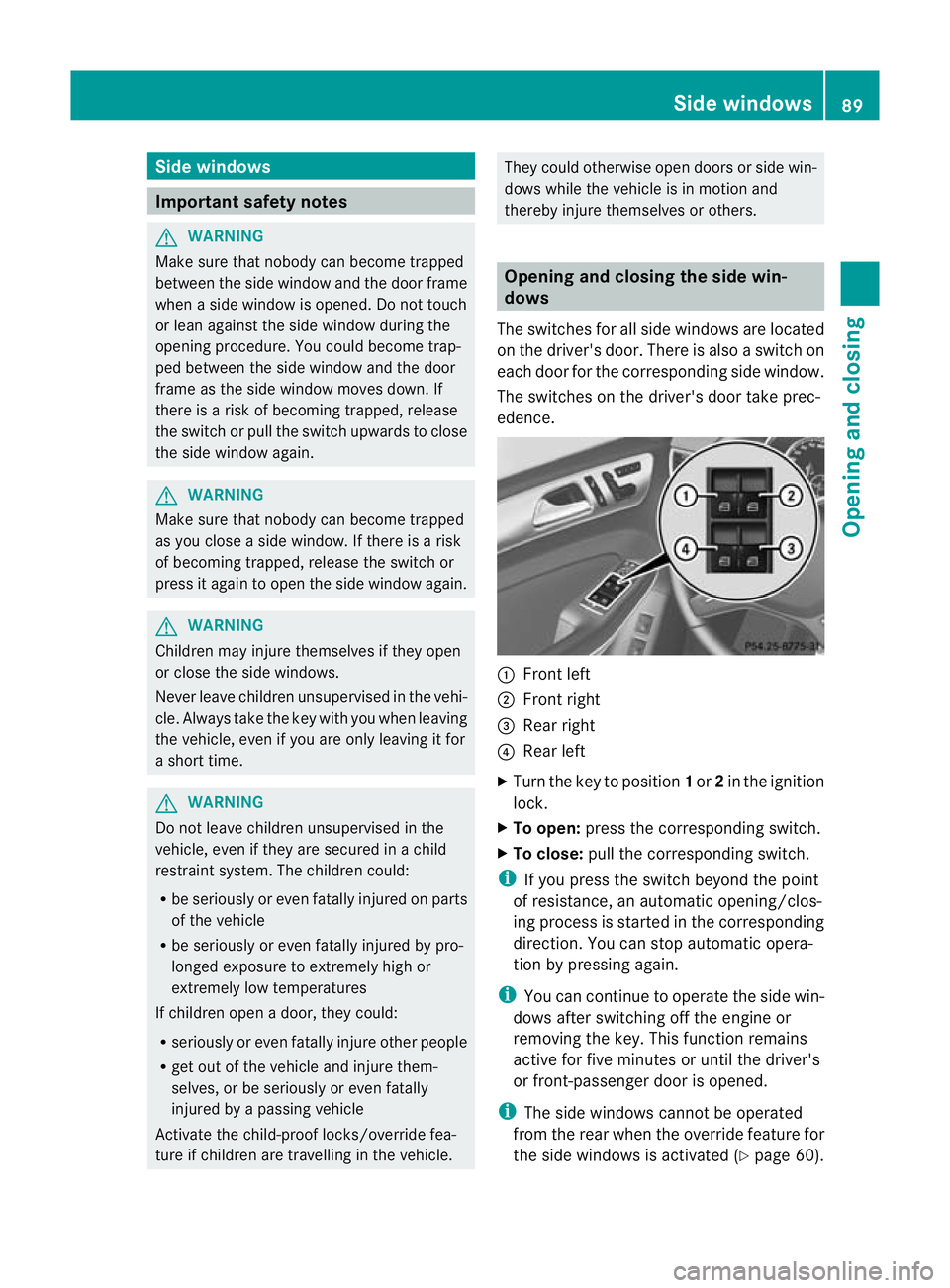
Th es witches for all side windows are located
on the driver's door. There is also aswitch on
each door for the correspondin gside window.
The switches on the driver's door take prec-
edence. :
Front left
; Front right
= Rear right
? Rear left
X Turn the key to position 1or 2in the ignition
lock.
X To open: press the corresponding switch.
X To close: pull the corresponding switch.
i If you press the switch beyond the point
of resistance, an automatic opening/clos-
ing process is started in the corresponding
direction. You can stop automatic opera-
tion by pressing again.
i You can continue to operate the side win-
dows after switching off the engine or
removing the key. This func tion remains
active for fiv eminutes or until the driver's
or front-passenger door is opened.
i The side windows cannot be operated
from the rear when the override featur efor
the side window sisactivate d(Ypage 60). Side windows
89Opening and closing Z
Page 94 of 441
With the key:
R
release the &button.
R press and hold the %button unti lthe
side windows and the slidin gsunroof or the
panorama sliding sunroof open again.
With KEYLESS-GO:
R release the senso rsurface on the door han-
dle.
R pull the door handle immediately and hold
it.
The side windows and the sliding sunroof
or the panorama sliding sunroof open.
Whe nyou lock the vehicle, you can simulta-
neously:
R close the side windows
R close the hinged side windows
R close the slidin gsunroof or the panorama
sliding sunroof
On vehicles with apanorama sliding sunroof,
you can then close the roller sunblinds.
Usin gthe key Th
ek ey must be close to the driver' sdoor
handle.
X Point the tip of the key at the driver's door
handle.
X Press and hold the &button until the
side window sand the sliding sunroo forthe
panorama slidin gsunroof are fully closed.
X Make sure that all the side windows and the
sliding sunroof or panorama sliding sunroof
are closed.
On vehicles with apanorama sliding sunroof:
X Press and hold the &button again until
the roller sunblinds of the panorama sliding
sunroof close.
X To interrupt convenienc eclosing:
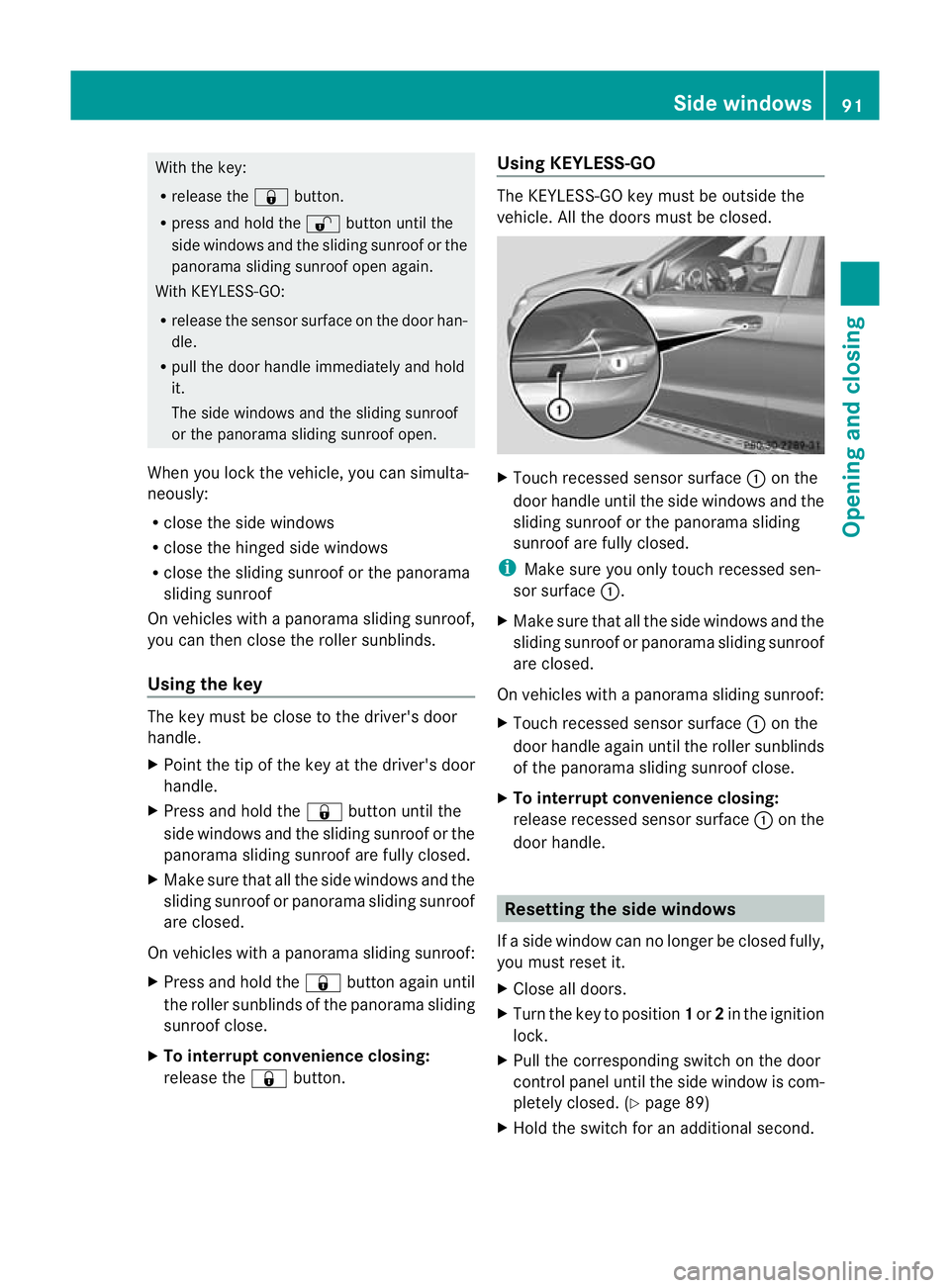
release the &button. Using KEYLESS-GO The KEYL
ESS-GO key must be outside the
vehicle. All the doors must be closed. X
Touch recesse dsensor surface :on the
door handle until the side windows and the
sliding sunroof or the panorama sliding
sunroof are fully closed.
i Make sure you only touc hrecessed sen-
sor surface :.
X Make sure that all the side windows and the
sliding sunroof or panorama sliding sunroof
are closed.
On vehicles with apanorama sliding sunroof:
X Touch recessed senso rsurface :on the
door handle again until the roller sunblinds
of the panorama sliding sunroof close.
X To interrupt convenienc eclosing:
release recessed sensor surface :on the
door handle. Resetting the side windows
If as ide window can no longer be closed fully,
you must reset it.
X Close all doors.
X Turn the key to position 1or 2in the ignition
lock.
X Pull the corresponding switch on the door
control panel until the side window is com-
pletely closed. (Y page 89)
X Hold the switch for an additional second. Side windows
91Opening and clos ing Z
Page 95 of 441

If th
eside window opens again slightly:
X Immediately pul lthe correspondin gswitch
on the door control panel until the side win-
dow is completely closed (Y page 89).
X Hold the switch for an additional second.
X If the corresponding side window remains
closed after the button has been released,
the side window has been reset correctly.
If this is not the case, repea tthe steps
abov eagain. 92
Side windowsOpening and closing
Page 96 of 441
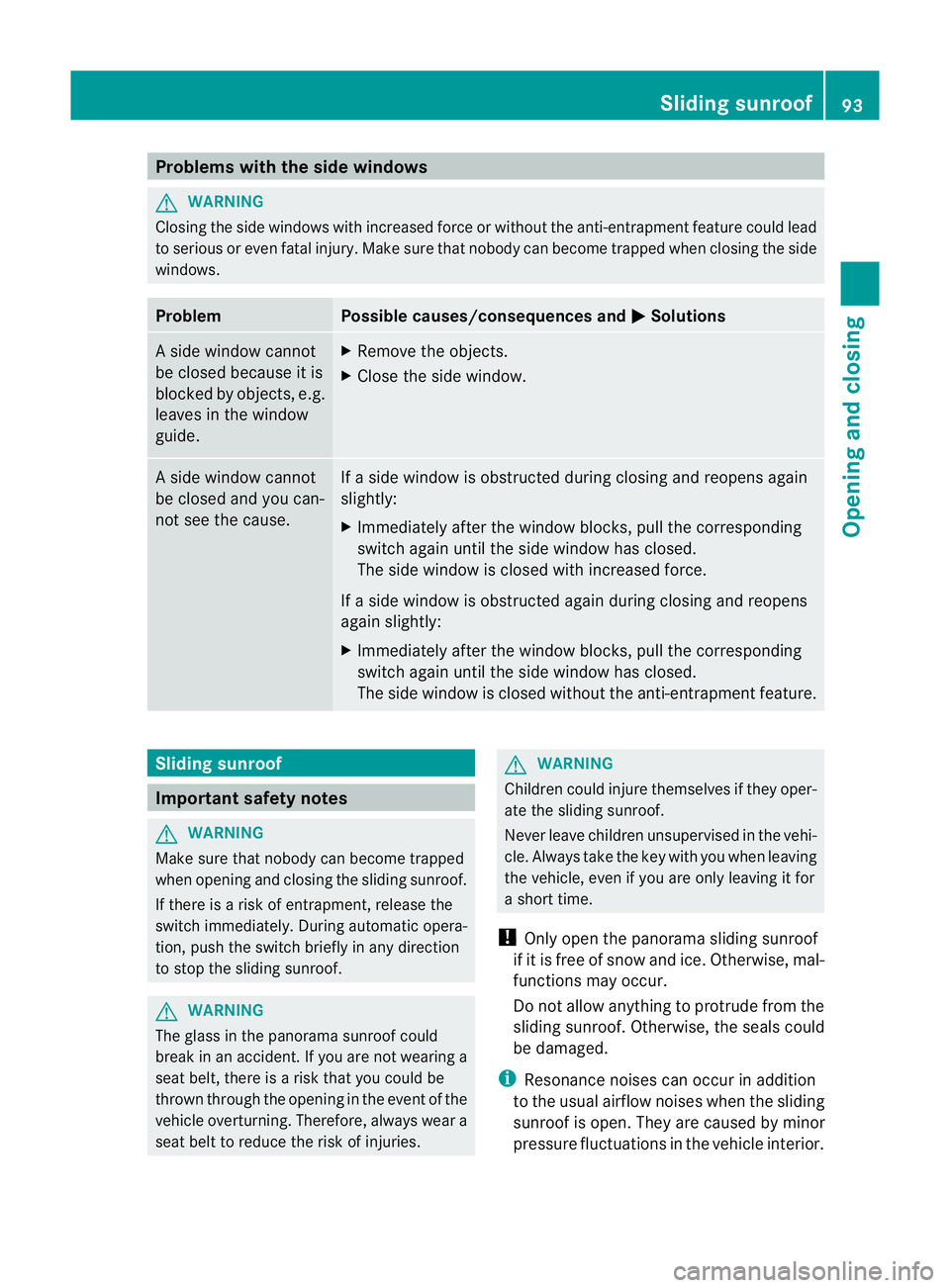
Problems wit
hthe side windows G
WARNING
Closing the side windows wit hincrease dforc eorw ithout the anti-entrapment featur ecould lead
to seriou soreven fata linjury. Make sure that nobody can become trappe dwhen closing the side
windows. Problem Possible causes/consequences and
M Solutions
As
ide window cannot
be closed because it is
blocked by objec ts,e .g.
leave sinthe window
guide. X
Remove the objects.
X Close the side window. As
ide window cannot
be closed and you can-
not see the cause. If
as ide window is obstructed durin gclosing and reopen sagain
slightly:
X Im me diately after the window blocks, pull the corresponding
switc hagain until the side window has closed.
The side window is closed with increased force.
If as ide window is obstructed again durin gclosing and reopens
again slightly:
X Im me diately after the window blocks, pull the corresponding
switc hagain until the side window has closed.
The side window is closed without the anti-entrapmen tfeature. Sliding sunroof
Important safet
ynotes G
WARNING
Make sure that nobody can become trapped
when openin gand closing the sliding sunroo f.
If there is arisk of entrapment ,release the
switch immediately .Durin gautomatic opera-
tion, push the switch briefly in any direction
to stop the sliding sunroof. G
WARNING
The glass in the panorama sunroof could
break in an accident .Ifyou are not wearing a
seat belt, ther eisar isk that you could be
thrown through the openin ginthe even tofthe
vehicle over turning.Therefore, always wear a
seat belt to reduce the risk of injuries. G
WARNING
Children coul dinjure themselves if they oper-
ate the sliding sunroof.
Never leave children unsupervise dint he vehi-
cle. Always tak ethe key with you when leaving
the vehicle, even if you ar eonly leaving it for
as hort time.
! Only open the panoram asliding sunroof
if it is free of snow and ice. Otherwise, mal-
func tions ma yoccur.
Do not allo wanything to protrude from the
sliding sunroof. Otherwise, the seals could
be damaged.
i Resonance noises can occur in addition
to the usua lairflow noises when the sliding
sunroof is open. They are caused by minor
pressure fluctuations in the vehicle interior. Slidin
gsunroof
93Openingand closing Z