warning MERCEDES-BENZ GL SUV 2012 Owner's Manual
[x] Cancel search | Manufacturer: MERCEDES-BENZ, Model Year: 2012, Model line: GL SUV, Model: MERCEDES-BENZ GL SUV 2012Pages: 441, PDF Size: 10.66 MB
Page 45 of 441
nor do they provid
eanindicatio nofairbag
deployment.
The vehicle may be deformed significantly,
e.g. the bonnet or the wing, withou tanairbag
being deployed. This is the case if only parts
which are relatively easily deformed are affec-
ted and the rat eofdeceleration is not high.
Conversely, airbags may be deployed even
though the vehicle suffers only minor defor-
mation. This is the case if, for example, very
rigid vehicle part ssuch as longitudinal body
members are hit, and sufficien tdeceleration
occu rsas aresult.
i The fron tbelt tensioners can only be trig-
gered if the seat belt tongues on the front
seats are cor rectly engage dinthe seat belt
buckles.
i Not all airbags ar edeployed in an acci-
dent .The different airbag system swork
independently of each other.
How the airbag system work sisdeter-
mined by the severity of the accident detec-
ted, especially the vehicle deceleration or
acceleration, and the apparent type of acci-
dent:
R head-on collision
R side impact
R overturn Airbags
Important safety notes G
WARNING
Airbags provide additional protection; they
are not, however ,asubstitute for seat belts.
Observe the following notes to reduce the risk
of serious or even fatal injury caused by airbag
deployment:
R all vehicle occupants –inparticular ,preg-
nant women –must wear their seat belt
correctly at all times and lean back against
the backrest, which should be posi tioned
as close to th evertical as possible. The head restraint must support th
eback of the
head at about eye level.
R always secur echildren less than
1.50 mtall or under 12 years of age in suit-
able child restraint systems.
R all vehicle occupant smust select aseat
position that is as far away from the airbag
as possible. The driver' sseat position must
allow the vehicle to be driven safely .The
driver's chest should be as fa raway from
the centre of the driver' sairbag cover as
possible.
R move the front-passenger seat as far back
as possible .This is especially important if
you hav esecured achild in achild rest raint
system on the front-passenger seat.
R vehicle occupant s–inparticular ,children
–m ust not lean their heads into the area of
the window in which the sidebag/window-
bag is deployed.
R rearward-facing child restraint systems
must not be fit tedtot he front-passenger
seat unless the front-passenger airbag has
been disabled. On the front-passenger
seat, the front-passenger airbag is disabled
if ac hild rest raint system with atrans-
ponde rfor automatic child seat recognition
is fit tedtot he front-passenger seat in a
vehicle equipped with automatic chil dseat
recognition. The 4PASSENGE RAIRBAG
OF Findicator lamp must be continuously
lit.
If the front-passenger sea tofyour vehicle
does not have automatic child seat recog-
nition ,oryour rearward-facing child
rest raint system does not have atrans-
ponde rfor automatic child seat recogni-
tion ,children must be secured in achild
rest raint system on asuitable seat in the
rear. If you secure aforward-facing child
rest raint system to the front-passenger
seat, you must move the front-passenger
seat as far back as possible.
R make sure there are no heavy or sharp-
edged objects in the pockets of clothing. 42
Occupant safetySafety
Page 46 of 441
R
do not lean forwards, e.g. over the cover of
the driver's/front-passenger fron tairbag,
particularly when the vehicle is in motion.
R do not put your feet on the dashboard.
R only hold the steering wheel on the outside.
This allows the airbag to be fully deployed.
You could be injured if the airbag is
deployed and you are holding the inside of
the steering wheel.
R do not lean on the doors from inside the
vehicle.
R make sure that ther eare no people ,ani-
mals or obje ctsb etween the vehicle occu-
pants and the area where the airbags are
deployed.
R do not place any objects between the seat
back rest and the door.
R do not hang any har dobjects, e.g. coat
hangers ,onthe gra bhandles or coat hooks.
R do not attac haccessories ,e.g. cup holders,
to the doors.
It is not possible to rule out arisk of injury
being caused by an airbag, due to the high
speed at which the airbag must be deployed. G
WARNING
Airbag functionality can only be assured if the
following parts are not covered and no badges
or stickers are attached to them:
R padded steering wheel boss
R kneebag cover below the steering column
R front-passenger airbag cover
R outer side of seat bolsters G
WARNING
When an airbag deploys, asmall amount of
powder is released. Th epowder may cause
short-term breathin gdifficulties to persons
sufferin gfrom asthma or other pulmonary
conditions.
In order to prevent potentia lbreathing diffi-
culties, you should leave th evehicle as soon
as it is safe to do so. You can also open the
window to allow fresh air to enter the vehicle interior
.The powder does not constitute a
healt hhazard and does not indicat ethat there
is af ire in the vehicle. G
WARNING
The airbag parts are hot after the airbag has
been deployed. Do not touch them as you
could burn yourself.
Have the airbags replaced at aqualified spe-
cialist workshop. Otherwise, occupants are
not protected by the airbags in the event of
another accident.
Airbag deployment slow sdown and restric ts
the movement of the vehicle occupant.
If the airbags are deployed ,you will hear a
bang and asmall amount of powder may also
be released. Only in rare cases will th ebang
affect your hearing. The powde rthat is
released generally does not constitute a
healt hhazard. The 6SRS warning lamp
lights up.
The airbag installation location sare identified
by th eAIRBAG symbol.
Front airbags !
Do no tplace heavy objects on the front-
passenger seat. The system may then
detec tthat the seat is occupied and if there
is an accident ,the restraint system sonthe
front-passenger side could be deployed.
Hav erestraint system sthat hav ebeen trig-
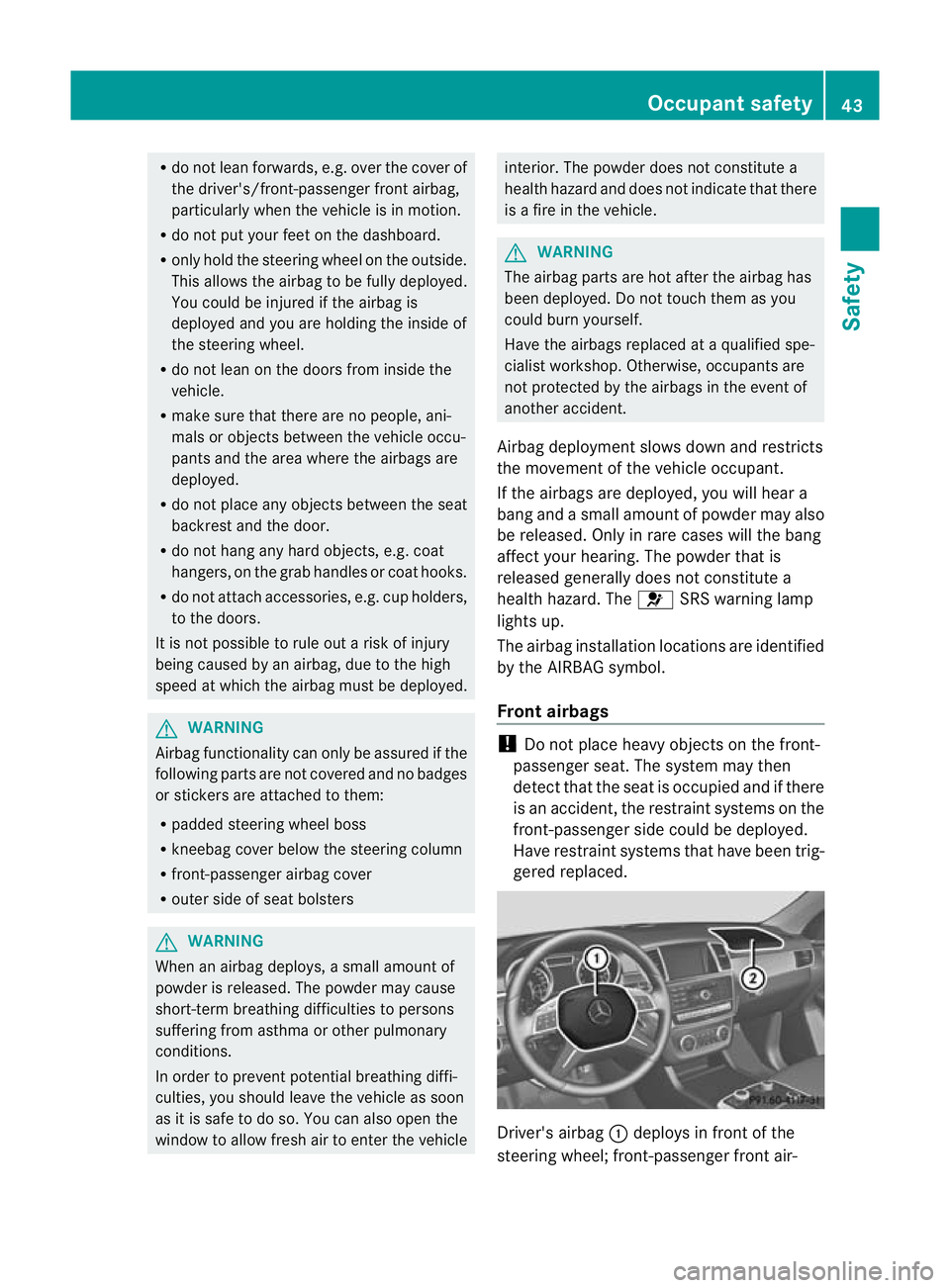
gered replaced. Driver's airbag
:deploys in front of the
steerin gwheel; front-passenger front air- Occupant safety
43Safety Z
Page 47 of 441
bag
;deploys in fron tofand above the glove
compartment.
The front airbags incre aseprotection for the
driver's and front-passenger's hea dand
chest.
The yare deployed:
R at th estart of an accident with ahigh rate
of vehicl eacceleratio nordeceleration in a
longitudina ldirection
R if the system determines that airbag
deployment can offer additional protection
to that provided by the seat belt
R depending on whether the seat belt is being
used
R independently of other airbags in the vehi-
cle
If the vehicle overturns, the fron tairbags are
generally not deployed. The fron tairbags are
deployed if the system detec tshigh vehi cle
deceleration in alongitudinal direction.
Vehicles with au tomatic child seat recog-
nition in th efront-passenger seat: the
fr ont-passenge rairbag is only activated if the
system determines that the fron t-passenger
seat is occupied. The 4PASSENGE RAIR-
BA GO FF indi cator lamp on the centr econ-
sole does not light up (Y page 52).
If ac hild restraint system is fitted on the fr ont-
pa ssenger seat and the 4PASSENGER
AIRB AGOFF indicato rlam pint he centr econ-
sol ed oesn ot light up:
R ac hild restraint system withou tatrans-
ponder for automatic child seat recognition
is fitted, or
R ac hild rest raint system with atransponder
for automatic child seat recognition is not
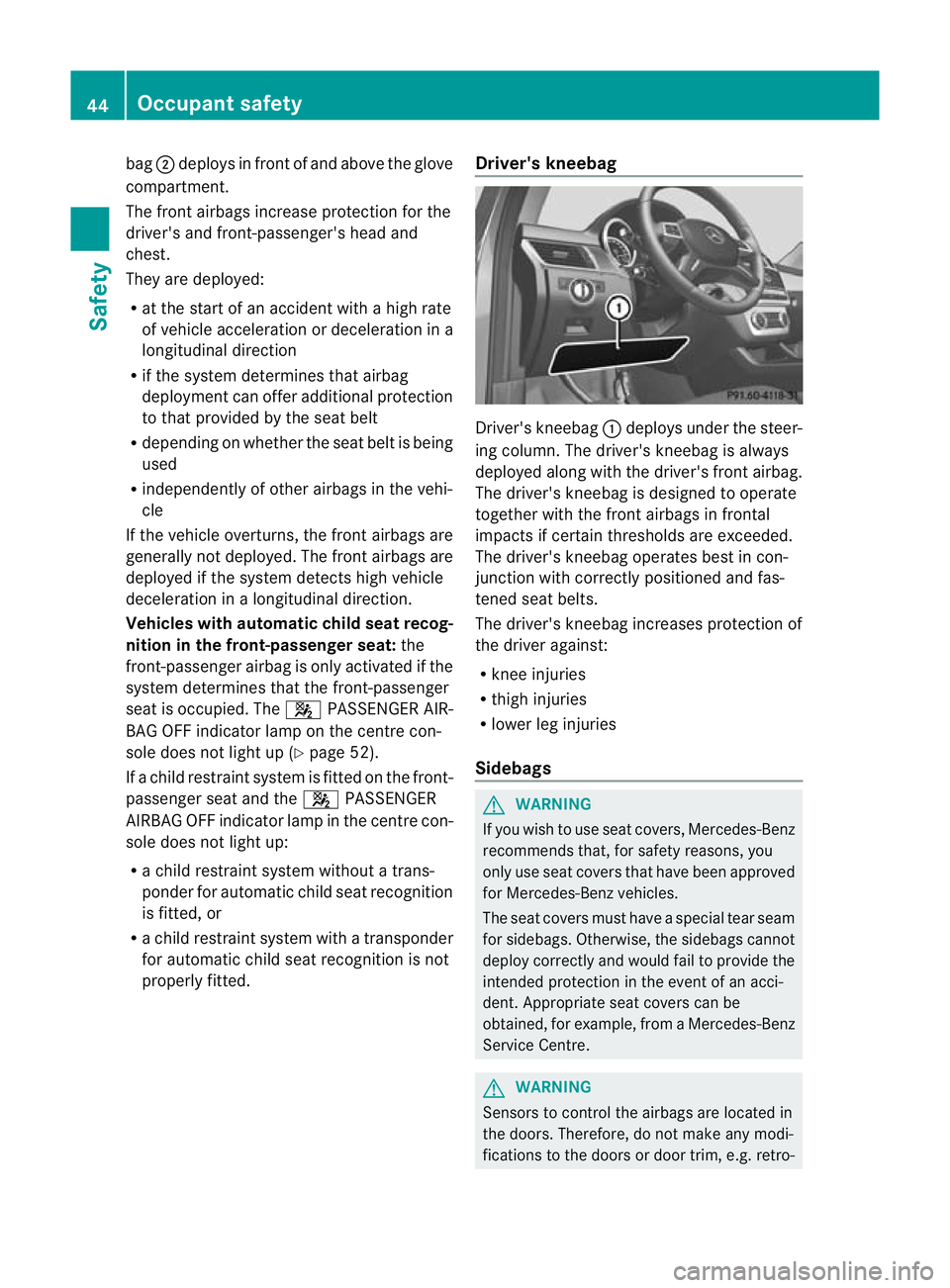
properly fitted. Driver's kneebag Driver'
skneebag :deploys under the steer-
ing column. The driver's kneebag is always
deploye dalong with the driver's front airbag.
The driver's kneebag is designed to operate
together with the front airbags in frontal
impact sifcertain thresholds are exceeded.
The driver' skneebag operates bes tincon-
jun ction with correctly positioned and fas-
tened seat belts.
The driver's kneebag increases protection of
the driver against:
R knee injuries
R thigh injuries
R lower leg injuries
Sidebags G
WARNING
If you wish to use seat covers, Mercedes-Benz
recommends that, for safety reasons, you
only use seat cover sthat hav ebeen approved
for Mercedes-Benz vehicles.
The seat covers must have aspecial tear seam
for sidebags. Otherwise, the sidebags cannot
deploy correctly and would fail to provide the
intended protection in the event of an acci-
dent. Appropriate seat cover scan be
obtained, for example, from aMercedes-Benz
Servic eCentre. G
WARNING
Sensor stocontrol the airbags are located in
the doors. Therefore, do not mak eany modi-
fications to the doors or doo rtrim, e.g .retro- 44
Occupant safetySafety
Page 48 of 441
fitting lo
udspeakers. Damag etothe doors
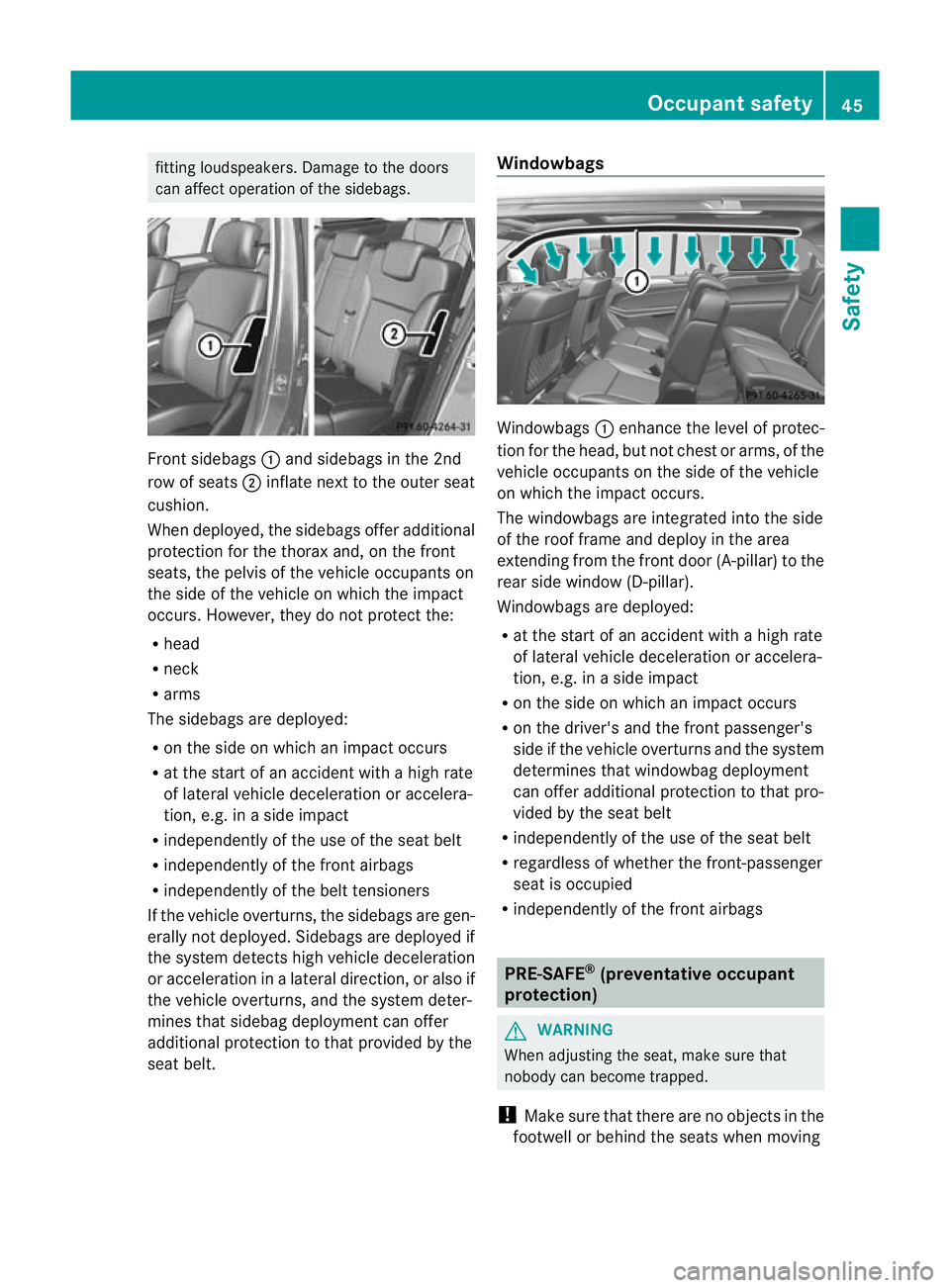
can affec toperation of the sidebags. Front sidebags
:and sidebag sinthe 2nd
row of seats ;inflate nex ttothe outer seat
cushion.
When deployed, the sidebag soffer additional
protectio nfor the thorax and, on the front
seats, the pelvis of the vehic leoccupants on
the side of the vehic leon which the imp act
occurs. Howev er,they do not protect the:
R head
R neck
R arms
The sidebag sare deploy ed:
R on the side on which an imp acto ccurs
R at the start of an accident with ahigh rate
of lateral vehicle deceleration or accelera-
tion, e.g. in aside impact
R independently of the use of the sea tbelt
R independently of the fron tairbags
R independen tlyo fthe belt tensioners
If the vehi cleo verturns, th esidebags are gen-
erally not deployed. Sidebags are deployed if
the system detects high vehicle deceleration
or acceleration in alatera ldirection, or als oif
the vehicl eoverturns ,and the system deter-
mines that sid ebag deployment can offer
additiona lprotectio ntothat provided by the
seat belt. Windowbags
Windo
wbags :enhance the leve lofprotec-
tio nfor the head, but not chest or arms, of the
vehicle occupants on the side of the vehicle
on which the impact occurs.
The windowbags ar eintegrate dinto the side
of the roof frame and dep loyint he area
extendin gfrom th efront door (A-pi llar) to the
rear side windo w(D-pillar).
Windo wbagsa re deploy ed:
R at the start of an accident with ahigh rate
of lateral vehicle deceleration or accelera-
tion ,e.g. in asidei mpact
R on th esideonw hich an impact occurs
R on the driver's and the front pass enger's
sid eift he vehicle overturns and the system
determines that windowbag deployment
can off eradditiona lprotectio ntothat pro-
vided by the sea tbelt
R independently of the use of the seat belt
R regardless of whether the front-passenger
seat is occupied
R independently of the fron tairbags PRE-SAFE
®
(preventative occup ant
protection) G
WARNING
Whe nadjusting the seat ,makes ure that
nobody can become trapped.
! Make sure that there are no object sinthe
footwell or behin dthe seat swhen moving Occup
ants afety
45Safety Z
Page 49 of 441
the seat back. There is
arisk thatthe seats
and/or the objec ts could be damaged.
PRE-SAFE ®
takes pre-emptive measures to
protect occupants in certain hazardous sit-
uations.
PRE-SAFE ®
intervenes:
R if BAS activates, e.g. in emergency braking
situations
R if BAS PLUS intervenes powerfull y—on
vehicles wit hDISTRONIC PLUS
R if, on vehicles with DISTRONIC PLUS, the
radar sensor system detects an imminent
dang er of collision in cer tain situations
R in critical drivin gsituations, e.g. when phys-
ical limits are exceeded and the vehicle
understeers or oversteers severely
PRE-SAFE ®
takes the following measures
depending on the hazardous situation detec-
ted:
R the front seat belts are pre-tensioned.
R vehicles with the memor yfunction: the
front-passenger seat is adjusted if it is in an
unfavourable position.
R vehicles with amulticontour seat: the air
pressure in the side bolsters of the back-
rest is increased.
R if the vehicle skids ,the slidin gsunroof/
panorama sliding sunroof and the side win-
dows are closed so that only asmall gap
remains.
If th ehazardous situation passe swithout
resulting in an accident ,PRE-SAFE ®
slackens
the belt pretensioning. On vehicles with mul-
ticontour seats ,the air pressur einthe side
bolster sisreduced again. All settings made
by PRE- SAFE®
can the nbereversed.
If the seat belts are not released:
X Move the backrest or seat back slightly, but
only when the vehicle is stationary.
The belt pretensioning is reduced and the
locki ng mech anism is released.
More information about seat belt adjustment,
ac onvenien ce function integ rated into PRE- SAFE
®
,c an be found in the "Seat belt adjust-
ment "section (Y page 48). Seat belts
Important safety notes G
WARNING
As eat belt which is not worn correctly, or
which has not been engaged in the seat belt
buckle correctly, can notp rovide th eintended
level of protection. Under certain circumstan-
ces, this could cause severe or even fatal inju-
ries in the event of an accident.
Therefore, make sure that all occupants —in
particular ,pregnant women —wear their seat
belts cor rectly at all times.
R Th es eat belt must fit snugly on your body
and must not be twisted.Therefore, avoid
wearing bulky clothing, e.g. awinter coat.
The shoulder section of the belt must be
routed across the centre of your shoulder
—onnoa ccount acros syour nec korunder
your arm —and pulled tight against your
uppe rbody. The lap belt must always pass
across your lap as low down as possible, i.e.
over your hip join ts—n ot across your abdo-
men .Ifn ecessary, push the seat belt
slightly downwards and adjust it by pulling
it in the direction the seat belt retracts.
R Do not rout ethe seat belt strap over sharp
or fragile objec ts.P lease make sure that
such object sare not on or in your clothing,
e.g .spectacles, pens or keys etc. The seat
belt strap could become damaged and tear
durin gana ccident and you or other vehicle
occupants coul dbeinjured.
R Only one person should use each sea tbelt
at any one time. Children must never travel
sittin gont he lap of another occupan t.The
child will not be secured in the even tofan
accident ,heavy braking or sudden change
of direction .This ma yresult in the child or
other occupants being seriously or fatally
injured. 46
Occupant safetySafety
Page 50 of 441
R
Persons under 1. 50mtall cannot wear the
seat belts correctly. For this reason secure
person sless than 1.50 mtall in specially
designed, suitable restraint systems.
R Children under 1. 50mt all and younger
than twelv eyears of age canno twear the
seat belts cor rectly. For thi sreason secure
them in special suitable child restraint sys-
tems installed on asuitable seat. Additional
information can be found in the Operating
Instructions in the chapter "Safety", "Chil-
dren in the Vehicle". Observe the installa-
tion instructions of the child restraint sys-
tem manufac turer.
R Do not secure an object wit haseat belt if
the seat belt is also being used by one of
the vehicle's occupants. G
WAR
NING
The seat belt doe snot offer the intended level
of protection unless the back rest is almost
ver tical. Under certain circumstances, this
coul dcause severe or even fatal injuries in the
event of an accident.
Befor estarting ajourney, mak esure that the
seat is properly adjusted and that the back-
rest is almost vertical. G
WARNING
Ad irtyo rdamaged seat belt or one that has
been modified or subjected to aload in an
accident no longer offers the intended level of
protection. Un dercertain cir cumstances, this
could caus esever eoreven fatal injurie sinthe
even tofana ccident.
For thi sreason ,chec kregularly that the seat
belts are not damaged or dirty.
Alway shave damaged seat belts or seat belts
that have been subjected to aload in an acci-
dent replaced at aqualified specialist work-
shop.
For safety reasons, Mercedes -Benz recom-
mends that you only use seat belts which have
been approved by Mercedes-Benz for your
vehicle. Seat belts are the most effectiv
emeans of
restraining the movemen tofvehicle occu-
pant sint he even tofanaccident. This
reduce sthe risk of vehicle occupan tscoming
into contact with parts of the vehicle interior.
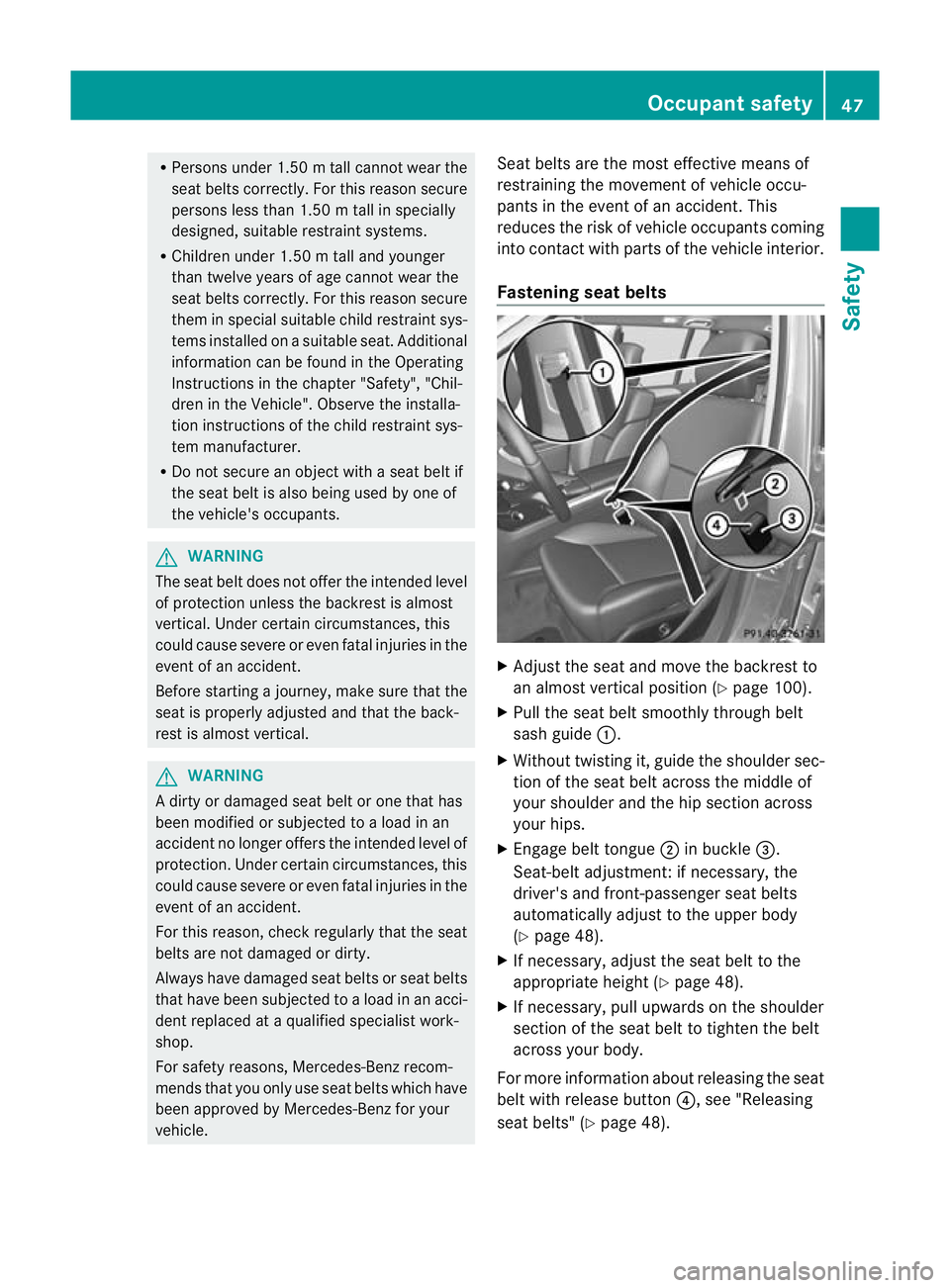
Fastenin gseat belts X
Adjust the seat and move the backrest to
an almost vertical position (Y page 100).
X Pull the seat belt smoothly through belt
sash guide :.
X Without twistin git, guid ethe shoulder sec-
tion of the seat belt across the middle of
your shoulder and the hip section across
your hips.
X Engage belt tongue ;in buckle =.
Seat-belt adjustment :ifnecessary, the
driver' sand front-passenger sea tbelts
automatically adjust to the upper body
(Y page 48).
X If necessary, adjust the seat belt to the
appropriate height (Y page 48).
X If necessary, pull upwards on the shoulder
section of the seat belt to tighten the belt
across your body.
For mor einformation about releasing the seat
bel tw ith release button ?,see "Releasing
seat belts" (Y page 48). Occupant safety
47Safety Z
Page 51 of 441
Sea
tbelt adjustment The seat-belt adjustment func
tion adjusts the
driver's and front-passenger seat belt to the
upper body of the occupants.
The belt strap is tighte neds lightly when:
R you engage the belt tongue in the belt
buckle and you then turn the key to position
2in the ignition lock.
R the key is in position 2in the ignition lock
and you then engage the belt tongue in the
buckle.
The seat-belt adjustment will apply acertain
tightening force if any slack is detected
between the occupant and the seat belt. Do
not hold on to the seat belt tightly while it is
adjusting. You can switch the seat-belt
adjustmen tonand off in the on-board com-
puter (Y page285).
Th es eat-belt adjustmen tisani ntegral part of
the PRE-SAFE ®
convenience function. More
information abou tPRE-SAFE ®
can be found
under "PRE-SAFE ®
(preventative occupant
protection)" (Y page 45).
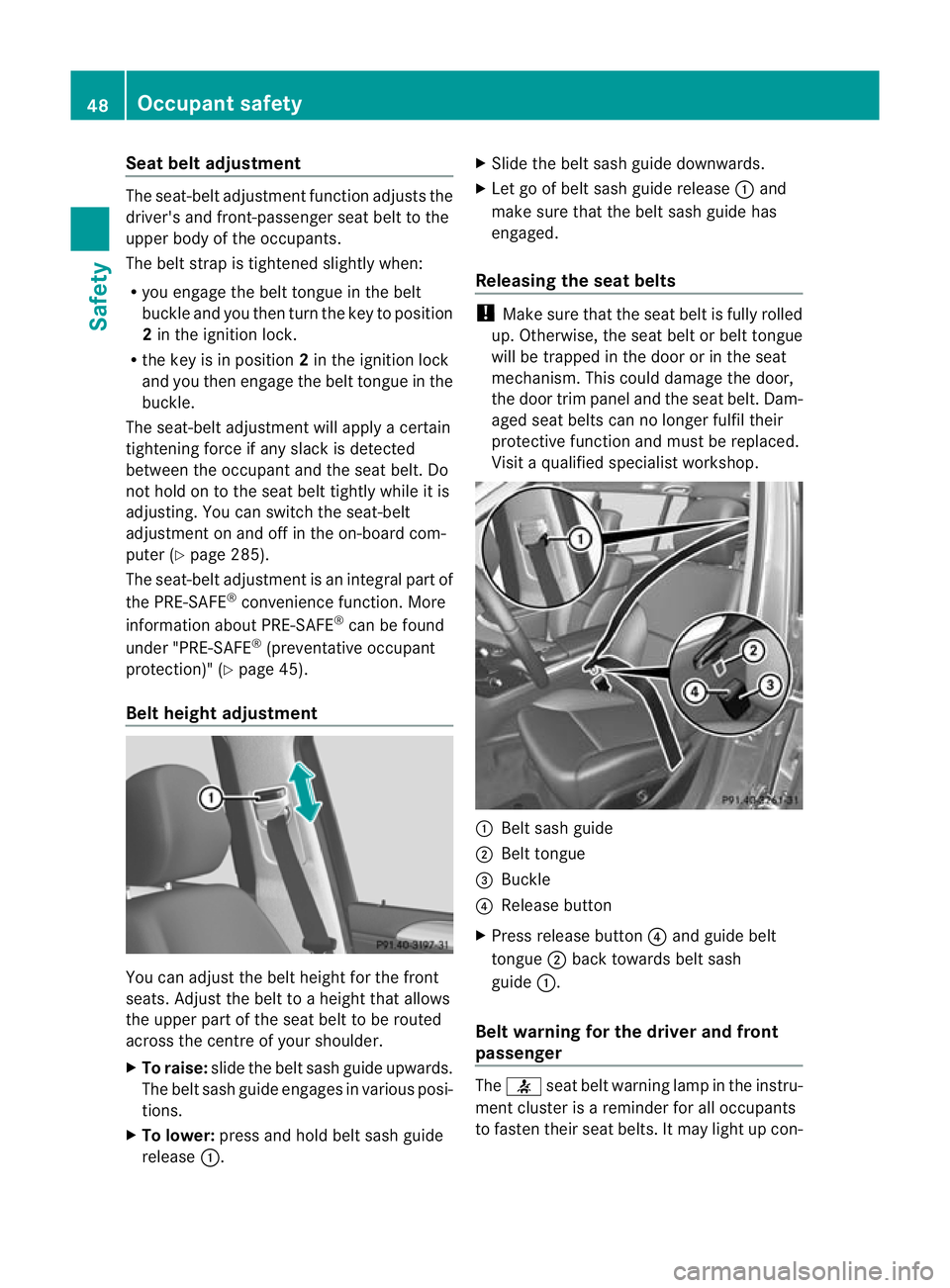
Belt height adjustment You can adjust the belt height for the front
seats
.Adjust the belt to aheight that allows
the upper part of the seat belt to be routed
across the centre of your shoulder.
X To raise: slide the belt sash guide upwards.
The belt sash guide engages in various posi-
tions.
X To lower: press and hold belt sash guide
release :. X
Slide the belt sash guide downwards.
X Let go of belt sash guide release :and
mak esure that the belt sash guide has
engaged.
Releasing the seat belts !
Make sure that the seat belt is fully rolled
up. Otherwise, the seat belt or belt tongue
will be trapped in the door or in the seat
mechanism. This could damage the door,
the door trim panel and the seat belt. Dam-
aged seat belts can no longer fulfil their
protective function and must be replaced.
Visit aqualified specialist workshop. :
Belt sash guide
; Belt tongue
= Buckle
? Release button
X Press release button ?and guide belt
tongue ;back towards belt sash
guide :.
Belt warning for the driver and front
passenger The
7 seat belt warning lamp in the instru-
ment cluster is areminder for all occupants
to fasten their seat belts. It may light up con- 48
Occupant safetySafety
Page 52 of 441
tinuousl
yorflash. In addition, th erem ay be a
warning tone.
The 7 seat belt warning lamp goes ou tand
the warning tone ceases when the driver and
the front pass enger hav efastened their seat
belt.
For certain coun tries only: regardless of
whether th edriver and the front passenger
have fastened their seat belts, the 7seat
bel tw arning lamp lights up for six seconds
after the engin eisstarted. It then goes out if
th ed river and the front passenger have fas-
tened thei rseat belts.
i For mor einformation on the 7seat
bel twarning lamp, see "Indicator and warn-
in gl am ps in the instrument cluster ,seat
belt" (Y page 325).
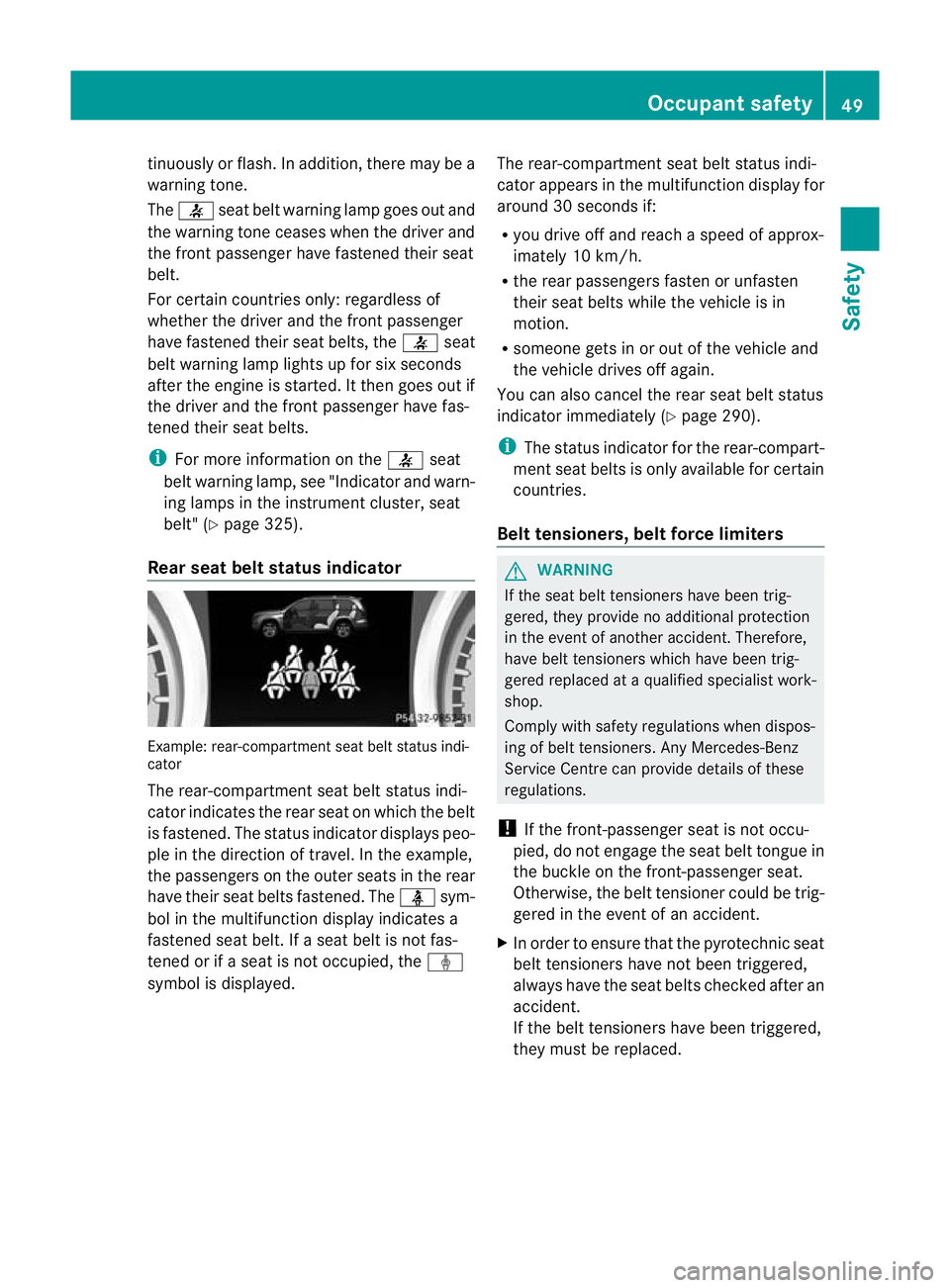
Rear seat belt status indicator Example: rear-compartment sea
tbelts tatus indi-
cator
The rear-comp artment sea tbelt status indi-
cator indicates the rear seat on which the belt
is fastened. The status indicator displays peo-
ple in the direc tion of travel. In the example,
the passenger sonthe outer seats in the rear
hav etheir seat belts fastened. The üsym-
bol in the multifunction displa yindicates a
fastened sea tbelt. If aseat belt is not fas-
tened or if aseat is not occupied, the ý
symbol is displayed. The rear-compartment seat belt status indi-
cator appear
sint he multifunction displa yfor
around 30 seconds if:
R you drive off and reach aspeed of approx-
imately 10 km/h.
R the rear passengers fasten or unfasten
their seat belts while the vehicle is in
motion.
R someon egets in or out of the vehicle and
the vehicle drives off again.
You can also can celthe rea rseat belt status
indicator immediately (Y page 290).
i The status indicator for the rear- compart-
ment seat belts is only available for certain
countries.
Bel ttensioners, belt force limiters G
WARNING
If the seat belt tensioners have been trig-
gered, they provide no additional protection
in the event of another accident. Therefore,
have belt tensioners which have been trig-
gered replaced at aqualified specialist work-
shop.
Comply with safety regulations when dispos-
ing of belt tensioners. An yMercedes-Benz
Ser vice Centre can provid edetails of these
regulations.
! If the front-passenger seat is not occu-
pied, do not engage the seat belt tongue in
the buckl eonthe front-passenger seat.
Otherwise, the belt tensioner could be trig-
gere dint he even tofanaccide nt.
X In order to ensur ethat the pyrotechnic seat
belt tensioner shave not been triggered,
alway shave the seat belts checked after an
accident.
If the belt tensioners have been triggered,
they must be replaced. Occupant safety
49Safety Z
Page 53 of 441
The seat belts on the following seats have belt
tensioner
sand bel tforc elimiters:
R driver's and front-passenger seat
R the outer seats in the second row
R the seats in the third row
The belt tensioners tighten the seat belts in
an accident ,pulling them close against the
body.
Belt tensioners do not correc tincorrect seat
positions or incorrectly fastened sea tbelts.
Belt tensioners do not pull vehicle occupants
back towards the backrest.
If the seat belt is also fit tedw ithabelt force
limiter and this is triggered, the force exer ted
by the seat belt on the vehicle occupant is
reduced.
The belt force limiters for the fron tseats are
synchronised with the fron tairbags, which
tak eona part of the deceleration force. This
result sinthe force exerted on the occupant
being distributed over agrea tera rea.
Th eb elt tensioners can only be activa ted
when:
R the ignition is switched on.
R the restraint system sare opera tional; see
"SR Swarnin glamp" (Y page 41).
The belt tensioners on the outside seats in the
second row and on the seats in the thir drow
ar et riggere dindependently of the lock status
of the sea tbelts.
The belt tensioners are triggere ddepending
on the type and severity of an accident:
R if, in the even tofahead-on or rear-end col-
lision, the vehicle decelerates or acceler-
ates rapidly in alongitudinal direction dur-
ing the initial stages of the impact
R if, in the even tofaside impact, on the side
opposit ethe impac tthe vehicle deceler-
ates or accelerates rapidly in alateral direc-
tion
R in certain situations where the vehicle over-
turns and the system determines that it can
provide additional protection If the airbags are deplo
yed,you will hear a
bang, and asmall amount of powder may also
be released. Only in rare cases will th ebang
affect your hearing. The powde rthat is
released generally does not constitute a
healt hhazard. The 6SRS warning lamp
lights up. Children in the vehicle
Child restraint systems
Important safety notes G
WARNING
To reduce the risk of serious or even fatal
injury to the child in the event of asudden
change in direction, braking or an accident:
R children less than 1.50 mtall and under
twelve years of age must always be secured
in special child restraint systems on asuit-
able vehicle seat. This is necessary
because the seat belts are not designed for
children.
R Do not drive with achild secured in arear-
ward-facing child restraint system on the
front-passenger seat. Exception: if the vehi-
cle is equipped with automatic child seat
recognition on the front-passenger seat
and the child is secured in achild restraint
system with transponders for automatic
chil dseat recognition
R if you secur eaforward-facing child
restraint system to the front-passenger
seat, you must mov ethe front-passenger
seat as fa rback as possible.
R children must never travel sitting on the lap
of another occupant. Due to the forces
which occur in the event of asudden
change of direction, heavy braking or an
accident, it would not be possible to
restrain the child. The child could be thrown
against parts of the vehicle interior and be
seriously or even fatally injured. 50
Children in the vehicleSafety
Page 54 of 441
G
WARNING
Do not le avec hildren unsupervised in the
vehicle, even if they ar esecur edinac hild
restraint system .They could injur ethem-
selv eson parts of the vehicle. They could also
be seriously or even fatally injure dbypro-
longe dexpos uretoe xtreme hea torcold.
Do not expose the child restraint system to
direct sunlight. Part softhe chil drestraint sys-
tem could heat up and the child could burn
herself/himself on them.
If ac hild opens adoor, the child or other per-
sons coul dbeinjured as aresult. They could
get out and injure themselves or be injured by
ap assing vehicle.
Observe the general notes on the HOLD func-
tion, which can be found under the same key-
word. G
WARNING
Unsecured or incorrectly positioned loads
increase the risk of injury for children and all
other occupant sinthe even tof:
R an accident
R sudden braking
R as udden change of direction
Do not transpor theavy or hard objects in the
vehicle interior unless they are secured. You
will fin dfurther information under "Loading
guidelines" in the index.
If ac hild is travellin ginyour vehicle, secure
the child using achild restraint system that is
recommended for Mercedes-Ben zvehicles.
The child restraint system must be appropri-
ate to the age, weight and size of the child.
You should preferabl yfit the child restraint
system to asuitable rear seat. Make sure that
the child is secured for the trip.
Mercedes -Benz recommends that you use
the listed child restraint systems
(Y page 58). You can obtain further infor-
mation about the cor rect chil drestraint sys-
tem from any Mercedes-Benz Ser vice Centre. i
It is advisabl etou se Mercedes-Ben zcare
product stoclean child restraint systems.
You can obtain information about this at
any Mercedes-Benz Service Centre.
Child restraint system on the front-
passenger seat G
WAR
NING
If the front-passenge rairbag is not disabled:
R ac hild secured in achild rest raint system
on the front-passenger seat could be seri-
ously and even fatally injured by the front-
passenger airbag deploying. This is espe-
cially arisk if the child is in the immediate
vicinit yofthe front-passenger airbag when
it deploys.
R never secur eachild on the front-passenger
seat in arearward-facing child restraint sys-
tem. Only secur earearward-facing child
restraint system on asuitable rear seat.
R alway smove the front-passenger seat to
the rearmost position if you secur eachild
in af orward-facing child rest raint system
on the front-passenger seat.
The front-passenger airbag is not disabled:
R on vehicles without automatic child seat
recognition on the front-passenger seat
R in vehicles with automatic child seat rec-
ognition in the front-passenger seat, if no
special child restraint system with trans-
ponders for automatic child seat recogni-
tion in the front-passenger seat has been
fitted
R on vehicles with automatic child seat rec-
ognition on the front-passenger seat, if the
PASSENGER AIRB AGOFF indicator lamp
4 is not lit.
To make you aware of this danger, acorre-
spondin gwarning sticker has been affixed on
the dashboard and on both sides of the sun
visor on the front-passenger side.
Information about recommended child
restraint systems is available at any
Mercedes-Benz Service Centre. Children in th
evehicle
51Safety Z