snow chains MERCEDES-BENZ GL SUV 2012 Owners Manual
[x] Cancel search | Manufacturer: MERCEDES-BENZ, Model Year: 2012, Model line: GL SUV, Model: MERCEDES-BENZ GL SUV 2012Pages: 441, PDF Size: 10.66 MB
Page 64 of 441
Important safety notes
If you fail to adapt your driving style or
become distracted, th edriving sa fetysys-
tems ca nneith er reduce th erisk of accident
no ro verri dethe law sofphysics. Driving
safety system sare mere ly aids desig nedto
assis tdrivi ng.You ar eresponsible for the dis-
tance to the vehicle in fr ont, forvehicle speed
and for braking in good time. Alway sadapt
your drivin gstyle to suit the prevailing road
and weather condition sand maintain asafe
distance from the vehicle in front .Drive care-
fully.
i Thed riving safet ysystems described only
work as effectively as possibl ewhen there
is adequate con tact betwee nthe tyres and
the roa dsurface. Pleas epay special atten-
tion to the notes on tyres, recommended
minimum tyre tread depths ,etc.
(Y page 396).
In wintry driving conditions, always use
winter tyres (M+S tyres) and if necessary,
snow chains .Only in this way will the driv-
ing safety systems described in this section
work as effectively as possible. ABS (Anti-lock Braking System)
Important safety notes i
Observe the "Important safety notes" sec-
tion (Y page61). G
WARNING
If ABS is faulty, the wheels could lock when
braking .The steerability and brakin gcharac-
teristics ma ybeseverely impaired. Addition-
ally, further driving safet ysystems are deac-
tivated. There is an increased danger of skid-
ding and accidents.
Drive on carefully. Have ABS checked imme-
diatel yata qualified specialist workshop.
When ABS is malfunctioning, other systems,
including driving safety systems, will also
become inoperative. Observe the infor mation on the ABS warning lamp (Y
page 326) and
display messages which may be shown in the
instrument cluster (Y page 291).
ABS regulate sbrake pressure in such away
that the wheels do not lock when you brake.
This allows you to continue steering the vehi-
cle when braking.
ABS works from aspeed of about 8km/h
upwards, regardless of road-surfac econdi-
tions. AB Sworksons lippery surfaces, even
when you only brake gently.
The yellow !ABS warnin glamp in the
instrument cluster lights up when the ignition
is switched on. It goes out when the engine is
running.
Brakes X
If ABS intervenes: continue to depress the
brake pedal with force until the braking sit-
uation is over.
X To mak eafull brake application:
depress th ebrake peda lwith full force.
If ABS intervenes when braking, you will feel
ap ulsing in the brake pedal.
The pulsating brake pedal can be an indica-
tion of hazardous road conditions, and func-
tions as areminder to take extr acare while
driving.
Off-road ABS An ABS system specifically suited to off-road
terrain is activated automatically once the off-
road program is activated on:
R
Vehicles without the ON&OFFROAD pack-
age (Y page 252)
R Vehicles with the ON&OFFROAD package
(Y page 253)
At speeds below 30 km/h, the front wheels
lock cyclically during braking. The digging-in
effect achieved in the process reduces the
stopping distance when driving off-road. This
limits steering capability. Driving safety systems
61Safety Z
Page 70 of 441
Deactivating/activating ESP
®G
WARNING
If you deactivat eESP®
,E SP ®
no longer sta-
bilises the vehicle. There is an increased risk
of skidding and an accident.
Only deactivat eESP®
in th esituation sdescri-
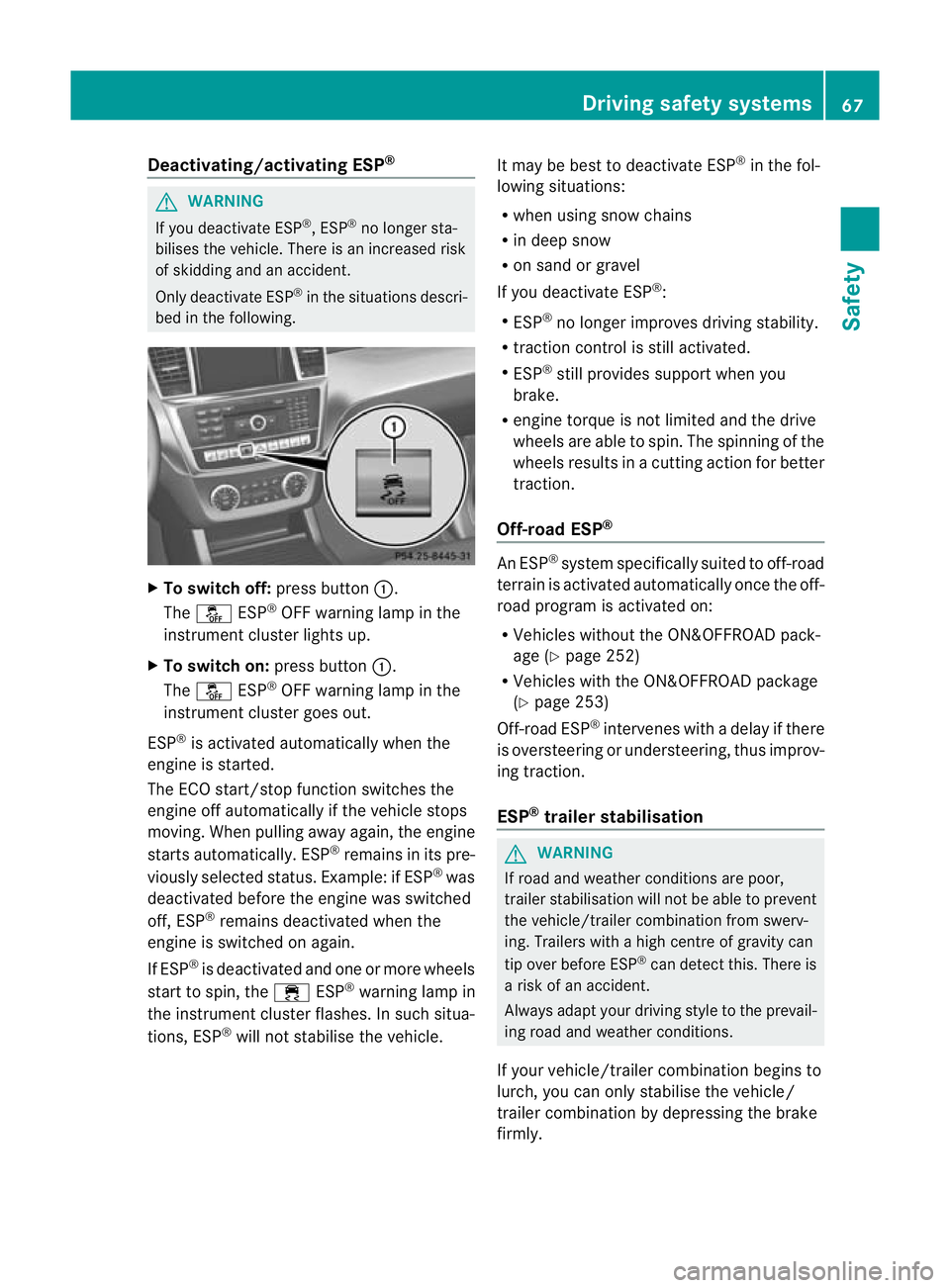
bed in th efollowing. X
To switch off: press button:.
The å ESP®
OF Fw arnin glamp in the
instrumen tcluster lights up.
X To switch on: press button:.
The å ESP®
OFF warnin glamp in the
instrumen tcluster goes out.
ESP ®
is activated automatically when the
engin eisstarted.
The ECO start/stop fun ction switches the
engin eoff automaticall yifthe vehi cles tops
moving. When pulling away again, the engine
start sautomatically. ESP ®
remain sinits pre-
viousl yselected status. Example: if ESP ®
was
deactiva tedb efor ethe engine was switched
off ,ESP ®
remains deactivated when the
engine is switched on again.
If ESP ®
is deactivated and one or more wheels
start to spin, the ÷ESP®
warning lamp in
th ei nstrumen tcluster flashes. In such situa-
tions, ESP ®
will not stabilise th evehicle. It may be best to deact
ivateESP®
in the fol-
lowing situations:
R when using sno wchains
R in deep snow
R on sand or gravel
If you deactivate ESP ®
:
R ESP ®
no longe rimproves driving stab ility.
R traction control is still activated.
R ESP ®
still provides support when you
brake.
R engine torque is not limited and the drive
wheels are abl etospin. The spinnin gofthe
wheels resu ltsinac utting action for better
traction.
Off-roa dESP® An ESP
®
syste mspecif icall ys uited to off-road
terrain is activated automatically once the off-
road progra misactivate don:
R Vehicles without the ON&OFFROAD pack-
age (Y page252)
R Vehicles wit hthe ON&OFFROAD package
(Y page 253)
Off-road ESP ®
intervenes with adelay if there
is oversteerin gorundersteering ,thus improv-
ing traction.
ESP ®
trailer stabilisation G
WARNING
If roa dand weather conditions are poor,
trailer stabilis ation will not be able to prevent
the vehicle/trailer combination from swerv-
ing. Trailers with ahigh centre of gravit ycan
tip over before ESP ®
can detect this. There is
ar isk of an accident.
Always adap tyour driving style to the prevail-
ing road and weather conditions.
If your vehicle/trailer combination begins to
lurch, you can only stabilise the vehicle/
trailer combination by depressin gthe brake
firmly. Driving safety systems
67Safety Z
Page 191 of 441
At the onse
tofwinter, have your vehicle win-
terproofed at aqualified specialist workshop.
Vehicles with th eON&OFFROAD pack-
age: if drivin ginsnow or with snow chains,
select the snow program (Y page 249)with
the off- road program selector wheel in the
centre console.
Observe the notes in the "Winter operation"
section (Y page 398).
Driving with summer tyres Observe the notes in the "Winter operation"
section (Y
page 398).
Slippery road surfaces G
WARNING
If you shift down on aslippery road surfac ein
an attempt to increase the engine's braking
effect ,the drive wheels coul dlose their grip.
This increases the risk of skiddin gand having
an accident.
Do not shift down for additional engine brak-
ing on aslippery road surface.
If the vehicle threaten stoskid or cannot be
stopped whe nmovin gatl ow speed:
X Move the transmission to position N.
X Try to bring the vehicle under con trolby
using corrective steering.
i For more information on driving with
snow chains, see (Y page 399).
You should drive particularly carefully on slip-
pery road surfaces. Avoid sudde naccelera-
tion, steering and brakin gmanoeuvres. Off-road driving
Important safety notes G
WARNING
If you drive up asteep incline at an angle or
turn on asteep incline, the vehicle could slip sideways, tip and overturn. There is
arisk of
an accident.
When drivin gupanincline, drive into the line
of fall (upw ards or downwards in astraight
line) and do not turn. G
WARNING
If the vehicle level is high, the vehicle centre
of gravity is raised .This coul dcause the vehi-
cle to tip over more easily on uphill or downhill
gradients. There is arisk of an accident.
Select the lowest possible vehicle level.
When drivin goff-road, sand, mud and water,
possibly mixe dwith oil, for example, could get
into the brakes. This could result in areduced
braking effect or in total brak efailure and also
in increased wear and tear. The braking char-
acteristic schange depending on the material
ingressing the brakes. Clean the brakes after
driving off-road. If you detec tareduce dbrak-
ing effect or grinding noises, have th ebrake
system checked in aqualified specialist work-
sho pass oon as possible. Adapt your driving
style to the differen tbraking characteristics.
Driving off- road increases the likelihood of
damage to the vehicle, which, in turn, can lead
to failure of the mechanical assembly or sys-
tems. Adapt your driving style to suit the ter-
rain conditions. Drive carefully. Have damage
to the vehicle rectified immediately at aquali-
fied specialist workshop.
Do not switch to transmission position N
when driving off-road. You could lose control
of the vehicle if you attempt to brake using
the service brake. If the gradient is too steep,
drive backwards in reverse gear.
General notes H
Environmental note
Protection of the environment is of primary
importance. Treat nature with respect.
Observe all prohibiting signs. 188
Driving tipsDrivin
gand pa rking
Page 223 of 441
G
WARNING
Th ef ront of th evehicle will veer out in the
direction of the oncoming traffic during the
parking operation. In some cases the vehic le
wil lalsot ake you onto sections of the oncom-
ing lane during the parking procedure.
You are responsibl efor safet yatall times and
must pay attention to any road users
approaching or passing. Stop the vehicle if
necessary or cancel the Activ eParking Assist
parking procedure. G
WARNING
Make sure that no persons or animals are in
the manoeuvring range. Otherwise, they
coul dbei njured.
! If unavoidable ,you should driv eover
obstacles such as kerb sslowly and not at
as har pangle .Otherwi se,you ma ydamage
the wheels or tyre s.
Activ eParking Ass isti sane lectroni cparking
aid with ultrasound. Ultrasoun disused to
mea surethe road on bothsides of th evehicle.
As uitable parking space is indicated by the
parking symbol. Activ esteering intervention
can assis tyou during parking. You ma yalso
use PARKTRONIC (Y page 216). When PARK-
TRONIC is switched off, Active Parking Assist
is also unavailable.
Use Active Parking Assist for parkin gspaces:
R that are parallel to the direction of travel
R that are on straight roads, not bends
R that are on the same level as the road, e.g.
not on the pavement
Parking tips:
R on narrow roads, driv easclosely as possi-
ble past the parkin gspace.
R parking spaces that are littered, overgrown
or partially occupied by trailer drawbars
might be identified incor rectly or not at all.
R snowfall or heavy rain may lea dtoap arking
space being measured inaccurately. R
pay attention to the PARKTRONIC
(Y page 217 )warning message sduring the
parking procedure.
R at any time, you can intervene in the steer-
ing procedure to correc tit. Active Parking
Assist will then be cancelled.
R when transporting aload which protrudes
from your vehicle, you should not use
Active Parkin gAssist.
R when snow chains or an emergenc yspare
wheel are fit ted, you should not use Active
Parking Assist here either.
R mak esure that the tyre pressures are
always correct. This has adirec tinfluence
on the parking characteristics of the vehi-
cle.
R the wa yyourv ehicle is positioned in the
parking space after parking is dependent
on various factor s. Theseinclude the posi-
tion and shape of the vehicles parked in
front and behind it and the conditions of the
location. It may be the case that Active
Parking Assist guides you too far into a
parking space, or not far enoug hinto it. In
some cases, it may also lead you across or
onto the kerb. If necessary, you should can-
cel the parking procedure with Active Park-
ing Assist.
R you can also engage forward gea rprema-
turely. Th evehicle redirects and does not
driv easf ar into the parking space. Should
ag ear be changed too earl ytoa chieve a
sensible parkin gposition ,the parkin gpro-
cedure will be cancelled.
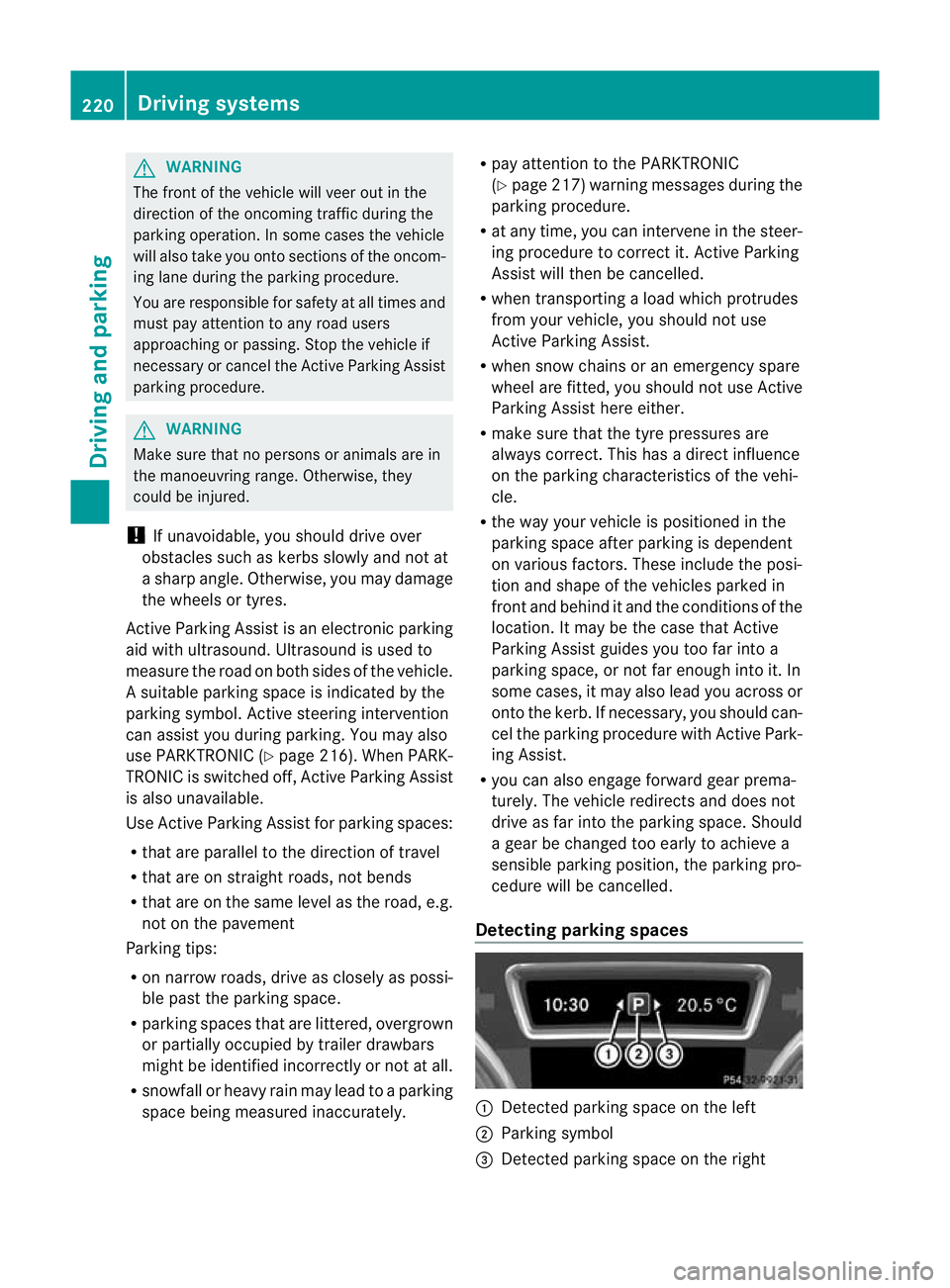
Detectin gparking spaces :
Detected parking space on the left
; Parking symbol
= Detected parking space on the right 220
Driving systemsDri
ving and parking
Page 252 of 441
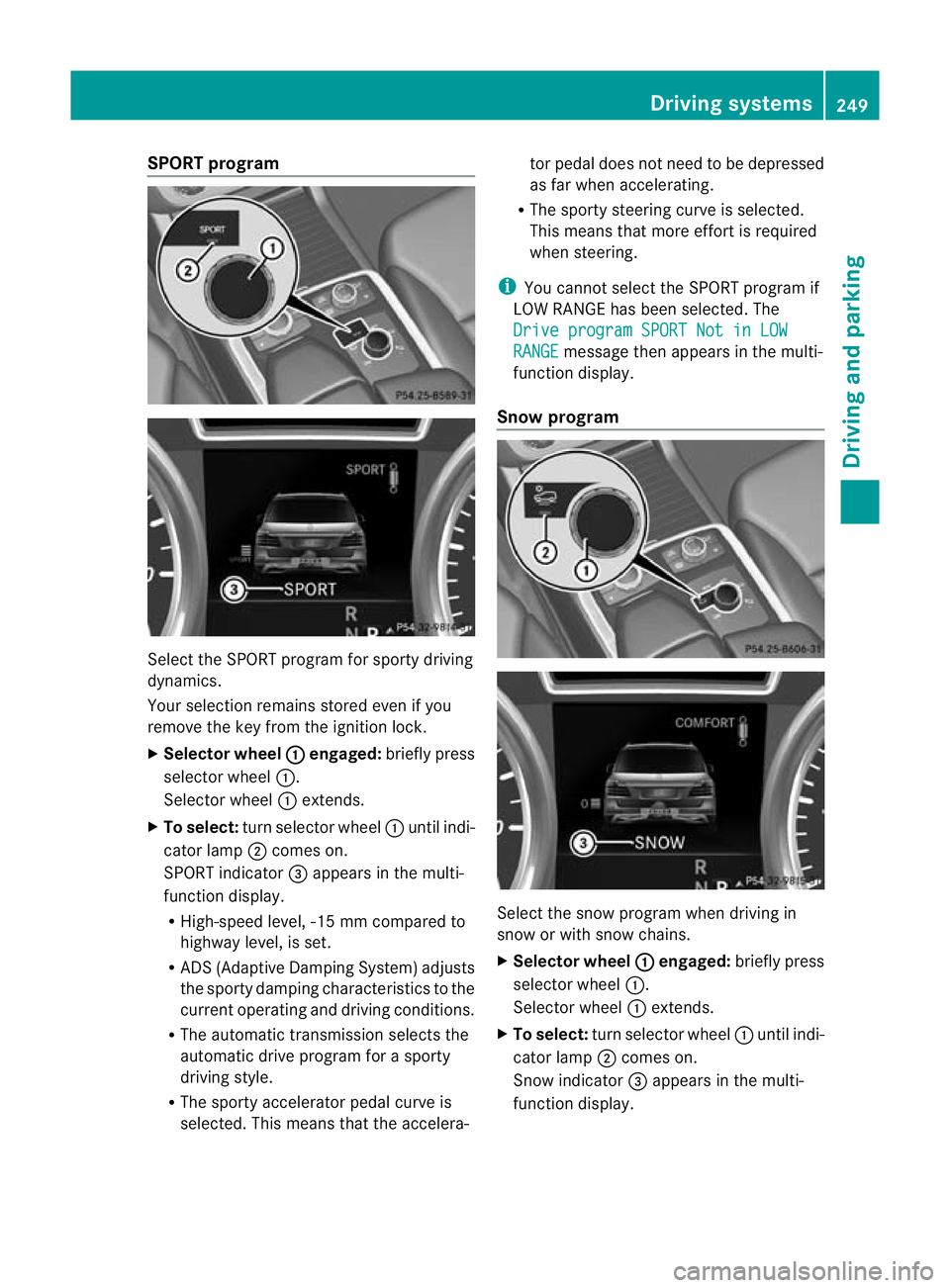
SPORT program
Select the SPOR
Tprogram for sport ydriving
dynamics.
Your selection remains store deven if you
remove th ekey from the ignition lock.
X Selector wheel : engaged:
briefly press
selector wheel :.
Selector wheel :extends.
X To select: turnselector wheel :until indi-
cator lamp ;comes on.
SPORT indicator =appear sint he multi-
func tion display.
R High-speed level, -1 5mmcompared to
highway level, is set.
R ADS (Adaptiv eDamping System) adjusts
the sporty damping characteristics to the
current operating and driving conditions.
R The automatic transmissio nselects the
automatic driv eprogram for asporty
driving style.
R The sporty accelerator pedal curve is
selected. This mean sthat the accelera- tor pedal does not need to be depressed
as fa
rwhen accelerating.
R The sport ysteering curve is selected.
Thi sm eans that mor eeffort is required
when steering.
i Youc annot select the SPORT program if
LOW RANGE has been selected .The
Driv eprogram SPORT Not in LOW RANGE message then appears in th
emulti-
function display.
Snow program Select the snow program when driving in
snow or with snow chains.
X
Selector wheel : engaged:
briefly press
selector wheel :.
Selector wheel :extends.
X To select: turn selector wheel :until indi-
cator lamp ;comes on.
Snow indicator =appears in the multi-
function display. Driving systems
249Drivingand pa rking Z
Page 256 of 441
depressed muc
hfurther in order to acceler-
ate.
Do not use the off-road program on roads that
are snow-covered or icy or if you have fitted
your vehicle with snow chains.
For information about drivin goff-road, see
(Y pag e188).
Off-road programs (vehicle swith the
ON&OFFROAD package) Gener
alnotes
The off -road program sassist you in drivi ng
off -road. The engine’s performanc echarac-
teristic sand the gearshifting characteristics
of the automati ctransmission are adapted for
this purpose .ABS ,ESP ®
and 4ET Sprograms
especiall yadapted to off -road drivin gare acti-
vated. An accele rator peda lcurve suitable for
the terrain is selected, i.e. the accelerator
pedal must be depressed further to acceler-
ate.
Do not use the off-road programs on roads
that are snow-covered or icy or if you have
fitted your vehicle with snow chains.
For information about drivin goff-road, see
(Y pag e188).
Th ef ollowin gprogram message sremai nin
the multifunction display until the corre-
sponding vehicle level has bee nset. Up to off-
road level 2, you can hide the program mes-
sages using the %or the abutton on
the multifunction steering wheel. Off
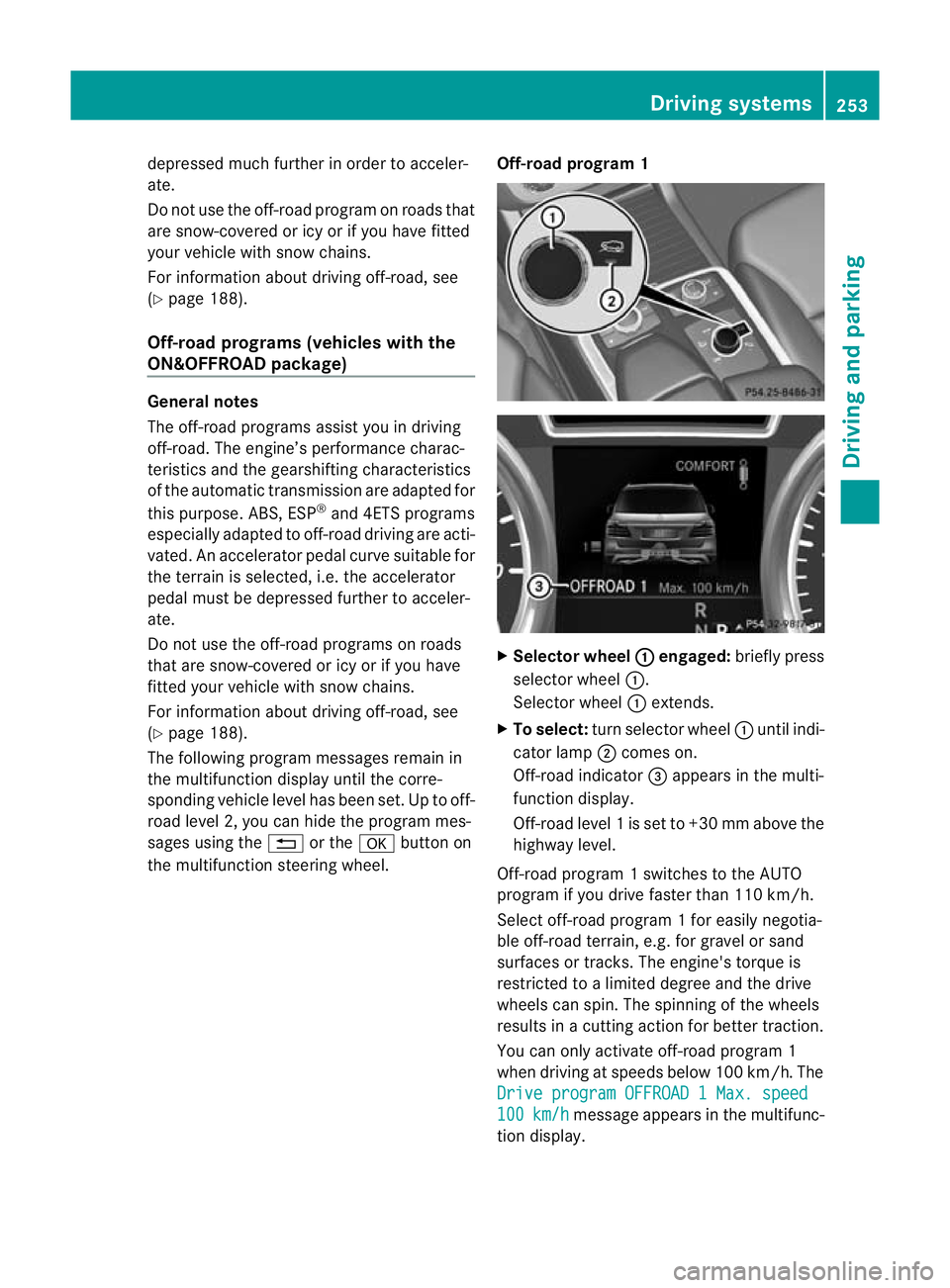
-road program 1 X
Selector wheel : engaged:
briefly press
selector wheel :.
Selector wheel :extends.
X To select: turn selector wheel :until indi-
cator lamp ;comes on.
Off-road indicator =appears in the multi-
function display.
Off-road level 1isset to +3 0mmabove the
highwa ylevel.
Off-road program 1switches to the AUTO
program if you drive faster than 110 km/h.
Select off-road program 1for easily negotia-
ble off -road terrain, e.g. for gravel or sand
surfaces or tracks. The engine's torque is
restricted to alimited degree and the drive
wheels can spin. The spinnin gofthe wheels
results in acutting action for better traction.
You can only activate off-road program 1
when driving at speeds below 100 km/ h.The
Driv eprogram OFFROAD 1Max. speed 100 km/h message appears in th
emultifunc-
tion display. Driving systems
253Drivingand pa rking Z
Page 258 of 441
HIGH RANGE
Positio
nfor all norma lon-
road driving conditions. LOW RANGE
Off-road pos
ition for driv-
ing off-road and fording.
The transmission ratio
between the engine and
wheels is only approx-
imately one third of that in
the HIG HRANGE road
pos ition. The drive torque
is correspondingly higher
as aresult.
Do not use LOW RANGE:
R on slippery road surfa-
ces, e.g. in the even tof
slush
R on snow or ice-covered
roads
R if you hav esnow chains
on you rvehicle The LOW RANGE off
-road gear assists you
when drivin goff-roa dand whe nfordi ng.W hen
LOW RANGE is engaged, the engine’s per-
forma ncec haracteristic sand the gearshifting
characteristic softhe automatic transmission
ar ea dapted for this purpose.
Fur ther information about "Drivin goff-road"
(Y pag e188). Yo uwill find information about
drivin gsafety systems in conjunction with
LOW RANGE in the "Safety" section
(Y page 60).
From HIGH RANG EtoLOW RAN GE
! Only change from HIGH RANGE to LOW
RANGE if:
R the engi neis running
R the transmission is in position N
R you are drivin gatspeeds below
40 km/h
X Press LOW RANGE button :.
Indicator lamp ;flashes.
Onc ethe gear change procedur eiscom-
plete, indicator lamp ;lights up. The LOW RANGE display appear
sint he multifunction
displa yand in the status indicator.
While indicator lamp ;is flashing, you can
cancel the gea rchange by pressing LOW
RANGE button :again.
i You can nota ctivate LOW RANGE if the
SPORT on-road program is activated. The
LOW RANG ENot in drive program SPORT message then appears in th
emulti-
function display.
From LOW RANG EtoHIGH RANGE
! Only change from HIGH RANGE to LOW
RANGE if:
R the engine is running
R the transmission is in position N
R if you are driving at speeds below
70 km/h
X Press LOW RANGE button :.
Indicator lamp ;flashes.
When the gear change is complete, indica-
tor lamp ;goes out. In the multifunction
display, the LOWR ANGE Off message
appears and status indicator =goes out.
Whil eindicator lamp ;is flashing, you can
cancel the gea rchange by pressing LOW
RANGE button :again. Driving systems
255Driving and parking Z
Page 402 of 441
Snow chains
G
WARNING
If you hav efitted snow chains to the front
wheels, they may scrape against the vehicle
body or chassis components. This could
cause damage to the vehicle or the tyres.
There is arisk of an accident.
To avoid hazardous situations:
R never fit snow chains on the fron twheels
R fit snow chains to the rea rwheels in pairs.
! You must driv eatraised vehicle level if
snow chains have been fitted. The vehicle
could otherwise be damaged. Observe the
information in the "AIRMATIC package"
section.
! Do not use the Adaptive Damping System
(ADS )sports mode if you have fit teds now
chains .The vehicle could otherwise be
damaged.
! On some tyr esizes there is not enough
space for snow chains. In order to prevent
damage to the vehicle or the tyres, observe
the "Tyre and wheel combinations" section
under "Tyres and wheels".
For safety reasons, Mercedes-Benz recom-
mends that you only use snow chains that
have been specially approved for your vehicle
by Mercedes-Benz, or that are of acorre-
spondin gstandard of quality.
If you intend to fit snow chains ,please bear
the following points in mind:
R only use snow chains when the road sur-
face is completely snow-covered. Remove
the snow chains as soon as possible when
you come to aroad that is not snow- cov-
ered.
R do not exceed the maximu mpermissible
speed of 50 km /h. R
local regulations may restric tthe use of
snow chains. Observ ethe appropriate reg-
ulations if you wish to fit snow chains.
R snow chains cannot be fitted to all wheel-
tyr ec ombinations. Permissible wheel-tyre
combination s(Ypage 409).
i You may wish to deactivat eESP®
when
pull inga way with snow chains fitted
(Y page 67). This way you can allow the
wheels to spin in acontrolled manner ,ach-
ieving an increased driving force (cutting
action).
For more information on driving with the
emergency spare wheel, se e(Ypage 414). Ty
re pr essure Tyr
epressure specifications G
WARNING
Tyres with too low or too high tyre pressure
contain the following hazards:
R they can burst, in particular if the vehicle is
heavily laden or when driven at high
speeds.
R the tyres can wear excessively and/or
unevenly, which can severely impair tyre
traction.
R the driving, steering and braking character-
istics may be severely impaired.
There is arisk of accident.
Follow recommended tyre inflation pressures
and check the pressure of all the tyres includ-
ing the spare wheel:
R at least every two weeks
R if the load changes
R before beginning along journey
R for changed operatin gconditions, e.g. off-
road driving
If necessary ,correct the tyr epressure. G
WARNING
If you fit unsuitabl eaccessories onto tyre
valves ,the tyr evalves may be overloaded and Tyr
epressure
399Wheels and ty res
Z
Page 404 of 441
i
The tyr epressure values given for low
load sare minimum values which offe ryou
good rid ecomfor tcharacteristics.
However ,you can also use the values given
for higher loads. These ar epermissible and
will not adversely affect the running of the
vehicle. Ty
re pr essur eloss warning system
Important safety notes While the vehicle is in motion, the tyre pres-
sure loss warnin gsystem monitors the set
tyre pressure using the rotational speed of
the wheels. This enable sthe system to detect
significant pressur eloss in atyre. If the speed
of rotation of awheel changes as aresult of
al oss of pressure, acorrespondin gwarning
message will appea rinthe multifunction dis-
play.
The tyr epressure warning system does not
warn yo uofani ncorrectly set tyre pressure.
Observe the notes on the recommended tyre
pressure (Y page399).
Th et yre pressure los swarning system does
not replace the need to regularly check your
vehicle's tyre pressures, since an even loss of
pressure on several tyres at the same time
cannot be detected by the tyre pressure loss
warning system.
The tyre pressure monitor is not able to warn
you of asudden loss of pressure, e.g. if the
tyre is penetrated by aforeign objec t. Inthe
event of asudden loss of pressure, bring the
vehicle to ahalt by braking carefully. Avoid
abrupt steering manoeuvres.
The function of the tyre pressure loss warning
system is limited or delayed if:
R snow chains are fitted to your vehicle's
tyres.
R road conditions are wintry.
R you are driving on sand or gravel.
R you adopt avery sporty driving style (cor-
nering at high speeds or driving with high
rates of acceleration). R
you are towing avery heavy or large trailer.
R you are driving with aheavy load (in the
vehicle or on the roof).
Resta rting the ty re pressur eloss warn-
ing system Restart the tyre pressure loss warnin
gsystem
if you have:
R changed the tyre pressure
R changed the wheels or tyres
R fitted new wheels or tyres
X Before restarting, make sure that the tyre
pressures are set properly on all four tyres
for the respective operating conditio ns.
The recommended tyr epressures can be
found in th etable on the fuel filler flap.
The tyre pressure loss warning system can
only give reliabl ewarnings if you have set
the correct tyre pressure. If an incorrect
tyre pressure is set, these incorrec tvalues
will be monitored.
X Also observ ethe notes in the sectionon
tyre pressures (Y page 399).
X Make sure tha tthe key is in posi-
tion 2(Ypage 159) in the ignition lock.
X Press the =or; button on the steer-
ing wheel to selec tthe Serv. menu.
X Press the 9or: button to select
Tyre pressure .
X Press the abutton.
The RunF lat Indicator active Restart with OK message appe
arsint he
multifunction display.
If yo uwish to confirm the resta rt:
X Press the abutton.
The Tyre press. no wOK? message
appe arsint he multifunction display.
X Press the 9or: button to select
Yes .
X Press the abutton.
The RunF lat Indicator restarted message appe
arsint he multifunction dis-
play. Ty
re pressure
401Wheelsand ty res Z
Page 414 of 441
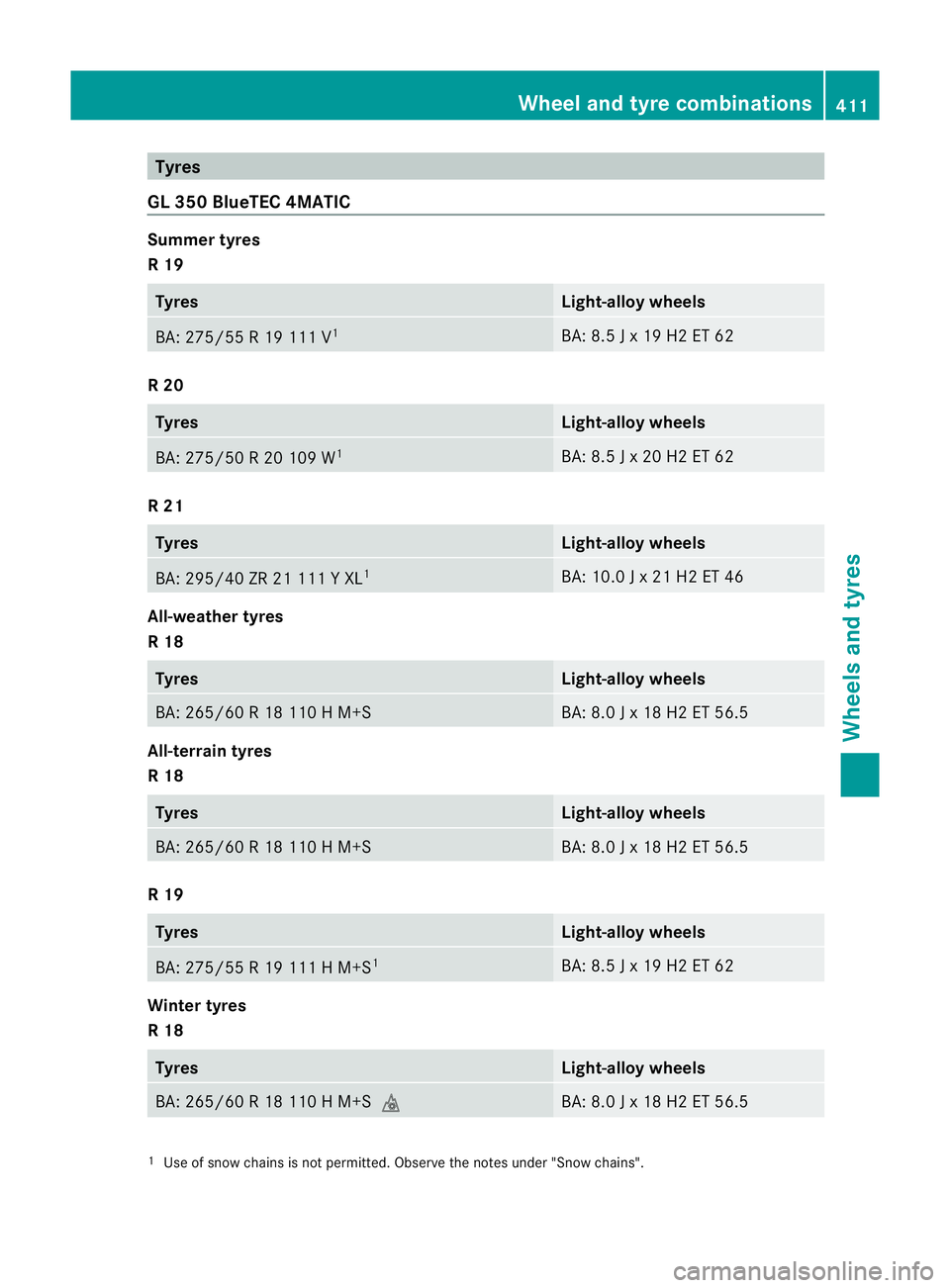
Tyres
GL 35 0BlueTEC 4MATIC Summ
ertyres
R19 Tyres Light-alloy whe
els BA: 275/55
R19111 V 1 BA
:8.5 Jx19H2ET62 R20
Tyres Light-allo
ywheels BA: 275/50
R20109 W1 BA: 8.5
Jx20H2ET62 R21
Tyres Light-alloy wheels
BA: 295/40 ZR 21 111
YXL1 BA: 10.0
Jx21H2ET46 All-weather tyres
R18
Tyres Light-alloy wheels
BA: 265/60
R18110HM +S BA: 8.0
Jx18H2ET56.5 All-terrain tyres
R18
Tyres Light-alloy wheels
BA: 265/60
R18110HM +S BA: 8.0
Jx18H2ET56.5 R19
Tyres Light-alloy wheels
BA: 275/55
R19111HM +S1 BA: 8.5
Jx19H2ET62 Winter tyres
R18
Tyres Light-alloy wheels
BA: 265/60
R18110HM +Si BA: 8.0
Jx18H2ET56.5 1
Use of sno wchains is not permitted. Observe the notes under "Snow chain s". Whee
land tyre combinations
411Wheels and tyres Z