belt MERCEDES-BENZ GLA 2016 User Guide
[x] Cancel search | Manufacturer: MERCEDES-BENZ, Model Year: 2016, Model line: GLA, Model: MERCEDES-BENZ GLA 2016Pages: 390, PDF Size: 10.2 MB
Page 47 of 390
tion. This poses an increased risk of injury or
even fatal injury.
Make sure that all vehicle occupants are
seated properly with a correctly fastened seat
belt.
G WARNING
The seat belt does not offer the intended level
of protection if you have not moved the back-
rest to an almost vertical position. When brak-
ing or in the event of an accident, you could
slide underneath the seat belt and sustain
abdomen or neck injuries, for example. This
poses an increased risk of injury or even fatal
injury.
Adjust the seat properly before beginning
your journey. Always ensure that the backrest
is in an almost vertical position and that the
shoulder section of your seat belt is routed
across the center of your shoulder.
G WARNING
Persons under 5 ft (1.50 m) in height cannot
fasten the seat belt correctly without an addi-
tional suitable restraint system. If the seat
belt is incorrectly fastened, it cannot protect
as intended. Furthermore, an incorrectly fas-
tened seat belt can cause additional injury, for
example, in an accident, during braking or an
abrupt change of direction. This poses an
increased risk of injury or even fatal injury.
For this reason, always secure persons under
5 ft (1.50 m) in height in suitable restrain t
systems.
If a child younger than twelve years old and
under 5 ft (1.50 m) in height is traveling in the
vehicle: R
always secure the child in a child restraint
system suitable for this Mercedes-Benz
vehicle. The child restraint system must be
appropriate to the age, weight and size of
the child R
always observe the instructions and safety
notes in the "Children in the vehicle" sec-
tion of this Operator's Manual ( Y
page 58) in addition to the child
restraint system manufacturer's installa-
tion instructions R
be sure to observe the instructions and
safety notes on the "Occupant classifica-
tion system (OCS)" ( Y
page 51)
G WARNING
The seat belts may not perform their intended
protective function if: R
they are damaged, modified, extremely
dirty, bleach or dyed R
the seat belt buckle is damaged or
extremely dirty R
the Emergency Tensioning Devices, belt
anchorages or inertia reels have been modi-
fied
Seat belts may sustain non-visible damage in
an accident, e.g. due to glass splinters. Modi-
fied or damaged seat belts may tear or fail,
e.g. in an accident. Modified Emergency Ten-
sioning Devices could accidentally trigger or
fail to deploy when necessary. This poses an
increased risk of injury or even fatal injury.
Never modify the seat belts, Emergency Ten-
sioning Devices, belt anchorages or inertia
reels. Make sure that the seat belts are
undamaged, not worn out and clean. Follow-
ing an accident, have the seat belts checked
immediately at a qualified specialist work-
shop.
Only use seat belts that have been approved
for your vehicle by Mercedes-Benz.
Sports seat or AMG Performance seat: this
seat is designed for the standard three-point
seat belt. If you install another mu lti-point
s eat belt, e.g. sport or racing seat belts, the
restraint system cannot provide the best level
of protection.
G WARNING
If you feed seat belts through the opening in
the seat backrest, the seat backrest may be
damaged or may even break in the event of an
accident. This poses an increased risk of
injury or even fatal injury.Occupant safety 45
Safety Z
Page 48 of 390
Only use the standard three-point seat belt.
Never modify the seat belt system.
Proper use of the seat belts Observe the safety notes on the seat belt
( Y
page 44).
All vehicle occupants must be wearing the
seat belt correctly before beginning the jour-
ney. Also make sure that all vehicle occu-
pants are always wearing the seat belt cor-
rectly while the vehicle is in motion.
When fastening the seat belt, always make
sure that: R
the seat belt tongue is only inserted to the
belt buckle belonging to that seat. R
the seat belt is tight across your body.
Avoid wearing bulky clothing, e.g. a winter
coat. R
the seat belt is not twisted.
Only then can the forces which occur be
distributed over the area of the belt. R
the shoulder section of the belt is always
routed across the center of your shoulder.
The shoulder section of the belt must not
come into contact with your neck or be
routed under your arm. Where possible,
adjust the seat belt to the appropriate
height. R
the lap belt passes tightly and as low down
as possible across your lap.
The lap belt must always be routed across
your hip joints and not across your abdo-
men. This applies particularly to pregnant
women. If necessary, push the lap belt
down to your hip joint and pull it tight using
the shoulder section of the belt. R
the seat belt is not routed across sharp,
pointed or fragile objects.
If you have such items located on or in your
clothing, e.g. pens, keys or eyeglasses,
store these in a suitable place. R
only one person is using a seat belt at a
time. Infants and children must never travel sit-
ting on the lap of a vehicle occupant. In the
event of an accident, they could be crushed
between the vehicle occupant and seat
belt. R
objects are never secured with a seat belt if
the seat belt is also being used by one of the
vehicle's occupants.
Also ensure that there are never objects
between a person and the seat, e.g. cush-
ions.
Seat belts are only intended to secure and
restrain vehicle occupants. Always observe
the "Loading guidelines" for securing objects,
luggage or loads ( Y
page 280).
Fastening and adjusting the seat belts Observe the safety notes on the seat belt
( Y
page 44) and the notes on correct use of
seat belts ( Y
page 46).
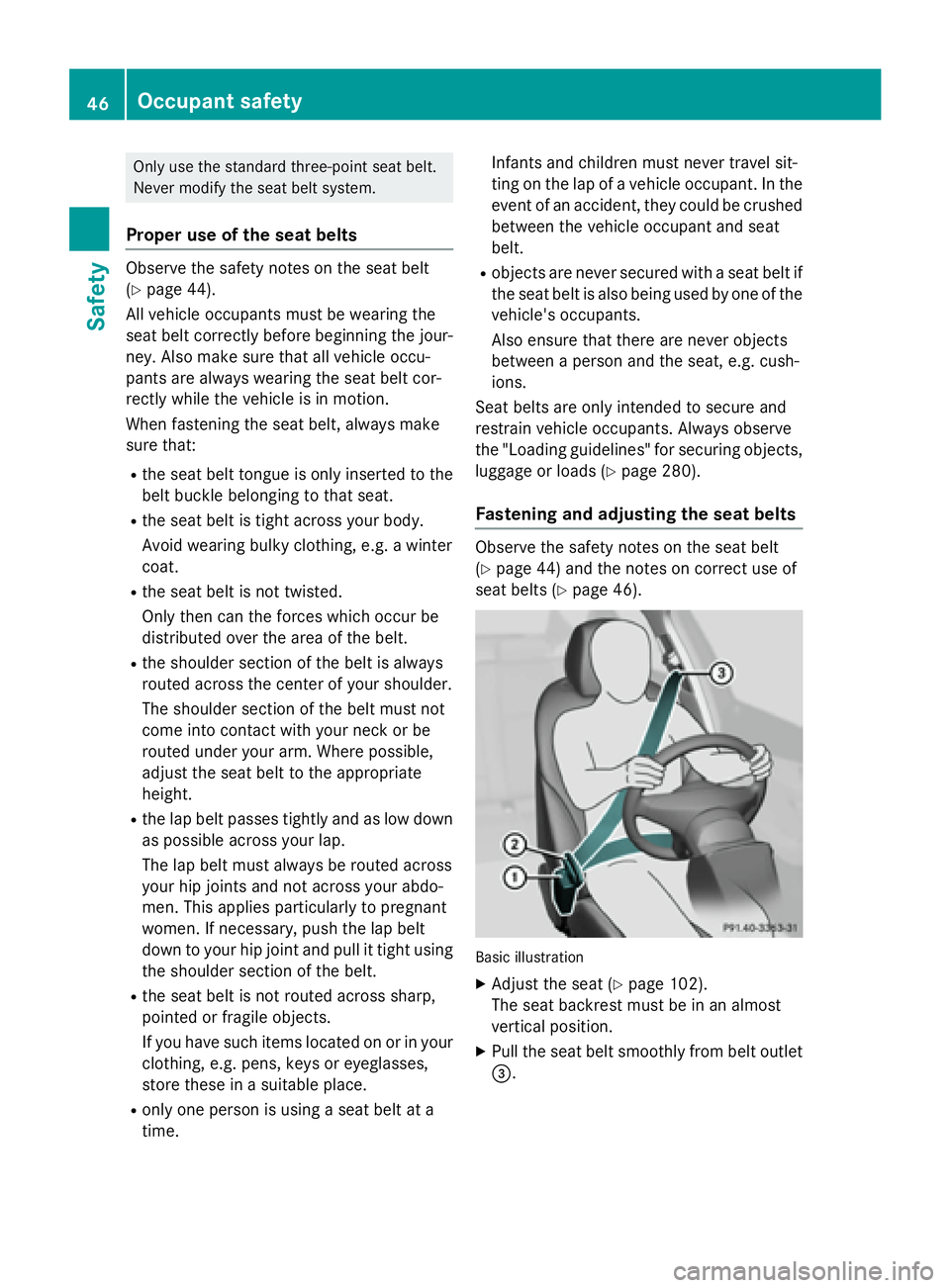
Basic illustration X
Adjust the seat ( Y
page 102).
The seat backrest must be in an almost
vertical position. X
Pull the seat belt smoothly from belt outlet
Page 49 of 390
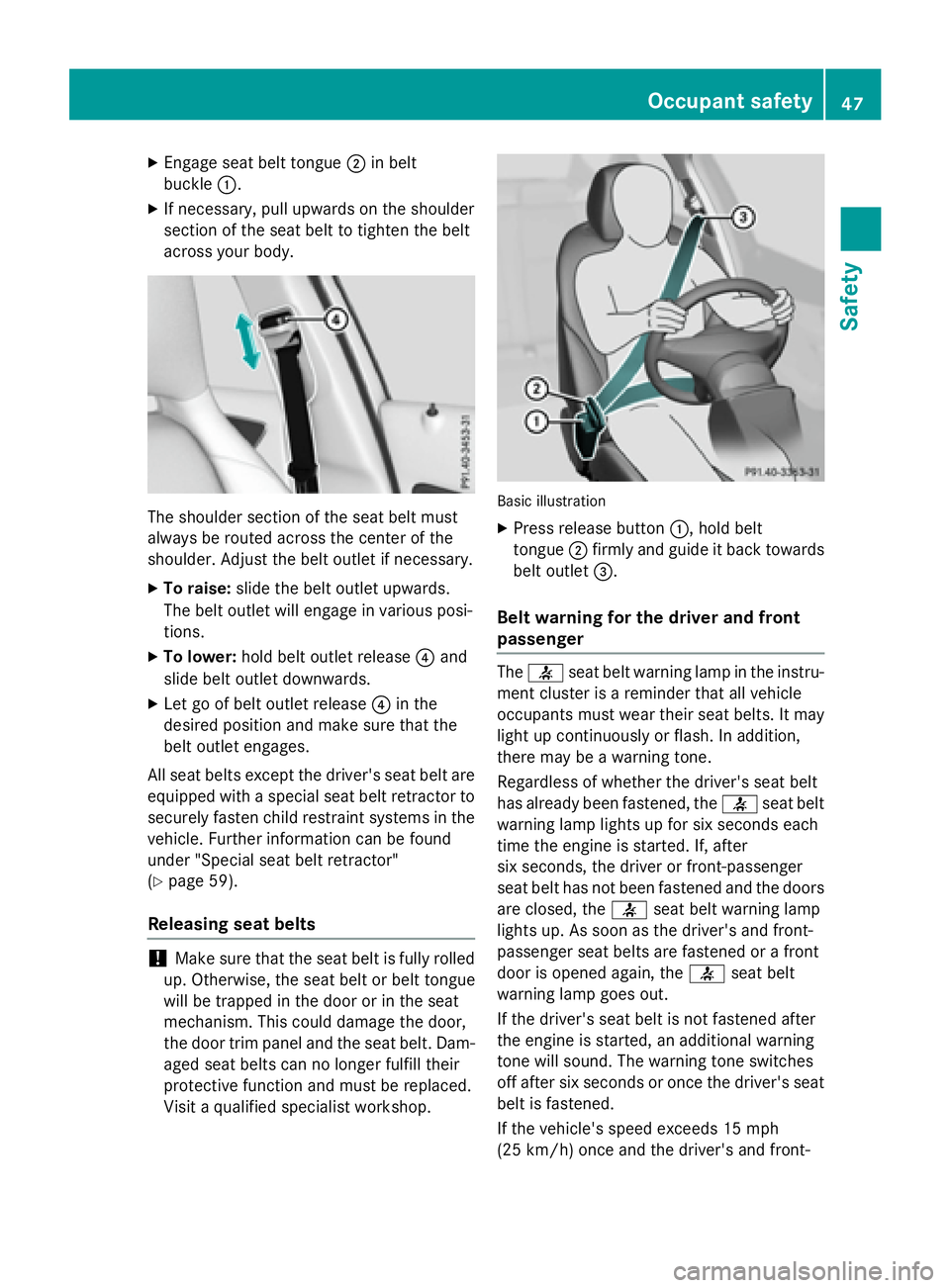
X
Engage seat belt tongue D in belt
buckle C .X
If necessary, pull upwards on the shoulder
section of the seat belt to tighten the belt
across your body.
The shoulder section of the seat belt must
always be routed across the center of the
shoulder. Adjust the belt outlet if necessary. X
To raise: slide the belt outlet upwards.
The belt outlet will engage in various posi-
tions. X
To lower: hold belt outlet release
Page 50 of 390
passenger seat belts are not fastened, a
warning tone sounds. A warning tone also
sounds with increasing intensity for
60 seconds or until the driver or front
passenger have fastened their seat belts.
If the driver or front passenger unfasten their
seat belts during the journey, the seat belt
warning is activated again.
i For more information on the v seat
belt warning lamp, see "Warning and indi-
cator lamps in the instrument cluster, seat
belts" ( Y
page 266).
Air bags
Introduction The installation point of an air bag can be rec-
ognized by the AIR BAG symbol.
An air bag complements the correctly fas-
tened seat belt. It is no substitute for the seat
belt. The air bag provides additional protec-
tion in applicable accident situations.
Not all air bags are deployed in an accident.
The different air bag systems function inde-
pendently from one another ( Y
page 56).
However, no system available today can com-
pletely eliminate injuries and fatalities.
It is also not possible to rule out a risk of injury
caused by an air bag due to the high speed at
which the air bag must be deployed.
Important safety notes
G WARNING
If you do not sit in the correct seat position,
the air bag cannot protect as intended and
could even cause additional injury when
deployed. This poses an increased risk of
injury or even fatal injury. To avoid hazardous situations, always make
sure that all of the vehicle's occupants: R
have fastened their seat belts correctly,
including pregnant women R
are sitting correctly and maintain the great-
est possible distance to the air bags R
follow the following instructions
Always make sure that there are no objects
between the air bag and the vehicle's occu-
pants. R
Adjust the seats properly before beginning
your journey. Always make sure that the
seat is in an almost upright position. The
center of the head restraint must support
the head at about eye level. R
Move the driver's and front-passenger
seats as far back as possible. The driver's
seat position must allow the vehicle to be
driven safely. R
Only hold the steering wheel on the out-
side. This allows the air bag to be fully
deployed. R
Always lean against the backrest while driv-
ing. Do not lean forwards or lean against
the door or side window. You may other-
wise be in the deployment area of the air
bags. R
Always keep your feet in the footwell in
front of the seat. Do not put your feet on the
dashboard, for example. Your feet may oth-
erwise be in the deployment area of the air
bag. R
For this reason, always secure persons less
than 5 ft (1.50 m) tall in suitable restraint
systems. Up to this height, the seat belt
cannot be worn correctly.
If a child is traveling in your vehicle, also
observe the following notes: R
Always secure children under twelve years
of age and less than 5 ft (1.50 m) tall in
suitable child restraint systems. R
Child restraint systems should be installed
on the rear seats.48
Occupant safety
Safety
Page 52 of 390
Knee bags
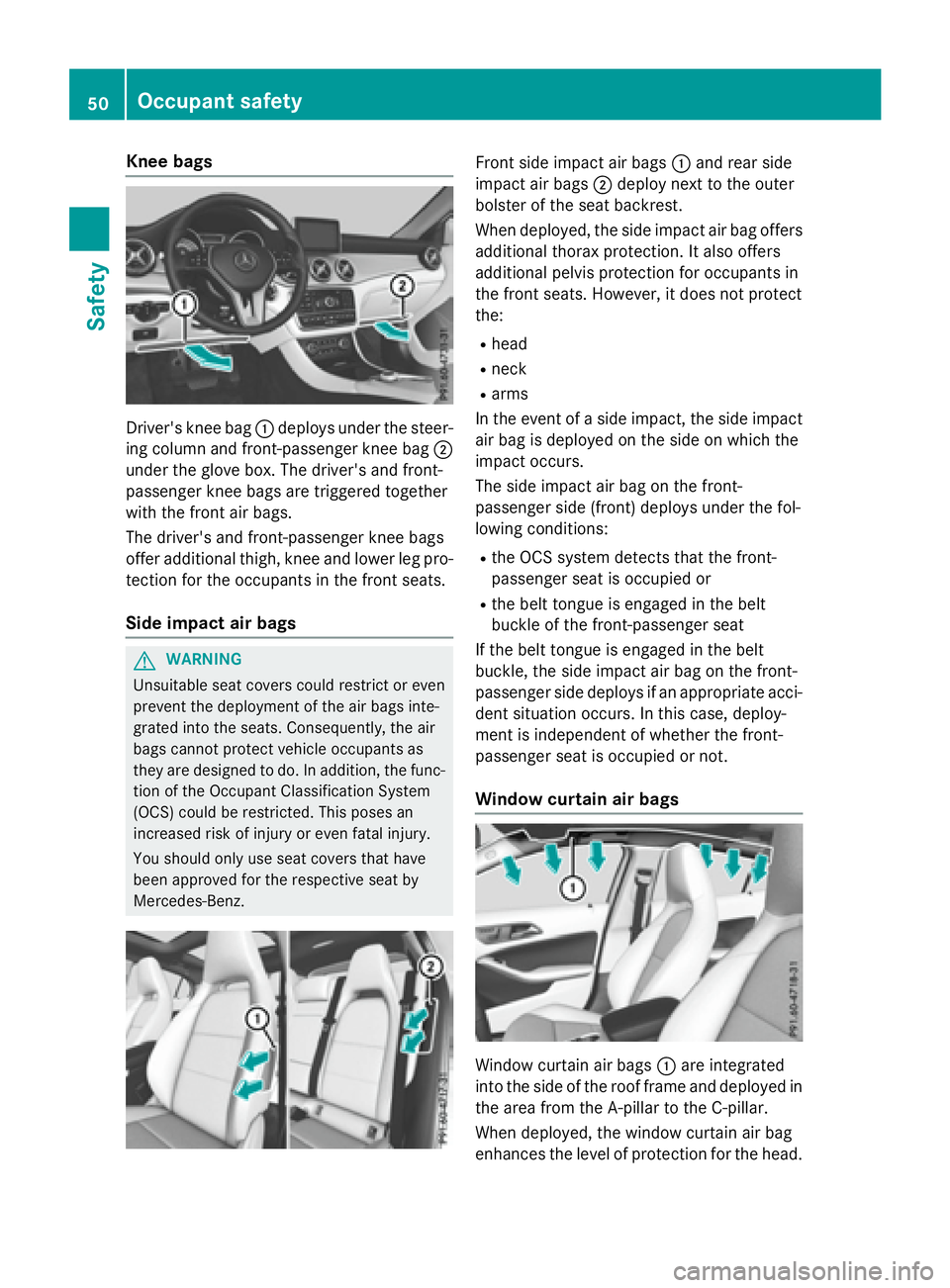
Driver' s knee bag C deploys under th e steer -
ing column and front-passenger knee bag D
under th e glov e box . The driver's and front-
passenger knee bags are triggered together
wit h th e fron t air bags .
The driver's and front-passenger knee bags
offer additional thigh, knee and lower leg pro -
tection for th e occupant s in th e fron t seats.
Side impact air bags
G WARNIN G
Unsuitable seat cover s could restrict or eve n
preven t th e deployment of th e air bags inte-
grate d int o th e seats. Consequently, th e air
bags canno t protect vehicl e occupant s as
they are designed to do. In addition , th e func-
tion of th e Occupant Classification Syste m
(OCS ) could be restricted. This poses an
increased ris k of injury or eve n fatal injury.
You should only use seat cover s that hav e
been approve d for th e respective seat by
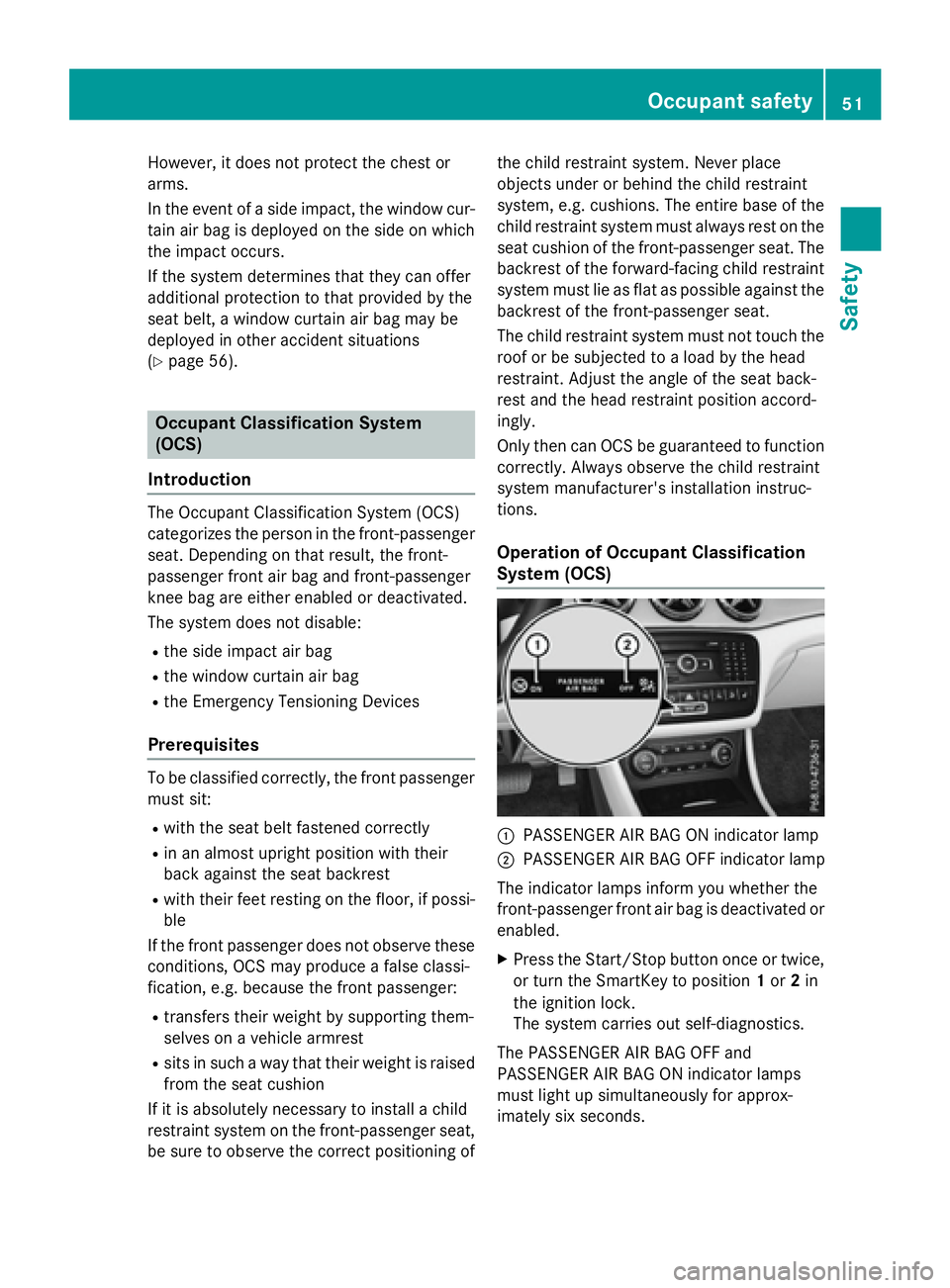
Mercedes-Benz. Fron t side impact air bags C and rear side
impact air bags D deplo y next to th e outer
bolste r of th e seat backr est.
When deployed, th e side impact air bag offers
additional thorax protection . It also offers
additional pelvis protection for occupant s in
th e fron t seats. Ho wever, it does no t protect
the: R
head R
neck R
arm s
In th e event of a side impact , th e side impact
air bag is deployed on th e side on whic h th e
impact occur s.
The side impact air bag on th e front-
passenger side (front) deploys under th e fol -
lowin g conditions: R
th e OCS system detects that th e front-
passenger seat is occupied or R
th e belt tongue is engage d in th e belt
buckl e of th e front-passenger seat
If th e belt tongue is engage d in th e belt
buckle, th e side impact air bag on th e front-
passenger side deploys if an appropriat e acci-
den t situation occur s. In this case, deploy-
men t is independen t of whether th e front-
passenger seat is occupied or not.
Window curtain air bags
Window curtai n air bags C are integrated
int o th e side of th e roo f frame and deployed in
th e area from th e A-pillar to th e C-pillar .
When deployed, th e window curtai n air bag
enhance s th e level of protection for th e head .50
Occupant safety
Safety
Page 53 of 390
However, it does not protect the chest or
arms.
In the event of a side impact, the window cur-
tain air bag is deployed on the side on which
the impact occurs.
If the system determines that they can offer
additional protection to that provided by the
seat belt, a window curtain air bag may be
deployed in other accident situations
( Y
page 56).
Occupant Classification System
(OCS)
Introduction The Occupant Classification System (OCS)
categorizes the person in the front-passenger
seat. Depending on that result, the front-
passenger front air bag and front-passenger
knee bag are either enabled or deactivated.
The system does not disable: R
the side impact air bag R
the window curtain air bag R
the Emergency Tensioning Devices
Prerequisites
To be classified correctly, the front passenger
must sit: R
with the seat belt fastened correctly R
in an almost upright position with their
back against the seat backrest R
with their feet resting on the floor, if possi-
ble
If the front passenger does not observe these
conditions, OCS may produce a false classi-
fication, e.g. because the front passenger: R
transfers their weight by supporting them-
selves on a vehicle armrest R
sits in such a way that their weight is raised
from the seat cushion
If it is absolutely necessary to install a child
restraint system on the front-passenger seat,
be sure to observe the correct positioning of the child restraint system. Never place
objects under or behind the child restraint
system, e.g. cushions. The entire base of the
child restraint system must always rest on the
seat cushion of the front-passenger seat. The
backrest of the forward-facing child restraint
system must lie as flat as possible against the
backrest of the front-passenger seat.
The child restraint system must not touch the
roof or be subjected to a load by the head
restraint. Adjust the angle of the seat back-
rest and the head restraint position accord-
ingly.
Only then can OCS be guaranteed to function
correctly. Always observe the child restraint
system manufacturer's installation instruc-
tions.
Operation of Occupant Classification
System (OCS)
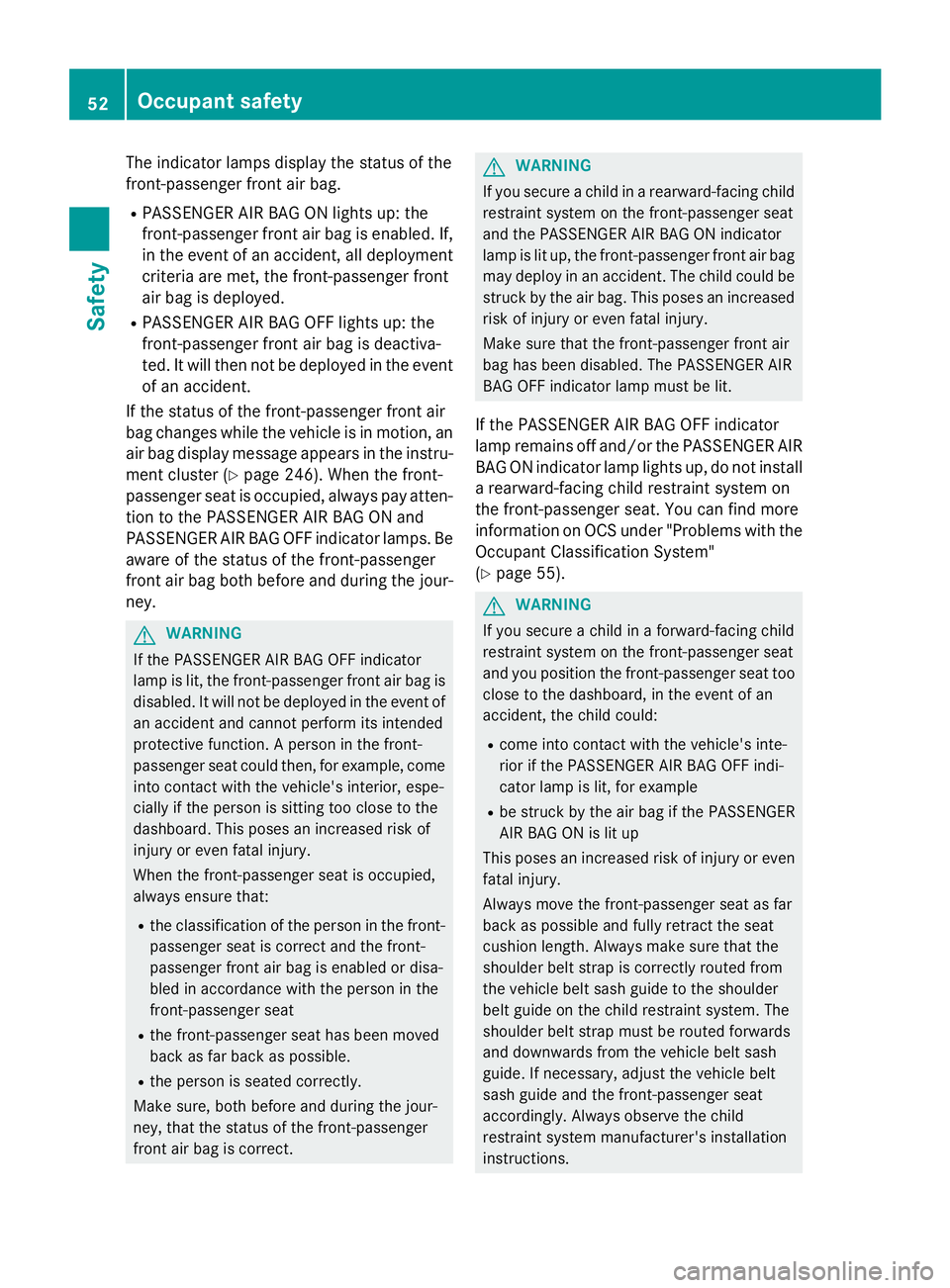
C
PASSENGER AIR BAG ON indicator lamp D
PASSENGER AIR BAG OFF indicator lamp
The indicator lamps inform you whether the
front-passenger front air bag is deactivated or
enabled. X
Press the Start/Stop button once or twice,
or turn the SmartKey to position 1 or 2 in
the ignition lock.
The system carries out self-diagnostics.
The PASSENGER AIR BAG OFF and
PASSENGER AIR BAG ON indicator lamps
must light up simultaneously for approx-
imately six second s.Occu pant safety 51
Safety Z
Page 54 of 390
The indicator lamps display the status of the
front-passenger front air bag. R
PASSENGER AIR BAG ON lights up: the
front-passenger front air bag is enabled. If,
in the event of an accident, all deployment
criteria are met, the front-passenger front
air bag is deployed. R
PASSENGER AIR BAG OFF lights up: the
front-passenger front air bag is deactiva-
ted. It will then not be deployed in the event
of an accident.
If the status of the front-passenger front air
bag changes while the vehicle is in motion, an
air bag display message appears in the instru-
ment cluster ( Y
page 246). When the front-
passenger seat is occupied, always pay atten-
tion to the PASSENGER AIR BAG ON and
PASSENGER AIR BAG OFF indicator lamps. Be
aware of the status of the front-passenger
front air bag both before and during the jour-
ney.
G WARNING
If the PASSENGER AIR BAG OFF indicator
lamp is lit, the front-passenger front air bag is
disabled. It will not be deployed in the event of
an accident and cannot perform its intended
protective function. A person in the front-
passenger seat could then, for example, come
into contact with the vehicle's interior, espe-
cially if the person is sitting too close to the
dashboard. This poses an increased risk of
injury or even fatal injury.
When the front-passenger seat is occupied,
always ensure that: R
the classification of the person in the front-
passenger seat is correct and the front-
passenger front air bag is enabled or disa-
bled in accordance with the person in the
front-passenger seat R
the front-passenger seat has been moved
back as far back as possible. R
the person is seated correctly.
Make sure, both before and during the jour-
ney, that the status of the front-passenger
front air bag is correct. G WARNING
If you secure a child in a rearward-facing child
restraint system on the front-passenger seat
and the PASSENGER AIR BAG ON indicator
lamp is lit up, the front-passenger front air bag
may deploy in an accident. The child could be
struck by the air bag. This poses an increased
risk of injury or even fatal injury.
Make sure that the front-passenger front air
bag has been disabled. The PASSENGER AIR
BAG OFF indicator lamp must be lit.
If the PASSENGER AIR BAG OFF indicator
lamp remains off and/or the PASSENGER AIR
BAG ON indicator lamp lights up, do not install
a rearward-facing child restraint system on
the front-passenger seat. You can find more
information on OCS under "Problems with the
Occupant Classification System"
( Y
page 55).
G WARNING
If you secure a child in a forward-facing child
restraint system on the front-passenger seat
and you position the front-passenger seat too
close to the dashboard, in the event of an
accident, the child could: R
come into contact with the vehicle's inte-
rior if the PASSENGER AIR BAG OFF indi-
cator lamp is lit, for example R
be struck by the air bag if the PASSENGER
AIR BAG ON is lit up
This poses an increased risk of injury or even
fatal injury.
Always move the front-passenger seat as far
back as possible and fully retract the seat
cushion length. Always make sure that the
shoulder belt strap is correctly routed from
the vehicle belt sash guide to the shoulder
belt guide on the child restraint system. The
shoulder belt strap must be routed forwards
and downwards from the vehicle belt sash
guide. If necessary, adjust the vehicle belt
sash guide and the front-passenger seat
accordingly. Always observe the child
restraint system manufacturer's installation
instructions.52
Occupant safety
Safety
Page 56 of 390
G DANGER
If th e PASSENGER AI R BA G OF F indicator
lamp remain s lit after th e system self-test , th e
front-passenger fron t air bag is disabled. It will
no t be deployed in th e event of an accident. In
this case, th e front-passenger fron t air bag
canno t perfor m it s intended protective func-
tion , e.g. when a person is seated in th e front-
passenger seat .
That person could, for example, come int o
contact wit h th e vehicle's interior, especially
if th e person is sitting to o close to th e dash -
board. This poses an increased ris k of injury or
eve n fatal injury.
Whe n th e front-passenger seat is occupied,
always ensur e that:R
th e classification of th e person in th e front-
passenger seat is correc t and th e front-
passenger fron t air bag is enabled or disa-
bled in accordanc e wit h th e person in th e
front-passenger seat R
th e person is seated properly wit h a cor-
rectl y fastene d seatbeltR
th e front-passenger seat has been moved
bac k as far bac k as possibl e
If th e PASSENGER AI R BA G OF F indicator
lamp remain s lit when it should not, th e front-
passenger seat may no t be used . Do no t
instal l a child restrain t system on th e front-
passenger seat . Hav
e th e O ccupant Classifi-
ca tion Syste m (OCS ) checke d and repaire d
immediately at a qualified specialist work-
shop.
G WARNIN G
Objects between th e seat surfac e and th e
child restrain t system could affec t OCS oper -
ation . This could result in th e front-passenger
air bag no t functioning as intended during an
accident. This poses an increased ris k of
injury or eve n fatal injury.
Do no t plac e any objects between th e seat
surfac e and th e child restrain t system. The
entire base of th e child restrain t system mus t
always res t on th e seat cushion of th e front-
passenger seat . The backrest of th e forward - facing child restrain t system must, as far as
possible, be resting on th e backrest of th e
front-passenger seat . Always compl y wit h th e
child restrain t system manufacturer' s instal -
lation instructions.
Afte r th e system self-test , th e PASSENGER
AI R BA G OF F or PASSENGER AI R BA G ON
indicator lamp displays th e status of th e front-
passenger fron t air bag ( Y
page 51) .
Fo r mor e information about th e OCS , see
"Problem s wit h th e Occupant Classification
System" ( Y
page 55) .54
Occupant safety
Safety
Page 57 of 390
Problems with the Occupant Classification System (OCS) Be sure to observe the notes on "System self-test" ( Y
page 53).
Problem
Possible causes/consequences and P Solutions
The PASSENGER AIR
BAG OFF indicator
lamp lights up and
remains lit, even
though the front-
passenger seat is occu-
pied by an adult or a
person of a stature cor-
responding to that of an
adult. The classification of the person on the front-passenger seat is
incorrect. X
Make sure the conditions for a correct classification of the per-
son on the front-passenger seat are met ( Y
page 51).X
If the PASSENGER AIR BAG OFF indicator lamp remains lit, the
front-passenger seat may not be used. X
Have OCS checked as soon as possible at an authorized
Mercedes-Benz Center.
The PASSENGER AIR
BAG OFF indicator
lamp does not light up
and/or does not stay
on.
The front-passenger
seat is: R
unoccupied R
occupied with the
weight of a child up
to twelve months old
in a child restraint
system OCS is malfunctioning. X
Make sure there is nothing between the seat cushion and the
child seat. X
Make sure that the entire base of the child restraint system rests
on the seat cushion of the front-passenger seat. The backrest of
the forward-facing child restraint system must lie as flat as pos-
sible against the backrest of the front-passenger seat. If nec-
essary, adjust the position of the front-passenger seat. X
Make sure that the seat cushion length is fully retracted. X
When installing the child restraint system, make sure that the
seat belt is tight. Do not pull the seat belt tight using the front-
passenger seat adjustment. This could result in the seat belt and
the child restraint system being pulled too tightly. X
Check for correct installation of the child restraint system.
Make sure that the head restraint does not apply a load to the
child restraint system. If necessary, adjust the head restraint
accordingly. X
Make sure that no objects are applying additional weight onto
the seat. X
If the PASSENGER AIR BAG OFF indicator lamp remains off and/
or the PASSENGER AIR BAG ON indicator lamp lights up, do not
install a child restraint system on the front-passenger seat. It is
recommended that you install the child restraint system on a
suitable rear seat. X
Have OCS checked as soon as possible at an authorized
Mercedes-Benz Center. Occupant safety 55
Safety Z
Page 58 of 390
Deployment of Emergency Tensioning
Device s an d air bags
Important safet y notes
G WARNING
The air bag parts are hot after an air bag has
bee n deployed . There is a ris k of injury.
Do no t touch th e air bag parts . Hav e a
deployed air bag replaced at a qualified spe -
cialis t workshop as soo n as possible.
G WARNING
A deployed air bag no longer offers any pro -
tection and canno t provid e th e intended pro -
tection in an accident. There is an increase d
ris k of injury.
Hav e th e vehicle towed to a qualified special-
ist workshop in order to hav e a deployed air
bag replaced.
It is important fo r your safet y and that of your
passenger to hav e deployed air bags replaced
and to hav e any malfunctionin g air bags
repaired. Thi s will hel p to mak e sur e th e air
bags continue to perform their protective
function fo r th e vehicle occupant s in th e
event of a crash .
G WARNING
Pyrotechnic Emergency Tensioning Devices
that hav e bee n deployed are no longer opera-
tional and are unable to perform their inten-
ded protective function . Thi s poses an
increase d ris k of injury or eve n fatal injury.
Therefore, hav e pyrotechni c Emergency Ten -
sioning Devices whic h hav e bee n triggere d
immediately replaced at a qualified specialis t
workshop .
If Emergency Tensioning Devices are trig-
gered or air bags are deployed , you will hear a
bang, and a small amount of powder may also
be released. The u restrain t system warn -
in g lamp lights up.
Only in rar e cases will th e ban g affec t your
hearing. The powder that is release d gener-
ally doe s no t constitute a health hazard , but it may caus e short-term breathin g difficulties in
people wit h asthm a or other respirator y prob-
lems. Provided it is saf e to do so, you should
leav e th e vehicle immediately or ope n th e
window in order to preven t breathin g difficul-
ties.
Ai r bags and pyrotechni c Emergency Tension-
in g Devices (ETDs) contain perchlorat e mate-
rial , whic h may require special handlin g and
regard fo r th e environment. National guide-
lines mus t be observed durin g dis posa l. In
C alifornia, see www.dtsc.ca.gov/
HazardousWaste/Perchlorate/
index.cfm .
Method of operation Durin g th e first stage of a collision , th e
restrain t system contro l uni t evaluates impor -
tant physical dat a relatin g to vehicle deceler -
ation or acceleration , suc h as:R
duration R
direction R
intensit y
Based on th e evaluation of this data, th e
restrain t system contro l uni t triggers th e
Emergency Tensioning Devices durin g a fron -
ta l or rea r collision .
An Emergency Tensioning Devic e can only be
triggered, if: R
th e ignition is switched on R
th e component s of th e restrain t system are
operational. You can fin d further informa-
tion under: "Restrain t system warnin g
lamp " ( Y
page 43) R
th e belt tongue is engage d in th e buckl e on
th e respective front-passenger seat
The Emergency Tensioning Devices in th e
rea r compartmen t are triggere d independ -
entl y of th e loc k status of th e seat belts.
If th e restrain t system contro l uni t detects a
more severe accident, further component s of
th e restrain t system are activated independ -
entl y of eac h other in certain fronta l collision
situations:56
Occupant safety
Safety