towing MERCEDES-BENZ GLA 2016 User Guide
[x] Cancel search | Manufacturer: MERCEDES-BENZ, Model Year: 2016, Model line: GLA, Model: MERCEDES-BENZ GLA 2016Pages: 390, PDF Size: 10.2 MB
Page 316 of 390
should drive for a few minutes after clean-
ing. Braking heats the brake discs and the
brake pads/linings, thus drying them. The
vehicle can then be parked.
Regular care of your vehicle is a condition for
retaining the quality in the long term.
Use care products and cleaning agents rec-
ommended and approved by Mercedes-Benz.
Washing the vehicle and cleaning the
paintwork
Automatic car wash
G WARNING
Braking efficiency is reduced after washing
the vehicle. There is a risk of an accident.
After the vehicle has been washed, brake
carefully while paying attention to the traffic
conditions until full braking power is restored.
! If DISTRONIC PLUS or the HOLD function
is activated, the vehicle brakes automati-
cally in certain situations.
To prevent damage to the vehicle, deacti-
vate DISTRONIC PLUS and the HOLD func-
tion in the following or other similar situa-
tions: R
when towing the vehicle R
in the car wash
! Never clean your vehicle in a Touchless
Automatic Car Wash as these use special
cleaning agents. These cleaning agents can
damage the paintwork or plastic parts.
! Make sure that the automatic transmis-
sion is in position N when washing your
vehicle in a tow-through car wash. The vehi-
cle could be damaged if the transmission is
in another position.
! Make sure that: R
the side windows and the sliding sunroof
are fully closed. R
the ventilation/heating is switched off
(the OFF button has been pressed/the
airflow control is set to position 0 ).R
the windshield wiper switch is in position
0 .
Otherwise, the vehicle might be damaged.
You can wash the vehicle in an automatic car
wash from the very start.
If the vehicle is very dirty, pre-wash it before
cleaning it in an automatic car wash.
After using an automatic car wash, wipe off
wax from the windshield and the wiper
blades. This will prevent smears and reduce
wiping noises caused by residue on the wind-
shield.
Washing by hand In some countries, washing by hand is only
allowed at specially equipped washing bays.
Observe the legal requirements in each coun-
try. X
Do not use hot water and do not wash the
vehicle in direct sunlight. X
Use a soft sponge to clean. X
Use a mild cleaning agent, such as a car
shampoo approved by Mercedes-Benz. X
Thoroughly hose down the vehicle with a
gentle jet of water. X
Do not point the water jet directly towards
the air inlet. X
Use plenty of water and rinse out the
sponge frequently. X
Rinse the vehicle with clean water and dry
thoroughly with a chamois. X
Do not let the cleaning agent dry on the
paintwork.
Carefully remove all deposits of road salt as
soon as possible when driving in winter.314
Care
Maintenance and care
Page 323 of 390
Useful information ............................ 322
Where will I find...? ........................... 322
Flat tire .............................................. 322
Battery (vehicle) ................................ 327
Jump-starting .................................... 331
Towing and tow-starting .................. 333
Fuses .................................................. 337 321
Breakdown assistance
Page 324 of 390
Useful information
i This Operator's Manual describes all
models and all standard and optional equip-
ment of your vehicle available at the time of
publication of the Operator's Manual.
Country-specific differences are possible.
Please note that your vehicle may not be
equipped with all features described. This
also applies to safety-related systems and
functions.
i Read the information on qualified special-
ist workshops ( Y
page 25).
Where will I find...?
Vehicle tool kit
General notes Vehicles with a TIREFIT kit: the TIREFIT kit is
located in the stowage well under the cargo
compartment floor.
Vehicles with a tire-change tool kit: the tire-
change tool kit is in the stowage well under
the cargo compartment floor.
i Apart from certain country-specific varia-
tions, the vehicles are not equipped with a
tire-change tool kit. Some tools for chang-
ing a wheel are specific to the vehicle. For
more information on which tire changing
tools are required and approved to perform
a wheel change on your vehicle, consult a
qualified specialist workshop.
Tools required for changing a wheel may
include, for example: R
Jack R
Wheel chock R
Lug wrench R
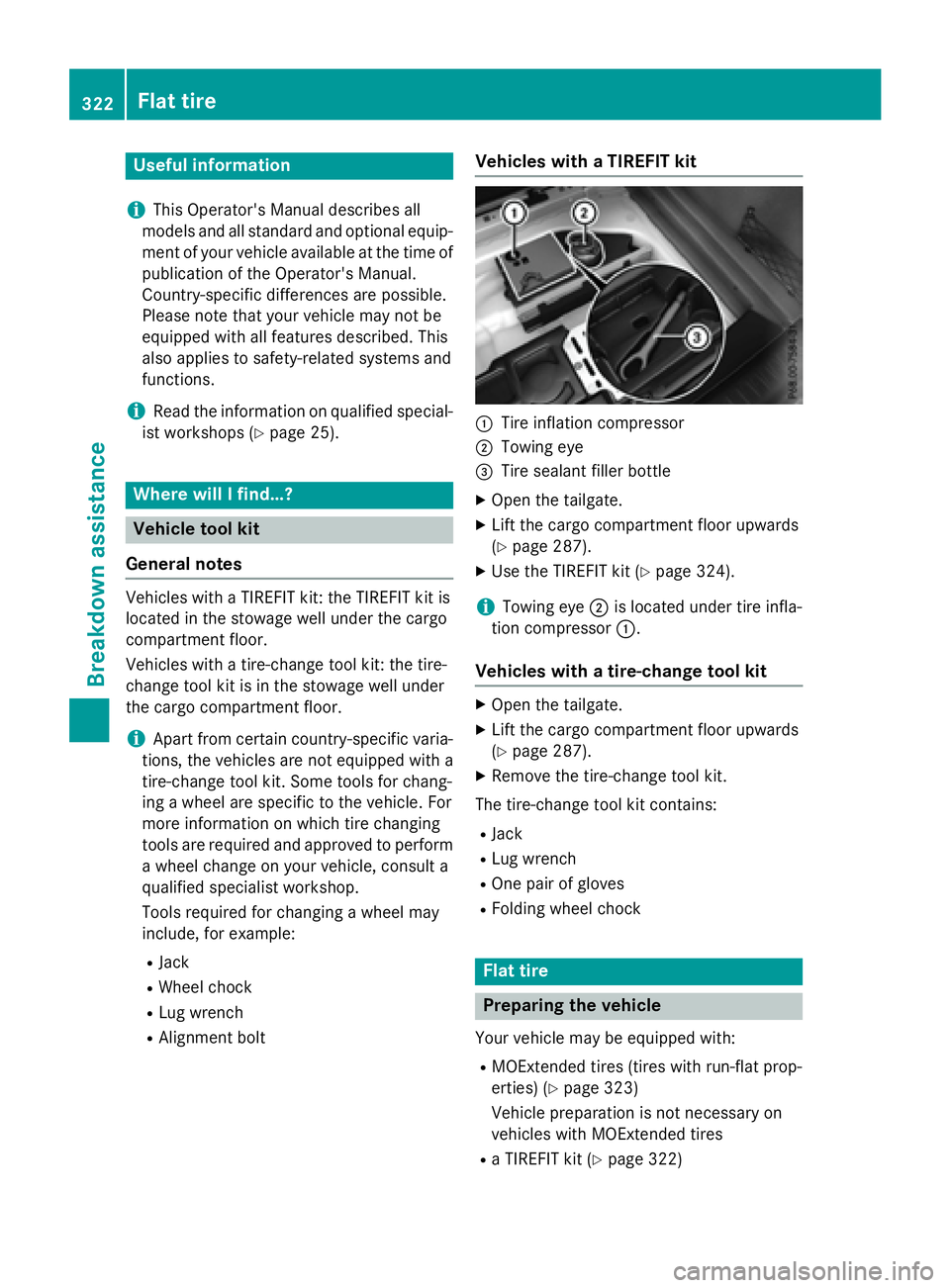
Alignment bolt Vehicles with a TIREFIT kit
C
Tire inflation compressor D
Towing eye
Page 336 of 390
! Make sure that the electric parking brake
is released. If the electric parking brake is
faulty, visit a qualified specialist workshop.
! Only secure the tow rope or tow bar at the
towing eyes. Otherwise, the vehicle could
be damaged.
! Do not use the towing eyes for recovery
purposes as this could damage the vehicle.
If in doubt, recover the vehicle with a crane.
! When towing, pull away slowly and
smoothly. If the tractive power is too high,
the vehicles could be damaged.
! The vehicle can be towed a maximum of
30 miles (50km). The towing speed of
30 mph (50km/h) must not be exceeded.
If the vehicle has to be towed more than
30 miles (50km), the front axle must be
raised or the entire vehicle raised and
transported.
! Do not tow with sling-type equipment.
This could damage the vehicle.
! When towing vehicles with KEYLESS-GO,
use the key instead of the Start/Stop but-
ton. Otherwise, the automatic transmission
may shift to position P when the driver's or
front-passenger door are opened, which
could lead to damage to the transmission.
! Vehicles with automatic transmission
must not be started by tow-starting. This
could otherwise damage the transmission.
It is better to have the vehicle transported
than to have it towed away.
If the vehicle can no longer be driven because
of an accident or breakdown, you have the
following options: R
Transporting the vehicle
As a rule, you should have the vehicle trans-
ported. R
Towing the vehicle with a tow rope or tow
bar
Only tow the vehicle in exceptional cases. The battery must be connected and charged.
Otherwise, you: R
cannot turn the SmartKey to position 2 in
the ignition lock R
cannot release the electric parking brake R
cannot shift the transmission to position N
The function of the electric parking brake and
the parking lock is dependent on the on-board
voltage.
If the on-board voltage is low or there is a
system malfunction, it is possible that: R
the electric parking brake may not be
applied in certain circumstances, or R
the transmission may not be shifted to P
Switch off non-essential consumers, e.g. the
radio.
Disarm the automatic locking feature before
the vehicle is towed ( Y
page 230). You could
otherwise be locked out when pushing or
towing the vehicle.
Installing/removing the towing eye
Installing the towing eye
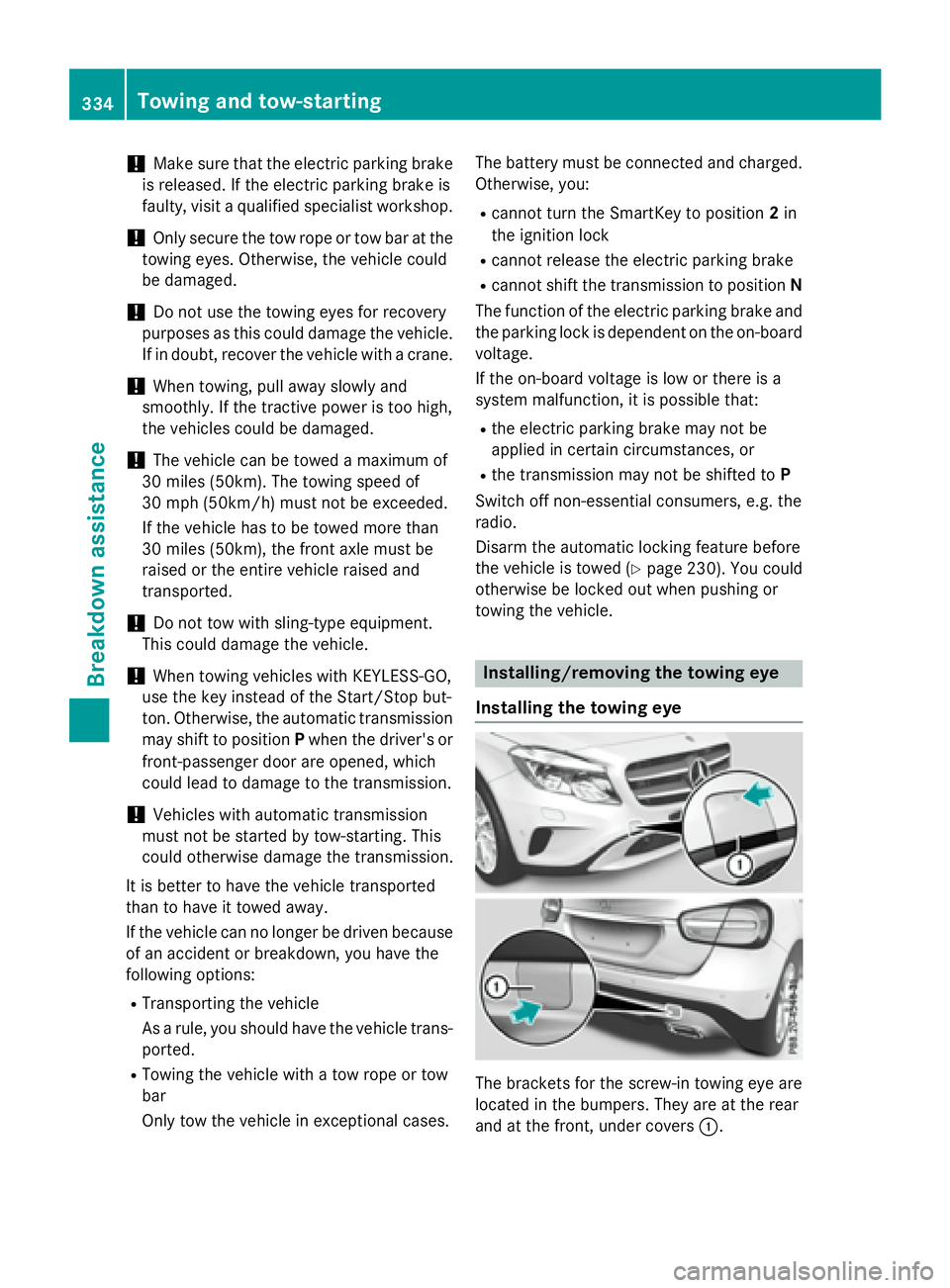
The brackets for the screw-in towing eye are
located in the bumpers. They are at the rear
and at the front, under covers C .334
Towing and tow-starting
Breakdown assistance
Page 337 of 390
X
Remove th e towin g eye from th e stowage
space.
The towin g eye is locate d wit h th e vehicl e
tool ki t under th e cargo compartmen t floor
( Y
page 322).
Vehicles wit h th e TIREFI T kit: th e towin g
eye is beneat h th e tire inflation compres-
sor . X
Press th e mar k on cover C inward s in th e
direction of th e arrow.X
Tak e cover C off th e opening.X
Screw in th e towin g eye clockwise to th e
stop.
Removin g th e towing eyeX
Unscrew and remove th e towin g eye.X
Attac h cover C to th e bumper and press
until it engages. X
Plac e th e towin g eye in th e stowage well
beneat h th e cargo compartmen t floor in
th e cargo compartmen t ( Y
page 322).X
Vehicles wit h th e TIREFI T kit: put bac k th e
tire inflation compressor.
Towing th e veh icle wit h th e fr ont axle
raised
Observ e th e important safet y note s when
towin g your vehicl e wit h th e fron t axl e raised
( Y
page 333).
Only vehicles withou t 4MATIC can be
towe d wit h th e front axle raised .
! Vehicles wit h 4MATIC mus t no t be towed
wit h either th e fron t or th e rear axl e raised,
as doin g so will damag e th e transmission .
Vehicles wit h 4MATIC may either be towed
away wit h bot h axles on th e ground or be loa-
ded up and transported.
! The ignition mus t be switched off if th e
vehicl e is bein g towed wit h th e fron t axl e
raised. Otherwise , ES P ®
may interven e and
damag e th e brak e system. X
On vehicles wit h KEYLESS-G O or th e
KEYLESS-G O star t function: you mus t
use th e SmartKey instead of th e Start/Sto p
butto n ( Y
page 150). X
Mak e sur e that th e vehicl e is stationary.X
Turn th e SmartKey to position 2 in th e igni-
tion lock. X
Whe n th e vehicl e is stationary, depress th e
brak e pedal and keep it depressed. X
Shift th e automatic transmission to posi-
tion P . X
Releas e th e brak e pedal .X
Releas e th e electric parkin g brake.X
Switc h off th e automatic locking
( Y
page 230). X
Switc h on th e hazard warnin g lamp s
( Y
page 119). X
Turn th e SmartKey in th e ignition loc k to
position 0 and leav e th e SmartKey in th e
ignition lock.
Towing a veh icle wit h bot h axles on
th e groun d
It is important that you observ e th e safet y
instruction s when towin g away your vehicl e
( Y
page 333). X
On vehicles wit h KEYLESS-G O or th e
KEYLESS-G O star t function: you mus t
use th e SmartKey instead of th e Start/Sto p
butto n ( Y
page 150).
The automatic transmission automatically
shift s to position P when you open th e driver's
or front-passenger doo r or when you remove
th e SmartKey from th e ignition lock. In order
to ensur e that th e automatic transmission
stays in position N when towin g th e vehicle,
you mus t observ e th e followin g points :X
Mak e sur e that th e vehicl e is stationary.X
Turn th e SmartKey to position 2 in th e igni-
tion lock.Towing and tow-starting 335
Breakdown assistance Z
Page 338 of 390
X
Depress and hold the brake pedal. X
Shift the automatic transmission to posi-
tion N .X
Leave the SmartKey in position 2 in the
ignition lock. X
Release the brake pedal. X
Release the electric parking brake. X
Switch on the hazard warning lamps
( Y
page 119).
i In order to signal a change of direction
when towing the vehicle with the hazard
warning lamps switched on, use the com-
bination switch as usual. In this case, only
the indicator lamps for the direction of
travel flash. After resetting the combina-
tion switch, the hazard warning lamp starts
flashing again.
Transporting the vehicle
4MATIC vehicles/vehicles with auto-
matic transmission
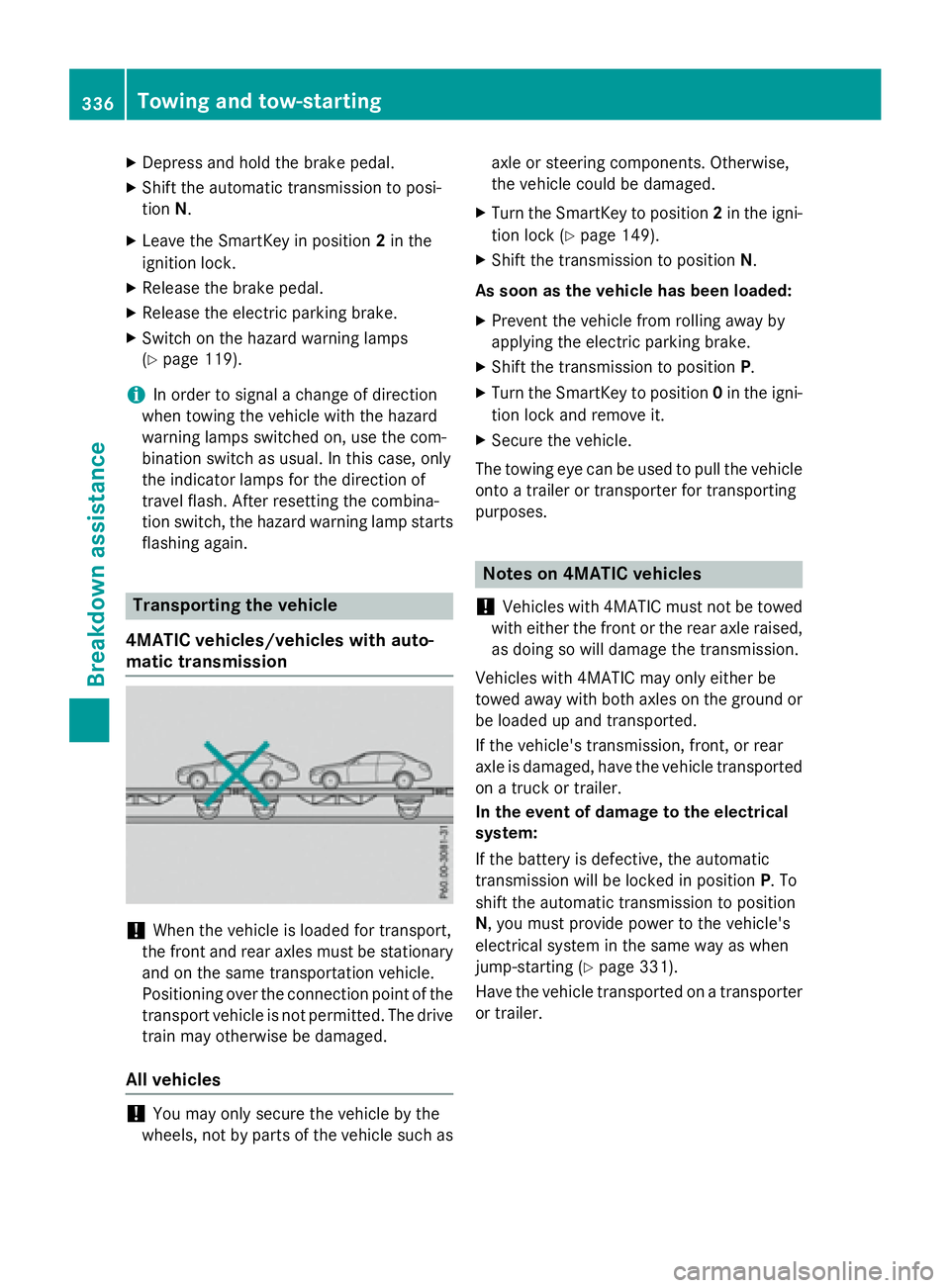
! When the vehicle is loaded for transport,
the front and rear axles must be stationary
and on the same transportation vehicle.
Positioning over the connection point of the
transport vehicle is not permitted. The drive
train may otherwise be damaged.
All vehicles
! You may only secure the vehicle by the
wheels, not by parts of the vehicle such as axle or steering components. Otherwise,
the vehicle could be damaged. X
Turn the SmartKey to position 2 in the igni-
tion lock ( Y
page 149). X
Shift the transmission to position N .
As soon as the vehicle has been loaded: X
Prevent the vehicle from rolling away by
applying the electric parking brake. X
Shift the transmission to position P .X
Turn the SmartKey to position 0 in the igni-
tion lock and remove it. X
Secure the vehicle.
The towing eye can be used to pull the vehicle
onto a trailer or transporter for transporting
purposes.
Notes on 4MATIC vehicles
! Vehicles with 4MATIC must not be towed
with either the front or the rear axle raised,
as doing so will damage the transmission.
Vehicles with 4MATIC may only either be
towed away with both axles on the ground or
be loaded up and transported.
If the vehicle's transmission, front, or rear
axle is damaged, have the vehicle transported
on a truck or trailer.
In the event of damage to the electrical
system:
If the battery is defective, the automatic
transmission will be locked in position P . To
shift the automatic transmission to position
N , you must provide power to the vehicle's
electrical system in the same way as when
jump-starting ( Y
page 331).
Have the vehicle transported on a transporter
or trailer.336
Towing and tow-starting
Breakdown assistance