fuel MERCEDES-BENZ GLA 2019 User Guide
[x] Cancel search | Manufacturer: MERCEDES-BENZ, Model Year: 2019, Model line: GLA, Model: MERCEDES-BENZ GLA 2019Pages: 346, PDF Size: 16.66 MB
Page 55 of 346
The rate of vehicle deceleration or accelera-tion and the direction of the force are essen-tially determined by:
Rthe distribution of forces during the collision
Rthe collision angle
Rthe deformation characteristics of the vehi-cle
Rthe characteristics of the object with whichthe vehicle has collided
Factors which can only be seen and measuredafter a collision has occurred do not play adecisive role in the deployment of an air bag.Nor do they provide an indication of air bagdeployment.
The vehicle can be deformed considerably,without an air bag being deployed. This is thecase if only parts which are relatively easilydeformed are affected and the rate of deceler-ation is not high. Conversely, air bags may bedeployed even though the vehicle suffers onlyminor deformation. This is the case if, forexample, very rigid vehicle parts such as longi-tudinal body members are hit, and sufficientdeceleration occurs as a result.
If the restraint system control unit detects aside impact or if the vehicle rolls over, theapplicable components of the restraint systemare deployed independently of each otherdepending on the apparent type of accident.
RSide impact air bags on the side where theimpact takes place, independently of theEmergency Tensioning Device and the useof the seat belt on the driver's seat andouter seats in the second row
The side impact air bag on the frontpassenger side deploys under the followingconditions:
-the OCS system detects that the frontpassenger seat is occupied or
-the seat belt buckle tongue is engaged inthe belt buckle of the front passengerseat
RWindow curtain air bag on the side ofimpact, independently of the use of the seatbelt and independently of whether the front-passenger seat is occupied
REmergency Tensioning Devices, if the sys-tem determines that deployment can offeradditional protection in this situation
RWindow curtain air bags on the driver's andfront-passenger side in certain situationswhen the vehicle rolls over, if the system
determines that deployment can offer addi-tional protection to that provided by theseat belt
iNot all air bags are deployed in an acci-dent. The different air bag systems workindependently of each other.
How the air bag system works is determinedby the severity of the accident detected,especially the vehicle deceleration or accel-eration and the apparent type of accident:
RHead-on collision
RSide impact
RRollover
Automatic measures after an acci-
dent
Immediately after an accident, the followingmeasures are implemented, depending on thetype and severity of the impact:
Rthe hazard warning lamps are switched on
Rthe emergency lighting is activated
Rthe vehicle doors are unlocked
Rthe front side windows are lowered
Rthe engine is switched off and the fuel sup-ply is cut off
Rvehicles with Mercedes me connect: auto-matic emergency call
Children in the vehicle
Important safety notes
Accident statistics show that children securedin the rear seats are safer than childrensecured in the front-passenger seat. For thisreason, Mercedes-Benz strongly advises thatyou install a child restraint system on a rearseat. Children are generally better protectedthere.
If a child younger than twelve years old andunder 5 ft (1.50 m) in height is traveling in thevehicle:
Ralways secure the child in a child restraintsystem suitable for Mercedes-Benz vehicles.The child restraint system must be appropri-ate to the age, weight and size of the child.
Rbe sure to observe the instructions andsafety notes in this section in addition to the
Children in the vehicle53
Safety
Z
Page 73 of 346
KEYLESS-GO start function
General notes
Bear in mind that the engine can be started byany of the vehicle occupants if there is aSmartKey in the vehicle.
Changing the settings of the locking
system
You can change the settings of the lockingsystem. This means that only the driver's doorand the fuel filler flap are unlocked when thevehicle is unlocked. This is useful if you fre-quently travel on your own.
XTo change the setting:press and hold the6and7buttons simultaneously forapproximately six seconds until the batteryindicator lamp flashes twice (Ypage 72).
If the setting of the locking system is changedwithin the signal range of the vehicle, pressingthe7or6button:
Rlocks or
Runlocks the vehicle
The SmartKey now functions as follows:
XTo unlock:press the6button once.
XTo unlock centrally:press the6buttontwice.
XTo lock centrally:press the7button.
The KEYLESS-GO function is changed as fol-lows:
XTo unlock the driver's door:touch theinner surface of the door handle on the driv-er's door.
XTo unlock centrally:touch the inner sur-face of the door handle on the front-passenger door or the rear door.
XTo lock centrally:touch the outer sensorsurface on one of the door handles.
XTo restore the factory settings:press andhold the6and7buttons simultane-ously for approximately six seconds until thebattery check lamp flashes twice(Ypage 72).
Mechanical key
General notes
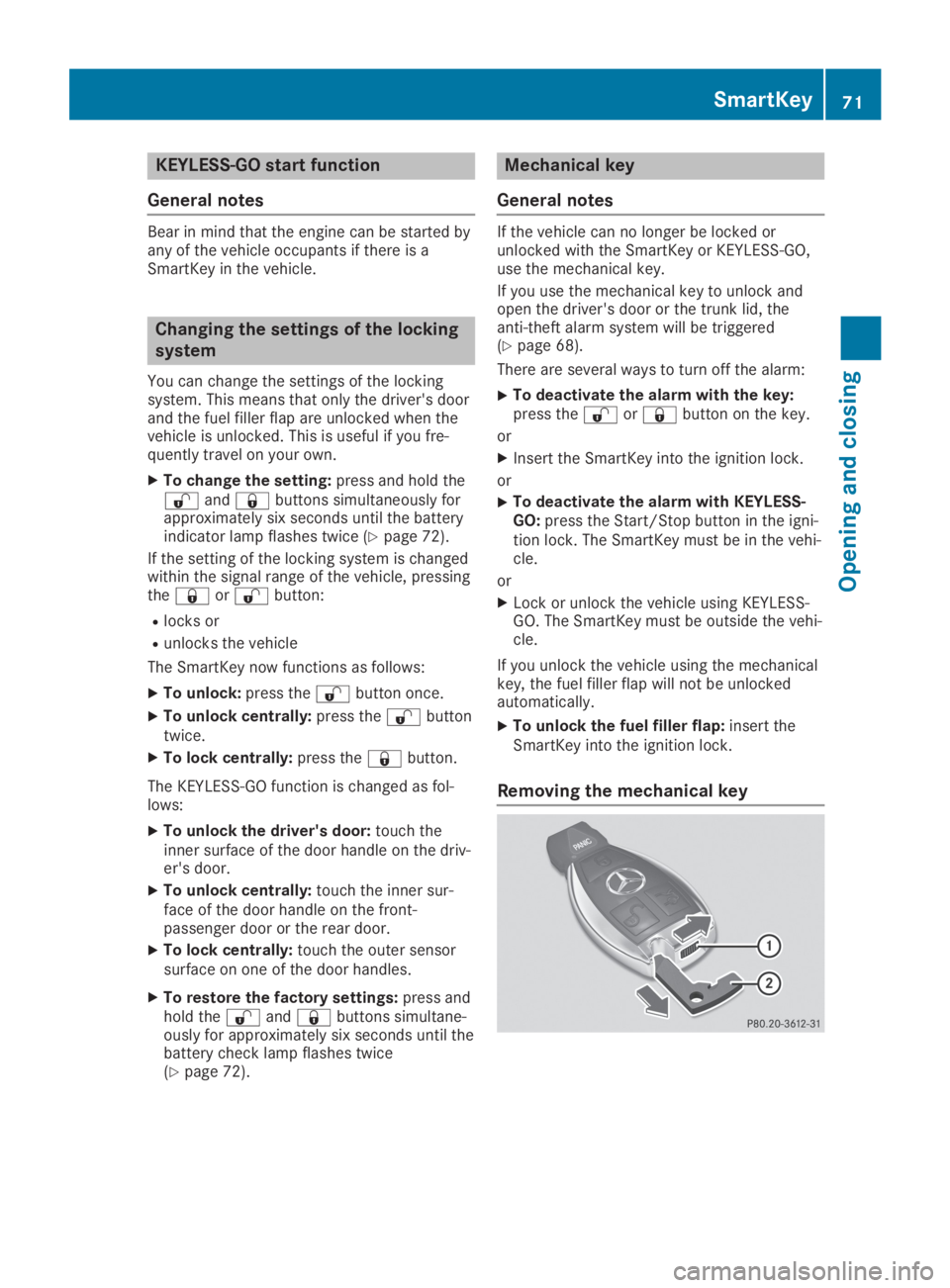
If the vehicle can no longer be locked orunlocked with the SmartKey or KEYLESS-GO,use the mechanical key.
If you use the mechanical key to unlock andopen the driver's door or the trunk lid, theanti-theft alarm system will be triggered(Ypage 68).
There are several ways to turn off the alarm:
XTo deactivate the alarm with the key:press the6or7button on the key.
or
XInsert the SmartKey into the ignition lock.
or
XTo deactivate the alarm with KEYLESS-GO:press the Start/Stop button in the igni-tion lock. The SmartKey must be in the vehi-cle.
or
XLock or unlock the vehicle using KEYLESS-GO. The SmartKey must be outside the vehi-cle.
If you unlock the vehicle using the mechanicalkey, the fuel filler flap will not be unlockedautomatically.
XTo unlock the fuel filler flap:insert theSmartKey into the ignition lock.
Removing the mechanical key
SmartKey71
Opening and closing
Z
Page 78 of 346
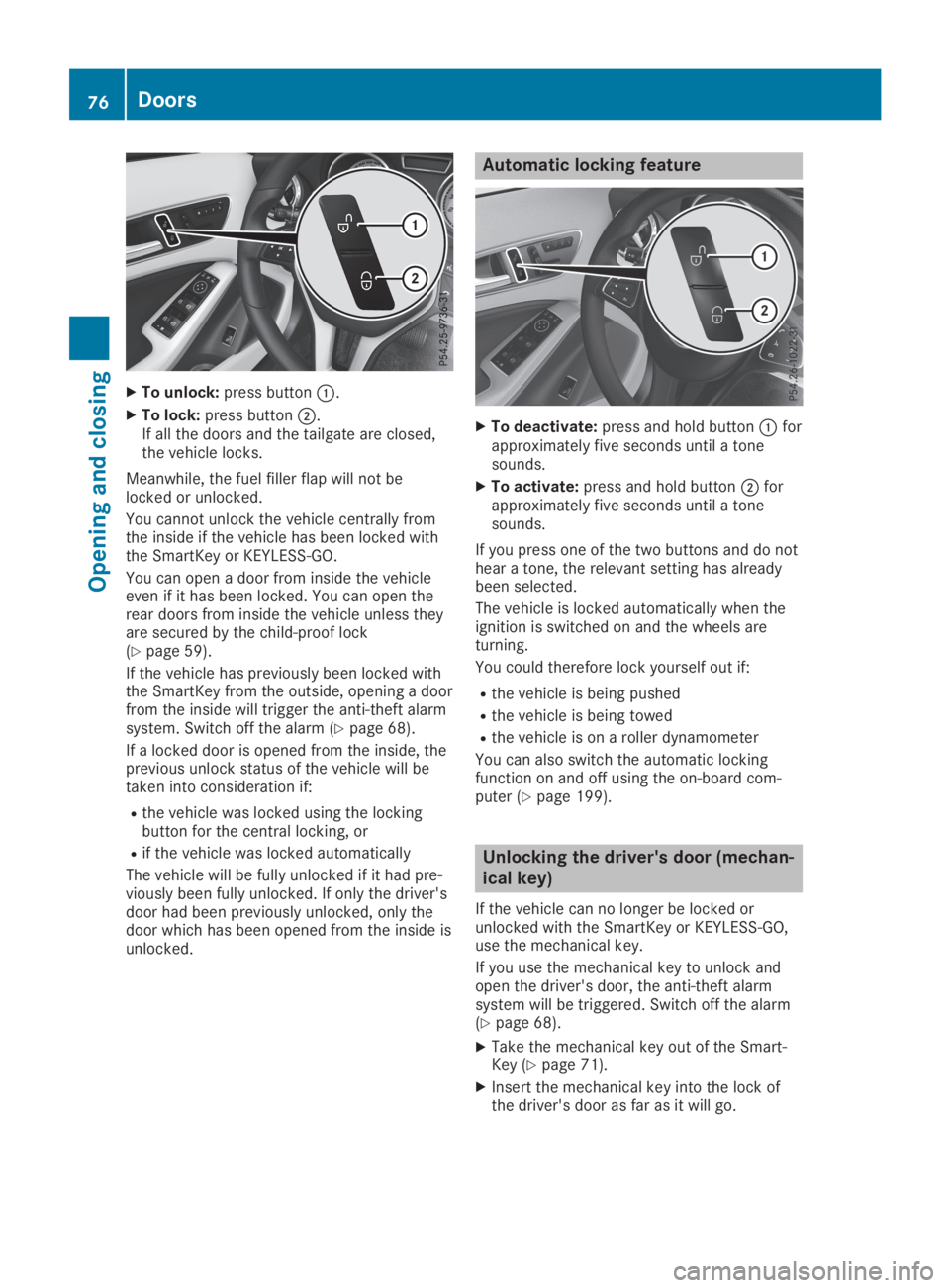
XTo unlock:press buttonC.
XTo lock:press buttonD.If all the doors and the tailgate are closed,the vehicle locks.
Meanwhile, the fuel filler flap will not belocked or unlocked.
You cannot unlock the vehicle centrally fromthe inside if the vehicle has been locked withthe SmartKey or KEYLESS-GO.
You can open a door from inside the vehicleeven if it has been locked. You can open therear doors from inside the vehicle unless theyare secured by the child-proof lock(Ypage 59).
If the vehicle has previously been locked withthe SmartKey from the outside, opening a doorfrom the inside will trigger the anti-theft alarmsystem. Switch off the alarm (Ypage 68).
If a locked door is opened from the inside, theprevious unlock status of the vehicle will betaken into consideration if:
Rthe vehicle was locked using the lockingbutton for the central locking, or
Rif the vehicle was locked automatically
The vehicle will be fully unlocked if it had pre-viously been fully unlocked. If only the driver'sdoor had been previously unlocked, only thedoor which has been opened from the inside isunlocked.
Automatic locking feature
XTo deactivate:press and hold buttonCforapproximately five seconds until a tonesounds.
XTo activate:press and hold buttonDforapproximately five seconds until a tonesounds.
If you press one of the two buttons and do nothear a tone, the relevant setting has alreadybeen selected.
The vehicle is locked automatically when theignition is switched on and the wheels areturning.
You could therefore lock yourself out if:
Rthe vehicle is being pushed
Rthe vehicle is being towed
Rthe vehicle is on a roller dynamometer
You can also switch the automatic lockingfunction on and off using the on-board com-puter (Ypage 199).
Unlocking the driver's door (mechan-
ical key)
If the vehicle can no longer be locked orunlocked with the SmartKey or KEYLESS-GO,use the mechanical key.
If you use the mechanical key to unlock andopen the driver's door, the anti-theft alarmsystem will be triggered. Switch off the alarm(Ypage 68).
XTake the mechanical key out of the Smart-Key (Ypage 71).
XInsert the mechanical key into the lock ofthe driver's door as far as it will go.
76Doors
Opening and closing
Page 79 of 346
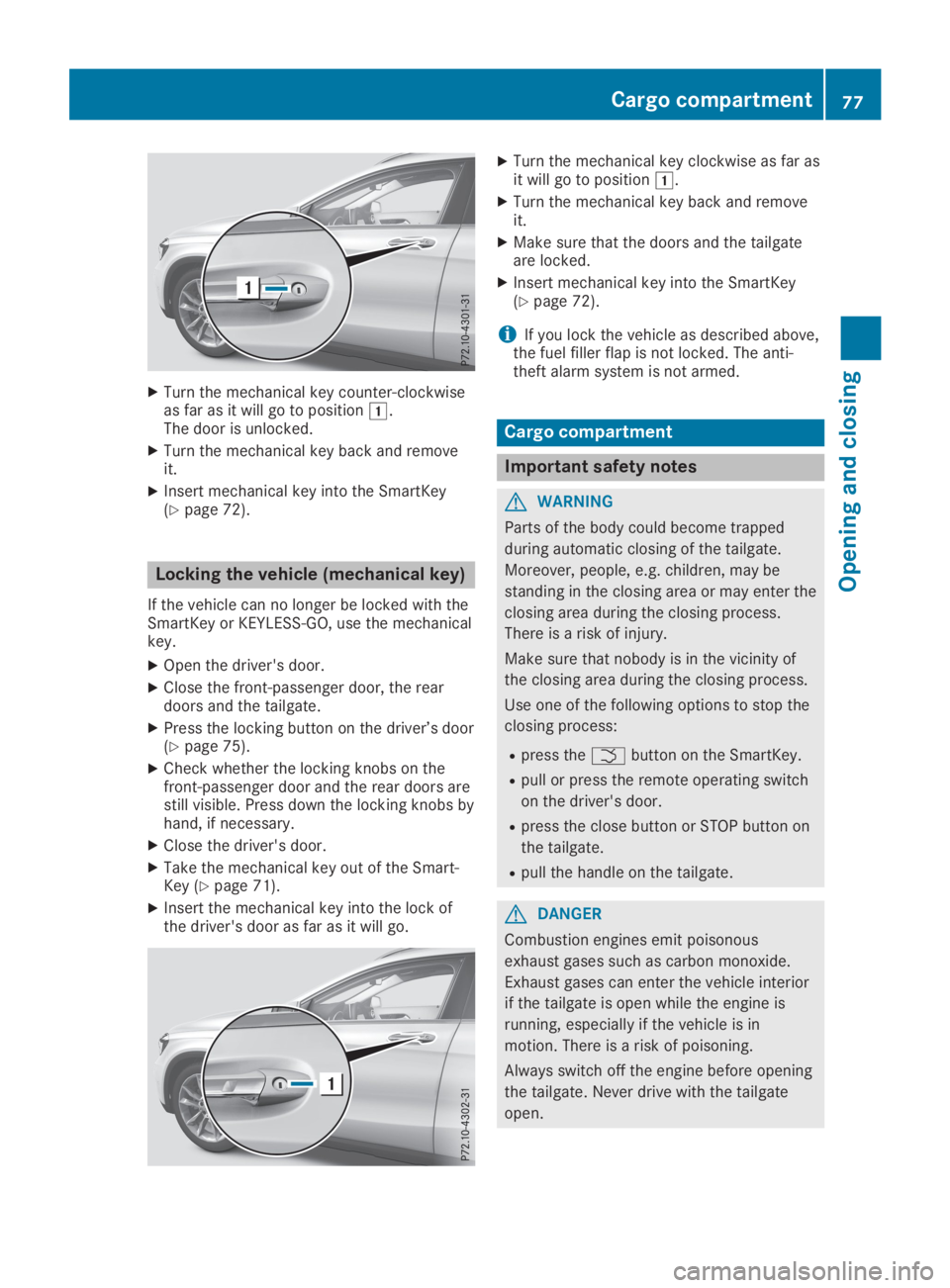
XTurn the mechanical key counter-clockwiseas far as it will go to positionG.The door is unlocked.
XTurn the mechanical key back and removeit.
XInsert mechanical key into the SmartKey(Ypage 72).
Locking the vehicle (mechanical key)
If the vehicle can no longer be locked with theSmartKey or KEYLESS-GO, use the mechanicalkey.
XOpen the driver's door.
XClose the front-passenger door, the reardoors and the tailgate.
XPress the locking button on the driver’s door(Ypage 75).
XCheck whether the locking knobs on thefront-passenger door and the rear doors arestill visible. Press down the locking knobs byhand, if necessary.
XClose the driver's door.
XTake the mechanical key out of the Smart-Key (Ypage 71).
XInsert the mechanical key into the lock ofthe driver's door as far as it will go.
XTurn the mechanical key clockwise as far asit will go to positionG.
XTurn the mechanical key back and removeit.
XMake sure that the doors and the tailgateare locked.
XInsert mechanical key into the SmartKey(Ypage 72).
iIf you lock the vehicle as described above,the fuel filler flap is not locked. The anti-theft alarm system is not armed.
Cargo compartment
Important safety notes
GWARNING
Parts of the body could become trapped
during automatic closing of the tailgate.
Moreover, people, e.g. children, may be
standing in the closing area or may enter the
closing area during the closing process.
There is a risk of injury.
Make sure that nobody is in the vicinity of
the closing area during the closing process.
Use one of the following options to stop the
closing process:
Rpress theTbutton on the SmartKey.
Rpull or press the remote operating switch
on the driver's door.
Rpress the close button or STOP button on
the tailgate.
Rpull the handle on the tailgate.
GDANGER
Combustion engines emit poisonous
exhaust gases such as carbon monoxide.
Exhaust gases can enter the vehicle interior
if the tailgate is open while the engine is
running, especially if the vehicle is in
motion. There is a risk of poisoning.
Always switch off the engine before opening
the tailgate. Never drive with the tailgate
open.
Cargo compartment77
Opening and closing
Z
Page 130 of 346
Rthe doors are closed and locked
Rthe windows and sliding sunroof are closed
Also make sure that:
Rthe fuel tank is sufficiently filled
Rthe starter battery has been sufficientlycharged
GWARNING
Limbs could be crushed or trapped if the
engine is started unintentionally during ser-
vice or maintenance work. There is a risk of
injury.
Always secure the engine against uninten-
tional starting before carrying out mainte-
nance or repair work.
Make sure that the engine cannot be startedvia your smartphone before carrying out main-tenance or repairs. You can prevent an enginestart via your smartphone, for example, if you:
Rswitch on the hazard warning lamps
Rdo not lock the doors
Ropen the hood
Pulling away
General notes
GWARNING
If the engine speed is above the idling speed
and you engage transmission position:
orF, the vehicle could pull away sud-
denly. There is a risk of an accident.
When engaging transmission position:
orF, always firmly depress the brake
pedal and do not simultaneously accelerate.
Depress the accelerator carefully when pullingaway.
The vehicle locks centrally once you havepulled away. The locking knobs in the doorsdrop down.
You can open the doors from the inside at anytime.
You can also deactivate the automatic lockingfeature (Ypage 199).
Vehicles with automatic transmission:it ispossible to shift the transmission from posi-
tion]to the desired position only if youdepress the brake pedal. Only then can theparking lock be deactivated.
All vehicles (except Mercedes-AMG vehi-cles):if you do not depress the brake pedal,the DIRECT SELECT lever can still be movedbut the parking lock remains engaged.
Mercedes-AMG vehicles:if you do notdepress the brake pedal, the selector lever canstill be moved but the parking lock remainsengaged.
At transmission fluid temperatures below
Page 131 of 346
ECO start/stop function
Introduction
The ECO start/stop function switches theengine off automatically if the vehicle is stop-ped under certain conditions.
The engine starts automatically when thedriver wants to pull away again. The ECOstart/stop function thereby helps you toreduce the fuel consumption and emissions ofyour vehicle.
Important safety notes
GWARNING
If the engine is switched off automatically
and you exit the vehicle, the engine is
restarted automatically. The vehicle may
begin moving. There is a risk of accident and
injury.
If you wish to exit the vehicle, always turn
off the ignition and secure the vehicle
against rolling away.
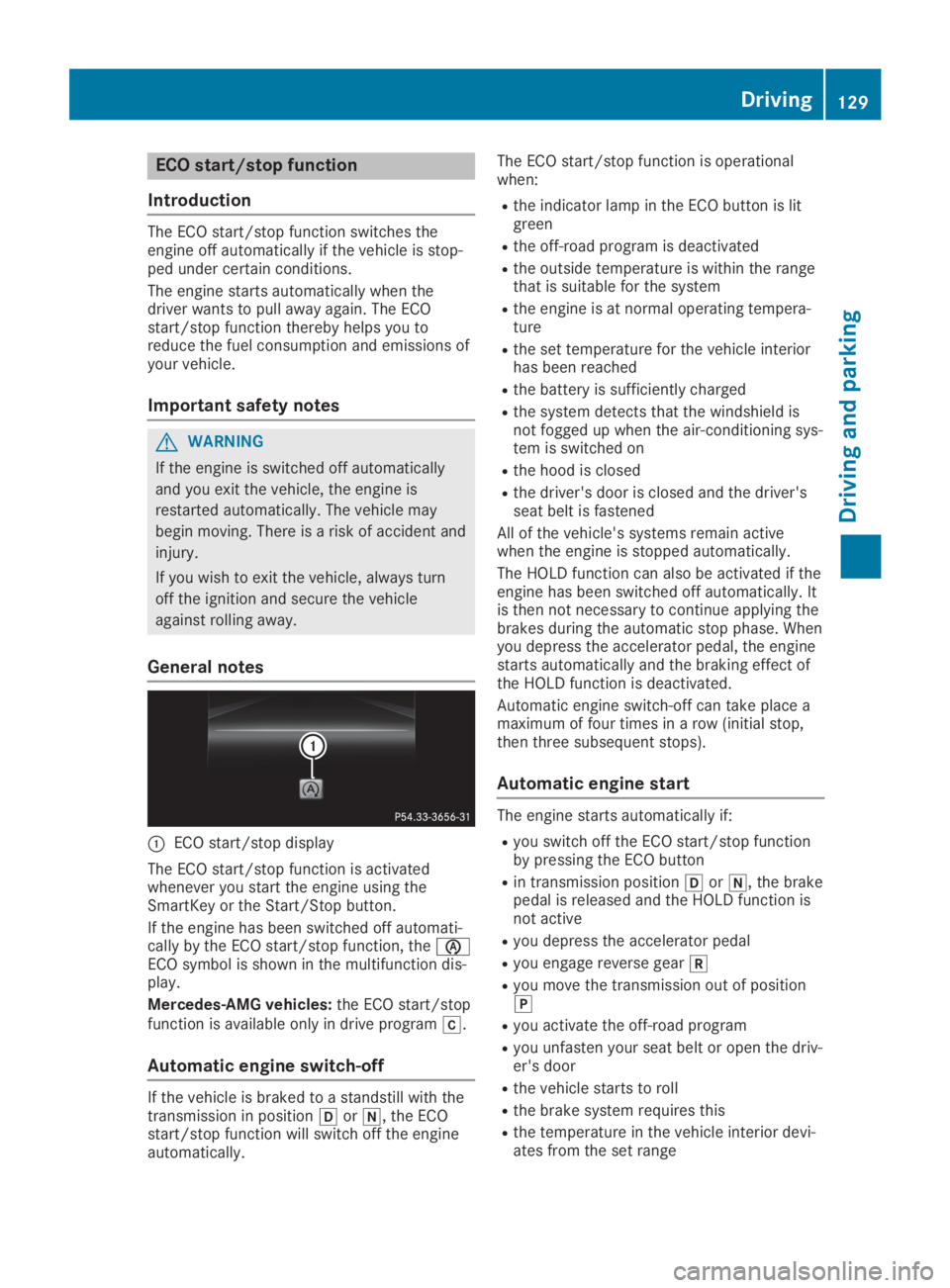
General notes
CECO start/stop display
The ECO start/stop function is activatedwhenever you start the engine using theSmartKey or the Start/Stop button.
If the engine has been switched off automati-cally by the ECO start/stop function, the
Page 133 of 346
Problems with the engine
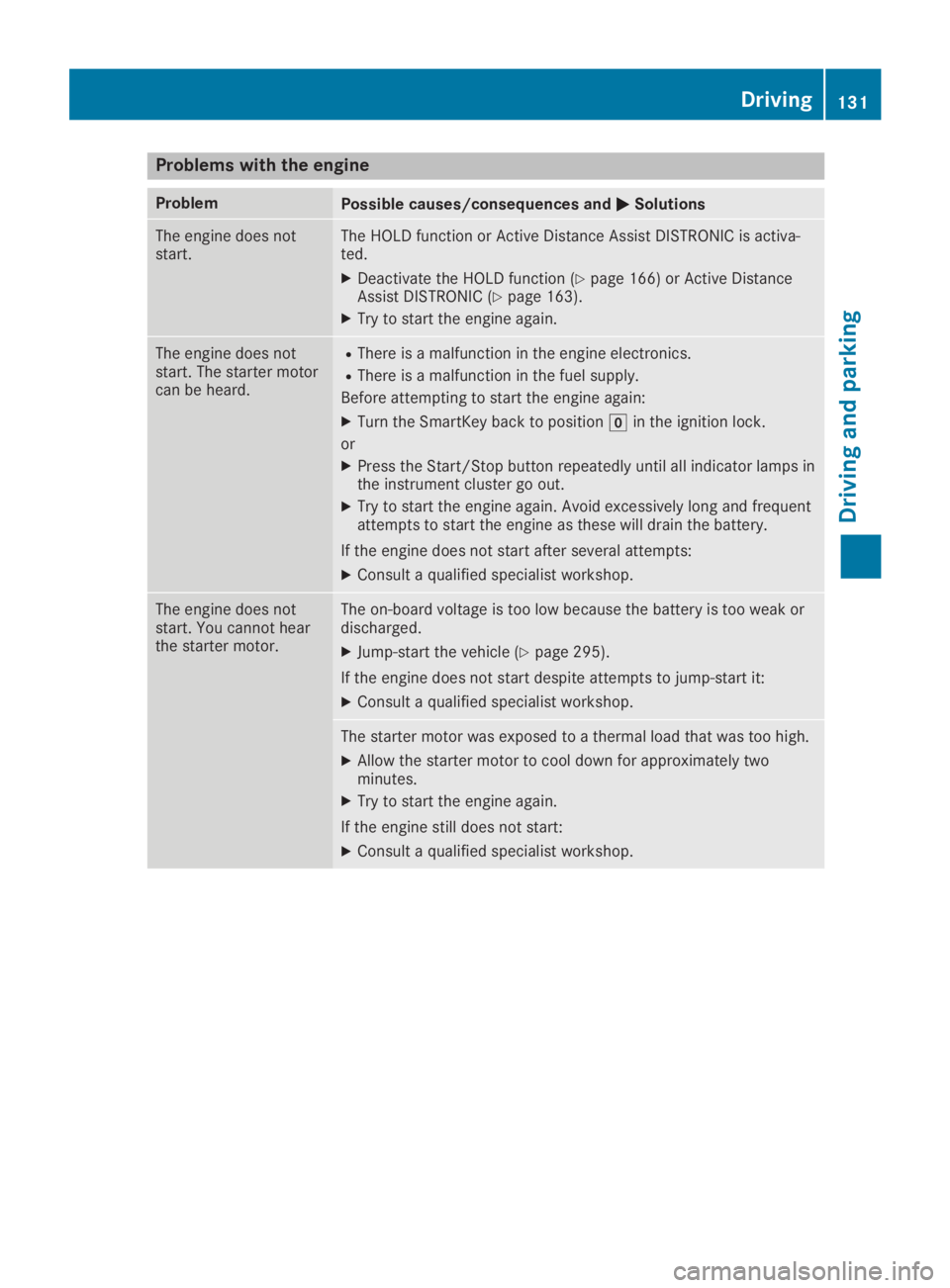
ProblemPossible causes/consequences andPPSolutions
The engine does notstart.The HOLD function or Active Distance Assist DISTRONIC is activa-ted.
XDeactivate the HOLD function (Ypage 166) or Active DistanceAssist DISTRONIC (Ypage 163).
XTry to start the engine again.
The engine does notstart. The starter motorcan be heard.
RThere is a malfunction in the engine electronics.
RThere is a malfunction in the fuel supply.
Before attempting to start the engine again:
XTurn the SmartKey back to positionZin the ignition lock.
or
XPress the Start/Stop button repeatedly until all indicator lamps inthe instrument cluster go out.
XTry to start the engine again. Avoid excessively long and frequentattempts to start the engine as these will drain the battery.
If the engine does not start after several attempts:
XConsult a qualified specialist workshop.
The engine does notstart. You cannot hearthe starter motor.
The on-board voltage is too low because the battery is too weak ordischarged.
XJump-start the vehicle (Ypage 295).
If the engine does not start despite attempts to jump-start it:
XConsult a qualified specialist workshop.
The starter motor was exposed to a thermal load that was too high.
XAllow the starter motor to cool down for approximately twominutes.
XTry to start the engine again.
If the engine still does not start:
XConsult a qualified specialist workshop.
Driving131
Driving and parking
Z
Page 134 of 346
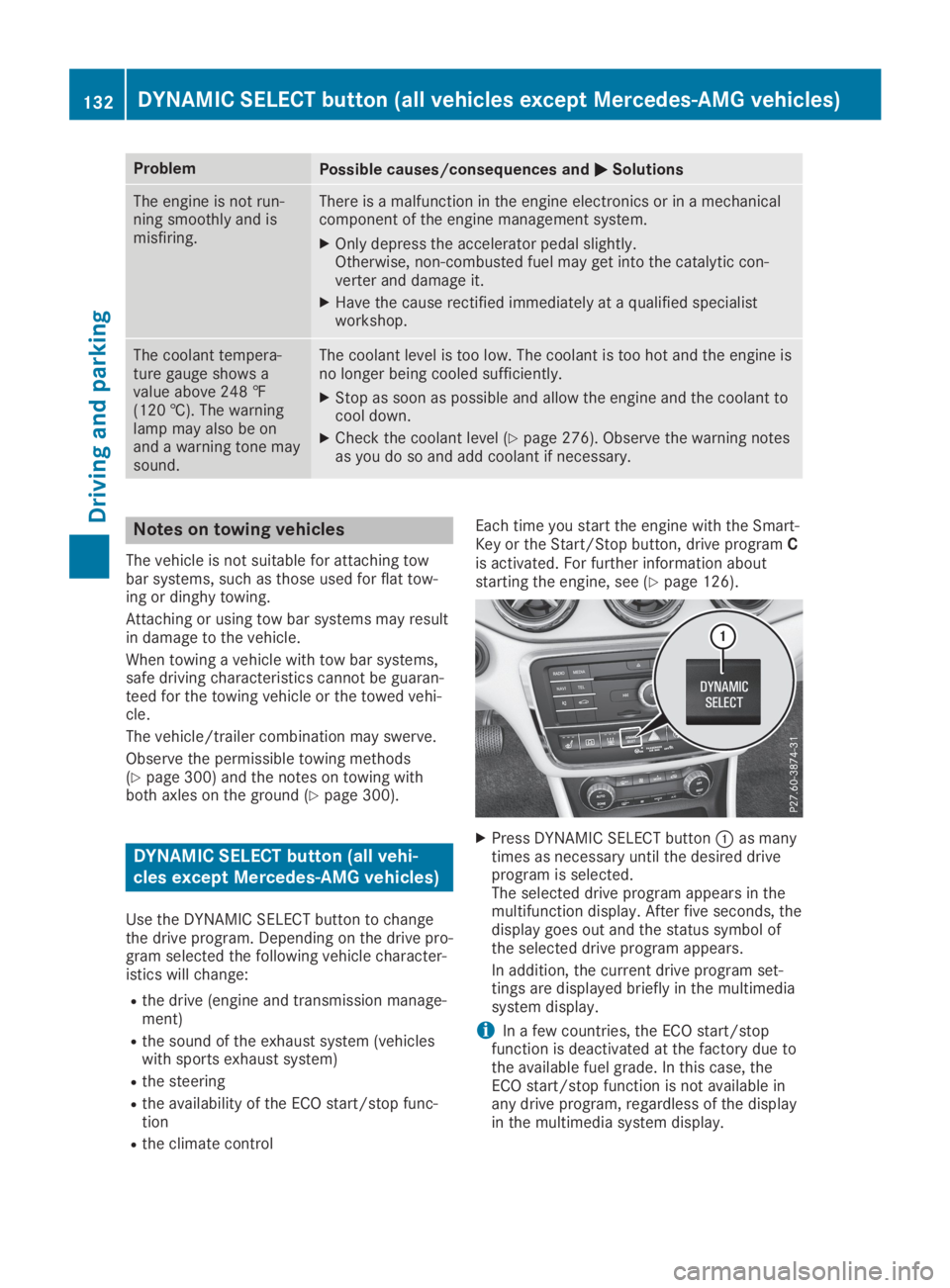
ProblemPossible causes/consequences andPPSolutions
The engine is not run-ning smoothly and ismisfiring.
There is a malfunction in the engine electronics or in a mechanicalcomponent of the engine management system.
XOnly depress the accelerator pedal slightly.Otherwise, non-combusted fuel may get into the catalytic con-verter and damage it.
XHave the cause rectified immediately at a qualified specialistworkshop.
The coolant tempera-ture gauge shows avalue above 248 ‡(120 †). The warninglamp may also be onand a warning tone maysound.
The coolant level is too low. The coolant is too hot and the engine isno longer being cooled sufficiently.
XStop as soon as possible and allow the engine and the coolant tocool down.
XCheck the coolant level (Ypage 276). Observe the warning notesas you do so and add coolant if necessary.
Notes on towing vehicles
The vehicle is not suitable for attaching towbar systems, such as those used for flat tow-ing or dinghy towing.
Attaching or using tow bar systems may resultin damage to the vehicle.
When towing a vehicle with tow bar systems,safe driving characteristics cannot be guaran-teed for the towing vehicle or the towed vehi-cle.
The vehicle/trailer combination may swerve.
Observe the permissible towing methods(Ypage 300) and the notes on towing withboth axles on the ground (Ypage 300).
DYNAMIC SELECT button (all vehi-
cles except Mercedes-AMG vehicles)
Use the DYNAMIC SELECT button to changethe drive program. Depending on the drive pro-gram selected the following vehicle character-istics will change:
Rthe drive (engine and transmission manage-ment)
Rthe sound of the exhaust system (vehicleswith sports exhaust system)
Rthe steering
Rthe availability of the ECO start/stop func-tion
Rthe climate control
Each time you start the engine with the Smart-Key or the Start/Stop button, drive programCis activated. For further information aboutstarting the engine, see (Ypage 126).
XPress DYNAMIC SELECT buttonCas manytimes as necessary until the desired driveprogram is selected.The selected drive program appears in themultifunction display. After five seconds, thedisplay goes out and the status symbol ofthe selected drive program appears.
In addition, the current drive program set-tings are displayed briefly in the multimediasystem display.
iIn a few countries, the ECO start/stopfunction is deactivated at the factory due tothe available fuel grade. In this case, theECO start/stop function is not available inany drive program, regardless of the displayin the multimedia system display.
132DYNAMIC SELECT button (all vehicles except Mercedes-AMG vehicles)
Driving and parking
Page 140 of 346
Holding the vehicle stationary on
uphill gradients
GWARNING
If the clutch overheats, the electronic man-
agement system is automatically deactiva-
ted. This interrupts the power transmission.
The vehicle may, for example, roll back-
wards on gradients. There is a risk of an
accident.
Never hold the vehicle stationary on uphill
gradients by depressing the accelerator.
The clutch may overheat if you hold the vehi-cle stationary on uphill gradients by depress-ing the accelerator pedal. If the clutch over-heats, a warning tone sounds.
All vehicles (except Mercedes-AMG vehi-
cles):theStop Vehicle Shift to 'P'Stop Vehicle Shift to 'P'
Leave Engine RunningLeave Engine Runningdisplay messageappears in the multifunction display. You willonly be able to continue your journey once theclutch has cooled down and the display mes-sage in the multifunction display has disap-peared.
Mercedes-AMG vehicles:theTrans. OilTrans. Oil
Overheated Drive on with CareOverheated Drive on with Caredisplaymessage appears in the multifunction display.
Do not hold the vehicle stationary on uphillgradients by depressing the accelerator pedal.Instead, only ever hold the vehicle stationaryon uphill gradients by:
Rdepressing the brake pedal
Ractivating the HOLD function
Rengaging the electric parking brake
Kickdown
Use kickdown for maximum acceleration.
XDepress the accelerator pedal beyond thepressure point.The automatic transmission shifts to a lowergear depending on the engine speed.
XEase off the accelerator pedal once thedesired speed is reached.The automatic transmission shifts back up.
Mercedes-AMG vehicles:it is only possibleto use kickdown in the automatic drive pro-gram and the temporary manual drive programM. When manual drive programMis perma-nently activated, kickdown is not possible.
For further information on kickdown in manualdrive programM(Ypage 142).
Rocking the vehicle free
Shifting back and forth between transmissionpositions[and^can help to free up thevehicle if it gets stuck in mud or snow. Thevehicle's engine management system limitsthe speed to a maximum of 5 mph (9 km/h)when shifting back and forth. To shift repeat-edly between transmission positions[and^, move the DIRECT SELECT lever up anddown past the point of resistance.
Drive programs
All vehicles (except Mercedes-AMG
vehicles)
Drive program C (Comfort)
Drive programCis characterized by the follow-ing:
Rthe vehicle delivers comfortable, economicalhandling characteristics.
Rthe vehicle pulls away more gently inforward and reverse gears, unless the accel-erator pedal is depressed fully.
Rthe vehicle has improved driving stability,for example on slippery road surfaces.
Roptimal fuel consumption resulting from theautomatic transmission shifting up sooner.The vehicle is driven in the low engine speedrange and the wheels are less likely to spin.
Drive program S (Sport)
Drive programSis characterized by the follow-ing:
Rsporty engine settings.
Rthe automatic transmission shifts up later.The fuel consumption possibly being higheras a result of the later automatic transmis-sion shift points.
Drive program I (Individual)
In drive programIthe following properties ofthe drive program can be selected:
Rthe drive (engine and transmission manage-ment)
Rthe steering
138Automatic transmission
Driving and parking
Page 141 of 346
Rthe availability of the ECO start/stop func-tion
Rthe climate control
Information about configuring drive programIwith the multimedia system can be found inthe Digital Operator's Manual.
iTo permanently select the gears in driveprogramIusing the steering wheel paddleshifters, select theM(manual) setting forthe drive.
Offroad drive program
TheOff-roaddrive program is characterizedby the following:
Rthe vehicle exhibits optimal driving charac-teristics on easily negotiable off-road ter-rain.
Drive program E (Economy)
Drive programEis characterized by the follow-ing:
Rcomfort-oriented engine settings.
Roptimal fuel consumption resulting from theautomatic transmission shifting up sooner.
Rthe vehicle pulls away more gently inforward and reverse gears, unless the accel-erator pedal is depressed fully.
Rthe vehicle has improved driving stability,for example on slippery road surfaces.
Rthe automatic transmission shifting upsooner. This results in the vehicle beingdriven at lower engine speeds and thewheels being less likely to spin.
Rgliding mode is activated automaticallywhen engine-internal conditions are fulfilledand the accelerator is not depressed. At thesame time the transmission’s clutch opensand the vehicle rolls freely using its kineticenergy. As a result great distances can becompleted without the engine brake andfuel consumption reduced.
iThe availability of gliding mode depends onvarious factors, including the following:
Rthe engine and transmission temperature
Rthe downhill gradient
Rthe vehicle speed
Rperforming regular adaptation functions
When you depress the brake pedal, glidingmode is deactivated, depending on pedalpressure.
When you activate cruise control or ActiveDistance Assist DISTRONIC, gliding mode isnot available.
Mercedes-AMG vehicles
Drive program I (Individual)
In drive programIthe following properties ofthe drive program can be selected:
Rthe drive (engine management)
Rthe transmission management
Rthe suspension (vehicles with AMG adaptivesport suspension system)
RESP®
Information about configuring drive programIwith the multimedia system can be found inthe Digital Operator's Manual.
Drive program C (Comfort)
Drive programCis characterized by the follow-ing:
Rthe vehicle delivers comfortable, economicalhandling characteristics.
Rthe vehicle pulls away more gently inforward and reverse gears, unless the accel-erator pedal is depressed fully.
Rthe vehicle has improved driving stability,for example on slippery road surfaces.
Roptimal fuel consumption resulting from theautomatic transmission shifting up sooner.The vehicle is driven in the low engine speedrange and the wheels are less likely to spin.
Rgliding mode is available.
Rthe ECO start/stop function is available.
Drive program S (Sport)
Drive programSis characterized by the follow-ing:
Rthe vehicle exhibits sporty driving character-istics.
Rthe automatic transmission shifts up later.The fuel consumption possibly being higheras a result of the later automatic transmis-sion shift points.
Rthe suspension exhibits stiff springing anddamping settings (vehicles with AIR adaptivesport suspension system).
Rgliding mode is not available.
Rthe ECO start/stop function is not available.
Automatic transmission139
Driving an d parking
Z