fuel consumption MERCEDES-BENZ GLA 2019 Owners Manual
[x] Cancel search | Manufacturer: MERCEDES-BENZ, Model Year: 2019, Model line: GLA, Model: MERCEDES-BENZ GLA 2019Pages: 346, PDF Size: 16.66 MB
Page 13 of 346
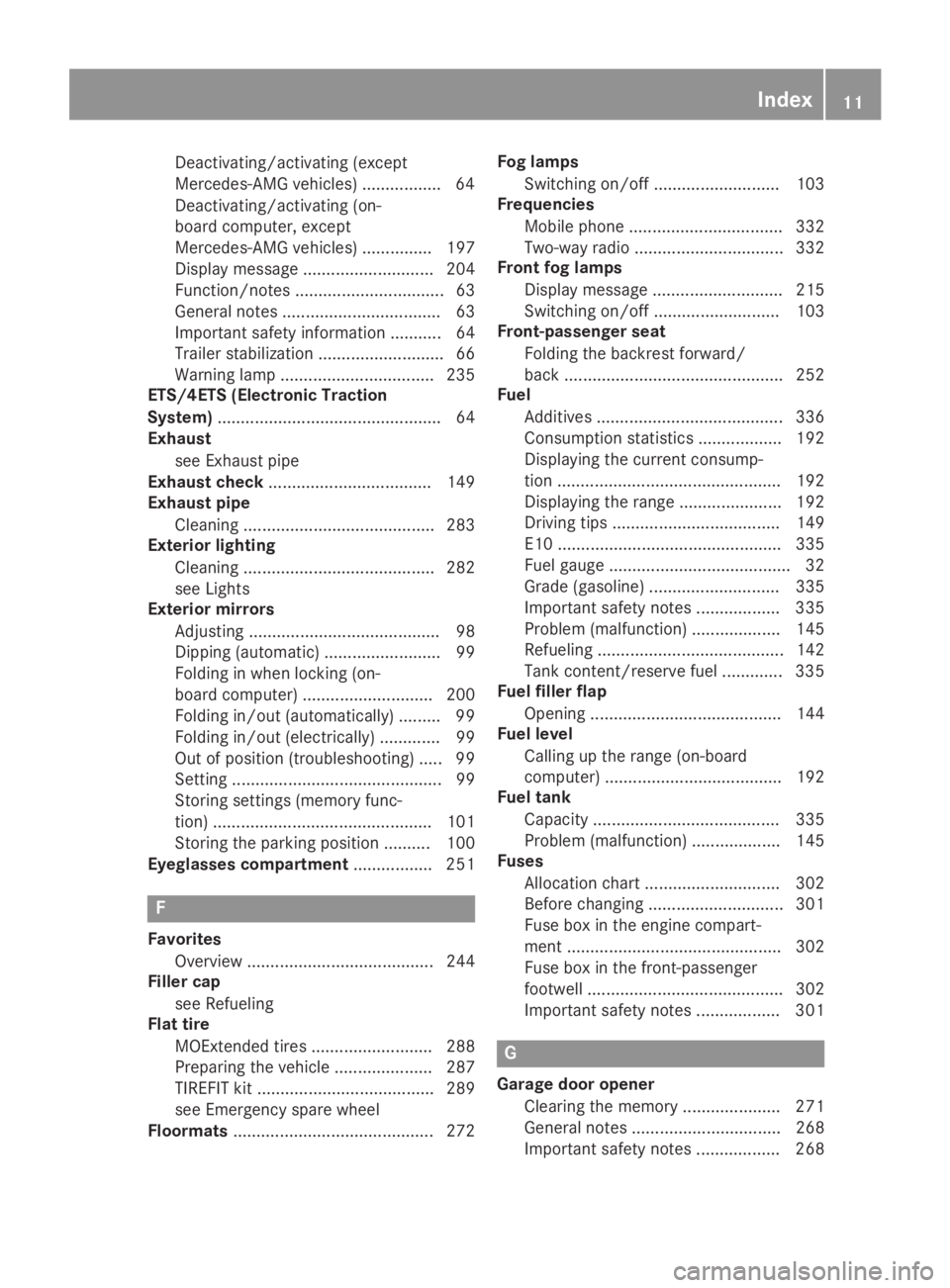
Deactivating/activating (except
Mercedes‑AMG vehicles) ................. 64
Deactivating/activating (on-
board computer, except
Mercedes-AMG vehicles) ............... 197
Display message ............................ 204
Function/notes................................ 63
General notes .................................. 63
Important safety information ........... 64
Trailer stabilization ........................... 66
Warning lamp ................................. 235
ETS/4ETS (Electronic Traction
System)................................................ 64
Exhaust
see Exhaust pipe
Exhaust check................................... 149
Exhaust pipe
Cleaning ......................................... 283
Exterior lighting
Cleaning ......................................... 282
see Lights
Exterior mirrors
Adjusting ......................................... 98
Dipping (automatic) ......................... 99
Folding in when locking (on-
board computer) ............................ 200
Folding in/out (automatically)......... 99
Folding in/out (electrically) ............. 99
Out of position (troubleshooting) ..... 99
Setting ............................................. 99
Storing settings (memory func-
tion) ............................................... 101
Storing the parking position .......... 100
Eyeglasses compartment................. 251
F
Favorites
Overview ........................................ 244
Filler cap
see Refueling
Flat tire
MOExtended tires.......................... 288
Preparing the vehicle ..................... 287
TIREFIT kit ...................................... 289
see Emergency spare wheel
Floormats........................................... 272
Fog lamps
Switching on/off........................... 103
Frequencies
Mobile phone ................................. 332
Two-way radio ................................ 332
Front fog lamps
Display message ............................ 215
Switching on/off........................... 103
Front-passenger seat
Folding the backrest forward/
back ............................................... 252
Fuel
Additives ........................................ 336
Consumption statistics .................. 192
Displaying the current consump-
tion ................................................ 192
Displaying the range ...................... 192
Driving tips .................................... 149
E10 ................................................ 335
Fuel gauge....................................... 32
Grade (gasoline)............................ 335
Important safety notes .................. 335
Problem (malfunction) ................... 145
Refueling ........................................ 142
Tank content/reserve fuel............. 335
Fuel filler flap
Opening ......................................... 144
Fuel level
Calling up the range (on-board
computer) ...................................... 192
Fuel tank
Capacity ........................................ 335
Problem (malfunction) ................... 145
Fuses
Allocation chart ............................. 302
Before changing ............................. 301
Fuse box in the engine compart-
ment .............................................. 302
Fuse box in the front-passenger
footwell .......................................... 302
Important safety notes .................. 301
G
Garage door opener
Clearing the memory ..................... 271
General notes ................................ 268
Important safety notes .................. 268
Index11
Page 27 of 346
Protecting the environment
General notes
HEnvironmental note
Daimler's declared policy is one of compre-
hensive environmental protection.
The objectives are for the natural resources
that form the basis of our existence on this
planet to be used sparingly and in a manner
that takes the requirements of both nature
and humanity into account.
You too can help to protect the environment
by operating your vehicle in an environmen-
tally responsible manner.
Fuel consumption and the rate of engine,
transmission, brake and tire wear are affec-
ted by these factors:
Roperating conditions of your vehicle
Ryour personal driving style
You can influence both factors. You should
bear the following in mind:
Operating conditions:
Ravoid short trips as these increase fuel
consumption.
Ralways make sure that the tire pressures
are correct.
Rdo not carry any unnecessary weight.
Rremove roof racks once you no longer
need them.
Ra regularly serviced vehicle will contribute
to environmental protection. You should
therefore adhere to the service intervals.
Ralways have service work carried out at a
qualified specialist workshop.
Personal driving style:
Rdo not depress the accelerator pedal
when starting the engine.
Rdo not warm up the engine when the vehi-
cle is stationary.
Rdrive carefully and maintain a safe dis-
tance from the vehicle in front.
Ravoid frequent, sudden acceleration and
braking.
Rchange gear in good time and use each
gear only up to
Page 131 of 346
ECO start/stop function
Introduction
The ECO start/stop function switches theengine off automatically if the vehicle is stop-ped under certain conditions.
The engine starts automatically when thedriver wants to pull away again. The ECOstart/stop function thereby helps you toreduce the fuel consumption and emissions ofyour vehicle.
Important safety notes
GWARNING
If the engine is switched off automatically
and you exit the vehicle, the engine is
restarted automatically. The vehicle may
begin moving. There is a risk of accident and
injury.
If you wish to exit the vehicle, always turn
off the ignition and secure the vehicle
against rolling away.
General notes
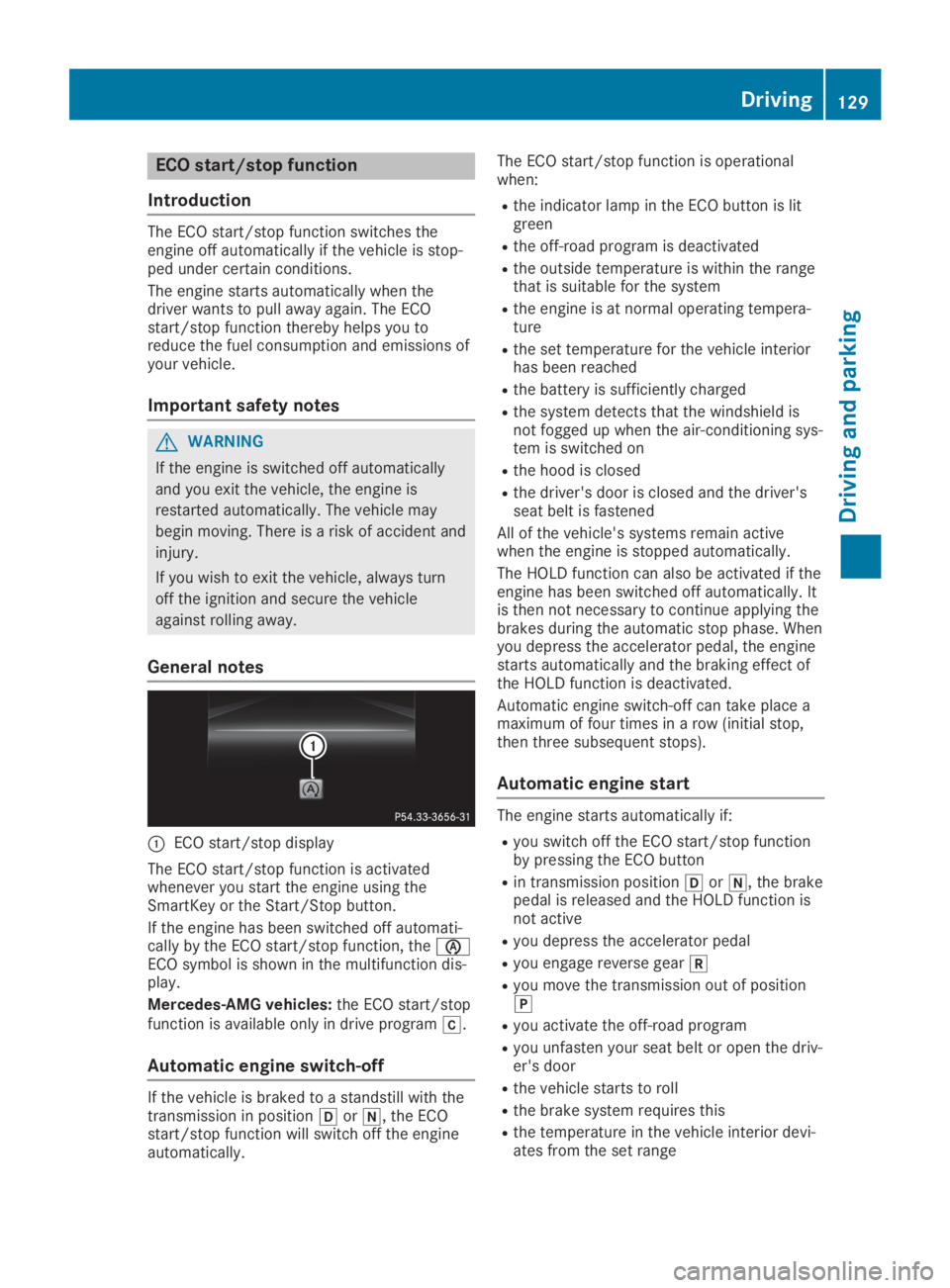
CECO start/stop display
The ECO start/stop function is activatedwhenever you start the engine using theSmartKey or the Start/Stop button.
If the engine has been switched off automati-cally by the ECO start/stop function, the
Page 140 of 346
Holding the vehicle stationary on
uphill gradients
GWARNING
If the clutch overheats, the electronic man-
agement system is automatically deactiva-
ted. This interrupts the power transmission.
The vehicle may, for example, roll back-
wards on gradients. There is a risk of an
accident.
Never hold the vehicle stationary on uphill
gradients by depressing the accelerator.
The clutch may overheat if you hold the vehi-cle stationary on uphill gradients by depress-ing the accelerator pedal. If the clutch over-heats, a warning tone sounds.
All vehicles (except Mercedes-AMG vehi-
cles):theStop Vehicle Shift to 'P'Stop Vehicle Shift to 'P'
Leave Engine RunningLeave Engine Runningdisplay messageappears in the multifunction display. You willonly be able to continue your journey once theclutch has cooled down and the display mes-sage in the multifunction display has disap-peared.
Mercedes-AMG vehicles:theTrans. OilTrans. Oil
Overheated Drive on with CareOverheated Drive on with Caredisplaymessage appears in the multifunction display.
Do not hold the vehicle stationary on uphillgradients by depressing the accelerator pedal.Instead, only ever hold the vehicle stationaryon uphill gradients by:
Rdepressing the brake pedal
Ractivating the HOLD function
Rengaging the electric parking brake
Kickdown
Use kickdown for maximum acceleration.
XDepress the accelerator pedal beyond thepressure point.The automatic transmission shifts to a lowergear depending on the engine speed.
XEase off the accelerator pedal once thedesired speed is reached.The automatic transmission shifts back up.
Mercedes-AMG vehicles:it is only possibleto use kickdown in the automatic drive pro-gram and the temporary manual drive programM. When manual drive programMis perma-nently activated, kickdown is not possible.
For further information on kickdown in manualdrive programM(Ypage 142).
Rocking the vehicle free
Shifting back and forth between transmissionpositions[and^can help to free up thevehicle if it gets stuck in mud or snow. Thevehicle's engine management system limitsthe speed to a maximum of 5 mph (9 km/h)when shifting back and forth. To shift repeat-edly between transmission positions[and^, move the DIRECT SELECT lever up anddown past the point of resistance.
Drive programs
All vehicles (except Mercedes-AMG
vehicles)
Drive program C (Comfort)
Drive programCis characterized by the follow-ing:
Rthe vehicle delivers comfortable, economicalhandling characteristics.
Rthe vehicle pulls away more gently inforward and reverse gears, unless the accel-erator pedal is depressed fully.
Rthe vehicle has improved driving stability,for example on slippery road surfaces.
Roptimal fuel consumption resulting from theautomatic transmission shifting up sooner.The vehicle is driven in the low engine speedrange and the wheels are less likely to spin.
Drive program S (Sport)
Drive programSis characterized by the follow-ing:
Rsporty engine settings.
Rthe automatic transmission shifts up later.The fuel consumption possibly being higheras a result of the later automatic transmis-sion shift points.
Drive program I (Individual)
In drive programIthe following properties ofthe drive program can be selected:
Rthe drive (engine and transmission manage-ment)
Rthe steering
138Automatic transmission
Driving and parking
Page 141 of 346
Rthe availability of the ECO start/stop func-tion
Rthe climate control
Information about configuring drive programIwith the multimedia system can be found inthe Digital Operator's Manual.
iTo permanently select the gears in driveprogramIusing the steering wheel paddleshifters, select theM(manual) setting forthe drive.
Offroad drive program
TheOff-roaddrive program is characterizedby the following:
Rthe vehicle exhibits optimal driving charac-teristics on easily negotiable off-road ter-rain.
Drive program E (Economy)
Drive programEis characterized by the follow-ing:
Rcomfort-oriented engine settings.
Roptimal fuel consumption resulting from theautomatic transmission shifting up sooner.
Rthe vehicle pulls away more gently inforward and reverse gears, unless the accel-erator pedal is depressed fully.
Rthe vehicle has improved driving stability,for example on slippery road surfaces.
Rthe automatic transmission shifting upsooner. This results in the vehicle beingdriven at lower engine speeds and thewheels being less likely to spin.
Rgliding mode is activated automaticallywhen engine-internal conditions are fulfilledand the accelerator is not depressed. At thesame time the transmission’s clutch opensand the vehicle rolls freely using its kineticenergy. As a result great distances can becompleted without the engine brake andfuel consumption reduced.
iThe availability of gliding mode depends onvarious factors, including the following:
Rthe engine and transmission temperature
Rthe downhill gradient
Rthe vehicle speed
Rperforming regular adaptation functions
When you depress the brake pedal, glidingmode is deactivated, depending on pedalpressure.
When you activate cruise control or ActiveDistance Assist DISTRONIC, gliding mode isnot available.
Mercedes-AMG vehicles
Drive program I (Individual)
In drive programIthe following properties ofthe drive program can be selected:
Rthe drive (engine management)
Rthe transmission management
Rthe suspension (vehicles with AMG adaptivesport suspension system)
RESP®
Information about configuring drive programIwith the multimedia system can be found inthe Digital Operator's Manual.
Drive program C (Comfort)
Drive programCis characterized by the follow-ing:
Rthe vehicle delivers comfortable, economicalhandling characteristics.
Rthe vehicle pulls away more gently inforward and reverse gears, unless the accel-erator pedal is depressed fully.
Rthe vehicle has improved driving stability,for example on slippery road surfaces.
Roptimal fuel consumption resulting from theautomatic transmission shifting up sooner.The vehicle is driven in the low engine speedrange and the wheels are less likely to spin.
Rgliding mode is available.
Rthe ECO start/stop function is available.
Drive program S (Sport)
Drive programSis characterized by the follow-ing:
Rthe vehicle exhibits sporty driving character-istics.
Rthe automatic transmission shifts up later.The fuel consumption possibly being higheras a result of the later automatic transmis-sion shift points.
Rthe suspension exhibits stiff springing anddamping settings (vehicles with AIR adaptivesport suspension system).
Rgliding mode is not available.
Rthe ECO start/stop function is not available.
Automatic transmission139
Driving an d parking
Z
Page 142 of 346
Drive program S+ (Sport Plus)
Drive programS+is characterized by the fol-lowing:
Rthe vehicle exhibits particularly sporty driv-ing characteristics.
Rthe automatic transmission shifts up later.
Rthe fuel consumption possibly being higheras a result of the later automatic transmis-sion shift points.
Rthe suspension exhibits particularly stiffspringing and damping settings (vehicleswith AMG adaptive sport suspension sys-tem).
Rgliding mode is not available.
Rthe ECO start/stop function is not available.
Drive program RACE (vehicles with AMG
adaptive sport suspension system)
iThe RACE drive program may not be usedon normal roads. RACE must only be activa-ted and used on dedicated race circuits, noton public roads.
TheRACEdrive program is characterized bythe following:
Rthe vehicle exhibits driving characteristicssuitable for the racetrack.
Rall vehicle systems are set for maximumsportiness.
Rthe automatic transmission shifts up later.
Rthe fuel consumption possibly being higheras a result of the later automatic transmis-sion shift points.
Rthe suspension exhibits particularly stiffspringing and damping settings.
Rgliding mode is not available.
Rthe ECO start/stop function is not available.
Manual gearshifting
General notes
You can change gear yourself using the steer-ing wheel paddle shifters. The transmissionmust be in position[to do this.
Depending on which steering wheel paddleshifter is pulled, the automatic transmissionimmediately shifts into the next gear down orup, if permitted.
Mercedes-AMG vehicles:to use manual shift-ing, you have two options:
Rtemporary setting
Rpermanent setting
If you activate manual gearshifting, the multi-function display will show the current gearinstead of transmission position[.
If manual gearshifting is deactivated, the gearswill be selected automatically.
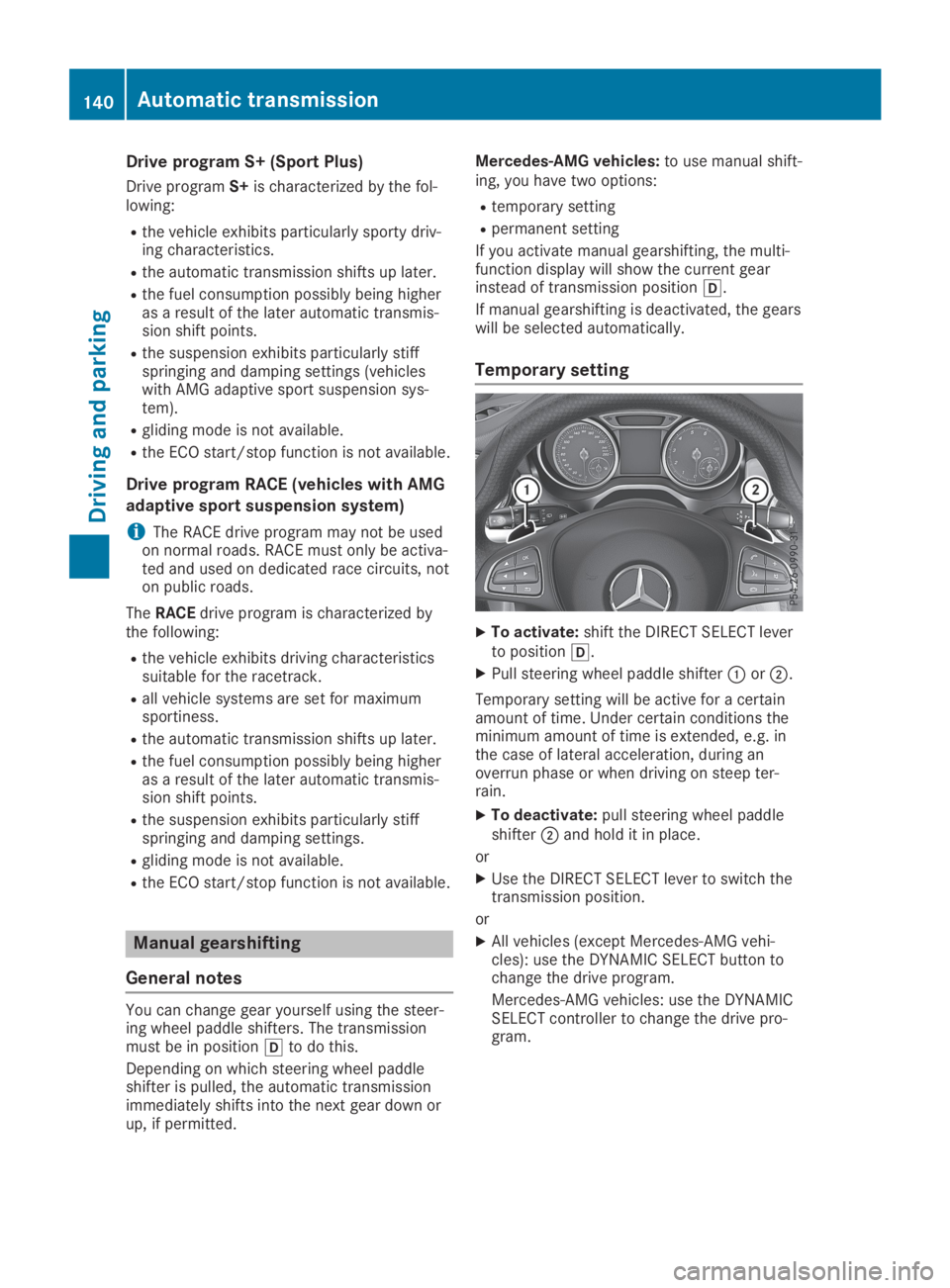
Temporary setting
XTo activate:shift the DIRECT SELECT leverto position[.
XPull steering wheel paddle shifterCorD.
Temporary setting will be active for a certainamount of time. Under certain conditions theminimum amount of time is extended, e.g. inthe case of lateral acceleration, during anoverrun phase or when driving on steep ter-rain.
XTo deactivate:pull steering wheel paddleshifterDand hold it in place.
or
XUse the DIRECT SELECT lever to switch thetransmission position.
or
XAll vehicles (except Mercedes-AMG vehi-cles): use the DYNAMIC SELECT button tochange the drive program.
Mercedes-AMG vehicles: use the DYNAMICSELECT controller to change the drive pro-gram.
140Automatic transmission
Driving and pa rking
Page 151 of 346
Bear in mind that at a speed of only 30 mph(approximately 50 km/h), the vehicle covers adistance of 44 ft (approximately 14 m) persecond.
Drive sensibly – save fuel
Observe the following tips to save fuel:
RThe tires should always be inflated to therecommended tire pressure.
RRemove unnecessary loads.
RRemove roof racks when they are not nee-ded.
RWarm up the engine at low engine speeds.
RAvoid frequent acceleration or braking.
RHave all maintenance work carried out asindicated by the service intervals in theMaintenance Booklet or by the service inter-val display.
Fuel consumption also increases when drivingin cold weather, in stop-start traffic and in hillyterrain.
Drinking and driving
GWARNING
Drinking and driving and/or taking drugs
and driving are very dangerous combina-
tions. Even a small amount of alcohol or
drugs can affect your reflexes, perceptions
and judgment.
The possibility of a serious or even fatal
accident is greatly increased when you drink
or take drugs and drive.
Do not drink or take drugs and drive or allow
anyone to drive who has been drinking or
taking drugs.
Emission control
GDANGER
Combustion engines emit poisonous
exhaust gases such as carbon monoxide.
Inhaling these exhaust gases is hazardous to
health and can result in poisoning. There is a
risk of fatal injury. Therefore, never leave the
engine running an enclosed space without
adequate ventilation.
Certain engine systems are designed to keepthe level of poisonous components in exhaustfumes within legal limits.
These systems only work at peak efficiency ifthey are serviced exactly in accordance withthe manufacturer's specifications. Always havework on the engine carried out at a qualifiedspecialist workshop. Mercedes-Benz recom-mends that you use an authorized Mercedes-Benz Center for this purpose. In particular,work relevant to safety or on safety-relatedsystems must be carried out at a qualified spe-cialist workshop.
The engine settings must not be changedunder any circumstances. Furthermore, allspecific service work must be carried out atregular intervals and in accordance with theMercedes-Benz service requirements. Detailscan be found in the Maintenance Booklet.
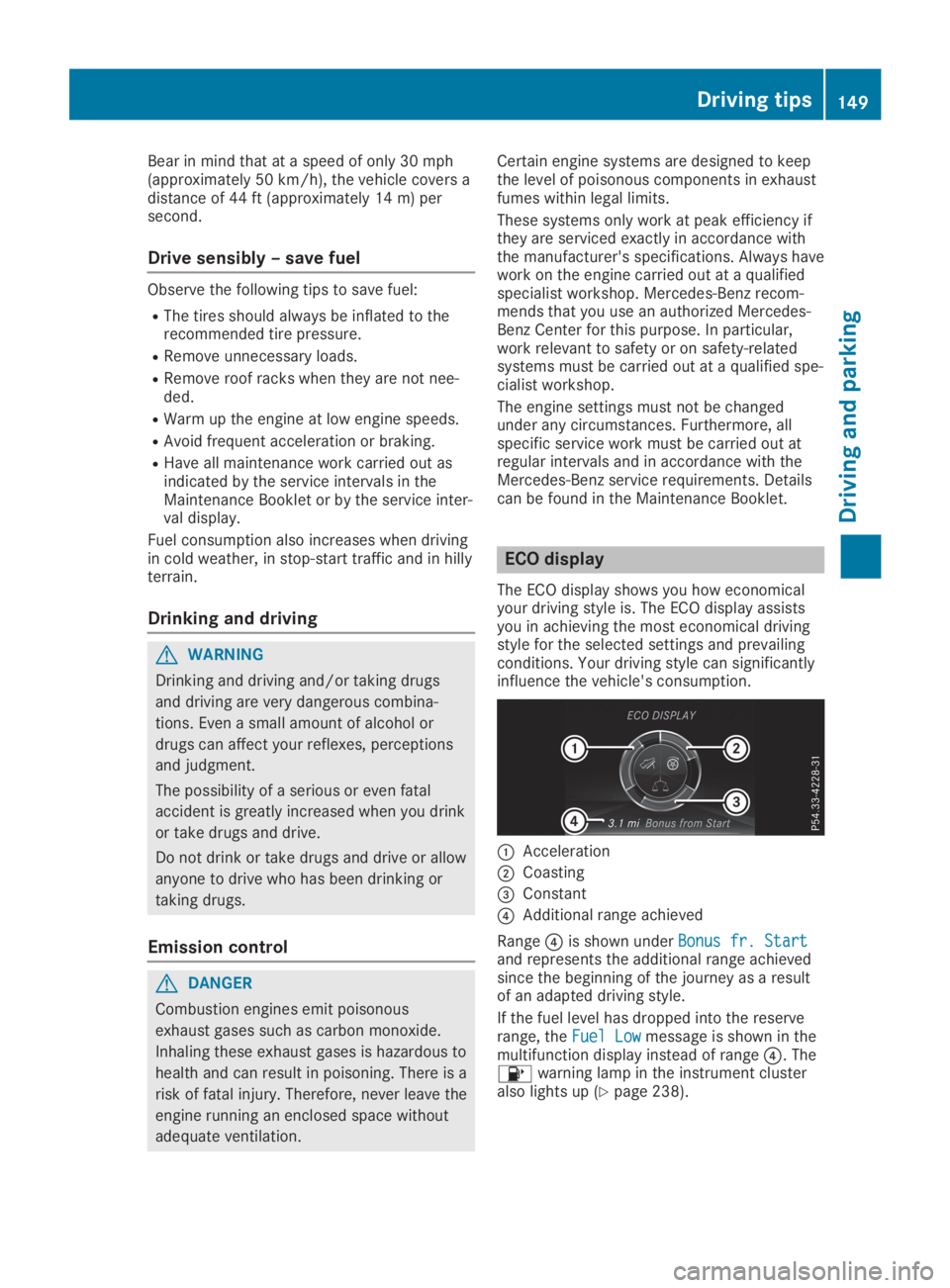
ECO display
The ECO display shows you how economicalyour driving style is. The ECO display assistsyou in achieving the most economical drivingstyle for the selected settings and prevailingconditions. Your driving style can significantlyinfluence the vehicle's consumption.
CAcceleration
DCoasting
Page 201 of 346
The selected unit of measurement for distanceapplies to:
RDigital speedometer in theTripTripmenu
ROdometer and the trip odometer
RTrip computer
RCurrent fuel consumption and approximaterange
RNavigation instructions in theNaviNavimenu
RCruise control
RActive Distance Assist DISTRONIC
RASSYST PLUS service interval display
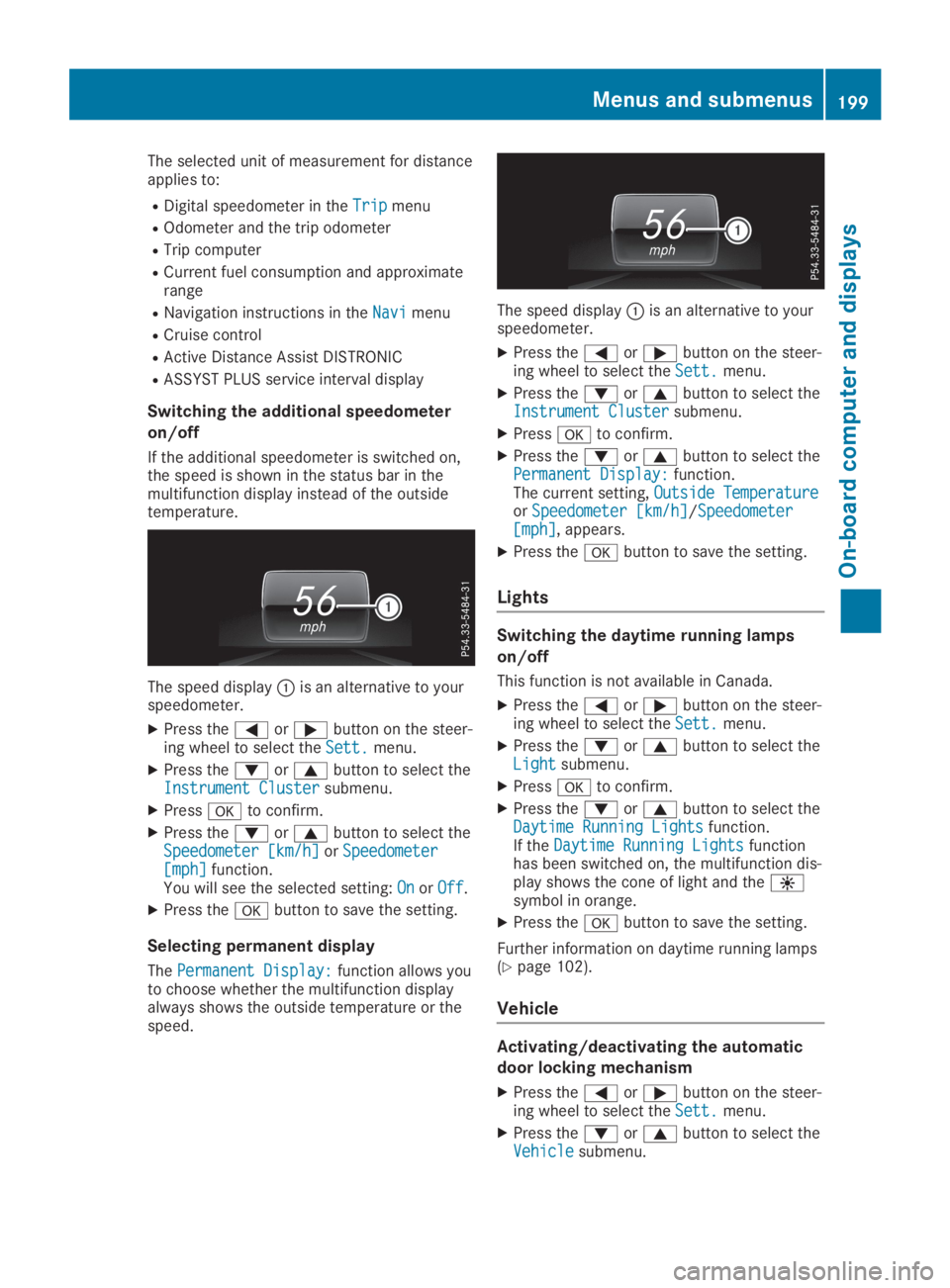
Switching the additional speedometer
on/off
If the additional speedometer is switched on,the speed is shown in the status bar in themultifunction display instead of the outsidetemperature.
The speed displayCis an alternative to yourspeedometer.
XPress theYorebutton on the steer-ing wheel to select theSett.Sett.menu.
XPress thedorcbutton to select theInstrument ClusterInstrument Clustersubmenu.
XPressvto confirm.
XPress thedorcbutton to select theSpeedometer [km/h]Speedometer [km/h]orSpeedometerSpeedometer[mph][mph]function.You will see the selected setting:OnOnorOffOff.
XPress thevbutton to save the setting.
Selecting permanent display
ThePermanent Display:Permanent Display:function allows youto choose whether the multifunction displayalways shows the outside temperature or thespeed.
The speed displayCis an alternative to yourspeedometer.
XPress theYorebutton on the steer-ing wheel to select theSett.Sett.menu.
XPress thedorcbutton to select theInstrument ClusterInstrument Clustersubmenu.
XPressvto confirm.
XPress thedorcbutton to select thePermanent Display:Permanent Display:function.The current setting,Outside TemperatureOutside TemperatureorSpeedometer [km/h]Speedometer [km/h]/SpeedometerSpeedometer[mph][mph], appears.
XPress thevbutton to save the setting.
Lights
Switching the daytime running lamps
on/off
This function is not available in Canada.
XPress theYorebutton on the steer-ing wheel to select theSett.Sett.menu.
XPress thedorcbutton to select theLightLightsubmenu.
XPressvto confirm.
XPress thedorcbutton to select theDaytime Running LightsDaytime Running Lightsfunction.If theDaytime Running LightsDaytime Running Lightsfunctionhas been switched on, the multifunction dis-play shows the cone of light and the
Page 312 of 346
Underinflated tires may:
Roverheat, leading to tire defects
Radversely affect handling
Rwear excessively and/or unevenly
Rhave an adverse effect on fuel consumption
Overinflated tires
GWARNING
Tires with excessively high pressure can
burst because they are damaged more eas-
ily by road debris, potholes etc. In addition,
they also suffer from irregular wear, which
can severely impair the braking properties
and the driving characteristics. There is a
risk of an accident.
Avoid tire pressures that are too high in all
the tires, including the spare wheel.
Overinflated tires may:
Rincrease the braking distance
Radversely affect handling
Rwear excessively and/or unevenly
Rhave an adverse effect on ride comfort
Rbe more susceptible to damage
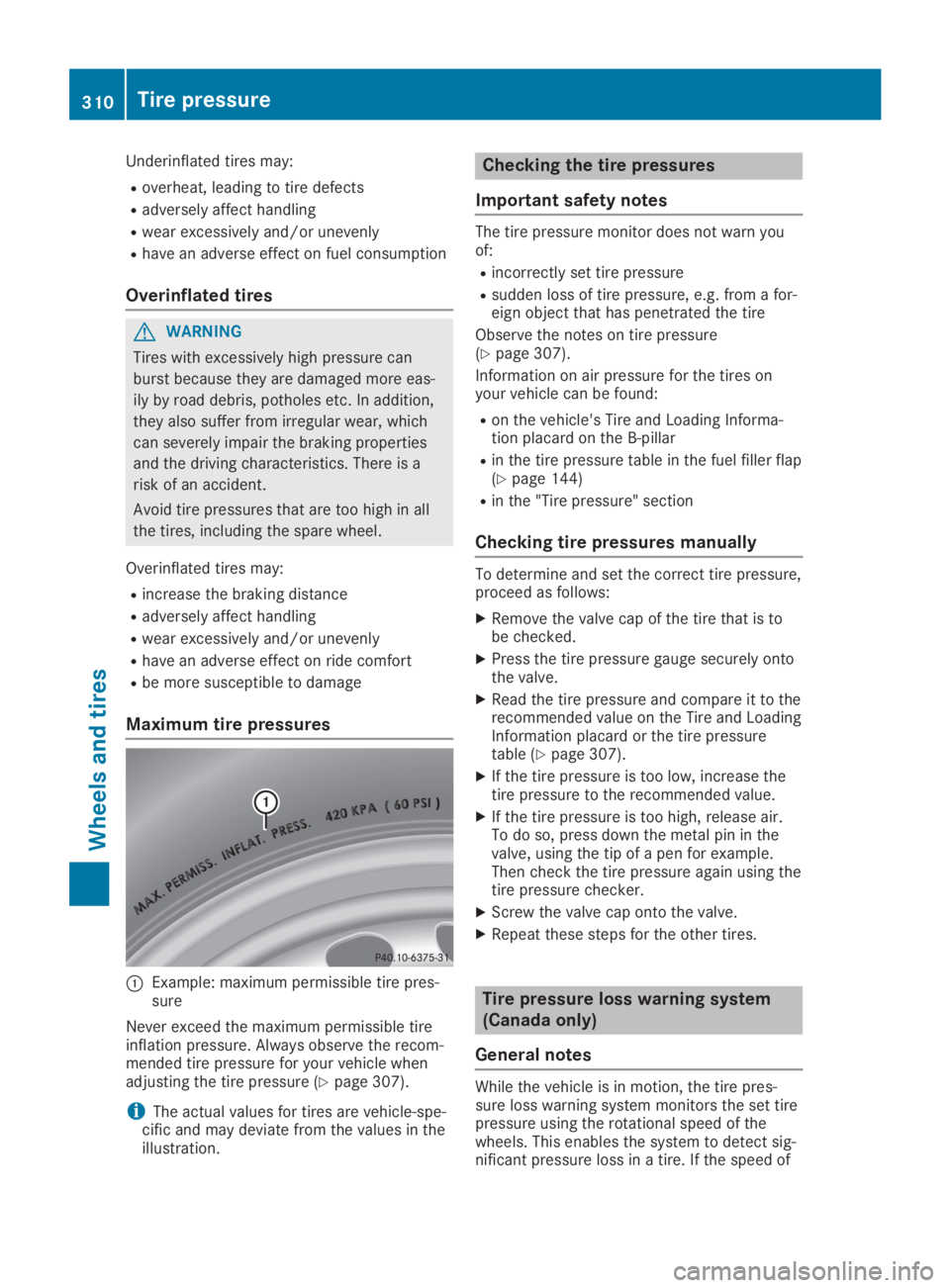
Maximum tire pressures
CExample: maximum permissible tire pres-sure
Never exceed the maximum permissible tireinflation pressure. Always observe the recom-mended tire pressure for your vehicle whenadjusting the tire pressure (Ypage 307).
iThe actual values for tires are vehicle-spe-cific and may deviate from the values in theillustration.
Checking the tire pressures
Important safety notes
The tire pressure monitor does not warn youof:
Rincorrectly set tire pressure
Rsudden loss of tire pressure, e.g. from a for-eign object that has penetrated the tire
Observe the notes on tire pressure(Ypage 307).
Information on air pressure for the tires onyour vehicle can be found:
Ron the vehicle's Tire and Loading Informa-tion placard on the B-pillar
Rin the tire pressure table in the fuel filler flap(Ypage 144)
Rin the "Tire pressure" section
Checking tire pressures manually
To determine and set the correct tire pressure,proceed as follows:
XRemove the valve cap of the tire that is tobe checked.
XPress the tire pressure gauge securely ontothe valve.
XRead the tire pressure and compare it to therecommended value on the Tire and LoadingInformation placard or the tire pressuretable (Ypage 307).
XIf the tire pressure is too low, increase thetire pressure to the recommended value.
XIf the tire pressure is too high, release air.To do so, press down the metal pin in thevalve, using the tip of a pen for example.Then check the tire pressure again using thetire pressure checker.
XScrew the valve cap onto the valve.
XRepeat these steps for the other tires.
Tire pressure loss warning system
(Canada only)
General notes
While the vehicle is in motion, the tire pres-sure loss warning system monitors the set tirepressure using the rotational speed of thewheels. This enables the system to detect sig-nificant pressure loss in a tire. If the speed of
310Tire pressure
Wheels and tires
Page 332 of 346
which have been approved by Mercedes-Benz specifically for your vehicle.
These tires have been specially adapted foruse with the control systems, such as ABS
or ESP®, and are marked as follows:
RMO = Mercedes-Benz Original
RMOE = Mercedes-Benz Original Extended(tires featuring run-flat characteristics)
RMO1 = Mercedes-Benz Original (only cer-tain AMG tires)
Mercedes-Benz Original Extended tires mayonly be used on wheels that have been spe-cifically approved by Mercedes-Benz.
Only use tires, wheels or accessories testedand approved by Mercedes-Benz. Certaincharacteristics, e.g. handling, vehicle noiseemissions or fuel consumption, may other-wise be adversely affected. In addition,when driving with a load, tire dimension var-iations could cause the tires to come intocontact with the bodywork and axle compo-nents. This could result in damage to thetires or the vehicle.
Mercedes-Benz accepts no liability for dam-age resulting from the use of tires, wheelsor accessories other than those tested andapproved.
Information on tires, wheels and approvedcombinations can be obtained from anyqualified specialist workshop.
!Retreaded tires are neither tested nor rec-ommended by Mercedes-Benz, since previ-ous damage cannot always be detected onretreaded tires. As a result, Mercedes-Benzcannot guarantee vehicle safety if retreadedtires are mounted. Do not mount used tiresif you have no information about their previ-ous usage.
The recommended pressures for various oper-ating conditions can be found:
Ron the Tire and Loading Information placardon the B-pillar on the driver's side
Rin the tire pressure table in the fuel filler flap
Observe the notes on recommended tire pres-sures under various operating conditions(Ypage 307).
Check tire pressures regularly, and only whenthe tires are cold. Comply with the mainte-nance recommendations of the tire manufac-turer in the vehicle document wallet.
Notes on the vehicle equipment – alwaysequip the vehicle:
Rwith tires of the same size on a given axle(left and right)
Rwith the same type of tire (summer tires,MOExtended tires, winter tires)
Exception: it is permissible to install a differ-ent type or make in the event of a flat tire.Observe the "MOExtended tires (tires withrun-flat characteristics" section(Ypage 288).
Vehicles equipped with MOExtended tires arenot equipped with a TIREFIT kit at the factory.It is therefore recommended that you addition-ally equip your vehicle with a TIREFIT kit if youmount tires that do not feature run-flat proper-ties, e.g. winter tires. A TIREFIT kit may beobtained from a qualified specialist workshop.
Emergency spare wheel
Important safety notes
GWARNING
The wheel or tire size as well as the tire type
of the spare wheel or emergency spare
wheel and the wheel to be replaced may dif-
fer. Mounting an emergency spare wheel
may severely impair the driving characteris-
tics. There is a risk of an accident.
To avoid hazardous situations:
Radapt your driving style accordingly and
drive carefully.
Rnever mount more than one spare wheel
or emergency spare wheel that differs in
size.
Ronly use a spare wheel or emergency
spare wheel of a different size briefly.
Rdo not switch ESP®off.
Rhave a spare wheel or emergency spare
wheel of a different size replaced at the
nearest qualified specialist workshop.
Observe that the wheel and tire dimen-
sions as well as the tire type must be cor-
rect.
When using an emergency spare wheel orspare wheel of a different size, you must not
330Emergency spare wheel
Wheels and tires