engine MERCEDES-BENZ GLA 2020 Owners Manual
[x] Cancel search | Manufacturer: MERCEDES-BENZ, Model Year: 2020, Model line: GLA, Model: MERCEDES-BENZ GLA 2020Pages: 346, PDF Size: 17.58 MB
Page 278 of 346
G
WARNING
Functions relevant tosafety arerestricted or
no longer available if:
R the engine isnot running
R the brake system orthe pow ersteering is
malfu nctioning
R there isamalfu nction inthe pow ersup ply
or the vehicl e'selectrica lsystem
When yourvehicl eis towed awayor towed
started, youmay requireconside rablymore
effort tosteer andbrake. Thereisarisk of
an accide nt.
In such cases, useatow bar. Before being
towed awayor tow started, makesurethe
steering movesfreely. X
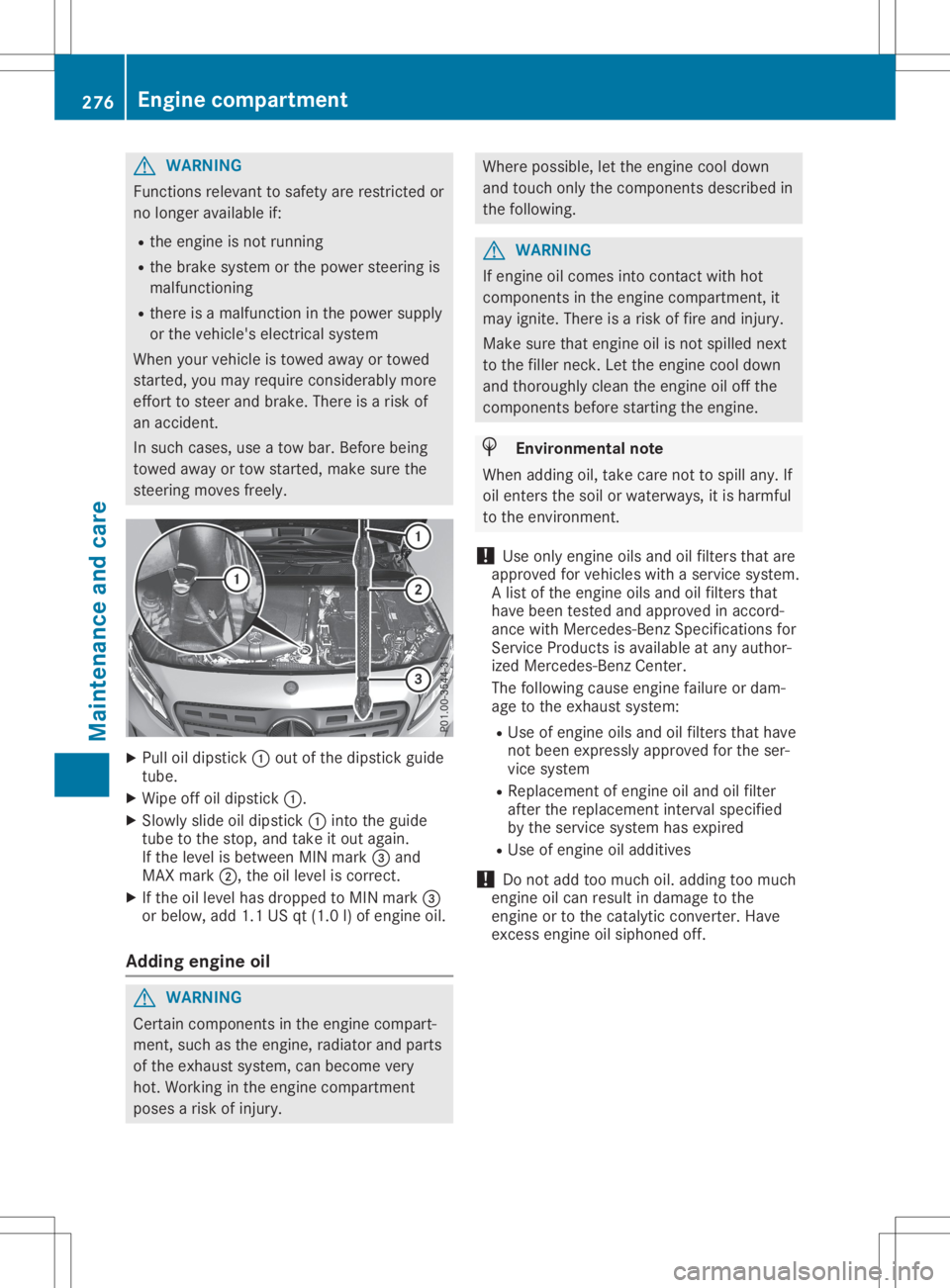
Pul loil dip stick 0043out ofthe dipstick guide
tube.
X Wip eoff oildip stick 0043.
X Slowl yslid eoil dip stick 0043into theguide
tube tothe stop, andtake itout again.
If the leve lis betwe enMIN mark 0087and
MAX mark 0044,theoilleve lis correct.
X Ifthe oilleve lhas dropp edtoMIN mark 0087
or bel ow, add 1.1USqt(1.0 l)of engine oil.
Adding engineoil G
WARNING
Certa incomponents inthe engine compart-
ment, suchasthe engine, radiator andparts
of the exhau stsystem, canbecome very
hot. Working inthe engine compartment
pose sa risk ofinjury . Where
possible,let the engine cooldown
and touch onlythecomponents describedin
the followi ng. G
WARNING
If engine oilcomes intocontact withhot
components inthe engine compartment, it
may ignite. Thereisarisk offire and injury .
Make surethatengine oilisnot spilled next
to the filler neck. Letthe engine cooldown
and thoroug hlyclea nthe engine oiloff the
components beforestarting theengine. H
Envi
ronmental note
When addingoil,take carenottospil lany. If
oil enters thesoil orwater ways,itis harmfu l
to the environment.
! Use
only engine oilsand oilfilters thatare
app roved forvehicl eswith aservice system.
A list ofthe engine oilsand oilfilters that
have been tested andapproved inaccord-
ance withMercede s-BenzSpecifications for
Service Productsisava ilable atany author-
ized Mercede s-BenzCenter.
The followi ngcaus eengine failure ordam-
age tothe exhau stsystem:
R Use ofengine oilsand oilfilters thathave
not been express lyapp roved forthe ser-
vice system
R Rep lace ment ofengine oiland oilfilter
after thereplacement intervalspecified
by the service system hasexpire d
R Use ofengine oiladd itives
! Do
not add toomuch oil.add ingtoo much
engine oilcan resu ltin dama getothe
engine ortothe catal yticconverter. Have
excess engineoilsiph oned off. 276
Eng
inecompar tmentMainten anceandcare
Page 279 of 346
Exam
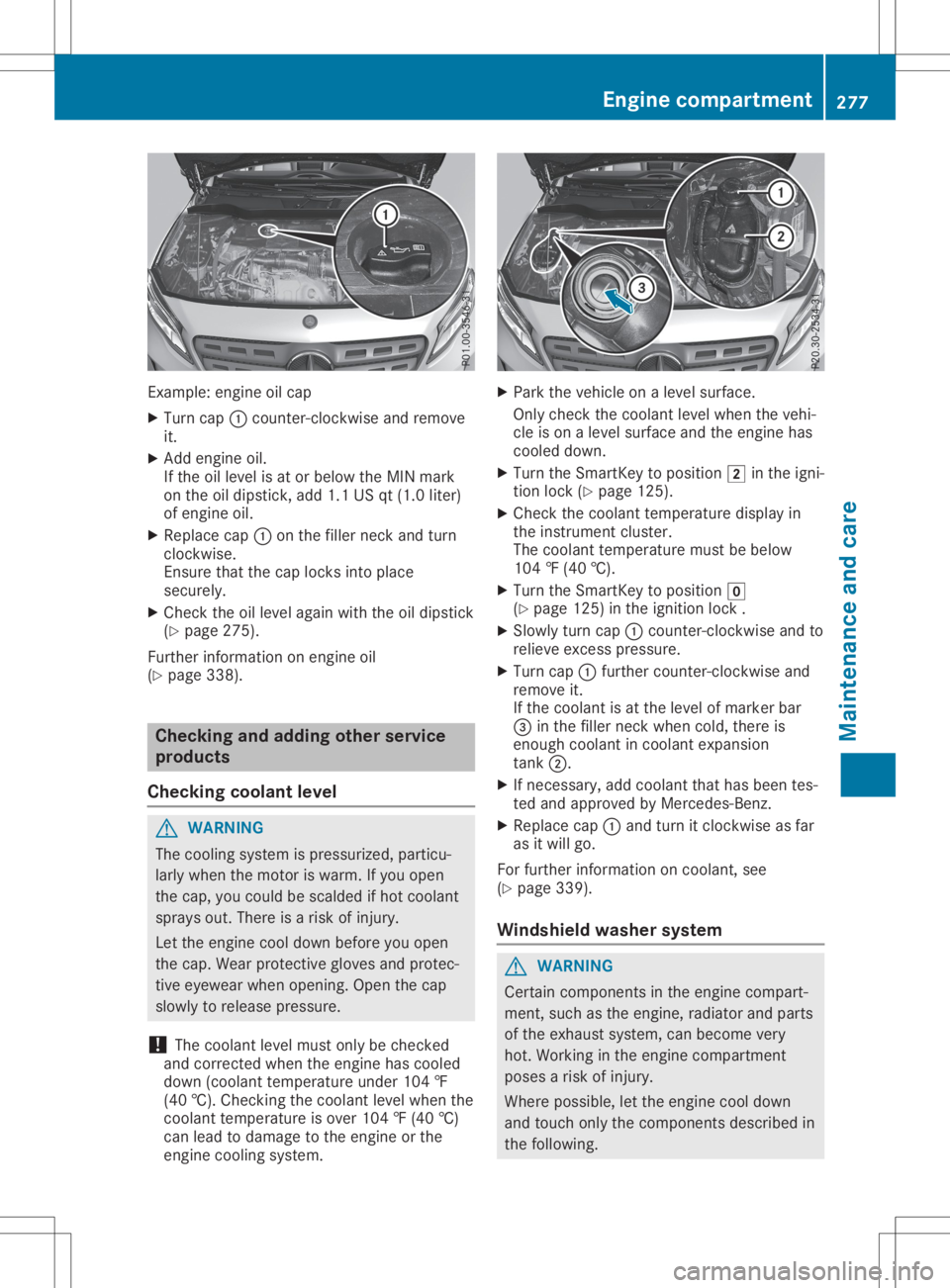
ple: eng ineoilcap
X Tu rn cap 0043cou nter-c lockwi seand remove
it.
X Add engineoil.
If the oille vel isat or below the MIN mark
on the oildi ps tick, add1.1 USqt(1.0 liter)
of eng ineoil.
X Re place cap 0043onthe fillerneck andturn
clo ckwi se.
Ensu retha tthe cap locks into place
sec urely.
X Ch eck theoille vel again wi th the oildi ps tick
(Y page 275 ).
Fur therinfo rma tionon eng ineoil
(Y page 338 ). Ch
eckin gand addi ngoth erservi ce
produ cts
Ch eckin gco olant leve l G
WA
RNING
The cooling system ispre ssu rize d,partic u-
la rly when the moto ris wa rm. Ifyo uop en
the cap,yo ucou ldbe sca lded ifhot coolant
sp rays out.The reisaris kof inju ry.
Let the enginecoo ldo wn befor eyo uop en
the cap.We arpro tecti veglove sand protec-
tive eyew earwh en openi ng. Open the cap
sl ow lyto release pre ssu re.
! The
coolant level mustonl ybe che cked
and correcte dwh en the enginehascoo led
do wn (coolant temp eratureund er104 ‡
(40 †).Ch ecki ngthe coolant level when the
coo lant temp eratureis ove r104 ‡(40 †)
can lead todama getothe engineorthe
eng inecoo ling system . X
Pa rk the vehicleon alevel surfa ce.
Onl yche ckthe coolant level when the vehi-
cle ison alevel surfa ce and theenginehas
coo led do wn.
X Tu rn the Sma rtKeyto positio n0048 inthe igni-
tio nlock (Ypage 125 ).
X Ch eck thecoolant temp eraturedisp layin
the instrument cluster .
The coolant temp eraturemu stbe below
104 ‡(40 †).
X Tu rn the Sma rtKeyto positio n005A
(Y page 125 )in the igniti onlock .
X Slo wlytur ncap 0043cou nter-c lockwi seand to
rel ieve exce sspre ssu re.
X Tu rn cap 0043furthe rcou nter-c lockwi seand
rem ove it.
If the coolant isat the level ofma rker bar
0087 inthe fillerneck when cold,the reis
eno ughcoo lant incoo lant exp ansion
tank 0044.
X Ifnece ssary,ad dcoo lant tha tha sbe en tes-
ted and appro ved byMe rced es-Benz.
X Re place cap 0043and turnit clo ckwi seasfar
as itwi llgo .
For furthe rinfo rma tionon coo lant, see
(Y page 339 ).
Win dshi eld wa she rsys tem G
WA
RNING
Ce rta incomp onents inthe enginecomp art-
ment, such asthe engine,ra diato rand parts
of the exhaust system ,can become very
hot. Workin gin the enginecomp artment
po ses aris kof inju ry.
Wh ere possi ble, letthe enginecoo ldo wn
and touchonl ythe comp onents descri bedin
the followi ng. En
gine compartmen t
277Mai ntenan ceand care Z
Page 280 of 346
G
WARNING
Opening thehood when theengine isover-
hea ted orwhen thereisafire inthe engine
compartment couldexpose youtohot gase s
or other service products.There isarisk of
injury .
Let anoverhe atedengine cooldownbefore
openi ngthe hood. Ifthere isafire inthe
engine compartment, keepthehood closed
and contact thefire depa rtment. G
WARNING
Windsh ieldwas herconcentrate ishigh ly
flamma ble.If winds hieldwas herconcentrate
gets onto hotcomponents ofthe engine or
the exhau stsystem, itcan ignite. Thereisa
risk offire and injury .
Make surethatwinds hieldwas herconcen-
trate isnot spilled inthe vicinity ofthe filler
neck. X
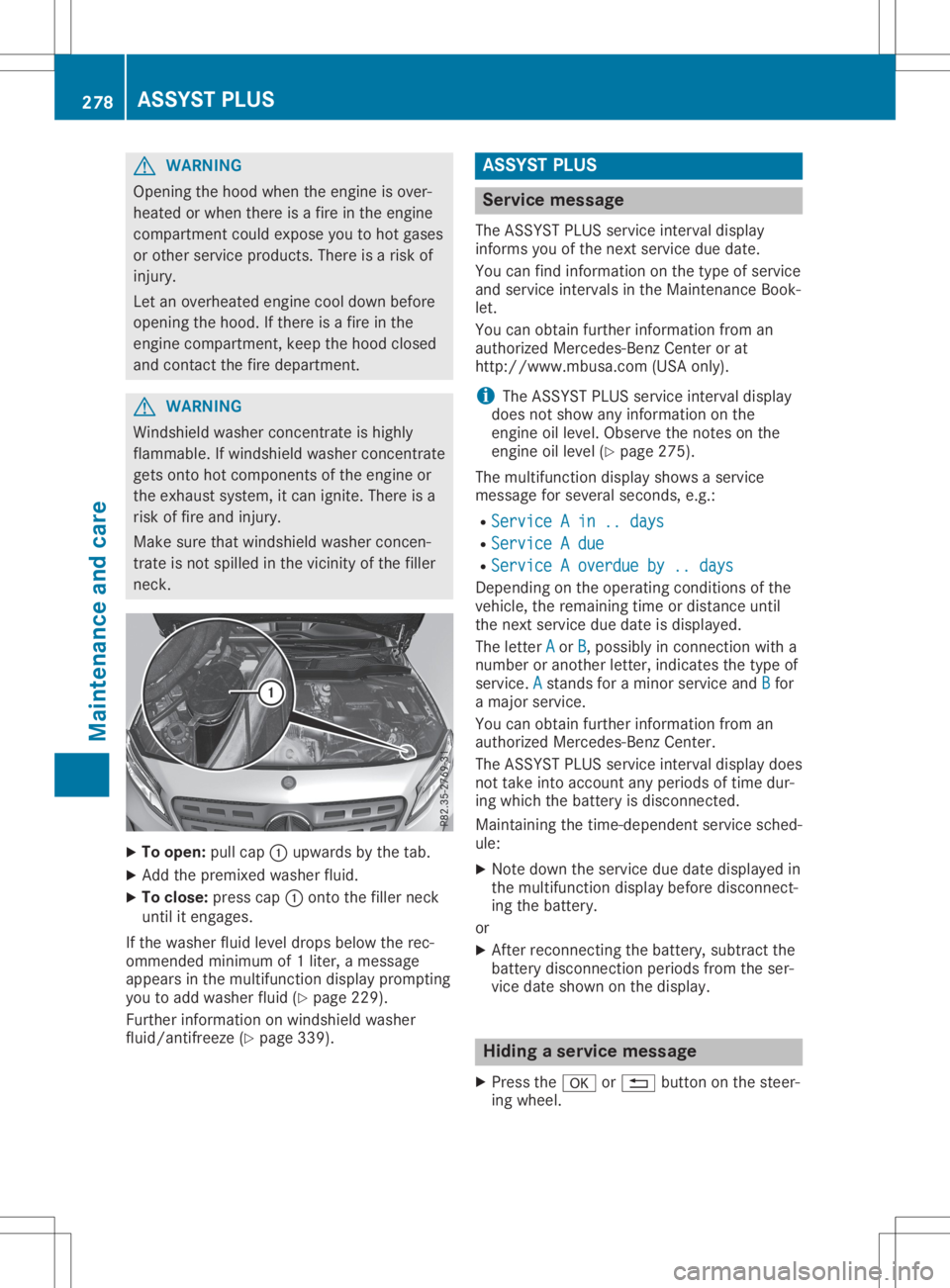
To open :pul lcap 0043upw ards bythe tab.
X Add thepremi xedwasherfluid.
X To clo se: press cap0043onto thefiller neck
until itengag es.
If the was herfluidleve ldrops below the rec-
ommended minimumof 1liter, amessa ge
app ears inthe multi function displayprompti ng
you toadd washerfluid(Y pag e229) .
Further informati onon winds hieldwas her
flui d/antifree ze(Y pag e339). ASSY
STPLU S Servic
emessag e
The ASSYST PLUSservice interval display
informs youofthe next service duedate.
You canfind informati ononthe type ofservice
and service intervalsin the Maintenance Book-
let.
You canobtai nfurther informati onfrom an
au thorized Mercede s-BenzCenter orat
http://www.mb usa.com (USA only).
i The
ASSYST PLUSservice interval display
does notshow anyinformati ononthe
engine oilleve l.Observe thenotes onthe
engine oilleve l(Y pag e275).
The multi function displayshow sa service
messa gefor severa lseconds, e.g.:
R Service Ain ..days Service
Ain ..days
R Service Adue Service
Adue
R Service Aoverdue by..days Service
Aoverdue by..days
Dependi ngon the opera tingconditions ofthe
vehicl e,the remai ningtime ordista nceuntil
the next service duedate isdisp layed.
The letter A A
or B B,
possi blyinconnection witha
number oranother letter,indicatesthe type of
service .A A
stands foraminor service andB B
for
a major service .
You canobtai nfurther informati onfrom an
au thorized Mercede s-BenzCenter.
The ASSYST PLUSservice interval displaydoes
not take intoaccount anyperiods oftime dur-
ing whichthe battery isdisconnected.
Mai ntaining thetime-dep endentservice sched-
ule :
X Note downthe service duedate displayed in
the multi function displaybefore disconnect-
ing the battery .
or X After reconnecting thebattery ,sub tract the
battery disconnectio nperi ods from theser-
vice date show non the disp lay. Hiding
aservi cemessag e
X Press the0076 or0038 button onthe steer-
ing whee l. 278
ASS
YST PLUSMainten anceandcare
Page 296 of 346
or
sparks arecreated, thehydrogen gascan
ignite. Thereisarisk ofan explosion.
R Make surethatthepositive terminalof a
conn ected battery doesnotcome into
cont actwith vehicle parts.
R Never placemetal object sor tools ona
battery.
R Itis important thatyouobserve the
described orderofthe battery terminals
when connectin gand disconn ectingabat-
tery.
R When jump-st arting,makesurethatthe
battery poleswithidentical polarityare
conn ected.
R Itis particularly importanttoobserve the
described orderwhen connectin gand dis-
conn ectin gthe jumper cables.
R Never connectordisconn ectthe battery
termin alswhile theengine isrunnin g. G
WARNING
Batt eryacid iscaustic. Thereisarisk of
injury.
Avoid contactwith skin, eyesorclothin g.Do
not inhale anybattery gases.Donot lean
over thebattery. Keepchildren awayfrom
batteries. Washawaybattery acidimmedi-
ately withplenty ofclean water andseek
medical attention. H
Environmental
note Batt
eries containpollutants.
It is illegal todispose of
them withthehousehold
rubbish. Theymust becol-
lected separately anddis-
posed ofinan environ men-
tally responsible recycling
system. Dispose
ofbatteries inan
environ mentallyresponsible
manner. Takedischarged
batteries toaquali fiedspe-
cialist workshop ortoacol- lection
pointforused bat-
teries.
! Have
thebattery regularly checkedata
quali fiedspecialist workshop.
Comply withtheservice intervalsinthe
Maintenan ceBooklet ,or cont actaquali fied
specialist workshop formore informat ion.
! You
should haveallwork involving thebat-
tery carried outataquali fiedspecialist
workshop. Inthe except ionalcasethatitis
necessary foryou todisconn ectthe battery
yourself, makesurethat:
R switch offthe engine andremove the
Smart Key.Onvehicles withKEYLE SS-GO,
make surethattheignition isswitched
off. Check thatallthe indicator lampsin
the instr ument cluster areoff. Otherwise,
electron iccomponen ts,such asthe alter-
nator, maybedamaged.
R you first remove thenegative terminal
clamp andthen thepositive terminal
clamp. Neverswapthetermin alclamps.
Otherwise, thevehicle's electronicsystem
may bedamaged.
R in vehicles withautomatic transmission,
the transm issionislocked inposition 005D
after thebattery isdisconn ected.The
vehicle issecured againstrollingaway.
You canthen nolonger movethevehicle.
The battery andthecover ofthe positive ter-
minal clamp mustbeinstalled securelydur-
ing operation.
Comply withsafety precautions andtake pro-
tect ivemeasures whenhandling batteries. Risk
ofexplosion. Fire,
open flames andsmokin gare
prohibited whenhandling thebat-
tery. Avoid creatin gsparks. Batt
eryacid iscaustic. Avoidcon-
tact with skin, eyesorclothin g.
Wear suitable protectiveclothin g,
especially gloves,apronandface-
guard.
Rinse anyacid spills immediately
with clear water. Contact aphysi-
cian ifnecessary. 294
Bat
tery (vehicl e)Breakdown assistance
Page 297 of 346
Wear
eyeprotec tion. Keep
children away. Observe
thisOperator' sManual.
For safety reasons, Mercedes- Benzrecom-
mends thatyouonly usebatter ieswhich have
been testedand approved foryour vehicle by
Mercedes- Benz.These batteriesprovide
incr eased impact protectiontoprevent vehicle
occupant sfrom sufferin gacid burns should
the batter ybe damaged inthe event ofan
accident .
In order forthe batter yto achieve themaxi-
mum possible servicelife,itmust alway sbe
sufficien tlycharged.
Like other batter ies,thevehicle batterymay
discharge overtime ifyou donot use thevehi-
cle. Inthis case, havethebatter ydisconn ec-
ted ataqualified specialist workshop. Youcan
also charge thebatter ywith acharger recom-
mended byMercedes- Benz.Contac ta quali-
fied specialist workshop forfurther informa-
tion.
Have thebatter ycondit ionofcharge checked
more frequent lyifyou usethevehicle mainly
for short tripsorifyou leave itstandin gidle
for alength yperiod. Consult aqualified spe-
cialist workshop ifyou wish toleave yourvehi-
cle parked foralong period oftime.
Only replace abatter ywith abatter ythat has
been recomm endedbyMercedes- Benz.
Remove theSmart Keyifyou park thevehicle
and donot require anyelectr icalcons umers.
The vehicle willthen usevery little energy,
thus conserving batterypower.
If the power supply hasbeen interrupted, e.g.
if you recon nectthebatter y,you willhave to:
R set the clock using themultimedia system
(see theDigital Operator' sManual)
R reset thefunct ionforfolding theexterior
mirrors in/outautomatically, byfolding the
mirrors outonce (Ypage 99) Charging
thebatt ery G
WARNIN
G
During charging andjump- starting,explosive
gases canescape fromthebatter y.There is
a risk ofan explosion.
Particularly avoidfire,open flames, creating
sparks andsmokin g.En sure there issuffi-
cient ventilation whilecharging andjump-
start ing.Donot lean over abatter y. G
WARNIN
G
Batt eryacid iscaustic. Thereisarisk of
injury.
Avoid contactwith skin,eyes orclothin g.Do
not inhale anybatter ygases. Donot lean
over thebatter y.Keep children awayfrom
batter ies.Wash awaybatter yacid immedi-
ately withplenty ofclean water andseek
medical attention. G
WARNIN
G
A discharged batterycan freez eat temper a-
tures below freezingpoint. Whenjump-start-
ing the vehicle orcharging thebatter y,
gases canescape fromthebatter y.There is
a risk ofan explosion.
Allow thefrozenbatter yto thaw outbefore
charging itor jump- starting.
! Only
usebatter ychargers withamaximum
charging voltageof14. 8V.
! Only
charge thebatter yusing thejump-
start ingconn ection point.
The jump- startingconn ection pointisin the
engine compart ment(Ypage 296).
X Open thehood.
X Connec tthe batter ycharger tothe positive
term inaland ground pointinthe same order
as when connectin gthe donor batteryin the
jump- startingprocedure (Ypage 296).
If the indicator /warninglamps donot light up
in the instrument clusteratlow temper atures,
it is very likely thatthedischarged batteryhas
froz en.Inthis case youmay neith erjump- start
the vehicle norcharge thebatter y.The service
life ofathawed-out batterymay beshort er.
The start ingcharact eristicscan beimpaired, Bat
tery(vehicle )
295Breakdown assistance Z
Page 299 of 346
G
WARNING
During thechargi ngprocess ,a battery produceshydrogen gas.Ifashort circuitoccurs or
spar ksare created ,the hydrogen gascan ignite. Thereisarisk ofan explo sion.
R Make surethattheposi tive terminal ofaconnected batterydoesnotcome intocontact with
vehicl eparts.
R Never placemetal objects ortools onabattery .
R Itis impor tantthatyouobse rvethe descri bedorder ofthe battery terminal swhen connect-
ing and disconnecting abattery .
R When jump-starting, makesurethatthebattery poleswith identical polarityareconnected.
R Itis particu larlyimpor tanttoobse rvethe descri bedorder whenconnecting anddisconnect-
ing the jumper cables.
R Never connect ordisconnect thebattery terminal swhi lethe engine isrunning. G
WARNING
A discha rgedbattery canfreeze attempera turesbelow freezing point.Whenjump-starting the
vehicl eor chargi ngthe battery ,gase scan escap efrom thebattery .There isarisk ofan explo -
sion.
Allow thefrozen battery tothaw outbefore chargingitor jump-starting.
! Avoid
repeatedand lengthy starting attempts. Otherwise,the catal yticconverter couldbe
dama gedbythe non-combusted fuel.
If the indica tor/warni nglamp sdo not light up inthe instrument clusteratlow tempera tures,itis
very likelythat thedischa rgedbattery hasfrozen. Inthis case youmay neither jump-start the
vehicl enor charge thebattery .Let the battery thawfirst.Theservice lifeofathawe d-outbattery
may beshorter. Thestarting characteristics canbeimpa ired,particu larlyat low tempera tures.
Have thethawe d-outbattery checked ataqua lified speci alist worksho p.
Do not start thevehicl eusi ng arapi dchargi ngdevi ce.Ifyou rvehicl e'sbattery isdischa rged,the
engine canbejump-started fromanother vehicleor from asecond batteryusing jumper cables.
Observe thefollowi ngpoints:
R The battery isnot accessi bleinall vehicl es.Ifthe other vehicle'sbattery isnot accessi ble,
jump-start thevehicl eusi ng asecond batteryorajump-starting device.
R You may onlyjump-start thevehicl ewhen theengine andexhau stsystem arecold.
R Do not start theengine ifthe battery isfrozen. Letthe battery thawfirst.
R Only jump-start frombatterie swith a12 Vvoltag erating.
R Only usejumper cablesthat arenot dama gedand have asuffi cient cross-section andinsul a-
ted terminal clamps.
R Make surethatthetwo vehicl esdo not touch.
Make surethat:
R The jumper cablesare not dama ged.
R Non-insul atedparts ofthe terminal clampsdo not come intocontact withother metal parts
whi lethe jumper cablesare connected tothe battery .
R The jumper cablescannot comeintocontact withparts thatcanmove whentheengine isrun-
ning, suchasthe V-belt pulley orthe fan.
X Secure thevehicl eby app lying the electric parkingbrake.
X Shift thetransmissi ontoposi tion 005D.
X Turn theSmartKey toposi tion 005Ainthe ignitio nlock andremove it. Jump-star
ting
297Breakdown assistance Z
Page 301 of 346
Tow
ingand tow-starti ng Impo
rtant safety notes G
WA
RNING
Fun ctio nsreleva ntto safety areres tric ted or
no longe rav ailabl e if:
R the engineisnot running
R the brakesystem orthe powe rstee ringis
ma lfunctio ning
R the reisama lfunctio nin the powe rsu pp ly
or the vehicle's electri calsystem
Wh enyour veh icleis tow edaway ortow ed
sta rted ,yo uma yreq uire cons idera blymor e
eff ort tostee rand brake. Thereisaris kof
an acc ident.
In such cas es, useatow bar.Befo rebeing
tow edaway ortow started ,ma kesure the
stee ringmov esfreely. G
WA
RNING
Yo ucan nolonge rstee rthe vehicleif the
stee ringwh eello ck hasbe en eng aged .
The reisaris kof an acc ident.
Alw ayssw itch offthe igniti onwhen tow ing
the vehiclewi th atow cableor atow bar. G
WA
RNING
Wh entow ingortow -sta rtingano therveh icle
and itsweight isgre atertha nthe permi ssi-
bl e gro sswe ight ofyour veh icle, the :
R the towingeyecou ldde tach itself
R the vehicle/tra iler comb inationcou ldrol l-
ove r.
The reisaris kof an acc ident.
Wh entow ingortow -sta rtingano therveh i-
cle ,its weight sho uld not begre atertha n
the permi ssible gro sswe ight ofyour veh icle.
Deta ils on the permi ssible gro ssveh iclewe ight
of your veh iclecan befou ndonthe vehicle
id enti ficati on plate (Ypage 334 ).
! Wh
enActiv eBra keAssi st,Activ eDis tance
Assi stDISTR ONICor the HOLD functio nis
acti vated ,the vehiclebra kes automa tically
in certa insitua tions. To
avoid da ma getothe vehicle, de acti vate
the sesystem sin the followi ng orsimil arsit-
ua tio ns:
R wh en tow ingthe vehicle
R in the carwash
! Ma
kesure tha tthe electri cpa rkin gbra ke
is rel eased .If the electri cpa rkin gbra keis
fa ulty, visitaqu alifi ed speci alistwo rksh op.
! Onl
ysec urethe tow ropeor tow barat the
tow ingeyes. Othe rwise, the vehiclecou ldbe
da ma ged.
! Do
not usethe towingeyes for reco very
pu rpo ses asthiscou ldda ma gethe vehicle.
If in do ubt,reco verthe vehiclewi th acra ne.
! Wh
entow ing,pu llaw ay slow lyand
smo othly.Ifthe tractiv epo we ris too high,
the vehicles cou ldbe dama ged.
! The
vehiclecan betow edama xim um of
30 miles(50km) .The towingspee dof
30 mph (50km/h) mustnot beexce eded.
If the vehicleha sto be tow edmor etha n
30 miles(50km) ,the frontaxl emu stbe
ra ised orthe entireveh iclera ised and trans-
po rted .
! Do
not tow with sling -typ eeq uipme nt.This
cou ldda ma gethe vehicle.
! Wh
entow ingaway veh icles with KEYL ESS-
GO ,us ethe key instea dof the Star t/Stop
bu tton. Theautoma tictransmi ssion may
othe rwise shi ftto positio n005D when you
op en the driver 'sor fro nt-pa ssenge rdo or,
wh ich cou ldda ma gethe transmi ssion.
! Veh
icles with automa tictransmi ssion mu st
not bestarted bytow -sta rting.Thi scou ld
othe rwise da ma gethe transmi ssion.
It is be tter tohave the vehicletra nsp orte d
tha nto have ittow edaway.
If the vehiclecan nolonge rbe driven becau se
of an acc ident orbre akd own,youha ve the fol-
lo wi ng optio ns:
R Tra nsp ortingthe vehicle.
As aru le,yo usho uld ha ve the vehicletra ns-
po rted .
R To wing the vehiclewi th atow ropeor tow
ba r.
Onl ytow thevehiclein exce ptiona lcas es. Tow
ingand tow-starti ng
299Break downass istanc e Z
Page 304 of 346
X
Turn theSmart Keytoposition 005Ainthe igni-
tion lock andremove it.
X Secure thevehicle.
The towing eyecan beused topull thevehicle
ont oatrailer ortrans porter fortrans portin g
purposes. Notes
on4MATIC vehicles
! Vehicles
with4MATI Cmust notbetowed
with either thefront orthe rear axle raised,
as doing sowill damage thetrans mission.
Vehicles with4MATI Cmay onlyeither be
towed awaywithboth axles onthe ground or
be loaded upand trans ported.
If the vehicle's transmission, front,or rear axle
is damaged, havethevehicle transported ona
truck ortrailer.
In the event ofdam agetothe electrical
system:
If the battery isdefect ive,theautomatic trans-
mission willbelocked inposition 005D.Toshift
the automatic transmission toposition 005C,you
must provide powertothe vehicle's on-board
electric alsystem inthe same wayaswhen
jump-st arting(Ypage 296).
Have thevehicle transported onatrans porter
or trailer. Tow-star
ting(emergency engine
star ting)
! Vehicles
withautomatic transmission must
not betow-st arted. Youcould otherwise
damage theautomatic transmission.
i You
canfind inform ationon"Jump-start-
ing" under (Ypage 296). Fuses
Import
antsafety notes G
WARNIN
G
If you manipulate orbridge afaulty fuseorif
you replace itwith afuse withahigher
amperage, theelectric cablescouldbeover-
loaded. Thiscould result inafire. There isa
risk ofan accident andinjury. Always
replace faultyfuseswiththespeci-
fied new fuses having thecorrec tamperage.
! Only
usefuses thathave been approved
for Mercedes- Benzvehicles andwhich have
the correc tfuse rating forthe system con-
cern ed.Only usefuses marked withan"S".
Otherwise, componentsorsystems couldbe
damaged.
! Make
surethatnomoisture canenter the
fuse boxwhen thecover isopen.
! When
closing thecover, makesurethatit
is lying correc tlyon the fuse box. Moisture
seeping inor dirt could otherwise impairthe
operation ofthe fuses.
The fuses inyour vehicle servetoclose down
faulty circuits. Ifafuse blows, allthe compo-
nent son the circuit andtheir functionsstop
operating.
Blown fusesmustbereplaced withfuses of
the same rating, whichyoucan recogn izeby
the color andvalue. Thefuse ratings, and
other items ofinform ationtobe complied with
are, listed inthe fuse allocation chart.
The fuse allocation chartisin the fuse boxin
the front -passenger footwell(Ypage 303).
If anewly insertedfuse alsoblows, havethe
cause traced andrectified ataqualified spe-
cialist workshop, e.g.anauthorized Mercedes-
Benz Center. Before
changing afuse
X Secure thevehicle against rollingaway
(Y page 145).
X Switch offallelectric alconsumer s.
X Vehicles withoutKEYLESS-GO: remove
the Smart Keyfrom theignition lock.
X Vehicles
withKEYL ESS-GO start-func-
tion orKEYL ESS-GO: openthedriver's
door.
The vehicle electron icsare now inposition
005A. This isthe same asthe Smart Keybeing
removed fromtheignition.
The fuses arelocated invarious fuseboxes:
R Fuse boxinthe engine compart mentonthe
left- hand sideofthe vehicle, whenviewed in
the direction oftravel
R Fuse boxinthe front -passenger footwell 302
FusesBr
eakdown assistance
Page 305 of 346
The
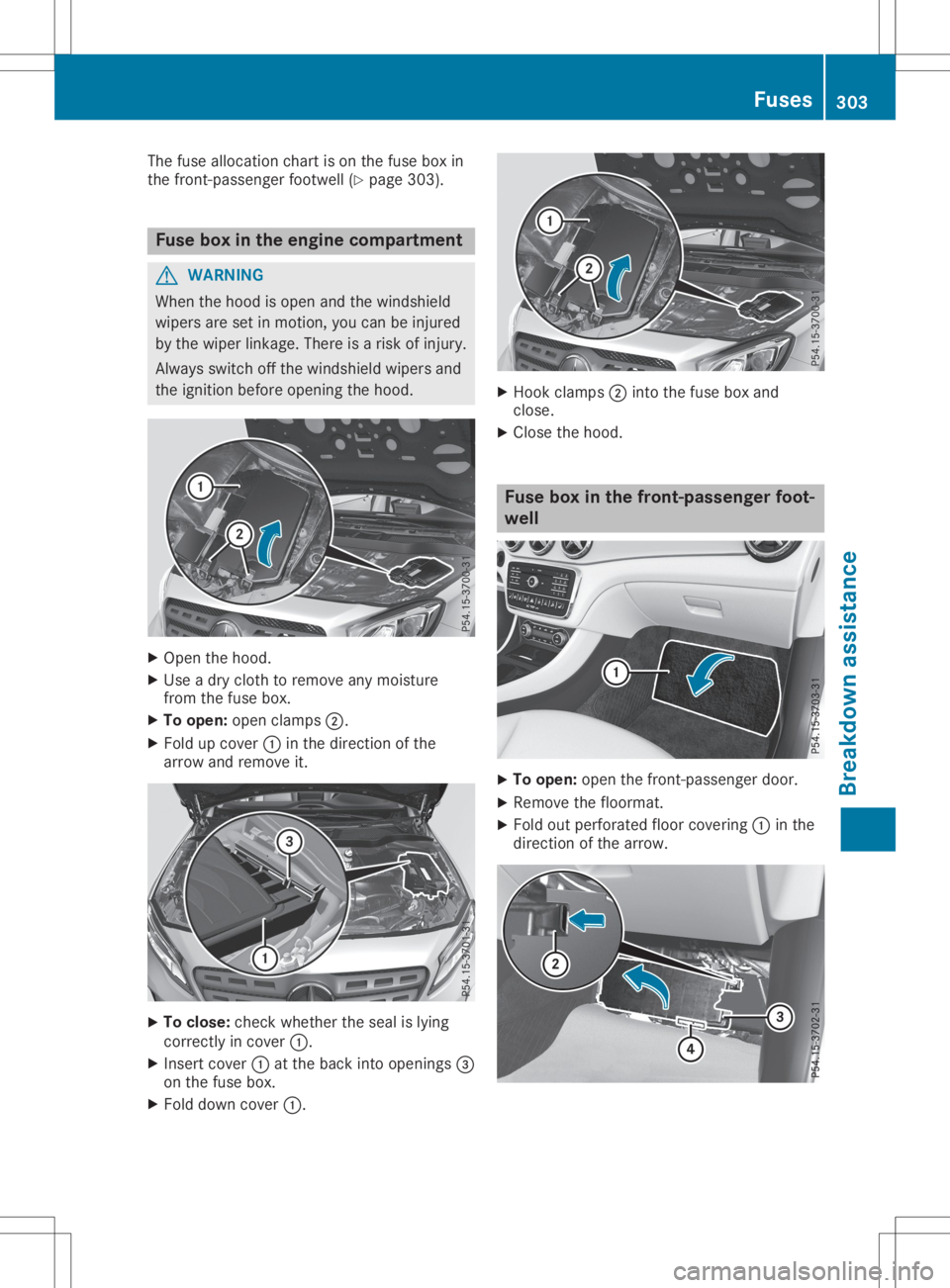
fuse allocation chartison the fuse boxin
the front -passenger footwell(Ypage 303). Fuse
boxinthe engine compar tment G
WARNIN
G
When thehood isopen andthewindshield
wipers aresetinmotion ,you can beinjured
by the wiper linkage. Thereisarisk ofinjury.
Always switchoffthe windshield wipersand
the ignition beforeopening thehood. X
Open thehood.
X Use adry cloth toremove anymoisture
from thefuse box.
X To open: openclamps 0044.
X Fold upcover 0043inthe direction ofthe
arrow andremove it. X
To close: checkwhether theseal islying
correc tlyincover 0043.
X Insert cover0043atthe back intoopenings 0087
on the fuse box.
X Fold down cover 0043. X
Hook clamps 0044into thefuse boxand
close.
X Close thehood. Fuse
boxinthe front- passenger foot-
well X
To open: openthefront -passenger door.
X Remove thefloormat.
X Fold outperforated floorcoverin g0043 inthe
direction ofthe arrow. Fuses
303Breakdown assistance Z
Page 329 of 346
The
wear pattern son the front andrear tires
differ, depending onthe operating conditions.
Rotate thewheels beforeaclear wearpattern
has formed onthe tires. Fronttires typically
wear more onthe shoulders andtherear tires
in the cent er.
On vehicles thathave thesame sizefront and
rear wheels, youcan rotat ethe wheels accord-
ing tothe inter valsinthe tire manufact urer's
warranty bookinyour vehicle document s.Ifno
warranty bookisavailabl e,the tires should be
rotat edevery 3,000 to6,000 miles(5,000 to
10,00 0km). Dependin gon tire wear, thismay
be required earlier.Donot change thedirec-
tion ofwheel rotation.
Clean thecont actsurfaces ofthe wheel and
the brake discthoroughly everytimeawheel
is rotat ed.Check thetire pressure and,ifnec-
essary, restartthetire pressure losswarning
system (Canada only)orthe tire pressure
monit or(USA only). Direction
ofrota tion
Tires withaspecified directionofrotat ionhave
additional benefits,e.g. ifthere isarisk of
hydroplaning. Theseadvantages canonly be
gained ifthe tires areinstalled correspon ding
to the direction ofrotat ion.
An arrow onthe sidewall ofthe tire indicates
its correc tdirection ofrotat ion. Storing
wheels
Stor ewheels thatarenot being usedinacool,
dry and preferably darkplace. Protectthe tires
from oil,grease, gasoline anddiesel. Mounting
awheel
Prepa ringthevehicle X
Stop thevehicle onsolid, non-slippery and
level ground.
X Apply theelectric parking brakemanually.
X Bring thefront wheels intothestraight-
ahead position.
X Shift thetrans mission toposition 005D.
X Switch offthe engine. X
Vehicles withoutKEYLESS-GO: remove
the Smart Keyfrom theignition lock.
X Vehicles
withKEYL ESS-GO start-func-
tion orKEYL ESS-GO: openthedriver's
door.
The vehicle electron icsare now inposition
0092. This isthe same as“key removed”.
X Vehicles
withKEYL ESS-GO start-func-
tion orKEYL ESS-GO: removetheStart /
Stop button fromtheignition lock
(Y page 125).
X Make surethattheengine cannotbe start ed
via your smartphon e(Y page 84).
X Ifincluded inthe vehicle equipment, remove
the tire- change toolkitfrom thevehicle.
X Safeguard thevehicle against rollingaway
(Y page 145).
i Apart
fromcertaincount ry-specific varia-
tions, thevehicles arenot equipped witha
tire- change toolkit.Some toolsforchanging
a wheel arespecific tothe vehicle. Formore
inform ationonwhich toolsarerequired to
perform awheel change onyour vehicle,
consult aqualified specialist workshop.
Necessary tire-changing toolscaninclude,
for example:
R Jack
R Wheel chock
R Lug wrench
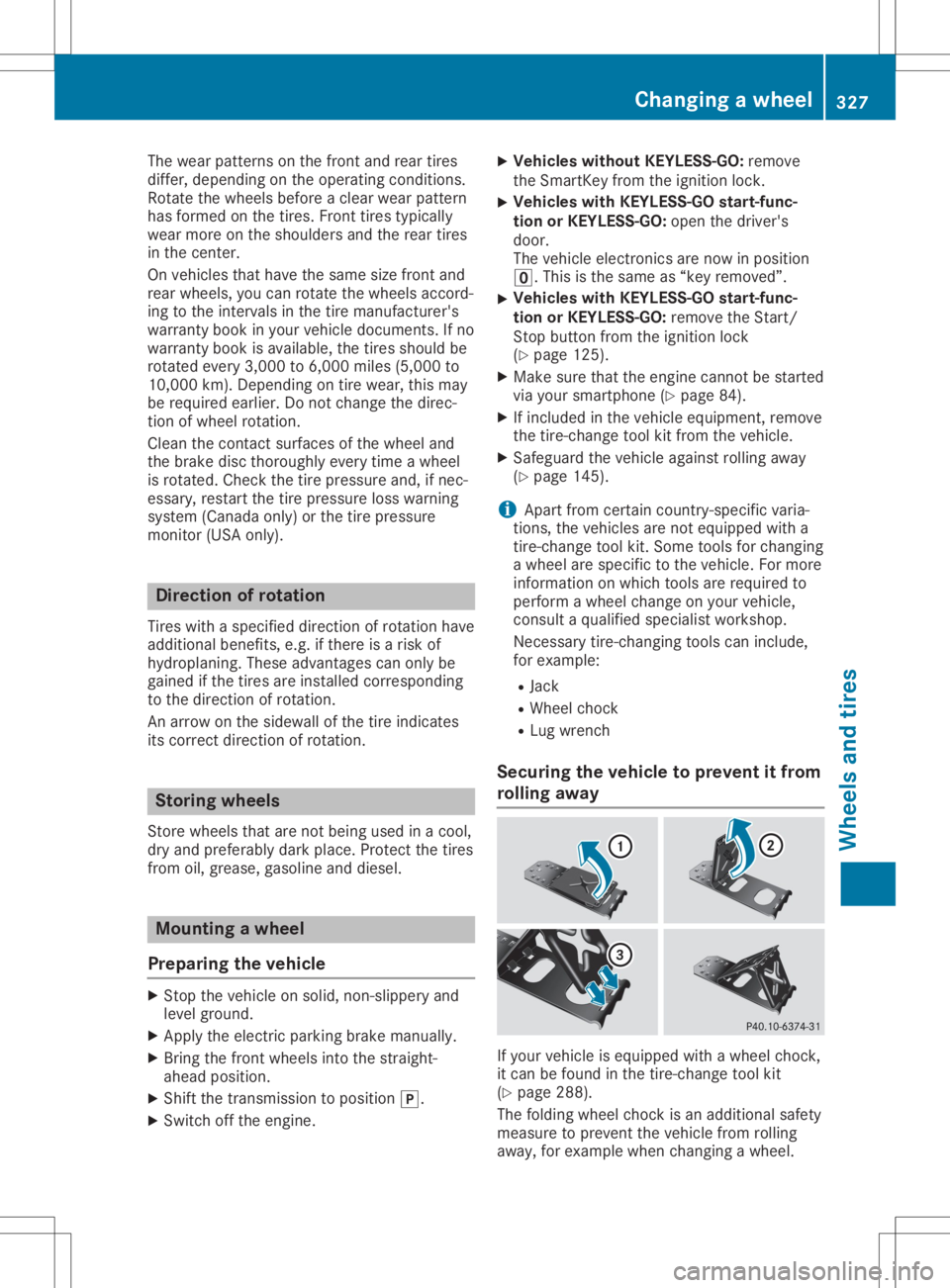
Securing thevehicle toprevent itfrom
rolling away If
your vehicle isequipped withawheel chock,
it can befound inthe tire- change toolkit
(Y page 288).
The folding wheelchock isan additional safety
measure toprevent thevehicle fromrolling
away ,for example whenchanging awheel. Changing
awheel
327Wheels andtires Z