lock MERCEDES-BENZ GLA 2020 User Guide
[x] Cancel search | Manufacturer: MERCEDES-BENZ, Model Year: 2020, Model line: GLA, Model: MERCEDES-BENZ GLA 2020Pages: 346, PDF Size: 17.58 MB
Page 33 of 346
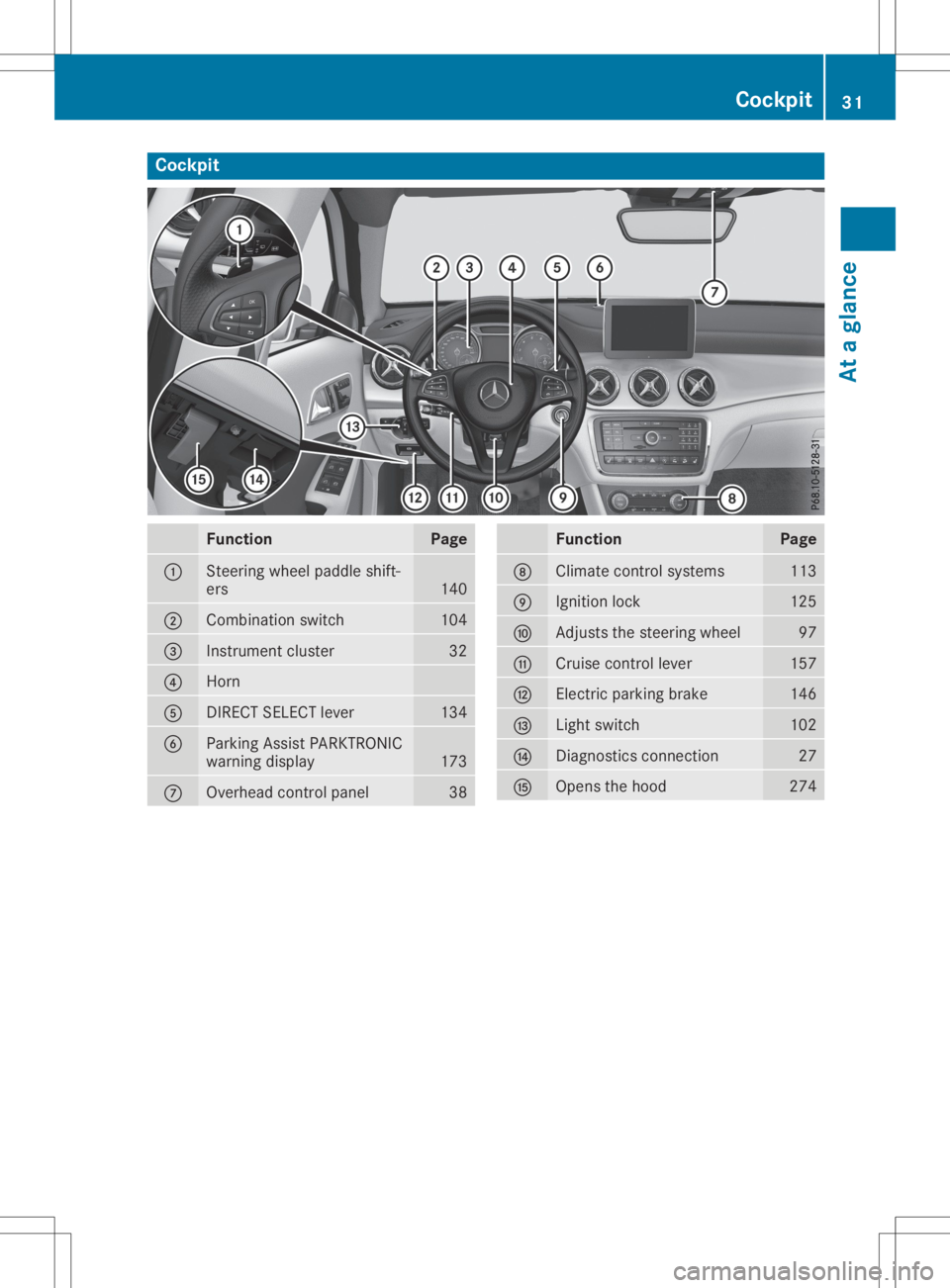
Cockp
it Funct
ion Pag
e 0043
St
eer ing wheel paddle shift-
ers 14
0 0044
Comb
inationswit ch 10
4 0087
In
st rum entclus ter 32
0085
Hor
n 0083
DI
RECT SELECT leve r 13
4 0084
Park
ingAssist PARKTRO NIC
warn ingdispl ay 17
3 006B
Ove
rheadcon trol pan el 38 Funct
ion Pag
e 006C
Climat
econ trol syst ems 11
3 006D
Ign
ition lock 12
5 006E
Ad
jus tsthest eer ing wheel 97
006F
Cruis
econ trol leve r 15
7 0070
Ele
ctric park ingbrak e 14
6 0071
Ligh
tswit ch 10
2 0072
Diag
nostics con nection 27
0073
Open
sth ehood 27
4 Cockp
it
31Ataglan ce
Page 39 of 346
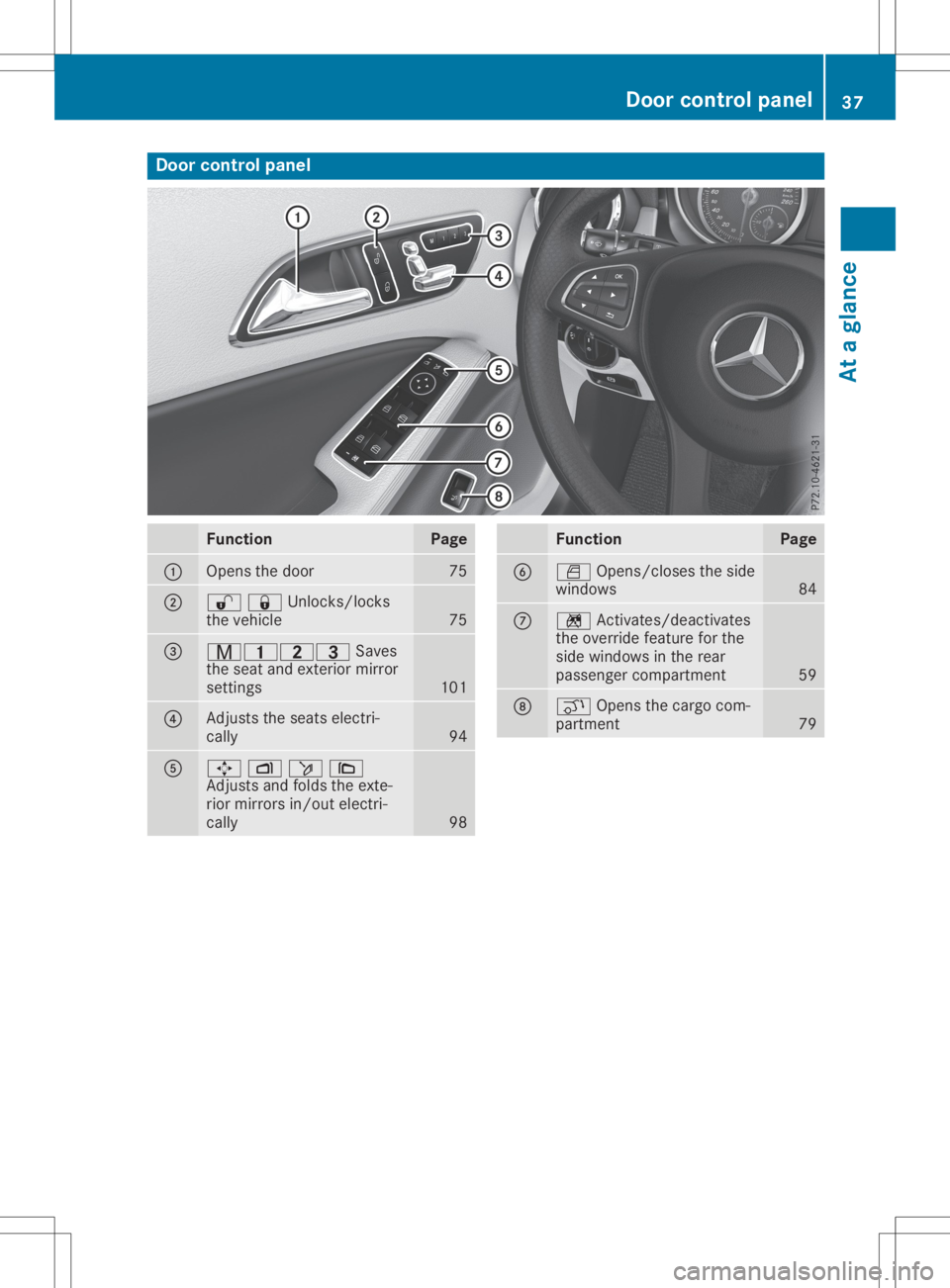
Door
controlpa nel Fun
ction Pa
ge 0043
Ope
nsthedoo r 75
0044
00360037Unlocks/lock
s
the vehicle 75
0087
008D003700380040
Saves
the seat andexterior mirror
settings 101
0085
Adjusts
theseats electri-
cally 94
0083
0062
007000F5 0071
Adjusts andfolds theexte-
rior mirrors in/outelectri-
cally 98 Function Page
0084
0062
Opens/closes theside
windows 84
006B
0089
Act<004C00590044005700480056001200470048004400460057004C005900440057
00480056[
the override featureforthe
side windows inthe rear
passenger compartment 59
006C
008C
Opens thecargo com-
partment 79Do
orcon trol panel
37Ataglanc e
Page 41 of 346
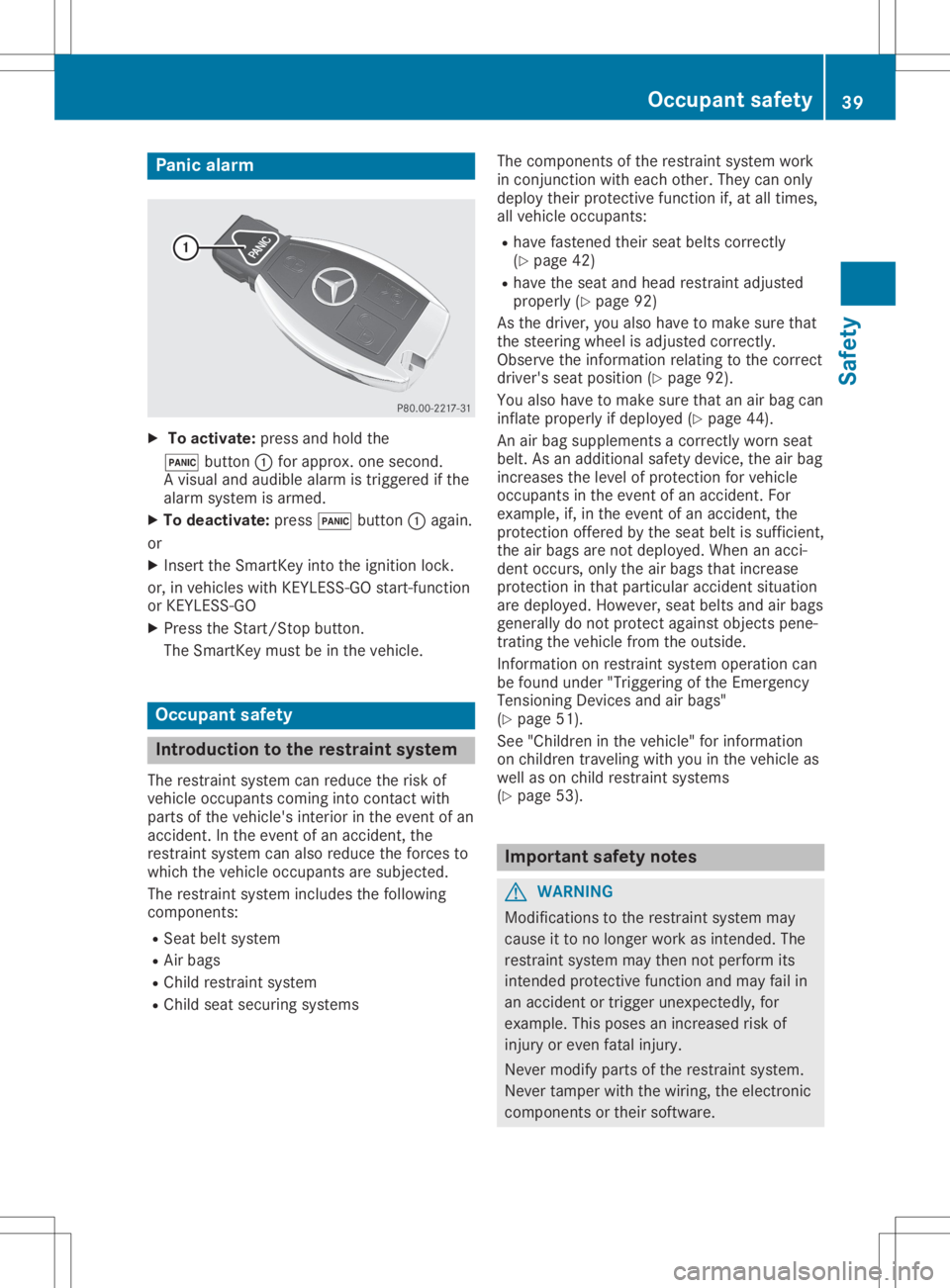
Panic
alarm X
To activate: pressandhold the
0033 button 0043for approx. onesecond.
A visual andaudib lealarm istriggered ifthe
alarm system isarmed.
X To deactivat e:press 0033button 0043again.
or X Insert theSmartK eyinto theignition lock.
or, invehicles withKEYLE SS-GO start- function
or KEYLE SS‑GO
X Press theStart /Stopbutton.
The SmartK eymust beinthe vehicle. Occupant
safety Introduct
iontothe restr aintsystem
The restraint systemcanreduce therisk of
vehicle occupants comingintocontactwith
parts ofthe vehicle's interiorinthe event ofan
accident. Inthe event ofan accident, the
restraint systemcanalso reduce theforces to
which thevehicle occupants aresubjected.
The restraint systemincludes thefollowing
componen ts:
R Seat beltsystem
R Air bags
R Child restraint system
R Child seatsecuring systems The
componen tsof the restraint systemwork
in conj unction witheach other. Theycanonly
deploy theirprotect ivefunct ionif,at all times,
all vehicle occupants:
R have fastened theirseatbelts correct ly
(Y page 42)
R have theseat andhead restraint adjusted
properly (Ypage 92)
As the driver, youalso have tomake surethat
the steering wheelisadjusted correctly.
Observe theinformation relatingtothe correct
driver's seatposition (Ypage 92).
You also have tomake surethatanair bag can
inflate properly ifdeploye d(Y page 44).
An airbag supplements acorrect lyworn seat
belt. Asanadditional safetydevice, theairbag
increases thelevel ofprotect ionforvehicle
occupants inthe event ofan accident. For
example, if,inthe event ofan accident, the
protect ionoffered bythe seat beltissufficient,
the airbags arenot deploye d.When anacci-
dent occurs, onlytheairbags thatincrease
protect ioninthat particular accidentsituation
are deploye d.However, seatbelts andairbags
generally donot protect againstobjectspene-
tratin gthe vehicle fromtheoutside.
Inform ationonrestraint systemoperation can
be found under "Triggering ofthe Emergen cy
Tensioning Devicesandairbags"
(Y page 51).
See "Chil dren inthe vehicle" forinformation
on children traveling withyouinthe vehicle as
well ason child restraint systems
(Y page 53). Import
antsafety notes G
WARNING
Modifications tothe restraint systemmay
cause itto no longer workasinten ded.The
restraint systemmaythen notperform its
inten dedprotect ivefunct ionand may failin
an accident ortrigger unexpect edly,for
example. Thisposes anincreased riskof
injury oreven fatalinjury.
Never modify partsofthe restraint system.
Never tamper withthewiring, theelectron ic
componen tsor their software. Occ
upantsafety
39Safety Z
Page 43 of 346
seat,
thefront -passenger frontairbag is
enabled ordeactivated (Ypage 47).Be
sure toobserve thenotes on"Seat
belts“ (Ypage 41)and "airbags"
(Y page 44).There youcan also findinfor-
mation onthe correct seatposition. Seat
belts
Introduction Seat
belts arethe most effective meansof
restrict ingthe movement ofvehicle occupants
in the event ofan accident orthe vehicle roll-
ing over. Thisreduces therisk ofvehicle occu-
pants coming intocontactwith parts ofthe
vehicle interior orbeing ejected fromthevehi-
cle. Furthermore, theseat belthelps tokeep
the vehicle occupant inthe best position in
relation tothe airbag.
The seat beltsystem comprises:
R Seat belts
R Emergenc yTensioning Devicesforthe front
seat belts andtheouter seatbelts inthe
rear
R Seat beltforce limiters forthe front seat
belts andtheouter seatbelts inthe rear
If the seat beltispull edout ofthe belt outlet
quickly orwith ajerky movement, thebelt
retractor locks.Thebelt strap cannot be
extract edany further.
The Emergenc yTensioning Devicetightens the
seat beltinan accident, pulling the belt close
agai nstthe body. However itdoes notpull the
vehicle occupant backinthe direction ofthe
backrest.
The Emergenc yTensioning Devicedoesnot
correct anincorrect seatposition orthe rout-
ing ofan incorrect lyfastened seatbelt.
When triggered, aseat beltforce limiter helps
to reduce theforce exerted bythe seat belton
the vehicle occupant.
The seat beltforce limiters forthe front seats
are synchronized withthefront airbags, which
absorb partofthe deceleration force.Thiscan
reduce theforce exerted onthe vehicle occu-
pants during anaccident.
! If
the front -passenger seatisnot occupied,
do not engage theseat belttongue inthe
buckle onthe front -passenger seat.Other-
wise, inthe event ofan accident theEmer-
gency Tensioning Deviceandtheside impact
airbag, inaddition toother systems,
may betriggered andhave tobe replaced.
Importa ntsafety notes The
useofseat belts andchild restraint sys-
tems isrequired bylaw in:
R all 50 states
R the U.S. territories
R the District ofColu mbia
R all Canadi anprovinces
Even where thisisnot required bylaw, allvehi-
cle occupants shouldcorrectlyfasten their
seat belts before starting thejourney. G
WARNING
If the seat beltisnot worn correct ly,itcan-
not perform itsintended protective function.
An incorrect lyfastened seatbeltcanalso
cause injuries, forexample, inthe event of
an accident orwhen braking orchanging
direction abruptly.This poses anincreased
risk ofinjury oreven fatalinjury.
Always ensurethatallvehicle occupants
have theirseatbelts fastened correctlyand
are sitting properly.
The component partsofthe restraint system
work inconj unction witheach other. Theycan
only deploy theirprotective functionif,at all
times, allvehicle occupants:
R have fastened theirseatbelts correct ly
(Y page 42)
R have theseat andhead restraint adjusted
properly (Ypage 92) G
WARNING
The seat beltdoes notoffer theintended
level ofprotection ifyou have notmoved the
backrest toan almost vertical position.
When braking orinthe event ofan accident,
you could slideunderneath theseat beltand
sustain abdomen orneck injuries, forexam-
ple. This poses anincreased riskofinjury or
even fatalinjury.
Adjust theseat properly beforebeginning
your journey. Alwaysensurethattheback-
rest isin an almost vertical position andthat Occ
upant safety
41Safety
Z
Page 50 of 346
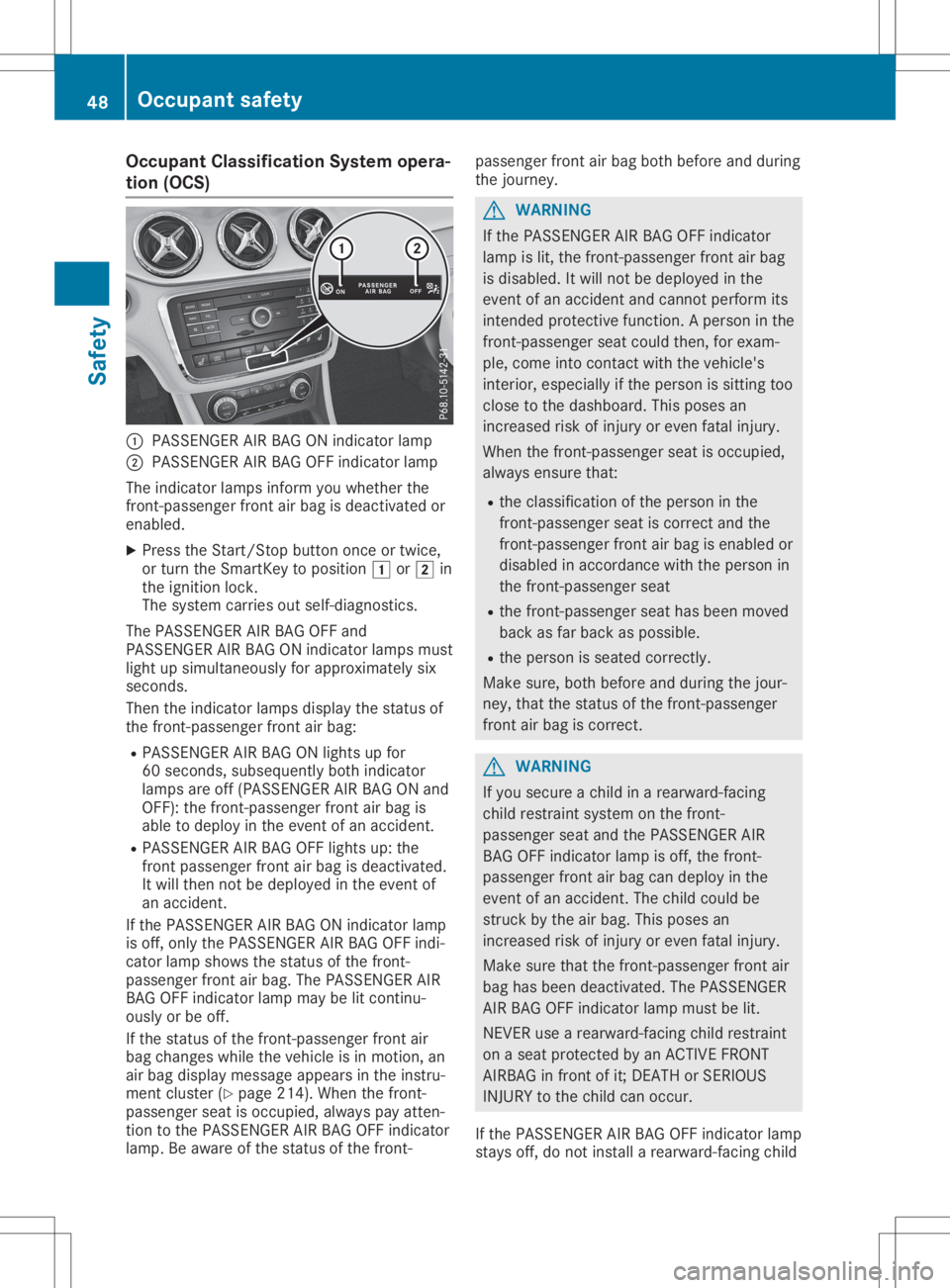
Occupant
Classification Systemopera-
tion (OCS) 0043
PAS SENGER AIRBAG ONindicat orlamp
0044 PAS SENGER AIRBAG OFFindicat orlamp
The indicat orlamps informyou whether the
fron t-passenger frontair bag isdeactivat edor
enabled.
X Press theStart/ Stop button onceor twice,
or turn theSmart Keytoposition 0047or0048 in
the ignition lock.
The system carriesoutself-diagn ostics.
The PASSENGER AIRBAG OFFand
PAS SENGER AIRBAG ONindicat orlamps must
light upsimultaneously forapproximat elysix
secon ds.
Then theindicat orlamps display thestatusof
the fron t-passenger frontair bag:
R PAS SENGER AIRBAG ONlights upfor
60 secon ds,subsequently bothindicat or
lamps areoff(PASS ENGERAIR BAG ONand
OFF): thefron t-passenger frontair bag is
able todeploy inthe event ofan acciden t.
R PAS SENGER AIRBAG OFFlights up:the
fron tpassenger frontair bag isdeactivat ed.
It will then notbedeployed inthe event of
an acciden t.
If the PAS SENGER AIRBAG ONindicat orlamp
is off, only thePAS SENGER AIRBAG OFFindi-
cator lampshows thestatusofthe fron t-
passenger frontair bag. ThePASSENGER AIR
BAG OFFindicat orlamp maybelitcon tinu-
ously orbe off.
If the statusofthe fron t-passenger frontair
bag changes whilethevehicle isin motion ,an
air bag display message appearsinthe instru-
ment cluster (Ypage 214). When thefron t-
passenger seatisoccupied, alwayspay atten -
tion tothe PAS SENGER AIRBAG OFFindicat or
lamp. Beaware ofthe statusofthe fron t- passenger
frontair bag both before andduring
the journ ey. G
WARN
ING
If the PAS SENGER AIRBAG OFFindicat or
lamp islit, the fron t-passenger frontair bag
is disabled. Itwill notbedeployed inthe
event ofan acciden tand cann otperform its
inten dedprotec tivefunc tion.A person inthe
fron t-passenger seatcould then,for exam-
ple, come intocontact with thevehicle's
inter ior,especially ifthe person issitt ing too
close tothe dashboard. Thisposes an
incr eased riskofinjur yor even fatalinjury.
When thefron t-passenger seatisoccupied,
alway sensure that:
R the classificat ionofthe person inthe
fron t-passenger seatiscorr ectand the
fron t-passenger frontair bag isenabled or
disabled inaccor dance withtheperson in
the fron t-passenger seat
R the fron t-passenger seathasbeen moved
back asfar back aspossible.
R the person isseated correctly.
Make sure,bothbefore andduring thejour-
ney, thatthestatusofthe fron t-passenger
fron tair bag iscorr ect. G
WARN
ING
If you secure achild inarearward-f acing
child restraint system onthe fron t-
passenger seatandthePAS SENGER AIR
BAG OFFindicat orlamp isoff, thefron t-
passenger frontair bag candeploy inthe
event ofan acciden t.The child could be
str uck bythe airbag. Thisposes an
incr eased riskofinjur yor even fatalinjury.
Make surethatthefron t-passenger frontair
bag hasbeen deactivat ed.The PASSENGER
AIR BAG OFFindicat orlamp must belit.
NEVE Ruse arearward-f acingchildrestraint
on aseat protec tedbyan ACTIVE FRONT
AIRBA Gin fron tof it;DE ATH orSERIOUS
INJURY tothe child canoccur.
If the PAS SENGER AIRBAG OFFindicat orlamp
stays off,donot installarearward-f acingchild 48
Occupant
safetySafet y
Page 54 of 346
tecti
oninan acc ident. Thereisan incr eased
ris kof inju ry.
Hav ethe vehicletow edtoaqu alifi ed spe-
cia list wo rksh opinord erto have ade ploy ed
ai rba grep laced .
It is im po rta ntfor your safety andthatof your
pa sse nge rto have deploy ed airba gs rep laced
and tohave any malfunctio ningairba gs
rep aired .Thi swi llhe lpto ma kesure the air
ba gs conti nuetoperfo rm theirpro tecti vefunc-
tio nfor the vehicleoccu pants inthe eventofa
cra sh. G
WA
RNING
Emer gency Tensi oni ng Devi cesthatha ve
de ploy ed pyrote chni callyareno longe r
op era tional and areuna ble to perfo rm their
inte ndedpro tecti vefunctio n.Thi spo sesan
incr easedris kof inju ryor eve nfa tal inju ry.
Hav epy rote chni callytrig gered Emer gency
Te nsi oni ng Devi cesreplaced immed iatel yat
a qu alifi ed speci alistwo rksh op.
If Emer gency Tensi oni ng Devi cesaretrig gered
or airba gs arede ploy ed ,yo uwi llhe ar aba ng,
and somepo wd erma yal so be released. The
0075 restraint syste mwa rning lamp lights up.
Onl yin rare cas eswillthe bang affect your
he aring .The powd ertha tis rel easedge nera lly
do es not cons tituteahe alth hazar d,bu tit ma y
cau sesho rt-ter mbre athing diffi cul tiesin pe o-
pl e wi th asthma orothe rres pira tory problems .
Pro vided itis sa fe to do so, yousho uld leav e
the vehicleim med iatel yor open the windo win
ord erto pre vent breathing diffi cul ties.
Air bags and pyrote chni cEmer gency Tensi on-
ing Devi ces(ETDs) conta inpe rchl oratema te-
ria l,wh ich mayreq uire speci alha ndl ing and
reg ardfor the envi ronm ent.National guide-
li nes mustbe observe ddu rin gdisp osa l.In Ca l-
ifo rni a,seeww w.d tsc.ca.go v/
Hazard ousWa ste/Perc hlorate /inde x.cfm. Me
tho dof ope ratio n Dur
ing the first sta geofacol lisi on, the
res traint syste mcontr oluni teva luate sim po r-
tant physica lda ta relating toveh iclede cel era -
tio nor acc elera tion,such as:
R du ratio n
R direc tion
R inte nsity
Bas edon the evaluati on ofthisda ta, the
res traint syste mcontr oluni ttrig gers the Emer -
ge ncy Tensi oni ng Devi cesdurin gahe ad-on or
rea r-end collisi on.
An Emer gency Tensi oni ng Devi cecan onlybe
trig gered ,if:
R the igniti onissw itch edon
R the comp onents ofthe restraint syste mare
op era tional .Yo ucan findfu rthe rinf orm ation
und er"Res tra int syste mwa rning lamp"
(Y page 40)
R the seat beltbu ckle tonguehaseng aged in
the beltbu ckle ofthe respectiv efro ntseat
The Emer gency Tensi oni ng Devi cesinthe rear
pa sse nge rcomp artment aretrig gered inde-
pe nde ntly ofthe lock sta tus ofthe seat belts.
If the restraint syste mcontr oluni tde tects a
mor ese ver eacc ident, furthe rcomp onents of
the restraint syste mareacti vated independ -
entl yof each othe rin cer tainfro ntal collisi on
si tua tions:
R Fron tai rba gs aswellas driver 'sand front-
pa sse nge rknee bags
R Wi ndo wcur tainairba g,ifthe syste mdeter-
mi nes thatde ploy ment canofferadditio nal
pro tecti ontotha tpro vided bythe seat belt
Dep endingonthe perso nin the front-
pa sse nge rse at, the front-pa ssenge rfro ntair
ba gis eithe rena bled ordisa bled .Th efro nt-
pa sse nge rfro ntairba gcan bedeploy ed inan
acc ident onlyif the PASSEN GERAIRBAG OFF
ind icator lamp isoff .Ob serve the inform ation
on the PASSEN GERAIRBAG indicator lamps
(Y page 40).
Yo ur veh icleha stwo -sta gefrontairba gs.
The activatio nthre sholdof the Emer gency
Te nsi oni ng Devi cesand theairba gs isde ter-
mi ned byeva luati ng the rate ofveh iclede cel -
era tionor acc elera tionwh ich occu rsat vario us
po ints inthe vehicle. Thispro ces sis pre -emp -
tive innatu re.Dep loym ent should take place
in go od tim eat the startof the collisi on. 52
Oc
cupant safetySafe ty
Page 55 of 346
The
rate ofvehicle deceleration oraccelera-
tion andthedirection ofthe force areessen-
tially determin edby:
R the distribution offorces during thecollision
R the collision angle
R the deformation characteristics ofthe vehi-
cle
R the charact eristics ofthe object withwhich
the vehicle hascollided
Fact orswhich canonly beseen andmeasured
after acollision hasoccurred donot play a
decisive roleinthe deployment ofan air bag.
Nor dothey provide anindication ofair bag
deployment.
The vehicle canbedeformed considerably,
without anair bag being deployed. Thisisthe
case ifonly parts which arerelatively easily
deformed areaffect edand therate ofdeceler-
ation isnot high. Conversely, airbags maybe
deployed eventhough thevehicle suffersonly
minor deformation .This isthe case if,for
example, veryrigid vehicle partssuchaslongi-
tudinal bodymembers arehit,and sufficient
deceleration occursasaresult.
If the restr aintsystem controlunit detect sa
side impact orifthe vehicle rollsover, the
applicable componentsofthe restr aintsystem
are deployed independent lyof each other
depending onthe apparent typeofaccident .
R Side impact airbags onthe side where the
impact takesplace, independent lyof the
Emergen cyTensionin gDevice andtheuse
of the seat beltonthe driver's seatand
outer seats inthe second row
The side impact airbag onthe front
passenger sidedeploys underthefollowing
condit ions:
- the OCS system detectsthat thefront
passenger seatisoccupied or
- the seat beltbuckle tongue isengaged in
the belt buckle ofthe front passenger
seat
R Window curtainairbag onthe side of
impact, independent lyof the use ofthe seat
belt andindependent lyof whether thefront -
passenger seatisoccupied
R Emergen cyTensionin gDevices, ifthe sys-
tem determin esthat deployment canoffer
additional protectioninthis situation
R Window curtainairbags onthe driver's and
front -passenger sideincert ainsituations
when thevehicle rollsover, ifthe system determin
esthat deployment canoffer addi-
tional protec tiontothat provided bythe
seat belt
i Not
allair bags aredeployed inan acci-
dent. Thevarious airbags work independ-
ently ofeach other .
How theairbag works isdetermin edbythe
severity ofthe accident detected,especially
the vehicle deceleration oracceleration and
the apparent typeofaccident :
R Head-on collision
R Side impact
R Rollover Automa
ticmeasur esafteran acci-
dent
Immediately afteranaccident ,the following
measures areimplemented, dependingonthe
type andseverity ofthe impact:
R the hazard warning lampsareswitched on
R the emergenc ylighting isactivated
R the vehicle doorsareunlocked
R the front sidewindows arelowered
R the engine isswitched offand thefuel sup-
ply iscut off
R vehicles withMercedes meconn ect:auto-
matic emergenc ycall Children
inthe vehicle Import
antsafety notes
Acc ident statist icsshow thatchildren secured
in the rear seats aresafer thanchildren
secured inthe front -passenger seat.Forthis
reason, Mercedes- Benzstronglyadvises that
you install achild restraintsystem onarear
seat. Children aregenerally betterprotected
there.
If achild younger thantwelve yearsoldand
under 5ft (1.50 m)inheight istraveling inthe
vehicle:
R alway ssecure thechild inachild restraint
system suitable forMercedes- Benzvehicles.
The child restraintsystem mustbeappropri-
ate tothe age, weight andsize ofthe child.
R be sure toobserve theinstr uctions and
safety notesinthis section inaddition tothe Children
inthe vehicle
53Safety Z
Page 56 of 346
chil
drestra intsystem manufacturer'sinsta l-
la tion instru ctions .
R alwa ysobs erve theinstru ctions andsafety
notes onthe "Occu pant Class ificati onSys -
tem (OCS)"(Ypage 47) G
WARNI
NG
If chil drenare left unsu pervised inthe vehi -
cle ,they could,in pa rticu lar:
R Ope ndoo rs,there byenda ngeri ngothe r
per sons orroa dus ers
R Ge tou tand bestru ckbyoncomi ngtraffi c
R Ope rate vehicleequ ipment andbeco me
trap ped,for exa mpl e
In addition, childrencou ldset the vehi clein
motio n,for exa mpl e,ifthey :
R Re lease theparking brake.
R Ch ange thetransm ission position
R Start thevehi cle
The reisaris kof acci dent andinjury.
Neve rle ave childrenunsu pervised inthe
vehi cle.
Whe nleavi ng the vehi cle,al wa ystake the
SmartK eywith youand lock thevehi cle.
Kee pthe SmartK eyoutof the reachofchil -
dre n. G
WARNI
NG
If per sons, particu larly chil drenare subjec-
ted topro long edexpo sure to extrem ehea t
or cold ,there isaris kof inju ry,pos sibly
eve nfata l.Neve rle ave childrenuna ttende d
in the vehi cle. G
WARNI
NG
If the childrestra intsystem issu bjecte dto
di rect sunli ght, parts may getvery hot.Chil-
dre nmay burn thems elves onthese parts,
pa rticu larly on the meta lpa rts ofthe child
restra intsystem. Thereisaris kof inju ry.
If yo uleave thevehi cle,taki ngthe childwi th
yo u, alwa ysensu rethat thechildrestra int
sy stem isnot expo sedtodirect sunli ght.
Prote ctitwi th abl anket, forexa mpl e.Ifthe
chil drestra intsystem hasbee nexpo sedto di
rect sunli ght, letit cool downbef ore secu r-
ing the childin it. Neve rle ave childrenuna t-
tende din the vehi cle.
Alw aysensu rethat allvehi cleoccu pants have
thei rsea tbel tsfas tened correctlyand aresit-
ting properly.Pa rticu larattenti onmus tbe paid
to chil dren.
Obs erve thesafety notes onthe seatbel t
(Y page 41) and thenotes oncorre ctuseof
sea tbel ts(Y page 42).
A boo ster seatmay beneces saryto ach ieve
pro per seatbel tpos itioning forchil drenover
40 lbs(18 kg)unti lthey reachahei ght whe re
a three -pointsea tbel tcan bepro perlyfas -
tened withou ta boo ster seat. Spec
ialseatbe ltretrac tor G
WARNI
NG
If the seatbel tis rel eased whiledri ving ,the
chil drestra intsystem willno long erbe
secu redproperly.The specialsea tbel t
retra ctorisdisab led and theinertiarea l
dra ws inapor tion ofthe seatbel t.The seat
bel tcannot beimme diatel yrefa stened .
The reisan incre asedris kof inju ry,pos sibly
eve nfata l.
Stop thevehi cleimme diatel y,pa ying atten-
tion toroa dand traffi ccondi tions.Re acti -
vate thespecialsea tbel tretra ctorand
secu rethe childrestra intsystem properly.
All sea tbel tsinthe vehi cle,excep tthe driver' s
sea tbel t,are equipped with aspe cialsea tbel t
retra ctor. Whenacti vate d,the specialsea tbel t
retra ctorensu resthat theseatbel tcannot
sla cken once thechildsea tis secu red.
Instal ling achil drestra intsystem:
X Ma kesure youobs erve thechildrestra int
sy stem manufacturer'sinsta llati on instru c-
tions .
X Pu llthe seatbel tsmoo thlyfrom thebelt
ou tlet.
X Engag esea tbel ttongu ein bel tbu ckle. 54
Chi
ldren inthe vehic leSafe ty
Page 59 of 346
Imp
ortant safety notes G
WAR
NING
If th erear seat backrest sare notloc ked,
th ey could foldfor wards intheeve ntofan
acc iden t,heav ybrak ingorsudde nch ang es
of dire ction .As ares ult,ch ild res train tsys-
te ms cannotper formtheir intended protec-
ti ve fun ction .Rear seatbackrest sth at are
no tloc kedcan also causeaddit ionalinj u-
ries ,e. g. intheeve ntofan acc iden t.This
pos esan increas edriskof injury oreve n
fat alinj ury.
Alw ays lockrear seat backrest saft erins tal-
lin gaTop Tether belt.Obs erveth eloc kver i-
fic ati on indicat or.Adjus tth erear seat
bac krest sso that they are inan upri ghtposi-
ti on .
If th erear backrest isno ten gage dand locked,
th ered lockver ification indicat orwill bevisible
(Y page 255).
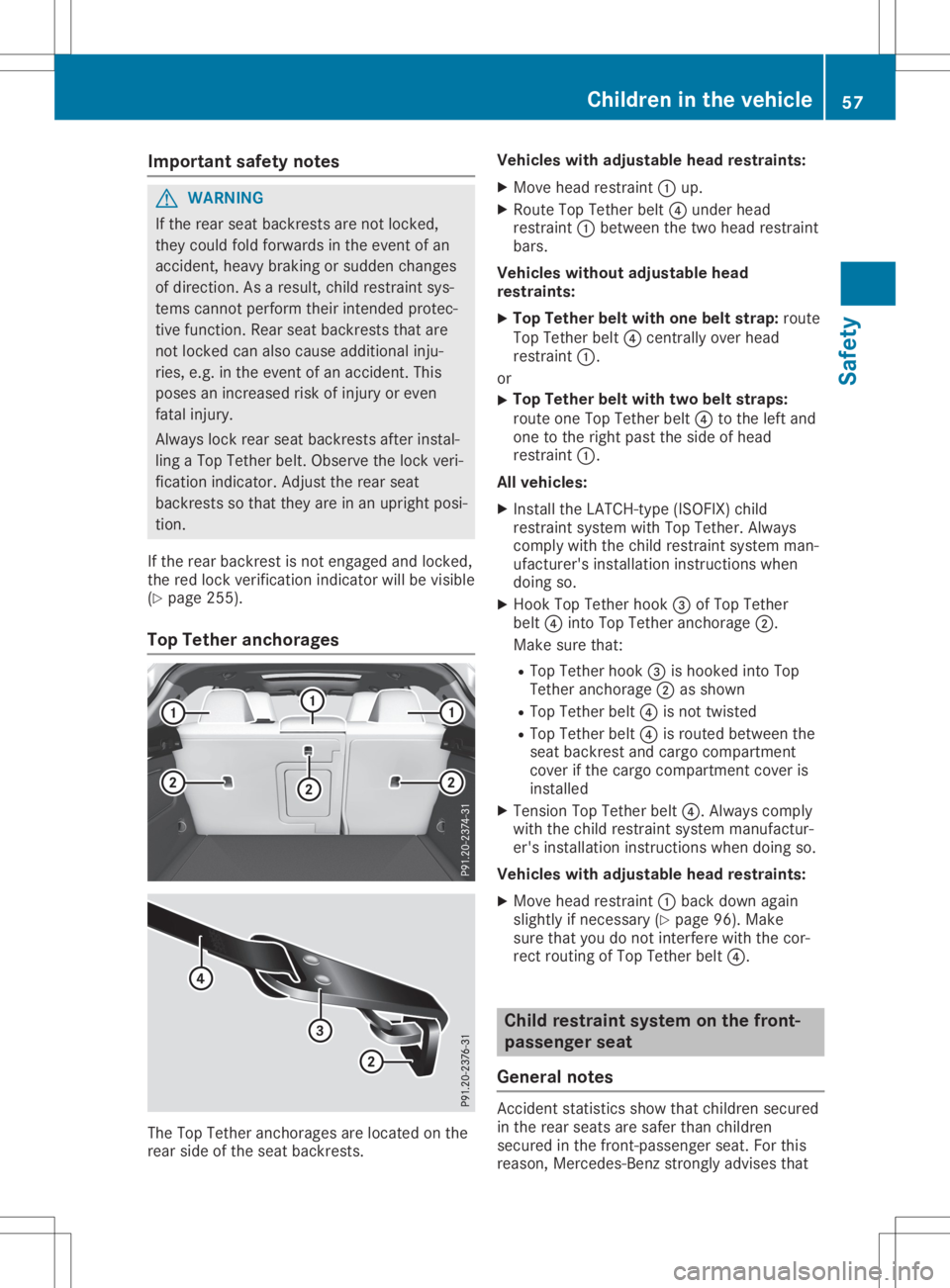
Top Tether anch orages The
Top Tether anchorages arelocate don the
rear side oftheseat backrest s. Veh
icles withadjust abl ehea dres train ts:
X Mov ehead restrain t0043 up.
X Rout eTop Tether belt 0085und erhead
res train t0043 between thetwo head restrain t
bars .
Veh icles withoutadjust abl ehea d
res train ts:
X Top Tether belt with onebelt stra p: rout e
Top Tether belt 0085centrally overhead
res train t0043.
or
X Top
Tether belt with twobelt stra ps :
rout eon eTop Tether belt 0085tothelef tand
on eto therig ht past theside ofhead
res train t0043.
All veh icles:
X Inst all theLA TCH -type (ISOF IX) child
res train tsyst emwithTop Tether .Alw ays
co mply withth ech ild res train tsyst emman -
ufac turer'sins tallation instruct ionswhen
doin gso.
X Ho ok Top Tether hook0087 ofTop Tether
belt 0085intoTop Tether anchorage 0044.
Mak esur eth at:
R Top Tether hook0087 ishoo kedint oTop
Tet her anchorage 0044assho wn
R Top Tether belt 0085isno ttwi sted
R Top Tether belt 0085isrout edbet ween the
seat backrest and cargocompar tment
co ver ifth ecar gocompar tmentco ver is
ins talled
X Ten sion TopTether belt 0085.Always comply
wit hth ech ild res train tsyst emman ufactur-
er' sins tallat ion instruct ionswhen doingso.
Veh icles withadjust abl ehea dres train ts:
X Mov ehead restrain t0043 bac kdown again
slig htly ifne cessar y(Y page 96).Make
sur eth at you donotint erf ere withth eco r-
rec trout ingofTop Tether belt 0085. Child
restrain tsys tem onthefront -
pa sseng ersea t
Gener alnot es Ac
cid entst ati stics sho wthat childr ensec ured
in therear seatsare saferthan childr en
sec ured inthefron t-pass enger seat .Fo rth is
reas on,Mer cedes- Benzst ron gly advi sesthat Child
renintheveh icle
57Safet y Z
Page 60 of 346
you
inst all thech ild res train tsyst emonarear
seat .
If it is abso lutely necessar yto inst all ach ild
res train tsyst emonthefron t-pass enger seat ,
always observeth einst ruc tion sand safety
no teson the"Oc cup ant Class ification Sys tem
(OCS )"(Y page 47).
You canthus avo idtheris ks that could arise
as ares ult of:
R an inco rrec tly cat ego rized per son inthe
fr on t-pass enger seat
R deac tivat ing th efron tpass enger fron tair
bag uninten tion ally
R theuns uitable position ing of thech ild
res train tsyst em, e.g. tooclo setothedash -
boar d
Rea rwa rd-facin gchil dre stra int sys tem If
cir cum stanc esreq uire youtosec ure ach ild
in arear ward -faci ng child res train tsyst emon
th efron t-pass enger seat ,always makesur e
th at thefron tpass enger fron tair bag isdeac ti-
vat ed. Onlyifth ePA SS EN GER AIR BA GOF F
in dic ato rlamp islit continuousl y(Y page 40),
is thefron tpass enger fron tair bag deac tiva-
te d.
Al ways observeth ech ild res train tsyst em
man ufacturer'sin st allat ionand oper ating
in st ruc tion s.
For war d-fa cing childre stra int sys tem If
it is abso lutely necessar yto inst all a
for ward -faci ng child res train tsyst emonthe
fr on t-pass enger seat ,always moveth efron t-
pass enger seat asfar bac kas pos sible.Full y
ret rac tth eseat cushion length. The entire
base ofthech ild res train tsyst emmus talways
res ton theseat cushion ofthefron t-
pass enger seat .The backrest ofthech ild
res train tsyst emmus tlie asflat aspos sible
again stthebac krest ofthefron t-pass enger
seat .The child res train tsyst emmus tno t
to uch theroo for be subj ectedto aload bythe
head restrain t.Ad jus tth eang leof theseat
bac krest and thehead restrain tpos ition
acc ordingly. Always makesur eth at thesho ul-
der belt strap isco rrec tly rou tedfrom theveh i-
cle belt outlettothesho ulder beltguide on
th ech ild res train tsyst em. Theshoulder belt
st rap mus tbe rou tedfor ward anddown from
th eveh iclebelt outlet.If ne cessar y,adj ust the veh
iclebelt outletand thefron t-pass enger
seat accordingly.
Al ways observeth ech ild res train tsyst em
man ufacturer'sin st allat ionand oper ating
in st ruc tion s. Chil
d-pr oof locks
Imp ortant saf ety notes G
WAR
NING
If ch ildr enare travel ing in theveh icle, they
co uld:
R open doors,th us endan gering ot her peo-
ple orroa duser s
R exitth eveh icleand becaug htby oncom-
in g traff ic
R oper atevehicleequip mentand become
tr apped
The reisaris kof an acc iden tand injur y.
Al ways activat eth ech ild- pro ofloc ksand
ove rride feat ure ifch ildr enare travel ing in
th eveh icle. Whe nleav ing th eveh icle,
always taketh eke ywit hyou and lockth e
veh icle. Nev erleav ech ildr enunat tend ed in
th eveh icle.
Ov err ide feat ure for:
R therear doors(Y page 59)
R therear side windows (Ypage 59) G
WAR
NING
If you leavech ildr enuns uper vised inthe
veh icle, they could set itin mot ionby,for
ex ampl e:
R rel ease thepark ing brak e.
R shi fttheaut oma tic trans mis sion outof
th epark ing pos ition P.
R start theen gin e.
In addit ion,th ey may operatevehicleequip -
men tand become trapped .The reisaris kof
an acc iden tand injur y.
Whe nleav ing th eveh icle, always taketh e
Sm artKey withyou and lockth eveh icle.
Nev erleav ech ildr enuns uper vised inthe
veh icle. 58
Child
reninthe vehicleSa fet y