ESP MERCEDES-BENZ GLA-Class 2017 X156 User Guide
[x] Cancel search | Manufacturer: MERCEDES-BENZ, Model Year: 2017, Model line: GLA-Class, Model: MERCEDES-BENZ GLA-Class 2017 X156Pages: 390, PDF Size: 8.37 MB
Page 29 of 390
COMAND/mbrace (Canada: TELEAID)
If the vehicle is equipped with COMAND or
mbrace, additional data about the vehicle’s
operation, the use of the vehicle in certain
situations, and the location of the vehicle may
be compiled through COMAND or the mbrace system.
For additional information please refer to the
COMAND User Manual and/or the mbrace
Terms and Conditions.
Event data recorders
This vehicle is equipped with an event data
recorder (EDR). The main purpose of an EDR
is to record data that will assist in under-
standing how a vehicle’s systems performed
in certain crash or near crash-like situations,
such as during air bag deployment or when
hitting a road obstacle. The EDR is designed
to record data related to vehicle dynamics
and safety systems for a short period of time,
typically 30 seconds or less.
The EDR in this vehicle is designed to record
such data as:
Rhow various systems in your vehicle are
operating
Rwhether or not the driver and passenger
seat belts are fastened
Rhow far (if at all) the driver is depressing the
accelerator and/or brake pedal and
Rhow fast the vehicle is traveling
This data can help provide a better under-
standing of the circumstances in which
crashes and injuries occur. NOTE: EDR data is recorded by your vehicle only if a non-trivial
crash situation occurs; no data is recorded by
the EDR under normal driving conditions and
no personal data (e.g., name, gender, age,
and crash location) are recorded. However,
other parties, such as law enforcement, can
combine the EDR data with the type of per-
sonal identification data routinely acquired
during a crash investigation. To read
data r
ecorded by an EDR, special
equipment is required, and access to the vehi-
cle or the EDR is needed. In addition to the
vehicle manufacturer, other parties that have the special equipment, such as law enforce-
ment, can read the information by accessing
the vehicle or the EDR.
EDR data may be used in civil and criminal
matters as a tool in accident reconstruction,
accident claims, and vehicle safety. Since the
Crash Data Retrieval CDR tool that is used to
extract data from the EDR is commercially
available, Mercedes-Benz USA, LLC
("MBUSA") expressly disclaims any and all lia-
bility arising from the extraction of this infor-
mation by unauthorized Mercedes-Benz per-
sonnel.
MBUSA will not share EDR data with others
without the consent of the vehicle owners or,
if the vehicle is leased, without the consent of
the lessee. Exceptions to this representation
include responses to subpoenas by law
enforcement; by federal, state or local gov-
ernment; in connection with or arising out of
litigation involving MBUSA or its subsidiaries
and affiliates; or, as required by law.
Warning: The EDR is a component of the
Restraint System Module. Tampering with,
altering, modifying or removing the EDR com-
ponent may result in a malfun
ction of the
Restraint System Module and other systems.
State laws or regulations regarding EDRs that conflict with federal regulation are pre-emp-
ted. This means that in the event of such con-
flict, the federal regulation governs. As of
February 2013, 13 states have enacted laws
relating to EDRs.
Information on copyright
General information
Information on license for free and open-
source software used in your vehicle and its
electronic components is available on the fol-
lowing website:
Introduction27
Z
Page 34 of 390
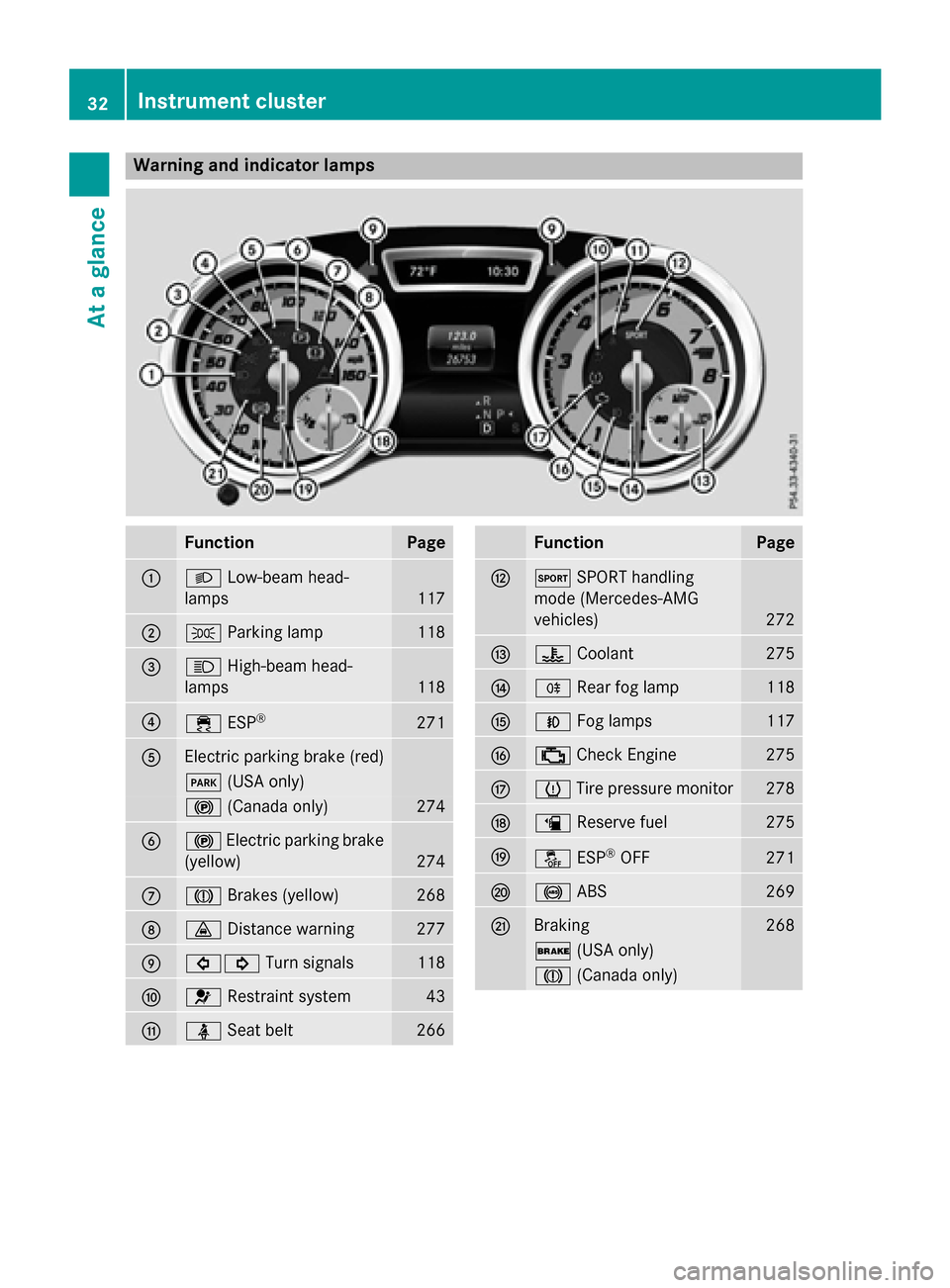
Warning and indicator lamps
FunctionPage
:LLow-beam head-
lamps
117
;T Parking lamp118
=KHigh-beam head-
lamps
118
?÷ ESP®271
AElectric parking brake (red)
F(USA only)
!(Canada only)274
B!Electric parking brake
(yellow)
274
CJ Brakes (yellow)268
D·Distance warning277
E#! Turn signals118
F6Restraint system43
GüSeat belt266
FunctionPage
HMSPORT handling
mode (Mercedes-AMG
vehicles)
272
I? Coolant275
JRRear fog lamp118
KNFog lamps117
L;Check Engine275
Mh Tire pressure monitor278
Næ Reserve fuel275
OåESP®OFF271
P!ABS269
QBraking268
$(USA only)
J(Canada only)
32Instrument cluster
At a glance
Page 37 of 390
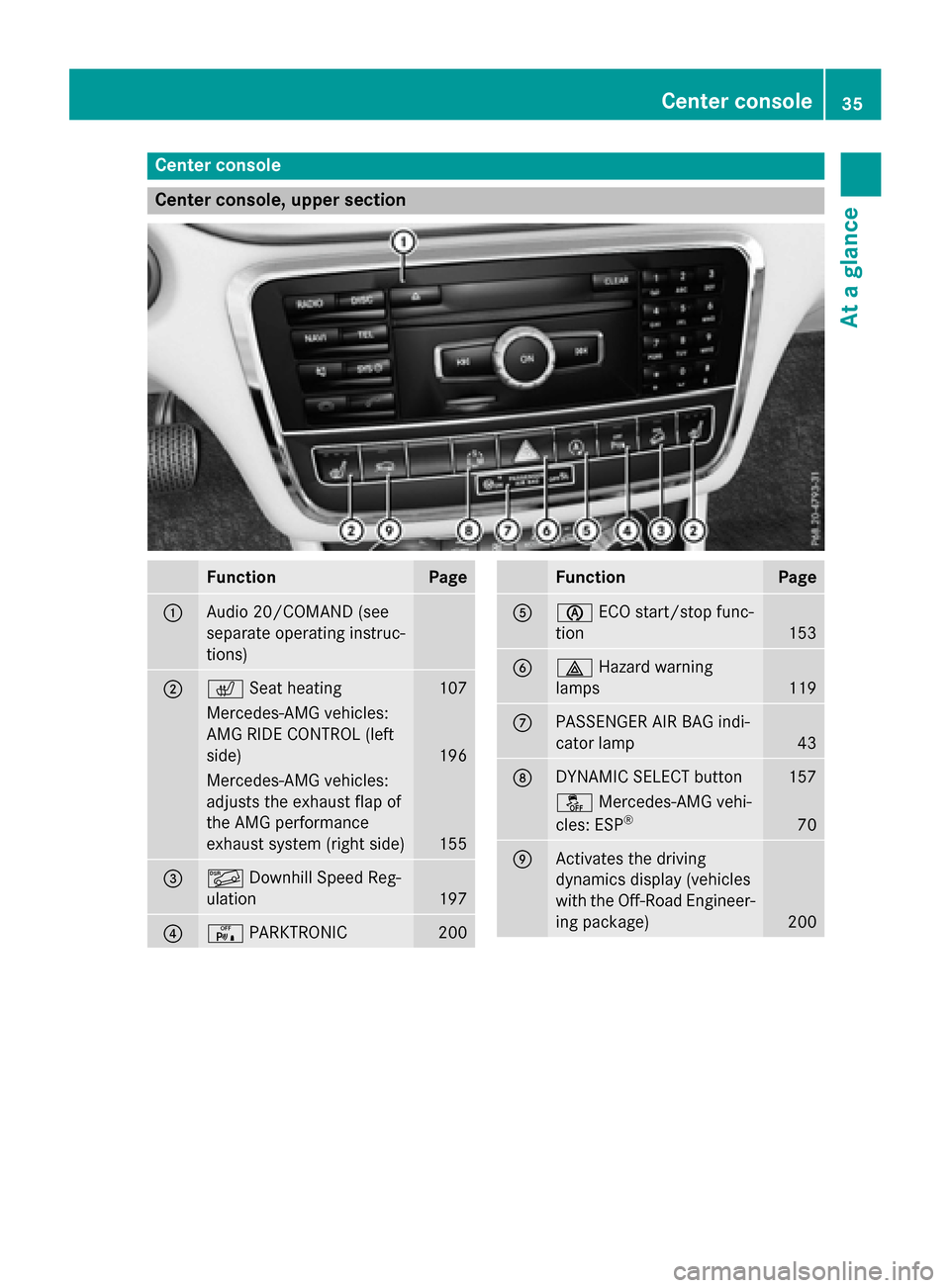
Center console
Center console, upper section
FunctionPage
:Audio 20/COMAND (see
separate operating instruc-
tions)
;cSeat heating107
Mercedes-AMG vehicles:
AMG RIDE CONTROL (left
side)
196
Mercedes-AMG vehicles:
adjusts the exhaust flap of
the AMG performance
exhaust system (right side)
155
=ÃDownhill Speed Reg-
ulation
197
?c PARKTRONIC200
FunctionPage
AèECO start/stop func-
tion
153
B£ Hazard warning
lamps
119
CPASSENGER AIR BAG indi-
cator lamp
43
DDYNAMIC SELECT button157
å Mercedes-AMG vehi-
cles: ESP®70
EActivates the driving
dynamics display (vehicles
with the Off-Road Engineer-
ing package)
200
Center console35
At a glance
Page 52 of 390
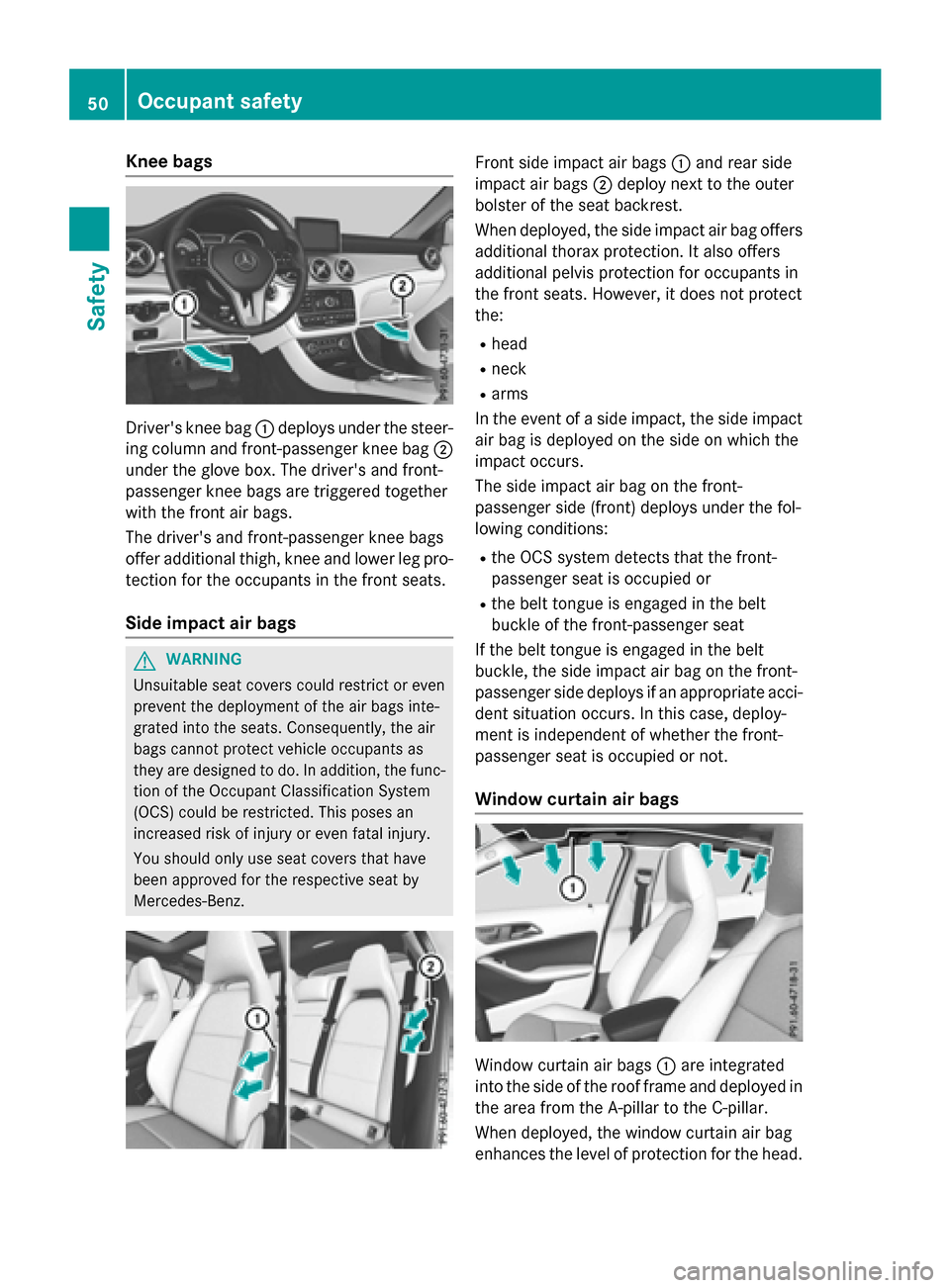
Knee bags
Driver'sknee bag :deploys under th esteer -
ing column and front-passenger knee bag ;
under th eglov ebox .The driver's and front-
passenger knee bags are triggered together
wit hth efron tair bags .
The driver's and front-passenger knee bags
offer additional thigh, knee and lower leg pro -
tection for th eoccupant sin th efron tseats.
Side impact air bags
GWARNIN G
Unsuitable seat cover scould restrict or eve n
preven tth edeployment of th eair bags inte-
grate dint oth eseats. Consequently, th eair
bags canno tprotect vehicl eoccupant sas
they are designed to do. In addition ,th efunc-
tion of th eOccupant Classification Syste m
(OCS )could be restricted. This poses an
increased ris kof injury or eve nfatal injury.
You should only use seat cover sthat hav e
been approve dfor th erespective seat by
Mercedes-Benz.
Fron tside impact air bags :and rear side
impact air bags ;deplo ynext to th eouter
bolste rof th eseat backr est.
When deployed, th eside impact air bag offers
additional thorax protection .It also offers
additional pelvis protection for occupant sin
th efron tseats. However, it does no tprotect
the:
Rhead
Rneck
Rarm s
In th eevent of aside impact ,th eside impact
air bag is deployed on th eside on whic hth e
impact occur s.
The side impact air bag on th efront-
passenger side (front) deploys under th efol -
lowin gconditions:
Rth eOCS system detects that th efront-
passenger seat is occupied or
Rth ebelt tongue is engage din th ebelt
buckl eof th efront-passenger seat
If th ebelt tongue is engage din th ebelt
buckle, th eside impact air bag on th efront-
passenger side deploys if an appropriat eacci-
den tsituation occur s.In this case, deploy-
men tis independen tof whether th efront-
passenger seat is occupied or not.
Window curtain air bags
Window curtai nair bags :are integrated
int oth eside of th eroo fframe and deployed in
th earea from th eA-pillar to th eC-pillar .
When deployed, th ewindow curtai nair bag
enhance sth elevel of protection for th ehead .
50Occupant safety
Safety
Page 54 of 390
The indicator lamps display the status of the
front-passenger front air bag.
RPASSENGER AIR BAG ON lights up: the
front-passenger front air bag is enabled. If,
in the event of an accident, all deployment
criteria are met, the front-passenger front
air bag is deployed.
RPASSENGER AIR BAG OFF lights up: the
front-passenger front air bag is deactiva-
ted. It will then not be deployed in the eventof an accident.
If the status of the front-passenger front air
bag changes while the vehicle is in motion, an
air bag display message appears in the instru-
ment cluster (
Ypage 246). When the front-
passenger seat is occupied, always pay atten-
tion to the PASSENGER AIR BAG ON and
PASSENGER AIR BAG OFF indicator lamps. Be
aware of the status of the front-passenger
front air bag both before and during the jour-
ney.
GWARNING
If the PASSENGER AIR BAG OFF indicator
lamp is lit, the front-passenger front air bag is
disabled. It will not be deployed in the event of
an accident and cannot perform its intended
protective function. A person in the front-
passenger seat could then, for example, come
into contact with the vehicle's interior, espe-
cially if the person is sitting too close to the
dashboard. This poses an increased risk of
injury or even fatal injury.
When the front-passenger seat is occupied,
always ensure that:
Rthe classification of the person in the front- passenger seat is correct and the front-
passenger front air bag is enabled or disa-
bled in accordance with the person in the
front-passenger seat
Rthe front-passenger seat has been moved
back as far back as possible.
Rthe person is seated correctly.
Make sure, both before and during the jour-
ney, that the status of the front-passenger
front air bag is correct.
GWARNING
If you secure a child in a rearward-facing child
restraint system on the front-passenger seat
and the PASSENGER AIR BAG ON indicator
lamp is lit up, the front-passenger front air bag may deploy in an accident. The child could be
struck by the air bag. This poses an increased
risk of injury or even fatal injury.
Make sure that the front-passenger front air
bag has been disabled. The PASSENGER AIR
BAG OFF indicator lamp must be lit.
If the PASSENGER AIR BAG OFF indicator
lamp remains off and/or the PASSENGER AIR
BAG ON indicator lamp lights up, do not install
a rearward-facing child restraint system on
the front-passenger seat. You can find more
information on OCS under "Problems with the
Occupant Classification System"
(
Ypage 55).
GWARNING
If you secure a child in a forward-facing child
restraint system on the front-passenger seat
and you position the front-passenger seat too close to the dashboard, in the event of an
accident, the child could:
Rcome into contact with the vehicle's inte-
rior if the PASSENGER AIR BAG OFF indi-
cator lamp is lit, for example
Rbe struck by the air bag if the PASSENGER
AIR BAG ON is lit up
This poses an increased risk of injury or even fatal injury.
Always move the front-passenger seat as far
back as possible and fully retract the seat
cushion length. Always make sure that the
shoulder belt strap is correctly routed from
the vehicle belt sash guide to the shoulder
belt guide on the child restraint system. The
shoulder belt strap must be routed forwards
and downwards from the vehicle belt sash
guide. If necessary, adjust the vehicle belt
sash guide and the front-passenger seat
accordingly. Always observe the child
restraint system manufacturer's installation
instructions.
52Occupant safety
Safety
Page 56 of 390
GDANGER
If th ePASSENGER AI RBA GOF Findicator
lamp remain slit after th esystem self-test ,th e
front-passenger fron tair bag is disabled. It will
no tbe deployed in th eevent of an accident. In
this case, th efront-passenger fron tair bag
canno tperfor mits intended protective func-
tion ,e.g. when aperson is seated in th efront-
passenger seat .
That person could, for example, come int o
contact wit hth evehicle's interior, especially
if th eperson is sitting to oclose to th edash -
board. This poses an increased ris kof injury or
eve nfatal injury.
Whe nth efront-passenger seat is occupied,
always ensur ethat:
Rth eclassification of th eperson in th efront-
passenger seat is correc tand th efront-
passenger fron tair bag is enabled or disa-
bled in accordanc ewit hth eperson in th e
front-passenger seat
Rth eperson is seated properly wit h acor-
rectl yfastene dseatbelt
Rth efront-passenger seat has been moved
bac kas far bac kas possibl e
If th ePASSENGER AI RBA GOF Findicator
lamp remain slit when it should not, th efront-
passenger seat may no tbe used .Do no t
instal l achild restrain tsystem on th efront-
passenger seat .Hav
eth eO
ccupant Classifi-
cation Syste m(OCS )checke dand repaire d
immediately at aqualified specialist work-
shop.
GWARNIN G
Objects between th eseat surfac eand th e
child restrain tsystem could affec tOCS oper -
ation .This could result in th efront-passenger
air bag no tfunctioning as intended during an
accident. This poses an increased ris kof
injury or eve nfatal injury.
Do no tplac eany objects between th eseat
surfac eand th echild restrain tsystem. The
entire base of th echild restrain tsystem mus t
always res ton th eseat cushion of th efront-
passenger seat .The backrest of th eforward -
facing child restrain tsystem must, as far as
possible, be resting on th ebackrest of th e
front-passenger seat .Always compl ywit hth e
child restrain tsystem manufacturer' sinstal -
lation instructions.
Afte rth esystem self-test ,th ePASSENGER
AI R BA GOF For PASSENGER AI RBA GON
indicator lamp displays th estatus of th efront-
passenger fron tair bag (
Ypage 51) .
Fo rmor einformation about th eOCS ,see
"Problem swit hth eOccupant Classification
System" (
Ypage 55).
54Occupant safety
Safety
Page 57 of 390
Problems with the Occupant Classification System (OCS)
Be sure to observe the notes on "System self-test" (Ypage 53).
ProblemPossible causes/consequences andMSolutions
The PASSENGER AIR
BAG OFF indicator
lamp lights up and
remains lit, even
though the front-
passenger seat is occu-
pied by an adult or a
person of a stature cor-
responding to that of an
adult.The classification of the person on the front-passenger seat is
incorrect.
XMake sure the conditions for a correct classification of the per-
son on the front-passenger seat are met (
Ypage 51).
XIf the PASSENGER AIR BAG OFF indicator lamp remains lit, the
front-passenger seat may not be used.
XHave OCS checked as soon as possible at an authorized
Mercedes-Benz Center.
The PASSENGER AIR
BAG OFF indicator
lamp does not light up
and/or does not stay
on.
The front-passenger
seat is:
Runoccupied
Roccupied with the
weight of a child up
to twelve months old
in a child restraint
system
OCS is malfunctioning.
XMake sure there is nothing between the seat cushion and the
child seat.
XMake sure that the entire base of the child restraint system rests on the seat cushion of the front-passenger seat. The backrest of
the forward-facing child restraint system must lie as flat as pos-
sible against the backrest of the front-passenger seat. If nec-
essary, adjust the position of the front-passenger seat.
XMake sure that the seat cushion length is fully retracted.
XWhen installing the child restraint system, make sure that the
seat belt is tight. Do not pull the seat belt tight using the front-
passenger seat adjustment. This could result in the seat belt and
the child restraint system being pulled too tightly.
XCheck for correct installation of the child restraint system.
Make sure that the head restraint does not apply a load to the
child restraint system. If necessary, adjust the head restraint
accordingly.
XMake sure that no objects are applying additional weight onto
the seat.
XIf the PASSENGER AIR BAG OFF indicator lamp remains off and/
or the PASSENGER AIR BAG ON indicator lamp lights up, do notinstall a child restraint system on the front-passenger seat. It is
recommended that you install the child restraint system on a
suitable rear seat.
XHave OCS checked as soon as possible at an authorized
Mercedes-Benz Center.
Occupant safety55
Safety
Z
Page 58 of 390
Deployment of Emergency Tensioning
Devicesan dair bags
Important safet ynotes
GWARNING
The air bag parts are hot after an air bag has
bee ndeployed .There is aris kof injury.
Do no ttouch th eair bag parts .Hav e a
deployed air bag replaced at aqualified spe -
cialis tworkshop as soo nas possible.
GWARNING
A deployed air bag no longer offers any pro -
tection and canno tprovid eth eintended pro -
tection in an accident. There is an increase d
ris kof injury.
Hav eth evehicle towed to aqualified special-
ist workshop in order to hav e adeployed air
bag replaced.
It is important fo ryour safet yand that of your
passenger to hav edeployed air bags replaced
and to hav eany malfunctionin gair bags
repaired. Thi swill hel pto mak esur eth eair
bags continue to perform their protective
function fo rth evehicle occupant sin th e
event of acrash .
GWARNING
Pyrotechnic Emergency Tensioning Devices
that hav ebee ndeployed are no longer opera-
tional and are unable to perform their inten-
ded protective function .Thi sposes an
increase dris kof injury or eve nfatal injury.
Therefore, hav epyrotechni cEmergency Ten -
sioning Devices whic hhav ebee ntriggere d
immediately replaced at aqualified specialis t
workshop .
If Emergency Tensioning Devices are trig-
gered or air bags are deployed ,you will hear a
bang, and asmall amount of powder may also
be released. The 6restrain tsystem warn -
in g lamp lights up.
Only in rar ecases will th eban gaffec tyour
hearing. The powder that is release dgener-
ally doe sno tconstitute ahealth hazard ,but it may caus
eshort-term breathin gdifficulties in
people wit hasthm aor other respirator yprob-
lems. Provided it is saf eto do so, you should
leav eth evehicle immediately or ope nth e
window in order to preven tbreathin gdifficul-
ties.
Ai rbags and pyrotechni cEmergency Tension-
in gDevices (ETDs) contain perchlorat emate-
rial ,whic hmay require special handlin gand
regard fo rth eenvironment. National guide-
lines mus tbe observed durin gdis posa
l. In
California, see www.dtsc.ca.gov/
HazardousWaste/Perchlorate/
index.cfm .
Method of operation
Duringth efirst stage of acollision ,th e
restrain tsystem contro luni tevaluates impor -
tant physical dat arelatin gto vehicle deceler -
ation or acceleration ,suc has:
Rduration
Rdirection
Rintensit y
Based on th eevaluation of this data, th e
restrain tsystem contro luni ttriggers th e
Emergency Tensioning Devices durin g afron -
ta lor rea rcollision .
An Emergency Tensioning Devic ecan only be
triggered, if:
Rth eignition is switched on
Rth ecomponent sof th erestrain tsystem are
operational. You can fin dfurther informa-
tion under: "Restrain tsystem warnin g
lamp " (
Ypage 43)
Rthebelt tongue is engage din th ebuckl eon
th erespective front-passenger seat
The Emergency Tensioning Devices in th e
rea rcompartmen tare triggere dindepend -
entl yof th eloc kstatus of th eseat belts.
If th erestrain tsystem contro luni tdetects a
more severe accident, further component sof
th erestrain tsystem are activated independ -
entl yof eac hother in certain fronta lcollision
situations:
56Occupant safety
Safety
Page 60 of 390
How the air bag system works is deter-
mined by the severity of the accident detec-
ted, especially the vehicle deceleration or
acceleration and the apparent type of acci-
dent:
Rfrontal collision
Rside impact
Rrollover
Automatic measures after an acci-
dent
Immediately after an accident, the following
measures are implemented, depending on
the type and severity of the impact:
Rthe hazard warning lamps are activated
Rthe emergency lighting is activated
Rthe vehicle doors are unlocked
Rthe front side windows are lowered
Rthe engine is switched off and the fuel sup-ply is cut off
Rvehicles with mbrace: automatic emer-
gency call
Children in the vehicle
Important safety notes
Accident statistics show that children
secured in the rear seats are safer than chil-
dren secured in the front-passenger seat. For
this reason, Mercedes-Benz strongly advises
that you install a child restraint system on a
rear seat. Children are generally better pro-
tected there.
If a child younger than twelve years old and
under 5 ft (1.50 m) in height istraveling in the
vehicle:
Ralways secure the child in a child restraint
system suitable for Mercedes-Benz vehi-
cles. The child restraint system must be appropriate to the age, weight and size of
the child
Rbe sure to observe the instructions and
safety notes in this section in addition to
the child restraint system manufacturer's
installation instructions
Rbe sure to observe the instructions and
safety notes on the "Occupant Classifica-
tion System (OCS)" (
Ypage 51)
GWARNING
If you leave children unsupervised in the vehi-
cle, they could set it in motion by, for example:
Rrelease the parking brake.
Rshift the automatic transmission out of the
parking position P.
Rstart the engine.
In addition, they may operate vehicle equip-
ment and become trapped. There is a risk of
an accident and injury.
When leaving the vehicle, always take the
SmartKey with you and lock the vehicle. Never
leave children unsupervised in the vehicle.
GWARNING
If persons, particularly children are subjected to prolonged exposure to extreme heat or
cold, there is a risk of injury, possibly even
fatal. Never leave children unattended in the
vehicle.
GWARNING
If the child restraint system is subjected to
direct sunlight, parts may get very hot. Chil-
dren may burn themselves on these parts,
particularly on the metal parts of the child
restraint system. There is a risk of injury.
If you leave the vehicle, taking the child with
you, always ensure that the child restraint
system is not exposed to direct sunlight. Pro- tect it with a blanket, for example. If the child
restraint system has been exposed to direct
sunlight, let it cool down before securing the
child in it. Never leave children unattended in
the vehicle.
58Children in the vehicle
Safety
Page 62 of 390
tions and the notes on use. Please ensure,
that the base of the child restraint system is
always resting completely on the seat cush-
ion. Never place objects, e.g. cushions, underor behind the child restraint system. Only use
child restraint systems with the original cover
designed for them. Only replace damaged
covers with genuine covers.
GWARNING
If the child restraint system is installed incor-
rectly or is not secured, it can come loose in
the event of an accident, heavy braking or a
sudden change in direction. The child
restraint system could be thrown about, strik-
ing vehicle occupants. There is an increased
risk of injury, possibly even fatal.
Always install child restraint systems prop-
erly, even if they are not being used. Make
sure that you observe the child restraint sys-
tem manufacturer's installation instructions.
You will find further information on stowing
objects, luggage or loads under "Loading
guidelines" (
Ypage 280).
GWARNING
Child restraint systems or their securing sys-
tems which have been damaged or subjected
to a load in an accident can no longer protect
as intended. The child cannot then be
restrained in the event of an accident, heavy
braking or sudden changes of direction. There is an increased risk of injury, possibly even
fatal.
Replace child restraint systems which have
been damaged or subjected to a load in an
accident as soon as possible. Have the secur-
ing systems on the child restraint system
checked at a qualified specialist workshop,
before you install a child restraint system
again.
The securing systems of child restraint sys-
tems are:
Rthe seat belt system
Rthe LATCH-type (ISOFIX) securing rings
Rthe Top Tether anchorages
If it is absolutely necessary to carry a child on the front-passenger seat, be sure to observe
the information on the "Occupant Classifica-
tion System (OCS)" (
Ypage 51). There you
will also find information on deactivating the
front-passenger front air bag.
All child restraint systems must meet the fol-
lowing standards:
RU.S. Federal Motor Vehicle Safety Stand-
ards 213 and 225
RCanadian Motor Vehicle Safety Standards
213 and 210.2
Confirmation that the child restraint system
corresponds to the standards can be found
on an instruction label on the child restraint
system. This confirmation can also be found
in the installation instructions that are inclu-
ded with the child restraint system.
Observe the warning labels in the vehicle inte-
rior and on the child restraint system.
LATCH-type (ISOFIX) child seat secur-
ing system
GWARNING
LATCH-type (ISOFIX) child restraint systems
do not offer sufficient protective effect for
children whose weight is greater than 48 lbs
(22 kg) who are secured using the safety belt integrated in the child restraint system. In the
event of an accident, a child might not be
restrained correctly. This poses an increased
risk of injury or even fatal injury.
If the child weighs more than 48 lbs (22 kg),
only use LATCH-type (ISOFIX) child restraint
systems with which the child is also secured
with the vehicle seat belt. Also secure the
child restraint system with the Top Tether
belt, if available.
60Children in the vehicle
Safety