light MERCEDES-BENZ GLA SUV 2013 Owner's Manual
[x] Cancel search | Manufacturer: MERCEDES-BENZ, Model Year: 2013, Model line: GLA SUV, Model: MERCEDES-BENZ GLA SUV 2013Pages: 401, PDF Size: 11.9 MB
Page 40 of 401
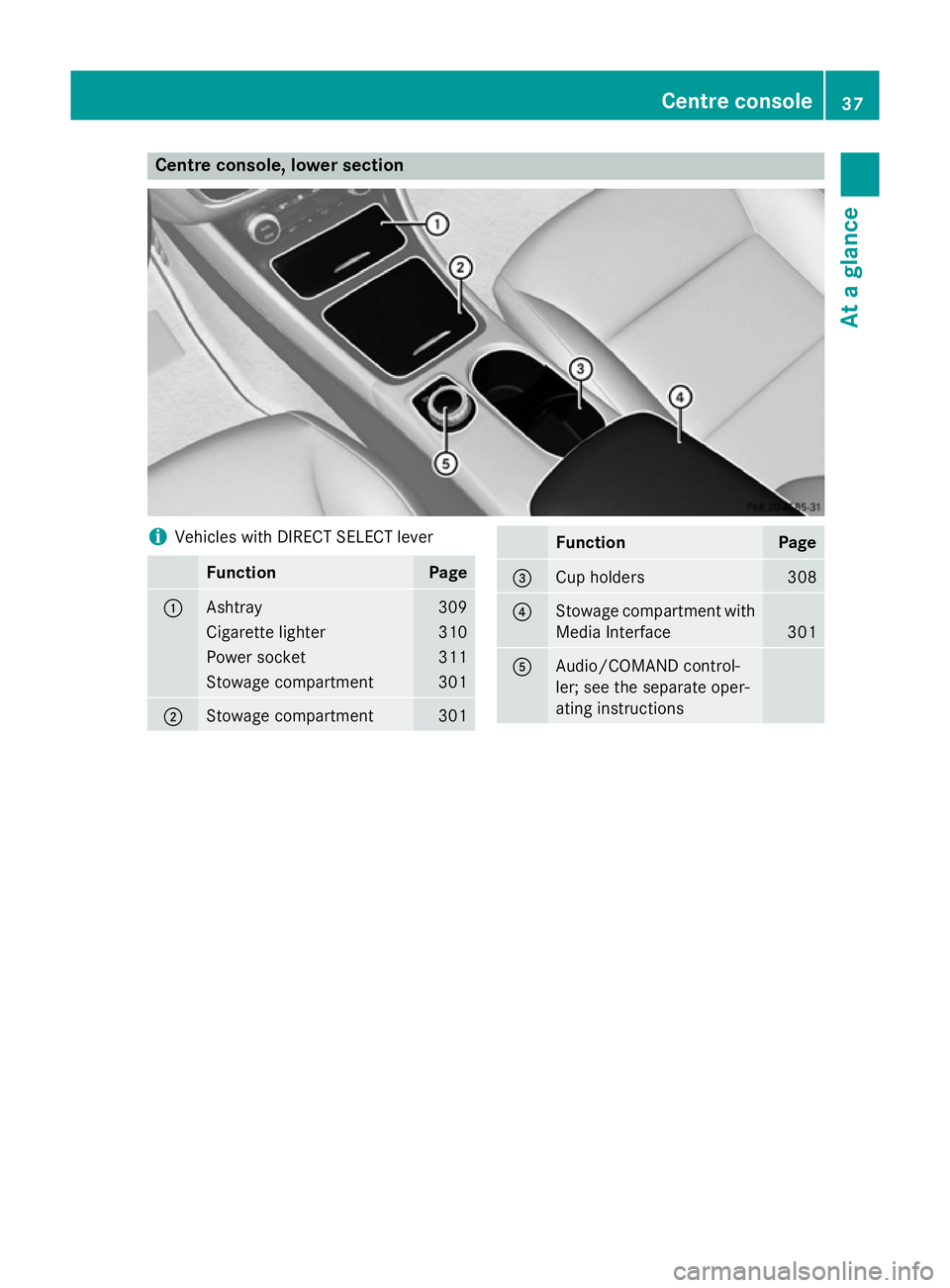
Centre console, lower section
i
Vehicles with DIRECT SELECT lever Function Page
:
Ashtray 309
Cigarette lighter 310
Power socket 311
Stowage compartment 301
;
Stowage compartment 301 Function Page
=
Cup holders 308
?
Stowage compartment with
Media Interface 301
A
Audio/COMAND control-
ler; see the separate oper-
ating instructions Centre console
37At a glance
Page 41 of 401
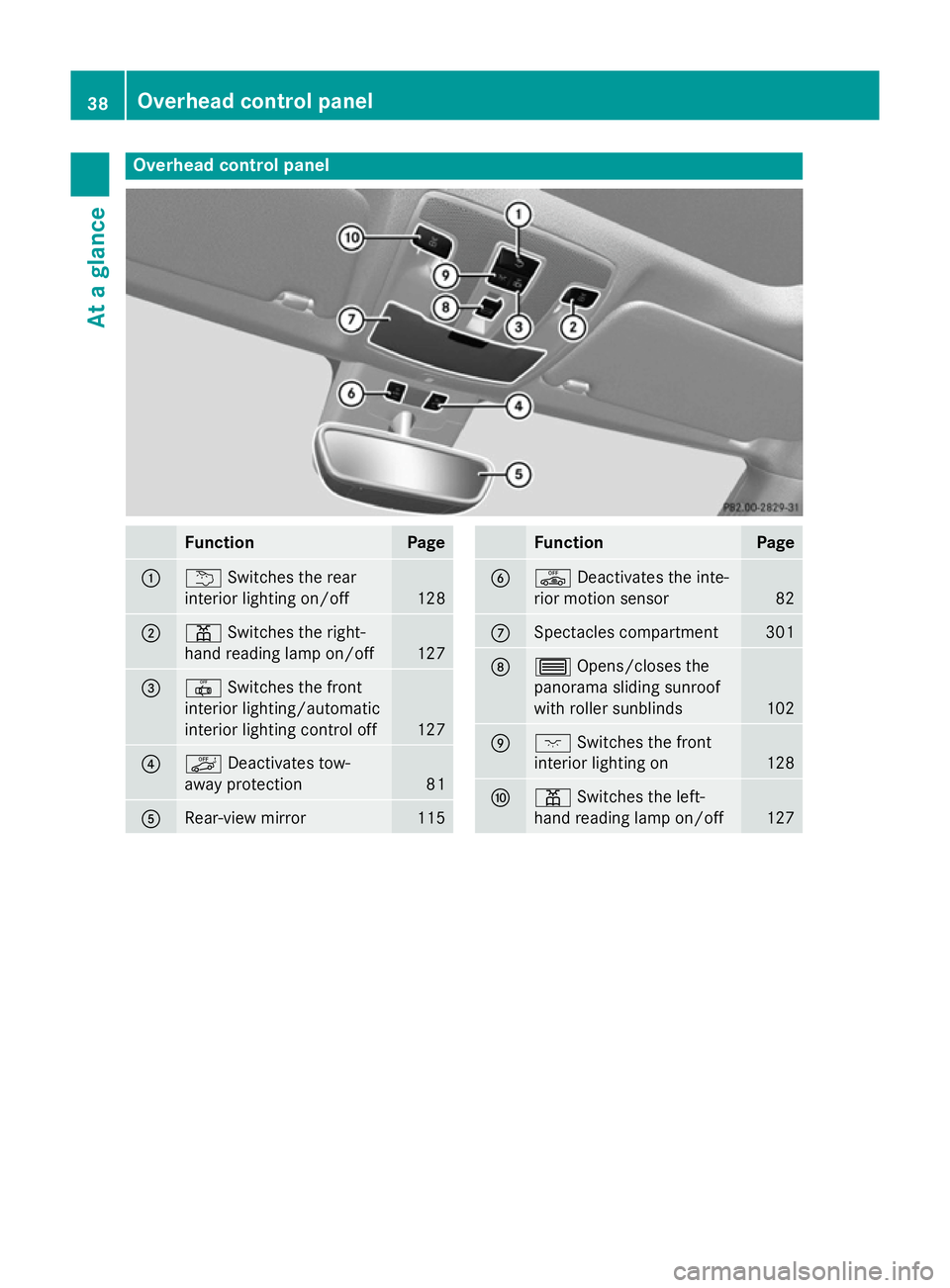
Overhead control panel
Function Page
:
u
Switches the rear
interior lighting on/off 128
;
p
Switches the right-
hand reading lamp on/off 127
=
|
Switches the front
interior lighting/automatic
interior lighting control off 127
?
ë
Deactivates tow-
away protection 81
A
Rear-view mirror 115 Function Page
B
ê
Deactivates the inte-
rior motion sensor 82
C
Spectacles compartment 301
D
3
Opens/closes the
panorama sliding sunroof
with roller sunblinds 102
E
c
Switches the front
interior lighting on 128
F
p
Switches the left-
hand reading lamp on/off 12738
Overhead control panelAt a glance
Page 45 of 401
Useful information
i This Owner's Manual describes all mod-
els, series and optional equipment for your
vehicle that were available at the time of
going to press. National variations are pos- sible. Note that your vehicle may not be
equipped with all of the functions descri-
bed. This is also the case for systems and
functions relevant to safety.
i Read the information on qualified special-
ist workshops: (Y page 25). Panic alarm
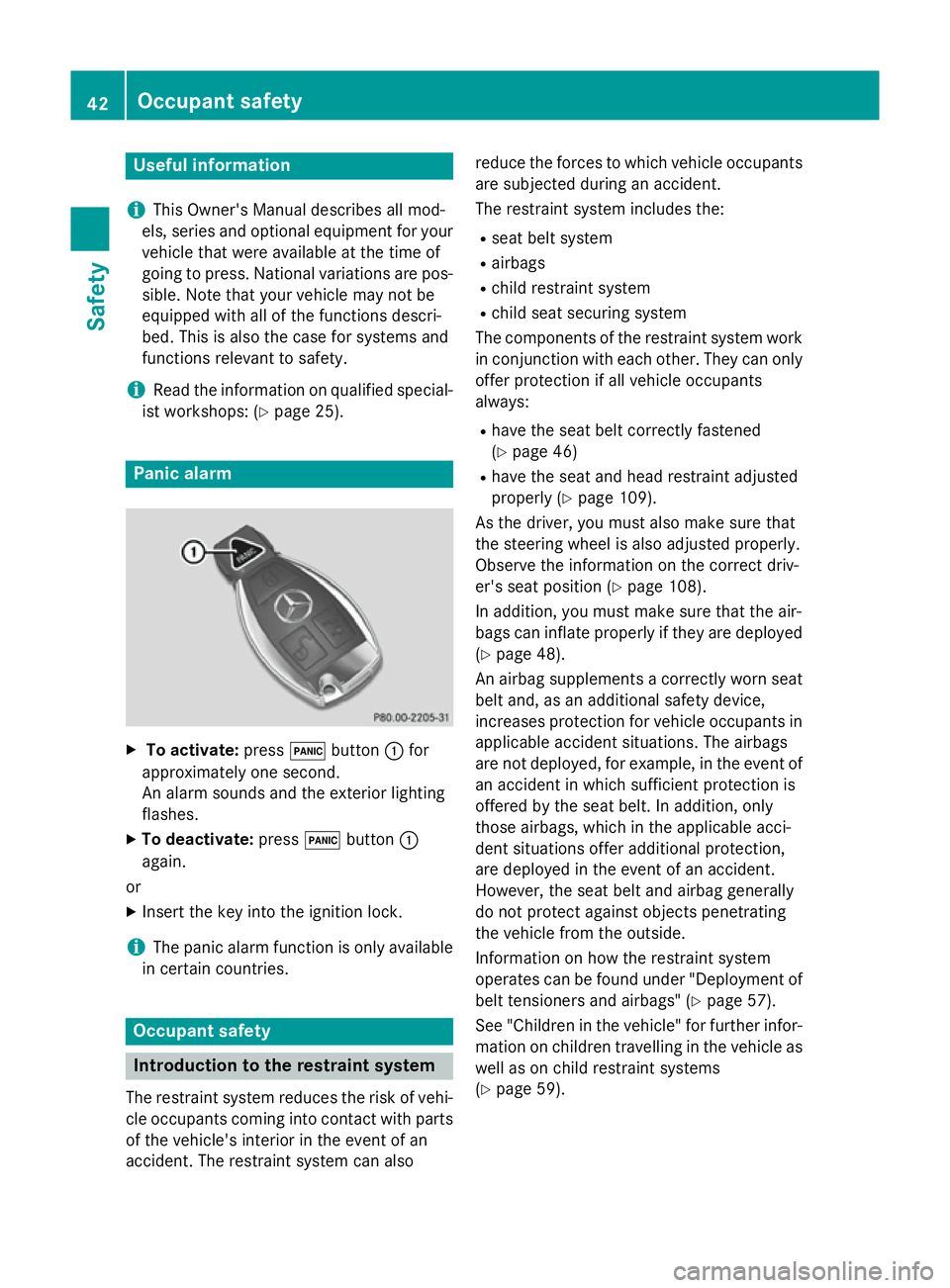
X
To activate: press!button :for
approximately one second.
An alarm sounds and the exterior lighting
flashes.
X To deactivate: press!button :
again.
or
X Insert the key into the ignition lock.
i The panic alarm function is only available
in certain countries. Occupant safety
Introduction to the restraint system
The restraint system reduces the risk of vehi-
cle occupants coming into contact with parts of the vehicle's interior in the event of an
accident. The restraint system can also reduce the forces to which vehicle occupants
are subjected during an accident.
The restraint system includes the:
R seat belt system
R airbags
R child restraint system
R child seat securing system
The components of the restraint system work
in conjunction with each other. They can only
offer protection if all vehicle occupants
always:
R have the seat belt correctly fastened
(Y page 46)
R have the seat and head restraint adjusted
properly (Y page 109).
As the driver, you must also make sure that
the steering wheel is also adjusted properly.
Observe the information on the correct driv-
er's seat position (Y page 108).
In addition, you must make sure that the air-
bags can inflate properly if they are deployed (Y page 48).
An airbag supplements a correctly worn seat
belt and, as an additional safety device,
increases protection for vehicle occupants in
applicable accident situations. The airbags
are not deployed, for example, in the event of an accident in which sufficient protection is
offered by the seat belt. In addition, only
those airbags, which in the applicable acci-
dent situations offer additional protection,
are deployed in the event of an accident.
However, the seat belt and airbag generally
do not protect against objects penetrating
the vehicle from the outside.
Information on how the restraint system
operates can be found under "Deployment of
belt tensioners and airbags" (Y page 57).
See "Children in the vehicle" for further infor- mation on children travelling in the vehicle as
well as on child restraint systems
(Y page 59). 42
Occupant safetySafety
Page 46 of 401
Important safety notes
G
WARNING
If the restraint system is modified, it may no
longer work as intended. The restraint system
may then not perform its intended protective function by failing in an accident or triggering
unexpectedly, for example. There is an
increased risk of injury, possibly even fatal.
Never modify parts of the restraint system. Do not attempt to modify the wiring as well as
electronic components or their software.
If it is necessary to modify an airbag system to
accommodate a person with disabilities, con- tact a Mercedes-Benz Service Centre. Restraint system warning lamp
The functions of the restraint system are
checked after the ignition is switched on and at regular intervals while the engine is run-
ning. Therefore, malfunctions can be detec-
ted in good time.
The restraint system warning lamp in the
instrument cluster lights up when the ignition is switched on. It goes out no later than a few
seconds after the engine is started. The com- ponents of the restraint system are in opera-
tional readiness.
A malfunction has occurred if the 6
restraint system warning lamp:
R does not light up after the ignition is
switched on
R does not go out after a few seconds with
the engine running
R lights up again while the engine is running G
WARNING
If the restraint system is malfunctioning,
restraint system components may be trig-
gered unintentionally or might not be trig-
gered at all in the event of an accident with a high rate of vehicle deceleration. This can
effect belt tensioners or airbags, for example. There is an increased risk of serious or even
fatal injuries.
Have the restraint system checked and
repaired immediately at a qualified specialist
workshop.
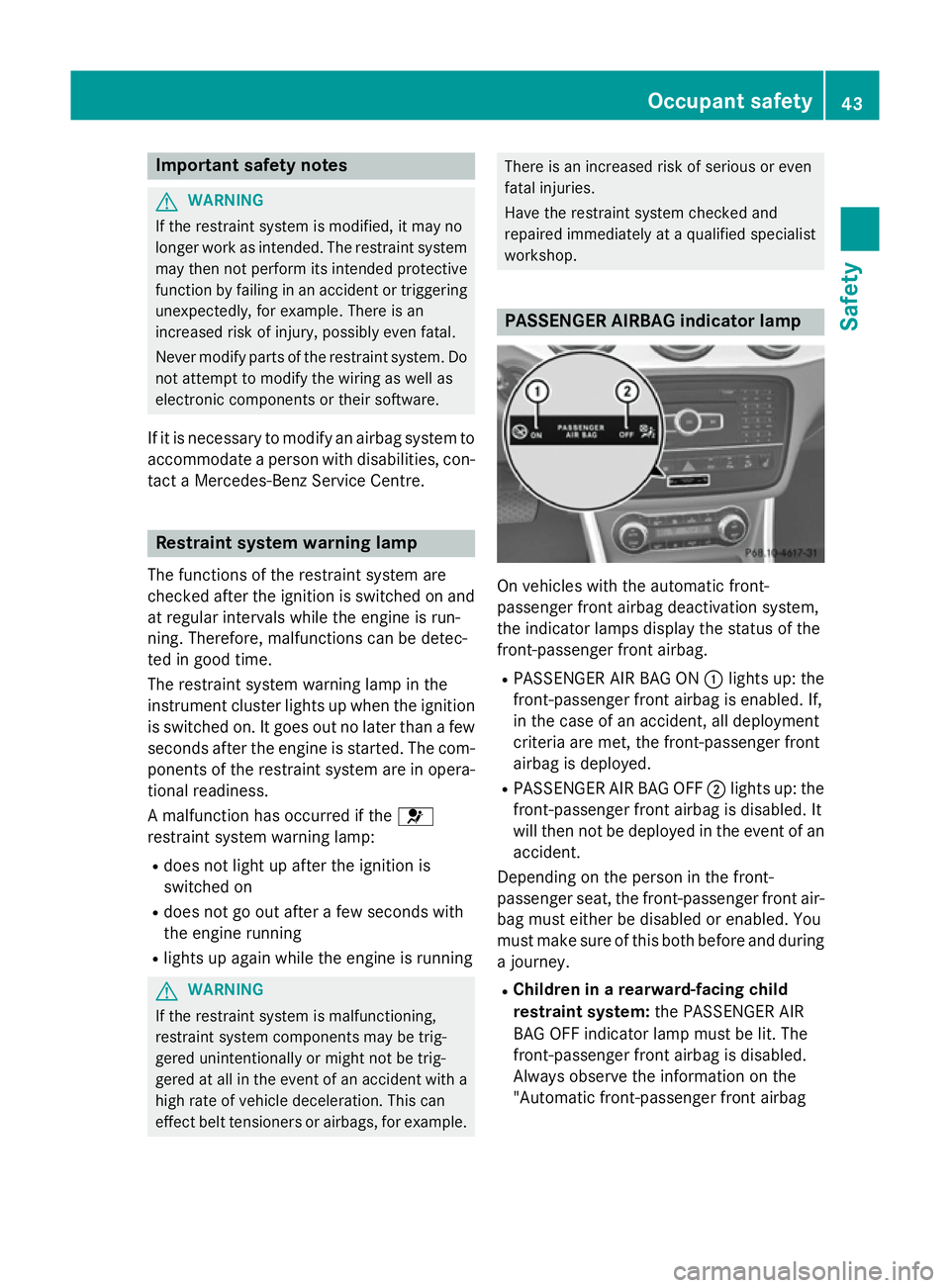
PASSENGER AIRBAG indicator lamp
On vehicles with the automatic front-
passenger front airbag deactivation system,
the indicator lamps display the status of the
front-passenger front airbag.
R PASSENGER AIR BAG ON :lights up: the
front-passenger front airbag is enabled. If,
in the case of an accident, all deployment
criteria are met, the front-passenger front
airbag is deployed.
R PASSENGER AIR BAG OFF ;lights up: the
front-passenger front airbag is disabled. It
will then not be deployed in the event of an
accident.
Depending on the person in the front-
passenger seat, the front-passenger front air-
bag must either be disabled or enabled. You
must make sure of this both before and during
a journey.
R Children in a rearward-facing child
restraint system: the PASSENGER AIR
BAG OFF indicator lamp must be lit. The
front-passenger front airbag is disabled.
Always observe the information on the
"Automatic front-passenger front airbag Occupant safety
43Safety Z
Page 47 of 401
deactivation system" (Y
page 51) and on
"Children in the vehicle" (Y page 59).
R Children in a forward-facing child
restraint system: depending on the instal-
led child restraint system, the age and size of the child the front-passenger front airbag
is either disabled or enabled. Therefore,
always observe the information on the
"Automatic front-passenger front airbag
deactivation system" (Y page 51) and on
"Children in the vehicle" (Y page 59).
R All other persons: the PASSENGER AIR
BAG ON indicator lamp must be lit. The
front-passenger front airbag is enabled.
Depending on the build of the person on the front-passenger seat, the PASSENGER AIR
BAG OFF indicator lamp may light up. The
front-passenger front airbag is disabled. It
will then not be deployed in the event of an
accident. In this case, the front-passenger
seat should not be used.
Always observe the information on the
"Automatic front-passenger front airbag
deactivation system" (Y page 51) as well
as on "Seat belts" (Y page 44) and "Air-
bags" (Y page 48). There you can also find
information on the correct seat position. Seat belts
Introduction A correctly worn seat belt is the most effec-
tive means of restraining the movement of
vehicle occupants in the event of a collision or
if the vehicle overturns. This reduces the risk of vehicle occupants coming into contact with
parts of the vehicle interior or being ejected
from it. The seat belt also helps to keep the
vehicle occupants in the best position in rela-
tion to the airbag being deployed. The seat belt system consists of:
R seat belts
R belt tensioners for the front seat belts and
the outer seat belts in the rear
R belt force limiters for the front seat belts
and the outer seat belts in the rear
If the seat belt is pulled quickly or sharply
from the belt outlet, the inertia reel locks. The
belt strap cannot be pulled out any further.
The belt tensioner tightens the seat belt in the event of a collision so that it fits tightly across
your body. However, it does not pull the vehi- cle occupants back in the direction of the seat
backrest.
The belt tensioner does not, however, correct an incorrect seat position or correct the rout-
ing of a seat belt that is worn incorrectly.
When triggered, seat belt force limiters help
to reduce the peak force exerted by the seat
belt on the vehicle occupant.
The belt force limiters on the front seats are
synchronised with the front airbags, which
take on a part of the deceleration force. This
can reduce the forces to which the vehicle
occupants are subjected during an accident.
! If the co-driver's seat is not occupied, do
not engage the seat belt tongue in the
buckle on the co-driver's seat. Otherwise,
the belt tensioner could be triggered in the
event of an accident and would have to be
replaced.
Important safety notes G
WARNING
The seat belt cannot perform its intended pro- tective function if it is not fastened correctly. Also, an improperly fastened seat belt can
cause additional injuries in the event of an
accident, sudden braking or abrupt changes
of direction. There is an increased risk of
injury, possibly even fatal.
Always make sure that all vehicle occupants
are wearing their seat belt and positioned cor-
rectly. 44
Occupant safetySafety
Page 50 of 401
cally, if necessary; see "Belt adjustment"
(Y
page 47).
X If necessary, pull upwards on the shoulder
section of the seat belt to tighten the belt
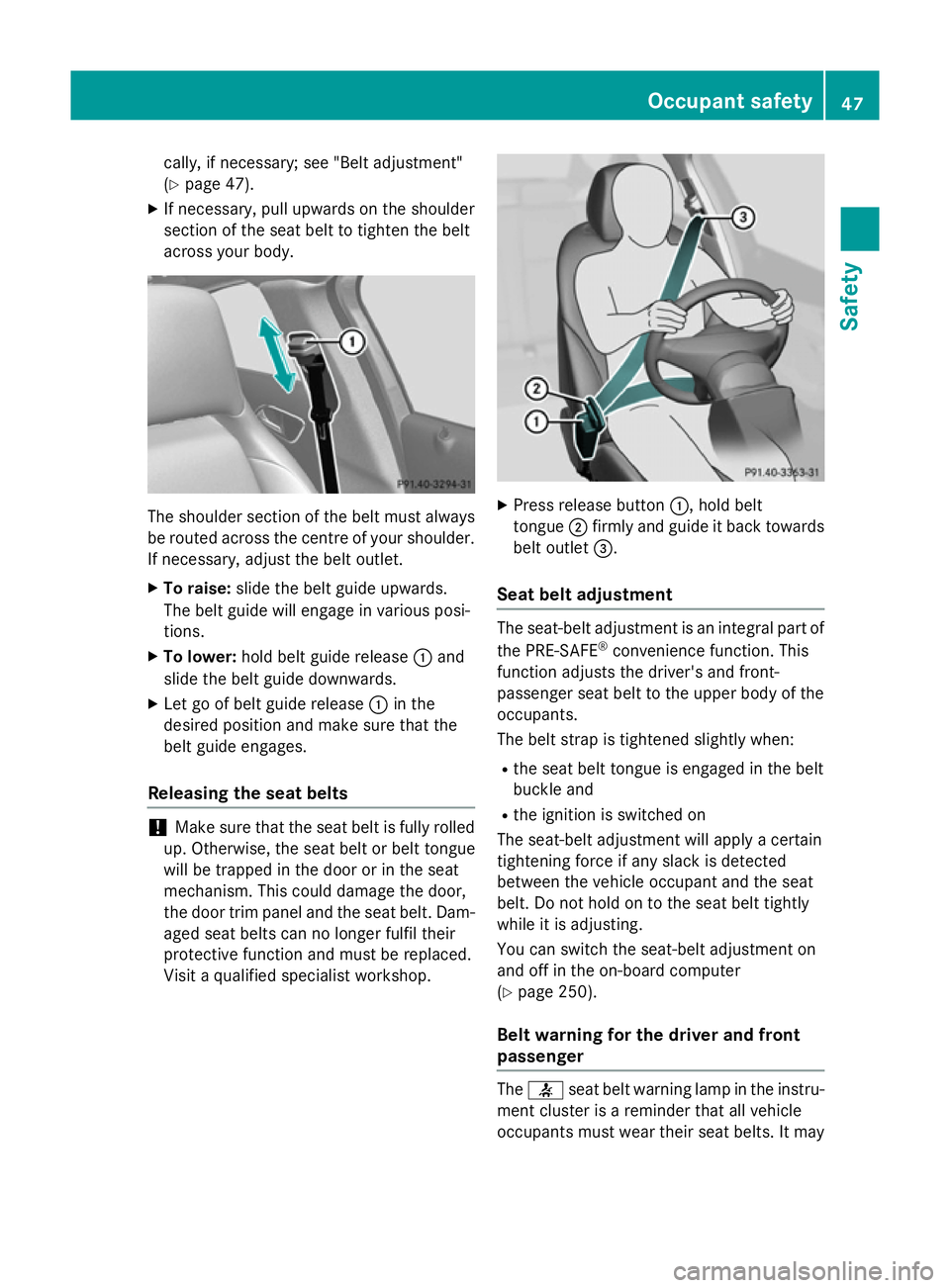
across your body. The shoulder section of the belt must always
be routed across the centre of your shoulder.
If necessary, adjust the belt outlet.
X To raise: slide the belt guide upwards.
The belt guide will engage in various posi-
tions.
X To lower: hold belt guide release :and
slide the belt guide downwards.
X Let go of belt guide release :in the
desired position and make sure that the
belt guide engages.
Releasing the seat belts !
Make sure that the seat belt is fully rolled
up. Otherwise, the seat belt or belt tongue
will be trapped in the door or in the seat
mechanism. This could damage the door,
the door trim panel and the seat belt. Dam- aged seat belts can no longer fulfil their
protective function and must be replaced.
Visit a qualified specialist workshop. X
Press release button :, hold belt
tongue ;firmly and guide it back towards
belt outlet =.
Seat belt adjustment The seat-belt adjustment is an integral part of
the PRE-SAFE ®
convenience function. This
function adjusts the driver's and front-
passenger seat belt to the upper body of the
occupants.
The belt strap is tightened slightly when:
R the seat belt tongue is engaged in the belt
buckle and
R the ignition is switched on
The seat-belt adjustment will apply a certain
tightening force if any slack is detected
between the vehicle occupant and the seat
belt. Do not hold on to the seat belt tightly
while it is adjusting.
You can switch the seat-belt adjustment on
and off in the on-board computer
(Y page 250).
Belt warning for the driver and front
passenger The
7 seat belt warning lamp in the instru-
ment cluster is a reminder that all vehicle
occupants must wear their seat belts. It may Occupant safety
47Safety Z
Page 51 of 401
light up continuously or flash. In addition, a
warning tone may sound.
The 7 seat belt warning lamp goes out and
the warning tone ceases when the driver and
the front passenger have fastened their seat
belts.
i For more information on the
7seat
belt warning lamp, see "Warning and indi-
cator lamps in the instrument cluster, seat
belt" (Y page 288).
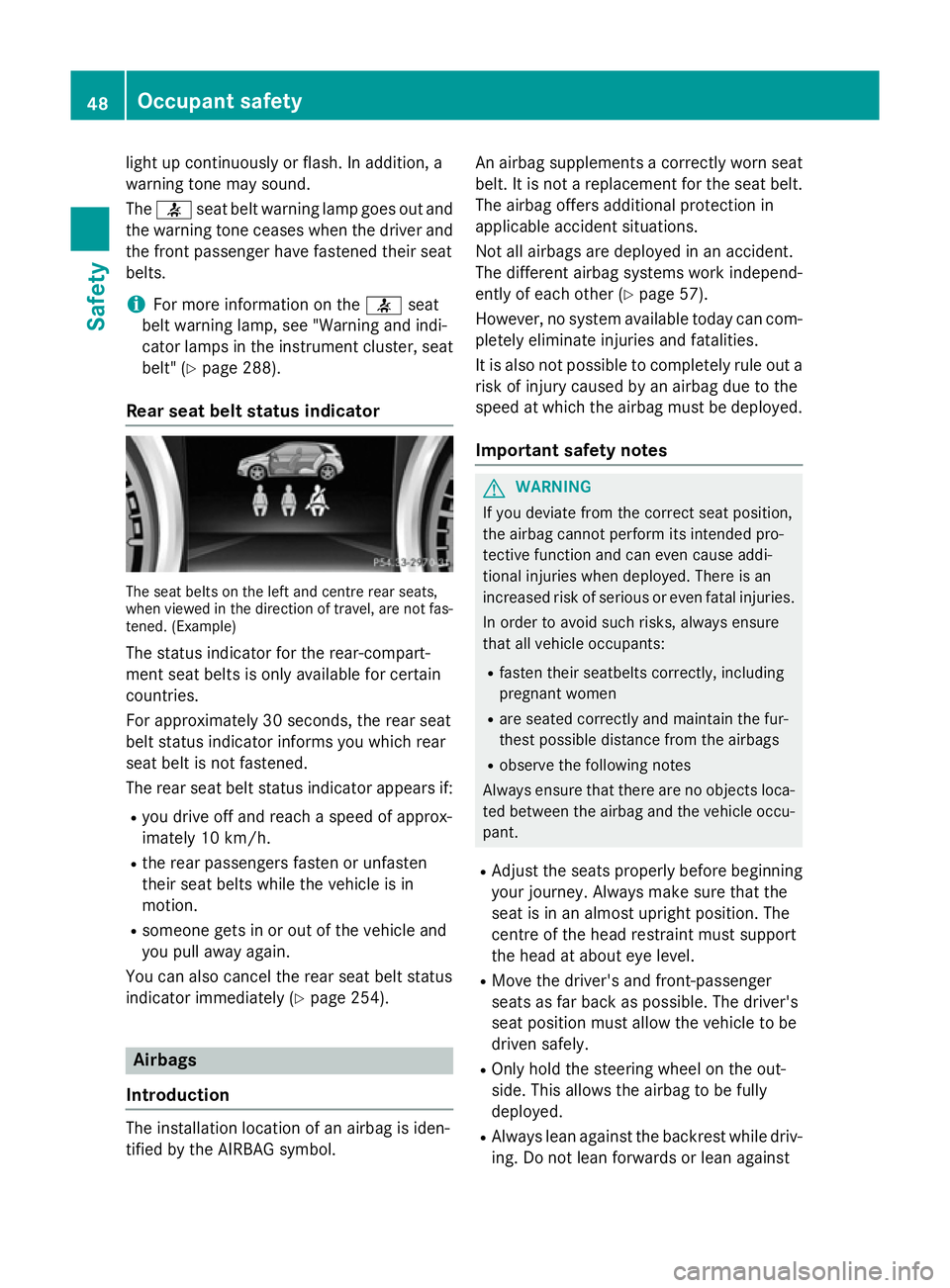
Rear seat belt status indicator The seat belts on the left and centre rear seats,
when viewed in the direction of travel, are not fas-
tened. (Example)
The status indicator for the rear-compart-
ment seat belts is only available for certain
countries.
For approximately 30 seconds, the rear seat
belt status indicator informs you which rear
seat belt is not fastened.
The rear seat belt status indicator appears if:
R you drive off and reach a speed of approx-
imately 10 km/h.
R the rear passengers fasten or unfasten
their seat belts while the vehicle is in
motion.
R someone gets in or out of the vehicle and
you pull away again.
You can also cancel the rear seat belt status
indicator immediately (Y page 254).Airbags
Introduction The installation location of an airbag is iden-
tified by the AIRBAG symbol. An airbag supplements a correctly worn seat
belt. It is not a replacement for the seat belt.
The airbag offers additional protection in
applicable accident situations.
Not all airbags are deployed in an accident.
The different airbag systems work independ-
ently of each other (Y page 57).
However, no system available today can com- pletely eliminate injuries and fatalities.
It is also not possible to completely rule out a
risk of injury caused by an airbag due to the
speed at which the airbag must be deployed.
Important safety notes G
WARNING
If you deviate from the correct seat position,
the airbag cannot perform its intended pro-
tective function and can even cause addi-
tional injuries when deployed. There is an
increased risk of serious or even fatal injuries.
In order to avoid such risks, always ensure
that all vehicle occupants:
R fasten their seatbelts correctly, including
pregnant women
R are seated correctly and maintain the fur-
thest possible distance from the airbags
R observe the following notes
Always ensure that there are no objects loca-
ted between the airbag and the vehicle occu-
pant.
R Adjust the seats properly before beginning
your journey. Always make sure that the
seat is in an almost upright position. The
centre of the head restraint must support
the head at about eye level.
R Move the driver's and front-passenger
seats as far back as possible. The driver's
seat position must allow the vehicle to be
driven safely.
R Only hold the steering wheel on the out-
side. This allows the airbag to be fully
deployed.
R Always lean against the backrest while driv-
ing. Do not lean forwards or lean against 48
Occupant safetySafety
Page 53 of 401
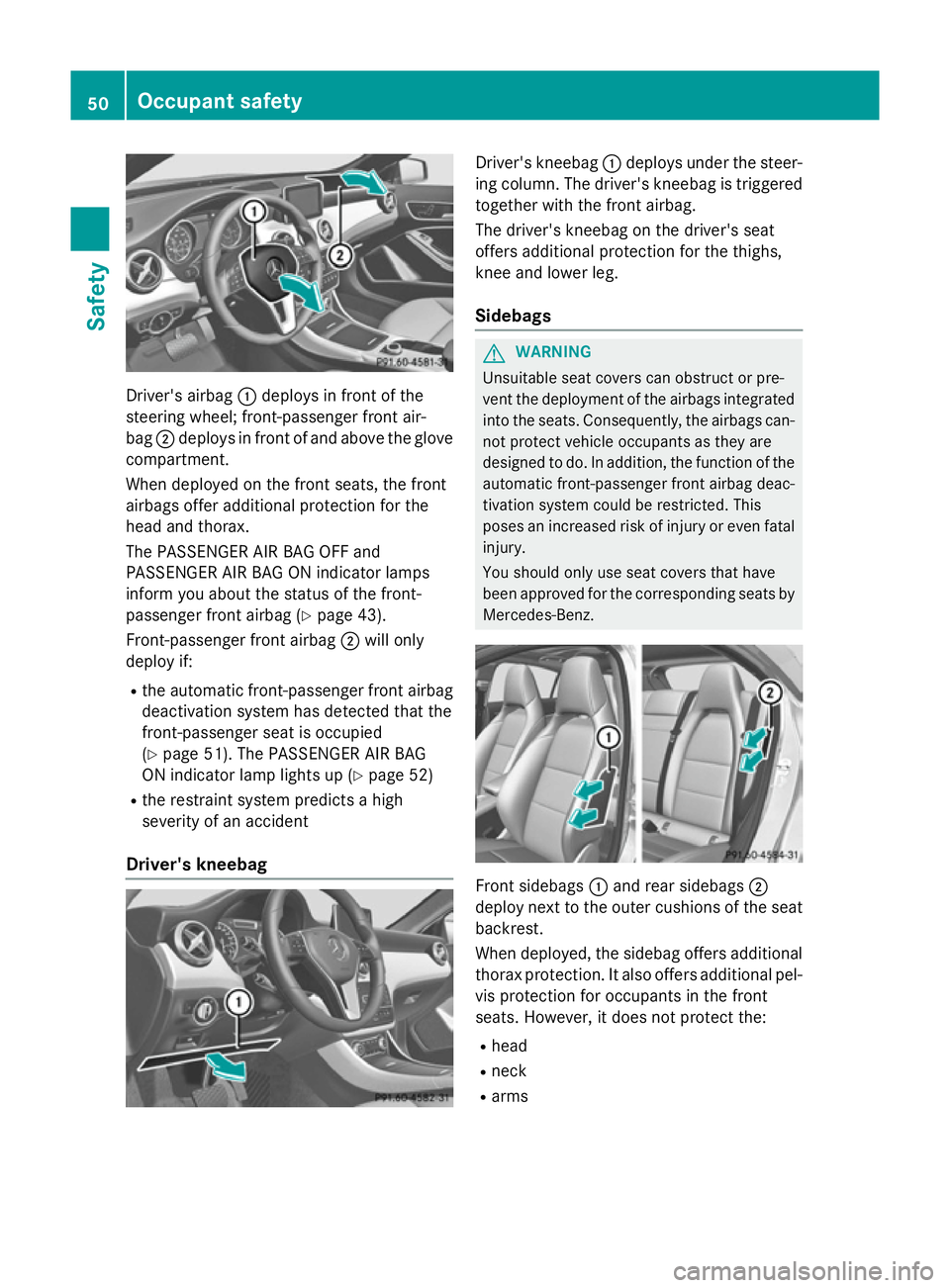
Driver's airbag
:deploys in front of the
steering wheel; front-passenger front air-
bag ;deploys in front of and above the glove
compartment.
When deployed on the front seats, the front
airbags offer additional protection for the
head and thorax.
The PASSENGER AIR BAG OFF and
PASSENGER AIR BAG ON indicator lamps
inform you about the status of the front-
passenger front airbag (Y page 43).
Front-passenger front airbag ;will only
deploy if:
R the automatic front-passenger front airbag
deactivation system has detected that the
front-passenger seat is occupied
(Y page 51). The PASSENGER AIR BAG
ON indicator lamp lights up (Y page 52)
R the restraint system predicts a high
severity of an accident
Driver's kneebag Driver's kneebag
:deploys under the steer-
ing column. The driver's kneebag is triggered
together with the front airbag.
The driver's kneebag on the driver's seat
offers additional protection for the thighs,
knee and lower leg.
Sidebags G
WARNING
Unsuitable seat covers can obstruct or pre-
vent the deployment of the airbags integrated into the seats. Consequently, the airbags can-
not protect vehicle occupants as they are
designed to do. In addition, the function of the automatic front-passenger front airbag deac-
tivation system could be restricted. This
poses an increased risk of injury or even fatal
injury.
You should only use seat covers that have
been approved for the corresponding seats by Mercedes-Benz. Front sidebags
:and rear sidebags ;
deploy next to the outer cushions of the seat
backrest.
When deployed, the sidebag offers additional thorax protection. It also offers additional pel- vis protection for occupants in the front
seats. However, it does not protect the:
R head
R neck
R arms 50
Occupant safetySafety
Page 54 of 401
In the event of a side impact, the sidebag is
deployed on the side on which the impact
occurs.
Vehicles with automatic front-passenger
front airbag deactivation: the sidebag on the
front-passenger side deploys under the fol-
lowing conditions:
R an occupant is detected on the front-
passenger seat or
R the belt tongue is engaged in the belt
buckle of the front-passenger seat
If the belt tongue is engaged in the belt
buckle, the sidebag on the front-passenger
side deploys if an appropriate accident situa- tion occurs. In this case, deployment is inde-
pendent of whether the front-passenger seat is occupied or not.
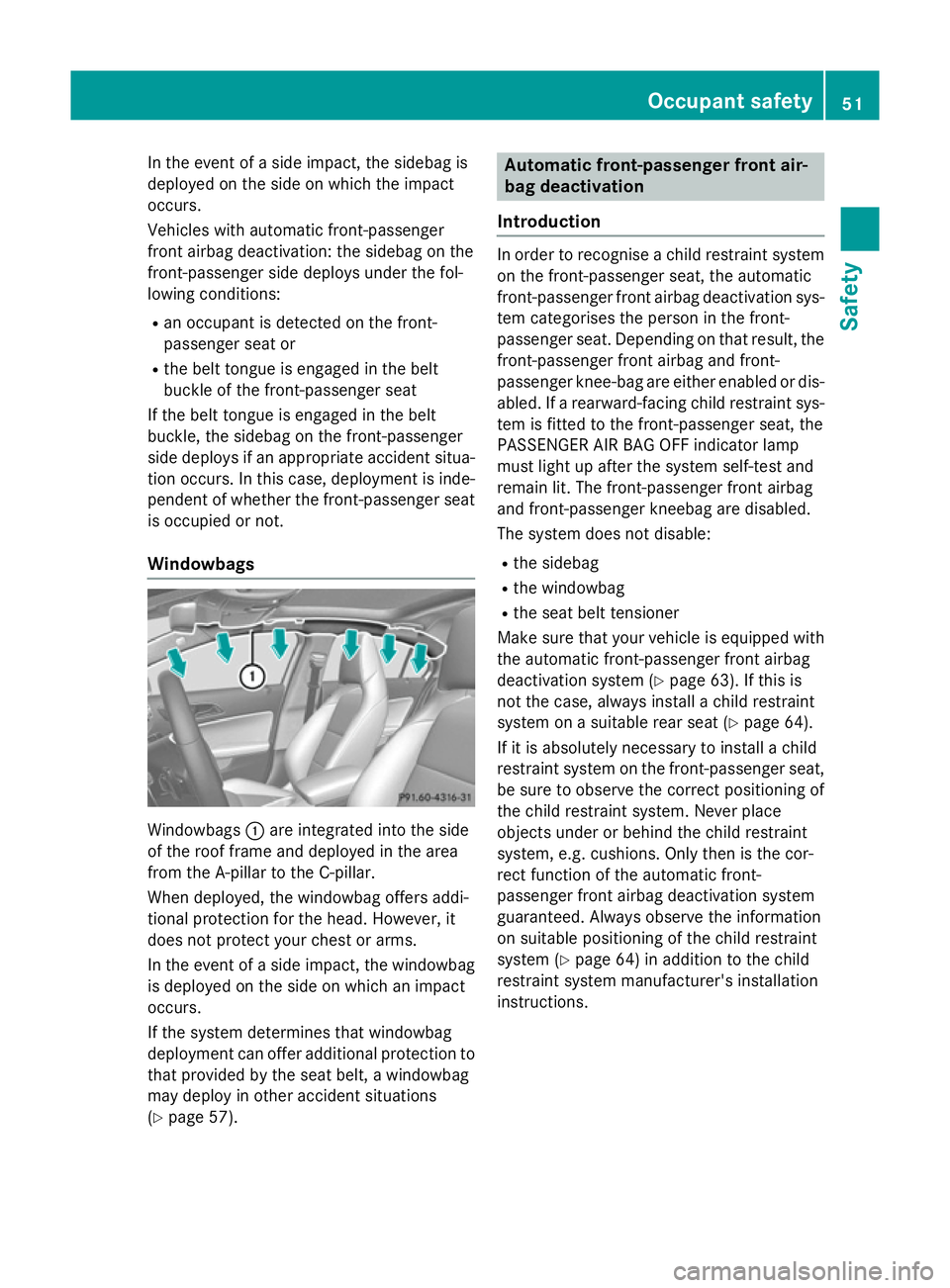
Windowbags Windowbags
:are integrated into the side
of the roof frame and deployed in the area
from the A-pillar to the C-pillar.
When deployed, the windowbag offers addi-
tional protection for the head. However, it
does not protect your chest or arms.
In the event of a side impact, the windowbag
is deployed on the side on which an impact
occurs.
If the system determines that windowbag
deployment can offer additional protection to
that provided by the seat belt, a windowbag
may deploy in other accident situations
(Y page 57). Automatic front-passenger front air-
bag deactivation
Introduction In order to recognise a child restraint system
on the front-passenger seat, the automatic
front-passenger front airbag deactivation sys- tem categorises the person in the front-
passenger seat. Depending on that result, the
front-passenger front airbag and front-
passenger knee-bag are either enabled or dis- abled. If a rearward-facing child restraint sys-
tem is fitted to the front-passenger seat, the
PASSENGER AIR BAG OFF indicator lamp
must light up after the system self-test and
remain lit. The front-passenger front airbag
and front-passenger kneebag are disabled.
The system does not disable:
R the sidebag
R the windowbag
R the seat belt tensioner
Make sure that your vehicle is equipped with
the automatic front-passenger front airbag
deactivation system (Y page 63). If this is
not the case, always install a child restraint
system on a suitable rear seat (Y page 64).
If it is absolutely necessary to install a child
restraint system on the front-passenger seat,
be sure to observe the correct positioning of
the child restraint system. Never place
objects under or behind the child restraint
system, e.g. cushions. Only then is the cor-
rect function of the automatic front-
passenger front airbag deactivation system
guaranteed. Always observe the information
on suitable positioning of the child restraint
system (Y page 64) in addition to the child
restraint system manufacturer's installation
instructions. Occupant safety
51Safety Z
Page 55 of 401
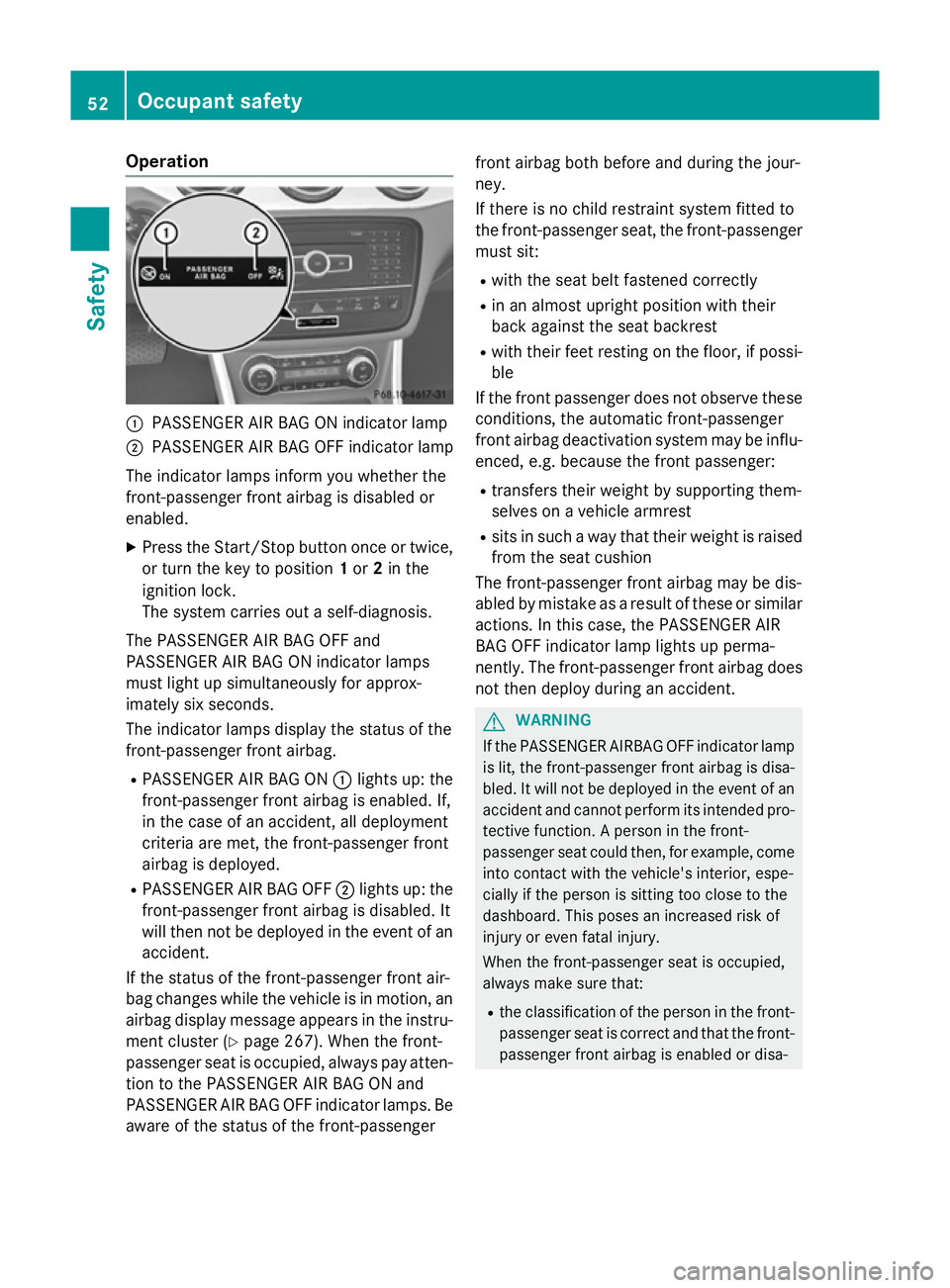
Operation
:
PASSENGER AIR BAG ON indicator lamp
; PASSENGER AIR BAG OFF indicator lamp
The indicator lamps inform you whether the
front-passenger front airbag is disabled or
enabled.
X Press the Start/Stop button once or twice,
or turn the key to position 1or 2in the
ignition lock.
The system carries out a self-diagnosis.
The PASSENGER AIR BAG OFF and
PASSENGER AIR BAG ON indicator lamps
must light up simultaneously for approx-
imately six seconds.
The indicator lamps display the status of the
front-passenger front airbag.
R PASSENGER AIR BAG ON :lights up: the
front-passenger front airbag is enabled. If,
in the case of an accident, all deployment
criteria are met, the front-passenger front
airbag is deployed.
R PASSENGER AIR BAG OFF ;lights up: the
front-passenger front airbag is disabled. It
will then not be deployed in the event of an accident.
If the status of the front-passenger front air-
bag changes while the vehicle is in motion, an
airbag display message appears in the instru-
ment cluster (Y page 267). When the front-
passenger seat is occupied, always pay atten-
tion to the PASSENGER AIR BAG ON and
PASSENGER AIR BAG OFF indicator lamps. Be aware of the status of the front-passenger front airbag both before and during the jour-
ney.
If there is no child restraint system fitted to
the front-passenger seat, the front-passenger
must sit:
R with the seat belt fastened correctly
R in an almost upright position with their
back against the seat backrest
R with their feet resting on the floor, if possi-
ble
If the front passenger does not observe these
conditions, the automatic front-passenger
front airbag deactivation system may be influ- enced, e.g. because the front passenger:
R transfers their weight by supporting them-
selves on a vehicle armrest
R sits in such a way that their weight is raised
from the seat cushion
The front-passenger front airbag may be dis-
abled by mistake as a result of these or similar
actions. In this case, the PASSENGER AIR
BAG OFF indicator lamp lights up perma-
nently. The front-passenger front airbag does not then deploy during an accident. G
WARNING
If the PASSENGER AIRBAG OFF indicator lamp is lit, the front-passenger front airbag is disa-
bled. It will not be deployed in the event of an
accident and cannot perform its intended pro-
tective function. A person in the front-
passenger seat could then, for example, come
into contact with the vehicle's interior, espe-
cially if the person is sitting too close to the
dashboard. This poses an increased risk of
injury or even fatal injury.
When the front-passenger seat is occupied,
always make sure that:
R the classification of the person in the front-
passenger seat is correct and that the front-
passenger front airbag is enabled or disa- 52
Occupant safetySafety