dimensions MERCEDES-BENZ GLA SUV 2018 Owner's Manual
[x] Cancel search | Manufacturer: MERCEDES-BENZ, Model Year: 2018, Model line: GLA SUV, Model: MERCEDES-BENZ GLA SUV 2018Pages: 338, PDF Size: 5.59 MB
Page 21 of 338
Start/Stop buttonRemoving ....................................... 125
Starting the engine ........................ 126
Start/stop function
see ECO start/stop function
Starting (engine) ................................ 125
STEER CONTROL ..................................6 7
Steering
Display message ............................2 25
Steering assistant STEER CON-
TROL
see STEER CONTROL
Steering wheel
Adjusting (manually) ........................ 96
Button overview ............................... 33
Buttons (on-board computer) ......... 186
Cleaning ......................................... 280
Important safety notes .................... 96
Paddle shifters ............................... 138
Steering wheel paddle shifters ........ 138
Stopwatch (RACETIMER) ................... 198
Stowage compartments
Armrest (front) ............................... 248
Armrest (under) ............................. 249
Center console .............................. 248
Center console (rear) ..................... 249
Cup holders ................................... 253
Eyeglasses compartment ............... 248
Glove box ....................................... 248
Important safety information ......... 247
Map pockets .................................. 249
Stowage net ................................... 249
Stowage net ....................................... 249
Summer opening
see Convenience opening feature
Summer tires ..................................... 301
Sun visor ............................................ 255
Suspension setting
AMG adaptive sport suspension
system ........................................... 165
Switching air-recirculation mode
on/off ................................................. 121
Switching on media mode
Via the device list .......................... 245
T
Tachometer ........................................ 185 Tail lamps
see Lights
Tailgate
Display message ............................ 224
Emergency unlocking ....................... 82
Important safety notes .................... 77
Limiting the opening angle ............... 82
Obstruction detection ...................... 78
Opening dimensions ...................... 333
Opening/closing (from outside) ....... 78
Opening/closing automatically
from inside ....................................... 81
Opening/closing automatically
from outside .................................... 79
Tank
see Fuel tank
Tank content
Fuel gauge ....................................... 32
Technical data
Capacities ...................................... 328
Information .................................... 326
Tires/wheels ................................. 323
Vehicle data ................................... 333
TELEAID
Call priority .................................... 260
Downloading destinations
(COMAND) ..................................... 261
Downloading routes ....................... 263
Emergency call .............................. 258
General notes ................................ 257
Geo fencing ................................... 264
Locating a stolen vehicle ............... 262
MB info call button ........................ 260
Remote vehicle locking .................. 262
Roadside Assistance button .......... 259
Search & Send ............................... 261
Self-test ......................................... 257
Speed alert .................................... 263
System .......................................... 257
Triggering the vehicle alarm ........... 264
Vehicle Health Check .................... 263
Vehicle remote unlocking .............. 262
Telephone
Accepting a call (multifunction
steering wheel) .............................. 193
Authorizing a mobile phone (con-
necting) ......................................... 243
Index19
Page 24 of 338
Type identification platesee Vehicle identification plate
U
UnlockingEmergency unlocking ....................... 76
From inside the vehicle (central
unlocking button) ............................. 75
Upshift indicator (on-board com-
puter, Mercedes-AMG vehicles) ....... 197
USB devices
Connecting to the Media Inter-
face ...............................................2 46
V
Vanity mirror (in the sun visor)........255
Vehicle
Correct use ...................................... 27
Data acquisition ............................... 28
Display message ............................ 222
Equipment ....................................... 26
Individual settings .......................... 195
Limited Warranty .............................2 8
Loading .......................................... 310
Locking (in an emergency) ............... 77
Locking (SmartKey) .......................... 69
Lowering ........................................ 323
Maintenance .................................... 26
Parking for a long period ................ 145
Pulling away ................................... 127
Raising ........................................... 321
Reporting problems ......................... 27
Securing from rolling away ............ 321
Transporting .................................. 296
Unlocking (in an emergency) ........... 76
Unlocking (SmartKey) ...................... 69
Vehicle data ................................... 333
Vehicle battery
see Battery (vehicle)
Vehicle data
Roof load (maximum) ..................... 333
Vehicle data (off-road driving)
Approach/departure angle ............ 334
Maximum gradient climbing abil-
ity .................................................. 334
Vehicle dimensions ........................... 333 Vehicle emergency locking
................ 77
Vehicle identification number
see VIN
Vehicle identification plate .............. 327
Vehicle tool kit .................................. 283
Ventilation
Setting the vents ........................... 122
Video
Operating the DVD ......................... 192
see also Digital Operator's Man-
ual .................................................. 239
VIN
Seat ............................................... 328
Type plate ...................................... 327
W
Warning and indicator lampsABS ................................................ 230
Active Brake Assist ........................ 237
Brakes ........................................... 229
Check Engine ................................. 234
Coolant .......................................... 235
Distance warning ........................... 237
ESP
®.............................................. 231
ESP®OFF ....................................... 232
Fuel tank ........................................ 234
Overview .......................................... 32
Reserve fuel ................................... 234
Restraint system ............................ 234
Seat belt ........................................ 227
SPORT handling mode ................... 232
Tire pressure monitor .................... 238
Warning triangle ................................ 283
Washer fluid
Display message ............................ 225
Weather display (COMAND)
see also Digital Operator's Man-
ual .................................................. 239
Wheel and tire combinations
Tires ............................................... 323
Wheel bolt tightening torque ........... 323
Wheel chock ...................................... 321
Wheels
Changing a wheel .......................... 319
Checking ........................................ 299
Cleaning ......................................... 277
Emergency spare wheel ................. 324
22Index
Page 80 of 338
GWARNING
If objects, luggage or loads are not secured or
not secured sufficiently, they could slip, tip
over or be flung around and thereby hit vehicle
occupants. There is a risk of injury, particu-
larly in the event of sudden braking or a sud-
den change in direction.
Always store objects so that they cannot be
flung around. Secure objects, luggage or
loads against slipping or tipping before the
journey.
!The tailgate swings upwards and to the rear
when opened. Therefore, make sure that
there is sufficient clearance above and behind
the tailgate.
The opening dimensions of the tailgate can be
found in the "Vehicle data" section
(
Ypage 333).
You should preferably place luggage or loads in
the cargo compartment. Observe the loading
guidelines (
Ypage 247).
Do not leave the SmartKey in the cargo com-
partment. You could otherwise lock yourself
out.
The tailgate can be:
Ropened and closed manually from outside
Rvehicles with EASY-PACK tailgate:
opened/closed automatically from the out-
side
Rvehicles with EASY-PACK tailgate:
opened/closed automatically from the inside
Rvehicles with EASY-PACK tailgate and
with KEYLESS-GO or KEYLESS-GO start
function: closed with the remote operating
switch on the SmartKey
Rreleased with the emergency release from the
inside
Tailgate obstruction detection with
reversing feature
On vehicles with an EASY-PACK tailgate, the
tailgate is equipped with automatic obstacle
recognition with a reversing feature. If a solid
object blocks or restricts the tailgate when auto-
matically opening or closing, this procedure is
stopped. If the tailgate is stopped during the
closing process, the tailgate automatically opens again slightly. The automatic obstruction
detection with reversing feature is only an aid. It
is not a substitute for your attentiveness when
opening and closing the tailgate.
GWARNING
The reversing feature does not respond:
Rto soft, light and thin objects, e.g. fingers
Rover the last 1/3 in (8 mm) of the closing
movement
The reversing feature cannot prevent some-
one from becoming trapped in these situa-
tions in particular. There is a risk of injury.
Make sure that no body parts are in close
proximity during the closing procedure.
If somebody becomes trapped:
Rpress the Fbutton on the SmartKey, or
Rpull or press the remote operating switch
on the driver's door or
Rpress the closing button/STOP button in
the tailgate or
Rpull the handle on the tailgate
Vehicles with HANDS-FREE ACCESS: it is also
possible to stop the closing process by perform-
ing a kicking movement under the rear bumper.
Opening and closing manually
Opening
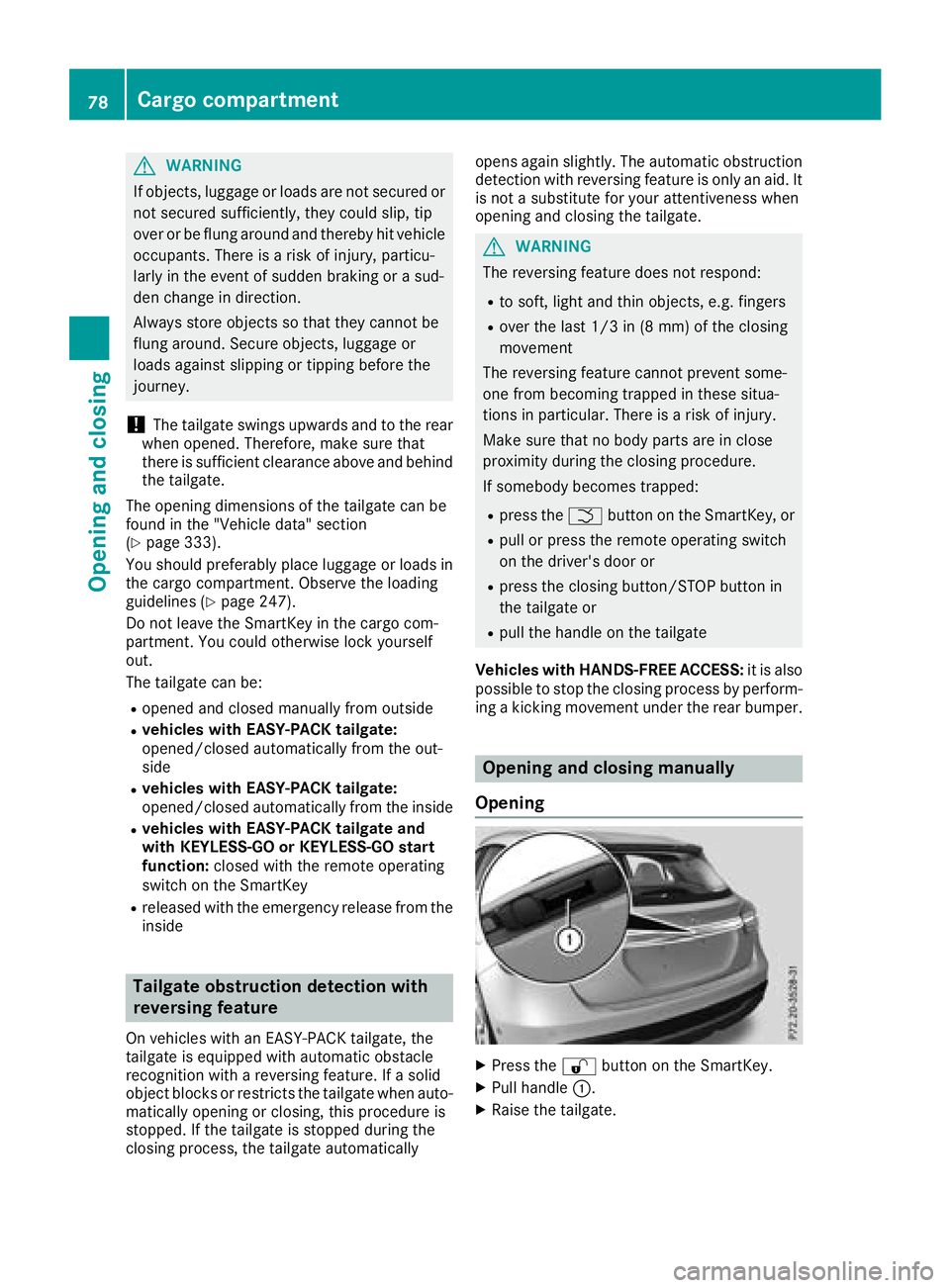
XPress the %button on the SmartKey.
XPull handle :.
XRaise the tailgate.
78Cargo compartment
Opening and closing
Page 81 of 338
Closing
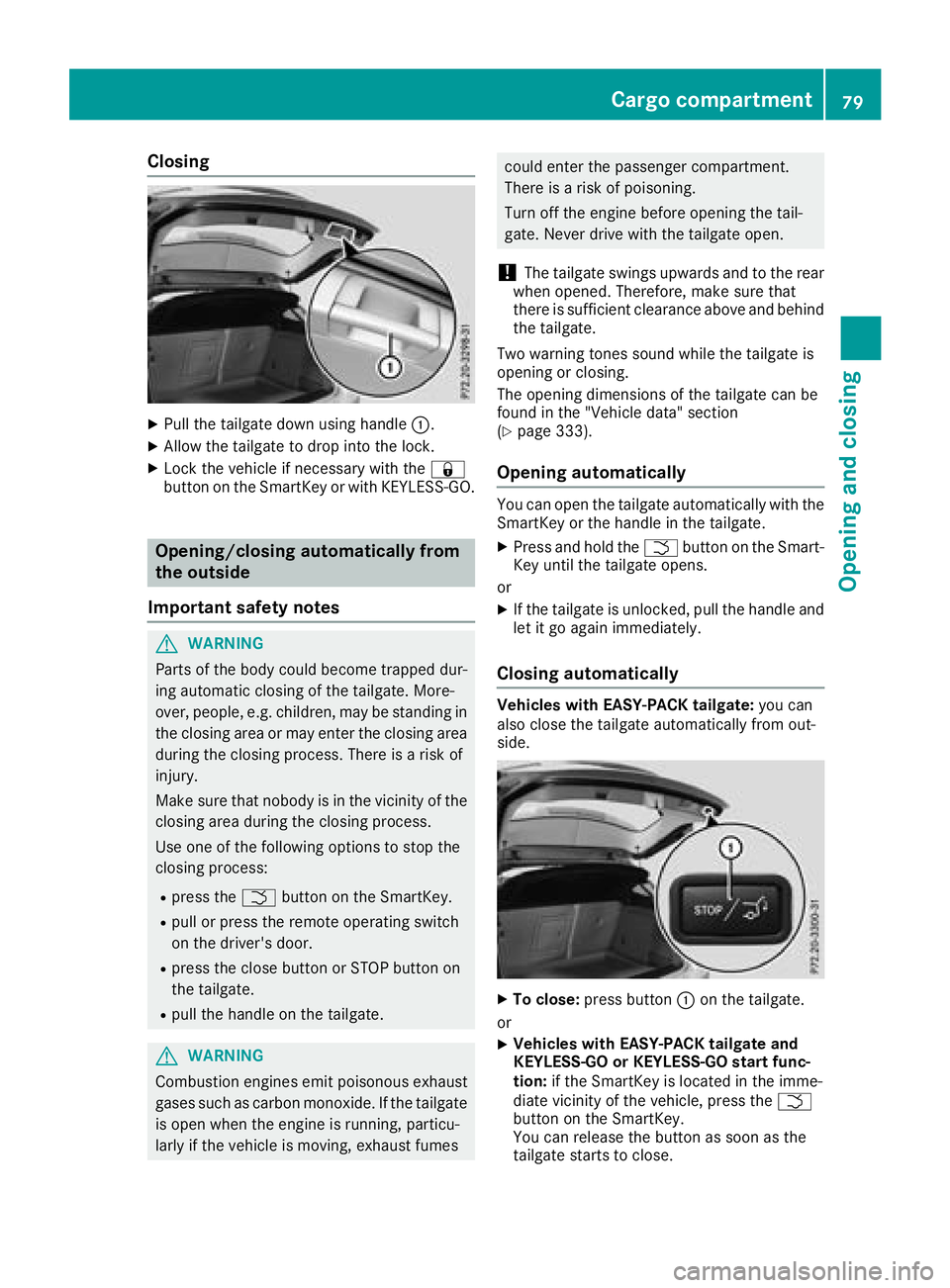
XPull the tailgate down using handle:.
XAllow the tailgate to drop into the lock.
XLock the vehicle if necessary with the &
button on the SmartKey or with KEYLESS-GO.
Opening/closing automatically from
the outside
Important safety notes
GWARNING
Parts of the body could become trapped dur-
ing automatic closing of the tailgate. More-
over, people, e.g. children, may be standing in the closing area or may enter the closing area
during the closing process. There is a risk of
injury.
Make sure that nobody is in the vicinity of the
closing area during the closing process.
Use one of the following options to stop the
closing process:
Rpress the Fbutton on the SmartKey.
Rpull or press the remote operating switch
on the driver's door.
Rpress the close button or STOP button on
the tailgate.
Rpull the handle on the tailgate.
GWARNING
Combustion engines emit poisonous exhaust
gases such as carbon monoxide. If the tailgate is open when the engine is running, particu-
larly if the vehicle is moving, exhaust fumes
could enter the passenger compartment.
There is a risk of poisoning.
Turn off the engine before opening the tail-
gate. Never drive with the tailgate open.
!The tailgate swings upwards and to the rear
when opened. Therefore, make sure that
there is sufficient clearance above and behind
the tailgate.
Two warning tones sound while the tailgate is
opening or closing.
The opening dimensions of the tailgate can be
found in the "Vehicle data" section
(
Ypage 333).
Opening automatically
You can open the tailgate automatically with the
SmartKey or the handle in the tailgate.
XPress and hold the Fbutton on the Smart-
Key until the tailgate opens.
or
XIf the tailgate is unlocked, pull the handle and
let it go again immediately.
Closing automatically
Vehicles with EASY-PACK tailgate: you can
also close the tailgate automatically from out-
side.
XTo close: press button :on the tailgate.
or
XVehicles with EASY-PACK tailgate and
KEYLESS-GO or KEYLESS-GO start func-
tion: if the SmartKey is located in the imme-
diate vicinity of the vehicle, press the F
button on the SmartKey.
You can release the button as soon as the
tailgate starts to close.
Cargo compartment79
Opening and closing
Z
Page 83 of 338
Operation
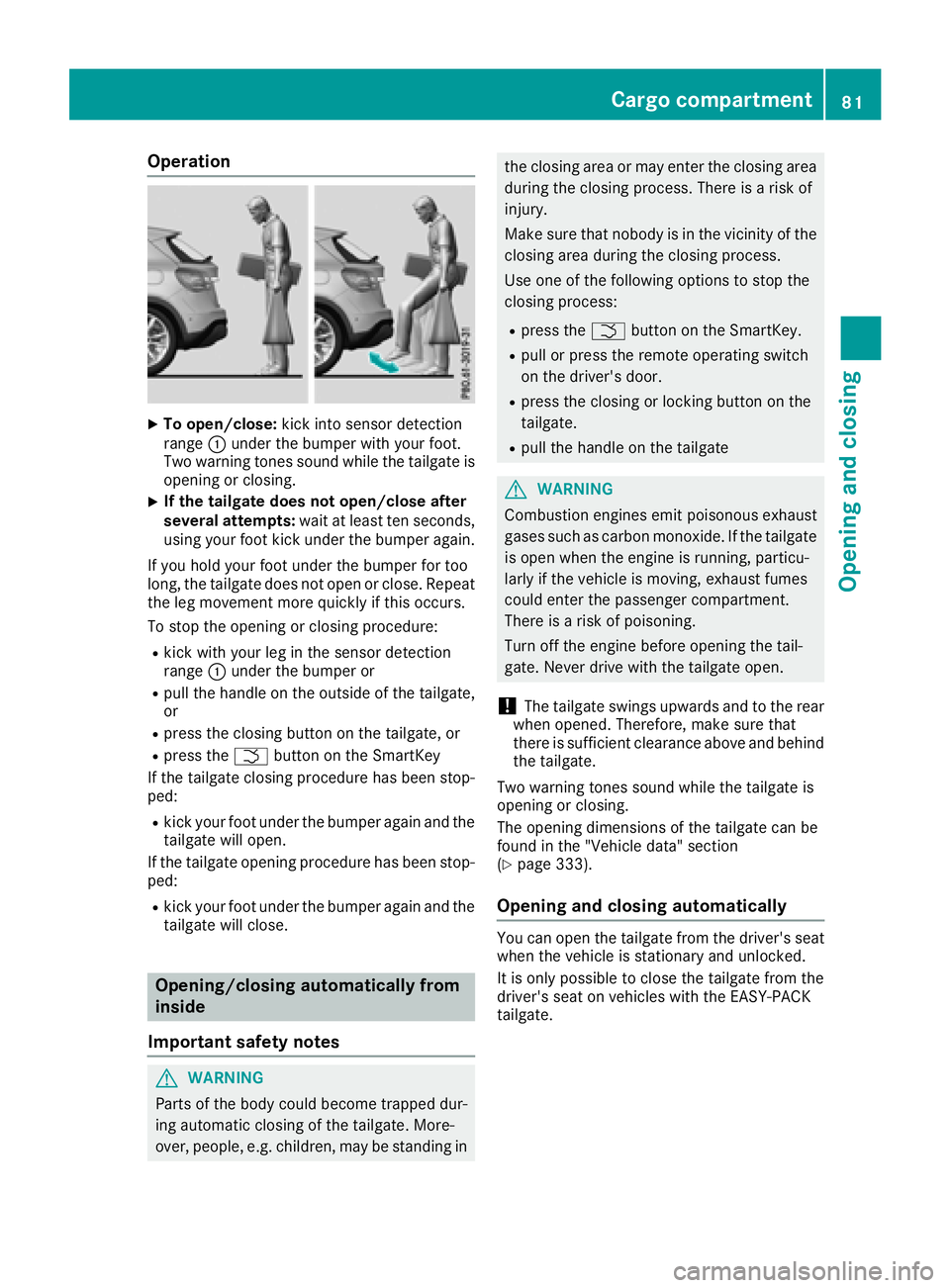
XTo open/close:kick into sensor detection
range :under the bumper with your foot.
Two warning tones sound while the tailgate is
opening or closing.
XIf the tailgate does not open/close after
several attempts: wait at least ten seconds,
using your foot kick under the bumper again.
If you hold your foot under the bumper for too
long, the tailgate does not open or close. Repeat
the leg movement more quickly if this occurs.
To stop the opening or closing procedure:
Rkick with your leg in the sensor detection
range :under the bumper or
Rpull the handle on the outside of the tailgate,
or
Rpress the closing button on the tailgate, or
Rpress the Fbutton on the SmartKey
If the tailgate closing procedure has been stop-
ped:
Rkick your foot under the bumper again and the tailgate will open.
If the tailgate opening procedure has been stop-
ped:
Rkick your foot under the bumper again and the
tailgate will close.
Opening/closing automatically from
inside
Important safety notes
GWARNING
Parts of the body could become trapped dur-
ing automatic closing of the tailgate. More-
over, people, e.g. children, may be standing in
the closing area or may enter the closing area
during the closing process. There is a risk of
injury.
Make sure that nobody is in the vicinity of the
closing area during the closing process.
Use one of the following options to stop the
closing process:
Rpress the Fbutton on the SmartKey.
Rpull or press the remote operating switch
on the driver's door.
Rpress the closing or locking button on the
tailgate.
Rpull the handle on the tailgate
GWARNING
Combustion engines emit poisonous exhaust
gases such as carbon monoxide. If the tailgate
is open when the engine is running, particu-
larly if the vehicle is moving, exhaust fumes
could enter the passenger compartment.
There is a risk of poisoning.
Turn off the engine before opening the tail-
gate. Never drive with the tailgate open.
!The tailgate swings upwards and to the rear
when opened. Therefore, make sure that
there is sufficient clearance above and behind
the tailgate.
Two warning tones sound while the tailgate is
opening or closing.
The opening dimensions of the tailgate can be
found in the "Vehicle data" section
(
Ypage 333).
Opening and closing automatically
You can open the tailgate from the driver's seat
when the vehicle is stationary and unlocked.
It is only possible to close the tailgate from the
driver's seat on vehicles with the EASY-PACK
tailgate.
Cargo compartment81
Opening and closing
Z
Page 84 of 338
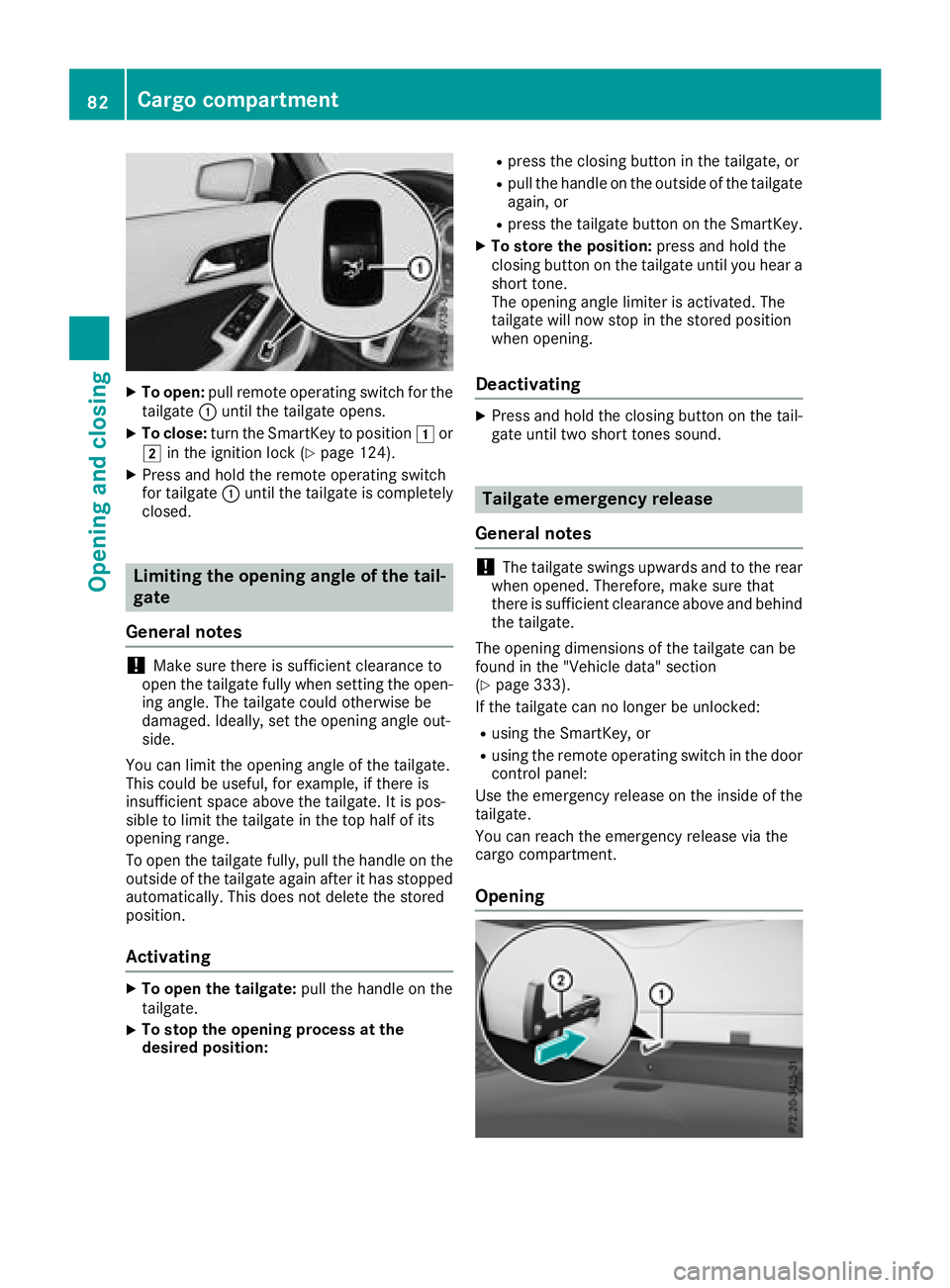
XTo open:pull remote operating switch for the
tailgate :until the tailgate opens.
XTo close: turn the SmartKey to position 1or
2 in the ignition lock (Ypage 124).
XPress and hold the remote operating switch
for tailgate :until the tailgate is completely
closed.
Limiting the opening angle of the tail-
gate
General notes
!Make sure there is sufficient clearance to
open the tailgate fully when setting the open-
ing angle. The tailgate could otherwise be
damaged. Ideally, set the opening angle out-
side.
You can limit the opening angle of the tailgate.
This could be useful, for example, if there is
insufficient space above the tailgate. It is pos-
sible to limit the tailgate in the top half of its
opening range.
To open the tailgate fully, pull the handle on the
outside of the tailgate again after it has stopped
automatically. This does not delete the stored
position.
Activating
XTo open the tailgate: pull the handle on the
tailgate.
XTo stop the opening process at the
desired position:
Rpress the closing button in the tailgate, or
Rpull the handle on the outside of the tailgate
again, or
Rpress the tailgate button on the SmartKey.
XTo store the position: press and hold the
closing button on the tailgate until you hear a
short tone.
The opening angle limiter is activated. The
tailgate will now stop in the stored position
when opening.
Deactivating
XPress and hold the closing button on the tail-
gate until two short tones sound.
Tailgate emergency release
General notes
!The tailgate swings upwards and to the rear
when opened. Therefore, make sure that
there is sufficient clearance above and behind
the tailgate.
The opening dimensions of the tailgate can be
found in the "Vehicle data" section
(
Ypage 333).
If the tailgate can no longer be unlocked:
Rusing the SmartKey, or
Rusing the remote operating switch in the door control panel:
Use the emergency release on the inside of the
tailgate.
You can reach the emergency release via the
cargo compartment.
Opening
82Cargo compartment
Opening and closing
Page 321 of 338
PSI (pounds per square inch)
A standard unit of measure for tire pressure.
Aspect ratio
Relationship between tire height and tire width
in percent.
Tire pressure
This is pressure inside the tire applying an out-
ward force to each square inch of the tire's sur-
face. The tire pressure is specified in pounds per
square inch (psi), in kilopascal (kPa) or in bar.
The tire pressure should only be corrected when
the tires are cold.
Cold tire pressure
The tires are cold:
Rif the vehicle has been parked with the tires
out of direct sunlight for at least three hours
and
Rif the vehicle has not been driven further than
1 mile (1.6 km)
Tread
The part of the tire that comes into contact with
the road.
Bead
The tire bead ensures that the tire sits securely
on the wheel. There are several steel wires in the
bead to prevent the tire from coming loose fromthe wheel rim.
Sidewall
The part of the tire between the tread and the
bead.
Weight of optional extras
The combined weight of those optional extras
that weigh more than the replaced standard
parts and more than 2.3 kg (5 lbs). These
optional extras, such as high-performance
brakes, level control, a roof rack or a high-per-
formance battery, are not included in the curb
weight and the weight of the accessories.
TIN (Tire Identification Number)
This is a unique identifier which can be used by
a tire manufacturer to identify tires, for example
for a product recall, and thus identify the pur-
chasers. The TIN is made up of the manufactur-
er's identity code, tire size, tire type code and
the manufacturing date.
Load bearing index
The load bearing index (also load index) is a code
that contains the maximum load bearing capa-
city of a tire.
Traction
Traction is the result of friction between the tires
and the road surface.
Treadwear indicators
Narrow bars (tread wear bars) that are distrib-
uted over the tire tread. If the tire tread is level
with the bars, the wear limit of áin (1.6 mm)
has been reached.
Occupant distribution
The distribution of occupants in a vehicle at their
designated seating positions.
Total load limit
Nominal load and luggage load plus 68 kg
(150 lbs) multiplied by the number of seats in
the vehicle.
Changing a wheel
Flat tire
The "Breakdown assistance" section
(Ypage 284) contains information and notes on
how to deal with a flat tire. Information on driv-
ing with MOExtended tires in the event of a flat
tire can be found under "MOExtended tires (tires
with run-flat characteristics" (
Ypage 284).
Rotating the wheels
GWARNING
Interchanging the front and rear wheels may
severely impair the driving characteristics if
the wheels or tires have different dimensions. The wheel brakes or suspension components
may also be damaged. There is a risk of acci-
dent.
Rotate front and rear wheels only if the wheels and tires are of the same dimensions.
!On vehicles equipped with a tire pressure
monitor, electronic components are located
in the wheel.
Changing a wheel319
Wheels and tires
Z
Page 326 of 338
These tires have been specially adapted for
use with the control systems, such as ABS or
ESP
®, and are marked as follows:
RMO = Mercedes-Benz Original
RMOE = Mercedes-Benz Original Extended
(tires featuring run-flat characteristics)
RMO1 = Mercedes-Benz Original (only cer-
tain AMG tires)
Mercedes-Benz Original Extended tires may
only be used on wheels that have been spe-
cifically approved by Mercedes-Benz.
Only use tires, wheels or accessories tested
and approved by Mercedes-Benz. Certain
characteristics, e.g. handling, vehicle noise
emissions or fuel consumption, may other-
wise be adversely affected. In addition, when
driving with a load, tire dimension variations
could cause the tires to come into contact
with the bodywork and axle components. This
could result in damage to the tires or the vehi- cle.
Mercedes-Benz accepts no liability for dam-
age resulting from the use of tires, wheels or
accessories other than those tested and
approved.
Information on tires, wheels and approved
combinations can be obtained from any quali-
fied specialist workshop.
!Retreaded tires are neither tested nor rec-
ommended by Mercedes-Benz, since previ-
ous damage cannot always be detected on
retreaded tires. As a result, Mercedes-Benz
cannot guarantee vehicle safety if retreaded
tires are mounted. Do not mount used tires if
you have no information about their previous
usage.
The recommended pressures for various oper-
ating conditions can be found:
Ron the Tire and Loading Information placard
on the B-pillar on the driver's side
Rin the tire pressure table in the fuel filler flap
Observe the notes on recommended tire pres-
sures under various operating conditions
(
Ypage 302).
Check tire pressures regularly, and only when
the tires are cold. Comply with the maintenance
recommendations of the tire manufacturer in
the vehicle document wallet. Notes on the vehicle equipment – always equip
the vehicle:
Rwith tires of the same size on a given axle (left
and right)
Rwith the same type of tire (summer tires,
MOExtended tires, winter tires)
Exception: it is permissible to install a differ-
ent type or make in the event of a flat tire.
Observe the "MOExt
ended t
ires (tires with
run-flat characteristics" section (Ypage 284).
Vehicles equipped with MOExtended tires are
not equipped with a TIREFIT kit at the factory. It
is therefore recommended that you additionally
equip your vehicle with a TIREFIT kit if you mount tires that do not feature run-flat properties, e.g.
winter tires. A TIREFIT kit may be obtained from a qualified specialist workshop.
Emergency spare wheel
Important safety notes
GWARNING
The wheel or tire size as well as the tire type of the spare wheel or emergency spare wheel
and the wheel to be replaced may differ.
Mounting an emergency spare wheel may
severely impair the driving characteristics.
There is a risk of an accident.
To avoid hazardous situations:
Radapt your driving style accordingly and
drive carefully.
Rnever mount more than one spare wheel or
emergency spare wheel that differs in size.
Ronly use a spare wheel or emergency spare
wheel of a different size briefly.
Rdo not switch ESP®off.
Rhave a spare wheel or emergency spare
wheel of a different size replaced at the
nearest qualified specialist workshop.
Observe that the wheel and tire dimensions
as well as the tire type must be correct.
When using an emergency spare wheel or spare
wheel of a different size, you must not exceed
the vehicle's maximum design speed of 50 mph (80 km/h) .
324Emergency spare wheel
Wheels and tires
Page 335 of 338
Refrigerant instruction label
Example: refrigerant instruction label
:
Symbol
;Refrigerant filling capacity
=Applicable standards
?PAG oil part number
AType of refrigerant
Warning symbol :advises you about:
RPossible dangers
RHaving service work carried out at a qualified
specialist workshop
Filling capacities
Mercedes ‑AMG
vehiclesCapacity
Refrigerant23.6 ± 0.4 oz
(670 ± 10 g)
PAG oil4.2 oz
(120 g)
All other modelsCapacity
Refrigerant22.9 ± 0.4 oz (650 ± 10 g)
PAG oil4.2 oz
(120 g)
Vehicle data
General notes
Please note that for the specified vehicle data:
RThe heights specified may vary as a result of:
-Tires
-Load
-Condition of the suspension
-Optional equipment
ROptional equipment reduces the maximum
payload
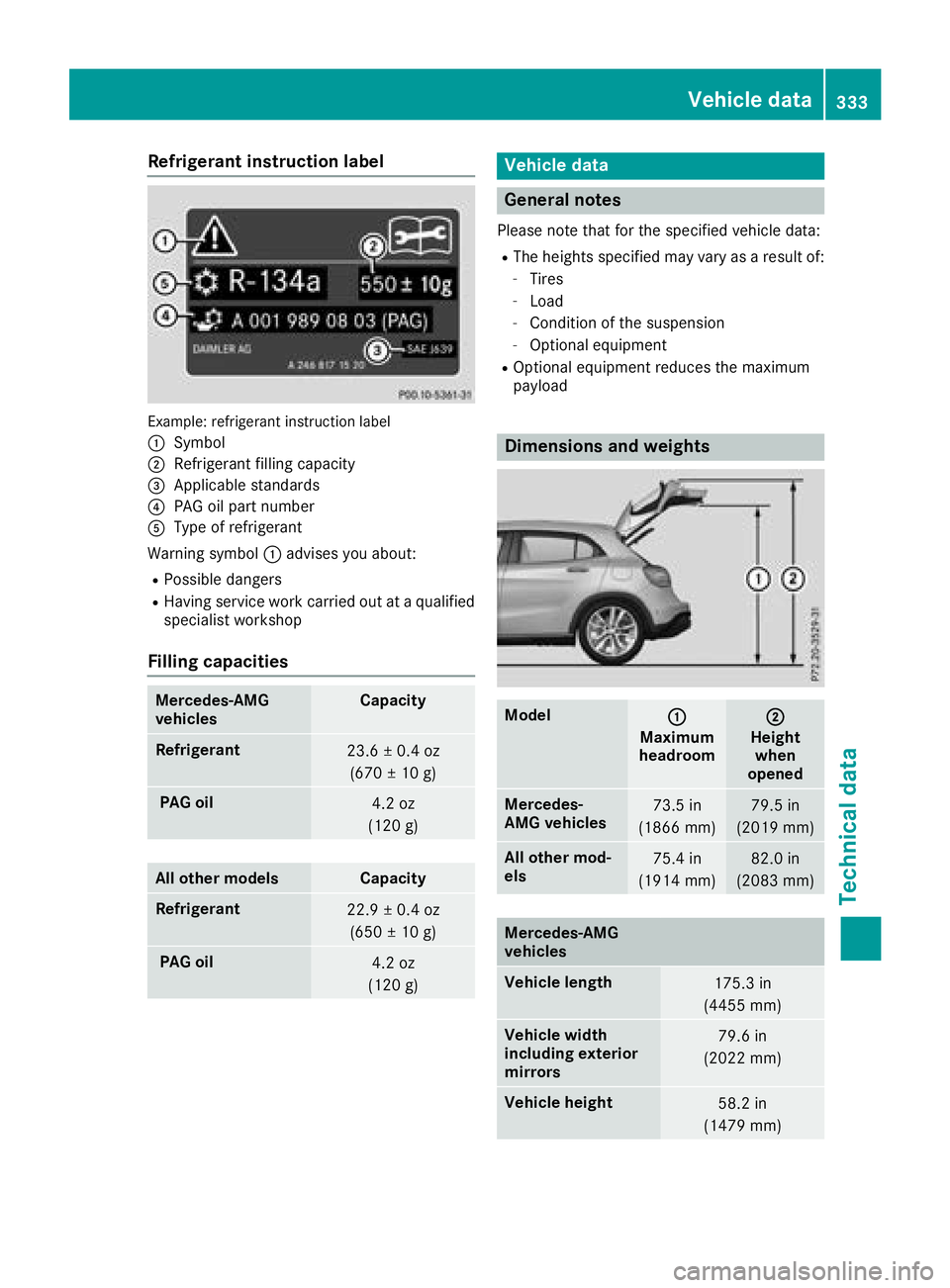
Dimensions and weights
Model:
Maximum
headroom
;
Height when
opened
Mercedes-
AMG vehicles73.5 in
(1866 mm)79.5 in
(2019 mm)
All other mod-
els75.4 in
(1914 mm)82.0 in
(2083 mm)
Mercedes‑AMG
vehicles
Vehicle length175.3 in
(4455 mm)
Vehicle width
including exterior
mirrors79.6 in
(2022 mm)
Vehicle height58.2 in
(1479 mm)
Vehicle data333
Technical data
Z