fold seats MERCEDES-BENZ GLA SUV 2018 Owner's Manual
[x] Cancel search | Manufacturer: MERCEDES-BENZ, Model Year: 2018, Model line: GLA SUV, Model: MERCEDES-BENZ GLA SUV 2018Pages: 338, PDF Size: 5.59 MB
Page 18 of 338
PASSENGER AIR BAGDisplay message ............................2 09
Indicator lamps ................................ 40
Problem (malfunction) ................... 209
Pets in the vehicle ............................... 59
Phone book
see also Digital Operator's Man-
ual ..................................................2 39
Plastic trim (cleaning instruc-
tions) ..................................................2 79
Power washers .................................. 275
Power windows
see Side windows
Protection against theft
ATA (Anti-Theft Alarm system) ......... 67
Immobilizer ...................................... 67
Protection of the environment
General notes .................................. 25
Pulling away
Automatic transmission ................. 127
General notes ................................ 127
Hill start assist ............................... 127
Q
QR codeMercedes-Benz Guide App ................. 1
Rescue card ..................................... 28
Qualified specialist workshop ........... 27
R
RACE START
Important safety notes .................. 164
RACE START (Mercedes-AMG vehi-
cles) .................................................... 164
RACE TIMER (on-board computer,
Mercedes-AMG vehicles) .................. 198
Radio
Selecting a station ......................... 191
see Digital Operator's Manual
Radio mode
see also Digital Operator's Man-
ual ..................................................2 39
Radio-wave reception/transmis-
sion in the vehicle
Declaration of conformity ................ 27 Rain closing feature (panorama
roof with power tilt/sliding panel)
.... 88
Reading lamp ..................................... 104
Rear compartment
Setting the air vents ......................1 22
Rear fog lamp
Display message ............................ 212
Replacing bulbs .............................1 07
Switching on/off ........................... 102
Rear lamps
see Lights
Rear seat
Adjusting the angle of the backr-
ests ................................................ 251
Rear seats
Folding the backrest forwards/
back ............................................... 251
Rear view camera
"Reverse parking" function ............ 177
Cleaning instructions ..................... 278
Display in the multimedia system .. 176
Function/notes .............................1 75
General notes ................................ 175
Switching on/off ........................... 176
Rear window defroster
Problem (malfunction) ................... 121
Switching on/off ........................... 121
Rear window wiper
Replacing the wiper blade .............. 111
Switching on/off ........................... 109
Rear-view mirror
Anti-glare (manual) .......................... 97
Dipping (automatic) ......................... 98
Reflective safety jacket .................... 282
Refrigerant (air-conditioning sys-
tem)
Important safety notes .................. 332
Refueling
Fuel gauge ....................................... 32
Important safety notes .................. 140
Refueling process .......................... 141
see Fu
el
Remote control
Garage door opener ....................... 264
Programming (garage door
opener) .......................................... 265
Replacing bulbs
Brake lamp ....................................1 07
16Index
Page 19 of 338
High-beam headlamps ................... 106
Important safety notes .................. 105
Installing/removing the cover
(front wheel arch) .......................... 106
Low-beam headlamps .................... 106
Overview of bulb types .................. 105
Rear fog lamp ................................ 107
Turn signals (front) ......................... 107
Turn signals (rear) .......................... 107
Rescue card ......................................... 28
Reserve (fuel tank)
see Fuel
Reserve fuel
Display message ............................ 215
Warning lamp ................................. 234
see Fuel
Residual heat (climate control) ........ 121
Restraint system
Display message ............................ 207
Introduction ..................................... 39
Warning lamp ................................. 234
Warning lamp (function) ................... 40
Reverse gear (selector lever) ........... 134
Reversing feature
Roller sunblind ................................. 89
Side windows ................................... 83
Tailgate ............................................ 78
Roadside Assistance (breakdown) .... 26
Roller sunblind
Panorama roof with power tilt/
sliding panel ..................................... 88
Roof carrier ........................................ 253
Roof lining and carpets (cleaning
guidelines) ......................................... 281
Roof load (maximum) ........................ 333
Route guidance
see also Digital Operator's Man-
ual .................................................. 239
S
SafetyChildren in the vehicle ..................... 53
see Occupant safety
Safety system
see Driving safety systems
SD card
Inserting ........................................ 245 Inserting/removing ........................ 245
Removing ....................................... 245
SD memory card
see also Digital Operator's Man-
ual .................................................. 239
Search & Send
see also Digital Operator's Man-
ual .................................................. 239
Seat
Correct driver's seat position ........... 91
Seat belts
Adjusting the height ......................... 43
Cleaning ......................................... 280
Correct usage .................................. 42
Fastening ......................................... 43
Important safety guidelines ............. 41
Introduction ..................................... 40
Releasing ......................................... 43
Warning lamp ................................. 227
Warning lamp (function) ................... 43
Seats
Adjusting (electrically) ..................... 93
Adjusting (manually) ........................ 92
Adjusting (Performance Seat) .......... 95
Adjusting the 4-way lumbar sup-
port .................................................. 95
Adjusting the head restraint ............ 93
Cleaning the cover ......................... 280
Folding the backrest (rear com-
partment) forwards/back .............. 251
Important safety notes .................... 91
Seat heating problem ...................... 96
Storing settings (memory func-
tion) ............................................... 100
Switching seat heating on/off ......... 95
Section
Cargo compartment ......................... 77
Securing cargo .................................. 252
Selecting a gear
see Automatic transmission
Selector lever
Cleaning ......................................... 280
Sensors (cleaning instructions) ....... 278
Service menu (on-board com-
puter) .................................................. 195
Service message
see ASSYST PLUS
Index17
Page 39 of 338

Door controlpanel
FunctionPage
:Opens th edoo r75
;%&Unlocks/locks
the vehicle75
=r45= Saves
the seat and exterior mirror
settings
99
?Adjusts the seats electrically93
A7 Zö\
Adjusts and folds the exterior
mirrors in/out electrically
97
FunctionPage
BW Opens/closes the side
windows84
Cn Activates/deactivates
the override feature for the
side windows in the rear
compartment
59
Dq Opens the cargo com-
partment79
Door control panel37
At a glance
Page 58 of 338
LATCH-type (ISOFIX) child seat secur-
ing system
GWARNING
For LATCH-type (ISOFIX) child restraint sys-
tems in which the child is secured using the
safety belt integrated in the child restraint
system, the maximum permissible weight of
the child and child restraint system together
is 73 lbs (33 kg).
If the child and the child restraint system
together weigh more than 73 lbs (33 kg), the
LATCH-type (ISOFIX) child restraint system
with integrated safety belt no longer offers
sufficient protection. The LATCH-type (ISO-
FIX) child seat securing system may be over-
loaded, and the child may not be restrained in
an accident, for example. This poses an
increased risk of injury or even fatal injury.
If the child and the child restraint system
together weigh more than 73 lbs (33 kg),use
only a LATCH-type (ISOFIX) ch ildrestraint sys-
tem in whic h the ch ild isalso secured with the
veh icle seat belt. Also secure the ch ild
restraint system with the Top Tether belt,if
available.
Regularly check that the permis siblegross
weight of the ch ildtogether with the ch ild
restraint system isstill maintained.
Alwa ys co mply wit h the manufacturer's instal-
lation and operating instructions for the ch ild
restraint system used.
Before every tr ip,make sure that the LATCH-
type (ISOFIX) ch ildrestraint system isengaged
correct ly inboth
LATCH
-type (ISOFIX) securing
rings
!When installing the ch ildrestraint system,
make sure that the seat beltfor the middle
seat does not get tr apped.The seat beltcould
otherwise be damaged.
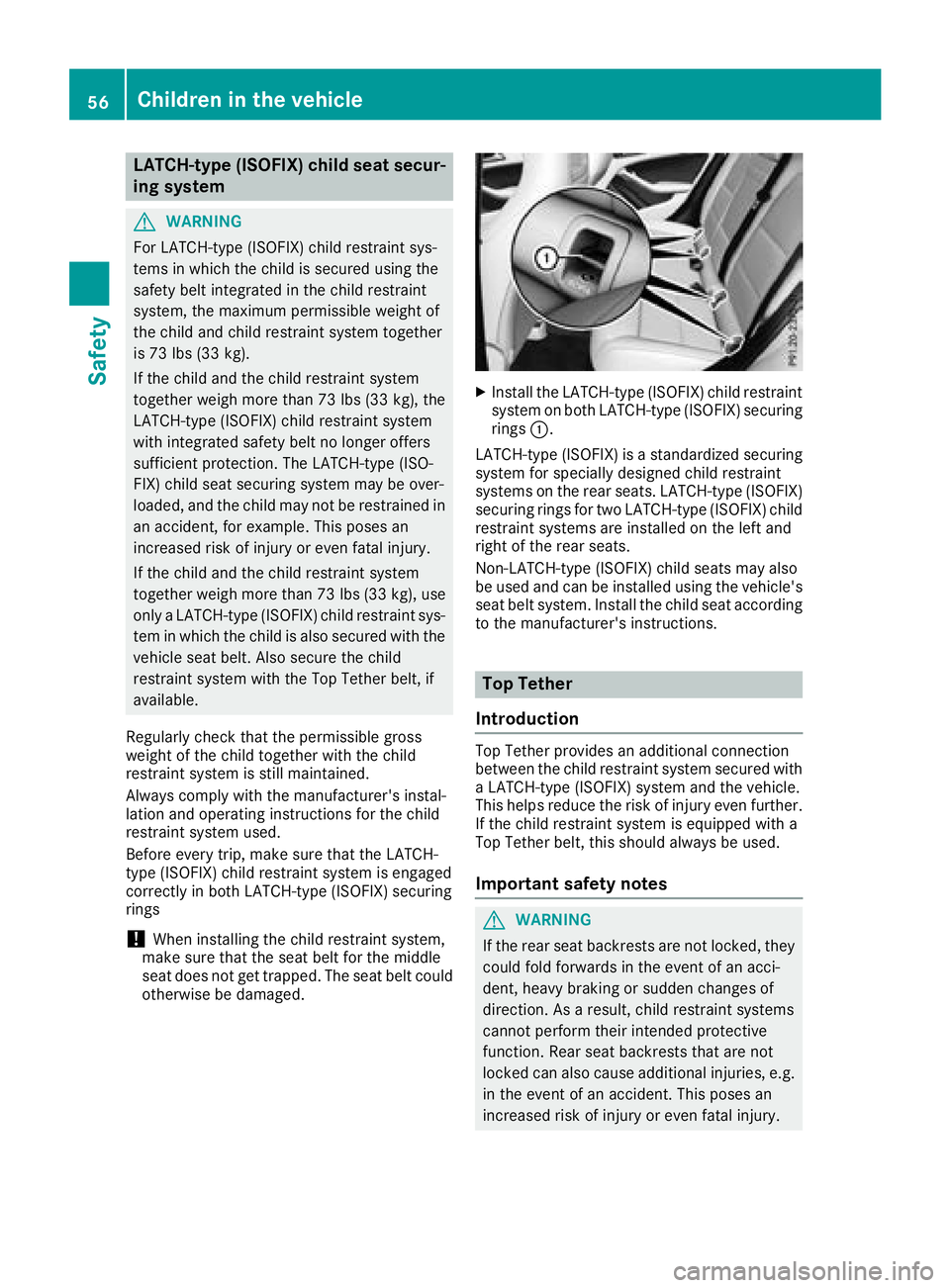
XInstall the LATCH-type (ISOFIX) child restraint
system on both LATCH-type (ISOFIX) securing
rings :.
LATCH-type (ISOFIX) is a standardized securing
system for specially designed child restraint
systems on the rear seats. LATCH-type (ISOFIX)
securing rings for two LATCH-type (ISOFIX) child
restraint systems are installed on the left and
right of the rear seats.
Non-LATCH-type (ISOFIX) child seats may also
be used and can be installed using the vehicle's
seat belt system. Install the child seat according
to the manufacturer's instructions.
Top Tether
Introduction
Top Tether provides an additional connection
between the child restraint system secured with
a LATCH-type (ISOFIX) system and the vehicle.
This helps reduce the risk of injury even further.
If the child restraint system isequipped with a
Top Tether belt, this should always be used.
Important safety notes
GWARNING
If the rear seat backrests are not locke d,they
could fold forwards in the event of an acci-
dent, heavy braking or sudden changes of
dire ction. As a result, child restraint systems
cannot perform their intended protective
function. Rear seat backrests that are not
locked can also cause additional injuries, e.g.
in the event of an accident. This poses an
increased risk of injury or even fatal injury.
56Children in the vehicle
Safety
Page 94 of 338
against your seat belt by the unsecured driv-
er's seat.
This could cause you to lose control of the
vehicle. The seat belt cannot protect as inten-
ded and could result in additional injury.
There is a risk of an accident and injury.
Before every journey, make sure that the driv-
er's seat is fully engaged.
Observe the safety notes on "Air bags"
(
Ypage 44) and "Children in the vehicle"
(Ypage 53).
GWARNING
If the driver's seat is not engaged, it could
move unexpectedly while the vehicle is in
motion. This could cause you to lose control of the vehicle. There is a risk of an accident.
Always make sure that the driver's seat is
engaged before starting the vehicle.
GWARNING
You could lose control of your vehicle if you do the following while driving:
Radjust the driver's seat, head restraint,
steering wheel or mirrors
Rfasten the seat belt
There is a risk of an accident.
Adjust the driver's seat, head restraint, steer-
ing wheel and mirror and fasten your seat belt before starting the engine.
GWARNING
If you adjust the seat height carelessly, you or
other vehicle occupants could be trapped and
thereby injured. Children in particular could
accidentally press the electrical seat adjust-
ment buttons and become trapped. There is a
risk of injury.
While moving the seats, make sure that your
hands or other body parts do not get under the
lever assembly of the seat adjustment sys-
tem.
!To prevent damage to the seats and the seat
heating, observe the following notes:
RDo not spill liquids onto the seats. Dry the
seats as soon as possible if liquid does get
spilled on the seats.
RIf the seat covers are damp or wet, do not
switch on the seat heating. Also, do not use
the seat heating to dry the seats.
RClean the seat covers as recommended;
see the "Interior care" section.
RDo not transport heavy loads on the seats.
Do not place pointed objects on the seat
cushions such as knives, nails or tools.
Where possible, use the seats only for car-
rying passengers.
RWhen operating the seat heating, do not
cover the seats with insulating materials,
e.g. blankets, coats, bags, protective cov-
ers, child seats or booster seats.
RWhen the seat heating is switched on, the
seat surface can be damaged as a result of objects being placed on the seats; for
exam ple, seat c
ushions, child seats and
protective covers not approved by
Mercedes-Benz.
!Make sure that there are no objects in the
footwell under or behind the seats when mov-
ing the seats back. There is a risk that the
seats and/or the objects could be damaged.
iFurther related subjects:
RCargo compartment enlargement (folding
down the rear seats) (Ypage 250)
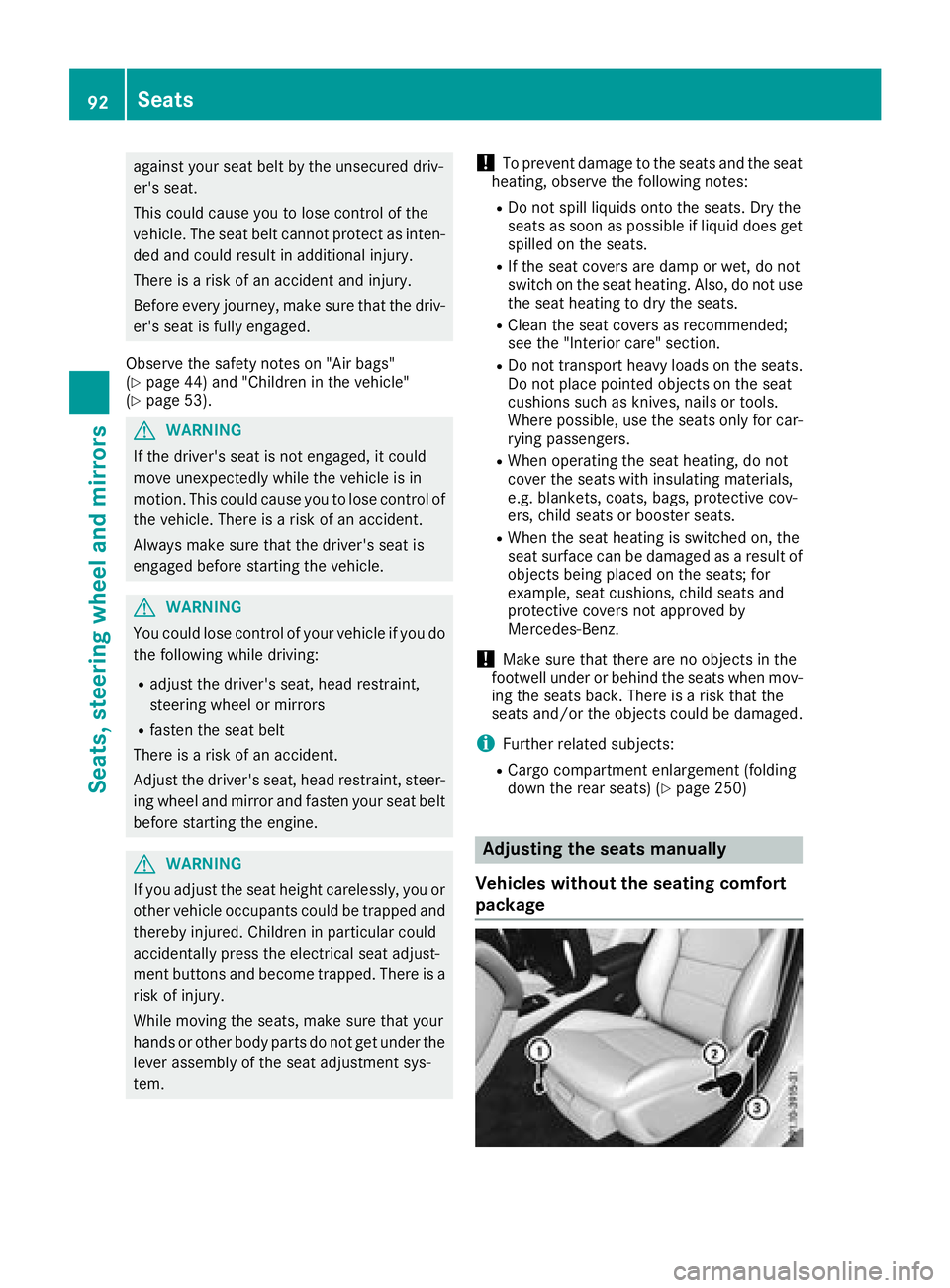
Adjusting the seats manually
Vehicles without the seating comfort
package
92Seats
Seats, steering wheel and mirrors
Page 100 of 338
Folding the exterior mirrors in or out
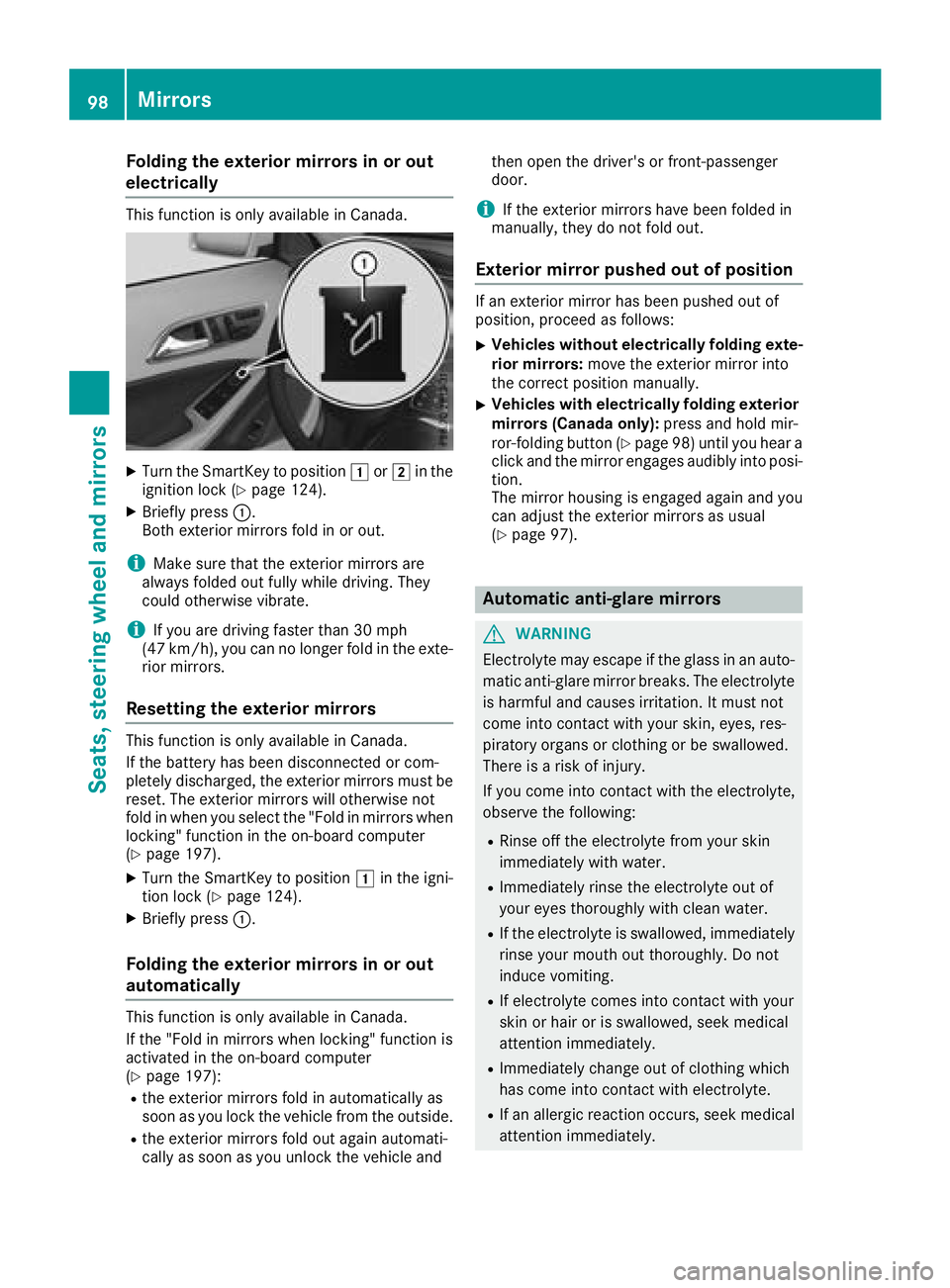
electrically
This function is only available in Canada.
XTurn theSmartKey to position 1or2 in th e
ignition loc k (Ypage 124).
XBriefly press :.
Both exterio rmirror sfol din or out .
iMakesure that th eexterio rmirror sare
always folded out fully while driving .They
could otherwise vibrate .
iIf you are driving fasterthan 30 mph
(47 km/h), you can no longer fol din th eexte -
rio rmirrors.
Resetting the exterior mirrors
This function is only available in Canada.
If th ebattery has been disconnected or com-
pletely discharged, th eexterio rmirror smust be
reset .The exterio rmirror swill otherwise no t
fol din when you select th e"Fold in mirror swhen
locking" function in th eon-board computer
(
Ypage 197).
XTurn th eSmartKey to position 1in th eigni-
tion loc k (Ypage 124).
XBriefly press :.
Folding the exterior mirrors in or out
automatically
This function is only available in Canada.
If the"Fold in mirror swhen locking" function is
activated in th eon-board computer
(
Ypage 197):
Rth eexterio rmirror sfol din automatically as
soo nas you loc kth evehicl efrom th eoutside .
Rtheexterio rmirror sfol dout again automati-
call yas soo nas you unlock th evehicl eand then open th
edriver' sor front-passenger
door .
iIf theexterio rmirror shave been folded in
manually, they do no tfol dout .
Exterior mirror pushed out of position
If an exterio rmirror has been pushed out of
position ,procee das follows :
XVehicles without electricall yfolding exte-
rior mirrors :mov eth eexterio rmirror int o
th ecorrect position manually.
XVehicles with electricall yfolding exterior
mirrors (Canad aonly): press and hold mir -
ror-foldin gbutto n (
Ypage 98) until you hear a
click and th emirror engage saudibly int oposi -
tion .
The mirror housing is engage dagain and you
can adjust th eexterio rmirror sas usual
(
Ypage 97).
Automatic anti-glare mirrors
GWARNIN G
Electrolyte may escape if th eglass in an auto -
matic anti-glare mirror breaks .The electrolyt e
is harmful and causes irritation .It must no t
come int ocontact wit hyour skin, eyes, res -
piratory organs or clothing or be swallowed.
Ther eis aris kof injury.
If you come int ocontact wit hth eelectrolyte,
observ eth efollowing:
RRins eoff th eelectrolyt efrom your skin
immediately wit hwater.
RImmediately rinse th eelectrolyt eout of
your eyes thoroughly wit hclean water.
RIf th eelectrolyt eis swallowed, immediately
rinse your mout hout thoroughly. Do no t
induce vomiting .
RIf electrolytecomes int ocontact wit hyour
skin or hair or is swallowed, seek medical
attention immediately.
RImmediately chang eout of clothing whic h
has come int ocontact wit helectrolyte.
RIf an allergic reaction occurs, seek medical
attention immediately.
98Mirrors
Seats, steering wheel and mirrors
Page 249 of 338
Loading guidelines
GWARNING
If objects, luggage or loads are not secured or
not secured sufficiently, they could slip, tip
over or be flung around and thereby hit vehicle
occupants. There is a risk of injury, particu-
larly in the event of sudden braking or a sud-
den change in direction.
Always store objects so that they cannot be
flung around. Secure objects, luggage or
loads against slipping or tipping before the
journey.
GWARNING
Combustion engines emit poisonous exhaust
gases such as carbon monoxide. If the tailgate is open when the engine is running, particu-
larly if the vehicle is moving, exhaust fumes
could enter the passenger compartment.
There is a risk of poisoning.
Turn off the engine before opening the tail-
gate. Never drive with the tailgate open.
GWARNING
The exhaust tail pipe and tail pipe trim can
become very hot. If you come into contact
with these parts of the vehicle, you could burn
yourself. There is a risk of injury.
Always be particularly careful around the
exhaust tail pipe and the tail pipe trim. Allow
these components to cool down before touch-
ing them.
The handling characteristics of a laden vehicle
are dependent on the distribution of the load
within the vehicle.
Observe the following notes when loading and
transporting a load:
RNever exceed the maximum permissible
gross vehicle mass or the gross axle weight
rating for the vehicle (including occupants).
The values are specified on the vehicle iden-
tification plate on the B-pillar of the driver's
door.
RThe cargo compartment is the preferred place
to carry objects.
RPosition heavy loads as far forward as possi-
ble and as low down in the cargo compart-
ment as possible.
RThe load must not protrude above the upper
edge of the seat backrests.
RAlways place the load against the rear or front seat backrests. Make sure that the seat
backrests are securely locked into place.
RAlways place the load behind unoccupied
seats if possible.
RUse the cargo tie-down rings and the parcel
nets to transport loads and luggage.
RUse cargo tie-down rings and fastening mate-
rials appropriate for the weight and size of theload.
RThe maximum load capacity of the stowage
well under the cargo compartment floor is
55 lbs (25 kg).
RSecure the load with sufficiently strong and
wear-resistant tie-downs. Pad sharp edges for
protection.
!Do not position the load on one part of the
folding cargo compartment floor only. The
maximum load capacity of the folding cargo
compartment floor is 220 lbs (100kg). Dis-
tribute the weight evenly to avoid damaging
the cargo compartment floor. Place a solid
board under the load if necessary. Please
note that the load on the cargo compartment floor will be increased when the load is lashed
down.
Stowage areas
Stowage spaces
Important safety notes
GWARNING
If you transport objects in the vehicle interior
and these are not adequately secured, they
could slip or be flung around and thereby
strike vehicle occupants. In addition, cup
holders, open stowage spaces and mobile
phone brackets may not always be able to
hold the objects placed in them in the event of
an accident. There is a risk of injury, particu-
larly in the event of sharp braking or sudden
changes of direction.
Stowage areas247
Stowage and features
Z