snow chains MERCEDES-BENZ GLC 2018 Owners Manual
[x] Cancel search | Manufacturer: MERCEDES-BENZ, Model Year: 2018, Model line: GLC, Model: MERCEDES-BENZ GLC 2018Pages: 390, PDF Size: 9.04 MB
Page 12 of 390
Driving downhil l ................................ 16 8
Driving in mountainous terrain
Approach/departur e angle ............ 16 8
Driving off-road
Drivin g downhill ............................ .1 68
see Off-road driving
Driving on flooded roads .................. 165
Driving safety system
Active Brake Assist .......................... 67
Crosswind Assist ............................ .7 3
Driving safet y systems
AB S (Anti-loc k Braking System) ...... .6 6
Active Brake Assist with cross-
traffic function ................................. 73
ADAPTIVE BRAKE ............................. 73
Adaptive Brake Assist ...................... 68
BAS (Brake Assist System) .............. 67
Distance warning function ............... 67
EBD (electronic brake force distri-
bution) ............................................. 73
ESP ®
(Electronic Stability Pro-
gram) ............................................... 69
Important safety information ........... 66
Overview .......................................... 66
STEER CONTROL ............................. 76
Driving system
AIR BODY CONTROL ...................... 184
AMG sports suspension based on
AIR BODY CONTROL ...................... 186
Distance Pilot DISTRONIC ............. 170
Distance Pilot DISTRONIC with
Steering Pilot ................................. 177
Off-road program ........................... 181
Parking assist PARKTRONIC .......... 191
Parking Pilot .................................. 188
RACE START (Mercedes-AMG
vehicles) ........................................ 183
Driving systems
360°camera .................................. 199
Active Blind Spot Assist ................. 209
Active Lane Keeping Assist ............ 212
ATTENTION ASSIST ........................ 203
Blind Spot Assist ............................ 205
Cruise control ................................ 169
Display message ............................ 256
Driving Assistance Plus package ... 209
HOLD function ............................... 178
Lane Ke eping Assist ...................... 207 Lane
Tracking package .................. 205
Rear view camera .......................... 194
Traffic Sign Assist .......................... 205
Driving tips
Automatic transmission ................. 149
Brakes ........................................... 163
Break-in period .............................. 135
Distance Pilot DISTRONIC ............. 176
Downhill gradient ........................... 163
Drinking and driving ....................... 161
Driving in winter ............................. 165
Driving on flooded roads ................ 165
Driving on sand .............................. 167
Driving on wet roads ...................... 164
Exhaust check ............................... 161
Fuel ................................................ 161
General .......................................... 160
Hydroplaning ................................. 164
Icy road surfaces ........................... 165
Important safety notes .................. 135
Limited braking efficiency on sal-
ted roads ....................................... 163
Off-road driving .............................. 165
Snow chains .................................. 351
Subjecting brakes to a load ........... 163
The first 1000 miles (1500 km) ..... 135
Tire ruts ......................................... 167
Towing a trailer .............................. 215
Traveling uphill ............................... 168
Wet road surface ........................... 163
DSR (Downhill Speed Regulation)
Display message ............................ 259
Function/notes ............................. 180
DVD video
Operating (on-board computer) ..... 229
see also Digital Operator's Man-
ual .................................................. 280
DYNAMIC SELECT switch
Automatic transmission ................. 144
Climate control (dual-zone auto-
matic climate control) .................... 127
E
EASY-ENTRY feature
Function/notes ............................. 106
EASY-EXIT feature
Function/notes ............................. 10610
Index
Page 22 of 390
Service message
see ASSYST PLUS
Service products
Brake fluid .................................... .3 80
Coolant (engine) ............................ 380
Engine oil ....................................... 379
Fuel ................................................ 377
Important safety notes .................. 377
Refrigerant (air-conditioning sys-
tem) ............................................... 381
Washer fluid ................................... 381
Setting the date/time format
see also Digital Operator's Man-
ual ................................................. .2 80
Setting the language
see also Digital Operator's Man-
ual ................................................. .2 80
Setting the time
see also Digital Operator's Man-
ual ................................................. .2 80
Settings
Factory (on-board computer) ......... 235
On-board computer ....................... 231
SETUP (on-board computer,
Mercedes-AMG vehicles) .................. 236
Side impact air bag ............................ .5 1
Side marker lamp (display mes-
sage) ................................................... 251
Side running board
Cleaning ......................................... 328
Side windows
Cleaning ......................................... 327
Convenience closing feature ............ 92
Convenience opening feature ......... .9 2
Important safety information ........... 91
Opening/closing .............................. 91
Problem (malfunction) .................... .9 4
Resettin g ........................................ .9 3
Reversin g feature ............................ .9 1
SIRIUS services
see also Digital Operator's Man-
ual .................................................. 280
Ski and snowboard bag ............... ..... 292
Sliding sunroof
Important safet y
notes .................... 94
Problem (malfunction) ..................... 97
see Panorama roof with power
tilt/sliding panel SmartKey
Changing the battery ....................... 81
Changing the programming ............ .8 0
Checking the battery ...................... .8 1
Convenience closing feature ............ 93
Convenience opening feature .......... 92
Display message ............................ 267
Door central locking/unlocking ...... .7 8
Important safety notes .................... 78
KEYLESS-GO start function .............. 80
Loss ................................................ .8 2
Mechanical key ................................ 80
Overview .......................................... 78
Positions (ignition lock) ................. 136
Problem (malfunction) ..................... 82
Starting the engine ........................ 138
Smartphone
Starting the engine ........................ 139
SMS
see also Digital Operator's Man-
ual .................................................. 280
Snow chains ...................................... 351
Socket (12 V)
Cargo compartment ....................... 305
Center console .............................. 305
General notes ................................ 305
Rear compartment ........................ .3 05
Sound
Switching on/off ........................... 281
Special seat belt retractor .................. 60
Specialist workshop ............................ 32
Speed, controlling
see Cruise control
Speedometer
Activating/deactivating the addi-
tional spee dometer ........................ 235
Di gi tal ............................................ 225
In the Instrument cluster ................. 37
Segments ...................................... 220
Selecting the display unit .............. .2 34
SPORT handling mode
Deactivating/activating
(Mercedes-AMG vehicles) ................ 71
Warning lamp ................................. 273
Sports exhaust system
AMG ............................................... 142
Standing lamps
Display message ............................ 25120
Index
Page 25 of 390
Maximum loaded vehicle weight
(definition) .................................... .3 68
Maximum permissible tire pres-
sure (definition) ............................ .3 68
Maximum tire load ......................... 366
Maximum tire load (definition) ....... 368
MOExtended tires .......................... 351
Optional equipment weight (defi-
nition) ............................................ 369
PSI (pounds per square inch) (def-
inition) .......................................... .3 68
Replacing ....................................... 369
Service life ..................................... 350
Sidewall (definition) ....................... 368
Snow chains .................................. 351
Speed rating (definition) ................ 368
Storing .......................................... .3 70
Structure and characteristics
(definition) ..................................... 367
Summer tires in winter .................. 351
Temperature .................................. 363
TIN (Tire Identification Number)
(definition) ..................................... 369
Tire bead (definition) ..................... .3 68
Tire pressure (definition) ................ 368
Tire pressures (recommended) ...... 367
Tire size (data) ............................... 373
Tire size designation, load-bearing
capacity, speed rating .................... 364
Tire tread ....................................... 350
Tire tread (definition) ..................... 368
Total load limit (definition) ............. 369
Traction ......................................... 363
Traction (definition) ....................... 369
Tread wear ..................................... 363
Uniform Tire Quality Grading
Standards ...................................... 362
Uniform Tire Quality Grading
Standards (definition) .................... 367
Wear indicator (definition) ............. 369
Wheel and tire combination ........... 373
Wheel rim (definition) .................... 367
see Flat tire
Top Tether ............................................ 62
Touchpad
Changing the station/music
track .............................................. 283
C h aracter suggestions ................... 282 Deleting characters ....................... 282
Entering a space ............................ 282
Entering characters ....................... 282
Gesture control .............................. 282
Handwriting recognition ................ 282
Operating the touchpad ................. 282
Overview ........................................ 282
Quick access for Audio .................. 283
Switching ....................................... 282
Switching input line ....................... 282
Tow-starting
Emergency engine starting ............ 347
Important safety notes .................. 343
Towing a trailer
Axle load, permissible .................... 384
Cleaning the trailer tow hitch ......... 329
Coupling up a trailer ...................... 216
Decoupling a trailer ....................... 218
Driving tips .................................... 215
ESP ®
(Electronic Stability Pro-
gram) ............................................... 72
Important safety notes .................. 214
Installing the ball coupling ............. 216
Lights display message .................. 251
Power supply ................................. 218
Pulling away with a trailer .............. 140
Removing the ball coupling ............ 218
Trailer loads ................................... 384
Towing away
Important safety guidelines ........... 343
Installing the towing eye ................ 344
Notes for 4MATIC vehicles ............ 346
Removing the towing eye ............... 345
Transporting the vehicle ................ 346
With both axles on the ground ....... 345
Towing eye ......................................... 333
Traction system
see ETS/4ETS (Electronic Trac-
tion System)
Traffic reports
see also Digital Operator's Man-
ual .................................................. 280
Traffic Sign Assist
Activating/deactivating the warn-
ing function .................................... 232
Display message ............................ 259
Function/notes ............................. 205
Important safety notes .................. 205 Index 23
Page 27 of 390
Vehicle level
AIR BODY CONTROL ...................... 185
Display message ............................ 256
Video
Operating the DVD ......................... 229
see also Digital Operator's Man-
ual .................................................. 280
VIN
Seat ............................................... 377
Type plate ...................................... 376
W Warning and indicator lamps
ABS ................................................ 271
Active Brake Assist ........................ 277
Airbag ............................................ 274
Brakes ........................................... 270
Coolant .......................................... 275
Distance warning ........................... 277
Engine diagnostics ......................... 274
ESP ®
.............................................. 271
ESP ®
OFF ....................................... 273
Fuel tank ........................................ 274
General notes ................................ 268
Overview .......................................... 37
Parking brake ................................ 274
PASSENGER AIR BAG ...................... 45
Reserve fuel ................................... 274
Restraint system ............................ 274
Seat belt ........................................ 269
SPORT handling mode ................... 273
Steering ......................................... 279
Tire pressure monitor .................... 278
Warranty .............................................. 29
Washer fluid
Display message ............................ 267
Weather display (COMAND)
see also Digital Operator's Man-
ual .................................................. 280
Wheel and tire combinations
Tires ............................................... 373
Wheel bolt tightening torque ........... 373
Wheel chock ...................................... 370
Wheels
Changing a wheel .......................... 369
Checking ........................................ 349
Cleaning ......................................... 326 Important safety notes .................. 349
Information on driving .................... 349
Interchanging/changing ................ 369
Mounting a new wheel ................... 372
Mounting a wheel .......................... 370
Removing a wheel .......................... 372
Snow chains .................................. 351
Storing ........................................... 370
Tightening torque ........................... 373
Wheel size/tire size ....................... 373
Window curtain air bag
Display message ............................ 248
Operation ......................................... 51
Windows
see Side windows
Windshield
Defrosting ...................................... 130
Windshield washer fluid
see Windshield washer system
Windshield washer system
Adding washer fluid ....................... 322
Important safety notes .................. 381
Windshield wipers
Problem (malfunction) ................... 123
Rear window wiper ........................ 121
Replacing the wiper blades ............ 121
Switchi ng on/off ........................... 120
Wi
nter driving
Important safety notes .................. 351
Slippery road surfaces ................... 165
Snow chains .................................. 351
Winter operation
Radiator cover ............................... 319
Summer tires ................................. 351
Winter tires
M+S tires ....................................... 351
Wiper arm
Moving to a vertical position .......... 121
Wiper blades
Cleaning ......................................... 327
Important safety notes .................. 121
Replacing ....................................... 121
Replacing (rear window) ................ 122
Replacing (windshield) ................... 121
Without changing gears
Display message ............................ 265
Wooden trim (cleaning instruc-
tions) .................................................. 330 Index 25
Page 68 of 390
Drivin g safet y systems
Overview of drivin g safet y systemsIn this section , you will fin d information about
th e followin g drivin g safet y systems :R
AB S ( A n ti-loc k B rakin g S ystem)
( Y
page 66)R
BA S ( B rak e A ssist S ystem) ( Y
page 67)R
Active Brak e Assis t ( Y
page 67 )R
ES P ®
( E lectronic S t ability P r ogram)
( Y
page 69)R
EB D ( E lectroni c B rak e forc e D istribution )
( Y
page 73 )R
ADAPTIV E BRAKE ( Y
page 73 )R
Active Brak e Assis t wit h cross-traffic function
( Y
page 73)R
STEE R CONTROL ( Y
page 76 )
Important safet y notesIf you fail to adapt your drivin g style or if you are
inattentive , th e drivin g safet y systems can nei-
ther reduce th e ris k of an acciden t no r override
th e laws of physics. Driving safet y systems are
merely aids designed to assist driving. You are
responsible fo r maintainin g th e distanc e to th e
vehicle in front, fo r vehicle speed, fo r braking in
goo d time, and fo r stayin g in lane. Always adapt
your drivin g style to suit th e prevailin g road and
weather condition s and maintain a saf e distanc e
from th e vehicle in front. Drive carefully.
The drivin g safet y systems described only wor k
as effectively as possible when there is ade-
quat e contact between th e tires and th e road
surface. Pay particular attention to th e informa-
tion regardin g tires , recommended minimum
tire tread depths etc. in th e "Wheels and tires "
section ( Y
page 349).
In wintr y drivin g conditions, always use winte r
tires (M+ S tires )a nd if necessary, snow chains.
Only in this way will the driving safety systems
described in this section work as effectively as
possible. ABS (Anti-lock Braking System)
General information ABS regulates brake pressure in such a way that
the wheels do not lock when you brake. This
allows you to continue steering the vehicle when
braking.
The % ABS warning lamp in the instrument
cluster lights up when the ignition is switched
on. It goes out when the engine is running.
ABS works from a speed of about 5 mph
(8 km/h), regardless of road-surface conditions.
ABS works on slippery surfaces, even when you
only brake gently.
Important safety notes
i Observe the "Important safety notes" sec-
tion ( Y
page 66).
G WARNING
If ABS is faulty, the wheels could lock when
braking. The steerability and braking charac-
teristics may be severely impaired. Addition-
ally, further driving safety systems are deac-
tivated. There is an increased danger of skid-
ding and accidents.
Drive on carefully. Have ABS checked imme-
diately at a qualified specialist workshop.
When ABS is malfunctioning, other systems,
including driving safety systems, will also
become inoperative. Observe the information
on the ABS warning lamp ( Y
page 271) and dis-
play messages which may be shown in the
instrument cluster ( Y
page 240).
Braking X
If ABS intervenes: continue to depress the
brake pedal vigorously until the braking sit-
uation is over. X
To make a full brake application: depress
the brake pedal with full force.
If ABS intervenes when braking, you will feel a
pulsing in the brake pedal.
The pulsating brake pedal can be an indication
of hazardous road conditions, and functions as a
reminder to take extra care while driving.66
Driving safety systems
Safety
Page 167 of 390
R
avoid sudden steering movements R
brake carefully
Driving on flooded roads
! Bear in mind that vehicles traveling in front
or in the opposite direction create waves. This
may cause the maximum permissible water
depth to be exceeded.
Failure to observe these notes may result in
damage to the engine, electrical systems and
transmission.
If you have to drive on stretches of road on which
water has collected, please bear in mind that: R
in the case of standing water, the water level
may be no higher than the lower edge of the
vehicle body R
you should drive no faster than walking pace
Winter driving
G WARNING
If you shift down on a slippery road surface in
an attempt to increase the engine's braking
effect, the drive wheels could lose their grip.
There is an increased danger of skidding and
accidents.
Do not shift down for additional engine brak-
ing on a slippery road surface.
G DANGER
If the exhaust pipe is blocked or adequate
ventilation is not possible, poisonous gases
such as carbon monoxide (CO) may enter the
vehicle. This is the case, e.g. if the vehicle
becomes trapped in snow. There is a risk of
fatal injury.
If you leave the engine or the auxiliary heating
running, make sure the exhaust pipe and area
around the vehicle are clear of snow. To
ensure an adequate supply of fresh air, open a
window on the side of the vehicle that is not
facing into the wind.
Have your vehicle winter-proofed at a qualified
specialist workshop at the onset of winter.
Drive particularly carefully on slippery road sur-
faces. Avoid sudden acceleration, steering and braking maneuvers. Do not use cruise control or
Distance Pilot DISTRONIC.
If the vehicle threatens to skid or cannot be
stopped when moving at low speed: X
Shift the transmission to position \\ .
The outside temperature indicator is not
designed to serve as an ice-warning device and
is therefore unsuitable for that purpose.
Changes in the outside temperature are dis-
played after a short delay.
Indicated temperatures just above the freezing
point do not guarantee that the road surface is
free of ice. The road may still be icy, especially in
wooded areas or on bridges. The vehicle could
skid if you fail to adapt your driving style. Always
adapt your driving st yle an d drive at a speed to
suit the prevailing weather conditions.
You should pay special attention to road condi-
tions when temperatures are around freezing
point.
For more information on driving with snow
chains, see ( Y
page 351).
For more information on driving with summer
tires, see ( Y
page 351).
Observe the notes in the "Winter operation" sec-
tion ( Y
page 351).
Off-road driving
Important safety notes
G WARNING
If you drive on a steep incline at an angle or
turn when driving on an incline, the vehicle
could slip sideways, tip and rollover. There is a
risk of an accident.
Always drive on a steep incline in the line of
fall (straight up or down) and do not turn the
vehicle.
G WARNING
Flammable material such as leaves, grass or
twigs may ignite if they come into contact with
hot parts of the exhaust system. There is a risk
of fire.
When driving on an unpaved road or off-road,
check the vehicle underside regularly. In par-
ticular, remove trapped plant parts or other Driving tips 165
Driving and parking Z
Page 184 of 390
Off-road program Slippery off-road program You can select the Slippery off-road program
for snow or rain.
The Slippery off-road program has the following
characteristics: R
The steering, drive, transmission and suspen-
sion are adapted for comfort. R
Vehicles with AIR BODY CONTROL: the
vehicle is adjusted to normal level. R
The ECO start/stop function is available
( Y
page 140).
ESP ®
and 4ETS programs especially adapted to
slippery surfaces are also activated for maxi-
mum stability.
For more information on driving with snow
chains, see ( Y
page 351).
Off-road off-road program You can select the Off-road off-road program
for driving on easily negotiable terrain, e.g. dirt
roads, gravel and sand.
The Off-road program has the following char-
acteristics: R
The steering, drive and suspension are adap-
ted for comfort R
The transmission is adapted for off-road driv-
ing R
Vehicles with AIR BODY CONTROL: the
vehicle is raised by 0.6 in (1 5 mm) compared
with the normal level
The Off-road program assists you when driving
in easily negotiable off-road terrain. The
engine’s performance characteristics and the
gearshifting characteristics of the automatic
transmission are adapted for this purpose. ABS,
ESP ®
and 4ETS programs especially adapted to
off-road driving are also activated.
Rocking free off-road program
The Rocking free off-road program is available
only in vehicles with AIR BODY CONTROL.
You can select the Rocking free off-road pro-
gram to free the vehicle from especially difficult
off-road terrain at low speeds. The Rocking free off-road program has the fol-
lowing characteristics: R
The steering, drive and suspension are adap-
ted for comfort R
The transmission is adapted for off-road driv-
ing R
The vehicle is raised by 2.0 in (50 mm) com-
pared with the normal level
ABS, ESP ®
and 4ETS programs especially adap-
ted to off-road driving are also activated.
The Ro cking free off-roa
d program can be
selected up to a speed of 12 mph (20 km/h).
If you are driving in the Rocking free off-road
program at speeds above 12 mph (20 km/h): R
the vehicle switches to the off-road program
Off-road R
the vehicle is lowered by 1.4 in (35 mm)
Notes on driving off-road ( Y
page 165).
Gradient off-road program You can use the Gradient off-road program to
overcome steep terrain.
The Gradient off-road program has the follow-
ing characteristics: R
The steering, drive and suspension are adap-
ted for comfort R
The transmission is adapted for off-road driv-
ing R
Manual gearshifting is activated
( Y
page 152) R
Vehicles with AIR BODY CONTROL: the
vehicle is raised by 0.6 in (1 5 mm) compared
with the normal level R
DSR is activated ( Y
page 180)
ABS, ESP ®
and 4ETS programs especially adap-
ted to gradients are also activated.
Trailer off-road program
Select the Trailer off-road program when tow-
ing a trailer.
The Trailer off-road program has the following
characteristics: R
The steering, drive and suspension are adap-
ted for comfort R
The transmission is adapted for off-road driv-
ing182
Driving systems
Driving and parking
Page 187 of 390
S (Sport) R
the suspension setting is
more taut R
the vehicle is set to low level R
at higher speeds, the vehicle
level does not continue to
lower R
Mercedes-AMG GLC 63
4MATIC+/GLC 63 S
4MATIC+: the 4MATIC+ is
synchronised more dynami-
cally
S+ (Sport
Plus)
Mercedes-
AMG GLC
63 4MATIC
+/GLC
63 S
4MATIC+:
RACE R
the suspension setting is
even more taut R
the vehicle is set to low level R
at higher speeds, the vehicle
level does not continue to
lower R
Mercedes-AMG GLC 63
4MATIC+/GLC 63 S
4MATIC+: the 4MATIC+ is
synchronised more dynami-
cally
Important safety notes
G WARNING
When the vehicle is being lowered, people
could become trapped if their limbs are
between the vehicle body and the wheels or
underneath the vehicle. There is a risk of
injury.
Make sure no one is underneath the vehicle or
in the immediate vicinity of the wheel arches
when the vehicle is being lowered.
i If one of the doors is open, the vehicle is not
lowered. Vehicle level Setting the raised vehicle level
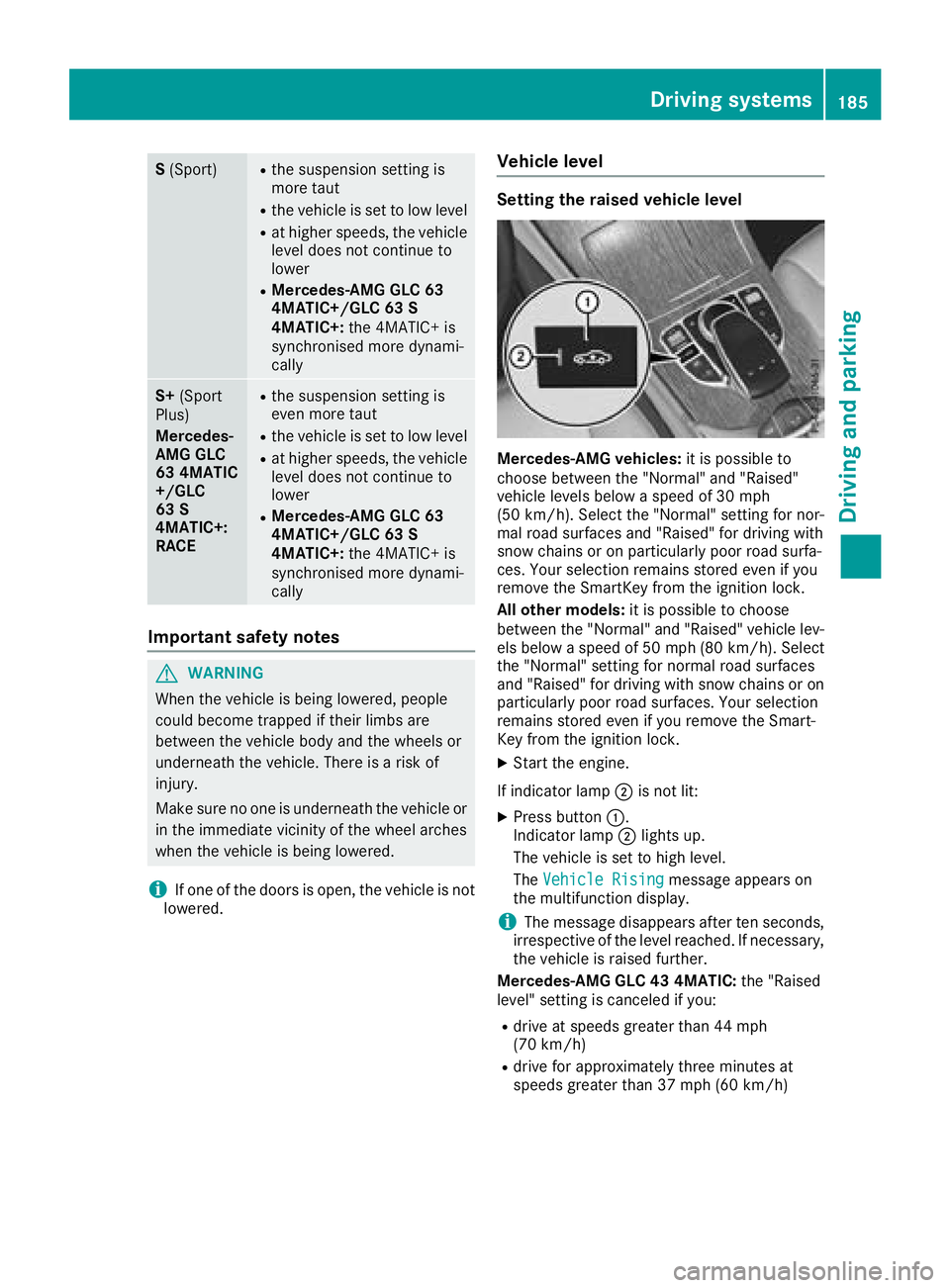
Mercedes-AMG vehicles: it is possible to
choose between the "Normal" and "Raised"
vehicle levels below a speed of 30 mph
(50 km/h). Select the "Normal" setting for nor-
mal road surfaces and "Raised" for driving with
snow chains or on particularly poor road surfa-
ces. Your selection remains stored even if you
remove the SmartKey from the ignition lock.
All other models: it is possible to choose
between the "Normal" and "Raised" vehicle lev-
els below a speed of 50 mph (80 km/ h) . Select
the "Normal" setting for normal road surfaces
and "Raised" for driving with snow chains or on
particularly poor road surfaces. Your selection
remains stored even if you remove the Smart-
Key from the ignition lock. X
Start the engine.
If indicator lamp D is not lit: X
Press button C .
Indicator lamp D lights up.
The vehicle is set to high level.
The Vehicle Rising
message appears on
the multifunction display.
i The message disappears after ten seconds,
irrespective of the level reached. If necessary,
the vehicle is raised further.
Mercedes-AMG GLC 43 4MATIC: the "Raised
level" setting is canceled if you: R
drive at speeds greater than 44 mph
(70 km/h) R
drive for approximately three minutes at
speeds greater than 37 mph (60 km/h)Driving systems 185
Driving and parking Z
Page 190 of 390
Parking Pilot
General notes Parking Pilot is an electronic parking aid with
ultrasound. It measures the road on both sides
of the vehicle. A parking symbol indicates a suit-
able parking space. Active steering intervention
and brake application can assist you during
parking and when exiting a parking space. You
can also still use Parking Assist PARKTRONIC
( Y
page 191).
Important safety notes Parking Pilot is only an aid. It is not a replace-
ment for your attention to your immediate sur-
roundings. You are always responsible for safe
maneuvering, parking and exiting a parking
space. Make sure that no persons, animals or
objects are in the path of your vehicle.
When Parking Assist PARKTRONIC is deactiva-
ted, Parking Pilot is also unavailable.
For vehicles with a trailer tow hitch installed, the
minimum length for parking spaces is slightly
longer.
If you have attached a trailer to your vehicle, you
should not use Parking Pilot. Once the electrical
connection is established between your vehicle
and the trailer, Parking Pilot is no longer availa-
ble. Parking Assist PARKTRONIC is deactivated
for the rear area.
G WARNING
While parking or pulling out of a parking
space, the vehicle swings out and can drive
onto areas of the oncoming lane. This could
result in a collision with another road user.
There is a risk of an accident.
Pay attention to other road users. Stop the
vehicle if necessary or cancel the Parking Pilot
parking procedure.
! If they cannot be avoided, drive over obsta-
cles such as curbs slowly and at an obtuse
angle. Otherwise, you may damage the
wheels or tires.
Parking Pilot may also display spaces not suita-
ble for parking, e.g.: R
where parking or stopping is prohibited R
in front of driveways or entrances and exits R
on unsuitable surfaces Parking tips: R
On narrow roads, drive as close to the parking
space as possible. R
Parking spaces that are littered or overgrown
might be identified or measured incorrectly. R
Parking spaces that are partially occupied by
trailer drawbars might not be identified as
such or be measured incorrectly. R
Snowfall or heavy rain may lead to a parking
space being measured inaccurately. R
Pay attention to the warning messages of
Parking Assist PARKTRONIC during the park-
ing procedure ( Y
page 193).R
You can intervene in the steering procedure
to correct it at any time. Parking Pilot is then
canceled- R
When transporting a load that protrudes from
your vehicle, you should not use Parking Pilot- R
Never use Parking Pilot when snow chains are
mounted. R
Always pay attention to the specified tire
pressure for your vehicle. This has a direct
influence on the parking characteristics of the
vehicle.
Use Parking Pilot for parking spaces that are: R
parallel or at right angles to the direction of
travel R
on straight roads, not bends R
on the same level as the road, e.g. not on the
pavement
Detecting parking spaces Objects located above the detection range of
Parking Pilot will not be detected when the park-
ing space is measured. These are not taken into
account when the parking procedure is calcula-
ted, e.g. overhanging loads, tail sections or load-
ing ramps of trucks. Parking Pilot may therefore
guide you into the parking space too early.
G WARNING
If there are objects above the detection range: R
Parking Pilot may steer in too early R
the vehicle may not stop in front of these
objects
You may cause a collision as a result. There is
a risk of an accident.
If objects are located above the detection
range, stop and deactivate Parking Pilot.188
Driving systems
Driving and parking
Page 354 of 390
For safety reasons, Mercedes-Benz recom-
mends that you only use snow chains that have
been specially approved for your vehicle by
Mercedes-Benz, or are of a corresponding
standard of quality. For more information,
please contact a qualified specialist workshop.
If you intend to mount snow chains, please bear
the following points in mind: R
Snow chains may not be mounted on all
wheel/tire combinations. Observe the infor-
mation regarding permitted wheel/tire com-
binations ( Y
page 373).R
Only use snow chains when driving on roads
completely covered by snow. Remove the
snow chains as soon as possible when you
come to a road that is not snow-covered. R
Local regulations may restrict the use of snow
chains. Observe the appropriate regulations if
you wish to mount snow chains. R
Do not exceed the maximum permissible
speed of 31 mph (50 km/h). R
On vehicles with AIR BODY CONTROL, you
must only drive at raised vehicle level if snow
chains have been installed ( Y
page 185).R
You must never use Parking Pilot ( Y
page 188)
when snow chains are installed.
You may wish to deactivate ESP ®
when pulling
away with snow chains installed: R
All vehicles (except Mercedes ‑ AMG vehicles)
( Y
page 70)R
Mercedes ‑ AMG vehicles ( Y
page 71)
You can thereby allow the wheels to spin in a
controlled manner, achieving an increased driv-
ing force (cutting action). Tire pressure
Tire pressure specifications
Important safety notes
G WARNING
Underinflated or overinflated tires pose the
following risks: R
the tires may burst, especially as the load
and vehicle speed increase. R
the tires may wear excessively and/or
unevenly, which may greatly impair tire
traction. R
the driving characteristics, as well as steer-
ing and braking, may be greatly impaired.
There is a risk of an accident.
Follow recommended tire inflation pressures
and check the pressure of all the tires includ-
ing the spare wheel: R
monthly, at least R
if the load changes R
before beginning a long journey R
under different operating conditions, e.g.
off-road driving
If necessary, correct the tire pressure.
The data on the Tire and Loading Information
placard and tire pressure table shown here are
examples. Tire pressure specifications are vehi-
cle-specific and may deviate from the data
shown here. The tire pressure specifications
that are valid for your vehicle can be found on
the Tire and Loading Information placard and
tire pressure table on the vehicle.
General notes The recommended tire pressures for the tires
mounted at the factory can be found on the
labels described here.
Operation with a trailer: the applicable value
for the rear axle is the maximum tire pressure
value stated in the table inside the fuel filler flap.
Further information on tire pressures can be
obtained at a qualified specialist workshop.352
Tire pressure
Wheels and tires