engine MERCEDES-BENZ GLC 2019 Owners Manual
[x] Cancel search | Manufacturer: MERCEDES-BENZ, Model Year: 2019, Model line: GLC, Model: MERCEDES-BENZ GLC 2019Pages: 370, PDF Size: 19.55 MB
Page 323 of 370
Mercedes-Benz. These batteries provideincreased impact protection to prevent vehicleoccupants from suffering acid burns should thebattery be damaged in the event of an accident.
In order for the battery to achieve the maximumpossible service life, it must always be suffi-ciently charged.
Like other batteries, the vehicle battery maydischarge over time if you do not use the vehicle.In this case, have the battery disconnected at aqualified specialist workshop. You can alsocharge the battery with a charger recommendedby Mercedes-Benz. Contact a qualified special-ist workshop for further information.
Have the battery charge state checked morefrequently if you use the vehicle mainly for shorttrips or if you leave it standing idle for a lengthyperiod. Consult a qualified specialist workshopif you wish to leave your vehicle parked for a longperiod of time.
Remove the SmartKey if you park the vehicleand do not require any electrical consumers.The vehicle will then use very little energy, thusconserving battery power.
Charging the 12 V battery
Vehicles with a lithium-ion battery:
!Only use battery chargers with a maximumcharging voltage of 14.4 V.
All vehicles except vehicles with a lithium-ion battery:
!Only use battery chargers with a maximumcharging voltage of 14.8 V.
GWARNING
During charging and jump-starting, explosive
gases can escape from the battery. There is a
risk of an explosion.
Particularly avoid fire, open flames, creating
sparks and smoking. Ensure there is sufficient
ventilation while charging and jump-starting.
Do not lean over a battery.
GWARNING
Battery acid is caustic. There is a risk of injury.
Avoid contact with skin, eyes or clothing. Do
not inhale any battery gases. Do not lean over
the battery. Keep children away from batter-
ies. Wash away battery acid immediately with
plenty of clean water and seek medical atten-
tion.
GWARNING
A discharged battery can freeze at tempera-
tures below freezing point. When jump-start-
ing the vehicle or charging the battery, gases
can escape from the battery. There is a risk of
an explosion.
Allow the frozen battery to thaw out before
charging it or jump-starting.
All vehicles:
!Only charge the battery using the jump-starting connection point.
The jump-starting connection point is in theengine compartment (Ypage 322).
XOpen the hood.
XConnect the battery charger to the positiveterminal and ground point in the same orderas when connecting the donor battery in thejump-starting procedure (Ypage 322).
Keep away from fire and open flames. Do notlean over a battery. Never charge the battery if itis still installed in the vehicle, unless you use abattery charger which has been tested andapproved by Mercedes-Benz. A battery chargerunit specially adapted for Mercedes-Benz vehi-cles and tested and approved by Mercedes-Benz is available as an accessory. It permits thecharging of the battery in its installed position.Contact an authorized Mercedes-Benz Centerfor further information and availability. Read thebattery charger's operating instructions beforecharging the battery.
All vehicles except vehicles with a lithium-ion battery:if the warning and indicator lampson the instrument cluster do not light up at lowtemperatures, it is very likely that the dis-charged battery has frozen. In this case you mayneither jump-start the vehicle nor charge thebattery. The service life of a thawed-out batterymay be shorter. The starting characteristics canbe impaired, particularly at low temperatures.Have the thawed-out battery checked at a quali-fied specialist workshop.
Vehicles with a lithium-ion battery:at lowtemperatures, do not charge a battery which hasbeen removed using a battery charger. Allow the
Battery (vehicle)321
Breakdown assistance
Z
Page 324 of 370
battery to warm up gently first, if necessary.Otherwise, the service life can be shortened andthe starting characteristics impaired, especiallyat low temperatures.
Jump-starting
For the jump-starting procedure, use only the jump-starting connection point in the engine com-partment, consisting of a positive terminal and a ground point.
All vehicles except vehicles with a lithium-ion battery:
GWARNING
Battery acid is caustic. There is a risk of injury.
Avoid contact with skin, eyes or clothing. Do not inhale any battery gases. Do not lean over the
battery. Keep children away from batteries. Wash away battery acid immediately with plenty of
clean water and seek medical attention.
GWARNING
During charging and jump-starting, explosive gases can escape from the battery. There is a risk
of an explosion.
Particularly avoid fire, open flames, creating sparks and smoking. Ensure there is sufficient ven-
tilation while charging and jump-starting. Do not lean over a battery.
GWARNING
During the charging process, a battery produces hydrogen gas. If a short circuit occurs or sparks
are created, the hydrogen gas can ignite. There is a risk of an explosion.
RMake sure that the positive terminal of a connected battery does not come into contact with
vehicle parts.
RNever place metal objects or tools on a battery.
RIt is important that you observe the described order of the battery terminals when connecting
and disconnecting a battery.
RWhen jump-starting, make sure that the battery poles with identical polarity are connected.
RIt is particularly important to observe the described order when connecting and disconnecting
the jumper cables.
RNever connect or disconnect the battery terminals while the engine is running.
GWARNING
A discharged battery can freeze at temperatures below freezing point. When jump-starting the
vehicle or charging the battery, gases can escape from the battery. There is a risk of an explosion.
Allow the frozen battery to thaw out before charging it or jump-starting.
If the warning and indicator lamps do not light up on the instrument cluster when temperatures arelow, it is probably because the discharged battery has frozen. In this case, you may neither chargethe battery nor jump-start the vehicle. The service life of a thawed-out battery may be shorter. Thestarting characteristics can be impaired, particularly at low temperatures. Have the thawed batterychecked at a qualified specialist workshop.
All vehicles:
322Jump-starting
Breakdown assistance
Page 325 of 370
!Avoid repeated and lengthy starting attempts. Otherwise, the catalytic converter could bedamaged by the non-combusted fuel.
Do not start the vehicle using a rapid charging device. If your vehicle's battery is discharged, theengine can be jump-started from another vehicle or from a donor battery using jumper cables.Observe the following points:
RThe battery is not accessible in all vehicles. If the other vehicle's battery is not accessible, jump-start the vehicle using a donor battery or a jump-starting device.
Ryou may only jump-start the vehicle when the engine and exhaust system are cold.
RAll vehicles except vehicles with a lithium-ion battery:do not start the engine if the batteryis frozen. Let the battery thaw first.
RJump-starting may be performed only using batteries with a nominal voltage of 12 V.
ROnly use jumper cables which have a sufficient cross-section and insulated terminal clamps.
RIf the battery is fully discharged, leave the battery that is being used to jump-start connected fora few minutes before attempting to start. This charges the battery slightly.
RMake sure that the two vehicles do not touch.
Make sure that:
RThe jumper cables are not damaged.
RBare parts of the terminal clamp do not come into contact with other metal parts while the jumpercables are connected to the battery.
RThe jumper cables cannot come into contact with parts that can move when the engine is running,such as the V-belt pulley or the fan.
XSecure the vehicle by applying the electric parking brake.
XShift the transmission to position].
XMake sure that the ignition is switched off. All indicator lamps in the instrument cluster must beoff. When using the SmartKey, turn the SmartKey to positionZin the ignition lock and remove it(Ypage 131).
XSwitch off all electrical consumers, e.g. rear window defroster, lighting, etc.
XOpen the hood.
iRight-hand-drive vehicle:the jump-starting connection points may be located on the otherside of the vehicle.
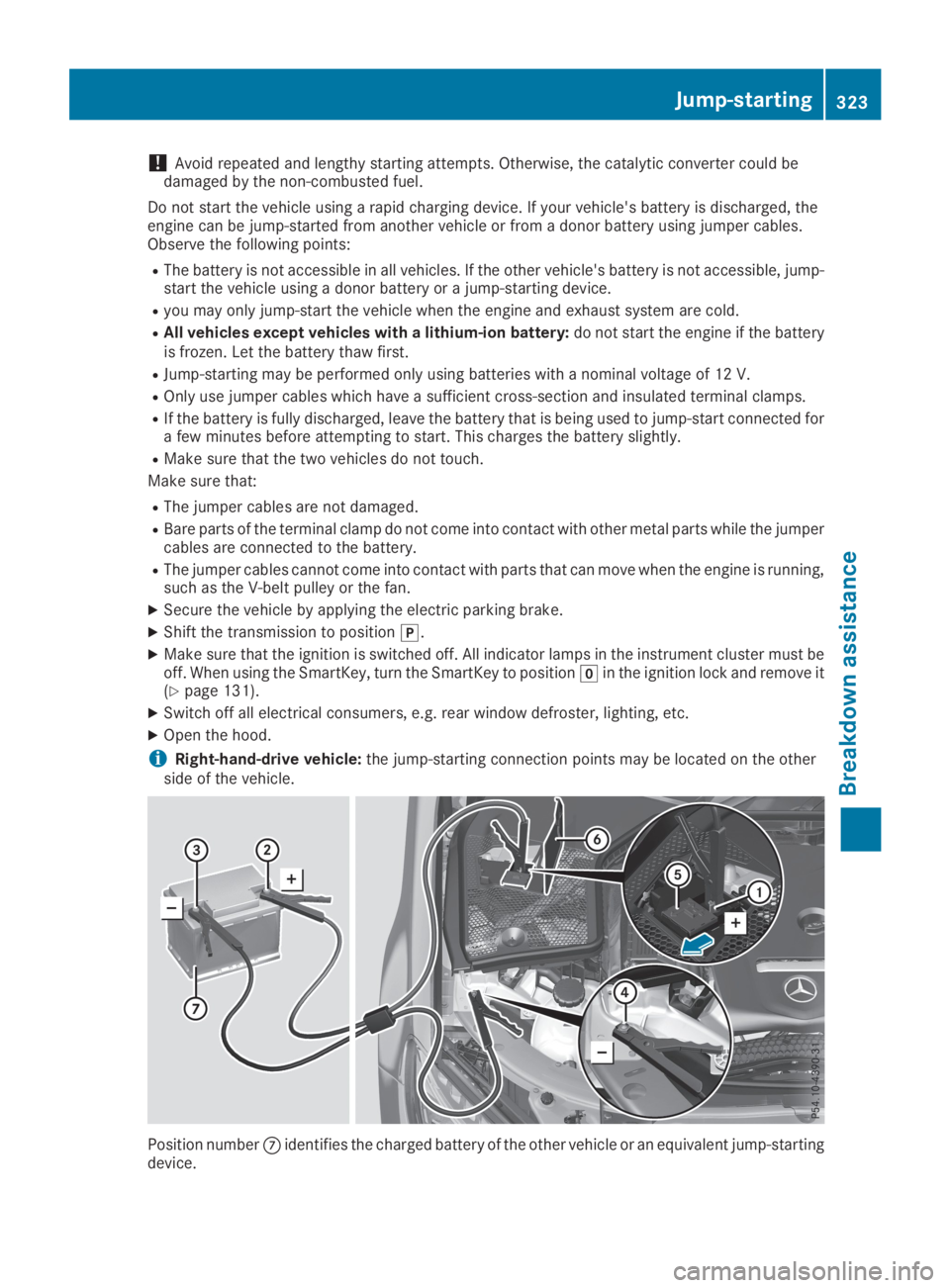
Position numberkidentifies the charged battery of the other vehicle or an equivalent jump-startingdevice.
Jump-starting323
Breakdown assistance
Z
Page 329 of 370
Notes on 4MATIC vehicles
!Vehicles with 4MATIC must not be towedwith either the front or the rear axle raised, asdoing so will damage the transmission.
Vehicles with 4MATIC may either be towed awaywith both axles on the ground or be loaded upand transported.
If the vehicle's transmission, front, or rear axle isdamaged, have the vehicle transported on atruck or trailer.
In the event of damage to the electrical sys-tem:if the battery is defective, the automatictransmission will be locked in positionP. To shiftthe automatic transmission to positionN, youmust provide power to the vehicle's electricalsystem in the same way as when jump-starting(Ypage 322).
Have the vehicle transported on a transporter ortrailer.
Tow-starting (emergency engine
starting)
!Vehicles with automatic transmission mustnot be tow-started. You could otherwise dam-age the automatic transmission.
iYou can find information on "Jump-starting"under (Ypage 322).
Fuses
Important safety notes
GWARNING
If you manipulate or bridge a faulty fuse or if
you replace it with a fuse with a higher amper-
age, the electric cables could be overloaded.
This could result in a fire. There is a risk of an
accident and injury.
Always replace faulty fuses with the specified
new fuses having the correct amperage.
Blown fuses must be replaced with fuses of thesame rating, which you can recognize by thecolor and value. The fuse ratings are listed in thefuse allocation chart.
The fuse allocation chart is on the fuse box in thecargo compartment (Ypage 328).
If a newly inserted fuse also blows, have thecause traced and rectified at a qualified special-ist workshop, e.g. an authorized Mercedes-BenzCenter.
!Only use fuses that have been approved forMercedes-Benz vehicles and which have thecorrect fuse rating for the system concerned.Otherwise, components or systems could bedamaged.
!Make sure that no moisture can enter thefuse box when the cover is open.
!When closing the cover, make sure that it islying correctly on the fuse box. Moisture seep-ing in or dirt could otherwise impair the oper-ation of the fuses.
The fuses in your vehicle serve to close downfaulty circuits. If a fuse blows, all the compo-nents on the circuit and their functions stopoperating.
Before changing a fuse
Observe the important safety notes(Ypage 327)
XSwitch off the engine.
XSwitch off all electrical consumers.
XMake sure that the ignition is switched off(Ypage 132).
or
XWhen using the SmartKey, turn the SmartKeyto position
Page 330 of 370
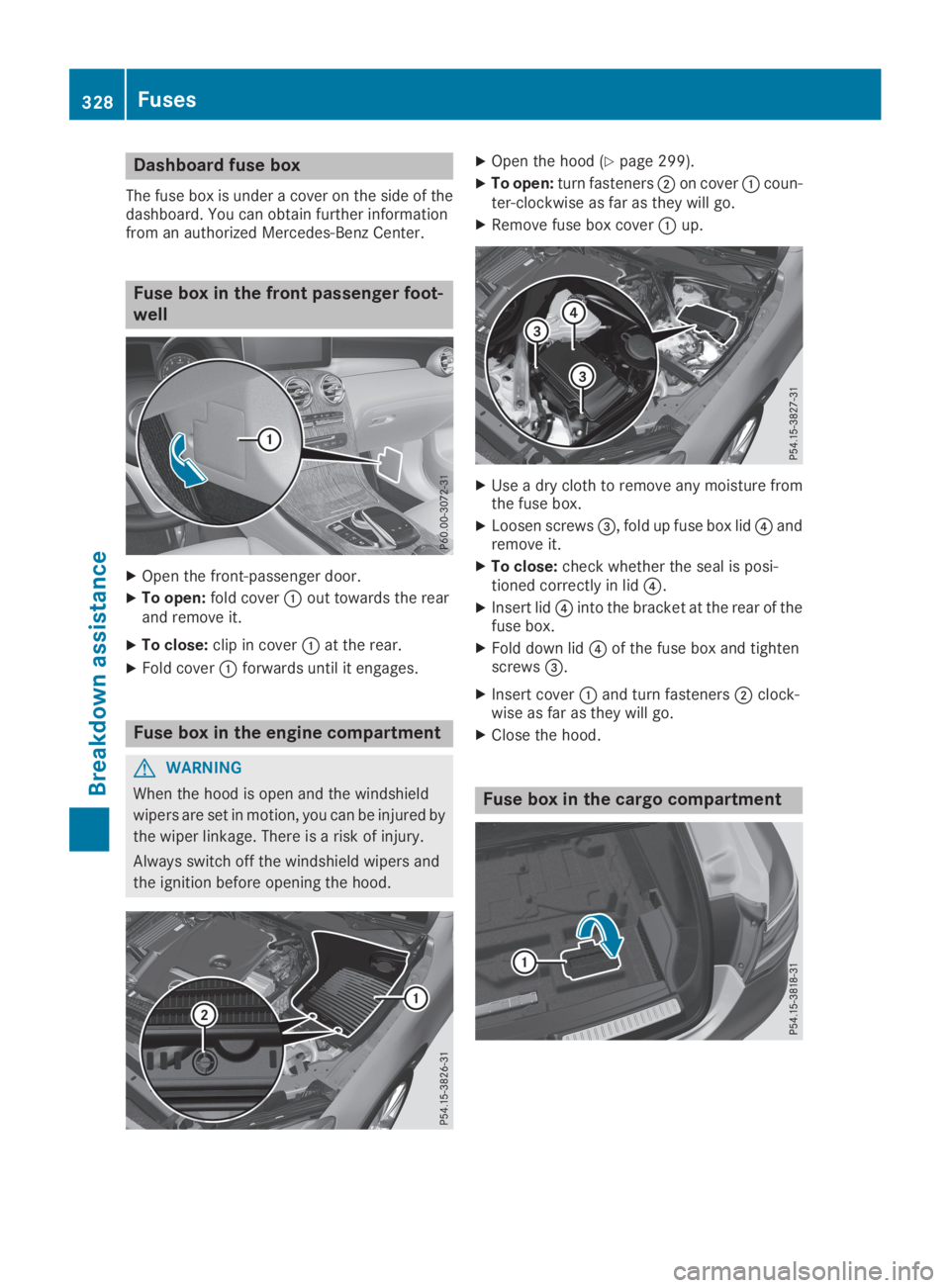
Dashboard fuse box
The fuse box is under a cover on the side of thedashboard. You can obtain further informationfrom an authorized Mercedes-Benz Center.
Fuse box in the front passenger foot-
well
XOpen the front-passenger door.
XTo open:fold coverCout towards the rearand remove it.
XTo close:clip in coverCat the rear.
XFold coverCforwards until it engages.
Fuse box in the engine compartment
GWARNING
When the hood is open and the windshield
wipers are set in motion, you can be injured by
the wiper linkage. There is a risk of injury.
Always switch off the windshield wipers and
the ignition before opening the hood.
XOpen the hood (Ypage 299).
XTo open:turn fastenersDon coverCcoun-ter-clockwise as far as they will go.
XRemove fuse box coverCup.
XUse a dry cloth to remove any moisture fromthe fuse box.
XLoosen screws
Page 353 of 370
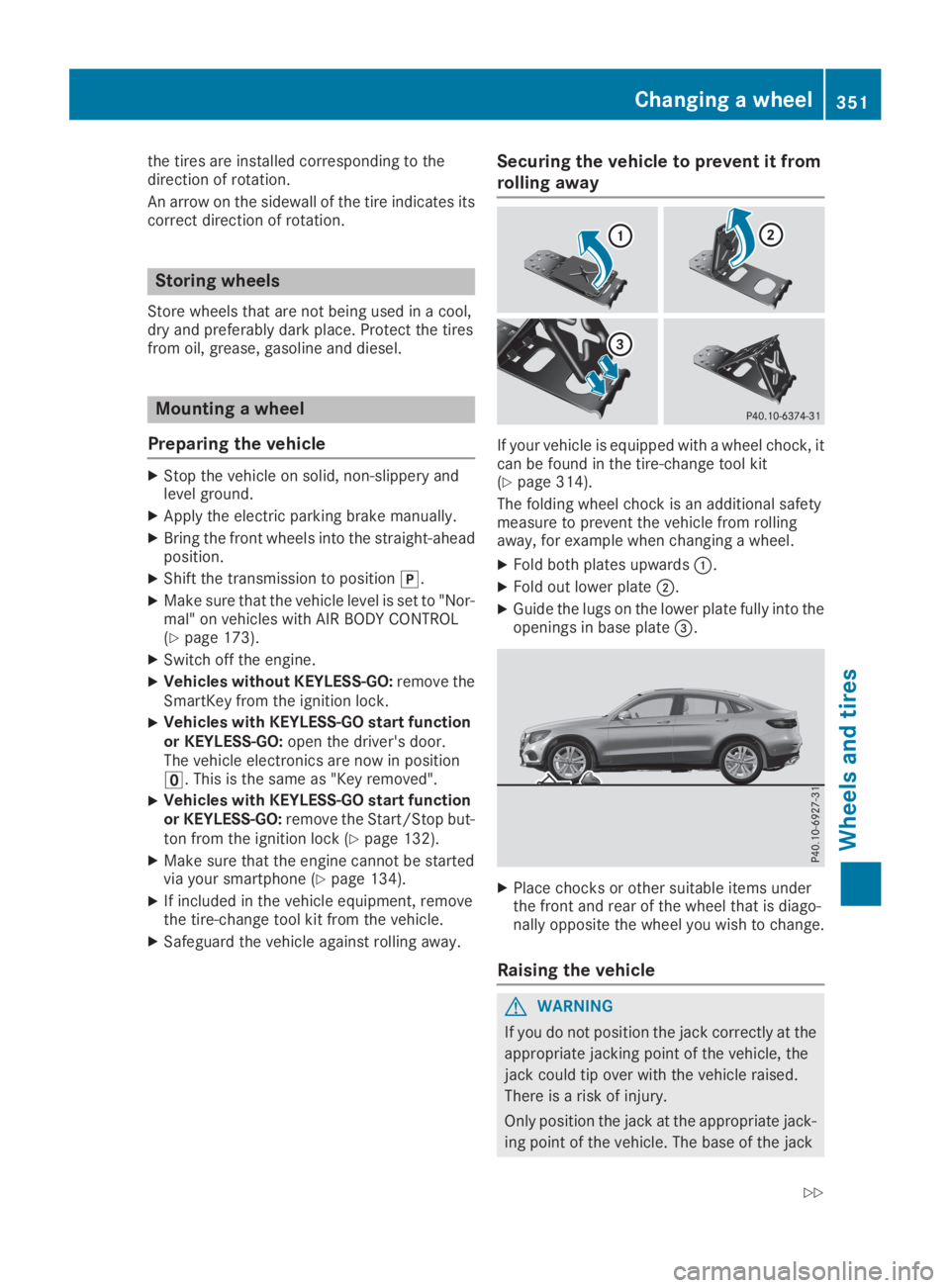
the tires are installed corresponding to thedirection of rotation.
An arrow on the sidewall of the tire indicates itscorrect direction of rotation.
Storing wheels
Store wheels that are not being used in a cool,dry and preferably dark place. Protect the tiresfrom oil, grease, gasoline and diesel.
Mounting a wheel
Preparing the vehicle
XStop the vehicle on solid, non-slippery andlevel ground.
XApply the electric parking brake manually.
XBring the front wheels into the straight-aheadposition.
XShift the transmission to position].
XMake sure that the vehicle level is set to "Nor-mal" on vehicles with AIR BODY CONTROL(Ypage 173).
XSwitch off the engine.
XVehicles without KEYLESS-GO:remove theSmartKey from the ignition lock.
XVehicles with KEYLESS-GO start functionor KEYLESS-GO:open the driver's door.The vehicle electronics are now in position
Page 354 of 370
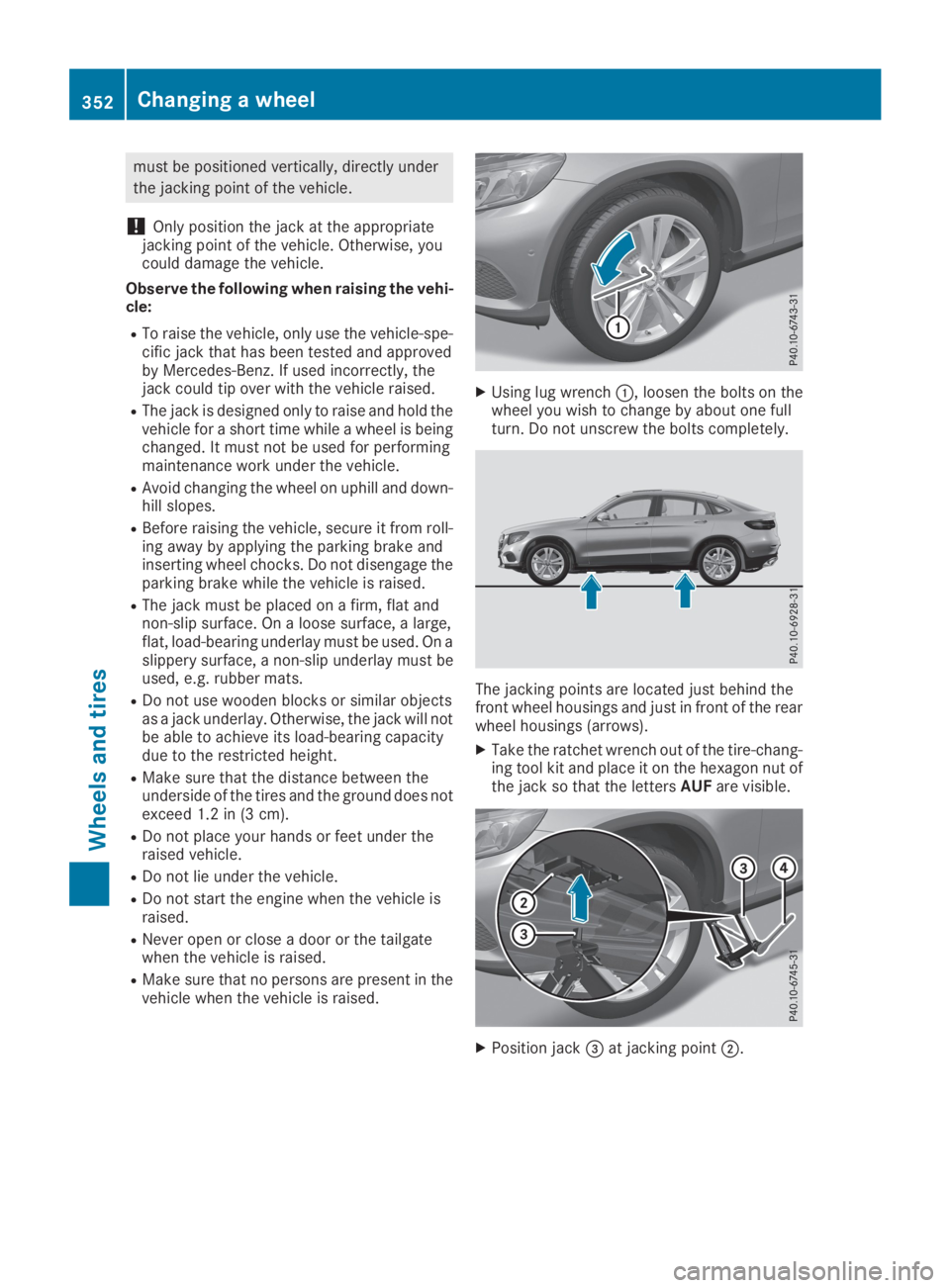
must be positioned vertically, directly under
the jacking point of the vehicle.
!Only position the jack at the appropriatejacking point of the vehicle. Otherwise, youcould damage the vehicle.
Observe the following when raising the vehi-cle:
RTo raise the vehicle, only use the vehicle-spe-cific jack that has been tested and approvedby Mercedes-Benz. If used incorrectly, thejack could tip over with the vehicle raised.
RThe jack is designed only to raise and hold thevehicle for a short time while a wheel is beingchanged. It must not be used for performingmaintenance work under the vehicle.
RAvoid changing the wheel on uphill and down-hill slopes.
RBefore raising the vehicle, secure it from roll-ing away by applying the parking brake andinserting wheel chocks. Do not disengage theparking brake while the vehicle is raised.
RThe jack must be placed on a firm, flat andnon-slip surface. On a loose surface, a large,flat, load-bearing underlay must be used. On aslippery surface, a non-slip underlay must beused, e.g. rubber mats.
RDo not use wooden blocks or similar objectsas a jack underlay. Otherwise, the jack will notbe able to achieve its load-bearing capacitydue to the restricted height.
RMake sure that the distance between theunderside of the tires and the ground does notexceed 1.2 in (3 cm).
RDo not place your hands or feet under theraised vehicle.
RDo not lie under the vehicle.
RDo not start the engine when the vehicle israised.
RNever open or close a door or the tailgatewhen the vehicle is raised.
RMake sure that no persons are present in thevehicle when the vehicle is raised.
XUsing lug wrenchC, loosen the bolts on thewheel you wish to change by about one fullturn. Do not unscrew the bolts completely.
The jacking points are located just behind thefront wheel housings and just in front of the rearwheel housings (arrows).
XTake the ratchet wrench out of the tire-chang-ing tool kit and place it on the hexagon nut ofthe jack so that the lettersAUFare visible.
XPosition jack
Page 360 of 370
iThe data shown on the vehicle identificationplate is used only as an example. This data isdifferent for every vehicle and can deviatefrom the data shown here. You can find thedata applicable to your vehicle on the vehicleidentification plate.
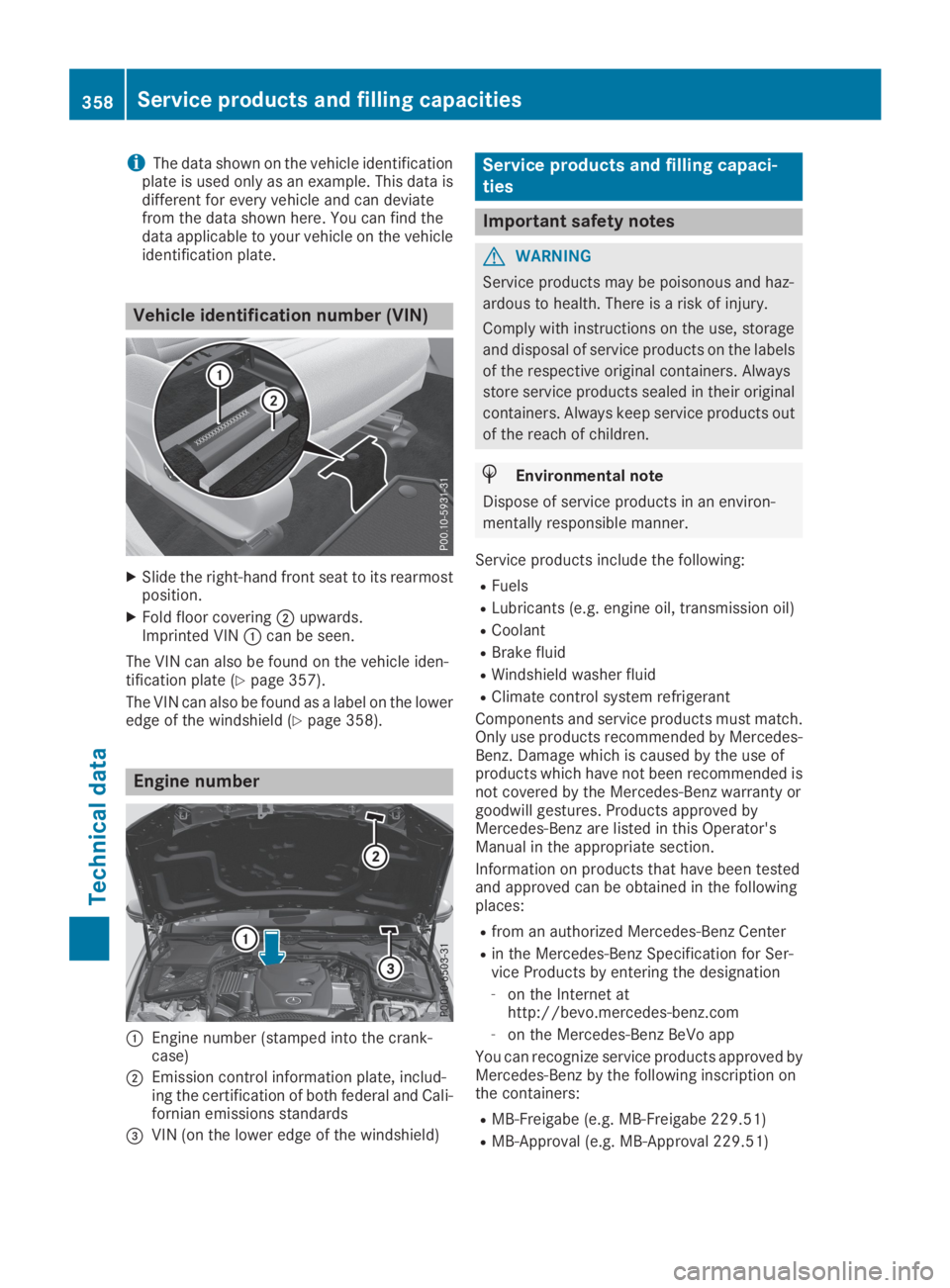
Vehicle identification number (VIN)
XSlide the right-hand front seat to its rearmostposition.
XFold floor coveringDupwards.Imprinted VINCcan be seen.
The VIN can also be found on the vehicle iden-tification plate (Ypage 357).
The VIN can also be found as a label on the loweredge of the windshield (Ypage 358).
Engine number
CEngine number (stamped into the crank-case)
DEmission control information plate, includ-ing the certification of both federal and Cali-fornian emissions standards
Page 361 of 370
Other designations or recommendations indi-cate a level of quality or a specification inaccordance with an MB Sheet Number (e.g. MB229.5). They have not necessarily beenapproved by Mercedes-Benz.
Other identifications, for example:
R0W-30
R5W-30
R5W-40
Fuel
Important safety notes
GWARNING
Fuel is highly flammable. Risk of fire and
explosion by improper handling of fuel.
You must avoid fire, open flames, smoking
and creating sparks. Switch off the ignition
before refueling and, if present, switch off the
auxiliary heating.
GWARNING
Fuel is poisonous and hazardous to health.
There is a risk of injury.
You must make sure that fuel does not come
into contact with your skin, eyes or clothing
and that it is not swallowed. Do not inhale fuel
vapors. Keep fuel away from children.
If you or others come into contact with fuel,
observe the following:
RWash away fuel from skin immediately
using soap and water.
RIf fuel comes into contact with your eyes,
immediately rinse them thoroughly with
clean water. Seek medical assistance with-
out delay.
RIf fuel is swallowed, seek medical assis-
tance without delay. Do not induce vomit-
ing.
RImmediately change out of clothing which
has come into contact with fuel.
Tank capacity
ModelTotal capacity
All models17.4 US gal(66.0l)
ModelOf whichreserve
Mercedes-AMG GLC 634MATIC+ Coupe
Mercedes-AMG GLC 63S 4MATIC+ Coupe
Approx.2.6 US gal(10.0l)
All other modelsApprox.1.8 US gal (7.0l)
Gasoline
Fuel grade
!Do not use diesel to refuel vehicles with agasoline engine. Do not switch on the ignitionif you accidentally refuel with the wrong fuel.Otherwise, the fuel will enter the fuel system.Even small amounts of the wrong fuel couldresult in damage to the fuel system and theengine. Notify a qualified specialist workshopand have the fuel tank and fuel lines drainedcompletely.
!Only refuel using low-sulfur premium-gradefuel with an octane rating of at least 91 AKI/95 RON.
iE10 fuel contains up to 10% ethanol by vol-ume. Your vehicle is E10-compatible. You canrefuel your vehicle using E10 fuel.
!Only use the fuel recommended. Operatingthe vehicle with other fuels can lead to dam-age to the fuel system, engine and exhaustsystem.
!Never refuel using:
RDiesel
RGasoline with more than 10% ethanol byvolume, e.g. E15, E20, E85, E100
RGasoline with more than 3% methanol byvolume, e.g. M15, M30, M85, M100
RGasoline with metalliferous additives
Do not mix such fuels with the fuel recom-mended for your vehicle.
Service products and filling capacities359
Technical data
Z
Page 362 of 370
!To ensure the longevity and full perform-ance of the engine, only premium-gradeunleaded gasoline may be used.
If premium-grade unleaded gasoline isunavailable and you have to refuel with regu-lar unleaded gasoline, observe the followingprecautions:
ROnly fill the fuel tank to half full with regularunleaded gasoline and add the rest as soonas possible with premium-grade unleadedgasoline.
RDo not drive at the maximum design speed.
RAvoid sudden acceleration and enginespeeds over 3000 rpm.
You will usually find information about the fuelgrade on the fuel pump. If you cannot find thelabel on the fuel pump, ask the gas station staff.
iFor further information, consult a qualifiedspecialist workshop or visithttp://www.mbusa.com (USA only).
As a temporary measure, if the recommendedfuel is not available, you may also use regularunleaded gasoline with an octane rating of87 AKI/91 RON. This may reduce engine per-formance and increase fuel consumption. Avoiddriving at full throttle and sudden acceleration.Never refuel using gasoline with a lower AKI.
Information on refueling (Ypage 151).
Additives
!Operating the engine with fuel additivesadded later can lead to engine failure. Do notmix fuel additives with fuel. This does notinclude additives for the removal and preven-tion of residue buildup. gasoline must only bemixed with additives recommended byMercedes-Benz. Comply with the instructionsfor use on the product label. More informationabout recommended additives can beobtained from any authorized Mercedes-BenzCenter.
Mercedes-Benz recommends that you use bran-ded fuels that have additives.
The fuel quality available in some countries maynot be sufficient. Residue could build up in thefuel injection system as a result. In such cases,and in consultation with an authorizedMercedes-Benz Center, the fuel may be mixedwith the cleaning additive recommended byMercedes-Benz. You must observe the notesand mixing ratios specified on the container.
Engine oil
General notes
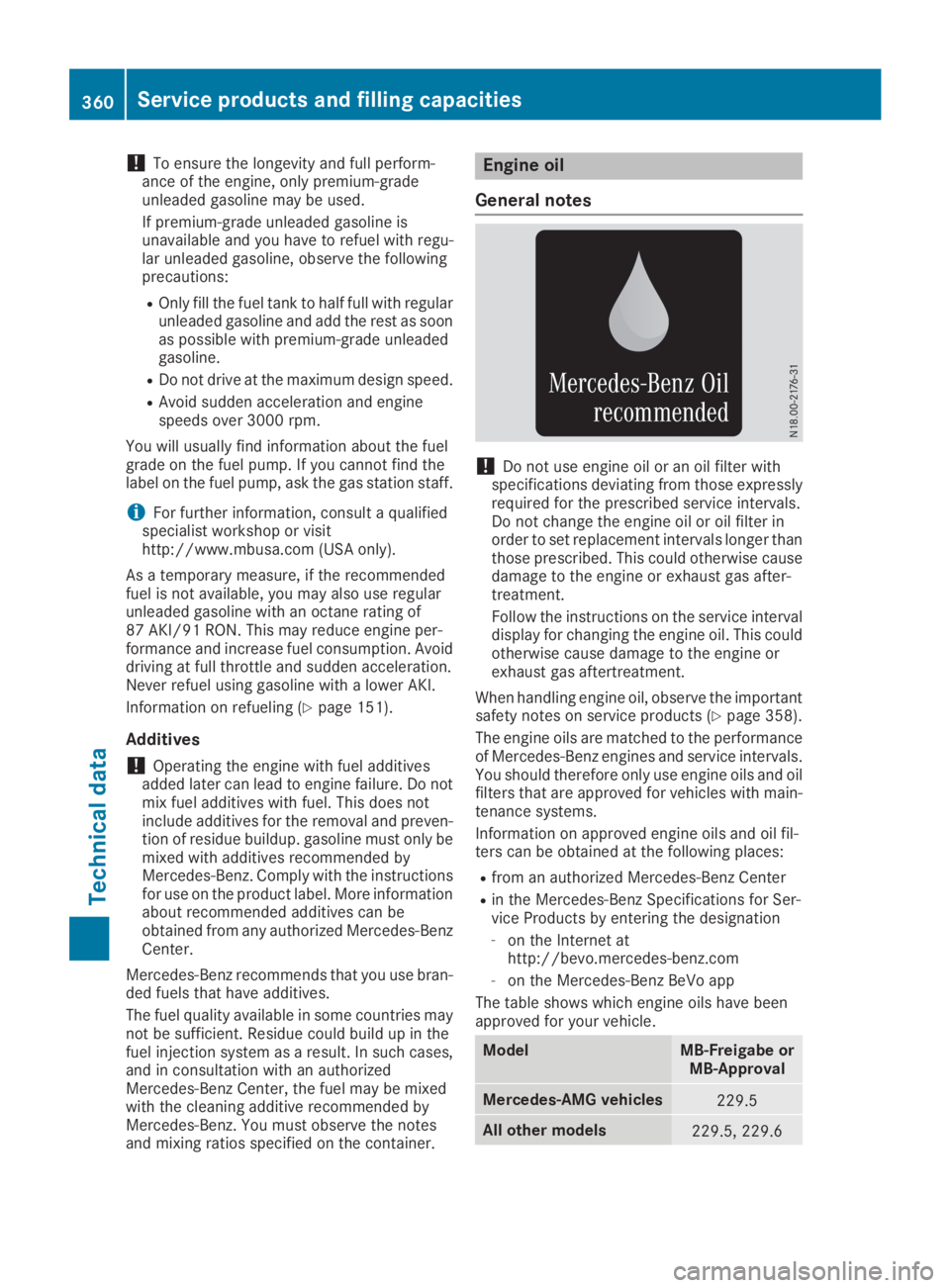
!Do not use engine oil or an oil filter withspecifications deviating from those expresslyrequired for the prescribed service intervals.Do not change the engine oil or oil filter inorder to set replacement intervals longer thanthose prescribed. This could otherwise causedamage to the engine or exhaust gas after-treatment.
Follow the instructions on the service intervaldisplay for changing the engine oil. This couldotherwise cause damage to the engine orexhaust gas aftertreatment.
When handling engine oil, observe the importantsafety notes on service products (Ypage 358).
The engine oils are matched to the performanceof Mercedes-Benz engines and service intervals.You should therefore only use engine oils and oilfilters that are approved for vehicles with main-tenance systems.
Information on approved engine oils and oil fil-ters can be obtained at the following places:
Rfrom an authorized Mercedes-Benz Center
Rin the Mercedes-Benz Specifications for Ser-vice Products by entering the designation
-on the Internet athttp://bevo.mercedes-benz.com
-on the Mercedes-Benz BeVo app
The table shows which engine oils have beenapproved for your vehicle.
ModelMB-Freigabe orMB-Approval
Mercedes-AMG vehicles229.5
All other models229.5, 229.6
360Service products and filling capacities
Technical data