belt MERCEDES-BENZ GLC 2019 User Guide
[x] Cancel search | Manufacturer: MERCEDES-BENZ, Model Year: 2019, Model line: GLC, Model: MERCEDES-BENZ GLC 2019Pages: 370, PDF Size: 19.55 MB
Page 47 of 370
occupant in the best position in relation to theair bag.
The seat belt system comprises:
RSeat belts
REmergency Tensioning Devices for the frontseat belts and the outer seat belts in the rear
RSeat belt force limiters for the front seat beltsand the outer seat belts in the rear
If the seat belt is pulled out of the belt outletquickly or with a jerky movement, the beltretractor locks. The belt strap cannot be extrac-ted any further.
The Emergency Tensioning Device tightens theseat belt in an accident, pulling the belt closeagainst the body. However it does not pull thevehicle occupant back in the direction of thebackrest.
The Emergency Tensioning Device does not cor-rect an incorrect seat position or the routing ofan incorrectly fastened seat belt.
When triggered, a seat belt force limiter helps toreduce the force exerted by the seat belt on thevehicle occupant.
The seat belt force limiters for the front seats aresynchronized with the front air bags, whichabsorb part of the deceleration force. This canreduce the force exerted on the vehicle occu-pants during an accident.
!If the front-passenger seat is not occupied,do not engage the seat belt tongue in thebuckle on the front-passenger seat. Other-wise, in the event of an accident the Emer-gency Tensioning Device and the side impactair bag, in addition to other systems, may betriggered and have to be replaced.
Important safety notes
The use of seat belts and child restraint systemsis required by law in:
Rall 50 states
Rthe U.S. territories
Rthe District of Columbia
Rall Canadian provinces
Even where this is not required by law, all vehicleoccupants should correctly fasten their seatbelts before starting the journey.
GWARNING
If the seat belt is not worn correctly, it cannot
perform its intended protective function. An
incorrectly fastened seat belt can also cause
injuries, for example, in the event of an acci-
dent or when braking or changing direction
abruptly. This poses an increased risk of injury
or even fatal injury.
Always ensure that all vehicle occupants have
their seat belts fastened correctly and are sit-
ting properly.
The components of the restraint system work inconjunction with each other. They can onlydeploy their protective function if, at all times, allvehicle occupants:
Rhave fastened their seat belts correctly(Ypage 46)
Rhave the seat and head restraint adjustedproperly (Ypage 96)
GWARNING
The seat belt does not offer the intended level
of protection if you have not moved the back-
rest to an almost vertical position. When brak-
ing or in the event of an accident, you could
slide underneath the seat belt and sustain
abdomen or neck injuries, for example. This
poses an increased risk of injury or even fatal
injury.
Adjust the seat properly before beginning
your journey. Always ensure that the backrest
is in an almost vertical position and that the
shoulder section of your seat belt is routed
across the center of your shoulder.
GWARNING
Persons less than 5 ft (1.50 m) tall cannot
wear the seat belt correctly without an addi-
tional and suitable restraint system. If the
seat belt is not worn correctly, it cannot per-
form its intended protective function. An
incorrectly fastened seat belt can also cause
injuries, for example, in the event of an acci-
dent or when braking or changing direction
abruptly. This poses an increased risk of injury
or even fatal injury.
For this reason, always secure persons under
5 ft (1.50 m) tall in suitable additional restraint
systems.
Occupant safety45
Safety
Z
Page 48 of 370
If a child younger than twelve years old andunder 5 ft (1.50m)in height is traveling in thevehicle:
Ralways secure the child in a child restraintsystem suitable for this Mercedes-Benz vehi-cle. The child restraint system must be appro-priate to the age, weight and size of the child
Ralways observe the instructions and safetynotes on "Children in the vehicle"(Ypage 59) in addition to the child restraintsystem manufacturer's installation and oper-ating instructions
Ralways observe the instructions and safetynotes on the "Occupant Classification System(OCS)" (Ypage 51)
GWARNING
The seat belts may not perform their intended
protective function if:
Rthey are damaged, modified, extremely
dirty, bleached or dyed
Rthe seat belt buckle is damaged or
extremely dirty
Rthe Emergency Tensioning Devices, belt
anchorages or inertia reels have been modi-
fied.
Seat belts may be damaged in an accident,
although the damage may not be visible, e.g.
due to splinters of glass. Modified or damaged
seat belts may tear or fail, e.g. in an accident.
Modified Emergency Tensioning Devices
could accidentally trigger or fail to deploy
when necessary. This poses an increased risk
of injury or even fatal injury.
Never modify the seat belts, Emergency Ten-
sioning Devices, belt anchorages and inertia
reels. Make sure that the seat belts are
undamaged, not worn out and clean. Follow-
ing an accident, have the seat belts checked
immediately at a qualified specialist work-
shop.
Only use seat belts that have been approved foryour vehicle by Mercedes-Benz.
AMG Performance seat:this seat is designedfor the standard three-point seat belt. If youinstall another multi-point seat belt, e.g. sport orracing seat belts, the restraint system cannotprovide the best level of protection.
GWARNING
If you feed seat belts through the opening in
the seat backrest, the seat backrest may be
damaged or may even break in the event of an
accident. This poses an increased risk of
injury or even fatal injury.
Only use the standard three-point seat belt.
Never modify the seat belt system.
Proper use of the seat belts
Observe the safety notes on the seat belt(Ypage 45).
All vehicle occupants must be wearing the seatbelt correctly before beginning the journey. Alsomake sure that all vehicle occupants are alwayswearing the seat belt correctly while the vehicleis in motion.
When fastening the seat belt, always make surethat:
Rthe seat belt buckle tongue is inserted onlyinto the belt buckle belonging to that seat
Rthe seat belt is pulled tight across your body
Avoid wearing bulky clothing, e.g. a wintercoat.
Rthe seat belt is not twisted
Only then can the forces which occur be dis-tributed over the area of the belt.
Rthe shoulder section of the belt is routedacross the center of your shoulder
The shoulder section of the seat belt shouldnot touch your neck or be routed under yourarm or behind your back. Where possible,adjust the seat belt to the appropriate height.
Rthe lap belt is taut and passes across your lapas low down as possible
The lap belt must always be routed acrossyour hip joints and not across your abdomen.This applies particularly to pregnant women.If necessary, push the lap belt down to yourhip joint and pull it tight using the shouldersection of the belt.
Rthe seat belt is not routed across sharp, poin-ted or fragile objects
If you have such items located on or in yourclothing, e.g. pens, keys or eyeglasses, storethese in a suitable place.
Ronly one person is using a seat belt
Infants and children must never travel sittingon the lap of a vehicle occupant. In the event
46Occupant safety
Safety
Page 49 of 370
of an accident, they could be crushedbetween the vehicle occupant and seat belt.
Robjects are never secured with a seat belt ifthe seat belt is also being used by one of thevehicle's occupants
Also ensure that there are never objectsbetween a person and the seat, e.g. cushions.
Seat belts are only intended to secure andrestrain vehicle occupants. Always observe the"Loading guidelines" for securing objects, lug-gage or loads (Ypage 278).
Fastening and adjusting the seat belts
Observe the safety notes on the seat belt(Ypage 45) and the notes on correct use of seatbelts (Ypage 46).
If the center rear seat belt is being used, alsoobserve the information about the seat belt forthe center rear seat (Ypage 47).
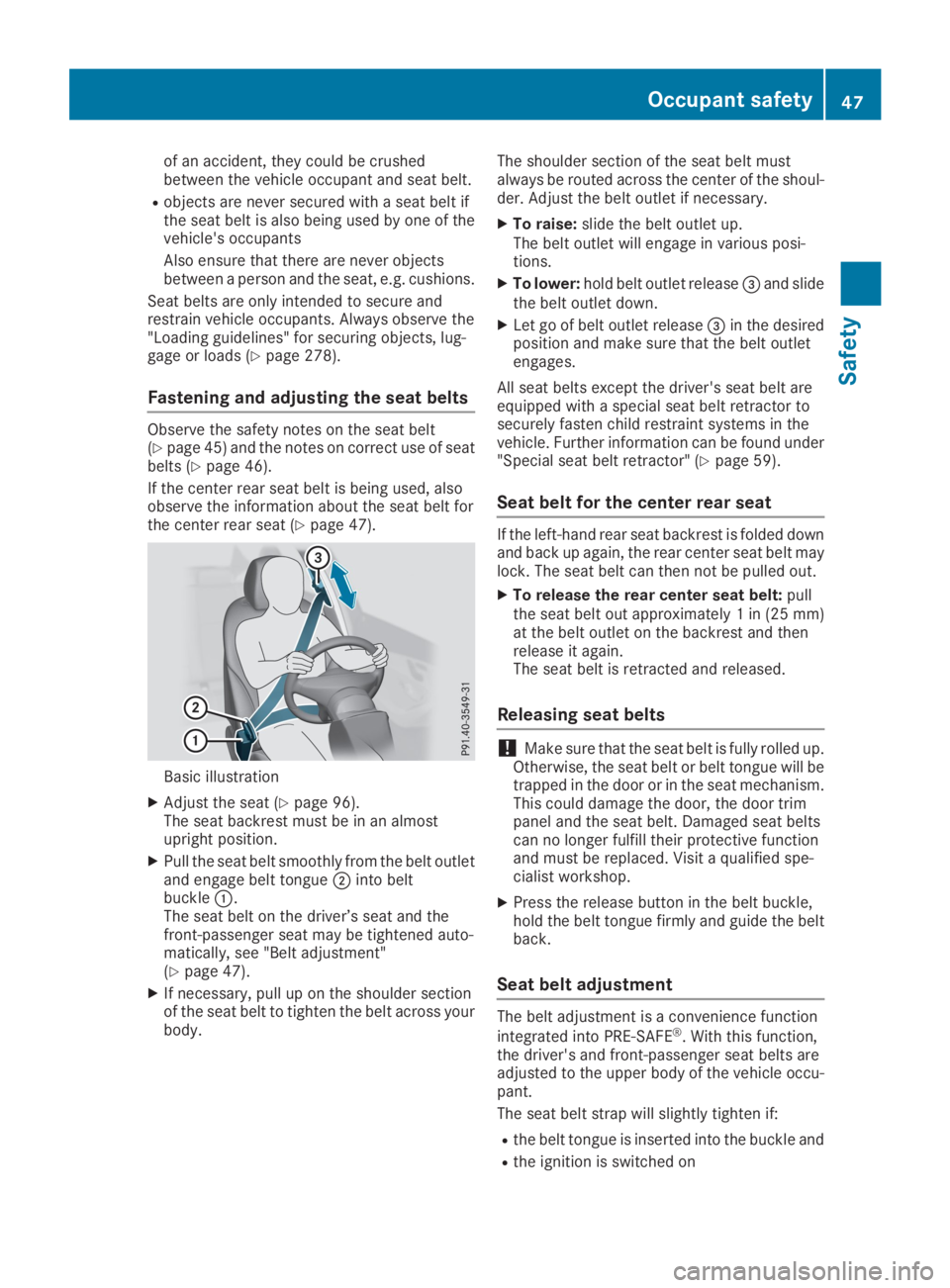
Basic illustration
XAdjust the seat (Ypage 96).The seat backrest must be in an almostupright position.
XPull the seat belt smoothly from the belt outletand engage belt tongueDinto beltbuckleC.The seat belt on the driver’s seat and thefront-passenger seat may be tightened auto-matically, see "Belt adjustment"(Ypage 47).
XIf necessary, pull up on the shoulder sectionof the seat belt to tighten the belt across yourbody.
The shoulder section of the seat belt mustalways be routed across the center of the shoul-der. Adjust the belt outlet if necessary.
XTo raise:slide the belt outlet up.The belt outlet will engage in various posi-tions.
XTo lower:hold belt outlet release
Page 50 of 370
The seat belt adjustment will apply a certaintightening force if any slack is detected betweenthe vehicle occupant and the seat belt. Do notgrab hold of the seat belt.
You can switch the seat belt adjustment on andoff using the multimedia system. Information onswitching the seat belt adjustment on and offcan be found in the Digital Operating Instruc-tions.
Belt warning for the driver and front
passenger
Thevseat belt warning lamp in the instru-ment cluster is a reminder that all vehicle occu-pants must wear their seat belts. It may light upcontinuously or flash. In addition, there may bea warning tone.
Regardless of whether the driver's seat belt hasalready been fastened, thevseat belt warn-ing lamp lights up for six seconds each time theengine is started. If the front doors are closedand the driver's or front-passenger seat belt hasnot been fastened, thevseat belt warninglamp lights up again after the six seconds. Assoon as the driver's and front-passenger seatbelts are fastened or a front door is openedagain, thevseat belt warning lamp goes out.
If the driver's seat belt is not fastened after theengine is started, an additional warning tone willsound. The warning tone switches off after sixseconds or once the driver's seat belt is fas-tened.
If the vehicle's speed exceeds 15 mph(25 km/h)once and the driver's and front-passenger seat belts are not fastened, a warningtone sounds. A warning tone also sounds withincreasing intensity for 60 seconds or until thedriver or front passenger have fastened theirseat belts.
If the driver or front passenger unfasten theirseat belts during the journey, the seat belt warn-ing is activated again.
Air bags
Introduction
The installation point of an air bag can be rec-ognized by the AIRBAG marking.
An air bag complements the correctly fastenedseat belt. It is no substitute for the seat belt. The
air bag provides additional protection in appli-cable accident situations.
Not all air bags are deployed in an accident. Thedifferent air bag systems function independ-ently from one another (Ypage 55).
However, no system available today can com-pletely eliminate injuries and fatalities.
It is also not possible to rule out a risk of injurycaused by an air bag due to the high speed atwhich the air bag must be deployed.
Important safety notes
GWARNING
If you do not sit in the correct seat position,
the air bag cannot protect as intended and
could even cause additional injury when
deployed. This poses an increased risk of
injury or even fatal injury.
To avoid hazardous situations, always make
sure that all of the vehicle's occupants:
Rhave fastened their seat belts correctly,
including pregnant women
Rare sitting correctly and maintain the great-
est possible distance to the air bags
Rfollow the following instructions
Always make sure that there are no objects
between the air bag and the vehicle's occu-
pants.
RAdjust the seats properly before beginningyour journey. Always make sure that the seatis in an almost upright position. The center ofthe head restraint must support the head atabout eye level.
RMove the driver's and front-passenger seatsas far back as possible. The driver's seat posi-tion must allow the vehicle to be driven safely.
ROnly hold the steering wheel on the outside.This allows the air bag to be fully deployed.
RAlways lean against the backrest while driv-ing. Do not lean forward or lean against thedoor or side window. You may otherwise be inthe deployment area of the air bags.
RAlways keep your feet in the footwell in frontof the seat. Do not put your feet on the dash-
48Occupant safety
Safety
Page 51 of 370
board, for example. Your feet may otherwisebe in the deployment area of the air bag.
RFor this reason, always secure persons lessthan 5 ft (1.50 m) tall in suitable restraint sys-tems. Up to this height, the seat belt cannotbe worn correctly.
If a child is traveling in your vehicle, alsoobserve the following notes:
RAlways secure children under twelve years ofage and less than 5 ft (1.50m)tall in suitablechild restraint systems.
RChild restraint systems should be installed onthe rear seats.
ROnly secure a child in a rearward-facing childrestraint system on the front-passenger seatwhen the front-passenger front air bag isdeactivated. If the PASSENGER AIR BAG OFFindicator lamp is permanently lit, the front-passenger front air bag is deactivated(Ypage 44).
RAlways observe the instructions and safetynotes on the "Occupant Classification System(OCS)" (Ypage 51) and on "Children in thevehicle" (Ypage 59) in addition to the childrestraint system manufacturer's installationand operating instructions.
Objects in the vehicle interior may preventan air bag from functioning correctly.Beforestarting your journey and to avoid risks resultingfrom the speed of the air bag as it deploys, makesure that:
Rthere are no people, animals or objectsbetween the vehicle occupants and an air bag
Rthere are no objects between the seat, doorand B-pillar
Rthere are no hard objects, e.g. coat hangers,hanging on the grab handles or coat hooks
Rno accessories, such as cup holders, areattached to the vehicle within the deploymentarea of an air bag, e.g. to doors, side windows,rear side trim or side walls
Rno heavy, sharp-edged or fragile objects are inthe pockets of your clothing. Store suchobjects in a suitable place
GWARNING
If you modify the air bag cover or affix objects
such as stickers to it, the air bag can no longer
function correctly. There is an increased risk
of injury.
Never modify an air bag cover or affix objects
to it.
GWARNING
Sensors to control the air bags are located in
the doors. Modifications or work not per-
formed correctly to the doors or door panel-
ing, as well as damaged doors, can lead to the
function of the sensors being impaired. The air
bags might therefore not function properly
anymore. Consequently, the air bags cannot
protect vehicle occupants as they are
designed to do. There is an increased risk of
injury.
Never modify the doors or parts of the doors.
Always have work on the doors or door pan-
eling carried out at a qualified specialist work-
shop.
Front air bags
!Do not place heavy objects on the front-passenger seat. This could cause the systemto identify the seat as being occupied. In theevent of an accident, the restraint systems onthe front-passenger side may be triggeredand have to be replaced.
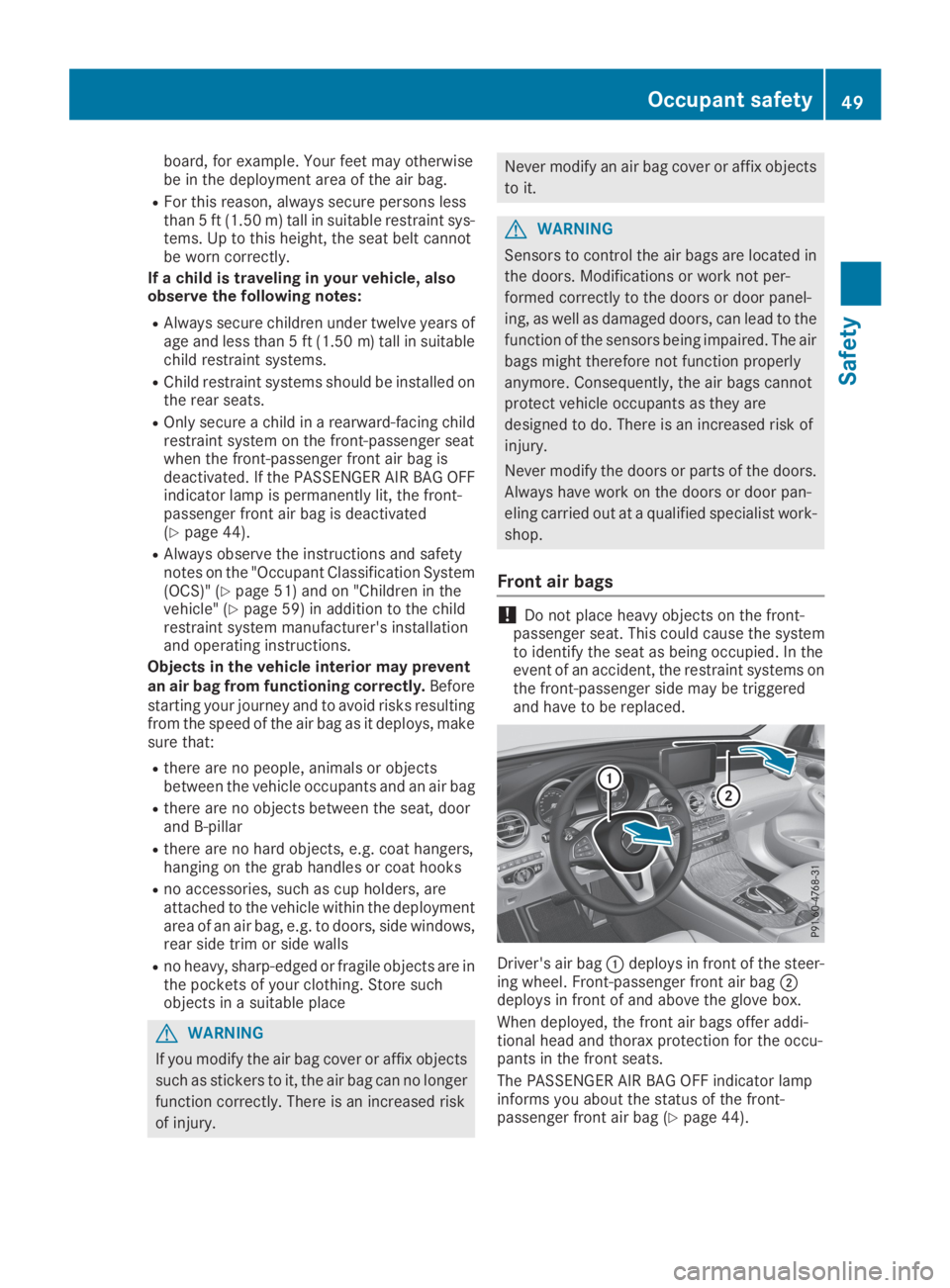
Driver's air bagCdeploys in front of the steer-ing wheel. Front-passenger front air bagDdeploys in front of and above the glove box.
When deployed, the front air bags offer addi-tional head and thorax protection for the occu-pants in the front seats.
The PASSENGER AIR BAG OFF indicator lampinforms you about the status of the front-passenger front air bag (Ypage 44).
Occupant safety49
Safety
Z
Page 52 of 370
The front-passenger front air bag will onlydeploy if:
Rthe system, based on the OCS weight sensorreadings, detects that the front-passengerseat is occupied (Ypage 51). ThePASSENGER AIR BAG OFF indicator lamp isnot lit (Ypage 51)
Rthe restraint system control unit predicts ahigh accident severity
Driver's knee bag
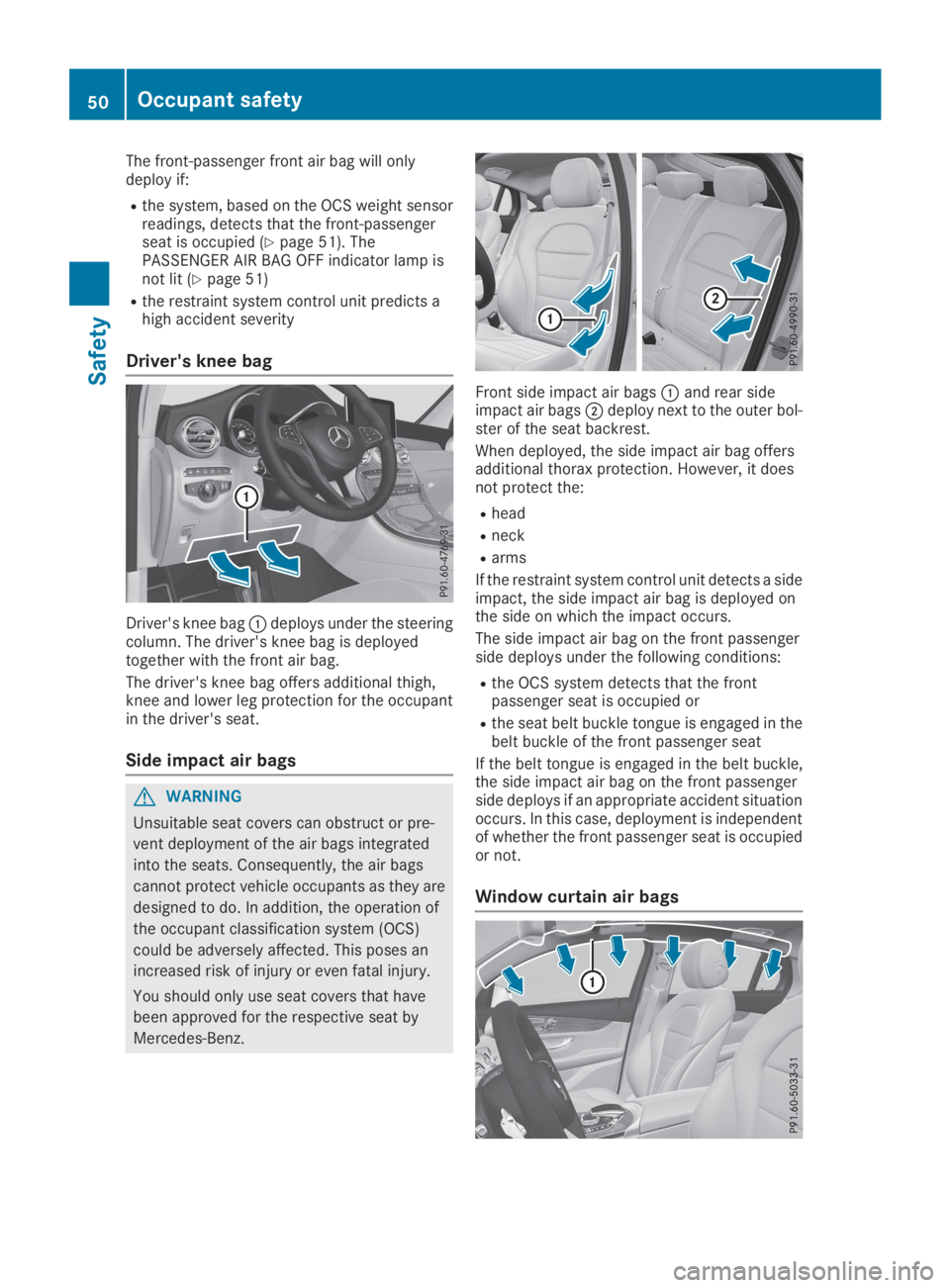
Driver's knee bagCdeploys under the steeringcolumn. The driver's knee bag is deployedtogether with the front air bag.
The driver's knee bag offers additional thigh,knee and lower leg protection for the occupantin the driver's seat.
Side impact air bags
GWARNING
Unsuitable seat covers can obstruct or pre-
vent deployment of the air bags integrated
into the seats. Consequently, the air bags
cannot protect vehicle occupants as they are
designed to do. In addition, the operation of
the occupant classification system (OCS)
could be adversely affected. This poses an
increased risk of injury or even fatal injury.
You should only use seat covers that have
been approved for the respective seat by
Mercedes-Benz.
Front side impact air bagsCand rear sideimpact air bagsDdeploy next to the outer bol-ster of the seat backrest.
When deployed, the side impact air bag offersadditional thorax protection. However, it doesnot protect the:
Rhead
Rneck
Rarms
If the restraint system control unit detects a sideimpact, the side impact air bag is deployed onthe side on which the impact occurs.
The side impact air bag on the front passengerside deploys under the following conditions:
Rthe OCS system detects that the frontpassenger seat is occupied or
Rthe seat belt buckle tongue is engaged in thebelt buckle of the front passenger seat
If the belt tongue is engaged in the belt buckle,the side impact air bag on the front passengerside deploys if an appropriate accident situationoccurs. In this case, deployment is independentof whether the front passenger seat is occupiedor not.
Window curtain air bags
50Occupant safety
Safety
Page 53 of 370
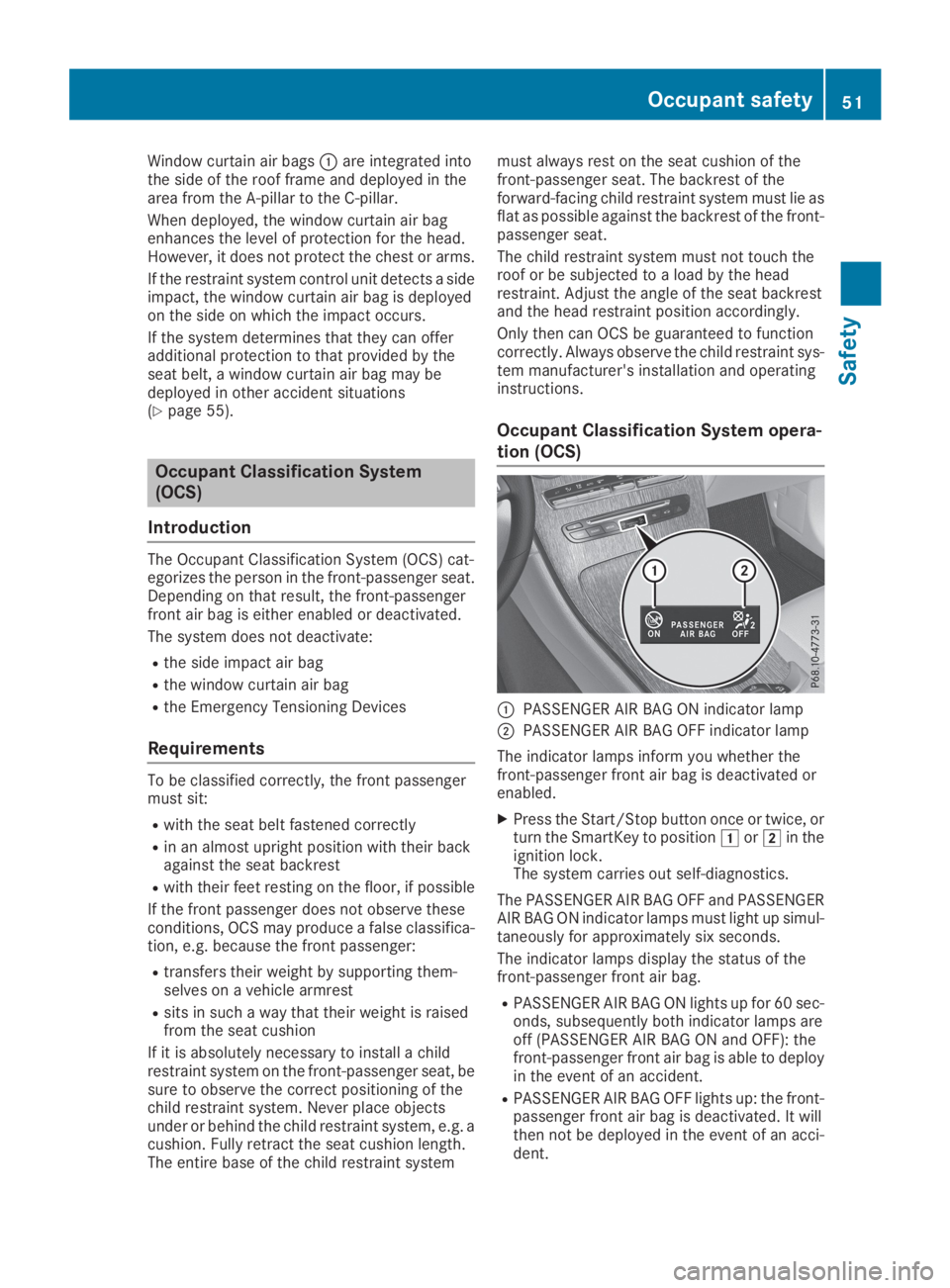
Window curtain air bagsCare integrated intothe side of the roof frame and deployed in thearea from the A-pillar to the C-pillar.
When deployed, the window curtain air bagenhances the level of protection for the head.However, it does not protect the chest or arms.
If the restraint system control unit detects a sideimpact, the window curtain air bag is deployedon the side on which the impact occurs.
If the system determines that they can offeradditional protection to that provided by theseat belt, a window curtain air bag may bedeployed in other accident situations(Ypage 55).
Occupant Classification System
(OCS)
Introduction
The Occupant Classification System (OCS) cat-egorizes the person in the front-passenger seat.Depending on that result, the front-passengerfront air bag is either enabled or deactivated.
The system does not deactivate:
Rthe side impact air bag
Rthe window curtain air bag
Rthe Emergency Tensioning Devices
Requirements
To be classified correctly, the front passengermust sit:
Rwith the seat belt fastened correctly
Rin an almost upright position with their backagainst the seat backrest
Rwith their feet resting on the floor, if possible
If the front passenger does not observe theseconditions, OCS may produce a false classifica-tion, e.g. because the front passenger:
Rtransfers their weight by supporting them-selves on a vehicle armrest
Rsits in such a way that their weight is raisedfrom the seat cushion
If it is absolutely necessary to install a childrestraint system on the front-passenger seat, besure to observe the correct positioning of thechild restraint system. Never place objectsunder or behind the child restraint system, e.g. acushion. Fully retract the seat cushion length.The entire base of the child restraint system
must always rest on the seat cushion of thefront-passenger seat. The backrest of theforward-facing child restraint system must lie asflat as possible against the backrest of the front-passenger seat.
The child restraint system must not touch theroof or be subjected to a load by the headrestraint. Adjust the angle of the seat backrestand the head restraint position accordingly.
Only then can OCS be guaranteed to functioncorrectly. Always observe the child restraint sys-tem manufacturer's installation and operatinginstructions.
Occupant Classification System opera-
tion (OCS)
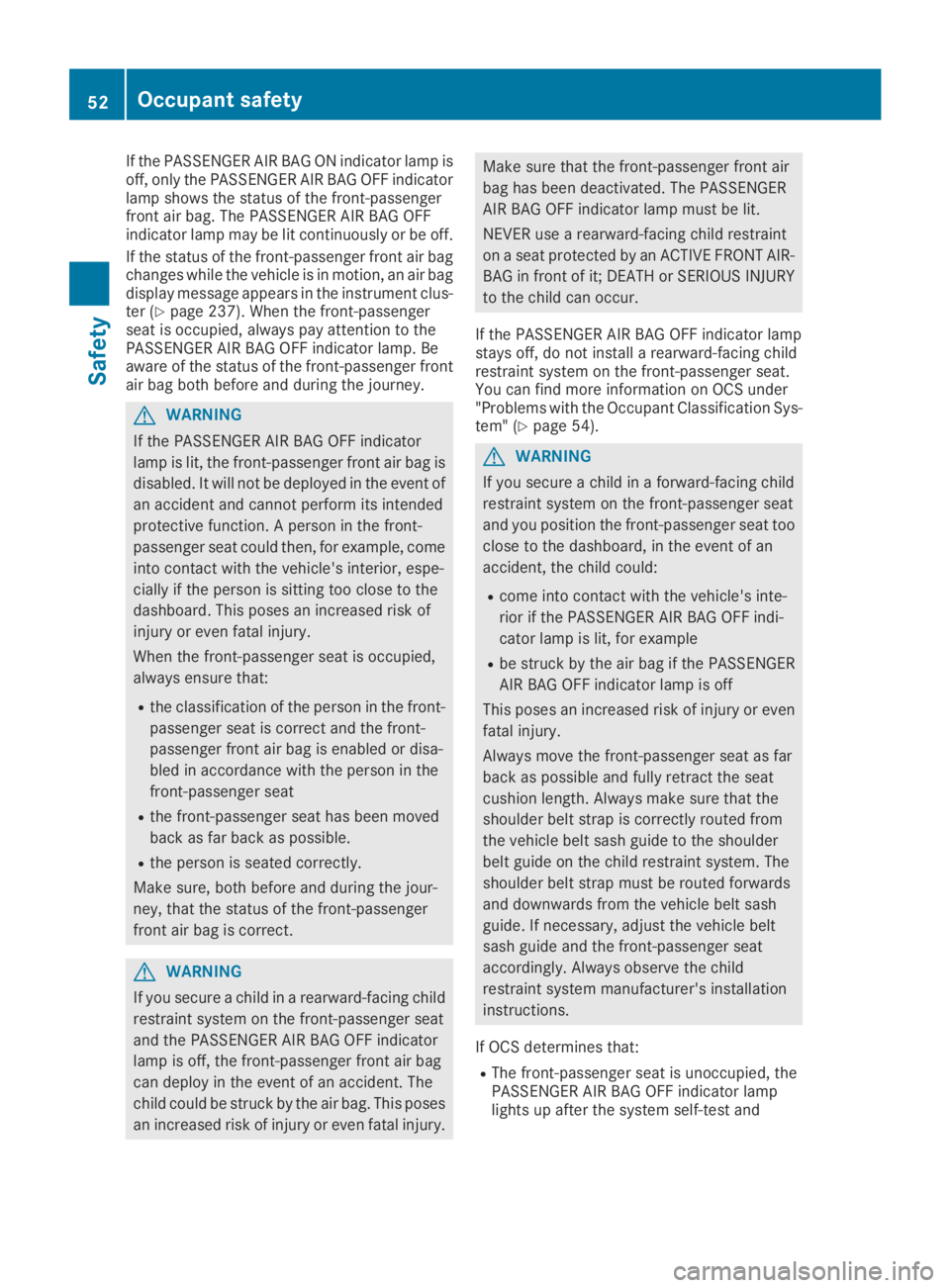
CPASSENGER AIR BAG ON indicator lamp
DPASSENGER AIR BAG OFF indicator lamp
The indicator lamps inform you whether thefront-passenger front air bag is deactivated orenabled.
XPress the Start/Stop button once or twice, orturn the SmartKey to positionGorHin theignition lock.The system carries out self-diagnostics.
The PASSENGER AIR BAG OFF and PASSENGERAIR BAG ON indicator lamps must light up simul-taneously for approximately six seconds.
The indicator lamps display the status of thefront-passenger front air bag.
RPASSENGER AIR BAG ON lights up for 60 sec-onds, subsequently both indicator lamps areoff (PASSENGER AIR BAG ON and OFF): thefront-passenger front air bag is able to deployin the event of an accident.
RPASSENGER AIR BAG OFF lights up: the front-passenger front air bag is deactivated. It willthen not be deployed in the event of an acci-dent.
Occupant safety51
Safety
Z
Page 54 of 370
If the PASSENGER AIR BAG ON indicator lamp isoff, only the PASSENGER AIR BAG OFF indicatorlamp shows the status of the front-passengerfront air bag. The PASSENGER AIR BAG OFFindicator lamp may be lit continuously or be off.
If the status of the front-passenger front air bagchanges while the vehicle is in motion, an air bagdisplay message appears in the instrument clus-ter (Ypage 237). When the front-passengerseat is occupied, always pay attention to thePASSENGER AIR BAG OFF indicator lamp. Beaware of the status of the front-passenger frontair bag both before and during the journey.
GWARNING
If the PASSENGER AIR BAG OFF indicator
lamp is lit, the front-passenger front air bag is
disabled. It will not be deployed in the event of
an accident and cannot perform its intended
protective function. A person in the front-
passenger seat could then, for example, come
into contact with the vehicle's interior, espe-
cially if the person is sitting too close to the
dashboard. This poses an increased risk of
injury or even fatal injury.
When the front-passenger seat is occupied,
always ensure that:
Rthe classification of the person in the front-
passenger seat is correct and the front-
passenger front air bag is enabled or disa-
bled in accordance with the person in the
front-passenger seat
Rthe front-passenger seat has been moved
back as far back as possible.
Rthe person is seated correctly.
Make sure, both before and during the jour-
ney, that the status of the front-passenger
front air bag is correct.
GWARNING
If you secure a child in a rearward-facing child
restraint system on the front-passenger seat
and the PASSENGER AIR BAG OFF indicator
lamp is off, the front-passenger front air bag
can deploy in the event of an accident. The
child could be struck by the air bag. This poses
an increased risk of injury or even fatal injury.
Make sure that the front-passenger front air
bag has been deactivated. The PASSENGER
AIR BAG OFF indicator lamp must be lit.
NEVER use a rearward-facing child restraint
on a seat protected by an ACTIVE FRONT AIR-
BAG in front of it; DEATH or SERIOUS INJURY
to the child can occur.
If the PASSENGER AIR BAG OFF indicator lampstays off, do not install a rearward-facing childrestraint system on the front-passenger seat.You can find more information on OCS under"Problems with the Occupant Classification Sys-tem" (Ypage 54).
GWARNING
If you secure a child in a forward-facing child
restraint system on the front-passenger seat
and you position the front-passenger seat too
close to the dashboard, in the event of an
accident, the child could:
Rcome into contact with the vehicle's inte-
rior if the PASSENGER AIR BAG OFF indi-
cator lamp is lit, for example
Rbe struck by the air bag if the PASSENGER
AIR BAG OFF indicator lamp is off
This poses an increased risk of injury or even
fatal injury.
Always move the front-passenger seat as far
back as possible and fully retract the seat
cushion length. Always make sure that the
shoulder belt strap is correctly routed from
the vehicle belt sash guide to the shoulder
belt guide on the child restraint system. The
shoulder belt strap must be routed forwards
and downwards from the vehicle belt sash
guide. If necessary, adjust the vehicle belt
sash guide and the front-passenger seat
accordingly. Always observe the child
restraint system manufacturer's installation
instructions.
If OCS determines that:
RThe front-passenger seat is unoccupied, thePASSENGER AIR BAG OFF indicator lamplights up after the system self-test and
52Occupant safety
Safety
Page 56 of 370
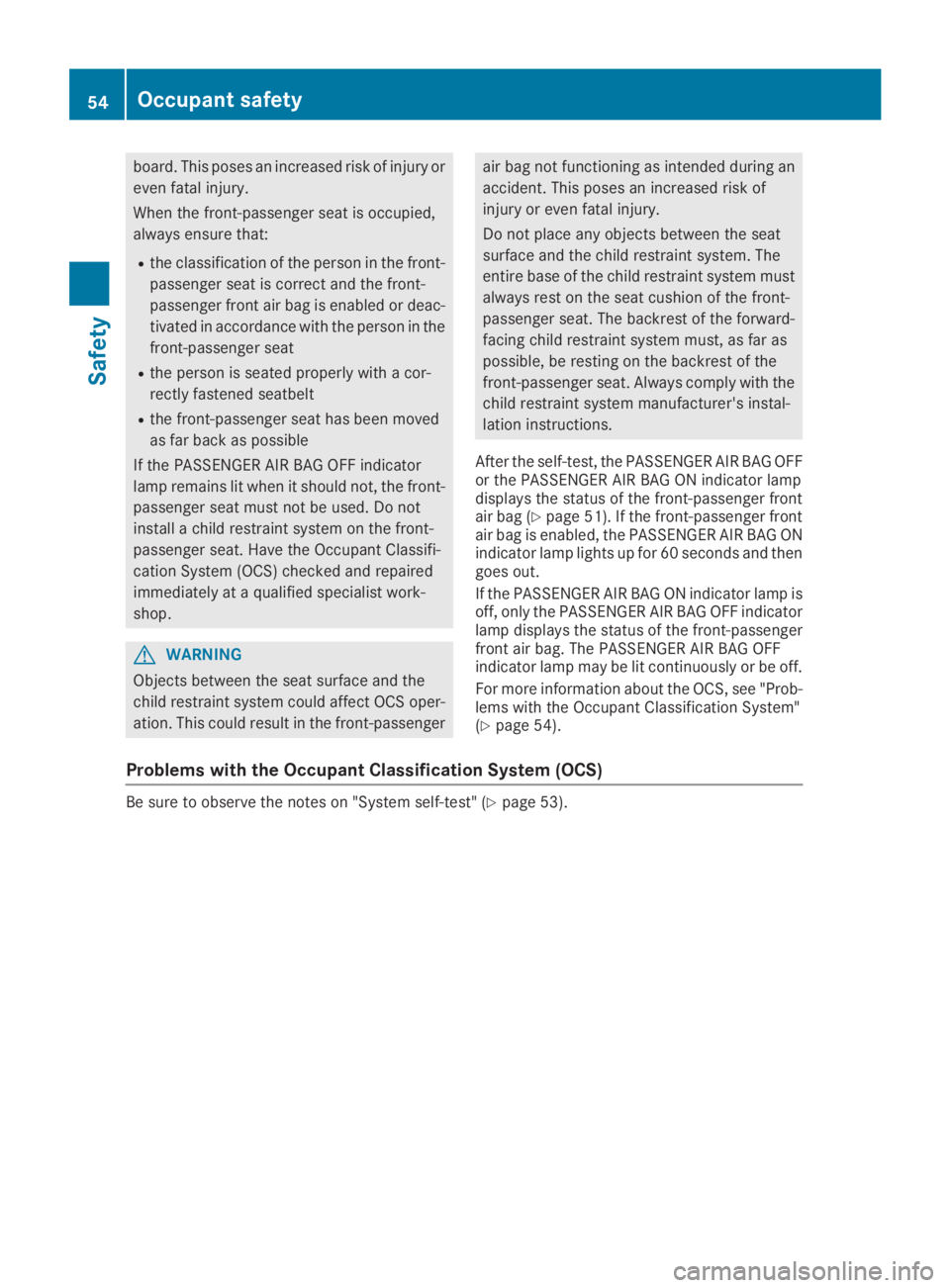
board. This poses an increased risk of injury or
even fatal injury.
When the front-passenger seat is occupied,
always ensure that:
Rthe classification of the person in the front-
passenger seat is correct and the front-
passenger front air bag is enabled or deac-
tivated in accordance with the person in the
front-passenger seat
Rthe person is seated properly with a cor-
rectly fastened seatbelt
Rthe front-passenger seat has been moved
as far back as possible
If the PASSENGER AIR BAG OFF indicator
lamp remains lit when it should not, the front-
passenger seat must not be used. Do not
install a child restraint system on the front-
passenger seat. Have the Occupant Classifi-
cation System (OCS) checked and repaired
immediately at a qualified specialist work-
shop.
GWARNING
Objects between the seat surface and the
child restraint system could affect OCS oper-
ation. This could result in the front-passenger
air bag not functioning as intended during an
accident. This poses an increased risk of
injury or even fatal injury.
Do not place any objects between the seat
surface and the child restraint system. The
entire base of the child restraint system must
always rest on the seat cushion of the front-
passenger seat. The backrest of the forward-
facing child restraint system must, as far as
possible, be resting on the backrest of the
front-passenger seat. Always comply with the
child restraint system manufacturer's instal-
lation instructions.
After the self-test, the PASSENGER AIR BAG OFFor the PASSENGER AIR BAG ON indicator lampdisplays the status of the front-passenger frontair bag (Ypage 51). If the front-passenger frontair bag is enabled, the PASSENGER AIR BAG ONindicator lamp lights up for 60 seconds and thengoes out.
If the PASSENGER AIR BAG ON indicator lamp isoff, only the PASSENGER AIR BAG OFF indicatorlamp displays the status of the front-passengerfront air bag. The PASSENGER AIR BAG OFFindicator lamp may be lit continuously or be off.
For more information about the OCS, see "Prob-lems with the Occupant Classification System"(Ypage 54).
Problems with the Occupant Classification System (OCS)
Be sure to observe the notes on "System self-test" (Ypage 53).
54Occupant safety
Safety
Page 57 of 370
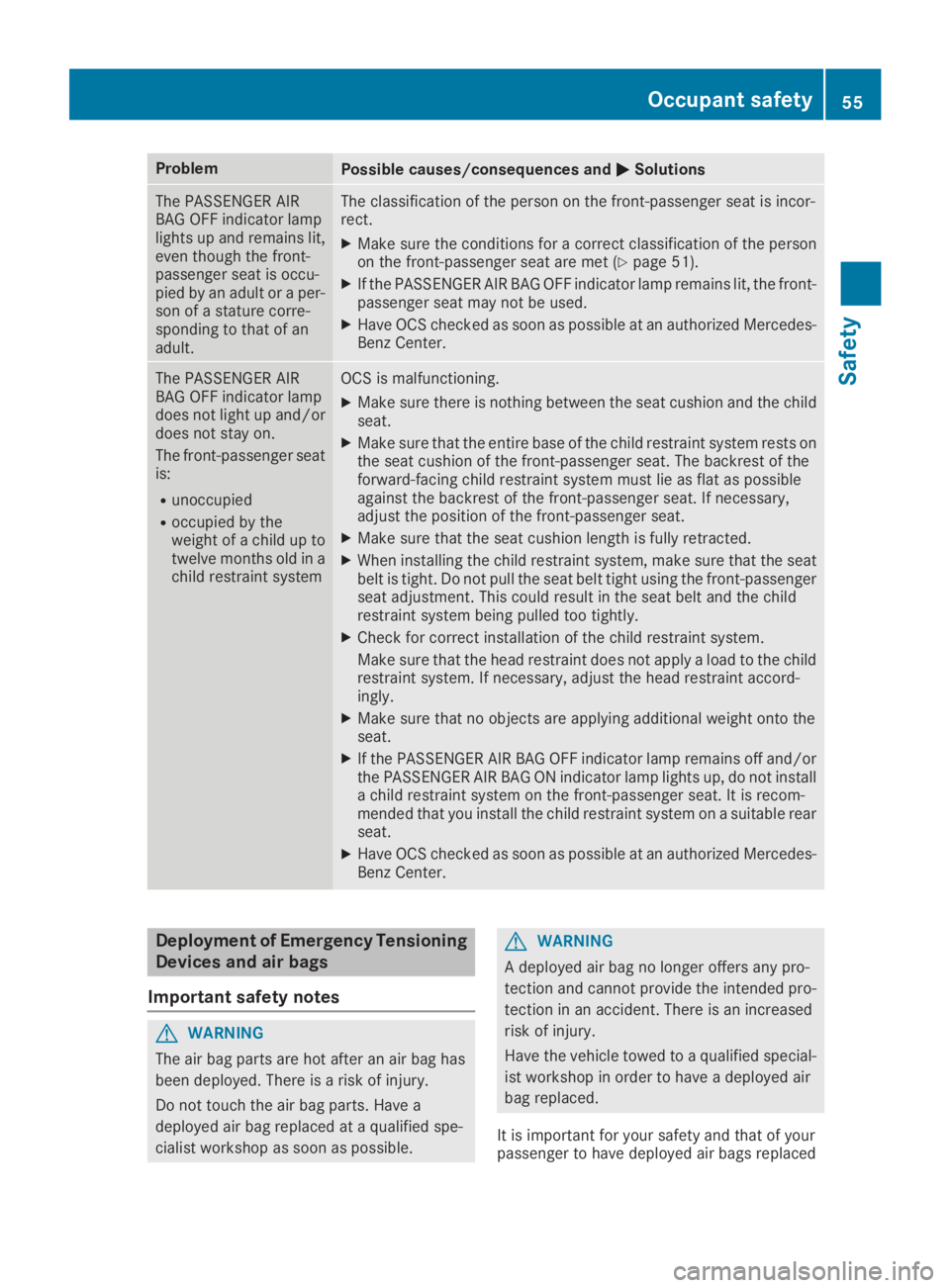
ProblemPossible causes/consequences andPPSolutions
The PASSENGER AIRBAG OFF indicator lamplights up and remains lit,even though the front-passenger seat is occu-pied by an adult or a per-son of a stature corre-sponding to that of anadult.
The classification of the person on the front-passenger seat is incor-rect.
XMake sure the conditions for a correct classification of the personon the front-passenger seat are met (Ypage 51).
XIf the PASSENGER AIR BAG OFF indicator lamp remains lit, the front-passenger seat may not be used.
XHave OCS checked as soon as possible at an authorized Mercedes-Benz Center.
The PASSENGER AIRBAG OFF indicator lampdoes not light up and/ordoes not stay on.
The front-passenger seatis:
Runoccupied
Roccupied by theweight of a child up totwelve months old in achild restraint system
OCS is malfunctioning.
XMake sure there is nothing between the seat cushion and the childseat.
XMake sure that the entire base of the child restraint system rests onthe seat cushion of the front-passenger seat. The backrest of theforward-facing child restraint system must lie as flat as possibleagainst the backrest of the front-passenger seat. If necessary,adjust the position of the front-passenger seat.
XMake sure that the seat cushion length is fully retracted.
XWhen installing the child restraint system, make sure that the seatbelt is tight. Do not pull the seat belt tight using the front-passengerseat adjustment. This could result in the seat belt and the childrestraint system being pulled too tightly.
XCheck for correct installation of the child restraint system.
Make sure that the head restraint does not apply a load to the childrestraint system. If necessary, adjust the head restraint accord-ingly.
XMake sure that no objects are applying additional weight onto theseat.
XIf the PASSENGER AIR BAG OFF indicator lamp remains off and/orthe PASSENGER AIR BAG ON indicator lamp lights up, do not installa child restraint system on the front-passenger seat. It is recom-mended that you install the child restraint system on a suitable rearseat.
XHave OCS checked as soon as possible at an authorized Mercedes-Benz Center.
Deployment of Emergency Tensioning
Devices and air bags
Important safety notes
GWARNING
The air bag parts are hot after an air bag has
been deployed. There is a risk of injury.
Do not touch the air bag parts. Have a
deployed air bag replaced at a qualified spe-
cialist workshop as soon as possible.
GWARNING
A deployed air bag no longer offers any pro-
tection and cannot provide the intended pro-
tection in an accident. There is an increased
risk of injury.
Have the vehicle towed to a qualified special-
ist workshop in order to have a deployed air
bag replaced.
It is important for your safety and that of yourpassenger to have deployed air bags replaced
Occupant safety55
Safety
Z