ECU MERCEDES-BENZ GLC 2019 Repair Manual
[x] Cancel search | Manufacturer: MERCEDES-BENZ, Model Year: 2019, Model line: GLC, Model: MERCEDES-BENZ GLC 2019Pages: 370, PDF Size: 19.55 MB
Page 317 of 370
Flat tire
Preparing the vehicle
Your vehicle may be equipped with:
RMOExtended tires (tires with run-flat proper-ties) (Ypage 315)
Vehicle preparation is not necessary on vehi-cles with MOExtended tires.
Ra TIREFIT kit (Ypage 314)
Vehicles equipped with MOExtended tires arenot equipped with a TIREFIT kit at the factory. Itis therefore recommended that you additionallyequip your vehicle with a TIREFIT kit if you mounttires that do not feature run-flat characteristics,e.g. winter tires. A TIREFIT kit may be obtainedfrom a qualified specialist workshop.
Vehicles with a Mercedes-Benz emergency callsystem which are not equipped with a TIREFITkit: in the event of a flat tire, contact the Cus-tomer Assistance Center for the Mercedes-Benzemergency call system (Ypage 294).
Information on changing and mounting wheels(Ypage 351).
XStop the vehicle on solid, non-slippery andlevel ground, as far away as possible fromtraffic.
XSwitch on the hazard warning lamps.
XSecure the vehicle against rolling away(Ypage 152).
XIf possible, bring the front wheels into thestraight-ahead position.
XSwitch off the engine.
XRemove the SmartKey from the ignition lock.
or, in vehicles with KEYLESS-GO start-functionor KEYLESS‑GO
XOpen the driver's door.The vehicle electronics are now in position
Page 322 of 370
RMake sure that the positive terminal of a
connected battery does not come into con-
tact with vehicle parts.
RNever place metal objects or tools on a bat-
tery.
RIt is important that you observe the descri-
bed order of the battery terminals when
connecting and disconnecting a battery.
RWhen jump-starting, make sure that the
battery poles with identical polarity are
connected.
RIt is particularly important to observe the
described order when connecting and dis-
connecting the jumper cables.
RNever connect or disconnect the battery
terminals while the engine is running.
GWARNING
Battery acid is caustic. There is a risk of injury.
Avoid contact with skin, eyes or clothing. Do
not inhale any battery gases. Do not lean over
the battery. Keep children away from batter-
ies. Wash away battery acid immediately with
plenty of clean water and seek medical atten-
tion.
All vehicles:
HEnvironmental note
Batteries contain dangerous
substances. It is against the
law to dispose of them with
the household rubbish. They
must be collected separately
and recycled to protect the
environment.
Dispose of batteries in an
environmentally friendly
manner. Take discharged
batteries to a qualified spe-
cialist workshop or a special
collection point for used bat-
teries.
!Have the battery regularly checked at aqualified specialist workshop.
Comply with the service intervals in the Main-tenance Booklet, or contact a qualified spe-cialist workshop for more information.
!Always have work on batteries carried out ata qualified specialist workshop.
Should it, in exceptional circumstances, beabsolutely necessary to disconnect the 12-volt battery yourself, please observe the fol-lowing:
RSecure the vehicle to prevent it from rollingaway.
RSwitch off the ignition.
RDisconnect the negative terminal first andthen the positive terminal.
The transmission is locked in position]after disconnecting the battery.
After the work has been done, install the bat-tery and replace the cover of the positive ter-minal clamp firmly.
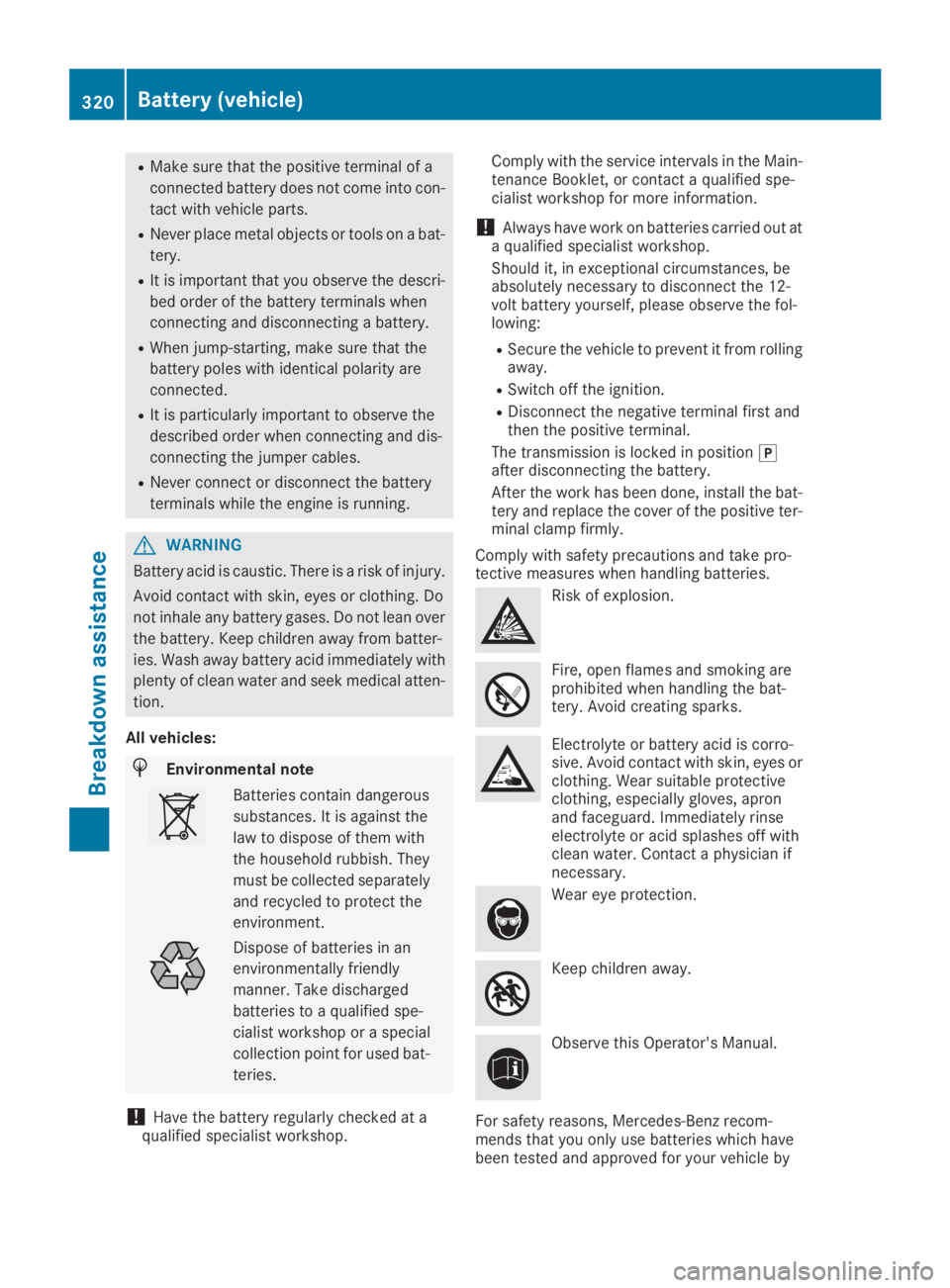
Comply with safety precautions and take pro-tective measures when handling batteries.
Risk of explosion.
Fire, open flames and smoking areprohibited when handling the bat-tery. Avoid creating sparks.
Electrolyte or battery acid is corro-sive. Avoid contact with skin, eyes orclothing. Wear suitable protectiveclothing, especially gloves, apronand faceguard. Immediately rinseelectrolyte or acid splashes off withclean water. Contact a physician ifnecessary.
Wear eye protection.
Keep children away.
Observe this Operator's Manual.
For safety reasons, Mercedes-Benz recom-mends that you only use batteries which havebeen tested and approved for your vehicle by
320Battery (vehicle)
Breakdown assistance
Page 325 of 370
!Avoid repeated and lengthy starting attempts. Otherwise, the catalytic converter could bedamaged by the non-combusted fuel.
Do not start the vehicle using a rapid charging device. If your vehicle's battery is discharged, theengine can be jump-started from another vehicle or from a donor battery using jumper cables.Observe the following points:
RThe battery is not accessible in all vehicles. If the other vehicle's battery is not accessible, jump-start the vehicle using a donor battery or a jump-starting device.
Ryou may only jump-start the vehicle when the engine and exhaust system are cold.
RAll vehicles except vehicles with a lithium-ion battery:do not start the engine if the batteryis frozen. Let the battery thaw first.
RJump-starting may be performed only using batteries with a nominal voltage of 12 V.
ROnly use jumper cables which have a sufficient cross-section and insulated terminal clamps.
RIf the battery is fully discharged, leave the battery that is being used to jump-start connected fora few minutes before attempting to start. This charges the battery slightly.
RMake sure that the two vehicles do not touch.
Make sure that:
RThe jumper cables are not damaged.
RBare parts of the terminal clamp do not come into contact with other metal parts while the jumpercables are connected to the battery.
RThe jumper cables cannot come into contact with parts that can move when the engine is running,such as the V-belt pulley or the fan.
XSecure the vehicle by applying the electric parking brake.
XShift the transmission to position].
XMake sure that the ignition is switched off. All indicator lamps in the instrument cluster must beoff. When using the SmartKey, turn the SmartKey to positionZin the ignition lock and remove it(Ypage 131).
XSwitch off all electrical consumers, e.g. rear window defroster, lighting, etc.
XOpen the hood.
iRight-hand-drive vehicle:the jump-starting connection points may be located on the otherside of the vehicle.
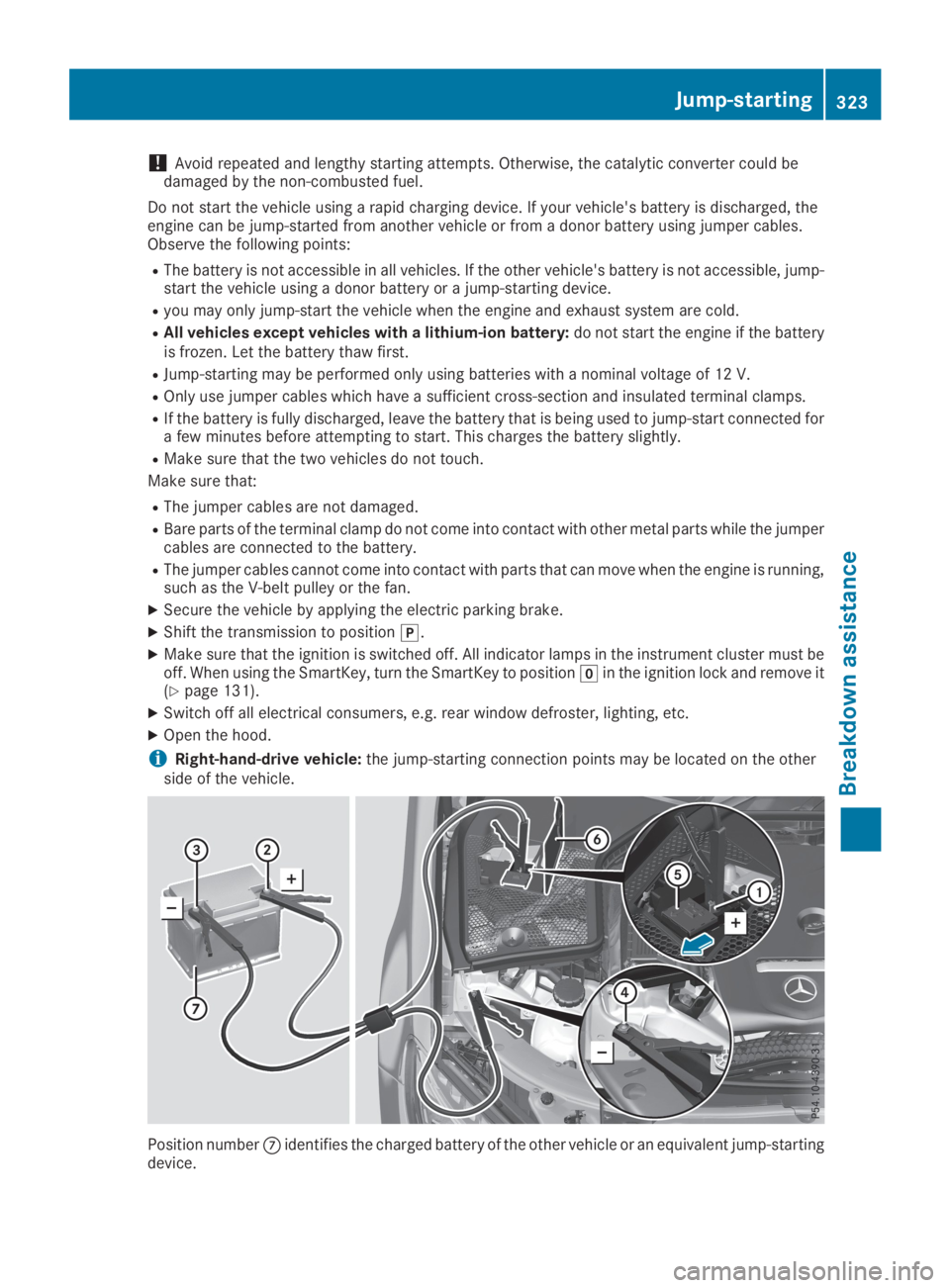
Position numberkidentifies the charged battery of the other vehicle or an equivalent jump-startingdevice.
Jump-starting323
Breakdown assistance
Z
Page 327 of 370
!Only secure the tow rope or tow bar at thetowing eyes, or the trailer tow hitch, if availa-ble. You could otherwise damage the vehicle.
!Do not use the trailer tow hitch for recoveryor towing. Do not use the towing eye forrecovery. this could damage the vehicle. If indoubt, have the vehicle recovered using acrane.
!When towing, pull away slowly andsmoothly. If the tractive power is too high, thevehicles could be damaged.
!Shift the automatic transmission to position\\and do not open the driver's or front pas-senger's door during towing. The automatictransmission may otherwise shift to position], which could damage the transmission.
!Do not tow with sling-type equipment. Thiscould damage the vehicle.
!You may tow the vehicle for a maximum dis-tance of 30 miles (50 kilometers). A towingspeed of 30 mph (50 km/h) must not beexceeded.
For towing distances over 30 miles(50 kilometers), the entire vehicle must beraised and transported.
It is better to have the vehicle transported thanto have it towed away.
If the vehicle has suffered transmission damage,have it transported on a transporter or trailer.
The automatic transmission must be in position\\when the vehicle is being towed. If the auto-matic transmission cannot be shifted to position\\, have the vehicle transported on a trans-porter or trailer.
The battery must be connected and charged.Otherwise, you:
Rcannot turn the SmartKey to positionHinthe ignition lock
Rcannot release the electric parking brake.
Rcannot shift the automatic transmission toposition\\
Disarm the automatic locking feature before thevehicle is towed (Ypage 84). You could other-wise be locked out when pushing or towing thevehicle.
Installing/removing the towing eye
Installing the towing eye
GWARNING
The exhaust tail pipe may be very hot. There is
a risk of burns when removing the rear cover.
Do not touch the exhaust pipe. Take particular
care when removing the rear cover.
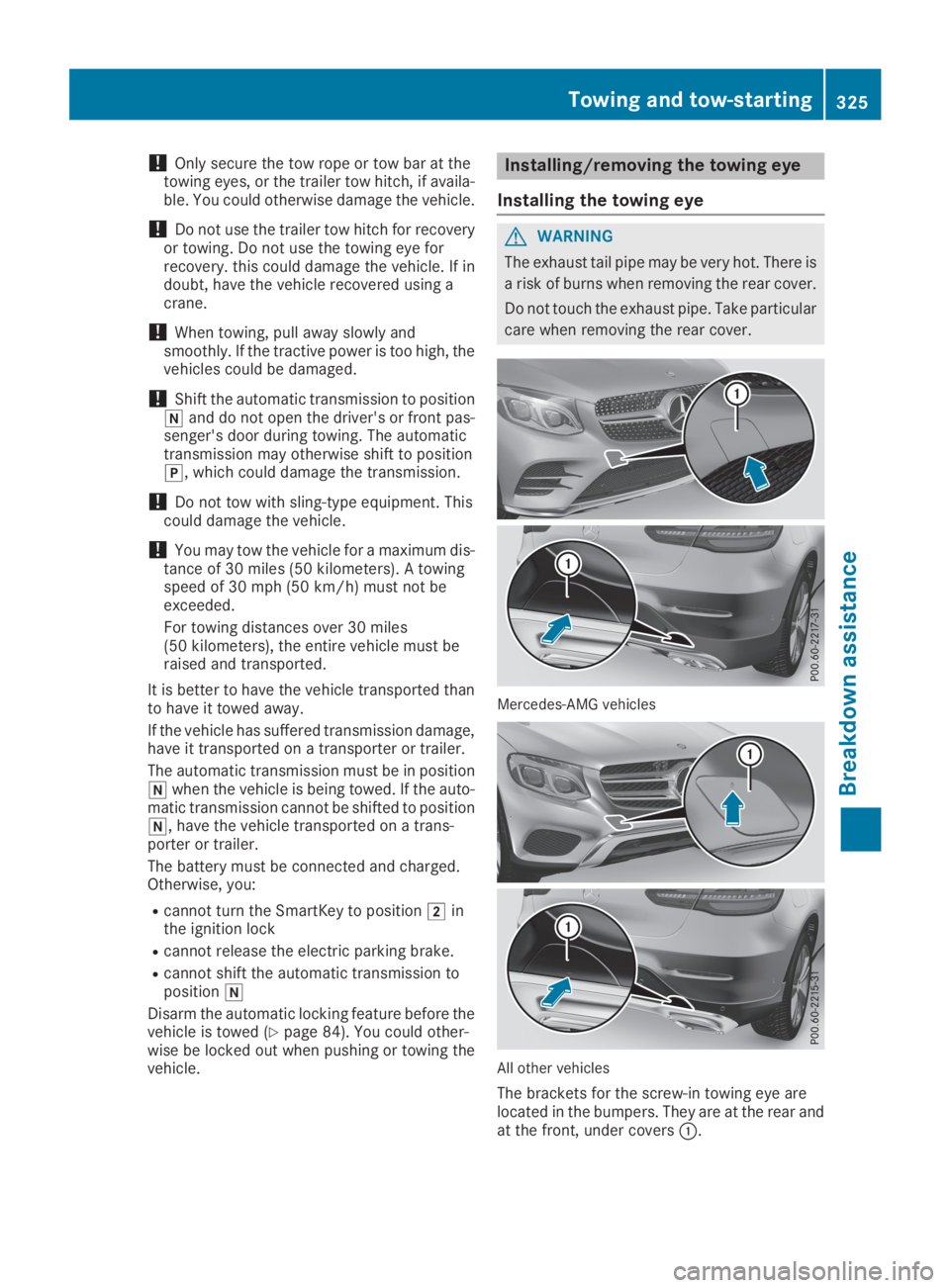
Mercedes-AMG vehicles
All other vehicles
The brackets for the screw-in towing eye arelocated in the bumpers. They are at the rear andat the front, under coversC.
Towing and tow-starting325
Breakdown assistance
Z
Page 328 of 370
XRemove the towing eye from the retainer(Ypage 314).
XMercedes-AMG vehicles:use a suitableobject, e.g. a screwdriver, to pry off coverCon the front bumper from underneath. Takethe cover from the opening, but do notremove it.
Press the mark on coverCon the rearbumper inward and remove.
XAll other vehicles:press the mark oncoverCinward and remove.
XScrew in the towing eye clockwise as far as itwill go and tighten it.
Vehicles with a trailer tow hitch do not have abracket for the screw-in towing eye at the back.Connect the towbar to the trailer tow hitch(Ypage 204).
Removing the towing eye
XUnscrew and remove the towing eye.
XAttach coverCto the bumper and press untilit engages.
Towing a vehicle with both axles on
the ground
The automatic transmission automatically shiftsto position]when you open the driver's orfront-passenger door or when you remove theSmartKey from the ignition lock. It is essential toobserve the following steps to ensure that theautomatic transmission remains in position\\during towing.
XMake sure that the vehicle is stationary.
XTurn the SmartKey to positionHin the igni-tion lock.
XDepress and hold the brake pedal.
XShift the automatic transmission to position\\.
XLeave the SmartKey in positionHin the igni-tion lock.
XRelease the brake pedal.
XRelease the electric parking brake.
XSwitch on the hazard warning lamps(Ypage 111).
In order to signal a change of direction whentowing the vehicle with the hazard warninglamps switched on, use the combination switchas usual. In this case, only the indicator lamps
for the direction of travel flash. After resettingthe combination switch, the hazard warninglamp starts flashing again.
Transporting the vehicle
General notes
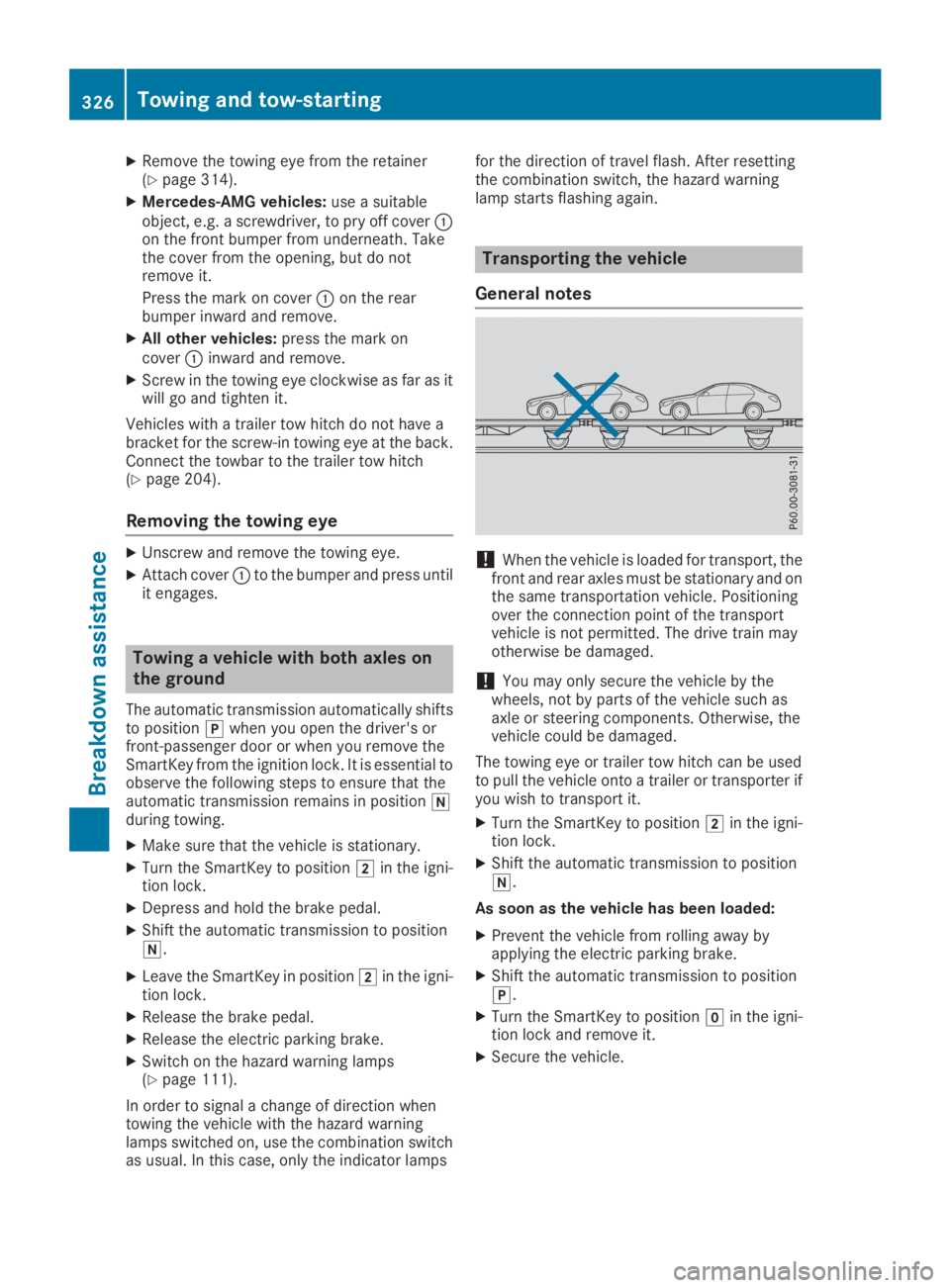
!When the vehicle is loaded for transport, thefront and rear axles must be stationary and onthe same transportation vehicle. Positioningover the connection point of the transportvehicle is not permitted. The drive train mayotherwise be damaged.
!You may only secure the vehicle by thewheels, not by parts of the vehicle such asaxle or steering components. Otherwise, thevehicle could be damaged.
The towing eye or trailer tow hitch can be usedto pull the vehicle onto a trailer or transporter ifyou wish to transport it.
XTurn the SmartKey to positionHin the igni-tion lock.
XShift the automatic transmission to position\\.
As soon as the vehicle has been loaded:
XPrevent the vehicle from rolling away byapplying the electric parking brake.
XShift the automatic transmission to position].
XTurn the SmartKey to positionZin the igni-tion lock and remove it.
XSecure the vehicle.
326Towing and tow-starting
Breakdown assistance
Page 338 of 370
Maximum tire pressures
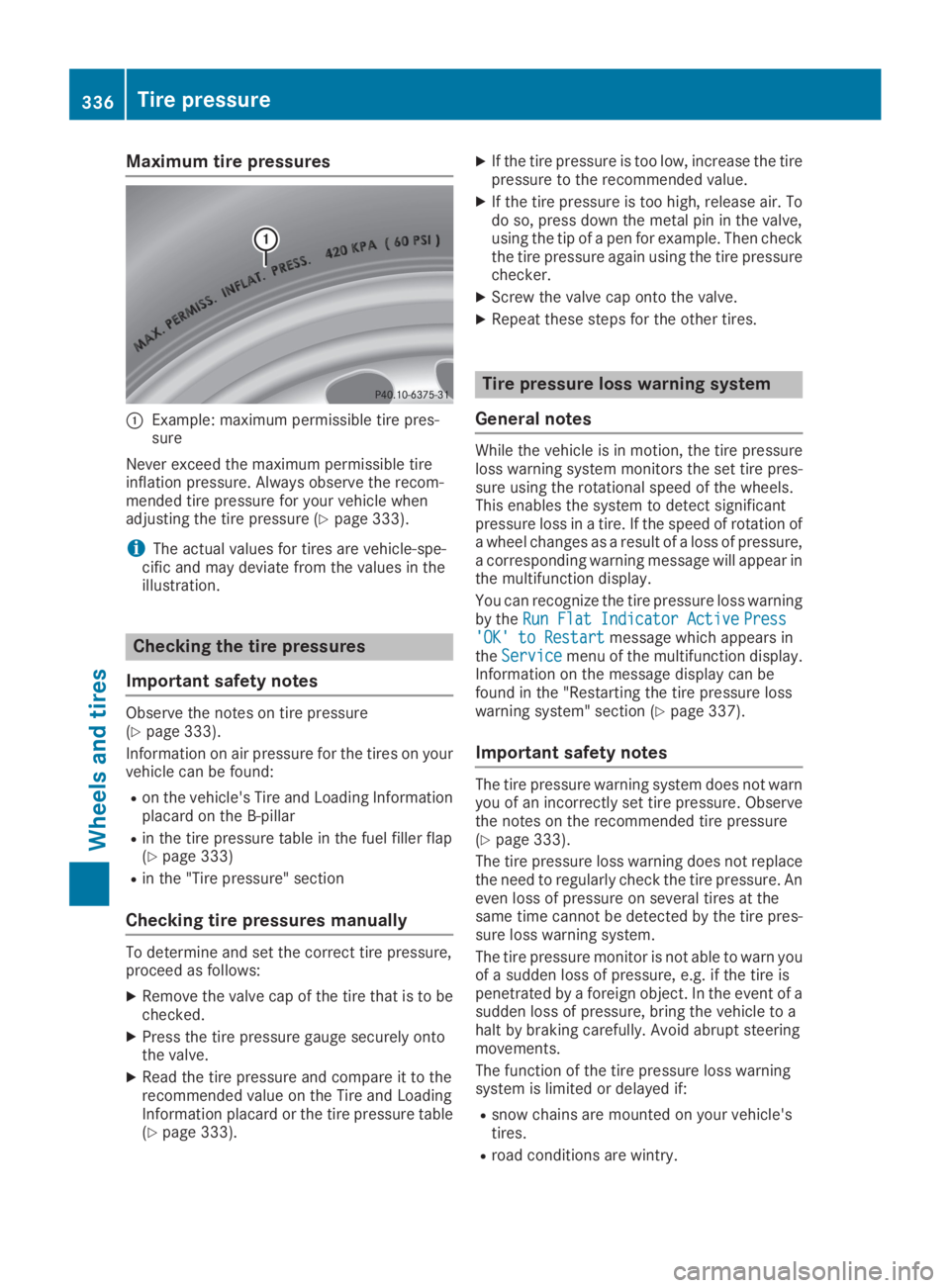
CExample: maximum permissible tire pres-sure
Never exceed the maximum permissible tireinflation pressure. Always observe the recom-mended tire pressure for your vehicle whenadjusting the tire pressure (Ypage 333).
iThe actual values for tires are vehicle-spe-cific and may deviate from the values in theillustration.
Checking the tire pressures
Important safety notes
Observe the notes on tire pressure(Ypage 333).
Information on air pressure for the tires on yourvehicle can be found:
Ron the vehicle's Tire and Loading Informationplacard on the B-pillar
Rin the tire pressure table in the fuel filler flap(Ypage 333)
Rin the "Tire pressure" section
Checking tire pressures manually
To determine and set the correct tire pressure,proceed as follows:
XRemove the valve cap of the tire that is to bechecked.
XPress the tire pressure gauge securely ontothe valve.
XRead the tire pressure and compare it to therecommended value on the Tire and LoadingInformation placard or the tire pressure table(Ypage 333).
XIf the tire pressure is too low, increase the tirepressure to the recommended value.
XIf the tire pressure is too high, release air. Todo so, press down the metal pin in the valve,using the tip of a pen for example. Then checkthe tire pressure again using the tire pressurechecker.
XScrew the valve cap onto the valve.
XRepeat these steps for the other tires.
Tire pressure loss warning system
General notes
While the vehicle is in motion, the tire pressureloss warning system monitors the set tire pres-sure using the rotational speed of the wheels.This enables the system to detect significantpressure loss in a tire. If the speed of rotation ofa wheel changes as a result of a loss of pressure,a corresponding warning message will appear inthe multifunction display.
You can recognize the tire pressure loss warningby theRun Flat Indicator ActiveRun Flat Indicator ActivePressPress'OK' to Restart'OK' to Restartmessage which appears intheServiceServicemenu of the multifunction display.Information on the message display can befound in the "Restarting the tire pressure losswarning system" section (Ypage 337).
Important safety notes
The tire pressure warning system does not warnyou of an incorrectly set tire pressure. Observethe notes on the recommended tire pressure(Ypage 333).
The tire pressure loss warning does not replacethe need to regularly check the tire pressure. Aneven loss of pressure on several tires at thesame time cannot be detected by the tire pres-sure loss warning system.
The tire pressure monitor is not able to warn youof a sudden loss of pressure, e.g. if the tire ispenetrated by a foreign object. In the event of asudden loss of pressure, bring the vehicle to ahalt by braking carefully. Avoid abrupt steeringmovements.
The function of the tire pressure loss warningsystem is limited or delayed if:
Rsnow chains are mounted on your vehicle'stires.
Rroad conditions are wintry.
336Tire pressure
Wheels and tires
Page 351 of 370
Speed rating
The speed rating is part of the tire identification.It specifies the speed range for which the tire isapproved.
GVW (Gross Vehicle Weight)
The gross vehicle weight includes the weight ofthe vehicle including fuel, tools, the spare wheel,accessories installed, occupants, luggage andthe drawbar noseweight, if applicable. The grossvehicle weight must not exceed the gross vehi-cle weight rating GVWR as specified on the vehi-cle identification plate on the B-pillar on thedriver's side.
GVWR (Gross Vehicle Weight Rating)
The GVWR is the maximum permissible grossweight of a fully loaded vehicle (the weight of thevehicle including all accessories, occupants,fuel, luggage and the drawbar noseweight, ifapplicable). The gross vehicle weight rating isspecified on the vehicle identification plate onthe B-pillar on the driver's side.
Maximum loaded vehicle weight
The maximum weight is the sum of:
Rthe curb weight of the vehicle
Rthe weight of the accessories
Rthe load limit
Rthe weight of the factory installed optionalequipment
Kilopascal (kPa)
Metric unit for tire pressure. 6.9 kPa corre-sponds to 1 psi. Another unit for tire pressure isbar. 100 kilopascals (kPa) are the equivalent of1 bar.
Load index
In addition to the load-bearing index, the loadindex may also be imprinted on the sidewall ofthe tire. This specifies the load-bearing capacitymore precisely.
Curb weight
The weight of a vehicle with standard equipmentincluding the maximum capacity of fuel, oil andcoolant. It also includes the air-conditioning sys-tem and optional equipment if these are instal-led in the vehicle, but does not include passen-gers or luggage.
Maximum load rating
The maximum tire load is the maximum permis-sible weight in kilograms or lbs for which a tire isapproved.
Maximum permissible tire pressure
Maximum permissible tire pressure for one tire.
Maximum load on one tire
Maximum load on one tire. This is calculated bydividing the maximum axle load of one axle bytwo.
PSI (pounds per square inch)
A standard unit of measure for tire pressure.
Aspect ratio
Relationship between tire height and tire widthin percent.
Tire pressure
This is pressure inside the tire applying an out-ward force to each square inch of the tire's sur-face. The tire pressure is specified in pounds persquare inch (psi), in kilopascal (kPa) or in bar.The tire pressure should only be corrected whenthe tires are cold.
Cold tire pressure
The tires are cold:
Rif the vehicle has been parked with the tiresout of direct sunlight for at least three hoursand
Rif the vehicle has not been driven further than1 mile (1.6 km)
Tread
The part of the tire that comes into contact withthe road.
Bead
The tire bead ensures that the tire sits securelyon the wheel. There are several steel wires in thebead to prevent the tire from coming loose fromthe wheel rim.
Sidewall
The part of the tire between the tread and thebead.
All about wheels and tires349
Wheels and tires
Z
Page 354 of 370
must be positioned vertically, directly under
the jacking point of the vehicle.
!Only position the jack at the appropriatejacking point of the vehicle. Otherwise, youcould damage the vehicle.
Observe the following when raising the vehi-cle:
RTo raise the vehicle, only use the vehicle-spe-cific jack that has been tested and approvedby Mercedes-Benz. If used incorrectly, thejack could tip over with the vehicle raised.
RThe jack is designed only to raise and hold thevehicle for a short time while a wheel is beingchanged. It must not be used for performingmaintenance work under the vehicle.
RAvoid changing the wheel on uphill and down-hill slopes.
RBefore raising the vehicle, secure it from roll-ing away by applying the parking brake andinserting wheel chocks. Do not disengage theparking brake while the vehicle is raised.
RThe jack must be placed on a firm, flat andnon-slip surface. On a loose surface, a large,flat, load-bearing underlay must be used. On aslippery surface, a non-slip underlay must beused, e.g. rubber mats.
RDo not use wooden blocks or similar objectsas a jack underlay. Otherwise, the jack will notbe able to achieve its load-bearing capacitydue to the restricted height.
RMake sure that the distance between theunderside of the tires and the ground does notexceed 1.2 in (3 cm).
RDo not place your hands or feet under theraised vehicle.
RDo not lie under the vehicle.
RDo not start the engine when the vehicle israised.
RNever open or close a door or the tailgatewhen the vehicle is raised.
RMake sure that no persons are present in thevehicle when the vehicle is raised.
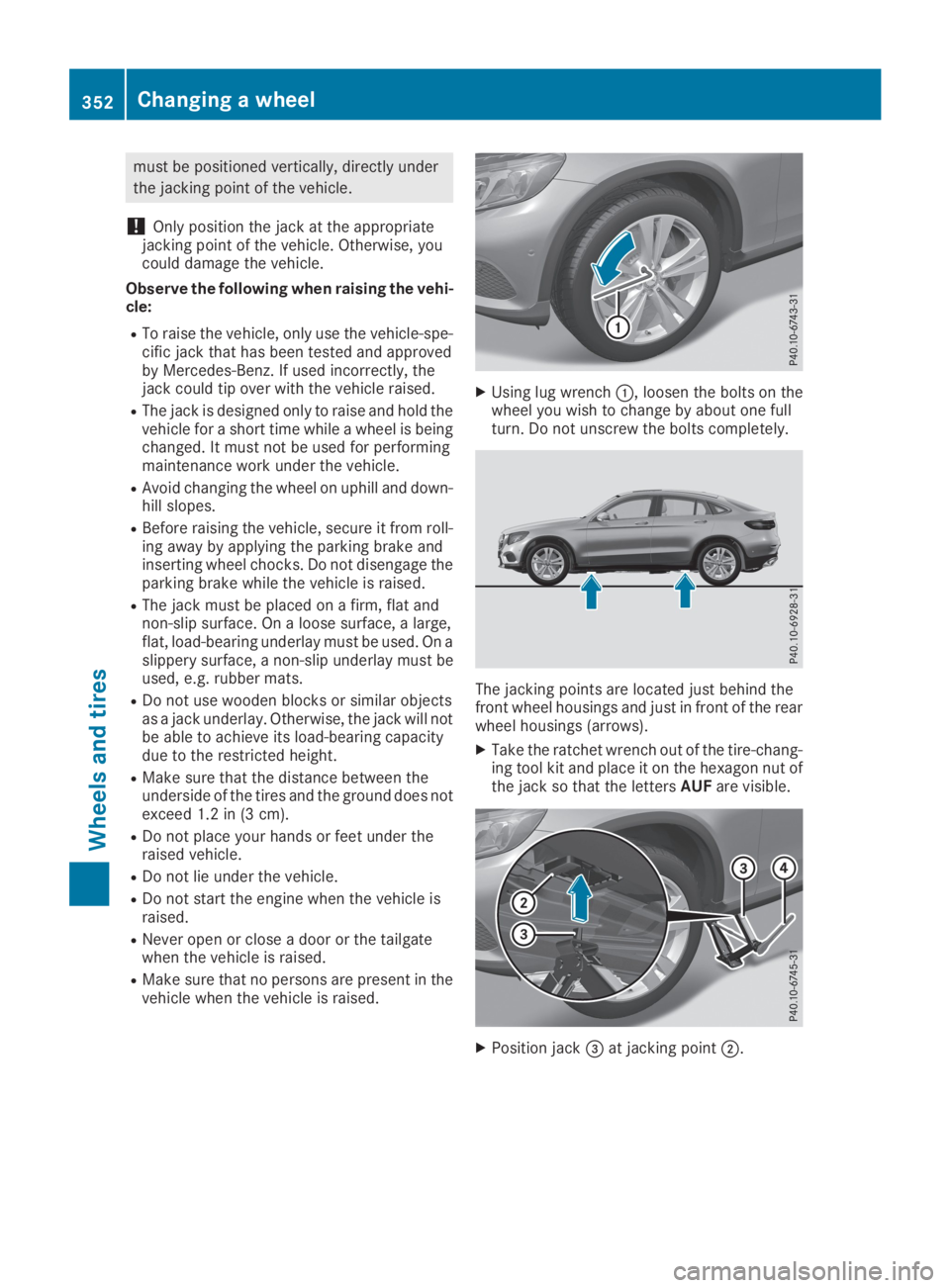
XUsing lug wrenchC, loosen the bolts on thewheel you wish to change by about one fullturn. Do not unscrew the bolts completely.
The jacking points are located just behind thefront wheel housings and just in front of the rearwheel housings (arrows).
XTake the ratchet wrench out of the tire-chang-ing tool kit and place it on the hexagon nut ofthe jack so that the lettersAUFare visible.
XPosition jack