battery MERCEDES-BENZ GLE 2016 Workshop Manual
[x] Cancel search | Manufacturer: MERCEDES-BENZ, Model Year: 2016, Model line: GLE, Model: MERCEDES-BENZ GLE 2016Pages: 450, PDF Size: 12.92 MB
Page 255 of 450
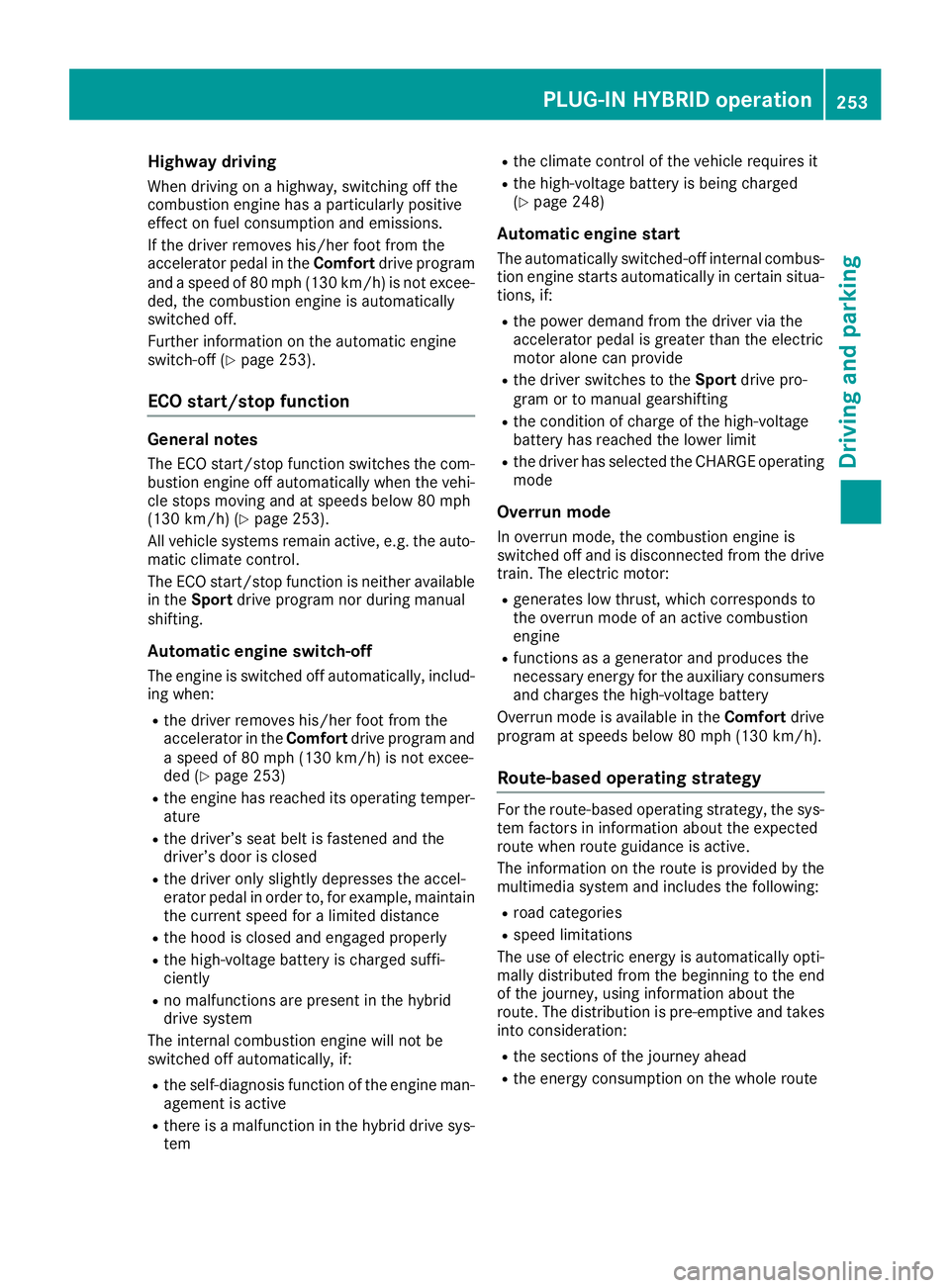
Highway driving When driving on a highway, switching off the
combustion engine has a particularly positive
effect on fuel consumption and emissions.
If the driver removes his/her foot from the
accelerator pedal in the Comfort drive program
and a speed of 80 mph (130 km/h) is not excee-
ded, the combustion engine is automatically
switched off.
Further information on the automatic engine
switch-off ( Y
page 253).
ECO start/stop function General notes The ECO start/stop function switches the com-
bustion engine off automatically when the vehi-
cle stops moving and at speeds below 80 mph
(130 km/h) ( Y
page 253).
All vehicle systems remain active, e.g. the auto-
matic climate control.
The ECO start/stop function is neither available
in the Sport drive program nor during manual
shifting.
Automatic engine switch-off The engine is switched off automatically, includ-
ing when: R
the driver removes his/her foot from the
accelerator in the Comfort drive program and
a speed of 80 mph (130 km/h) is not excee-
ded ( Y
page 253)R
the engine has reached its operating temper-
ature R
the driver’s seat belt is fastened and the
driver’s door is closed R
the driver only slightly depresses the accel-
erator pedal in order to, for example, maintain
the current speed for a limited distance R
the hood is closed and engaged properly R
the high-voltage battery is charged suffi-
ciently R
no malfunctions are present in the hybrid
drive system
The internal combustion engine will not be
switched off automatically, if: R
the self-diagnosis function of the engine man-
agement is active R
there is a malfunction in the hybrid drive sys-
tem R
the climate control of the vehicle requires it R
the high-voltage battery is being charged
( Y
page 248)
Automatic engine start The automatically switched-off internal combus-
tion engine starts automatically in certain situa-
tions, if: R
the power demand from the driver via the
accelerator pedal is greater than the electric
motor alone can provide R
the driver switches to the Sport drive pro-
gram or to manual gearshifting R
the condition of charge of the high-voltage
battery has reached the lower limit R
the driver has selected the CHARGE operating
mode
Overrun mode In overrun mode, the combustion engine is
switched off and is disconnected from the drive
train. The electric motor: R
generates low thrust, which corresponds to
the overrun mode of an active combustion
engine R
functions as a generator and produces the
necessary energy for the auxiliary consumers
and charges the high-voltage battery
Overrun mode is available in the Comfort drive
program at speeds below 80 mph (130 km/h).
Route-based operating strategy For the route-based operating strategy, the sys-
tem factors in information about the expected
route when route guidance is active.
The information on the route is provided by the
multimedia system and includes the following: R
road categories R
speed limitations
The use of electric energy is automatically opti-
mally distributed from the beginning to the end
of the journey, using information about the
route. The distribution is pre-emptive and takes
into consideration: R
the sections of the journey ahead R
the energy consumption on the whole routePLUG-IN HYBRID operation 253
Driving and parking Z
Page 264 of 450

the vehicle and trailer may carry, pay atten-
tion to the respective lowest values. R
The trailer drawbar load on the ball coupling
must be added to the rear axle load to avoid
exceeding the permissible gross axle weight.
The permissible gross vehicle weight is indi-
cated on the identification plate located on
the B-pillar on the driver's side of the vehicle.
i Mercedes-Benz recommends a trailer load
where the trailer drawbar noseweight
accounts for 8 % to 15 % of the trailer's per-
missible gross weight.
i The weight of additional accessories, pas-
sengers, and cargo reduces the permissible
trailer load and drawbar load for your vehicle.
Checking the vehicle and trailer weight R
To check that the weights of the towing vehi-
cle and the trailer comply with the maximum
permissible values, have the vehicle/trailer
combination (including the driver, passen-
gers, and cargo with a fully laden trailer)
weighed on a calibrated weighbridge. R
Check the gross axle weight rating of the front
and rear axles, the gross weight of the trailer
and the trailer drawbar noseweight.
Removing the ball coupling X
Remove the spring cotter. X
Remove the bolt from the ball coupling
recess. X
Remove the ball coupling from the ball cou-
pling recess. X
Clean the ball coupling if it is dirty. X
Stow the ball coupling so that it cannot be
thrown around.
Observe the loading guidelines ( Y
page 329)
and the safety notes regarding stowage spaces
( Y
page 330).
Information on cleaning and care of the trailer
tow hitch ( Y
page 366).
Trailer power supply
! Accessories with a maximum power con-
sumption of 180 W can be connected to the
permanent power supply. You must not charge a trailer battery using the
power supply.
The trailer socket of your vehicle is equipped at
the factory with a permanent power supply.
The permanent power supply is supplied via
trailer socket pin 4.
The trailer's permanent power supply is
switched off in the event of low vehicle supply
voltage and after six hours at the latest.
A qualified specialist workshop can provide
more information about installing the trailer
electrics.262
Towing a trailer
Driving an d parking
Page 275 of 450

X
Press the d or c button to set Off ,
Standard or Adaptive .
When Lane Keeping Assist or Active Lane
Keeping Assist is activated, the multifunction
display shows the lane markings as bright
lines in the assistance graphic. X
Press the v button to save the setting.
For further information about Lane Keeping
Assist, see ( Y
page 229).
For further information about Active Lane Keep-
ing Assist, see ( Y
page 233).
Service menu
Introduction
Depending on the equipment installed in the
vehicle, you have the following options in the
Serv. menu:R
Calling up display messages in message
memory ( Y
page 280)R
Restarting the tire pressure loss warning sys-
tem ( Y
page 394) or checking the tire pres-
sure electronically ( Y
page 396)R
Calling up the service due date
( Y
page 360) R
Displaying the coolant temperature (PLUG-IN
HYBRID vehicles) ( Y
page 273)
Displaying the coolant temperature The Coolant menu is only available on PLUG-IN
HYBRID vehicles.
Observe the notes on coolant temperature
( Y
page 264). X
Press the Y or e button on the steering
wheel to select the Sett. menu.X
Press the d or c button to select the
Serv. submenu.X
Confirm by pressing v on the steering
wheel. X
Press the d or c button to select the
Coolant submenu. X
Press v to confirm your selection.
The coolant temperature is shown in a bar
display.
Settings menu
Introduction
Depending on the equipment installed in the
vehicle, In the Sett. menu you have the follow-
ing options: R
Changing HYBRID settings (PLUG-IN HYBRID
vehicles) ( Y
page 273) R
Changing the instrument cluster settings
( Y
page 274) R
Changing the light settings ( Y
page 275)R
Changing the vehicle settings ( Y
page 275)R
Changing the convenience settings
( Y
page 275) R
Restoring the factory settings ( Y
page 276)
HYBRID submenu (PLUG-IN HYBRID
vehicles)
Setting the maximum charge current
Using the Maximum Charge Current: function,
you can limit the charge current value at which
the high-voltage battery should be charged.
Before charging the high-voltage battery at a
power socket, check the maximum permissible
charge current for the relevant power socket or
the building.
Only set the maximum permissible charge cur-
rent using the function if: R
it is not possible to set the charge current on
the charging cable R
the precise maximum permitted charge cur-
rent can only be set via the on-board com-
puterMenus and submenus 273
On-board computer and displays Z
Page 276 of 450
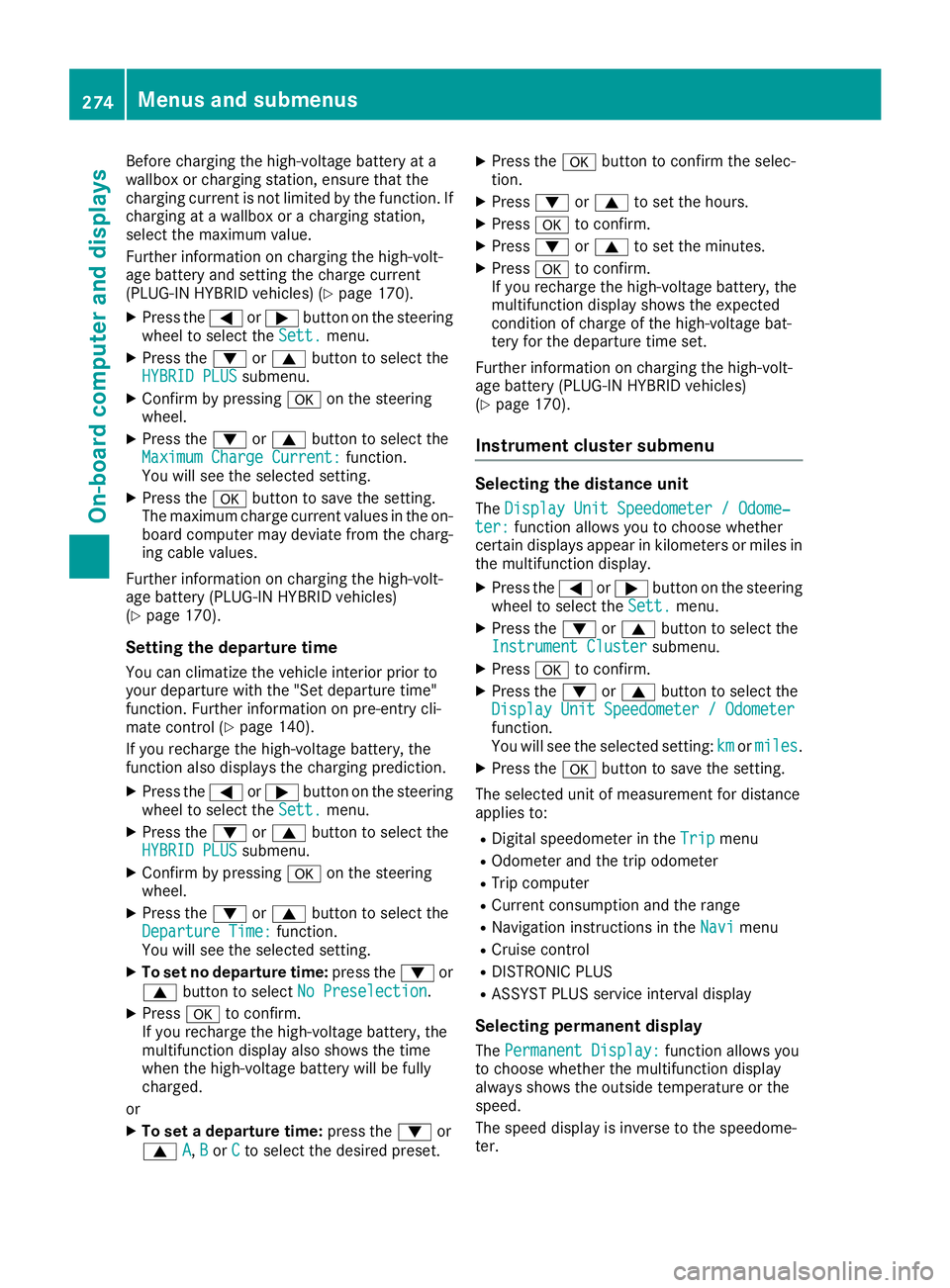
Before charging the high-voltage battery at a
wallbox or charging station, ensure that the
charging current is not limited by the function. If
charging at a wallbox or a charging station,
select the maximum value.
Further information on charging the high-volt-
age battery and setting the charge current
(PLUG-IN HYBRID vehicles) ( Y
page 170).X
Press the Y or e button on the steering
wheel to select the Sett. menu.X
Press the d or c button to select the
HYBRID PLUS submenu.X
Confirm by pressing v on the steering
wheel. X
Press the d or c button to select the
Maximum Charge Current: function.
You will see the selected setting. X
Press the v button to save the setting.
The maximum charge current values in the on-
board computer may deviate from the charg-
ing cable values.
Further information on charging the high-volt-
age battery (PLUG-IN HYBRID vehicles)
( Y
page 170).
Setting the departure time You can climatize the vehicle interior prior to
your departure with the "Set departure time"
function. Further information on pre-entry cli-
mate control ( Y
page 140).
If you recharge the high-voltage battery, the
function also displays the charging prediction. X
Press the Y or e button on the steering
wheel to select the Sett. menu.X
Press the d or c button to select the
HYBRID PLUS submenu.X
Confirm by pressing v on the steering
wheel. X
Press the d or c button to select the
Departure Time: function.
You will see the selected setting. X
To set no departure time: press the d or
c button to select No Preselection .X
Press v to confirm.
If you recharge the high-voltage battery, the
multifunction display also shows the time
when the high-voltage battery will be fully
charged.
or X
To set a departure time: press the d or
c A , B or C to select the desired preset. X
Press the v button to confirm the selec-
tion. X
Press d or c to set the hours.X
Press v to confirm. X
Press d or c to set the minutes.X
Press v to confirm.
If you recharge the high-voltage battery, the
multifunction display shows the expected
condition of charge of the high-voltage bat-
tery for the departure time set.
Further information on charging the high-volt-
age battery (PLUG-IN HYBRID vehicles)
( Y
page 170).
Instrument cluster submenu Selecting the distance unit The Display Unit Speedometer / Odome‐
ter: function allows you to choose whether
certain displays appear in kilometers or miles in
the multifunction display. X
Press the Y or e button on the steering
wheel to select the Sett. menu.X
Press the d or c button to select the
Instrument Cluster submenu.X
Press v to confirm. X
Press the d or c button to select the
Display Unit Speedometer / Odometer
function.
You will see the selected setting: km or miles .X
Press the v button to save the setting.
The selected unit of measurement for distance
applies to: R
Digital speedometer in the Trip menuR
Odometer and the trip odometer R
Trip computer R
Current consumption and the range R
Navigation instructions in the Navi menuR
Cruise control R
DISTRONIC PLUS R
ASSYST PLUS service interval display
Selecting permanent display
The Permanent Display: function allows you
to choose whether the multifunction display
always shows the outside temperature or the
speed.
The speed display is inverse to the speedome-
ter.274
Menus and submenus
On-board computer and displays
Page 288 of 450
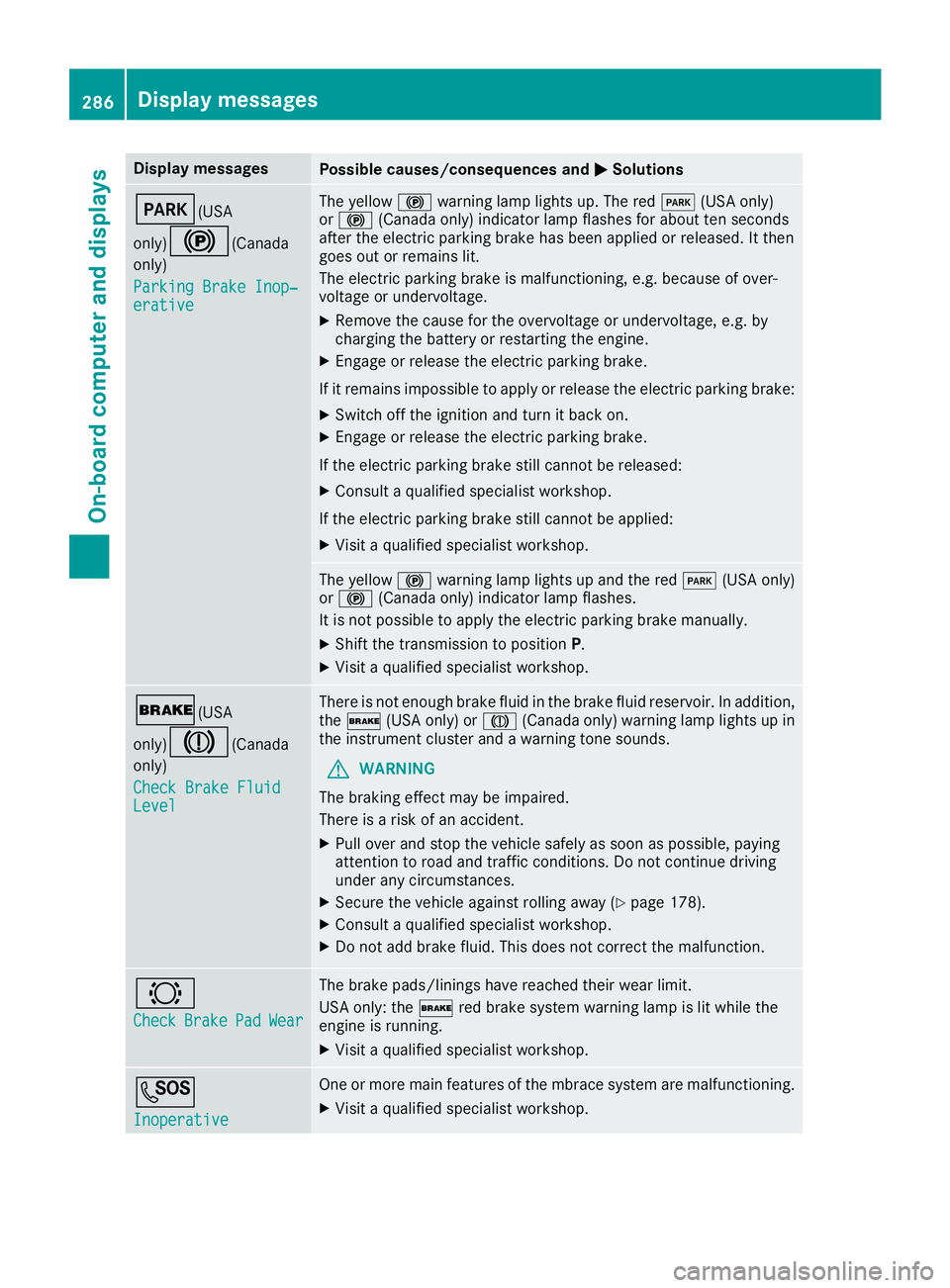
Display messages
Possible causes/consequences and P Solutions
I (USA
only)
$ ( Canada
only)
Parkin g Brake Inop‐
erativ e The yellow $ warning lamp lights up. The red I (US A only)
or $ (Canada only) indicator lamp flashes for about te n seconds
after th e electric parking brak e has been applie d or released. It then
goe s out or remain s lit .
The electric parking brak e is malfunctioning , e.g. because of over-
voltag e or undervoltage. X
Remove th e caus e for th e overvoltage or undervoltage, e.g. by
charging th e battery or restarting th e engine.X
Engage or release th e electric parking brake.
If it remain s impossible to apply or release th e electric parking brake:X
Switc h off th e ignition and tur n it bac k on .X
Engage or release th e electric parking brake.
If th e electric parking brak e still canno t be released:X
Consult a qualified specialist workshop .
If th e electric parking brak e still canno t be applied:X
Visit a qualified specialist workshop .
The yellow $ warning lamp lights up and th e red I (US A only)
or $ (Canada only) indicator lamp flashes .
It is no t possibl e to apply th e electric parking brak e manually.X
Shift th e transmission to position P .X
Visit a qualified specialist workshop .
' (USA
only)
M ( Canada
only)
Check Brake Fluid
Level There is no t enough brak e flui d in th e brak e flui d reservoir . In addition ,
th e ' (US A only) or M (Canada only) warning lamp lights up in
th e instrumen t cluste r and a warning tone sounds.
G WARNIN G
The braking effec t may be impaired.
There is a ris k of an accident.X
Pull ove r and stop th e vehicl e safely as soo n as possible, payin g
attention to roa d and traffic conditions. Do no t continu e drivin g
under any circumstances. X
Secur e th e vehicl e against rollin g away ( Y
page 178).X
Consult a qualified specialist workshop .X
Do no t add brak e fluid . This does no t correc t th e malfunction .
& Check Brake Pad Wea r The brak e pads/linings hav e reached their wear limit.
US A only: th e ' red brak e system warning lamp is lit while th e
engin e is running. X
Visit a qualified specialist workshop .
S Inoperative On e or mor e main features of th e mbrace system are malfunctioning .X
Visit a qualified specialist workshop .286
Display messages
On-board computer and displays
Page 299 of 450
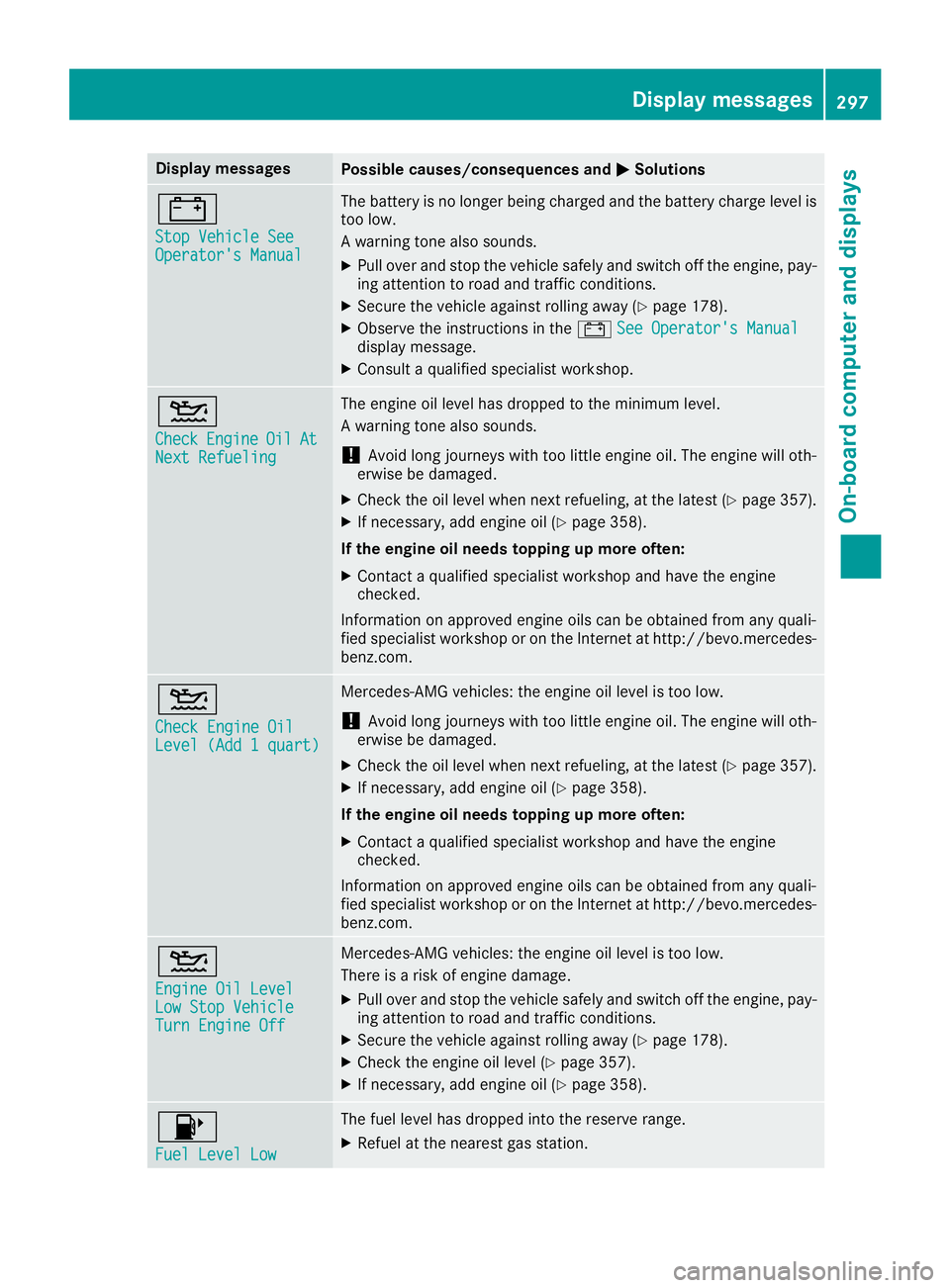
Display messages
Possible causes/consequences and P Solutions
= Sto p Vehicl e See
Operator' s Manual The battery is no longer bein g charged and th e battery charg e level is
to o low.
A warning tone also sounds. X
Pull ove r and stop th e vehicl e safely and switch off th e engine, pay-
ing attention to roa d and traffic conditions.X
Secur e th e vehicl e against rollin g away ( Y
page 178).X
Observ e th e instruction s in th e = See Operator' s Manual
display message .X
Consult a qualified specialist workshop .
Page 301 of 450
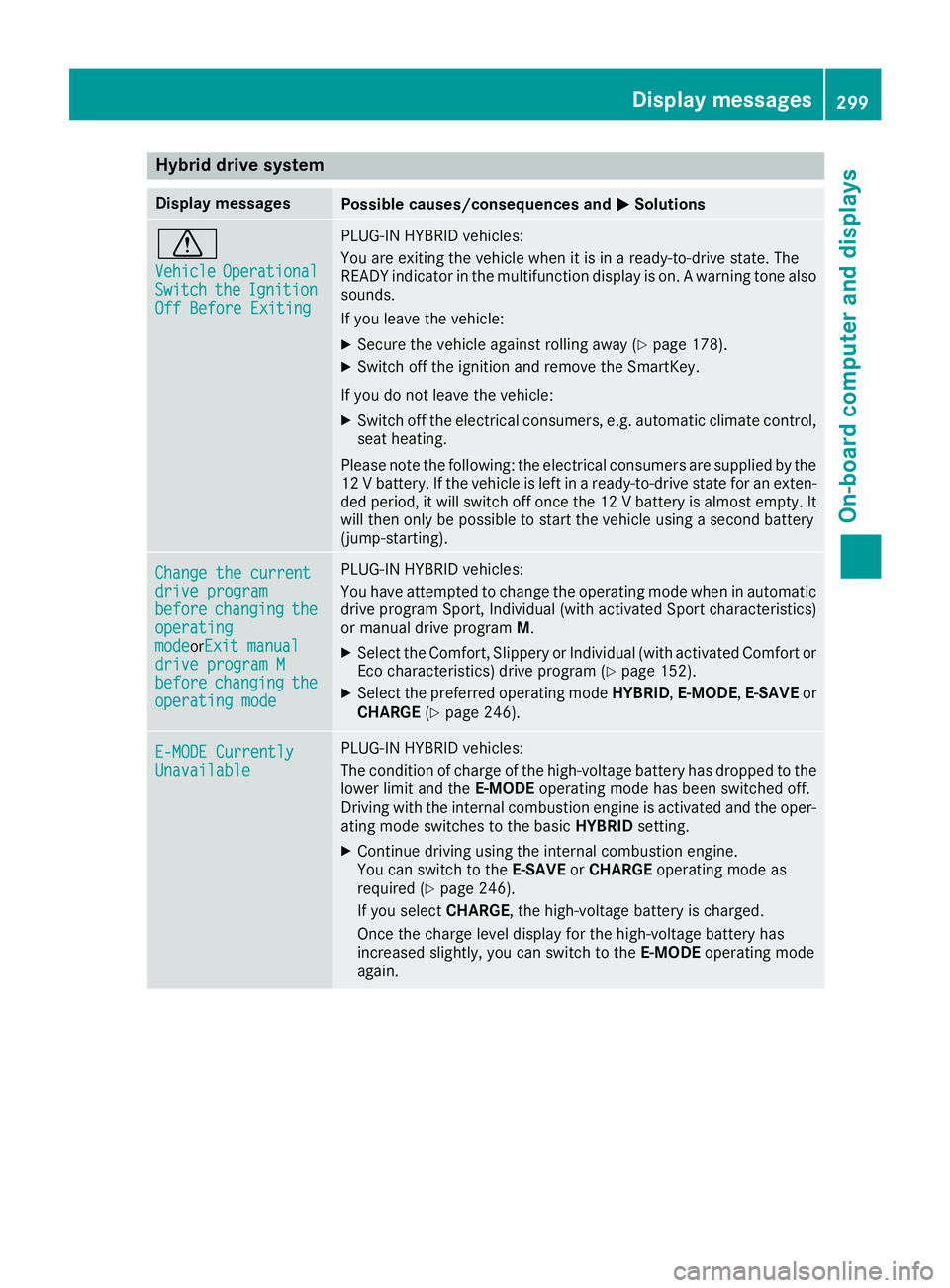
Hybrid drive system Display messages
Possible causes/consequences and P Solutions
r Vehicle Operational
Switch the Ignition
Off Before Exiting PLUG-IN HYBRID vehicles:
You are exiting the vehicle when it is in a ready-to-drive state. The
READY indicator in the multifunction display is on. A warning tone also
sounds.
If you leave the vehicle: X
Secure the vehicle against rolling away ( Y
page 178).X
Switch off the ignition and remove the SmartKey.
If you do not leave the vehicle: X
Switch off the electrical consumers, e.g. automatic climate control,
seat heating.
Please note the following: the electrical consumers are supplied by the
12 V battery. If the vehicle is left in a ready-to-drive state for an exten-
ded period, it will switch off once the 12 V battery is almost empty. It
will then only be possible to start the vehicle using a second battery
(jump-starting).
Change the current
drive program
before changing the
operating
mode or Exit manual
drive program M
before changing the
operating mode PLUG-IN HYBRID vehicles:
You have attempted to change the operating mode when in automatic
drive program Sport, Individual (with activated Sport characteristics)
or manual drive program M .X
Select the Comfort, Slippery or Individual (with activated Comfort or
Eco characteristics) drive program ( Y
page 152).X
Select the preferred operating mode HYBRID , E-MODE , E-SAVE or
CHARGE ( Y
page 246).
E-MODE Currently
Unavailable PLUG-IN HYBRID vehicles:
The condition of charge of the high-voltage battery has dropped to the
lower limit and the E-MODE operating mode has been switched off.
Driving with the internal combustion engine is activated and the oper-
ating mode switches to the basic HYBRID setting.X
Continue driving using the internal combustion engine.
You can switch to the E-SAVE or CHARGE operating mode as
required ( Y
page 246).
If you select CHARGE , the high-voltage battery is charged.
Once the charge level display for the high-voltage battery has
increased slightly, you can switch to the E-MODE operating mode
again. Display messages 299
On-board computer and displays Z
Page 314 of 450
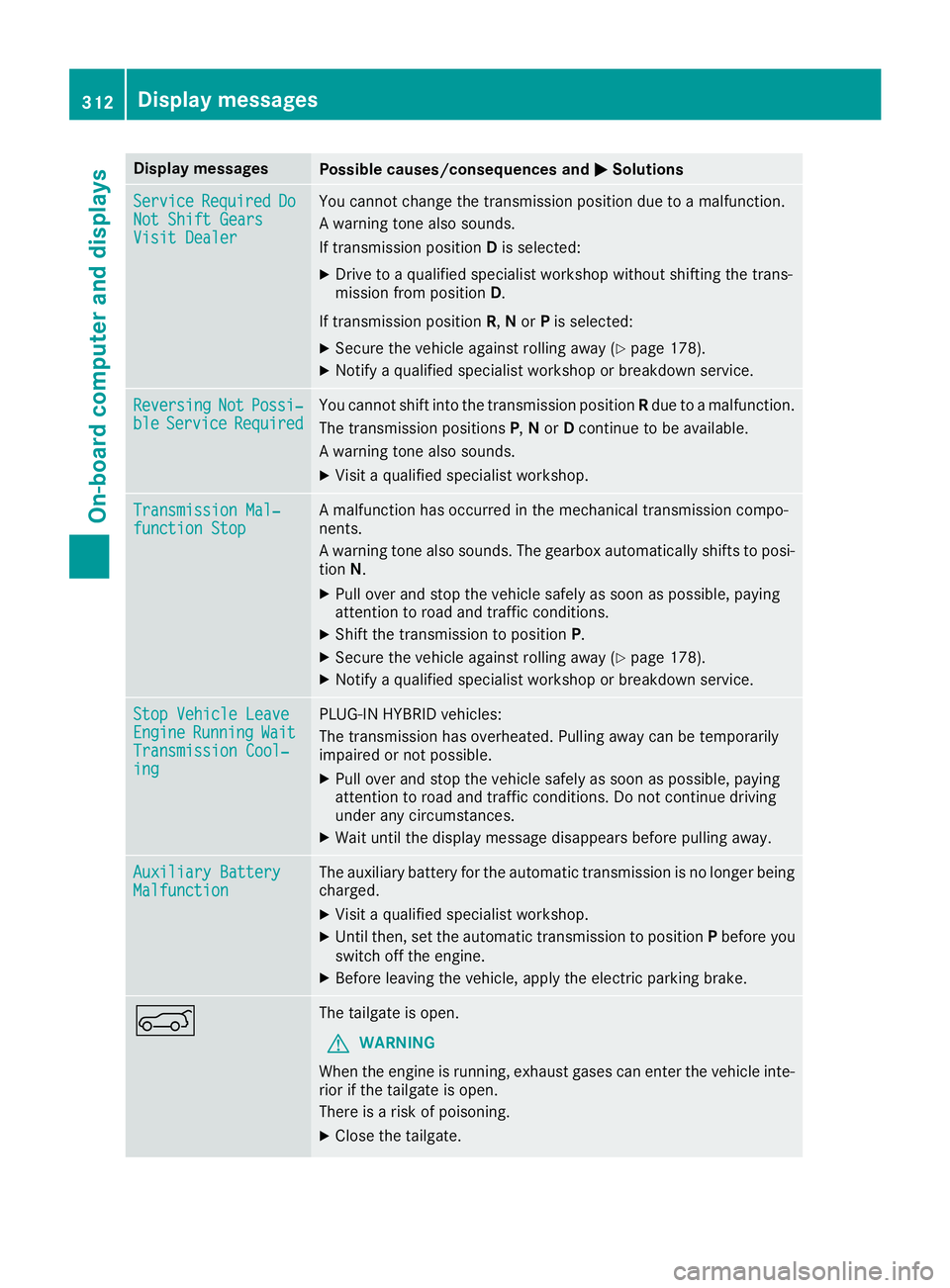
Display messages
Possible causes/consequences and P Solutions
Servic e Required Do
Not Shift Gears
Visit Dealer You canno t chang e th e transmission position due to a malfunction .
A warning tone also sounds.
If transmission position D is selected:X
Drive to a qualified specialist workshop without shifting th e trans -
mission from position D .
If transmission position R , N or P is selected:X
Secur e th e vehicl e against rollin g away ( Y
page 178).X
Notify a qualified specialist workshop or breakdown service.
Reversing Not Possi‐
ble Servic e Required You canno t shift int o th e transmission position R due to a malfunction .
The transmission position s P , N or D continu e to be available.
A warning tone also sounds. X
Visit a qualified specialist workshop .
Transmission Mal ‐
function Sto p A malfunction has occurred in th e mechanical transmission compo -
nents.
A warning tone also sounds. The gearbox automatically shift s to posi-
tion N . X
Pull ove r and stop th e vehicl e safely as soo n as possible, payin g
attention to roa d and traffic conditions.X
Shift th e transmission to position P .X
Secur e th e vehicl e against rollin g away ( Y
page 178).X
Notify a qualified specialist workshop or breakdown service.
Sto p Vehicl e Leave
Engine Runnin g Wai t
Transmission Cool‐
ing PLUG-I N HYBRID vehicles:
The transmission has overheated. Pullin g away can be temporarily
impaire d or no t possible.X
Pull ove r and stop th e vehicl e safely as soo n as possible, payin g
attention to roa d and traffic conditions. Do no t continu e drivin g
under any circumstances. X
Wait until th e display message disappear s before pullin g away.
Auxiliary Batter y
Malfunction The auxiliary battery for th e automatic transmission is no longer bein g
charged. X
Visit a qualified specialist workshop .X
Unti l then , set th e automatic transmission to position P before you
switch off th e engine.X
Befor e leaving th e vehicle, apply th e electric parking brake.
e The tailgat e is open .
G WARNIN G
Whe n th e engin e is running, exhaust gase s can ente r th e vehicl e inte-
rio r if th e tailgat e is open .
There is a ris k of poisoning .X
Clos e th e tailgate.312
Display messages
On-board computer and displays
Page 315 of 450
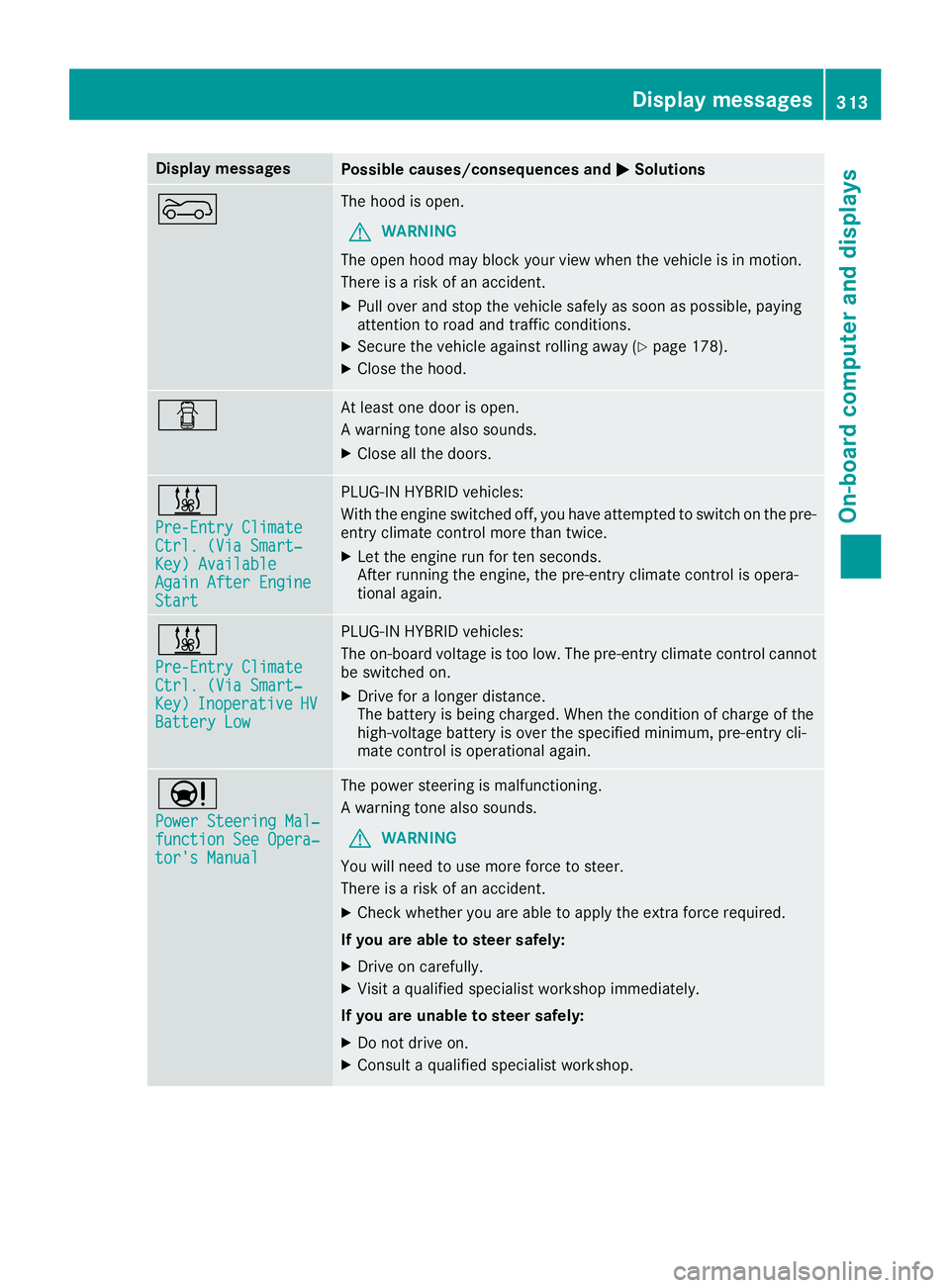
Display messages
Possible causes/consequences and P Solutions
f The hoo d is open .
G WARNIN G
The open hoo d may bloc k your vie w when th e vehicl e is in motion .
There is a ris k of an accident.X
Pull ove r and stop th e vehicl e safely as soo n as possible, payin g
attention to roa d and traffic conditions.X
Secur e th e vehicl e against rollin g away ( Y
page 178).X
Clos e th e hood.
Q At least on e door is open .
A warning tone also sounds. X
Clos e all th e doors.
; Pre-Entry Climat e
Ctrl. (Vi a Smart‐
Key ) Available
Again After Engine
Start PLUG-I N HYBRID vehicles:
Wit h th e engin e switched off , you hav e attempte d to switch on th e pre -
entr y climat e control mor e than twice .X
Let th e engin e run for te n seconds.
Afte r runnin g th e engine, th e pre-entry climat e control is opera-
tional again .
; Pre-Entry Climat e
Ctrl. (Vi a Smart‐
Key ) Inoperative HV
Batter y Low PLUG-I N HYBRID vehicles:
The on-boar d voltag e is to o low. The pre-entry climat e control canno t
be switched on .X
Drive for a longer distance.
The battery is bein g charged. Whe n th e condition of charg e of th e
high-voltage battery is ove r th e specified minimum , pre-entry cli -
mat e control is operational again .
Page 345 of 450
12 V sockets
General notes X
Turn the SmartKey to position 1 in the ignition
lock ( Y
page 145).
With the exception of the socket in the front
center console, all sockets can be used for
accessories with a maximum current draw of
240 W (20 A). The socket in the front center
console can be used for accessories with a max-
imum current draw of 180 W( 15 A). Accessories
include such items as chargers for mobile
phones.
If you use the sockets for long periods when the
engine is switched off, the battery may dis-
charge.
i An emergency cut-out ensures that the on-
board voltage does not drop too low. If the on-
board voltage is too low, the power to the
sockets is automatically cut. This ensures
that there is sufficient power to start the
engine.
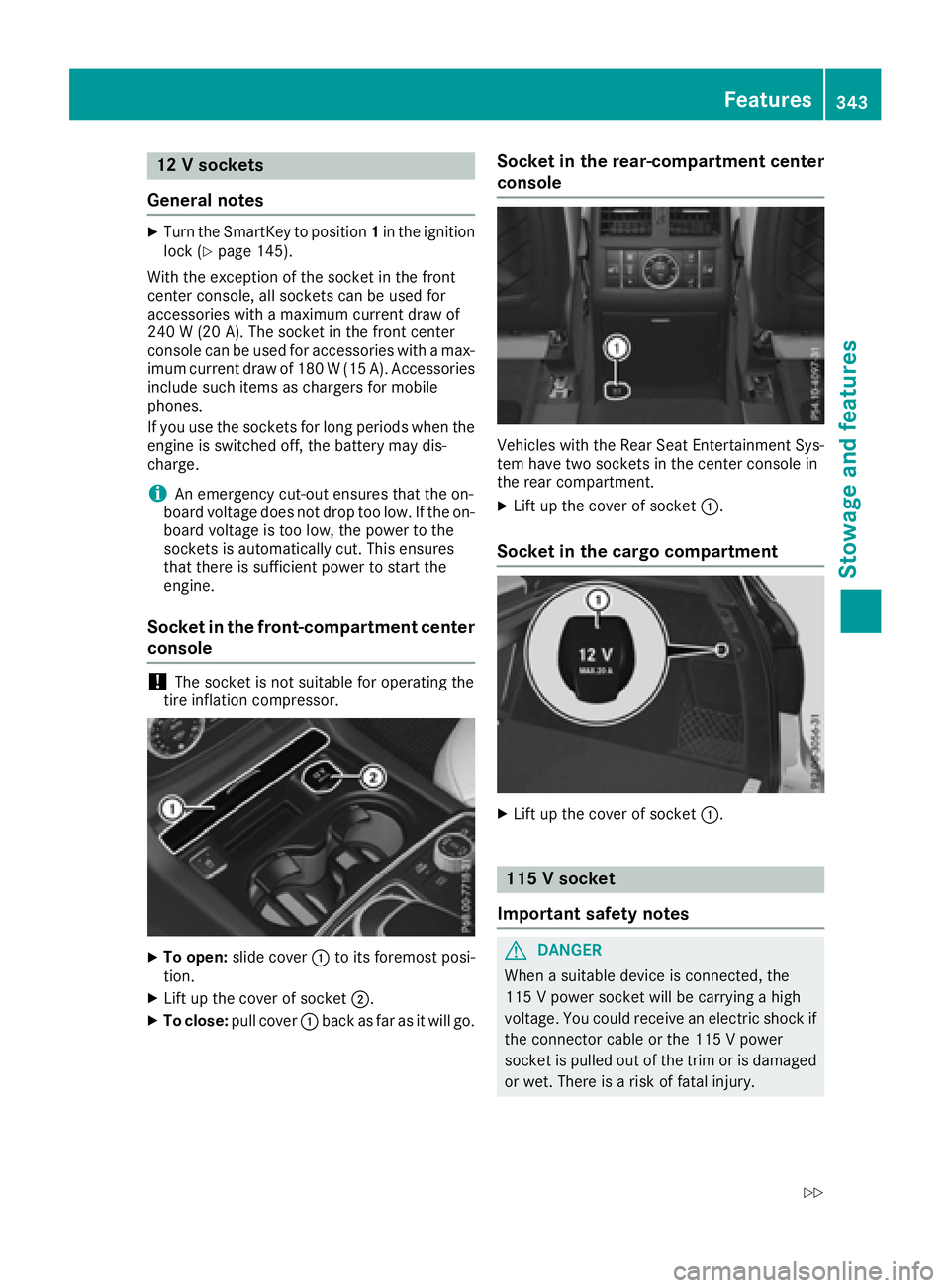
Socket in the front-compartment center
console
! The socket is not suitable for operating the
tire inflation compressor.
X
To open: slide cover C to its foremost posi-
tion. X
Lift up the cover of socket D .X
To close: pull cover C back as far as it will go. Socket in the rear-compartment center
console
Vehicles with the Rear Seat Entertainment Sys-
tem have two sockets in the center console in
the rear compartment. X
Lift up the cover of socket C .
Socket in the cargo compartment
X
Lift up the cover of socket C .
115 V socket
Important safety notes
G DANGER
When a suitable device is connected, the
115 V powe r socket will be carrying a high
voltage. You could receive an electric shock if
the connector cable or the 115 V power
socket is pulled out of the trim or is damaged
or wet. There is a risk of fatal injury. Features 343
Stowage and features Z