park assist MERCEDES-BENZ GLE 2017 Workshop Manual
[x] Cancel search | Manufacturer: MERCEDES-BENZ, Model Year: 2017, Model line: GLE, Model: MERCEDES-BENZ GLE 2017Pages: 390, PDF Size: 11.63 MB
Page 339 of 390
shift to position P when the driver's or front-
passenger door are opened, which could lead
to damage to the transmission.
! Do not tow with sling-type equipment. This
could damage the vehicle.
! Vehicles with differential locks: make sure
the differential locks are in automatic mode.
When towing, the differential locks must not
be switched on. The transmission may other-
wise be damaged.
! The vehicle can be towed a maximum of
30 miles (50km). The towing speed of 30 mph
(50 km/h) must not be exceeded.
If the vehicle has to be towed more than
30 miles (50km), the entire vehicle must be
raised and transported.
It is better to have the vehicle transported than
to have it towed away.
If the vehicle has suffered transmission damage,
have it transported on a transporter or trailer.
The automatic transmission must be in position
N when the vehicle is being towed.
The battery must be connected and charged.
Otherwise, you: R
cannot turn the SmartKey to position 2 in the
ignition lock R
cannot release the electric parking brake R
cannot shift the automatic transmission to
position N
Disarm the automatic locking feature before the
vehicle is towed ( Y
page 233). You could other-
wise be locked out when pushing or towing the
vehicle.
If the vehicle is in a dangerous area, it can be
towed out of that area with both axles on the
ground. In this case, the towing distance must
not be greater than 165 ft (50 m) and must not
exceed a towing speed of 6 mph (10 km/h). For
longer distances, have the vehicle loaded and
transported. Installing/removing the towing eye
Installing the towing eye
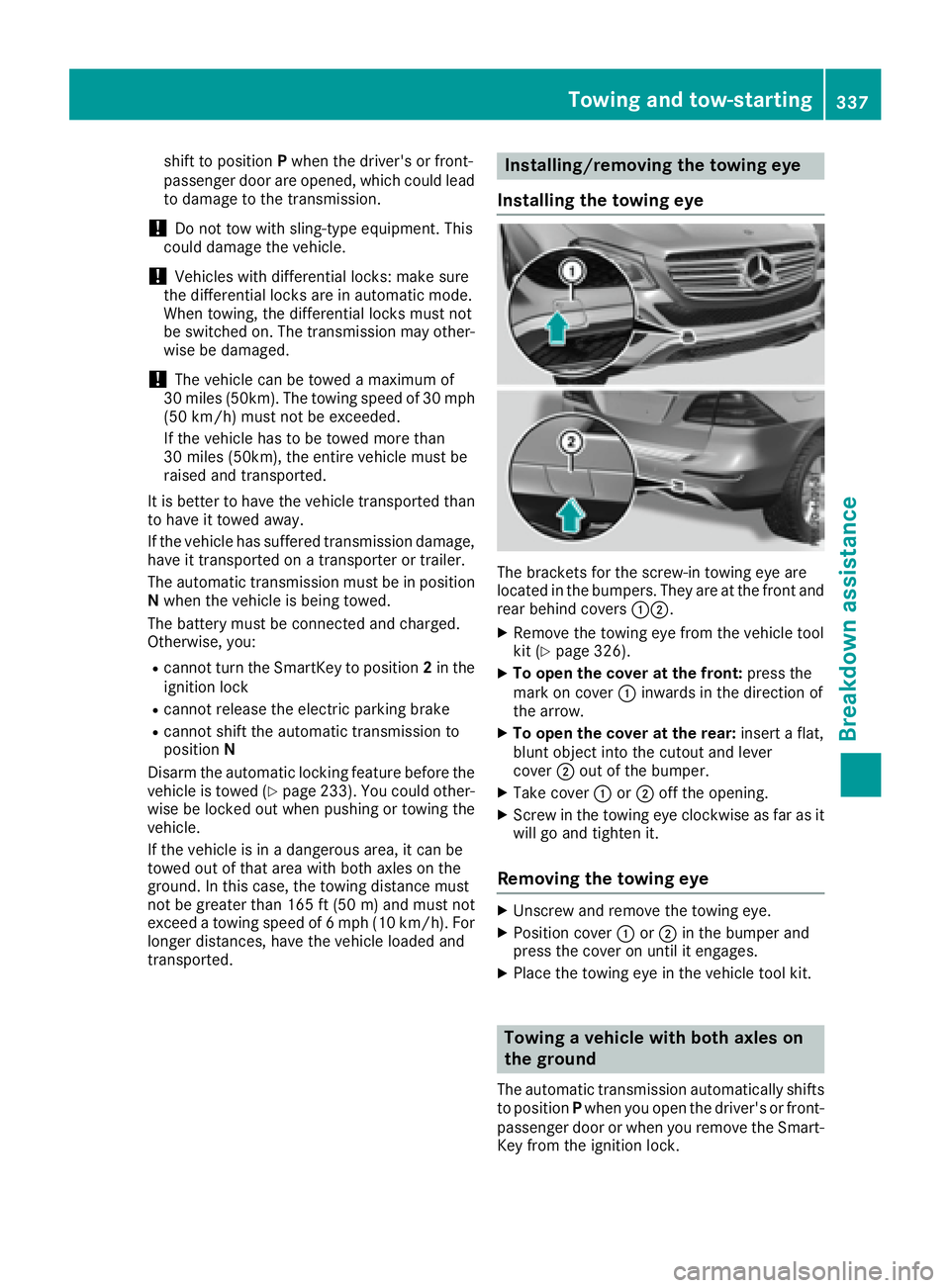
The brackets for the screw-in towing eye are
located in the bumpers. They are at the front and
rear behind covers CD .X
Remove the towing eye from the vehicle tool
kit ( Y
page 326). X
To open the cover at the front: press the
mark on cover C inwards in the direction of
the arrow. X
To open the cover at the rear: insert a flat,
blunt object into the cutout and lever
cover D out of the bumper. X
Take cover C or D off the opening.X
Screw in the towing eye clockwise as far as it
will go and tighten it.
Removing the towing eye X
Unscrew and remove the towing eye. X
Position cover C or D in the bumper and
press the cover on until it engages. X
Place the towing eye in the vehicle tool kit.
Towing a vehicle with both axles on
the ground
The automatic transmission automatically shifts
to position P when you open the driver's or front-
passenger door or when you remove the Smart-
Key from the ignition lock.Towing and tow-starting 337
Breakdown assistance Z
Page 340 of 390
In order to ensure that the automatic transmis-
sion stays in position N when towing the vehicle,
you must observe the following points: X
Make sure that the vehicle is stationary. X
Turn the SmartKey to position 2 in the ignition
lock. X
Depress and hold the brake pedal. X
Shift the automatic transmission to position
N . X
Leave the SmartKey in position 2 in the igni-
tion lock. X
Release the brake pedal. X
Release the electric parking brake. X
Switch on the hazard warning lamps
( Y
page 109).
In order to signal a change of direction when
towing the vehicle with the hazard warning
lamps switched on, use the combination switch
as usual. In this case, only the indicator lamps
for the direction of travel flash. After resetting
the combination switch, the hazard warning
lamp starts flashing again.
Transporting the vehicle
4MATIC vehicles/vehicles with auto-
matic transmission
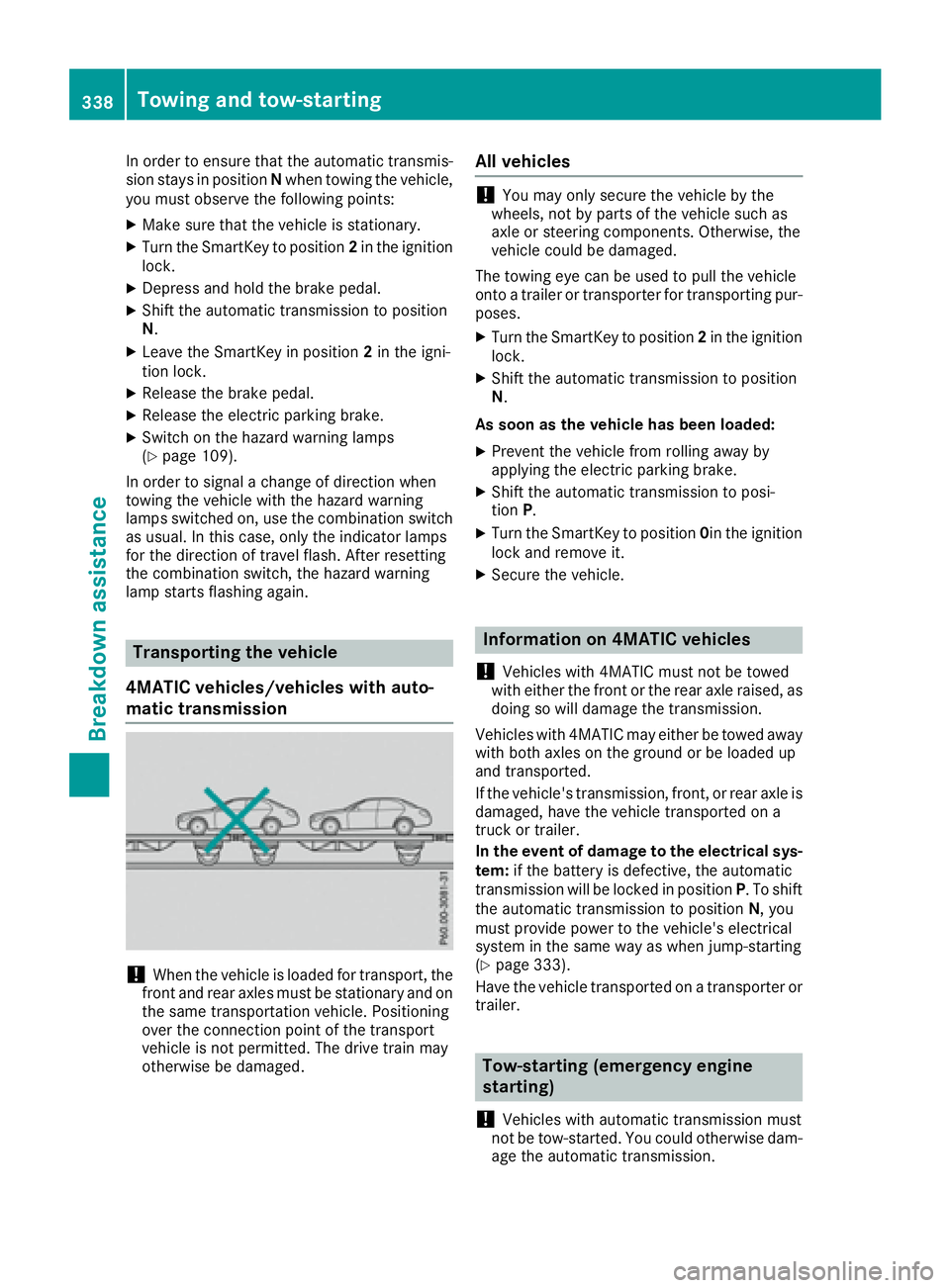
! When the vehicle is loaded for transport, the
front and rear axles must be stationary and on
the same transportation vehicle. Positioning
over the connection point of the transport
vehicle is not permitted. The drive train may
otherwise be damaged. All vehicles
! You may only secure the vehicle by the
wheels, not by parts of the vehicle such as
axle or steering components. Otherwise, the
vehicle could be damaged.
The towing eye can be used to pull the vehicle
onto a trailer or transporter for transporting pur-
poses. X
Turn the SmartKey to position 2 in the ignition
lock. X
Shift the automatic transmission to position
N .
As soon as the vehicle has been loaded: X
Prevent the vehicle from rolling away by
applying the electric parking brake. X
Shift the automatic transmission to posi-
tion P . X
Turn the SmartKey to position 0 in the ignition
lock and remove it. X
Secure the vehicle.
Information on 4MATIC vehicles
! Vehicles with 4MATIC must not be towed
with either the front or the rear axle raised, as
doing so will damage the transmission.
Vehicles with 4MATIC may either be towed away
with both axles on the ground or be loaded up
and transported.
If the vehicle's transmission, front, or rear axle is
damaged, have the vehicle transported on a
truck or trailer.
In the event of damage to the electrical sys-
tem: if the battery is defective, the automatic
transmission will be locked in position P . To shift
the automatic transmission to position N , you
must provide power to the vehicle's electrical
system in the same way as when jump-starting
( Y
page 333).
Have the vehicle transported on a transporter or
trailer.
Tow-starting (emergency engine
starting)
! Vehicles with automatic transmission must
not be tow-started. You could otherwise dam-
age the automatic transmission.338
Towing and tow-starting
Breakdown assistance
Page 376 of 390
Fuel
Important safety notes
G WARNIN G
Fuel is highly flammable. If you handle fuel
incorrectly, there is a ris k of fir e and explo-
sion .
You must avoi d fire, open flames, creating
sparks and smoking. Switc h off th e engin e
and , if applicable, th e auxiliary heating before
refueling.
G WARNIN G
Fuel is poisonous and hazardous to health.
Ther e is a ris k of injury.
You must mak e sure that fuel does no t come
int o contact wit h your skin, eyes or clothing
and that it is no t swallowed. Do no t inhale fuel
vapors. Kee p fuel away from children .
If you or other s come int o contact wit h fuel ,
observ e th e following:R
Wash away fuel from skin immediately
usin g soap and water.R
If fuel comes int o contact wit h your eyes,
immediately rinse them thoroughly wit h
clean water. Seek medical assistanc e with-
out delay. R
If fuel is swallowed, seek medical assis-
tance without delay. Do no t induce vomit -
ing . R
Immediately chang e out of clothing whic h
has come int o contact wit h fuel .
Tank capacity
Model Total capa-
cit y
GLE 550 e 4MATIC
21.1 US gal
(80.0 l)
Al l ot her models
24.6 US gal
(93.0 l) Model Of which
reserve
Mercedes-AMG GLE 43
4MATIC Approx.
3.2 US gal
(12.0 l)
GLE 550 4MATIC
Approx.
2.6 US gal
(10.0 l)
Mercedes ‑ AMG vehicles
Approx.
3.7 US gal
(14.0 l)
Al l ot her models
Approx.
3.2 US gal
(12.0 l)
Gasoline Fuel grade
! Do not use diesel to refuel vehicles with a
gasoline engine. Do not switch on the ignition
if you accidentally refuel with the wrong fuel.
Otherwise, the fuel will enter the fuel system.
Even small amounts of the wrong fuel could
result in damage to the fuel system and the
engine. Notify a qualified specialist workshop
and have the fuel tank and fuel lines drained
completely.
! Only refuel using unleaded premium grade
gasoline with at least 91 AKI/95 RON.
i E10 fuel contains up to 10% bioethanol.
Your vehicle is E10-compatible. You can
refuel your vehicle using E10 fuel.
! Only use the fuel recommended. Operating
the vehicle with other fuels can lead to dam-
age to the fuel system, engine and exhaust
system.
! Do not use the following: R
E15 (gasoline with 15% ethanol) R
E85 (gasoline with 85% ethanol) R
E100 (1 00% ethanol) R
M15 (gasoline with 15% methanol) R
M30 (gasoline with 30% methanol) R
M85 (gasoline with 85% methanol) R
M100 (1 00% methanol) R
Gasoline with metalliferous additives R
Diesel374
Service products and filling capacities
Technical data
Page 378 of 390
Flexible Fuel vehicles Import ant safety notes
G WARNIN G
Fuel is highly flammable. If you handle fuel
incorrectly, there is a ris k of fir e and explo-
sion .
You must avoi d fire, open flames, creating
sparks and smoking. Switc h off th e engin e
and , if applicable, th e auxiliary heating before
refueling.
G WARNIN G
Fuel is poisonous and hazardous to health.
Ther e is a ris k of injury.
You must mak e sure that fuel does no t come
int o contact wit h your skin, eyes or clothing
and that it is no t swallowed. Do no t inhale fuel
vapors. Kee p fuel away from children .
If you or other s come int o contact wit h fuel ,
observ e th e following:R
Wash away fuel from skin immediately
usin g soap and water.R
If fuel comes int o contact wit h your eyes,
immediately rinse them thoroughly wit h
clean water. Seek medical assistanc e with-
out delay. R
If fuel is swallowed, seek medical assis-
tance without delay. Do no t induce vomit -
ing . R
Immediately chang e out of clothing whic h
has come int o contact wit h fuel .
Flexible Fuel vehicles can be refueled wit h th e
followin g fuel types:R
premium-grade unleaded gasolin eR
E8 5 fuelR
a mixtur e of E8 5 fuel and premium-grade
unleaded gasolin e
i Flexible Fuel vehicles can be recognize d by
th e Ethanol up to E85 sticker on th e inside of
th e fuel filler flap . Fuel consu mp tionThe energ y conten t of E8 5 fuel is less than that
of th e sam e amoun t of premium-grade gasoline.
The amoun t of fuel consumed when operating
th e vehicl e wit h E8 5 fuel is therefor e higher than
wit h premium-grade gasoline.
Maintenance Infor m your authorize d Mercedes-Ben z C ente r
that you are operating or have operate d th e
vehicl e wit h E8 5 fuel .
Low outside temperatures If th e outside temperature is belo w 32 ‡( 0 †),
the starting procedure can take noticeably lon-
ger when operating with E85 fuel.
E85 fuel is not suitable for use at outside tem-
peratures under -4 ‡ (-20 †).
DEF
Important safety notes Comply with the important safety notes for ser-
vice products when handling DEF ( Y
page 373).
DEF is a water-soluble fluid for the exhaust gas
aftertreatment of diesel engines. It is: R
not poisonous R
colorless and odorless R
not flammable
When you open the DEF container, small
amounts of ammonia vapor may be released.
Ammonia vapors have a pungent odor and are
particularly irritating to the skin, to mucous
membranes and to the eyes. You may experi-
ence a burning sensation in your eyes, nose and
throat. Coughing and watering of the eyes are
possible.
Do not inhale ammonia vapors. Fill the DEF tank
only in well-ventilated areas.
Low outside temperatures
DEF freezes at a temperature of approximately
12 ‡( -11 †). The vehicle is delivere d from th e
factory equippe d wit h a DE F preheatin g system.
Winte r operation can thus be guaranteed even
at temperature s below 12 ‡ (-11 †).376
Service pr od ucts and filling capacities
Technical data