technical data MERCEDES-BENZ GLE 2018 User Guide
[x] Cancel search | Manufacturer: MERCEDES-BENZ, Model Year: 2018, Model line: GLE, Model: MERCEDES-BENZ GLE 2018Pages: 398, PDF Size: 9.25 MB
Page 306 of 398
Roof carrier
Important safety notes
G WARNING
When you load the roof, the center of gravity
of the vehicle rises and the driving character-
istics change. If you exceed the maximum roof
load, the driving characteristics, as well as
steering and braking, will be greatly impaired.
There is a risk of an accident.
Never exceed the maximum roof load and
adjust your driving style.
! Mercedes-Benz recommends that you only
use roof carriers that have been tested and
approved for Mercedes-Benz vehicles. This
helps to prevent damage to the vehicle.
Position the load on the roof carrier in such a
way that the vehicle will not sustain damage
even when it is in motion.
Depending on the vehicle equipment, ensure
that when the roof carrier is installed you can: R
raise the sliding sunroof fully R
open the panorama roof with power tilt/
sliding panel fully R
open the tailgate fully
You will find information on the maximum roof
load in the "Technical data" section
( Y
page 390).
An incorrectly secured roof carrier or roof load
may become detached from the vehicle. You
must therefore ensure that you observe the roof
carrier manufacturer's installation instructions.
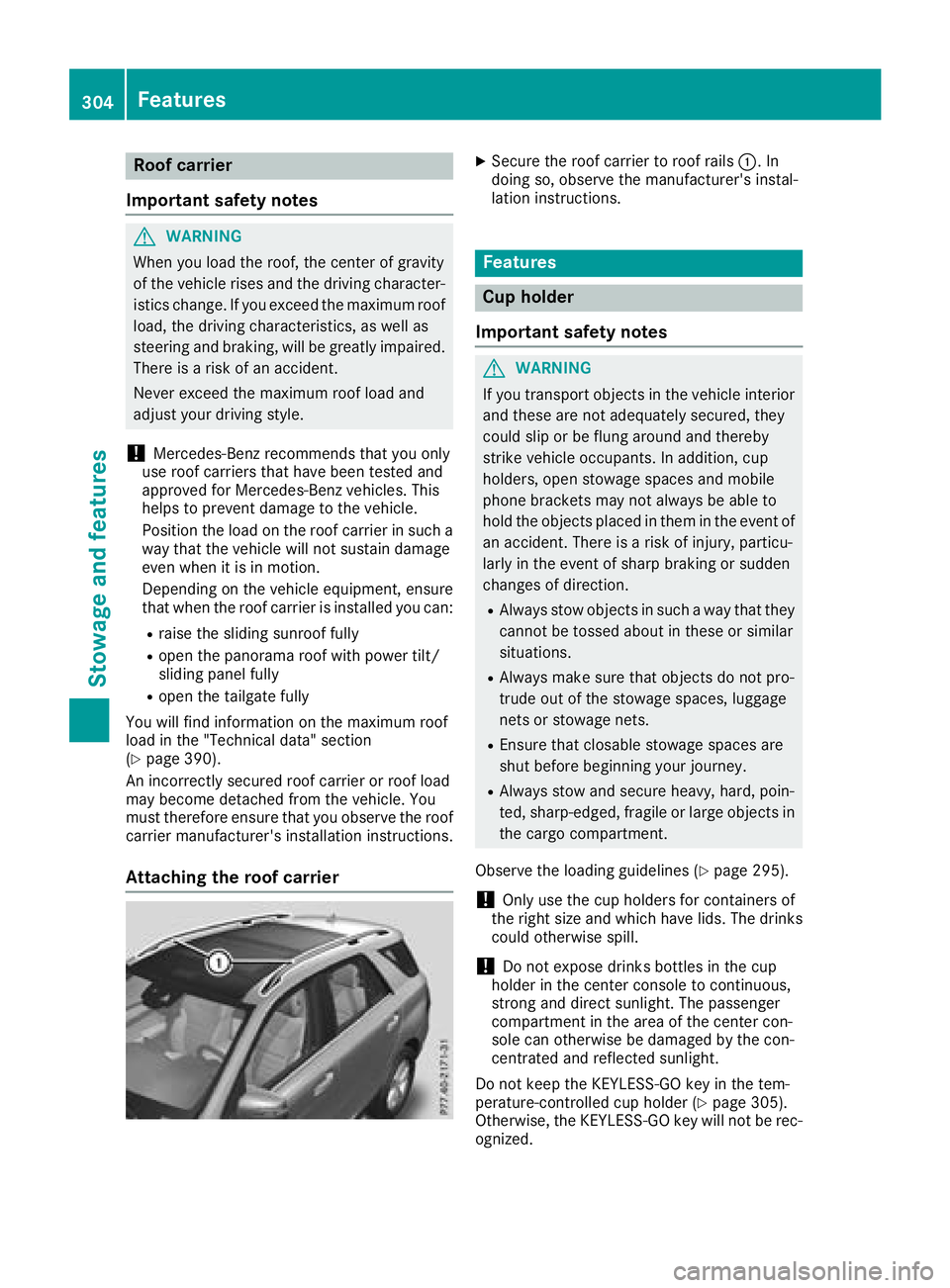
Attaching the roof carrier X
Secure the roof carrier to roof rails C . In
doing so, observe the manufacturer's instal-
lation instructions.
Features
Cup holder
Important safety notes
G WARNING
If you transport objects in the vehicle interior
and these are not adequately secured, they
could slip or be flung around and thereby
strike vehicle occupants. In addition, cup
holders, open stowage spaces and mobile
phone brackets may not always be able to
hold the objects placed in them in the event of
an accident. There is a risk of injury, particu-
larly in the event of sharp braking or sudden
changes of direction. R
Always stow objects in such a way that they
cannot be tossed about in these or similar
situations. R
Always make sure that objects do not pro-
trude out of the stowage spaces, luggage
nets or stowage nets. R
Ensure that closable stowage spaces are
shut before beginning your journey. R
Always stow and secure heavy, hard, poin-
ted, sharp-edged, fragile or large objects in
the cargo compartment.
Observe the loading guidelines ( Y
page 295).
! Only use the cup holders for containers of
the right size and which have lids. The drinks
could otherwise spill.
! Do not expose drinks bottles in the cup
holder in the center console to continuous,
strong and direct sunlight. The passenger
compartment in the area of the center con-
sole can otherwise be damaged by the con-
centrated and reflected sunlight.
Do not keep the KEYLESS-GO key in the tem-
perature-controlled cup hol der ( Y
page 305).
Otherwise, the KEYLESS-GO key will not be rec-
ognized.304
Features
Stowage and features
Page 383 of 398
Information regarding technical data Plug-i n hybrid: be sur e to read th e separat e
Operator's Manual. Otherwise, you may no t rec -
ognize dangers.
i The dat a state d her e specifically refers to a
vehicl e wit h standard equipment. Consult an
authorize d Mercedes-Ben z Cente r for th e
dat a for all vehicl e variants and trim levels.
Vehicle electronics
Installing two-way radios and mobile
phones (RF transmitters)
G WARNIN G
The electromagneti c radiation from two-way
radios can interfere wit h th e vehicl e electron -
ics if two-way radios are manipulated or ret -
rofitte d incorrectly. This could jeopardiz e th e
operating safet y of th e vehicle. Ther e is a ris k
of an accident.
You should hav e all wor k on electrical and
electronic component s carried out at a quali-
fie d specialist workshop.
G WARNIN G
If you incorrectl y operate two-way radios in
th e vehicle, th e electromagneti c radiation
may interfere wit h th e vehicl e electronics , for
exampl e if:R
th e two-way radi o is no t connecte d to an
exterio r antennaR
th e exterio r antenna is no t correctl y moun -
te d or is no t low-reflection
This could jeopardiz e th e operating safet y of
th e vehicle. Ther e is a ris k of an accident.
Hav e th e low-reflection exterio r antenna
installed at a qualified specialist workshop.
Always connec t two-way radios to th e low-
reflection exterio r antenna when operating in
th e vehicle.
! The operating permit may be invalidated if
th e instruction s for installation and use of
two-way radios are no t observed. In particular, th e followin g condition s must be
complied with: R
only approve d wavebands may be used R
observ e th e maximum permissible output
in these wavebands R
only approve d antenna position s may be
used
Excessiv e levels of electromagneti c radiation
may caus e damag e to your healt h and th e healt h
of others. Using an exterio r antenna takes int o
accoun t curren t scientific discussion s relating
to th e possible healt h hazards that may result
from electromagneti c fields.
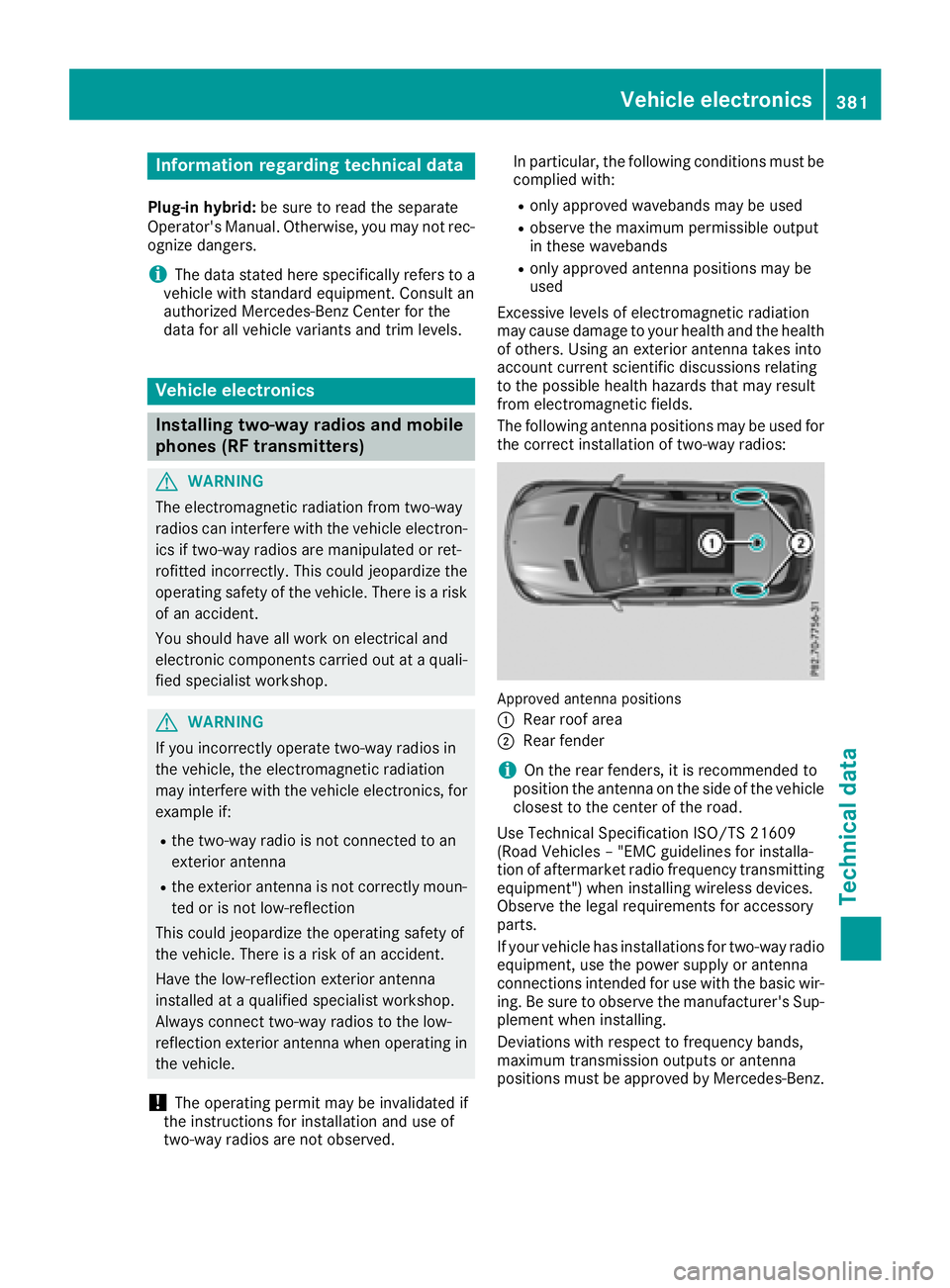
The fo llowin g a
ntenna position s may be used for
th e correc t installation of two-way radios:
Approved antenna position s
C
Rear roo f areaD
Rear fender
i On th e rear fenders, it is recommended to
position th e antenna on th e side of th e vehicl e
closes t to th e center of th e road .
Use Technical Specification ISO/TS 2160 9
(Road Vehicles – "EM C guidelines for installa-
tion of aftermarket radi o frequency transmitting
equipment") when installin g wireless devices.
Observ e th e legal requirements for accessory
parts.
If your vehicl e has installation s for two-way radi o
equipment, use th e power suppl y or antenna
connection s intended for use wit h th e basic wir-
ing . Be sur e to observ e th e manufacturer' s Sup -
plemen t when installing.
Deviation s wit h respec t to frequency bands,
maximum transmission output s or antenna
position s must be approve d by Mercedes-Benz.Vehicle electronics 381
Technical data Z
Page 386 of 398
Fuel
Important safety notes
G WARNIN G
Fuel is highly flammable. If you handle fuel
incorrectly, there is a ris k of fir e and explo-
sion .
You must avoi d fire, open flames, creating
sparks and smoking. Switc h off th e engin e
and , if applicable, th e auxiliary heating before
refueling.
G WARNIN G
Fuel is poisonous and hazardous to health.
Ther e is a ris k of injury.
You must mak e sure that fuel does no t come
int o contact wit h your skin, eyes or clothing
and that it is no t swallowed. Do no t inhale fuel
vapors. Kee p fuel away from children .
If you or other s come int o contact wit h fuel ,
observ e th e following:R
Wash away fuel from skin immediately
usin g soap and water.R
If fuel comes int o contact wit h your eyes,
immediately rinse them thoroughly wit h
clean water. Seek medical assistanc e with-
out delay. R
If fuel is swallowed, seek medical assis-
tance without delay. Do no t induce vomit -
ing . R
Immediately chang e out of clothing whic h
has come int o contact wit h fuel .
Tank capacity
Model Total capa-
cit y
GLE 550 e 4MATIC
21.1 US gal
(80.0 l)
Al l ot her models
24.6 US gal
(93.0 l) Model Of which
reserve
Mercedes-AMG GLE 43
4MATIC Approx.
3.2 US gal
(12.0 l)
Mercedes ‑ AMG vehicles
Approx.
3.7 US gal
(14.0 l)
Al l ot her models
Approx.
3.2 US gal
(12.0 l)
Gasoline Fuel grade
! Do not use diesel to refuel vehicles with a
gasoline engine. Do not switch on the ignition
if you accidentally refuel with the wrong fuel.
Otherwise, the fuel will enter the fuel system.
Even small amounts of the wrong fuel could
result in damage to the fuel system and the
engine. Notify a qualified specialist workshop
and have the fuel tank and fuel lines drained
completely.
! Only refuel using unleaded premium grade
gasoline with at least 91 AKI/95 RON.
i E10 fuel contains up to 10% bioethanol.
Your vehicle is E10-compatible. You can
refuel your vehicle using E10 fuel.
! Only use the fuel recommended. Operating
the vehicle with other fuels can lead to dam-
age to the fuel system, engine and exhaust
system.
! Do not use the following: R
Gasoline with more than 10% ethanol R
E100 (1 00% ethanol) R
Gasoline with methanol R
M100 (1 00% methanol) R
Gasoline with metalliferous additives R
Diesel
Do not mix such fuels with the fuel recom-
mended for your vehicle.
! To ensure the longevity and full perform-
ance of the engine, only premium-grade
unleaded gasoline must be used.384
Service products and filling capacities
Technical data
Page 387 of 398
If standard unleaded gasoline is unavailable
and you have to refuel with unleaded gasoline
of a lower grade, observe the following pre-
cautions: R
Only fill the fuel tank to half full with regular
unleaded gasoline and fill the rest with pre-
mium-grade unleaded gasoline as soon as
possible. R
Do not drive at the maximum speed. R
Avoid sudden acceleration and engine
speeds over 3,000 rpm.
You will usually find information about the fuel
grade on the fuel pump. If you cannot find the
label on the fuel pump, ask the gas station staff.
i For more information, please contact a
qualified specialist workshop or visit
http://www.mbusa.com (USA only).
As a temporary measure, if the recommended
fuel is not available, you may also use regular
unleaded gasoline with an octane rating of
87 AKI/91 RON. This may reduce engine per-
formance and increase fuel consumption. Avoid
driving at full throttle and sudden acceleration.
Never refuel using gasoline with a lower AKI.
Information on refueling ( Y
page 151).
Additives
! Operating the engine with fuel additives
added later can lead to engine failure. Do not
mix fuel additives with fuel. This does not
include additives for the removal and preven-
tion of residue buildup. gasoline must only be
mixed with additives recommended by
Mercedes-Benz. Comply with the instructions
for use on the product label. More information
about recommended additives can be
obtained from any authorized Mercedes-Benz
Center.
Mercedes-Benz recommends that you use bran-
ded fuels that have additives.
The fuel quality available in some countries may
not be sufficient. Residue could build up in the
fuel injection system as a result. In such cases,
and in consultation with an authorized
Mercedes-Benz Center, the fuel may be mixed
with the cleaning additive recommended by
Mercedes-Benz. You must observe the notes
and mixing ratios specified on the container. Diesel Fuel grade
G WARNING
If you mix diesel fuel with gasoline, the flash
point is lower than that of pure diesel fuel.
When the engine is running, exhaust system
components could overheat without being
noticed. There is a risk of fire.
Never refuel with gasoline. Never mix gasoline
with diesel fuel.
! Only use Ultra Low Sulfur Diesel (ULSD),
otherwise it may lead to increased wear and
damage to the fuel system, engine and
exhaust system.
! Do not use the following: R
gasoline R
diesel with a bio-diesel content greater
than 5% (e.g. B20) R
bio-diesel R
vegetable oil R
paraffin R
kerosene R
marine diesel R
heating oil
Do not mix such fuels with diesel fuel and do
not use any special additives. Otherwise,
engine damage may occur.
! In countries outside USA and Canada, only
use sulfur-free diesel with a sulfur content
under 50 ppm. Otherwise, the emission con-
trol system could be damaged.
You will usually find information about the fuel
grade on the pump. If you cannot find the label
on the pump, ask the staff for assistance.
Information on refueling ( Y
page 151).
Low outside temperatures
i Diesel fuel with improved cold flow proper-
ties is available during the winter months.
Further information about fuel properties can
be obtained from oil companies, e.g. at gas
stations.Service products and filling capacities 385
Technical data Z
Page 388 of 398
Flexible Fuel vehicles Import ant safety notes
G WARNIN G
Fuel is highly flammable. If you handle fuel
incorrectly, there is a ris k of fir e and explo-
sion .
You must avoi d fire, open flames, creating
sparks and smoking. Switc h off th e engin e
and , if applicable, th e auxiliary heating before
refueling.
G WARNIN G
Fuel is poisonous and hazardous to health.
Ther e is a ris k of injury.
You must mak e sure that fuel does no t come
int o contact wit h your skin, eyes or clothing
and that it is no t swallowed. Do no t inhale fuel
vapors. Kee p fuel away from children .
If you or other s come int o contact wit h fuel ,
observ e th e following:R
Wash away fuel from skin immediately
usin g soap and water.R
If fuel comes int o contact wit h your eyes,
immediately rinse them thoroughly wit h
clean water. Seek medical assistanc e with-
out delay. R
If fuel is swallowed, seek medical assis-
tance without delay. Do no t induce vomit -
ing . R
Immediately chang e out of clothing whic h
has come int o contact wit h fuel .
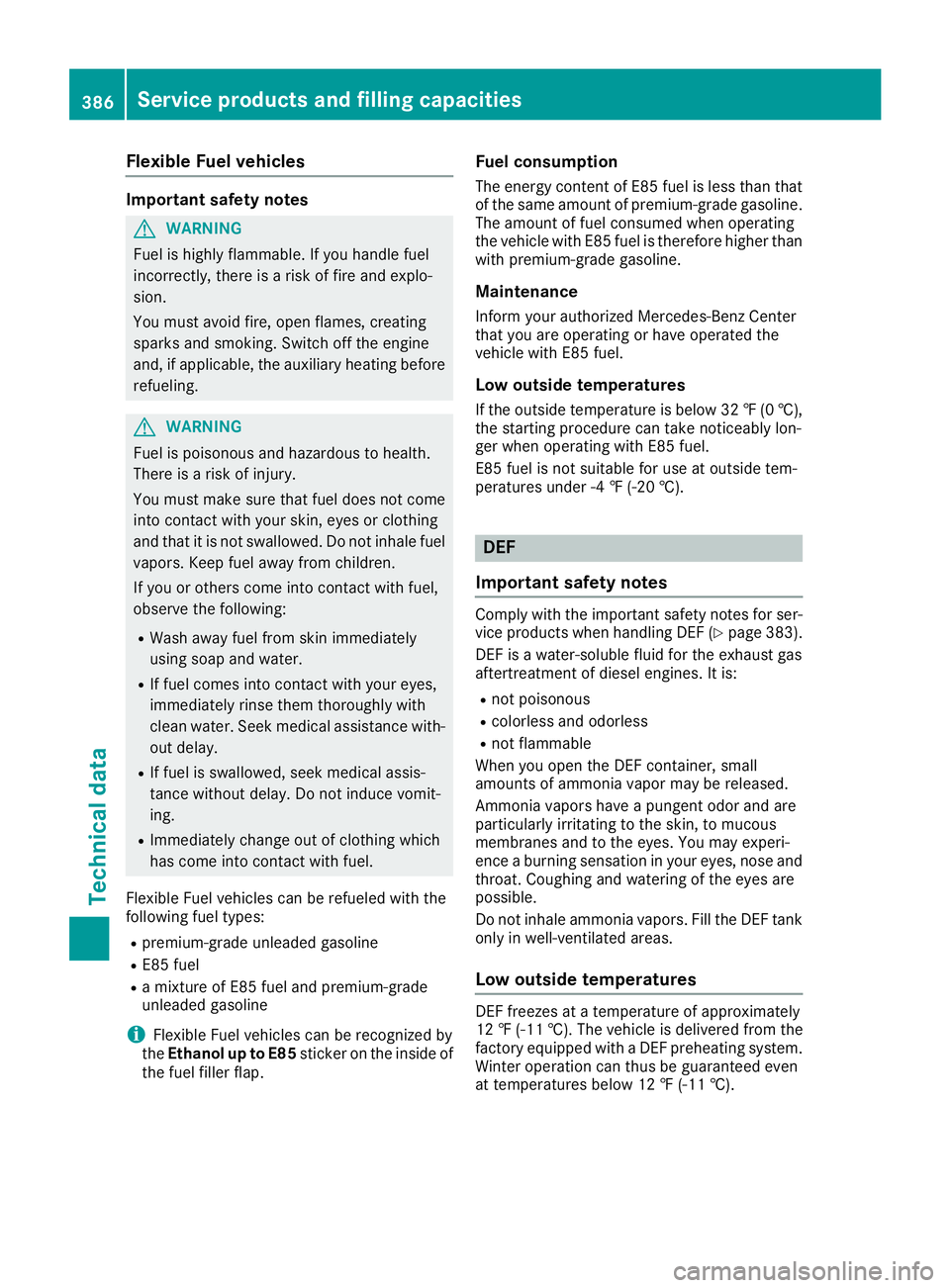
Flexible Fuel vehicles can be refueled wit h th e
followin g fuel types:R
premium-grade unleaded gasolin eR
E8 5 fuelR
a mixtur e of E8 5 fuel and premium-grade
unleaded gasolin e
i Flexible Fuel vehicles can be recognize d by
th e Ethanol up to E85 sticker on th e inside of
th e fuel filler flap . Fuel consu mp tionThe energ y conten t of E8 5 fuel is less than that
of th e sam e amoun t of premium-grade gasoline.
The amoun t of fuel consumed when operating
th e vehicl e wit h E8 5 fuel is therefor e higher than
wit h premium-grade gasoline.
Maintenance Infor m your authorize d Mercedes-Ben z C ente r
that you are operating or have operate d th e
vehicl e wit h E8 5 fuel .
Low outside temperatures If th e outside temperature is belo w 32 ‡( 0 †),
the starting procedure can take noticeably lon-
ger when operating with E85 fuel.
E85 fuel is not suitable for use at outside tem-
peratures under -4 ‡ (-20 †).
DEF
Important safety notes Comply with the important safety notes for ser-
vice products when handling DEF ( Y
page 383).
DEF is a water-soluble fluid for the exhaust gas
aftertreatment of diesel engines. It is: R
not poisonous R
colorless and odorless R
not flammable
When you open the DEF container, small
amounts of ammonia vapor may be released.
Ammonia vapors have a pungent odor and are
particularly irritating to the skin, to mucous
membranes and to the eyes. You may experi-
ence a burning sensation in your eyes, nose and
throat. Coughing and watering of the eyes are
possible.
Do not inhale ammonia vapors. Fill the DEF tank
only in well-ventilated areas.
Low outside temperatures
DEF freezes at a temperature of approximately
12 ‡( -11 †). The vehicle is delivere d from th e
factory equippe d wit h a DE F preheatin g system.
Winte r operation can thus be guaranteed even
at temperature s below 12 ‡ (-11 †).386
Service pr od ucts and filling capacities
Technical data
Page 389 of 398
Additives
! Only use DE F in accordanc e wit h IS O
22241. Do no t use additive s wit h DE F and do
no t dilut e DE F wit h water. This may destroy
th e BlueTE C exhaust gas aftertreatmen t sys-
tem.
Purity
! Impurities in DE F (e.g. due to other servic e
products , cleaning agents or dust ) lead to :R
increased emission value sR
damag e to th e catalytic converterR
engin e damag eR
malfunction s in th e BlueTE C exhaust gas
aftertreatmen t system
Assuring th e purity of DE F is particularly impor-
tan t wit h respec t to avoidin g malfunction s in th e
BlueTE C exhaust gas aftertreatmen t system.
If DE F is pumped out of th e DE F tank, e.g. during
repair work, it mus t no t be returned to th e tank.
The purity of th e fluid can no longer be guaran-
teed.
Filling capacities Model Total capacit y
All models
8. 5 US gal
(32.0 l)
Engine oil
Gene ra l notes
! Do no t use engin e oil or an oil filter wit h
specification s deviating from those expressl y
require d for th e prescribed servic e intervals. Do no t chang e th e engin e oil or oil filter in
order to set replacemen t intervals longer than
those prescribed. This could otherwise caus e
damag e to th e engin e or exhaust gas after-
treatment.
Follow th e instruction s on th e servic e interval
display for changing th e engin e oil. This could
otherwise caus e damag e to th e engin e or
exhaust gas aftertreatment.
When handlin g engin e oil, observ e th e important
safet y note s on servic e products ( Y
page 383).
The engin e oils are matched to th e performance
of Mercedes-Benz engines and servic e intervals.
You should therefor e only use engin e oils and oil
filters that are approve d for vehicles wit h main -
tenance systems .
Fo r a list of approve d engin e oils and oil filters ,
consult an authorize d Mercedes-Benz Center.
Alternatively, visit th e websit e
http://bevo.mercedes-benz.co m .
The table shows whic h engin e oils hav e been
approve d for your vehicle.
Gasolin e engines MB-Freigabe or
MB-Approva l
All models
229.5, 229. 6
Mercede s ‑ AMG vehicles
229. 5
Diesel engines MB-Freigabe or
MB-Approva l
All models
229.52
Mercedes-AMG vehicles: only use SA E 0W-40
or SA E 5W-40 engin e oils .
i MB approval is indicated on th e oil contain -
ers .
Filling capacities The followin g value s refer to an engin e oil
change, includin g th e oil filter.
Model Capacit y
GLE 300 d 4MATIC
6. 9 US qt (6.5 l)
GLE 350 d 4MATIC
8.5 US qt (8.0 l)
Mercedes-AMG
GLE 43 4MATIC 7.4 US qt (7.0 l)Service products and filling capacities 387
Technical data Z
Page 390 of 398
Model Capacity
GLE 550 4MATIC
Mercedes-AMG
GLE 63 4MATIC
Mercedes-AMG
GLE 63 S 4MATIC 9.0 US qt (8.5 l)
Al l ot her models
7.4 US qt (7.0 l)
Ad ditives
! Do not use any additives in the engine oil.
This could damage the engine.
Brake fluid
G WARNING
The brake fluid constantly absorbs moisture
from the air. This lowers the boiling point of
the brake fluid. If the boiling point of the brake
fluid is too low, vapor pockets may form in the
brake system when the brakes are applied
hard. This would impair braking efficiency.
There is a risk of an accident.
You should have the brake fluid renewed at
the specified intervals.
Comply with the important safety notes for ser-
vice products when handling brake fluid
( Y
page 383).
Only use brake fluid approved for Mercedes-
Benz according to MB-Freigabe or MB-Approval
331.0.
Information about approved brake fluid can be
obtained at any qualified specialist workshop or
on the Internet at
http://bevo.mercedes-benz.com .
i Have the brake fluid regularly replaced at a
qualified specialist workshop in accordance
with the replacement intervals and the
replacement confirmed in the service report. Coolant
Important safety notes
G WARNING
If antifreeze comes into contact with hot com-
ponents in the engine compartment, it may
ignite. There is a risk of fire and injury.
Let the engine cool down before you add anti-
freeze. Make sure that antifreeze is not spilled
next to the filler neck. Thoroughly clean the
antifreeze from components before starting
the engine.
! Only add coolant that has been premixed
with the desired antifreeze protection. You
could otherwise damage the engine.
Further information on coolants can be found
in the Mercedes-Benz Specifications for Ser-
vice Products, MB BeVo 310.1, e.g. on the
Internet at
http://bevo.mercedes-benz.com . Or con-
tact a qualified specialist workshop.
! Always use a suitable coolant mixture, even
in countries where high temperatures prevail.
Otherwise, the engine cooling system is not
sufficiently protected from corrosion and
overheating.
i Have the coolant regularly replaced at a
qualified specialist workshop and the replace-
ment confirmed in the service report.
Comply with the important safety notes for ser-
vice products when handling coolant
( Y
page 383).
The coolant is a mixture of water and anti-
freeze/corrosion inhibitor. It is responsible for
the following: R
anti-corrosion protection R
antifreeze protection R
raising the boiling point
If the coolant has antifreeze protection down to
-35 ‡ ( -37 †), the boiling point of the coolant
during operation is approximately 266 ‡
(130 †).388
Service products and filling capacities
Technical data
Page 391 of 398
The antifreeze concentrate/corrosion inhibitor
concentration in the engine cooling system
should: R
be at least 50%. This will protect the engine
cooling system against freezing down to
approximately -35 ‡ (-37 †). R
not exceed 55% (antifreeze protection down
to -49 ‡[ -45 †]). Otherwise, heat will not be
dissipated as effectively.
Mercedes-Benz recommends an antifreeze/
corrosion inhibitor concentrate in accordance
with MB Specifications for Service Products
310.1.
i When the vehicle is first delivered, it is filled
with a coolant mixture that ensures adequate
antifreeze and anti-corrosion protection.
i The coolant is checked at specified intervals
at a qualified specialist workshop.
Filling capacities Missing values were not available at time of
going to print.
Model Capacity
Mercedes ‑ AMG
vehicles Approx. 11.9 US qt
(11.3 l)
GLE 300 d 4MATIC
Approx. 10.7 US qt
(10.1 l)
GLE 350
Approx. 11.1 US qt
(10.5 l)
GLE 350 4MATIC
Approx. 11.1 US qt
(10.5 l)
GLE 350 d 4MATIC
Approx. 12.2 US qt
(11.5 l)
GLE 400 4MATIC
Approx. 10.3 US qt
(9.7 l)
Mercedes-AMG
GLE 43 4MATIC Approx. 10.3 US qt
(9.7 l)
GLE 550 4MATIC
All other models
Approx. 10.3 US qt
(9.7 l) Windshield washer system
Important safety notes
G WARNING
Windshield washer concentrate could ignite if
it comes into contact with hot engine compo-
nents or the exhaust system. There is a risk of
fire and injury.
Make sure that no windshield washer con-
centrate is spilled next to the filler neck.
! Only MB SummerFit and MB WinterFit
washer fluid should be mixed together. The
spray nozzles may otherwise become
blocked.
Do not use distilled or de-ionized water. Other-
wise, the level sensor may give a false reading.
When handling washer fluid, observe the impor-
tant safety notes on service products
( Y
page 383).
At temperatures above freezing: X
Fill the washer fluid reservoir with a mixture of
water and windshield washer fluid, e.g. MB
SummerFit.
Add 1 part MB SummerFit to 100 parts water.
At temperatures below freezing: X
Fill the washer fluid reservoir with a mixture of
water and washer fluid, e.g. MB WinterFit.
For the correct mixing ratio refer to the infor-
mation on the antifreeze reservoir.
i Add windshield washer fluid, e.g. MB Sum-
merFit or MB WinterFit, to the washer fluid all
year round.
Climate control system refrigerant
Important safety notes The climate control system of your vehicle is fil-
led with refrigerant R ‑ 134a.
The instruction label regarding the refrigerant
type used can be found on the radiator cross
member.
! Only the refrigerant R ‑ 134a and the PAG oil
approved by Mercedes-Benz may be used.
The approved PAG oil may not be mixed with
any other PAG oil that is not approved forService products and filling capacities 389
Technical data Z
Page 393 of 398
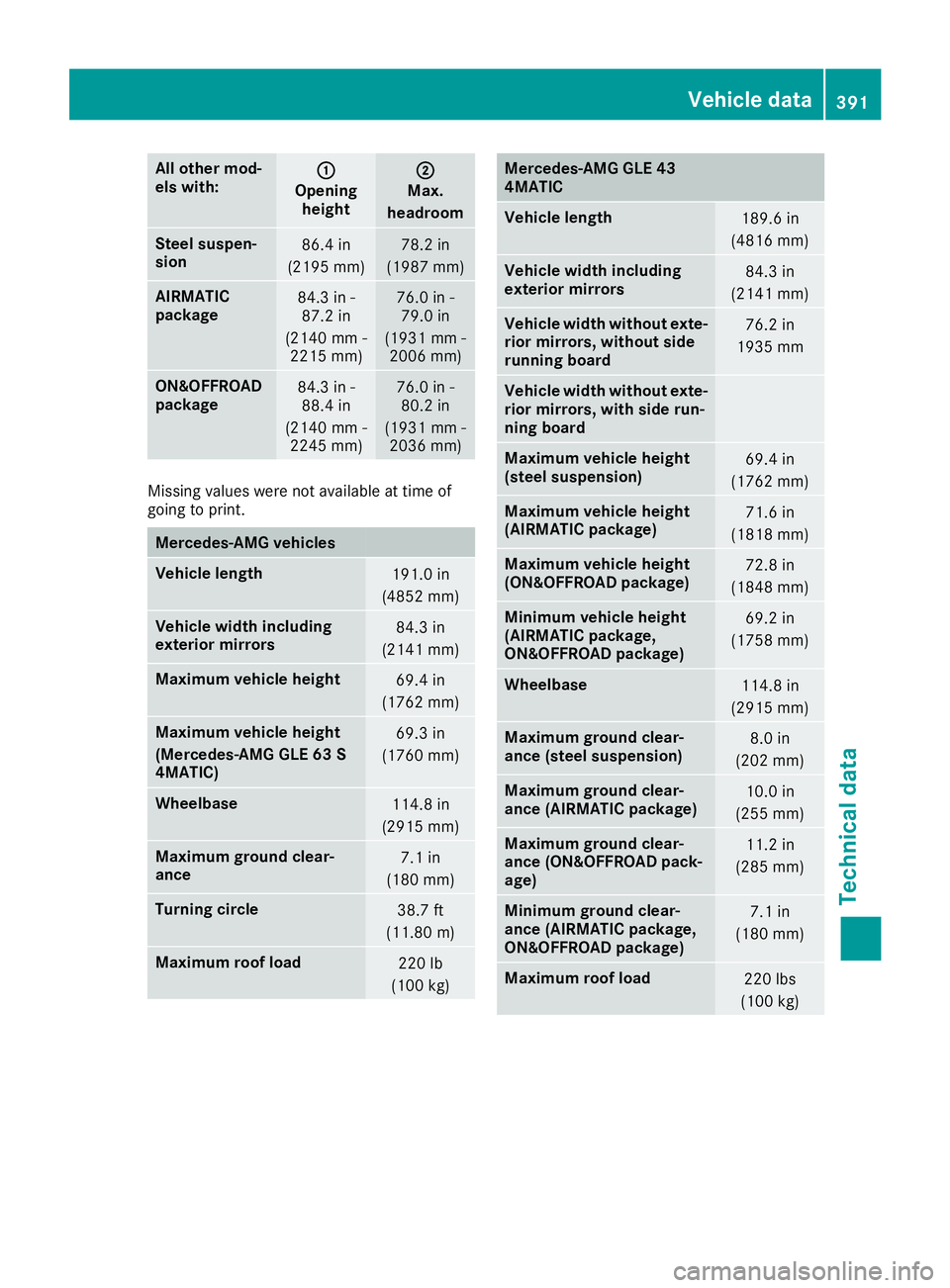
All other mod -
els with: C
Opening
height D
Max.
headr oom
Steel suspen-
sion 86.4 in
(2195 mm ) 78.2 in
(1987 mm )
AIRMATIC
package 84.3 in -
87.2 in
(2140 mm -
2215 mm ) 76.0 in -
79.0 in
(1931 mm -
2006 mm )
ON&O FFROAD
package 84.3 in -
88.4 in
(2140 mm -
2245 mm ) 76.0 in -
80.2 in
(1931 mm -
2036 mm )
Missin g values were not available at time of
going to print.
Mercedes ‑ AMG vehicles
Vehicle length
191.0 in
(4852 mm)
Vehicle width including
exterior mirrors 84.3 in
(2141 mm)
Maximum vehicle height
69.4 in
(1762 mm)
Maximum vehicle height
(Mercedes-AMG GLE 63 S
4MATIC) 69.3 in
(1760 mm)
Wheelbase
114.8 in
(2915 mm)
Maximum ground clear-
ance 7.1 in
(180 mm)
Turning circle
38.7 ft
(11.80 m)
Maximum roof load
220 lb
(100 kg) Mercedes-AMG GLE 43
4MATIC
Vehicle length
189.6 in
(4816 mm)
Vehicle width including
exterior mirrors 84.3 in
(2141 mm)
Vehicle width without exte-
rior mirrors, without side
running board 76.2 in
1935 mm
Vehicle width without exte-
rior mirrors, with side run-
ning board
Maximum vehicle height
(steel suspension) 69.4 in
(1762 mm)
Maximum vehicle height
(AIRMATIC package) 71.6 in
(1818 mm)
Maximum vehicle height
(ON&OFFROAD package) 72.8 in
(1848 mm)
Minimum vehicle height
(AIRMATIC package,
ON&OFFROAD package) 69.2 in
(1758 mm)
Wheelbase
114.8 in
(2915 mm)
Maximum ground clear-
ance (steel suspension) 8.0 in
(202 mm)
Maximum ground clear-
ance (AIRMATIC package) 10.0 in
(255 mm)
Maximum ground clear-
ance (ON&OFFROAD pack-
age) 11.2 in
(285 mm)
Minimum ground clear-
ance (AIRMATIC package,
ON&OFFROAD package) 7.1 in
(180 mm)
Maximum roof load
220 lbs
(100 kg)Vehicle data 391
Technical data Z
Page 394 of 398
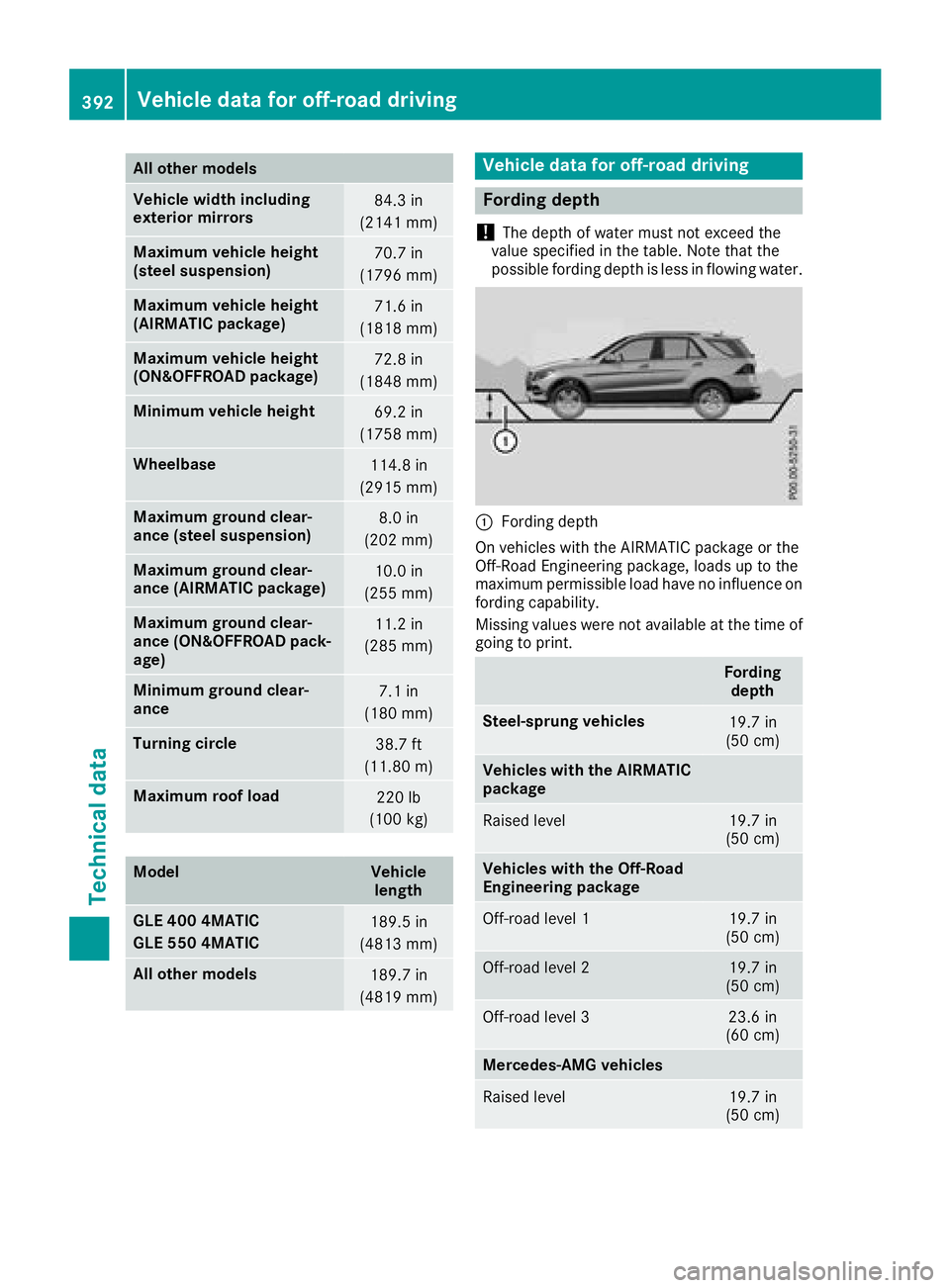
All other mod els
Vehicle width including
exteri or mir ror s 84.3 in
(2141 mm)
Maximum vehicle height
(steel suspension) 70.7 in
(1796 mm)
Maximum vehicle height
(AIRM ATIC package) 71.6 in
(1818 mm)
Maximum vehicle height
(ON&OFFROAD package) 72.8 in
(1848 mm)
Mini mu m vehicle height
69.2 in
(1758 mm)
Wh eelbase
114.8 in
(2915 mm)
Maximum ground clear-
ance (steel suspension) 8.0 in
(202 mm)
Maximum ground clear-
ance (AIRM ATIC package) 10.0 in
(255 mm)
Maximum ground clear-
ance (ON&OFFROAD pack-
age) 11.2 in
(285 mm)
Mini mu m ground clear-
ance 7.1 in
(180 mm)
Tu rn ing circle
38.7 ft
(11.80 m)
Maximum roof load
220 lb
(100 kg)
Model Vehicle
length
GLE 400 4MATIC
GLE 550 4MATIC 189.5 in
(4813 mm)
All other mod els
189.7 in
(4819 mm) Vehicle data for off-road driving
Fording depth
! The depth of water must not exceed the
value specified in the table. Note that the
possible fording depth is less in flowing water.
C
Fording depth
On vehicles wit h the AIRMATIC package or the
Off-Road Engineering package, loads up to the
maximum permissible load have no influence on
fording capab ilit y.
Missing values were not availab le at the time of
going to print.
Ford ing
depth
Steel-sprung vehicles
19 .7 in
(50 cm)
Vehicles with th e AIRMATIC
package
Raised level 19 .7 in
(50 cm)
Vehicles with th e Off-Road
Engineeri ng package
Off-road level 1 19 .7 in
(50 cm)
Off-road level 2 19 .7 in
(50 cm)
Off-road level 3 23 .6 in
(60 cm)
Mercedes-AMG vehicles
Raised level 19 .7 in
(50 cm)392
Vehicle data for off-road driving
Technical data