charging MERCEDES-BENZ GLE HYBRID 2017 Owners Manual
[x] Cancel search | Manufacturer: MERCEDES-BENZ, Model Year: 2017, Model line: GLE HYBRID, Model: MERCEDES-BENZ GLE HYBRID 2017Pages: 58, PDF Size: 1.98 MB
Page 4 of 58
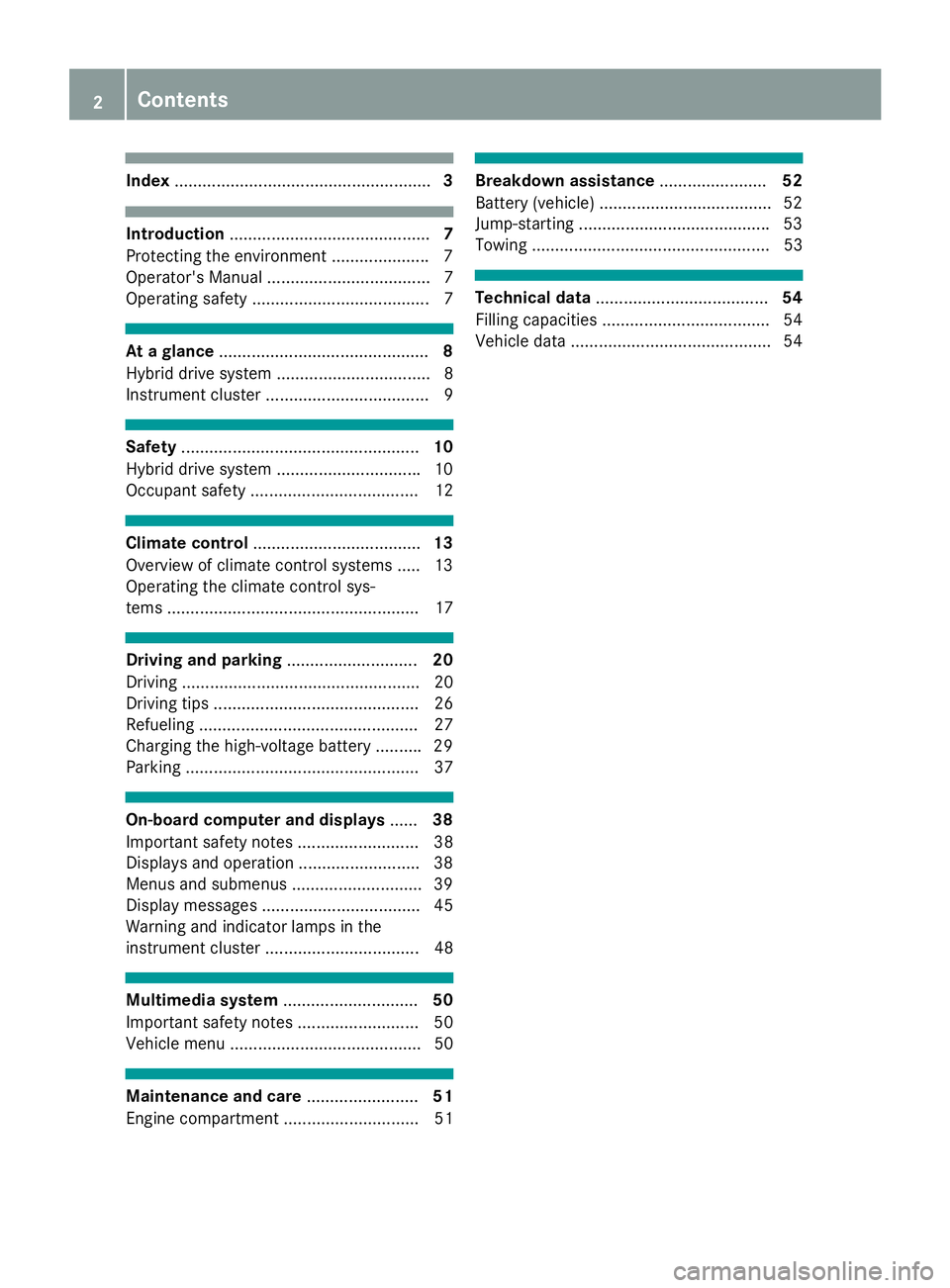
Index ....................................................... 3
Introduction ........................................... 7
Protecting the environment .................... .7
Operator's Manual ................................... 7
Operating safety ...................................... 7
At a glance ............................................. 8
Hybrid drive system ................................. 8
Instrument cluster ................................... 9
Safety ................................................... 10
Hybrid drive system .............................. .1 0
Occupant safety .................................... 12
Climate control .................................... 13
Overview of climate control systems ..... 13
Operating the climate control sys-
tems ...................................................... 17
Driving and parking ............................ 20
Driving ................................................... 20
Driving tips ............................................ 26
Refueling ............................................... 27
Charging the high-voltage battery ......... .2 9
Parking .................................................. 37
On-board computer and displays ...... 38
Important safety notes .......................... 38
Displays and operation .......................... 38
Menus and submenus ........................... .3 9
Display messages .................................. 45
Warning and indicator lamps in the
instrument cluster ................................. 48
Multimedia system ............................. 50
Important safety notes .......................... 50
Vehicle menu ......................................... 50
Maintenance and care ........................ 51
Engine compartment ............................. 51 Breakdown assistance ....................... 52
Battery (vehicle) .................................... .5 2
Jump-starting ........................................ .5 3
Towing ................................................... 53
Technical data ..................................... 54
Filling capacities .................................... 54
Vehicle data .......................................... .5 42
Contents
Page 5 of 58
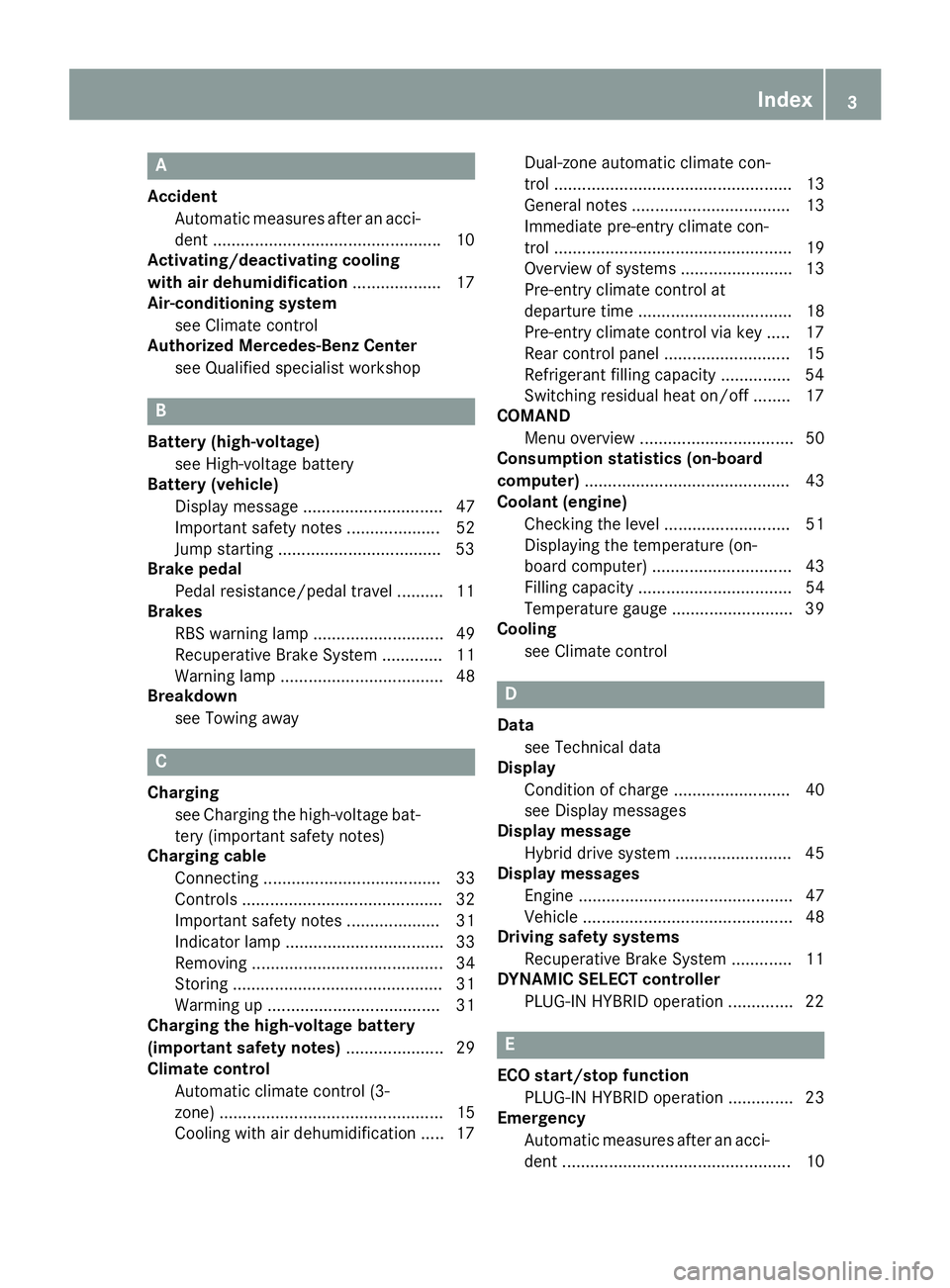
A Accident
Automat ic measures after an acc i-
dent ................................................ .1 0
Activating/deactivating cooling
with air dehumidification .................. .1 7
Air-conditioning system
see Climat e control
Authorized Mercedes-Benz Center
see Qualified specialist workshop
B Battery (high-voltage)
see High-voltage battery
Battery (vehicle)
Dis play message .............................. 47
Im portant safety notes .................... 52
Jump starting .................................. .5 3
Brake pedal
Pedal resistance/pedal travel .......... 11
Brakes
RBS warning lamp ............................ 49
Recuperative Brake System ............. 11
Warning lamp ................................... 48
Breakdown
see Towing away
C
Charging
see Charging the high-voltage bat-
tery (important safety notes)
Charging cable
Connecting ...................................... 33
Controls ........................................... 32
Important safety notes .................... 31
Indicator lamp .................................. 33
Removing ......................................... 34
Storing ............................................. 31
Warming up ..................................... 31
Charging the high-voltage battery
(important safety notes) ..................... 29
Climate control
Automatic climate control (3-
zone) ................................................ 15
Cooling with air dehumidification ..... 17 Dual-zone automatic climate con-
trol ................................................... 13
General notes .................................. 13
Immediate pre-entry climate con-
trol ................................................... 19
Overview of systems ........................ 13
Pre-entry climate control at
departure time ................................. 18
Pre-entry climate control via key ..... 17
Rear control panel ........................... 15
Refrigerant filling capacity ............... 54
Switching residual heat on/off ........ 17
COMAND
Menu overview ................................. 50
Consumption statistics (on-board
computer) ............................................ 43
Coolant (engine)
Checking the level ........................... 51
Displaying the temperature (on-
board computer) .............................. 43
Filling capacity ................................. 54
Temperature gauge .......................... 39
Cooling
see Climate control
D
Data
see Technical data
Display
Condition of charge ......................... 40
see Display messages
Display message
Hybrid drive system ......................... 45
Display messages
Engine .............................................. 47
Vehicle ............................................. 48
Driving safety systems
Recuperative Brake System ............. 11
DYNAMIC SELECT controller
PLUG-IN HYBRID operation .............. 22
E
ECO start/stop function
PLUG-IN HYBRID operation .............. 23
Emergency
Automatic measures after an acci-
dent ................................................. 10 Index 3
Page 6 of 58
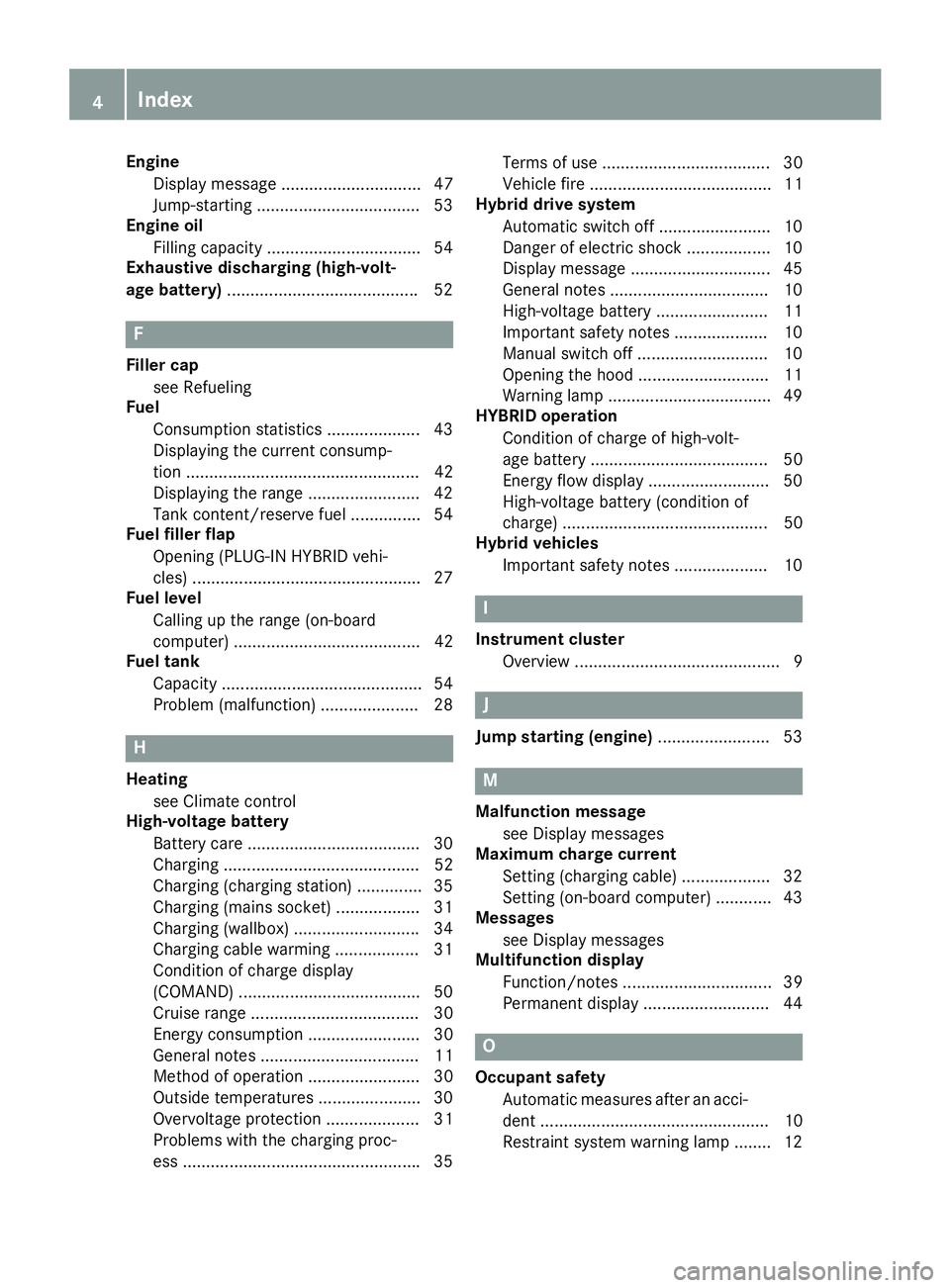
Engine
Display message .............................. 47
Jump-starting .................................. .5 3
Engine oil
Filling capacity ................................ .5 4
Exhaustive discharging (high-volt-
age battery) ........................................ .5 2
FFiller cap
see Refueling
Fuel
Consumption statistics .................... 43
Displaying the current consump-
tion .................................................. 42
Displaying the range ........................ 42
Tank content/reserve fuel .............. .5 4
Fuel filler flap
Opening (PLUG-IN HYBRID vehi-
cles) ................................................ .2 7
Fuel level
Calling up the range (on-board
computer) ........................................ 42
Fuel tank
Capacity .......................................... .5 4
Problem (malfunction) ..................... 28
H
Heating
see Climate control
High-voltage battery
Battery care .................................... .3 0
Charging .......................................... 52
Charging (charging station) .............. 35
Charging (mains socket) .................. 31
Charging (wallbox) .......................... .3 4
Charging cable warming .................. 31
Con dit ion of charge display
(COMAND) ...................................... .5 0
Cruise range .................................... 30
Energy consumption ........................ 30
General notes .................................. 11
Method of operation ........................ 30
Out side temperatures ...................... 30
Overvoltage protection .................... 31
Pro blem s wit h the charging proc-
ess .................................................. .3 5 Terms of use .................................... 30
Vehicle fire ....................................... 11
Hybrid drive system
Automatic switch off ........................ 10
Danger of electric shock .................. 10
Display message .............................. 45
General notes ................................. .1 0
High-voltage battery ........................ 11
Imp ortant safety notes .................... 10
Manual switch off ............................ 10
Opening the hood ............................ 11
Warning lamp ................................... 49
HYBRID operation
Condition of charge of high-volt-
age battery ...................................... 50
Energy flow display .......................... 50
High-voltage battery (condition of
charge) ............................................ 50
Hybrid vehicles
Important safety notes .................... 10
I Instrument cluster
Overview ............................................ 9
J
Jump starting (engine) ........................ 53
M
Malfunction message
see Display messages
Maximum charge current
Setting (charging cable) ................... 32
Setting (on-board computer) ............ 43
Messages
see Display messages
Multifunction display
Function/notes ................................ 39
Permanent display ........................... 44
O
Occupant safety
Automatic measures after an acci-
dent ................................................. 10
Restraint system warning lamp ........ 124
Index
Page 7 of 58
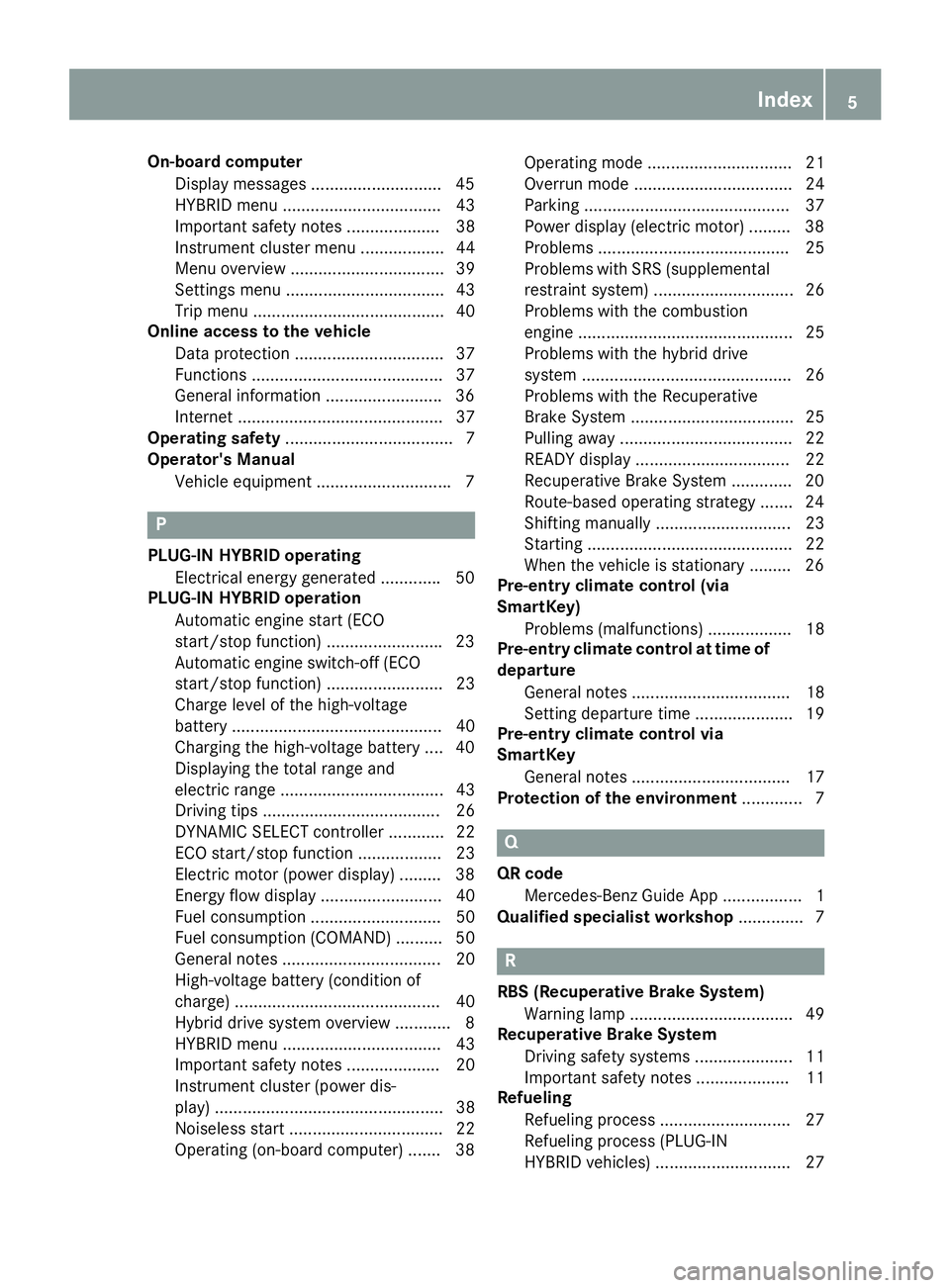
On-board computer
Display messages ........................... .4 5
HYBRID menu .................................. 43
Important safety notes .................... 38
Instrument cluster menu .................. 44
Menu overview ................................. 39
Settings menu .................................. 43
Trip menu ......................................... 40
Online access to the vehicle
Data protection ................................ 37
Functions ......................................... 37
General information ........................ .3 6
Internet ............................................ 37
Operating safety .................................... 7
Operator's Manual
Vehicle equipment ............................ .7
P PLUG-IN HYBRID operating
Electrical energy generated ............ .5 0
PLUG-IN HYBRID operation
Automatic engine start (ECO
start/stop function) ........................ .2 3
Automatic engine switch-off (ECO
start/stop function) ......................... 23
Charge level of the high-voltage
battery ............................................. 40
Charging the high-voltage battery .... 40
Displaying the total range and
electric range ................................... 43
Driving tips ...................................... 26
DYNAMIC SELECT controller ............ 22
ECO start/stop function .................. 23
Electric motor (power display) ......... 38
Energy flow display .......................... 40
Fuel consumption ............................ 50
Fuel consumption (COMAND) .......... 50
General notes .................................. 20
High-voltage battery (condition of
charge) ............................................ 40
Hybrid drive system overview ............ 8
HYBRID menu .................................. 43
Important safety notes .................... 20
Instrument cluster (power dis-
play) ................................................. 38
Noiseless start ................................. 22
Operating (on-board computer) ....... 38 Operating mode ............................... 21
Overrun mode .................................. 24
Parking ............................................ 37
Power display (electric motor) ......... 38
Problems ......................................... 25
Problems with SRS (supplemental
restraint system) .............................. 26
Problems with the combustion
engine .............................................. 25
Problems with the hybrid drive
system ............................................. 26
Problems with the Recuperative
Brake System ................................... 25
Pulling away ..................................... 22
READY display ................................. 22
Recuperative Brake System ............. 20
Route-based operating strategy ....... 24
Shifting manually ............................. 23
Starting ............................................ 22
When the vehicle is stationary ......... 26
Pre-entry cli mate control (via
SmartKe y)
Problems (malfunctions) .................. 18
Pre-entry climate control at time of
departure
General notes .................................. 18
Setting departure time ..................... 19
Pre-entry climate control via
SmartKey
General notes .................................. 17
Protection of the environment ............. 7
Q
QR code
Mercedes-Benz Guide App ................. 1
Qualified specialist workshop .............. 7
R
RBS (Recuperative Brake System)
Warning lamp ................................... 49
Recuperative Brake System
Driving safety systems ..................... 11
Important safety notes .................... 11
Refueling
Refueling process ............................ 27
Refueling process (PLUG-IN
HYBRID vehicles) ............................. 27 Index 5
Page 13 of 58
X
If possible, move the vehicle out of the
danger zone: shift the automatic transmis-
sion into position N .X
Release the electric parking brake. X
Roll the vehicle to a safe place and park it
safely.
Get assistance from others if necessary.
The vehicle is locked automatically when the
ignition is switched on and the wheels are turn-
ing. There is therefore a risk of being locked out
if the vehicle is being pushed or tested on a
dynamometer. X
Switch the ignition off. X
Shift the automatic transmission to park posi-
tion P .
Apply the electric parking brake.
Safeguard the vehicle against rolling away
(see the vehicle Operator's Manual). X
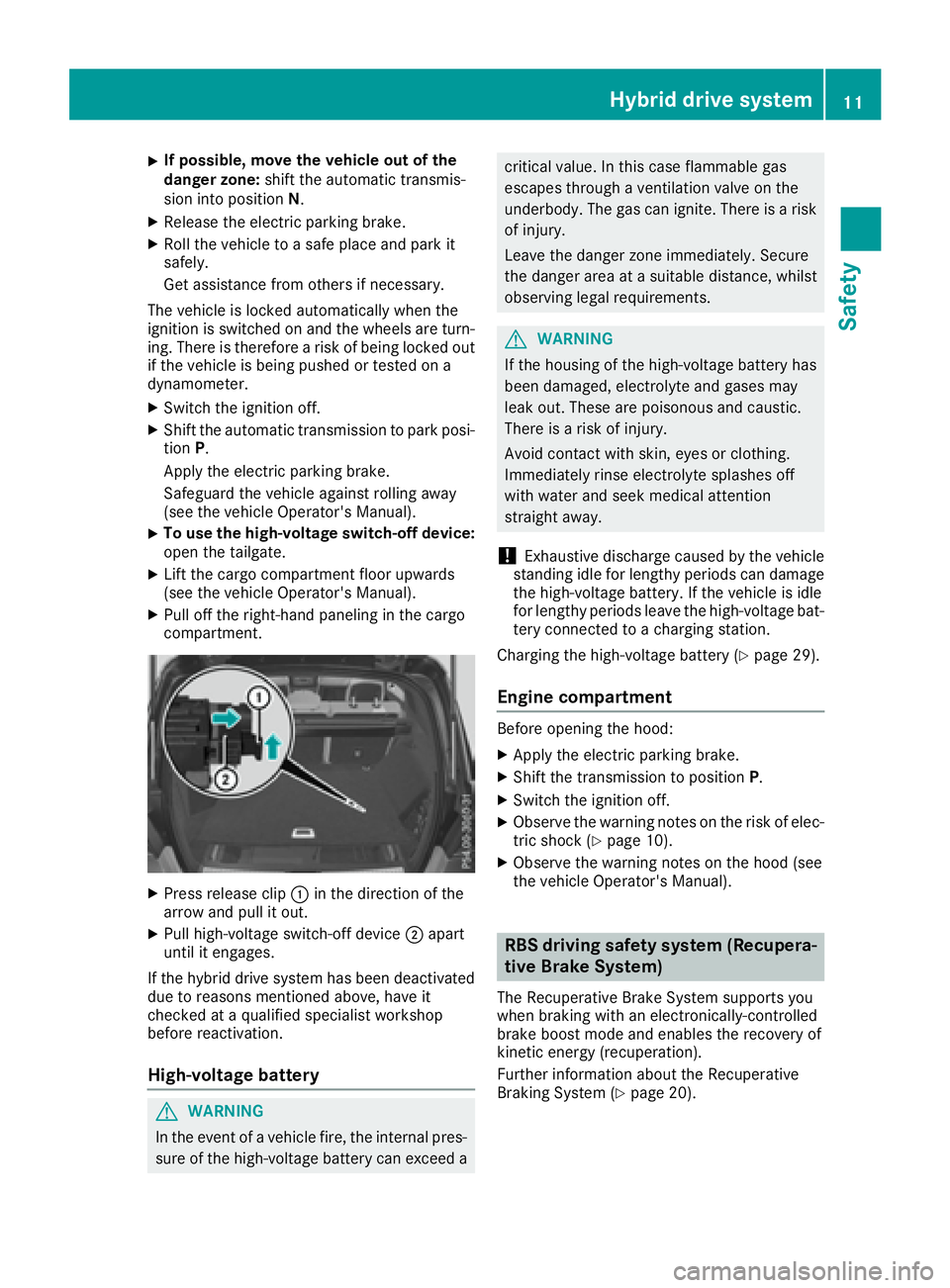
To use the high-voltage switch-off device:
open the tailgate. X
Lift the cargo compartment floor upwards
(see the vehicle Operator's Manual). X
Pull off the right-hand paneling in the cargo
compartment.
X
Press release clip C in the direction of the
arrow and pull it out. X
Pull high-voltage switch-off device D apart
until it engages.
If the hybrid drive system has been deactivated
due to reasons mentioned above, have it
checked at a qualified specialist workshop
before reactivation.
High-voltage battery
G WARNING
In the event of a vehicle fire, the internal pres-
sure of the high-voltage battery can exceed a critical value. In this case flammable gas
escapes through a ventilation valve on the
underbody. The gas can ignite. There is a risk
of injury.
Leave the danger zone immediately. Secure
the danger area at a suitable distance, whilst
observing legal requirements.
G WARNING
If the housing of the high-voltage battery has
been damaged, electrolyte and gases may
leak out. These are poisonous and caustic.
There is a risk of injury.
Avoid contact with skin, eyes or clothing.
Immediately rinse electrolyte splashes off
with water and seek medical attention
straight away.
! Exhaustive discharge caused by the vehicle
standing idle for lengthy periods can damage
the high-voltage battery. If the vehicle is idle
for lengthy periods leave the high-voltage bat-
tery connected to a charging station.
Charging the high-voltage battery ( Y
page 29).
Engine compartment Before opening the hood: X
Apply the electric parking brake. X
Shift the transmission to position P .X
Switch the ignition off. X
Observe the warning notes on the risk of elec-
tric shock ( Y
page 10). X
Observe the warning notes on the hood (see
the vehicle Operator's Manual).
RBS driving safety system (Recupera-
tive Brake System) The Recuperative Brake System supports you
when braking with an electronically-controlled
brake boost mode and enables the recovery of
kinetic energy (recuperation).
Further information about the Recuperative
Braking System ( Y
page 20).Hybrid drive system 11
Safety Z
Page 20 of 58
When the vehicle is pre-heated, the following
functions are activated if required: R
Climate control system R
Blower R
Seat heating
If you have activated ionization via the multime-
dia system, it is activated together with pre-
entry climate control.
Activating/deactivating Before "Pre-entry climate control via SmartKey"
can be activated, you must activate the function
using the on-board computer. X
To activate: unlock the vehicle with the
SmartKey or KEYLESS-GO.
The climate control functions are activated
for up to 5 minutes for pre-heating and pre-
cooling. X
To deactivate: "Pre-entry climate control via
SmartKey" deactivates automatically when
the engine is started.
The following functions remain active after the
engine is started: R
Seat heating (heating) R
Seat ventilation (ventilation) R
Ionization
Problems with "Pre-entry climate control via SmartKey" Problem
Possible causes/consequences and P Solutions
"Pre-entry climate con-
trol via SmartKey" can-
not be switched on or
has switched itself off. The condition of charge of the high-voltage battery is under the speci-
fied minimum condition of charge. X
Start the engine when the vehicle is at a standstill.
The engine powers the electric motor. The electric motor operates
as a generator. The high-voltage battery is being charged.
Further information on charging the high-voltage battery via: R
a mains socket ( Y
page 31)R
a charging station ( Y
page 35)R
a wallbox ( Y
page 34)
"Pre-entry climate control via SmartKey" has been started more than
twice with the engine switched off. X
Switch on the engine and let it run for more than ten seconds. X
Try again to switch on "Pre-entry climate control via SmartKey".
Pre-entry climate control at time of
departure
Important safety notes
G WARNING
If persons, particularly children are subjected
to prolonged exposure to extreme heat or
cold, there is a risk of injury, possibly even
fatal. Never leave children unattended in the
vehicle. General notes You can use the "Pre-entry climate control at
departure time" function to cool or heat the
vehicle interior if the engine is not running.
The "Pre-entry climate control at departure
time" function can be activated regardless of
whether or not the vehicle is connected to an
electric power supply. The condition of charge of
the high-voltage battery must be higher than the
specified minimum condition of charge, how-
ever.
When the vehicle is connected to an electric
power supply, priority is given to charging the
high-voltage battery to the specified minimum
charge. "Pre-entry climate control at departure
time" is only activated subsequently.18
Operating the climate control systems
Climate control
Page 25 of 58
Available drive programs:
Individual R
Indivi dual settings
Sp ort R
Spo rty driv ing style wit h
increased boost mode R
Electric-only operation is
not poss ible
Comfort R
Comfortable, economical
driv ing style R
Electric-only operation is
poss ible
Slippery R
Optimal driv ing charac-
teristics on slipp ery or
snow-covered roads R
Electric-only operation is
poss ible
Further information on the driv e program (see
the veh icle Operator's Manual).
Using the steering wheel paddle shifters, you
can temporar ily change gears yourself. For fur-
ther information on the manual driv e program
( Y
page 23).
Manual gear shifting Using the steering wheel paddle shifters, you
can temporar ily change gears yourself. The
transmission must be in position D . When you
activate manual gearshifting, the combustion
engine is automatically swit ched on.X
To activate: pull the left or right steering
wheel paddle shifter.
Manual gearshifting is activated temporar ily.
The selected gear and M appear in the mult i-
function display.
The ECO start /s top function is not availab le
when manually changing gear.
Further information on manual gearshifting (see
the veh icle Operator's Manual).
ECO start/stop function
General notes
The ECO start/stop function swit ches the com-
bustion engine off automatically when the veh i-
cle stops moving and at spee ds below 80 mph
(13 0 km/ h) ( Y
page 24). All vehicle systems remain active, e.g. the auto-
matic climate control.
The ECO start/stop function is neither available
in the Sport drive program nor during manual
shifting.
Automatic engine switch-off The engine is switched off automatically, includ-
ing when: R
the driver removes his/her foot from the
accelerator in the Comfort drive program and
a speed of 80 mph (130 km/h) is not excee-
ded ( Y
page 24) R
the engine has reached its operating temper-
ature R
the driver’s seat belt is fastened and the
driver’s door is closed R
the driver only slightly depresses the accel-
erator pedal in order to, for example, maintain
the current speed for a limited distance R
the hood is closed and engaged properly R
the high-voltage battery is charged suffi-
ciently R
no malfunctions are present in the hybrid
drive system
The internal combustion engine will not be
switched off automatically, if: R
the self-diagnosis function of the engine man-
agement is active R
there is a malfunction in the hybrid drive sys-
tem R
the climate control of the vehicle requires it R
the high-voltage battery is charging
( Y
page 40).
Automatic engine start The automatically switched-off internal combus-
tion engine starts automatically in certain situa-
tions, if: R
the power demand from the driver via the
accelerator pedal is greater than the electric
motor alone can provide R
the driver switches to the Sport drive pro-
gram or to manual gearshifting R
the condition of charge of the high-voltage
battery has reached the lower limit R
the driver has selected the CHARGE operating
mode Driving 23
Driving and parking
Page 31 of 58
Charging the high-voltage battery
Important safety notes
G DANGER
The vehicle's high-voltage electrical system is
under high voltage. If you modify components
in the vehicle's high-voltage electrical system
or touch damaged components, you may be
electrocuted. The components in the vehi-
cle's high-voltage electrical system may be
damaged in an accident, although the damage
is not visible. There is a risk of fatal injury.
Following an accident, do not touch any high-
voltage components and never modify the
vehicle's high-voltage electrical system. Have
the vehicle towed away after an accident and
the vehicle's high-voltage electrical system
checked by a qualified specialist workshop.
G WARNING
In the event of a vehicle fire, the internal pres-
sure of the high-voltage battery can exceed a
critical value. In this case flammable gas
escapes through a ventilation valve on the
underbody. The gas can ignite. There is a risk
of injury.
Leave the danger zone immediately. Secure
the danger area at a suitable distance, whilst
observing legal requirements.
G DANGER
Connecting the charging cable to the mains
supply via incorrectly installed mains sockets
or by means of adapters, extension cables or
similar could cause a fire or an electric shock.
There is a risk of fatal injury.
To avoid hazardous situations, observe the
following: R
Only connect the charging cable to mains
sockets: -
which have been properly installed and -
which have been inspected by a qualified
electrician R
For safety reasons, only use the charging
cables supplied with the vehicle, or charg- ing cables which have been approved for
use with this vehicle. R
Never use a damaged charging cable. R
Do not use: -
extension cables -
extension reels -
multiple sockets R
Never use socket adapters to connect the
charging cable to the mains socket. The
only exception being if the adapter has
been tested and approved by the manufac-
turer for charging the high-voltage battery
of an electric vehicle. R
Observe the safety notes in the operating
instructions for the socket adapter.
G DANGER
Connecting the charging cable to the vehicle
via an incorrectly installed wallbox or by
means of adapters, extension cables or simi-
lar could cause a fire or an electric shock.
There is a risk of fatal injury.
To avoid hazardous situations, observe the
following: R
Only connect the charging cable to a wall-
box if: -
the wallbox is properly installed -
the wallbox has been inspected by a
qualified electrician -
the charging cable is not damaged. R
Do not extend the charging cable. R
Do not use an adapter. R
Always observe the safety notes in the wall-
box's operating instructions.
The vehicle's high voltage electrical system is
under high voltage. R
Do not tamper with the high-voltage compo-
nents or the orange cables of the high-voltage
electrical system. R
Do not touch high-voltage components or the
orange cables of the high-voltage electrical
system when a vehicle has been involved in a
crash.Charging the high-voltage battery 29
Driving and parking Z
Page 32 of 58
R
Never touch damaged components or the
damaged orange cables of the high-voltage
electrical system. R
Do not remove the covers of the high-voltage
electrical system components that are
marked with a warning sticker.
General notes
Method of operation The vehicle is equipped with a high-voltage bat-
tery for driving. The high-voltage battery stores
the energy needed to operate the electric motor
and releases it again.
The electric motor uses energy that has been
stored in the high-voltage battery when pulling
away, accelerating and during the journey.
In overrun mode, kinetic energy is converted by
means of energy recuperation into electrical
energy and stored in the high-voltage battery.
Information on overrun mode ( Y
page 24).
The high-voltage battery can be charged as fol-
lows: R
through energy recuperation while the vehicle
is in motion R
through the combustion engine while driving
in CHARGE operating mode ( Y
page 21)R
with the relevant charging cable at an electri-
cal outlet while the vehicle is stationary R
at a wallbox while the vehicle is stationary R
at a charging station while the vehicle is sta-
tionary
The high-voltage battery can be charged in a
nominal voltage range from 100 V to 240 V.
You can view the condition of charge of the high-
voltage battery in the multifunction display.
Information about this can be found under
"Energy flow display" ( Y
page 40).
High and low outside temperatures Low outside temperatures
At very low outside temperatures the maximum
power output of the high-voltage battery may be
reduced. The high-voltage battery is then no
longer able to provide the normal electrical
power output.
High outside temperatures
To prevent damage to the high-voltage battery
due to very high outside temperatures, the max- imum power output of the high-voltage battery
is reduced by the vehicle.
Energy consumption and electrical
range The maximum electrical range is generally
reduced by: R
high and low outside temperatures R
operating the climate control system R
switching on consumers
The battery's physical characteristics are such
that leaving the vehicle parked for long periods
at low outdoor temperatures without charging it
can lead to: R
a reduction in battery performance R
longer charge times
Notes on battery care Avoid storing or transporting the vehicle at
excessively high or low temperatures over a long
period.
If you park the vehicle and leave it stationary for
long periods: R
check the condition of charge of the high-
voltage battery more often R
connect the vehicle to a power supply
This prevents self-discharge and damage to the
high-voltage battery.
Terms of use Please note the information on exceptions and
limitations in warranty documentation and in
the Maintenance Booklet.
Handling the charging cable and charg-
ing cable controls Always read the notes on the charging cable on
the inside of the charge socket flap.
Do not leave the charging cable controls
( Y
page 32) hanging loose from an electrical
outlet. Otherwise, this could result in a poor
contact with the electrical outlet and malfunc-
tions when charging the vehicle.30
Charging the high-voltage battery
Driving and parking
Page 33 of 58
To ensure that the brackets within the charging
cable controls are not subjected to incorrect
loads, observe the following: R
Never lift or carry the controls by the charging
cable connector or the mains plug. R
To transport the charging cable, the charging
cable can be: -
wrapped around the controls or -
secured to the housing of the controls
Heat generated by the charging cable
and charging cable connector Pay attention to the "Important safety notes"
( Y
page 29).
During the charging process, the charging cable
and charging cable connector may heat up.
The charging cable and the charging cable con-
nector will only heat up within the permissible
limiting values, provided that: R
the power supply and the charging cable are
not damaged R
the instructions for handling the charging
cable and controls on the charging cable are
observed
If the charging cable or charging cable connec-
tor become too hot, have the mains power sup-
ply checked.
Protection device against overvoltage
! Overvoltage in the mains supply may dam-
age the vehicle. For this reason, the vehicle is
equipped with a protection device against
overvoltage in the mains supply. This device
may be triggered during severe thunder-
storms, for example, and may lead to the buil-
ding's fuse being tripped and an interruption
in the power supply. These functions protect
the vehicle. After the building fuse is switched
on again, the charging process resumes auto-
matically. Following an interruption in the
power supply or tripping of the building's fuse,
it may take up to 10 minutes for charging to
resume automatically.
Switch on the building protection system again
after it has been triggered. Otherwise, the
charging process cannot be continued. General information about the charging
procedure Pay attention to the "Important safety notes"
( Y
page 29).
The vehicle socket is located in the rear bumper
on the right below the tail lamp.
The charge socket flap and the vehicle are cen-
trally locked or unlocked simultaneously.
Charging the high-voltage battery via
the electrical outlet
Charging cable for electrical outlets Important safety notes
! Only use the charging cable to charge the
high-voltage battery. Do not use the charging
cable for other purposes. It may otherwise be
damaged.
The vehicle is supplied with a country-specific
charging cable for connection to a mains socket.
Only use the charging cable supplied with the
vehicle or a charging cable approved for the
vehicle.
i If you use the supplied 12 A charging cable
to charge a high-voltage battery: R
the charge time increases considerably R
electrical consumption increases consider-
ably
Where possible, charge the high-voltage bat-
tery at a charging station ( Y
page 35). Only
then can certified electrical energy consump-
tion levels be reached.
i The charging process can vary depending on
the power supply. Therefore, always observe
the local information.
Information about charging from a wallbox
( Y
page 34).
Information on charging at a charging station
( Y
page 35).
Stowing the charging cable
The charging cable can be stowed and secured
in the bag provided in the cargo compartment of
the vehicle.Charging the high-voltage battery 31
Driving and parking Z