dimensions MERCEDES-BENZ GLK-CLASS SUV 2013 User Guide
[x] Cancel search | Manufacturer: MERCEDES-BENZ, Model Year: 2013, Model line: GLK-CLASS SUV, Model: MERCEDES-BENZ GLK-CLASS SUV 2013Pages: 380, PDF Size: 19.54 MB
Page 354 of 380
Treadwear indicators
Narrow bars (tread wear bars) that are
distributed over the tire tread.
If the tire tread
is level with the bars, the wear limit of 00CD in
(1.6 mm) has been reached. Occupant distribution
The distribution of occupants in a vehicle at
their designated seating positions. Total load limit
Nominal load and luggage load plus 68 kg
(150 lbs)
multiplied by
the number of seats in
the vehicle. Changing a wheel
Flat tire
You can find
information on
what to do in the
event of a flat tire in the "Flat tire" section
(Y page 312).
Information on driving with MOExtended tires
in the event of a flat tire can be found under
"MOExtended tires (tires with run-flat
characteristics" (Y page 313). Rotating the wheels
G
WARNING
Interchanging the front and rear wheels may
severely impair the driving characteristics if
the wheels or tires have
different dimensions.
The wheel brakes or suspension components
may also be damaged. There is a risk of
accident.
Rotate front and rear wheels only if the wheels
and tires are of the same dimensions.
! On vehicles equipped with a tire pressure
monitor, electronic components are
located in the wheel. Tire-mounting tools should not be used
near the valve. This could damage the
electronic components.
Only have tires changed at a qualified
specialist workshop.
Always observe the instructions and safety
notes in the "Mounting a wheel" section
(Y page 353).
The wear patterns on the front and rear tires
differ, depending on the operating
conditions.
Rotate the wheels before a clear wear pattern
has formed on the tires. Front tires typically
wear more on the shoulders and the rear tires
in the center.
If your vehicle's tire configuration allows, you
can rotate the wheels according to the
intervals in the tire manufacturer's warranty
book in your vehicle documents. If no
warranty book is available, the tires should be
rotated every 3,000 to 6,000 miles (5,000 to
10,000 km), or earlier if tire wear requires. Do
not change the direction of wheel rotation.
Clean the contact surfaces of the wheel and
the brake disc thoroughly every time a wheel
is rotated. Check the tire pressures.
Information on changing tires and mounting
the spare wheel ( Y page 352). Direction of rotation
Tires with a specified direction of rotation
have additional benefits, e.g. if
there is a risk
of hydroplaning. You will only gain these
benefits if the correct direction of rotation is
maintained.
An arrow on the sidewall of the tire indicates
its correct direction of rotation. Storing wheels
Store wheels that are not
being used in a cool,
dry and preferably dark place. Protect the
tires from oil, grease, gasoline and diesel. 352
Changing a wheel
Wheels and tires
Page 362 of 380
R
only use a spare wheel or emergency spare
wheel of a different size briefly.
R do not switch ESP ®
off.
R have a spare wheel or emergency spare
wheel of a different size replaced at the
nearest qualified specialist workshop.
Observe that the wheel and tire dimensions
as well as the tire type must be correct.
When using an emergency spare wheel or
spare wheel of a different size, you must not
exceed the maximum speed of 50 mph
(80 km/h).
Snow chains must not be mounted on
emergency spare wheels. General notes
You should regularly check the pressure of
the emergency spare wheel, particularly
prior
to long trips, and correct the pressure as
necessary (Y page 331). The applicable value
is found on the wheel or under "Technical
data" ( Y page 357).
i When you are driving with the collapsible
spare wheel mounted, the tire pressure
loss warning system or the tire pressure
monitor cannot function reliably. Only
restart the tire pressure loss warning
system/the tire pressure monitor when the
damaged wheel has been replaced with a
new wheel.
Vehicles with tire pressure monitor:
after mounting an emergency spare wheel,
the system may still display the tire
pressure of the removed wheel for a few
minutes. The value displayed for the
mounted emergency spare wheel is not the
same as the current tire pressure of the
emergency spare wheel.
An emergency spare wheel may also be
mounted against the direction of rotation.
Observe the time restriction on use as well as
the speed limitation specified on the
emergency spare wheel. Replace the tires after six years at the latest,
regardless of wear. This also applies to the
emergency spare wheel.
Collapsible spare wheel
Removing the collapsible emergency
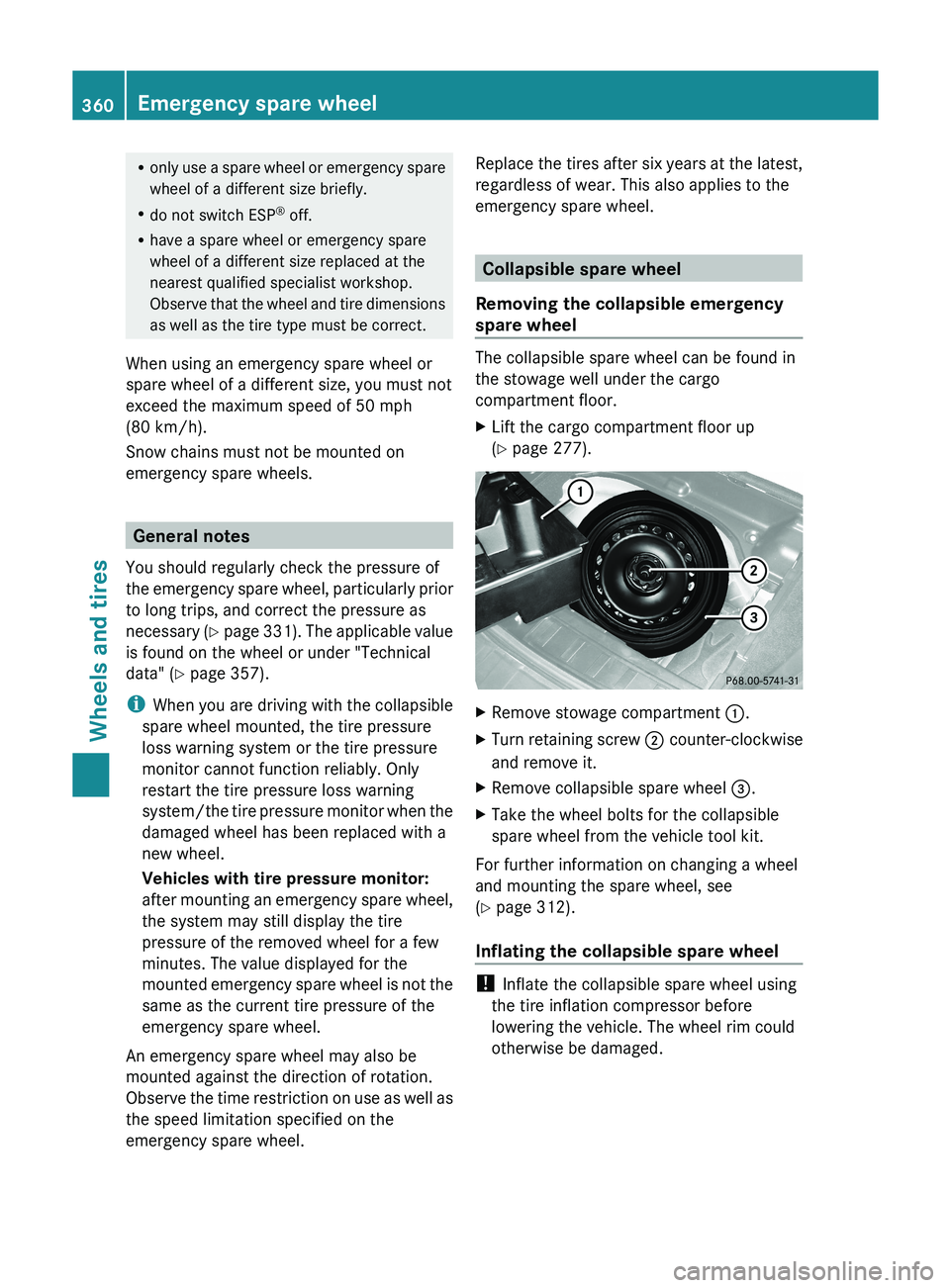
spare wheel The collapsible spare wheel can be found in
the stowage well under the cargo
compartment floor.
X
Lift the cargo compartment floor up
(Y page 277). X
Remove stowage compartment 0043.
X Turn retaining screw 0044 counter-clockwise
and remove it.
X Remove collapsible spare wheel 0087.
X Take the wheel bolts for the collapsible
spare wheel from the vehicle tool kit.
For further information on changing a wheel
and mounting the spare wheel, see
(Y page 312).
Inflating the collapsible spare wheel !
Inflate the collapsible spare wheel using
the tire inflation compressor before
lowering the vehicle. The wheel rim could
otherwise be damaged. 360
Emergency spare wheel
Wheels and tires
Page 376 of 380
Dimensions and weights
Model 0043
Opening height 0044
Max.
headroom GLK 250
BlueTEC
4MATIC
82.2 in
(2087 mm) 77.0 in
(1955 mm) All other
models
82.1 in
(2086 mm) 76.9 in
(1954 mm) Missing values were not available at time of
going to print.
All models
Vehicle length
178.6 in (4536 mm)
Vehicle width
including exterior
mirrors
79.4 in (2016 mm)
Wheelbase
108.5 in (2755 mm)
Turning radius
38.2 ft (11.65 m)
Maximum roof load
GLK 250 BlueTEC
Vehicle height
66.7 in (1694 mm)
Ground clearance
8.0 in (204 mm) GLK 350
BlueEFFICIENCY
GLK 350 4MATIC
BlueEFFICIENCY
Vehicle height
66.7 in (1693 mm)
Ground clearance
8.2 in (208 mm)
Trailer tow hitch
Mounting dimensions
! If you have a trailer tow hitch retrofitted,
changes to the engine cooling system and
drive train may be necessary,
depending on
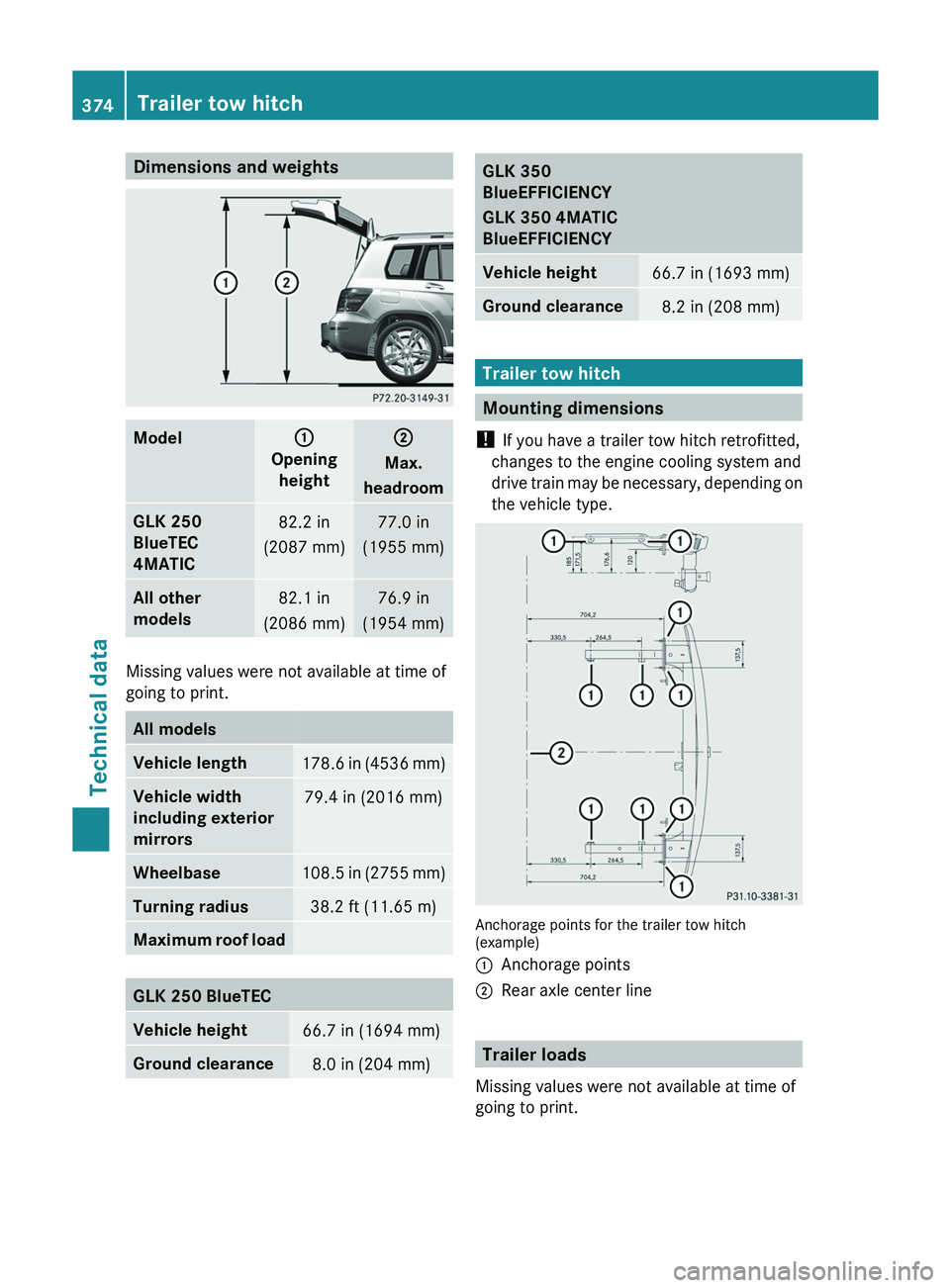
the vehicle type. Anchorage points for the trailer tow hitch
(example)
0043
Anchorage points
0044 Rear axle center line Trailer loads
Missing values were not available at time of
going to print. 374
Trailer tow hitch
Technical data