dimensions MERCEDES-BENZ GLK-CLASS SUV 2013 Owners Manual
[x] Cancel search | Manufacturer: MERCEDES-BENZ, Model Year: 2013, Model line: GLK-CLASS SUV, Model: MERCEDES-BENZ GLK-CLASS SUV 2013Pages: 380, PDF Size: 19.54 MB
Page 19 of 380
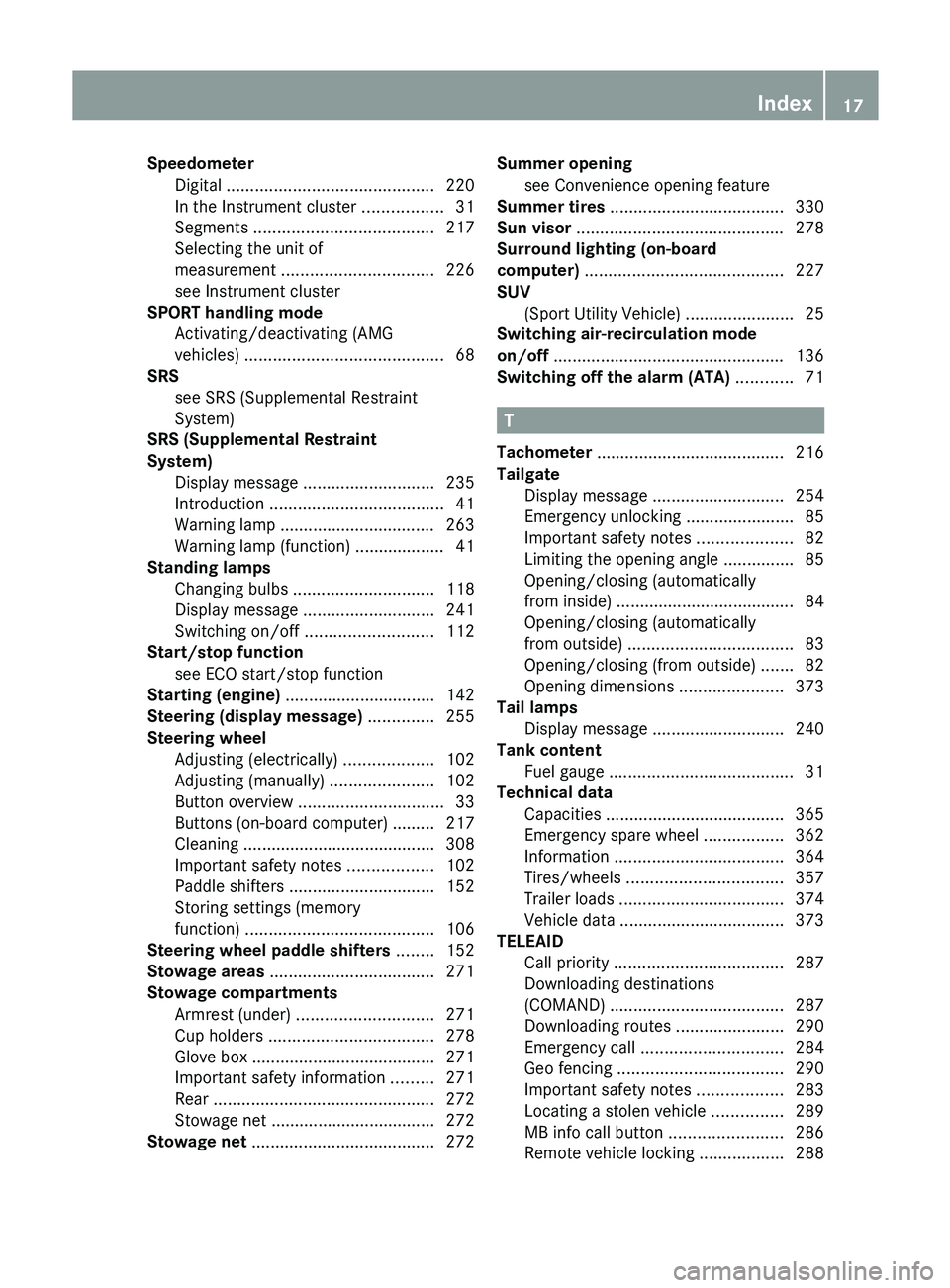
Speedometer
Digital ............................................ 220
In the Instrument cluster ................. 31
Segments ...................................... 217
Selecting the unit of
measurement ................................ 226
see Instrument cluster
SPORT handling mode
Activating/deactivating (AMG
vehicles) .......................................... 68
SRS
see SRS (Supplemental Restraint
System)
SRS (Supplemental Restraint
System)
Display message ............................ 235
Introduction ..................................... 41
Warning lamp ................................. 263
Warning lamp (function) ................... 41
Standing lamps
Changing bulbs .............................. 118
Display message ............................ 241
Switching on/off ........................... 112
Start/stop function
see ECO start/stop function
Starting (engine) ................................ 142
Steering (display message) ..............255
Steering wheel Adjusting (electrically) ...................102
Adjusting (manually) ...................... 102
Button overview ............................... 33
Buttons (on-board computer) ......... 217
Cleaning ......................................... 308
Important safety notes .................. 102
Paddle shifters ............................... 152
Storing settings (memory
function) ........................................ 106
Steering wheel paddle shifters ........152
Stowage areas ................................... 271
Stowage compartments Armrest (under) ............................. 271
Cup holders ................................... 278
Glove box ....................................... 271
Important safety information ......... 271
Rear ............................................... 272
Stowage net ................................... 272
Stowage net ....................................... 272Summer opening
see Convenience opening feature
Summer tires ..................................... 330
Sun visor ............................................ 278
Surround lighting (on-board
computer) .......................................... 227
SUV (Sport Utility Vehicle) .......................25
Switching air-recirculation mode
on/off ................................................. 136
Switching off the alarm (ATA) ............71 T
Tachometer ........................................ 216
Tailgate Display message ............................ 254
Emergency unlocking .......................85
Important safety notes .................... 82
Limiting the opening angle ...............85
Opening/closing (automatically
from inside) ......................................
84
Opening/closing (automatically
from outside) ................................... 83
Opening/closing (from outside) ....... 82
Opening dimensions ...................... 373
Tail lamps
Display message ............................ 240
Tank content
Fuel gauge ....................................... 31
Technical data
Capacities ...................................... 365
Emergency spare wheel ................. 362
Information .................................... 364
Tires/wheels ................................. 357
Trailer loads ................................... 374
Vehicle data ................................... 373
TELEAID
Call priority .................................... 287
Downloading destinations
(COMAND) ..................................... 287
Downloading routes .......................290
Emergency call .............................. 284
Geo fencing ................................... 290
Important safety notes .................. 283
Locating a stolen vehicle ............... 289
MB info call button ........................ 286
Remote vehicle locking .................. 288 Index
17
Page 21 of 380
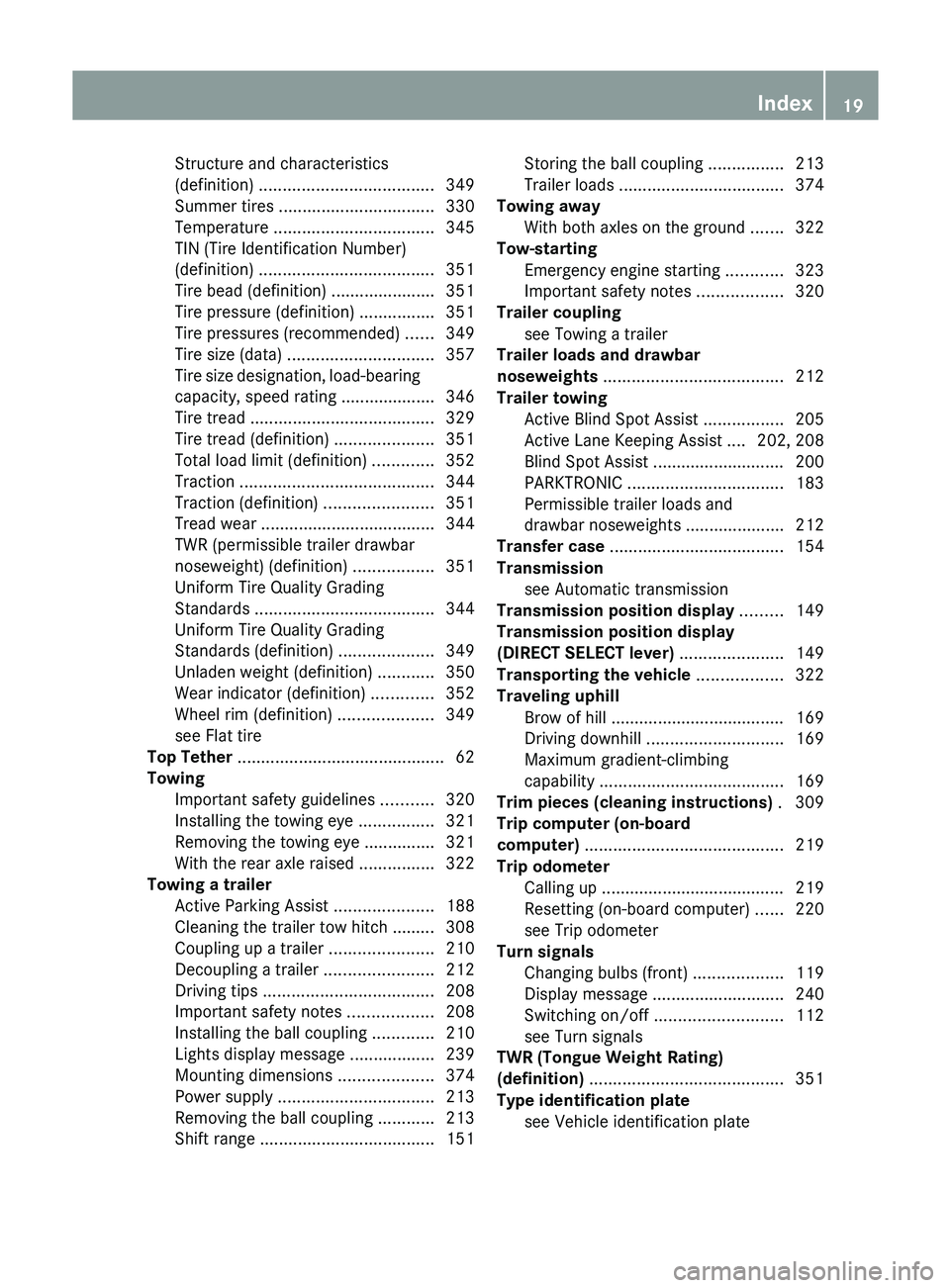
Structure and characteristics
(definition) .....................................
349
Summer tires ................................. 330
Temperature .................................. 345
TIN (Tire Identification Number)
(definition) ..................................... 351
Tire bead (definition) ......................351
Tire pressure (definition) ................ 351
Tire pressures (recommended)
......349
Tire size (data) ............................... 357
Tire size designation, load-bearing
capacity, speed rating .................... 346
Tire tread ....................................... 329
Tire tread (definition) .....................351
Total load limit (definition) ............. 352
Traction ......................................... 344
Traction (definition) ....................... 351
Tread wear ..................................... 344
TWR (permissible trailer drawbar
noseweight) (definition) .................351
Uniform Tire Quality Grading
Standards ...................................... 344
Uniform Tire Quality Grading
Standards (definition) .................... 349
Unladen weight (definition) ............ 350
Wear indicator (definition) .............352
Wheel rim (definition) .................... 349
see Flat tire
Top Tether ............................................ 62
Towing Important safety guidelines ...........320
Installing the towing eye ................ 321
Removing the towing eye ...............321
With the rear axle raised ................ 322
Towing a trailer
Active Parking Assist .....................188
Cleaning the trailer tow hitch ......... 308
Coupling up a trailer ......................210
Decoupling a trailer ....................... 212
Driving tips .................................... 208
Important safety notes .................. 208
Installing the ball coupling .............210
Lights display message .................. 239
Mounting dimensions .................... 374
Power supply ................................. 213
Removing the ball coupling ............213
Shift range ..................................... 151Storing the ball coupling
................213
Trailer loads ................................... 374
Towing away
With both axles on the ground ....... 322
Tow-starting
Emergency engine starting ............ 323
Important safety notes
..................320
Trailer coupling
see Towing a trailer
Trailer loads and drawbar
noseweights ...................................... 212
Trailer towing Active Blind Spot Assist ................. 205
Active Lane Keeping Assist .... 202, 208
Blind Spot Assist ............................ 200
PARKTRONIC ................................. 183
Permissible trailer loads and
drawbar noseweights .....................212
Transfer case ..................................... 154
Transmission see Automatic transmission
Transmission position display .........149
Transmission position display
(DIRECT SELECT lever) ......................149
Transporting the vehicle .................. 322
Traveling uphill Brow of hill ..................................... 169
Driving downhill ............................. 169
Maximum gradient-climbing
capability ....................................... 169
Trim pieces (cleaning instructions) . 309
Trip computer (on-board
computer) .......................................... 219
Trip odometer Calling up ....................................... 219
Resetting (on-board computer) ...... 220
see Trip odometer
Turn signals
Changing bulbs (front) ................... 119
Display message ............................ 240
Switching on/off ........................... 112
see Turn signals
TWR (Tongue Weight Rating)
(definition) ......................................... 351
Type identification plate see Vehicle identification plate Index
19
Page 22 of 380
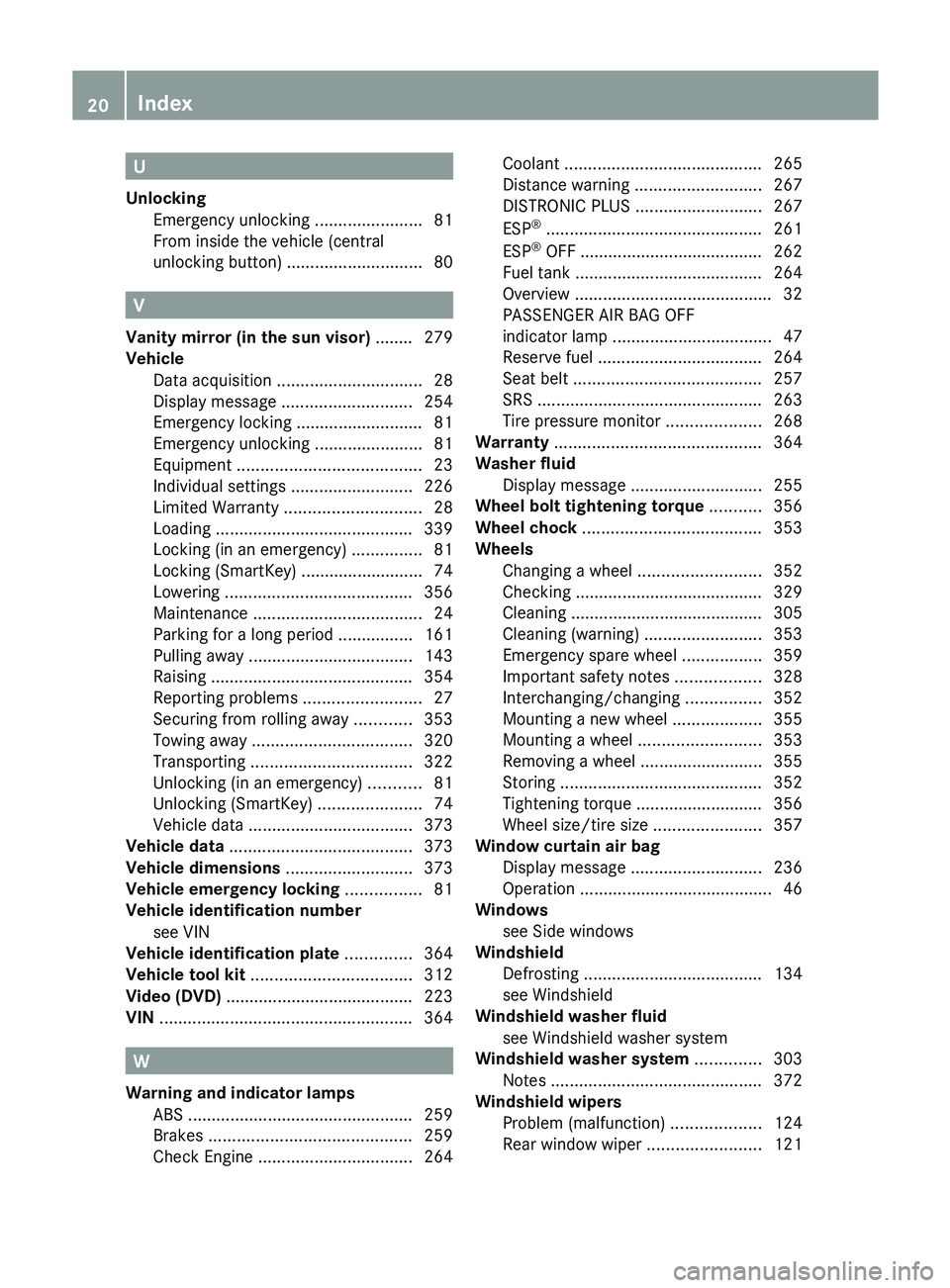
U
Unlocking Emergency unlocking .......................81
From inside the vehicle (central
unlocking button) ............................. 80V
Vanity mirror (in the sun visor) ........ 279
Vehicle Data acquisition ............................... 28
Display message ............................ 254
Emergency locking ........................... 81
Emergency unlocking .......................81
Equipment
....................................... 23
Individual settings ..........................226
Limited Warranty ............................. 28
Loading .......................................... 339
Locking (in an emergency) ............... 81
Locking (SmartKey) .......................... 74
Lowering ........................................ 356
Maintenance .................................... 24
Parking for a long period ................ 161
Pulling away ................................... 143
Raising ........................................... 354
Reporting problems .........................27
Securing from rolling away ............353
Towing away .................................. 320
Transporting .................................. 322
Unlocking (in an emergency) ........... 81
Unlocking (SmartKey) ......................74
Vehicle data ................................... 373
Vehicle data ....................................... 373
Vehicle dimensions ...........................373
Vehicle emergency locking ................81
Vehicle identification number see VIN
Vehicle identification plate ..............364
Vehicle tool kit .................................. 312
Video (DVD) ........................................ 223
VIN ...................................................... 364W
Warning and indicator lamps ABS ................................................ 259
Brakes ........................................... 259
Check Engine ................................. 264Coolant
.......................................... 265
Distance warning ........................... 267
DISTRONIC PLUS
...........................
267
ESP ®
.............................................. 261
ESP ®
OFF ....................................... 262
Fuel tank ........................................ 264
Overview .......................................... 32
PASSENGER AIR BAG OFF
indicator lamp .................................. 47
Reserve fuel
................................... 264
Seat belt ........................................ 257
SRS ................................................ 263
Tire pressure monitor .................... 268
Warranty ............................................ 364
Washer fluid Display message ............................ 255
Wheel bolt tightening torque ...........356
Wheel chock ...................................... 353
Wheels Changing a wheel .......................... 352
Checking ........................................ 329
Cleaning ......................................... 305
Cleaning (warning) .........................353
Emergency spare wheel ................. 359
Important safety notes .................. 328
Interchanging/changing ................352
Mounting a new wheel ................... 355
Mounting a wheel .......................... 353
Removing a wheel ..........................355
Storing ........................................... 352
Tightening torque ........................... 356
Wheel size/tire size ....................... 357
Window curtain air bag
Display message ............................ 236
Operation ......................................... 46
Windows
see Side windows
Windshield
Defrosting ...................................... 134
see Windshield
Windshield washer fluid
see Windshield washer system
Windshield washer system .............. 303
Notes ............................................. 372
Windshield wipers
Problem (malfunction) ...................124
Rear window wiper ........................12120
Index
Page 84 of 380
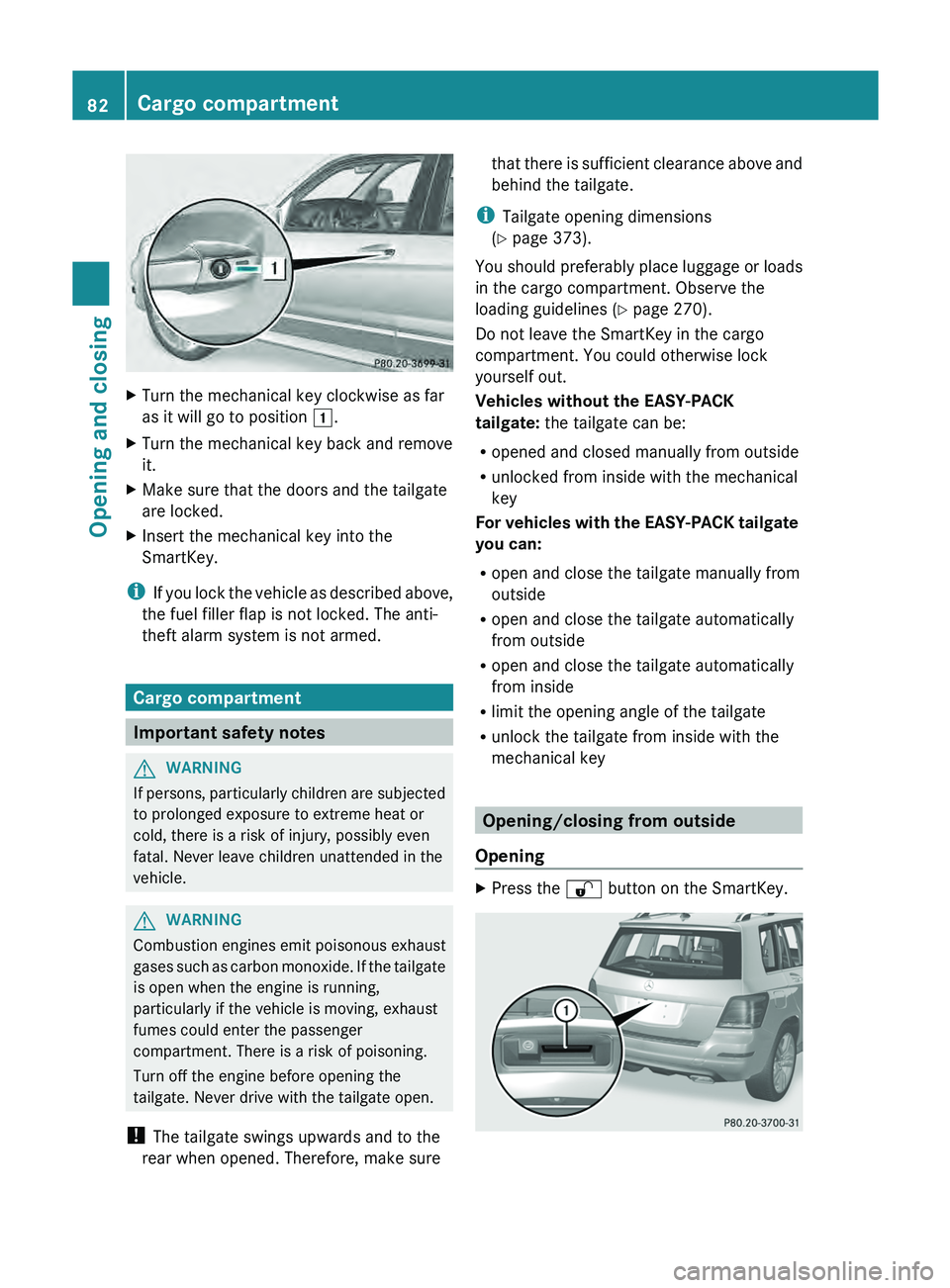
X
Turn the mechanical key clockwise as far
as it will go to position 0047.
X Turn the mechanical key back and remove
it.
X Make sure that the doors and the tailgate
are locked.
X Insert the mechanical key into the
SmartKey.
i If you lock the vehicle
as described above,
the fuel filler flap is not locked. The anti-
theft alarm system is not armed. Cargo compartment
Important safety notes
G
WARNING
If persons, particularly children are subjected
to prolonged exposure to extreme heat or
cold, there is a risk of injury, possibly even
fatal. Never leave children unattended in the
vehicle. G
WARNING
Combustion engines emit poisonous exhaust
gases such as carbon monoxide.
If the tailgate
is open when the engine is running,
particularly if the vehicle is moving, exhaust
fumes could enter the passenger
compartment. There is a risk of poisoning.
Turn off the engine before opening the
tailgate. Never drive with the tailgate open.
! The tailgate swings upwards and to the
rear when opened. Therefore, make sure that there is sufficient clearance above and
behind the tailgate.
i Tailgate opening dimensions
(Y page 373).
You should preferably place luggage
or loads
in the cargo compartment. Observe the
loading guidelines ( Y page 270).
Do not leave the SmartKey in the cargo
compartment. You could otherwise lock
yourself out.
Vehicles without the EASY-PACK
tailgate: the tailgate can be:
R opened and closed manually from outside
R unlocked from inside with the mechanical
key
For vehicles with the EASY-PACK tailgate
you can:
R open and close the tailgate manually from
outside
R open and close the tailgate automatically
from outside
R open and close the tailgate automatically
from inside
R limit the opening angle of the tailgate
R unlock the tailgate from inside with the
mechanical key Opening/closing from outside
Opening X
Press the 0036 button on the SmartKey.82
Cargo compartment
Opening and closing
Page 85 of 380
X
Pull handle 0043.
X Raise the tailgate.
Vehicles with the EASY-PACK tailgate: if
you pull handle 0043 and
keep it in this position,
you can open the tailgate manually. If you
release the handle, the tailgate opens
automatically.
Closing X
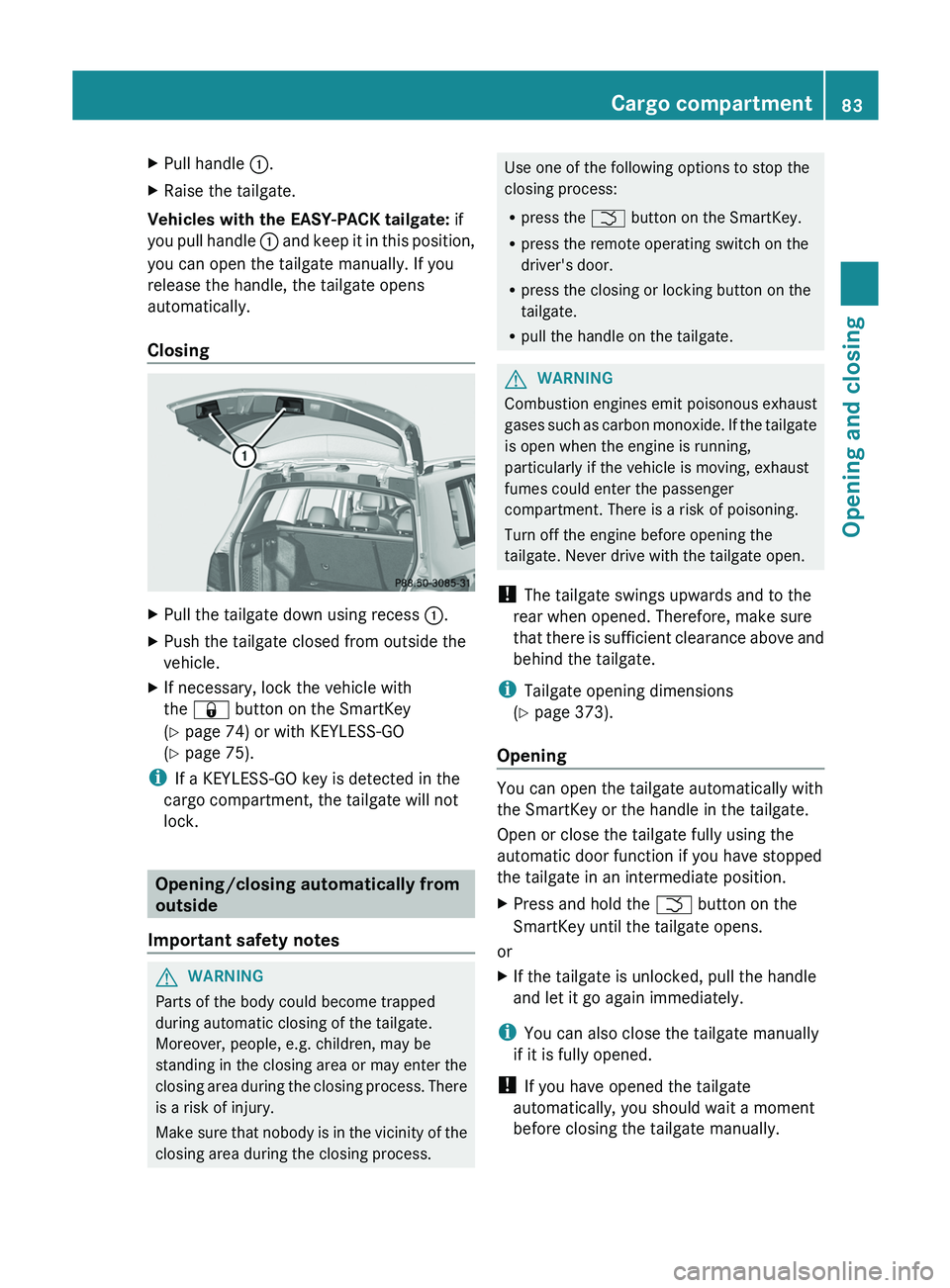
Pull the tailgate down using recess 0043.
X Push the tailgate closed from outside the
vehicle.
X If necessary, lock the vehicle with
the 0037 button on the SmartKey
(Y page 74) or with KEYLESS-GO
(Y page 75).
i If a KEYLESS-GO key is detected in the
cargo compartment, the tailgate will not
lock. Opening/closing automatically from
outside
Important safety notes G
WARNING
Parts of the body could become trapped
during automatic closing of the tailgate.
Moreover, people, e.g. children, may be
standing in the closing area or may enter the
closing area during the closing
process. There
is a risk of injury.
Make sure that nobody is in the vicinity of the
closing area during the closing process. Use one of the following options to stop the
closing process:
R
press the 0054 button on the SmartKey.
R press the remote operating switch on the
driver's door.
R press the closing or locking button on the
tailgate.
R pull the handle on the tailgate. G
WARNING
Combustion engines emit poisonous exhaust
gases such as
carbon monoxide.
If the tailgate
is open when the engine is running,
particularly if the vehicle is moving, exhaust
fumes could enter the passenger
compartment. There is a risk of poisoning.
Turn off the engine before opening the
tailgate. Never drive with the tailgate open.
! The tailgate swings upwards and to the
rear when opened. Therefore, make sure
that there is sufficient clearance above and
behind the tailgate.
i Tailgate opening dimensions
(Y page 373).
Opening You can open the tailgate automatically with
the SmartKey or the handle in the tailgate.
Open or close the tailgate fully using the
automatic door function if you have stopped
the tailgate in an intermediate position.
X
Press and hold the 0054 button on the
SmartKey until the tailgate opens.
or
X If the tailgate is unlocked, pull the handle
and let it go again immediately.
i You can also close the tailgate manually
if it is fully opened.
! If you have opened the tailgate
automatically, you should wait a moment
before closing the tailgate manually. Cargo compartment
83
Opening and closing Z
Page 87 of 380
!
The tailgate swings upwards and to the
rear when opened. Therefore, make sure
that there is sufficient clearance
above and
behind the tailgate.
i Tailgate opening dimensions
(Y page 373).
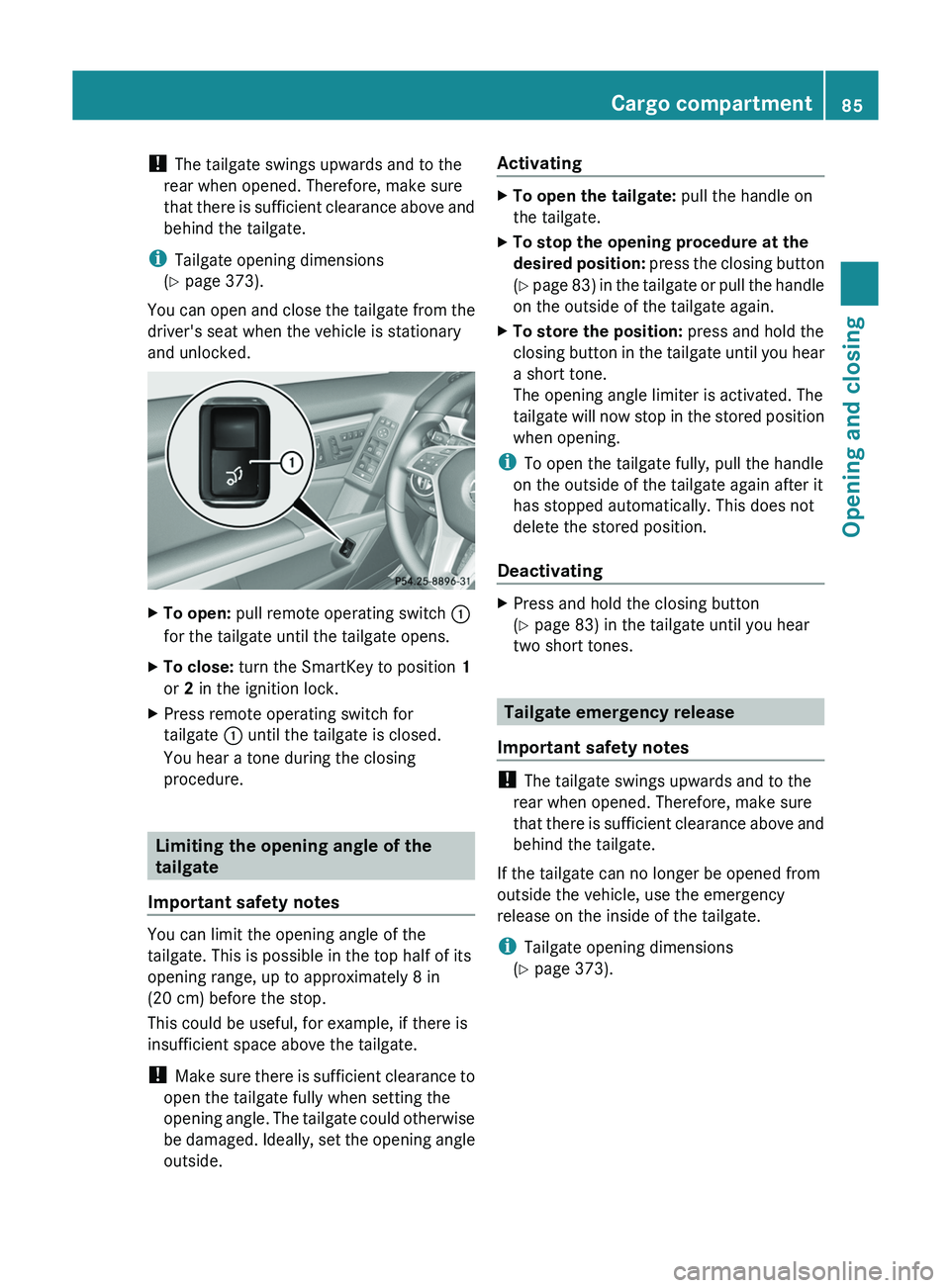
You can open and close the tailgate from the
driver's seat when the vehicle is stationary
and unlocked. X
To open: pull remote operating switch 0043
for the tailgate until the tailgate opens.
X To close: turn the SmartKey to position 1
or 2 in the ignition lock.
X Press remote operating switch for
tailgate 0043 until the tailgate is closed.
You hear a tone during the closing
procedure. Limiting the opening angle of the
tailgate
Important safety notes You can limit the opening angle of the
tailgate. This is possible in the top half of its
opening range, up to approximately 8 in
(20 cm) before the stop.
This could be useful, for example, if there is
insufficient space above the tailgate.
!
Make sure there is
sufficient clearance to
open the tailgate fully when setting the
opening angle. The tailgate could otherwise
be damaged. Ideally, set the opening angle
outside. Activating X
To open the tailgate: pull the handle on
the tailgate.
X To stop the opening procedure at the
desired position: press the
closing button
(Y page 83) in the tailgate or pull the handle
on the outside of the tailgate again.
X To store the position: press and hold the
closing button in the tailgate
until you hear
a short tone.
The opening angle limiter is activated. The
tailgate will now stop in the stored position
when opening.
i To open the tailgate fully, pull the handle
on the outside of the tailgate again after it
has stopped automatically. This does not
delete the stored position.
Deactivating X
Press and hold the closing button
(Y page 83) in the tailgate until you hear
two short tones. Tailgate emergency release
Important safety notes !
The tailgate swings upwards and to the
rear when opened. Therefore, make sure
that there is sufficient clearance
above and
behind the tailgate.
If the tailgate can no longer be opened from
outside the vehicle, use the emergency
release on the inside of the tailgate.
i Tailgate opening dimensions
(Y page 373). Cargo compartment
85
Opening and closing Z
Page 211 of 380

The vehicle/trailer combination:
R
is heavier
R is restricted in its acceleration and
gradient-climbing capability
R has an increased braking distance
R is affected more by strong crosswinds
R demands more sensitive steering
R has a larger turning radius
This could impair the handling
characteristics.
When towing a trailer, always adjust your
speed to the current road and weather
conditions. Do not exceed the maximum
permissible speed for your vehicle/trailer
combination.
General notes R
Do not exceed the legally prescribed
maximum speed for vehicle/trailer
combinations in the relevant country.
This lowers the risk of an accident.
R Only install an approved trailer
coupling on
your vehicle.
Further information on availability and on
installation is available from any authorized
Mercedes-Benz Center.
R The bumpers of your vehicle are not
suitable for installing detachable trailer
couplings.
R Do not install hired trailer couplings or
other detachable trailer couplings on the
bumpers of your vehicle.
R To reduce the risk of damage to the ball
coupling, remove it from the ball coupling
recess when not in use.
i When towing a trailer, set the tire
pressure on the rear axle of the towing
vehicle for a maximum load; see the tire
pressure table in the fuel filler flap
(Y page 349).
You will find installation dimensions and loads
in the "Technical data" section
(Y page 374). Missing values for the maximum noseweight
of the trailer drawbar on the ball coupling
were
unavailable at
the time
of going to print.
However, the actual noseweight must not
exceed the value given on the identification
plates of the trailer tow hitch and trailer. The
lowest weight applies.
Please note that when towing a trailer,
PARKTRONIC ( Y page 180) is only available
with limitations or not at all.
i On vehicles without level control, the
height of the ball coupling will alter
according to the load placed on the vehicle.
If necessary, use a trailer with a height-
adjustable drawbar.
Driving tips i
Observe the notes on ESP ®
trailer
stabilization ( Y page 69).
The maximum permissible speed for
vehicle/
trailer combinations depends on the type of
trailer. Before beginning the journey, check
the trailer's documents to see what the
maximum permissible speed is. Observe the
legally prescribed maximum speed in the
relevant country.
For certain Mercedes-Benz vehicles, the
maximum permissible rear axle load is
increased when towing a trailer. Refer to the
"Technical data" section to find out whether
this applies to your vehicle.
If you utilize any of the added maximum rear
axle load when towing a trailer, the vehicle/
trailer combination may not exceed a
maximum speed of 60 mph (100 km/h) for
reasons concerning the operating permit.
This also applies in countries in which the
permissible maximum speed for vehicle/
trailer combinations is above 60 mph
(100 km/h).
When towing a trailer, your vehicle's handling
characteristics will be different in comparison
with when driving without a trailer.
On long and steep downhill gradients, you
must select shift range 1, 2 or 3 in good time. Towing a trailer
209
Driving and parking Z
Page 212 of 380
i
This also applies if you have activated
cruise control.
This will use the braking
effect of the engine,
so that less braking will be required to
maintain the speed, This relieves the load on
the brake system and prevents the brakes
from overheating and wearing too quickly. If
you need additional braking, depress the
brake pedal repeatedly rather than
continuously.
Driving tips R
Maintain a greater distance from the
vehicle in front than when
driving without a
trailer.
R Avoid braking abruptly. If possible, brake
gently at first to allow the trailer to run on.
Then, increase the braking force rapidly.
R The values given for gradient-climbing
capabilities from a standstill refer to sea
level. When driving in mountainous areas,
note that the power output of the engine
and, consequently, the vehicle's gradient-
climbing capability, decreases with
increasing altitude.
If the trailer swings from side to side:
X Do not accelerate.
X Do not counter-steer.
X Brake if necessary. Installing the ball coupling
G
WARNING
If the ball coupling is not installed and secured
correctly the trailer
may come
loose. There is
a risk of an accident.
Install and secure the ball coupling as
described in the ball coupling installation
instructions. Make sure that the ball coupling
is installed and secured correctly before every
journey.
! Mercedes-Benz recommends that you
only use ball couplings that have been tested and approved by Mercedes-Benz.
This helps to avoid damage to the vehicle.
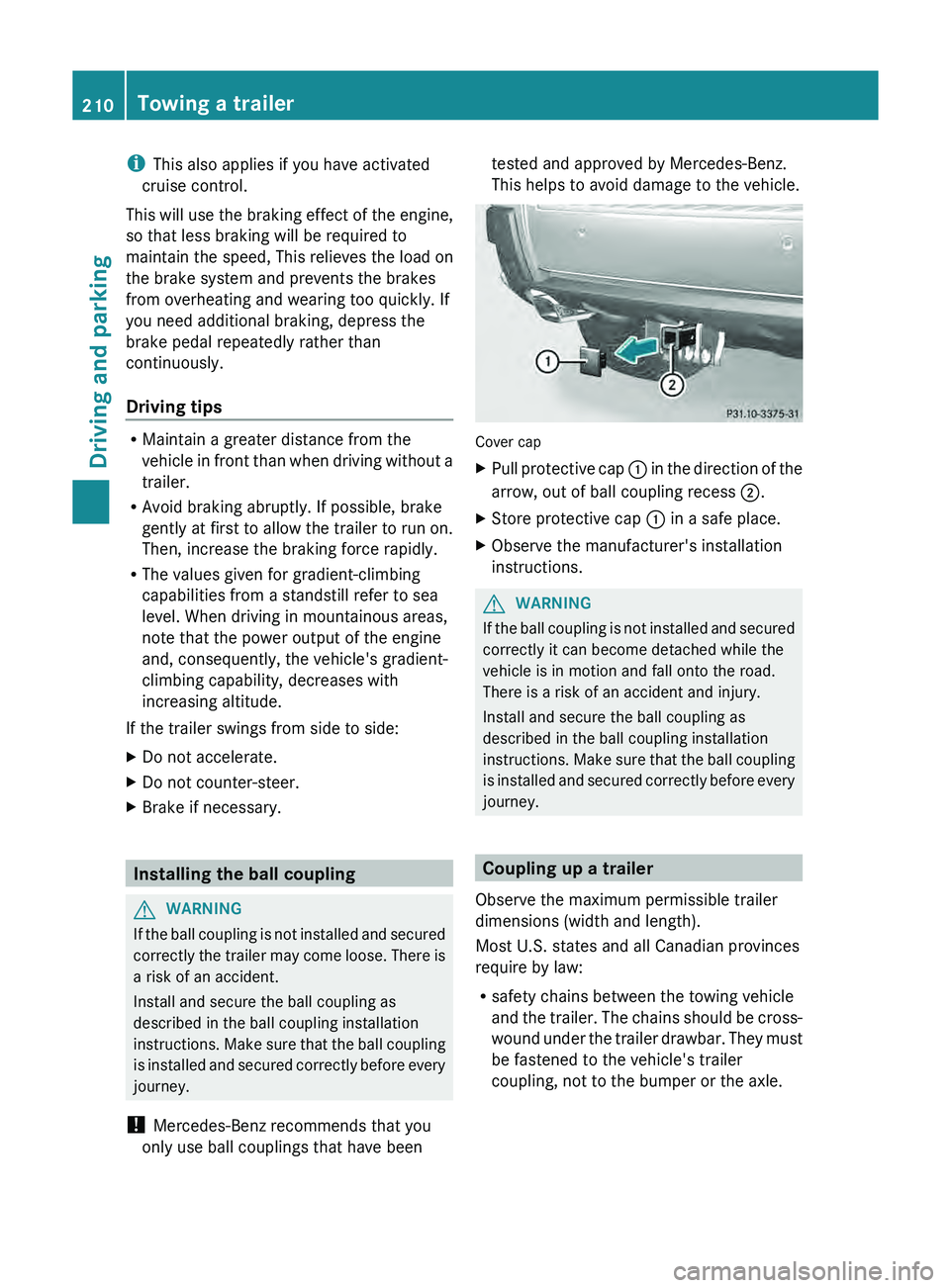
Cover cap
X
Pull protective cap 0043 in the direction of
the
arrow, out of ball coupling recess 0044.
X Store protective cap 0043 in a safe place.
X Observe the manufacturer's installation
instructions. G
WARNING
If the ball coupling is not installed and secured
correctly it can become detached while the
vehicle is in motion and fall onto the road.
There is a risk of an accident and injury.
Install and secure the ball coupling as
described in the ball coupling installation
instructions. Make sure that the
ball coupling
is installed and secured correctly before every
journey. Coupling up a trailer
Observe the maximum permissible trailer
dimensions (width and length).
Most U.S. states and all Canadian provinces
require by law:
R safety chains between the towing vehicle
and the trailer. The chains
should be cross-
wound under the trailer drawbar. They must
be fastened to the vehicle's trailer
coupling, not to the bumper or the axle. 210
Towing a trailer
Driving and parking
Page 330 of 380
Useful information
i This Operator's Manual describes all
models and all standard and optional
equipment of your vehicle available at the
time of publication of the Operator's
Manual. Country-specific differences are
possible. Please note that your
vehicle may
not be equipped with all features
described. This also applies to safety-
related systems and functions.
i Read the information on qualified
specialist workshops: ( Y page 27).Important safety notes
G
WARNING
If wheels and tires of the wrong size are used,
the wheel brakes or suspension components
may be damaged. There is a risk of an
accident.
Always replace wheels and tires with those
that fulfill the specifications of the original
part.
When replacing wheels, make sure
to use the
correct:
R designation
R model
When replacing tires, make sure to use the
correct:
R designation
R manufacturer
R model G
WARNING
A flat tire severely impairs the driving,
steering and braking characteristics of the
vehicle. There is a risk of accident.
Tires without run-flat characteristics:
R do not drive with a flat tire.
R immediately replace the flat tire with your
emergency spare wheel or spare wheel, or
consult a qualified specialist workshop. Tires with run-flat characteristics:
R
pay attention to the information and
warning notices on MOExtended tires
(tires
with run-flat characteristics).
Accessories that are not approved for your
vehicle by Mercedes-Benz or are not being
used correctly can impair the operating
safety.
Before purchasing and using non-approved
accessories, visit a qualified specialist
workshop and inquire about:
R suitability
R legal stipulations
R factory recommendations
Information on the dimensions and types of
wheels and tires for your vehicle can be found
in the "Wheel/tire combinations" section
(Y page 357).
Information on air pressure for the tires on
your vehicle can be found:
R on the vehicle's Tire and Loading
Information placard on the B-pillar
R on the tire pressure label on the fuel filler
flap
R in the "Tire pressure" section
Modification work on the brake system and
wheels is not permitted. The use of wheel
spacers or brake dust shields is not
permitted. This invalidates the general
operating permit for the vehicle.
i Further information on wheels and tires
can be obtained at any qualified specialist
workshop. Operation
Information on driving
R If the vehicle is heavily loaded, check the
tire pressures and correct them if
necessary.
R When parking your vehicle, make
sure that
the tires do not get deformed by the curb 328
Operation
Wheels and tires
Page 334 of 380
Follow recommended tire inflation pressures
and check the pressure of all the tires
including the spare wheel:
R
monthly, at least
R if the load changes
R before beginning a long journey
R under different operating conditions, e.g.
off-road driving
If necessary, correct the tire pressure.
The recommended tire pressures for
the tires
mounted at the factory can be found on the
labels described here.
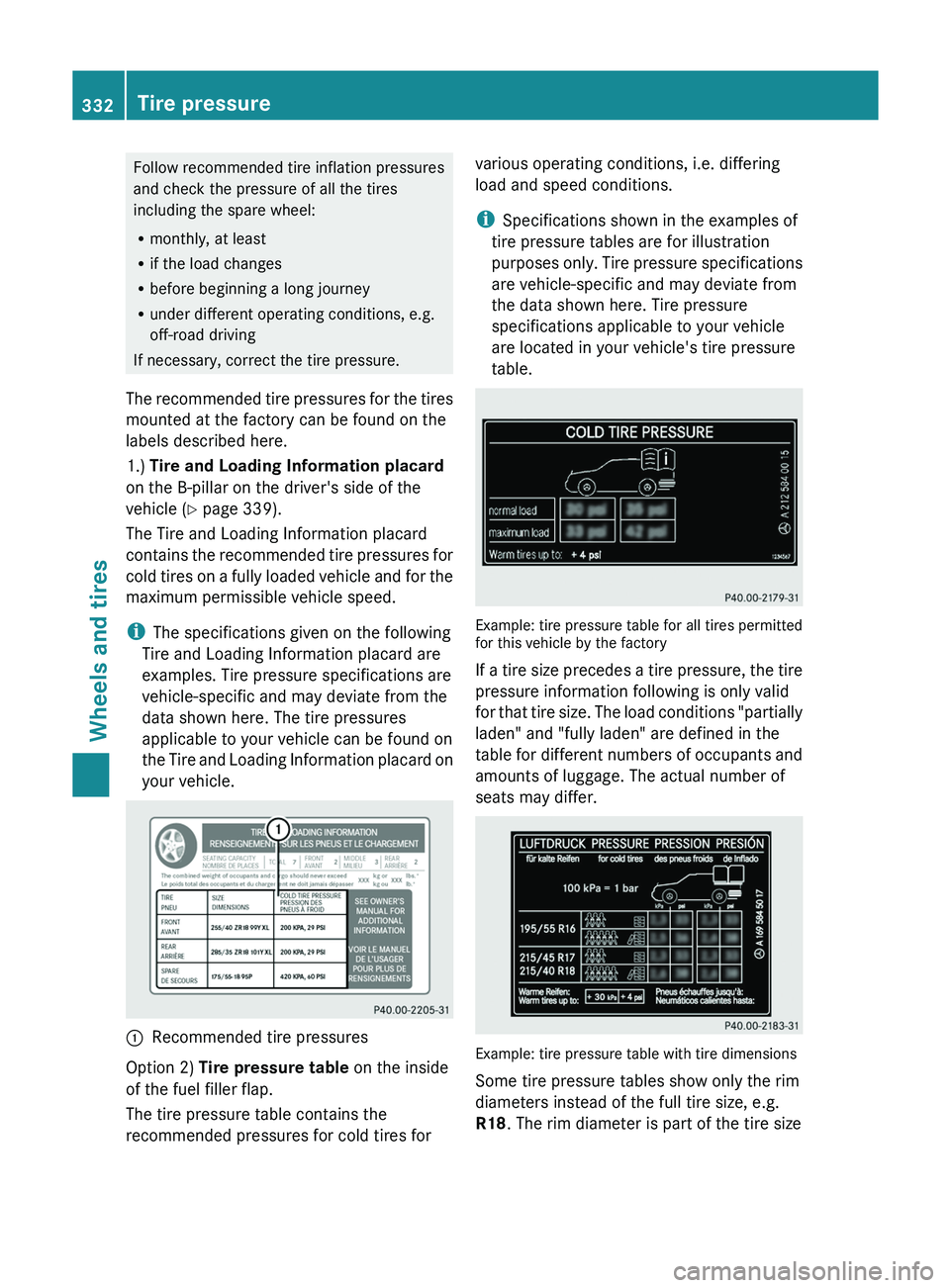
1.) Tire and Loading Information placard
on the B-pillar on the driver's side of the
vehicle ( Y page 339).
The Tire and Loading Information placard
contains the recommended tire pressures
for
cold tires on a fully loaded vehicle and for the
maximum permissible vehicle speed.
i The specifications given on the following
Tire and Loading Information placard are
examples. Tire pressure specifications are
vehicle-specific and may deviate from the
data shown here. The tire pressures
applicable to your vehicle can be found on
the Tire and Loading Information
placard on
your vehicle. 0043
Recommended tire pressures
Option 2) Tire pressure table on the inside
of the fuel filler flap.
The tire pressure table contains the
recommended pressures for cold tires for various operating conditions, i.e. differing
load and speed conditions.
i
Specifications shown in the examples of
tire pressure tables are for illustration
purposes only. Tire pressure specifications
are vehicle-specific and may deviate from
the data shown here. Tire pressure
specifications applicable to your vehicle
are located in your vehicle's tire pressure
table. Example: tire pressure table for all tires permitted
for this vehicle by the factory
If a tire size
precedes
a tire pressure, the tire
pressure information following is only valid
for that tire size. The load conditions "partially
laden" and "fully laden" are defined in the
table for different numbers of occupants and
amounts of luggage. The actual number of
seats may differ. Example: tire pressure table with tire dimensions
Some tire pressure tables show only the rim
diameters instead of the full tire size, e.g.
R18. The rim diameter is part of the tire size332
Tire pressure
Wheels and tires