light MERCEDES-BENZ GLK-CLASS SUV 2013 User Guide
[x] Cancel search | Manufacturer: MERCEDES-BENZ, Model Year: 2013, Model line: GLK-CLASS SUV, Model: MERCEDES-BENZ GLK-CLASS SUV 2013Pages: 380, PDF Size: 19.54 MB
Page 19 of 380
Speedometer
Digital ............................................ 220
In the Instrument cluster ................. 31
Segments ...................................... 217
Selecting the unit of
measurement ................................ 226
see Instrument cluster
SPORT handling mode
Activating/deactivating (AMG
vehicles) .......................................... 68
SRS
see SRS (Supplemental Restraint
System)
SRS (Supplemental Restraint
System)
Display message ............................ 235
Introduction ..................................... 41
Warning lamp ................................. 263
Warning lamp (function) ................... 41
Standing lamps
Changing bulbs .............................. 118
Display message ............................ 241
Switching on/off ........................... 112
Start/stop function
see ECO start/stop function
Starting (engine) ................................ 142
Steering (display message) ..............255
Steering wheel Adjusting (electrically) ...................102
Adjusting (manually) ...................... 102
Button overview ............................... 33
Buttons (on-board computer) ......... 217
Cleaning ......................................... 308
Important safety notes .................. 102
Paddle shifters ............................... 152
Storing settings (memory
function) ........................................ 106
Steering wheel paddle shifters ........152
Stowage areas ................................... 271
Stowage compartments Armrest (under) ............................. 271
Cup holders ................................... 278
Glove box ....................................... 271
Important safety information ......... 271
Rear ............................................... 272
Stowage net ................................... 272
Stowage net ....................................... 272Summer opening
see Convenience opening feature
Summer tires ..................................... 330
Sun visor ............................................ 278
Surround lighting (on-board
computer) .......................................... 227
SUV (Sport Utility Vehicle) .......................25
Switching air-recirculation mode
on/off ................................................. 136
Switching off the alarm (ATA) ............71 T
Tachometer ........................................ 216
Tailgate Display message ............................ 254
Emergency unlocking .......................85
Important safety notes .................... 82
Limiting the opening angle ...............85
Opening/closing (automatically
from inside) ......................................
84
Opening/closing (automatically
from outside) ................................... 83
Opening/closing (from outside) ....... 82
Opening dimensions ...................... 373
Tail lamps
Display message ............................ 240
Tank content
Fuel gauge ....................................... 31
Technical data
Capacities ...................................... 365
Emergency spare wheel ................. 362
Information .................................... 364
Tires/wheels ................................. 357
Trailer loads ................................... 374
Vehicle data ................................... 373
TELEAID
Call priority .................................... 287
Downloading destinations
(COMAND) ..................................... 287
Downloading routes .......................290
Emergency call .............................. 284
Geo fencing ................................... 290
Important safety notes .................. 283
Locating a stolen vehicle ............... 289
MB info call button ........................ 286
Remote vehicle locking .................. 288 Index
17
Page 21 of 380
Structure and characteristics
(definition) .....................................
349
Summer tires ................................. 330
Temperature .................................. 345
TIN (Tire Identification Number)
(definition) ..................................... 351
Tire bead (definition) ......................351
Tire pressure (definition) ................ 351
Tire pressures (recommended)
......349
Tire size (data) ............................... 357
Tire size designation, load-bearing
capacity, speed rating .................... 346
Tire tread ....................................... 329
Tire tread (definition) .....................351
Total load limit (definition) ............. 352
Traction ......................................... 344
Traction (definition) ....................... 351
Tread wear ..................................... 344
TWR (permissible trailer drawbar
noseweight) (definition) .................351
Uniform Tire Quality Grading
Standards ...................................... 344
Uniform Tire Quality Grading
Standards (definition) .................... 349
Unladen weight (definition) ............ 350
Wear indicator (definition) .............352
Wheel rim (definition) .................... 349
see Flat tire
Top Tether ............................................ 62
Towing Important safety guidelines ...........320
Installing the towing eye ................ 321
Removing the towing eye ...............321
With the rear axle raised ................ 322
Towing a trailer
Active Parking Assist .....................188
Cleaning the trailer tow hitch ......... 308
Coupling up a trailer ......................210
Decoupling a trailer ....................... 212
Driving tips .................................... 208
Important safety notes .................. 208
Installing the ball coupling .............210
Lights display message .................. 239
Mounting dimensions .................... 374
Power supply ................................. 213
Removing the ball coupling ............213
Shift range ..................................... 151Storing the ball coupling
................213
Trailer loads ................................... 374
Towing away
With both axles on the ground ....... 322
Tow-starting
Emergency engine starting ............ 323
Important safety notes
..................320
Trailer coupling
see Towing a trailer
Trailer loads and drawbar
noseweights ...................................... 212
Trailer towing Active Blind Spot Assist ................. 205
Active Lane Keeping Assist .... 202, 208
Blind Spot Assist ............................ 200
PARKTRONIC ................................. 183
Permissible trailer loads and
drawbar noseweights .....................212
Transfer case ..................................... 154
Transmission see Automatic transmission
Transmission position display .........149
Transmission position display
(DIRECT SELECT lever) ......................149
Transporting the vehicle .................. 322
Traveling uphill Brow of hill ..................................... 169
Driving downhill ............................. 169
Maximum gradient-climbing
capability ....................................... 169
Trim pieces (cleaning instructions) . 309
Trip computer (on-board
computer) .......................................... 219
Trip odometer Calling up ....................................... 219
Resetting (on-board computer) ...... 220
see Trip odometer
Turn signals
Changing bulbs (front) ................... 119
Display message ............................ 240
Switching on/off ........................... 112
see Turn signals
TWR (Tongue Weight Rating)
(definition) ......................................... 351
Type identification plate see Vehicle identification plate Index
19
Page 32 of 380
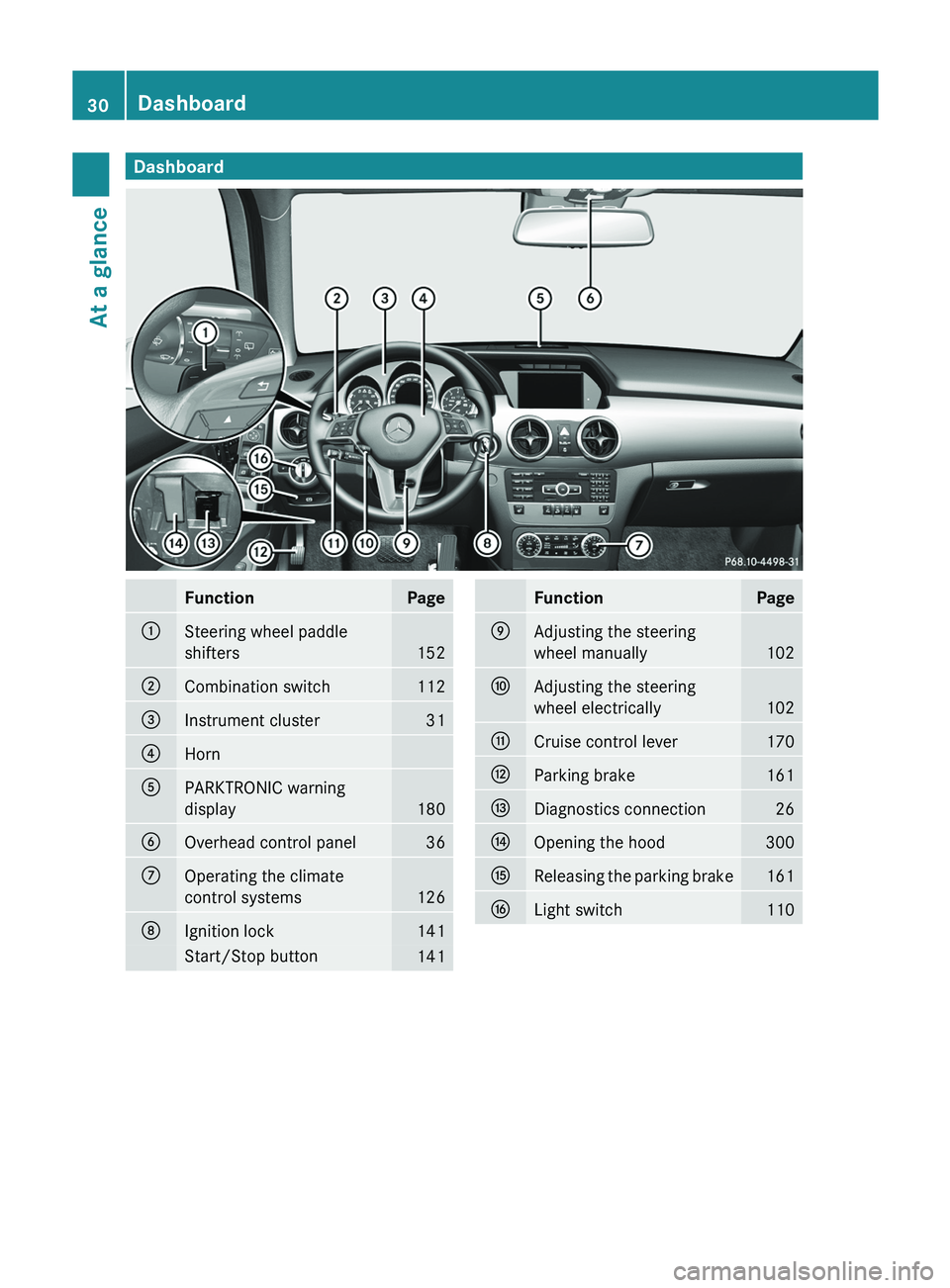
Dashboard
Function Page
0043
Steering wheel paddle
shifters
152
0044
Combination switch 112
0087
Instrument cluster 31
0085
Horn
0083
PARKTRONIC warning
display
180
0084
Overhead control panel 36
006B
Operating the climate
control systems
126
006C
Ignition lock 141
Start/Stop button
141 Function Page
006D
Adjusting the steering
wheel manually
102
006E
Adjusting the steering
wheel electrically
102
006F
Cruise control lever 170
0070
Parking brake 161
0071
Diagnostics connection 26
0072
Opening the hood 300
0073
Releasing the parking brake 161
0074
Light switch 11030
DashboardAt a glance
Page 33 of 380
Instrument cluster
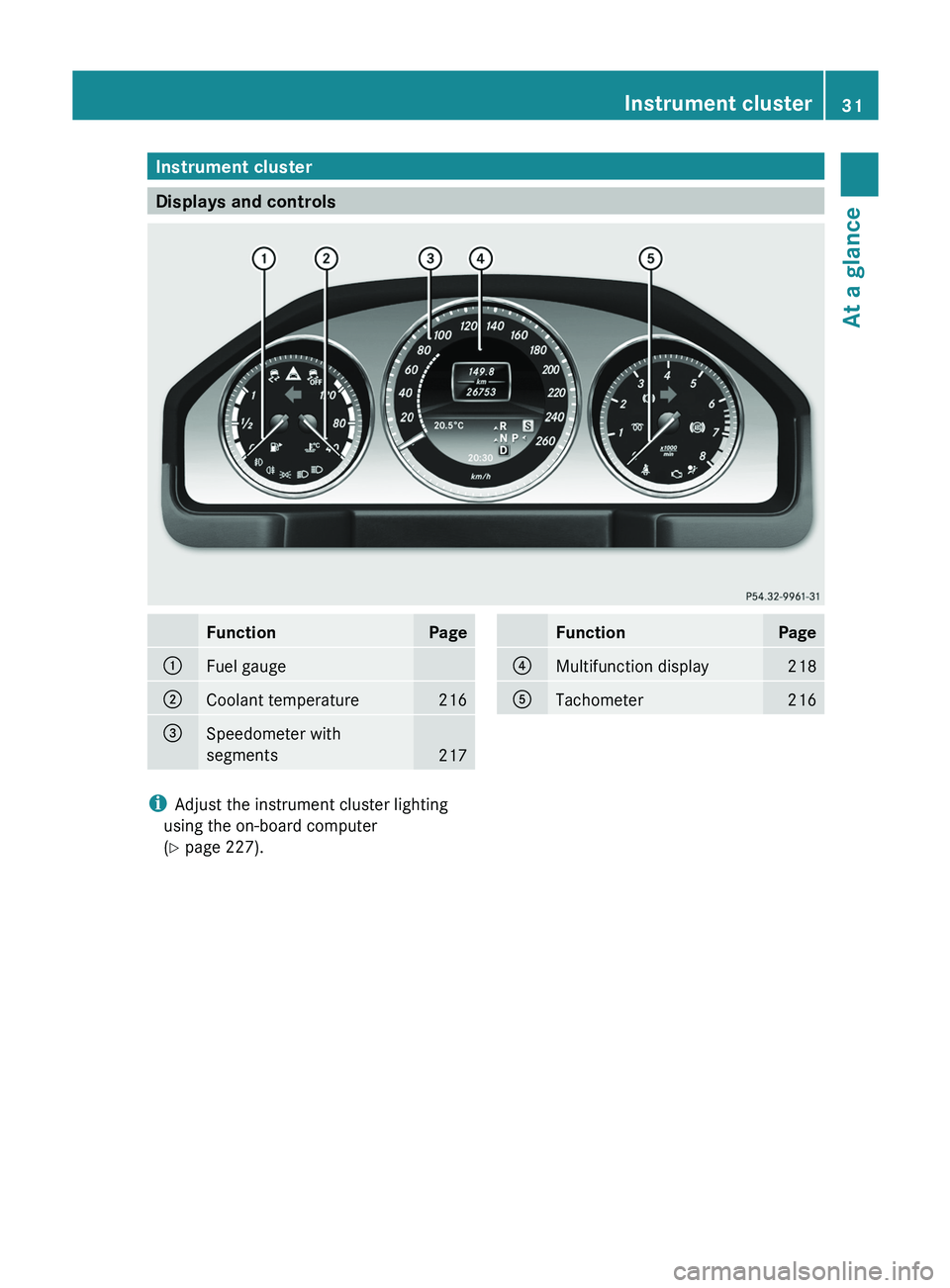
Displays and controls
Function Page
0043
Fuel gauge
0044
Coolant temperature 216
0087
Speedometer with
segments
217 Function Page
0085
Multifunction display 218
0083
Tachometer 216
i
Adjust the instrument cluster lighting
using the on-board computer
(Y page 227). Instrument cluster
31At a glance
Page 37 of 380
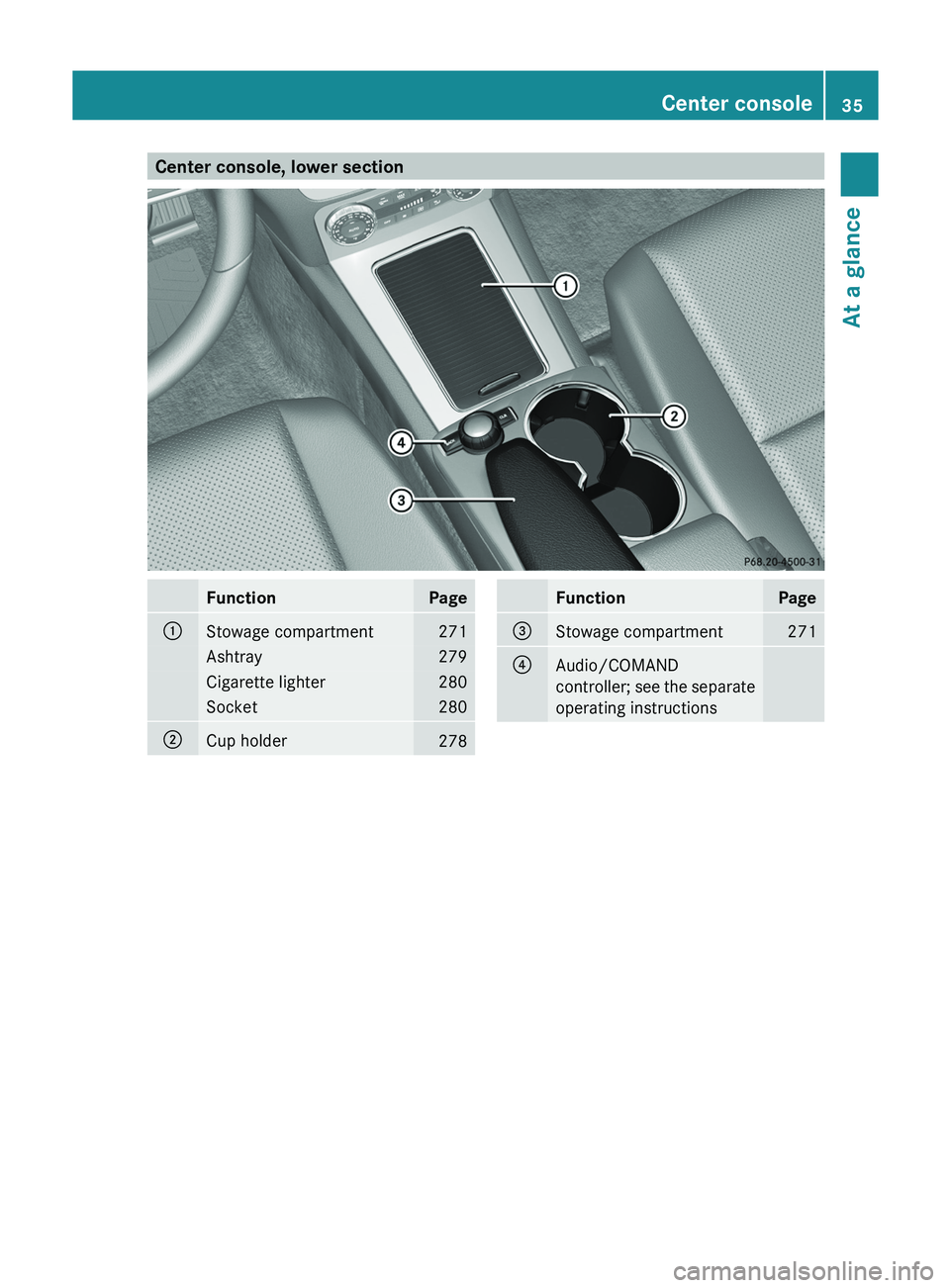
Center console, lower section
Function Page
0043
Stowage compartment 271
Ashtray 279
Cigarette lighter 280
Socket 280
0044
Cup holder
278 Function Page
0087
Stowage compartment 271
0085
Audio/COMAND
controller; see the separate
operating instructions Center console
35At a glance
Page 38 of 380
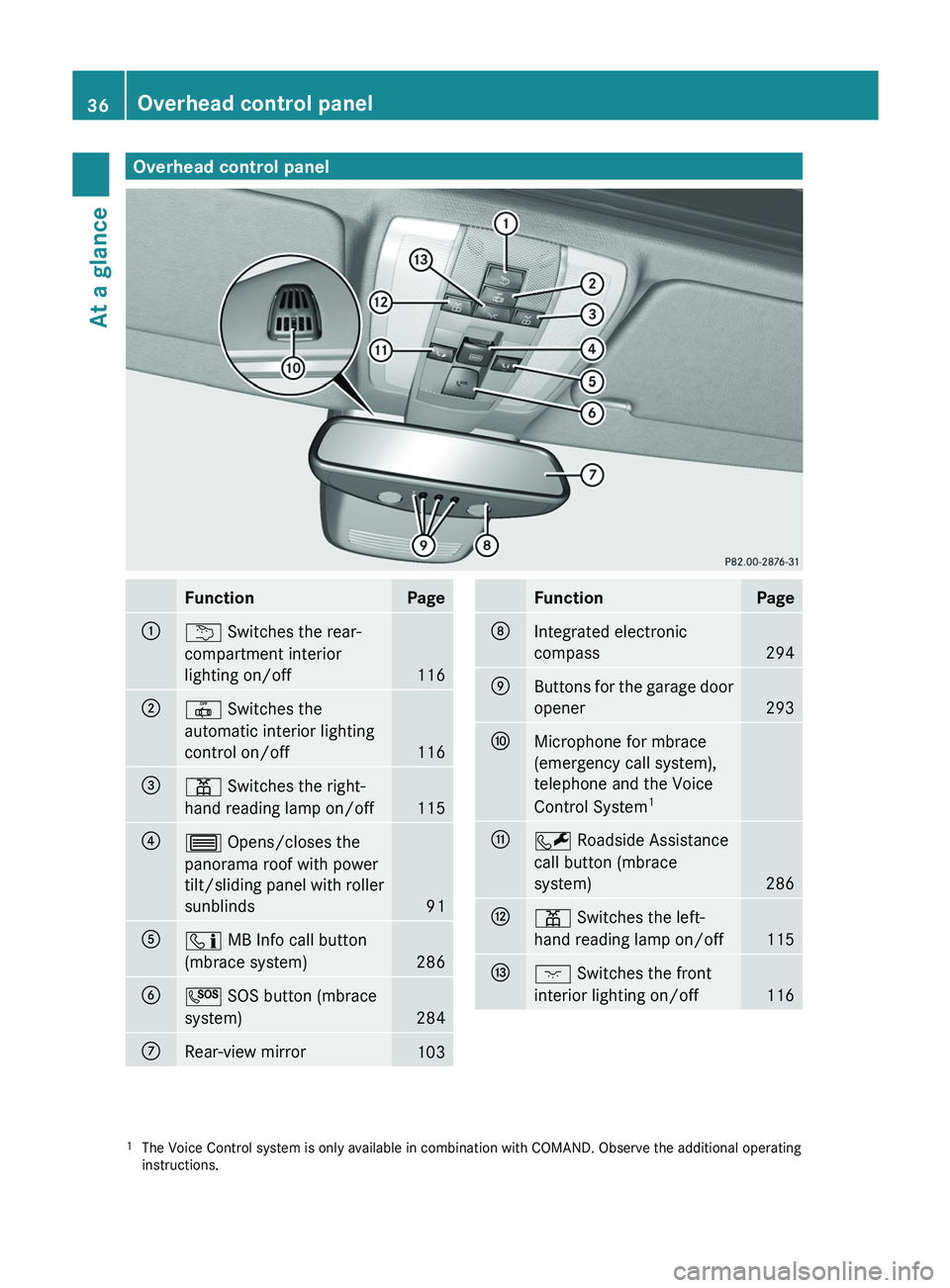
Overhead control panel
Function Page
0043
0042 Switches the rear-
compartment interior
lighting on/off
116
0044
0033 Switches the
automatic interior lighting
control on/off
116
0087
003D Switches the right-
hand reading lamp on/off
115
0085
0057 Opens/closes the
panorama roof with power
tilt/sliding panel with roller
sunblinds
91
0083
00D9 MB Info call button
(mbrace system)
286
0084
0053 SOS button (mbrace
system)
284
006B
Rear-view mirror
103 Function Page
006C
Integrated electronic
compass
294
006D
Buttons for the garage door
opener
293
006E
Microphone for mbrace
(emergency call system),
telephone and the Voice
Control System
1 006F
0052 Roadside Assistance
call button (mbrace
system)
286
0070
003D Switches the left-
hand reading lamp on/off
115
0071
004A Switches the front
interior lighting on/off
116
1
The Voice Control system is only available in combination with COMAND. Observe the additional operating
instructions.36
Overhead control panelAt a glance
Page 42 of 380
Useful information
i This Operator's Manual describes all
models and all standard and optional
equipment of your vehicle available at the
time of publication of the Operator's
Manual. Country-specific differences are
possible. Please note that your
vehicle may
not be equipped with all features
described. This also applies to safety-
related systems and functions.
i Read the information on qualified
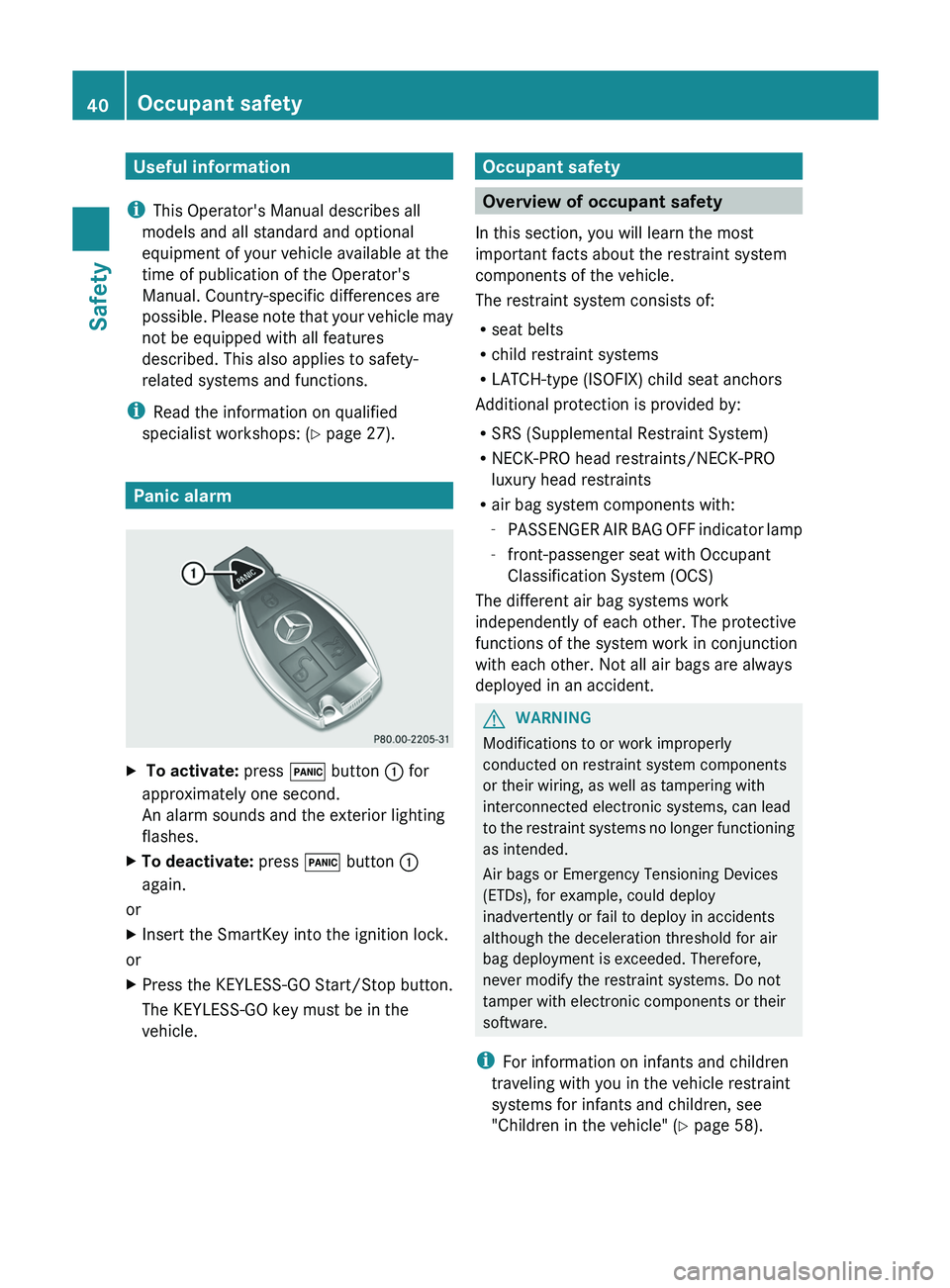
specialist workshops: ( Y page 27).Panic alarm
X
To activate: press 0033 button 0043 for
approximately one second.
An alarm sounds and the exterior lighting
flashes.
X To deactivate: press 0033 button 0043
again.
or
X Insert the SmartKey into the ignition lock.
or
X Press the KEYLESS-GO Start/Stop button.
The KEYLESS-GO key must be in the
vehicle. Occupant safety
Overview of occupant safety
In this section, you will learn the most
important facts about the restraint system
components of the vehicle.
The restraint system consists of:
R seat belts
R child restraint systems
R LATCH-type (ISOFIX) child seat anchors
Additional protection is provided by:
R SRS (Supplemental Restraint System)
R NECK-PRO head restraints/NECK-PRO
luxury head restraints
R air bag system components with:
-PASSENGER AIR BAG OFF indicator
lamp
- front-passenger seat with Occupant
Classification System (OCS)
The different air bag systems work
independently of each other. The protective
functions of the system work in conjunction
with each other. Not all air bags are always
deployed in an accident. G
WARNING
Modifications to or work improperly
conducted on restraint system components
or their wiring, as well as tampering with
interconnected electronic systems, can lead
to the restraint systems no
longer functioning
as intended.
Air bags or Emergency Tensioning Devices
(ETDs), for example, could deploy
inadvertently or fail to deploy in accidents
although the deceleration threshold for air
bag deployment is exceeded. Therefore,
never modify the restraint systems. Do not
tamper with electronic components or their
software.
i For information on infants and children
traveling with you in the vehicle restraint
systems for infants and children, see
"Children in the vehicle" ( Y page 58).40
Occupant safety
Safety
Page 43 of 380
SRS (Supplemental Restraint System)
Introduction SRS consists of:
R
The 0075 SRS warning lamp
R Air bags
R Air bag control unit (with crash sensors)
R Emergency Tensioning Devices
R Belt force limiters
SRS reduces the risk of occupants coming
into contact with the vehicle's interior in the
event of an accident. It can also reduce the
effect of the forces to which occupants are
subjected during an accident.
SRS warning lamp SRS functions are checked regularly when
you switch on the ignition and when the
engine is running. Therefore, malfunctions
can be detected in good time.
The
0075 SRS warning lamp in
the instrument
cluster lights up when the ignition is switched
on. It goes out no later than a few seconds
after the engine is started.
The SRS components are in operational
readiness when the 0075 SRS warning lamp
goes out while the engine is running. G
WARNING
The SRS self-check has detected a
malfunction if the 0075 SRS indicator lamp:
R does not light up at all
R does not go out after approximately four
seconds after the engine is started
R comes on after the engine was started or
while driving.
For your safety, Mercedes-Benz strongly
recommends that you have the system
checked as soon as
possible
at an authorized
Mercedes-Benz Center. SRS may otherwise
fail to activate when it is needed in the event
of an accident, which could lead to serious or
fatal injuries. SRS might also be activated unexpectedly and unnecessarily, which could
also result in injury.
In addition, work carried out improperly on
SRS may render SRS inoperative or cause
unintended air bag deployment. Work on the
SRS system should only be carried out by
qualified specialist personnel. Consult an
authorized Mercedes-Benz Center.
If it is necessary to modify an air bag system
to accommodate a person with disabilities,
contact an authorized Mercedes-Benz
Center
for details. USA only: for further information
contact our Customer Assistance center at
1-800-FOR-MERCedes (1-800-367-6372).
Safety guidelines for seat belts,
Emergency Tensioning Devices (ETDs)
and air bags G
WARNING
R Damaged seat belts or seat
belts that have
been subjected to stress in an accident
must be replaced. Their anchoring points
must also be checked. Only use seat belts
installed or supplied by an authorized
Mercedes-Benz Center.
R Air bags and pyrotechnic Emergency
Tensioning Devices (ETDs) contain
perchlorate material, which may require
special handling and regard for the
environment. Check your national disposal
guidelines. California residents, see
www.dtsc.ca.gov/HazardousWaste/
Perchlorate/index.cfm.
R Air bags and ETDs are designed to function
on a one-time-only basis. An air bag or ETD
that has deployed must be replaced.
R Do not pass seat belts over sharp edges.
They could tear.
R Do not make any modification that could
change the effectiveness of the seat belts.
R Do not bleach or dye seat belts as this may
severely weaken them. In a crash they may
not be able to provide adequate protection.
R No modifications of any kind may be made
to any components or wiring of the SRS. Occupant safety
41
Safety
Z
Page 46 of 380
It is important to your safety and that of your
passenger to have deployed
air
bags replaced
and to have any malfunctioning air bags
repaired. This will help to make sure the air
bags will continue to provide supplemental
crash protection for occupants .
Front air bags The front air bags increase protection for the
driver's and front-passenger's head and
chest.
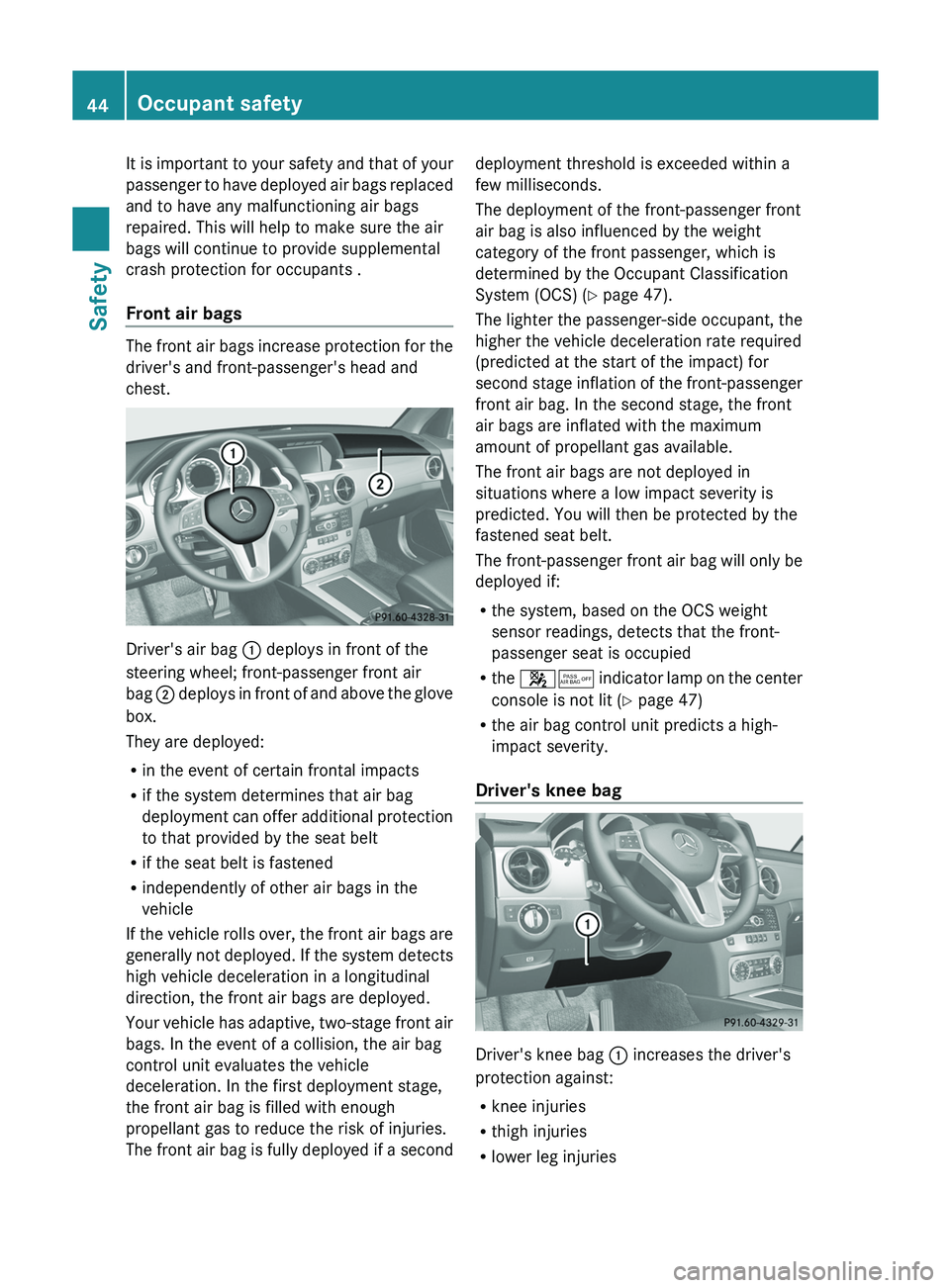
Driver's air bag
0043 deploys in front of the
steering wheel; front-passenger front air
bag 0044 deploys in front of
and above the glove
box.
They are deployed:
R in the event of certain frontal impacts
R if the system determines that air bag
deployment can offer additional protection
to that provided by the seat belt
R if the seat belt is fastened
R independently of other air bags in the
vehicle
If the vehicle rolls over, the front air bags are
generally not deployed. If the system detects
high vehicle deceleration in a longitudinal
direction, the front air bags are deployed.
Your vehicle has adaptive, two-stage front air
bags. In the event of a collision, the air bag
control unit evaluates the vehicle
deceleration. In the first deployment stage,
the front air bag is filled with enough
propellant gas to reduce the risk of injuries.
The front air bag is fully deployed if a second deployment threshold is exceeded within a
few milliseconds.
The deployment of the front-passenger front
air bag is also influenced by the weight
category of the front passenger, which is
determined by the Occupant Classification
System (OCS) (
Y page 47).
The lighter the passenger-side occupant, the
higher the vehicle deceleration rate required
(predicted at the start of the impact) for
second stage
inflation of
the
front-passenger
front air bag. In the second stage, the front
air bags are inflated with the maximum
amount of propellant gas available.
The front air bags are not deployed in
situations where a low impact severity is
predicted. You will then be protected by the
fastened seat belt.
The front-passenger front air bag will only be
deployed if:
R the system, based on the OCS weight
sensor readings, detects that the front-
passenger seat is occupied
R the 00730074 indicator lamp on the center
console is not lit (Y page 47)
R the air bag control unit predicts a high-
impact severity.
Driver's knee bag Driver's knee bag 0043 increases the driver's
protection against:
R
knee injuries
R thigh injuries
R lower leg injuries44
Occupant safety
Safety
Page 49 of 380
deployment can offer additional protection
to that provided by the seat belt
R independently of the front air bags
Window curtain air bags 0043
will not deploy in
the event of impacts which do not exceed the
system's preset deployment thresholds for
vehicle acceleration/deceleration. You will
then be protected by the fastened seat belt. Occupant Classification System
(OCS)
How the Occupant Classification
System works The Occupant Classification System (OCS)
categorizes the occupant on the front-
passenger
seat
by means
of
a weight sensor.
The front-passenger front air bag is
deactivated automatically for certain weight
categories. The 00730074 indicator lamp
shows you the current status. If the
00730074 indicator lamp lights up, the front-
passenger air bag is disabled.
The system does not deactivate:
R the side impact air bag
R the pelvis air bag
R the window curtain air bag
R the Emergency Tensioning Devices
To be classified correctly, the front passenger
must sit:
R with the seat belt fastened correctly
R in a position that is as upright as possible
with their back against the seat backrest
R with their feet on the floor
If the front-passenger's weight is transferred
to another object in the vehicle (e.g. by
leaning on armrests), OCS may not be able to
approximate the occupant's weight category.
If the front-passenger seat, the seat cover or
the seat cushion are damaged, have the
necessary repair work carried out at an
authorized Mercedes-Benz Center. For safety reasons, Mercedes-Benz
recommends that you only use seat
accessories that have been approved by
Mercedes-Benz.
Both the driver and the front passenger
should always observe the
00730074
indicator lamp to determine whether or not
the front passenger is positioned correctly. G
WARNING
If the 00730074 indicator lamp illuminates
when an adult or someone
larger than a small
individual is in the front-passenger seat, have
the front passenger reposition himself or
herself in the seat until the 00730074
indicator lamp goes out.
In the event of a collision, the air bag control
unit will not allow front-passenger front air
bag deployment when the OCS has classified
the front-passenger seat occupant as
weighing as much as or less than a typical 12-
month-old child in a standard child restraint
or if the front-passenger seat is classified as
being empty.
When the OCS senses that the front-
passenger seat occupant is classified as
being up to or less than the weight of a typical
12-month-old child in a standard child
restraint, the 00730074 indicator lamp will
illuminate when the engine is started and
remain illuminated, indicating that the front-
passenger front air bag is deactivated.
When the OCS senses that the front-
passenger seat is classified as being empty,
the 00730074 indicator lamp will illuminate
when the engine is started and remain
illuminated, indicating that the front-
passenger front air bag is deactivated.
When the OCS senses that the front-
passenger seat occupant is classified as
being heavier than the weight of a typical 12-
month-old child seated in a standard child
restraint or as being a small individual (such
as a young teenager or a small adult), the
00730074 indicator lamp will illuminate for
approximately 6 seconds when the engine is
started and then, depending on occupant Occupant safety
47
Safety
Z