light MERCEDES-BENZ GLK-CLASS SUV 2014 User Guide
[x] Cancel search | Manufacturer: MERCEDES-BENZ, Model Year: 2014, Model line: GLK-CLASS SUV, Model: MERCEDES-BENZ GLK-CLASS SUV 2014Pages: 384, PDF Size: 48.23 MB
Page 19 of 384
SRS
see SRS (Supplemental Restraint
System)
SRS (Supplemental Restraint
System)
Display message ............................ 239
Introduction ..................................... 43
Warning lamp ................................. 267
Warning lamp (function) ................... 43
Standing lamps
Changing bulbs .............................. 120
Display message ............................ 245
Switching on/off ........................... 114
Start/stop function
see ECO start/stop function
Starting (engine) ................................ 146
Steering (display message) ..............259
Steering wheel Adjusting (electrically) ...................105
Adjusting (manually). .....................104
Button overview ............................... 35
Buttons (on-board computer) ......... 221
Cleaning ......................................... 311
Important safety notes ..................104
Paddle shifters ............................... 156
Storing settings (memory function) 109
Steering wheel paddle shifters ........156
Stowage areas ................................... 275
Stowage compartments Armrest (under) ............................. 275
Cup holders ................................... 282
Glove box ...................................... .275
Important safety information .........275
Rear ............................................... 276
Stowage net ................................... 276
Stowage net ....................................... 276
Summer opening see Convenience opening feature
Summer tires ..................................... 332
Sun visor ............................................ 282
Surround lighting (on-board
computer) .......................................... 231
SUV (Sport Utility Vehicle) .......................25
Switching air-recirculation mode
on/off ................................................. 139
Switching off the alarm (ATA) ............74 T
Tachometer ........................................ 220
Tailgate Display message ............................ 258
Emergency unlocking .......................88
Important safety notes ....................84
Limiting the opening angle ...............87
Opening/closing (automatically
from inside) ...................................... 87
Opening/closing (automatically
from outside) ................................... 85
Opening/closing (from outside) .......85
Opening dimensions ......................375
Tail lamps
Display message ............................ 244
Tank content
Fuel gauge ....................................... 33
Technical data
Capacities ...................................... 367
Emergency spare wheel .................364
Information .................................... 366
Tires/wheels ................................. 359
Trailer loads ................................... 376
Vehicle data ................................... 375
TELEAID
Call priority .................................... 291
Downloading destinations
(COMAND) ..................................... 291
Downloading routes .......................294
Emergency call .............................. 288
Geo fencing ................................... 295
Locating a stolen vehicle ...............293
MB info call button ........................290
Remote vehicle locking ..................292
Roadside Assistance button ..........290
Search & Send ............................... 292
Self-test ......................................... 288
Speed alert .................................... 294
System .......................................... 288
Triggering the vehicle alarm ........... 295
Vehicle remote malfunction
diagnosis ....................................... 293
Vehicle remote unlocking ..............292
Tele Aid
General notes ................................ 287 Index
17
Page 21 of 384
Tire bead (definition
)...................... 353
Tire pressure (definition) ................353
Tire pressures (recommended )...... 351
Tire size (data) ............................... 359
Tire size designation, load-bearing
capacity, speed rating .................... 348
Tire tread ....................................... 331
Tire tread (definition) .....................353
Total load limit (definition) .............354
Traction ......................................... 346
Traction (definition) .......................353
Tread wea r..................................... 346
TWR (permissible trailer drawbar
noseweight) (definition) .................353
Uniform Tire Quality Grading
Standards ...................................... 346
Uniform Tire Quality Grading
Standards (definition) ....................351
Unladen weight (definition) ............352
Wear indicator (definition) .............354
Wheel rim (definition) ....................351
see Flat tire
Top Tether ............................................ 65
Towing Important safety guidelines ...........322
Installing the towing eye ................323
Removing the towing eye ...............323
With the rear axle raised ................324
Towing a trailer
Active Parking Assist .....................192
Cleaning the trailer tow hitch ......... 310
Coupling up a trailer ......................214
Decoupling a trailer .......................216
Driving tips .................................... 212
Important safety notes ..................212
Installing the ball coupling .............214
Lights display message ..................243
Mounting dimensions ....................376
Power supply ................................. 217
Removing the ball coupling ............216
Storing the ball coupling ................217
Trailer loads ................................... 376
Towing away
With both axles on the ground .......324
Tow-starting
Emergency engine starting ............325
Important safety notes ..................322Trailer coupling
see Towing a trailer
Trailer loads and drawbar
noseweights ...................................... 216
Trailer towing Active Blind Spot Assist .................209
Active Lane Keeping Assist .... 206, 212
Blind Spot Assist ............................ 204
PARKTRONIC ................................. 187
Permissible trailer loads and
drawbar noseweights .....................216
Transfer case ..................................... 158
Transmission see Automatic transmission
Transmission position display .........153
Transmission position display
(DIRECT SELECT lever) ......................153
Transporting the vehicle ..................324
Traveling uphill Brow of hill ..................................... 173
Driving downhill ............................. 173
Maximum gradient-climbing
capability ....................................... 173
Trim pieces (cleaning instructions) .311
Trip computer (on-board computer) 223
Trip odometer Calling up ....................................... 223
Resetting (on-board computer) ......224
Turn signals
Changing bulbs (front) ...................121
Display message ............................ 244
Switching on/off ........................... 114
TWR (Tongue Weight Rating)
(definition) ......................................... 353
Type identification plate see Vehicle identification plate U
Unlocking Emergency unlocking .......................83
From inside the vehicle (central
unlocking button) ............................. 82 Index
19
Page 34 of 384
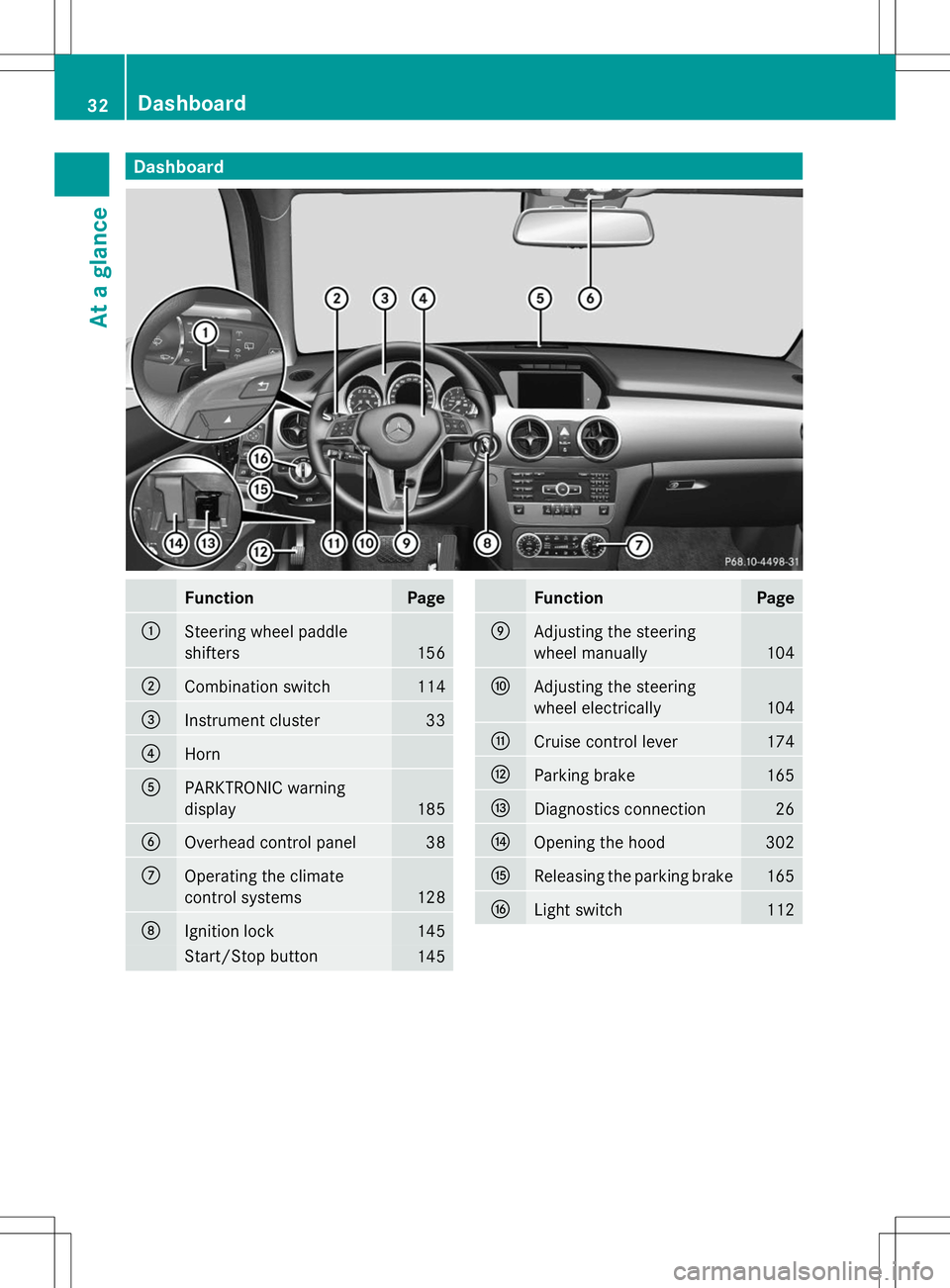
Dashboard
Function Page
:
Steering wheel paddle
shifters
156
;
Combination switch 114
=
Instrument cluster 33
?
Horn
A
PARKTRONIC warning
display
185
B
Overhead control panel 38
C
Operating the climate
control systems
128
D
Ignition lock 145
Start/Stop button
145 Function Page
E
Adjusting the steering
wheel manually
104
F
Adjusting the steering
wheel electrically
104
G
Cruise control lever 174
H
Parking brake 165
I
Diagnostics connection 26
J
Opening the hood 302
K
Releasing the parking brake 165
L
Light switch 11232
Dashboa
rdAt a glance
Page 35 of 384
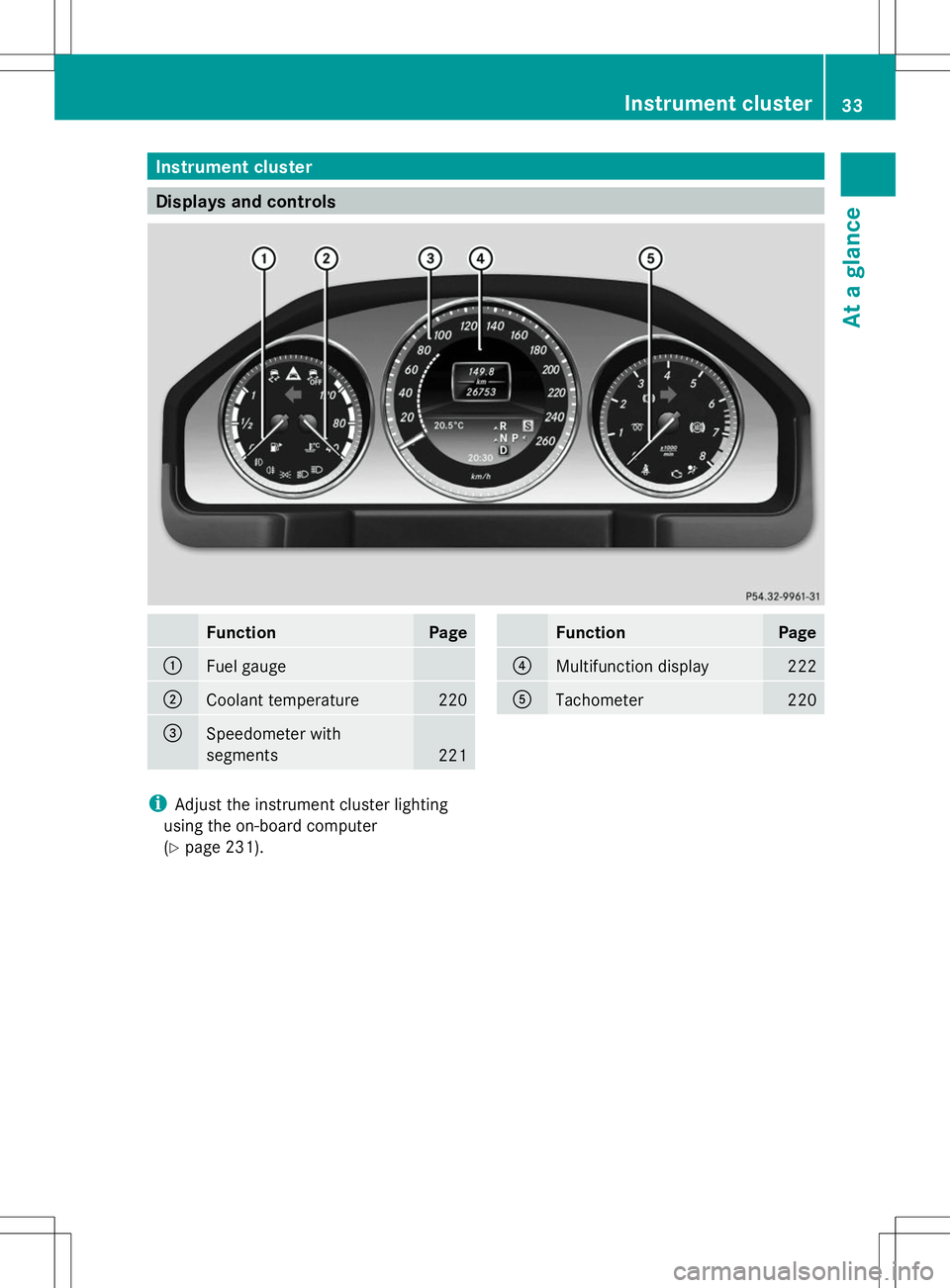
Instrument cluster
Displays and controls
Function Page
:
Fuel gauge
;
Coolant temperature 220
=
Speedometer with
segments
221 Function Page
?
Multifunction display 222
A
Tachometer 220
i
Adjust the instrument cluster lighting
using the on-board computer
(Y page 231). Instrument cluster
33At a glance
Page 39 of 384
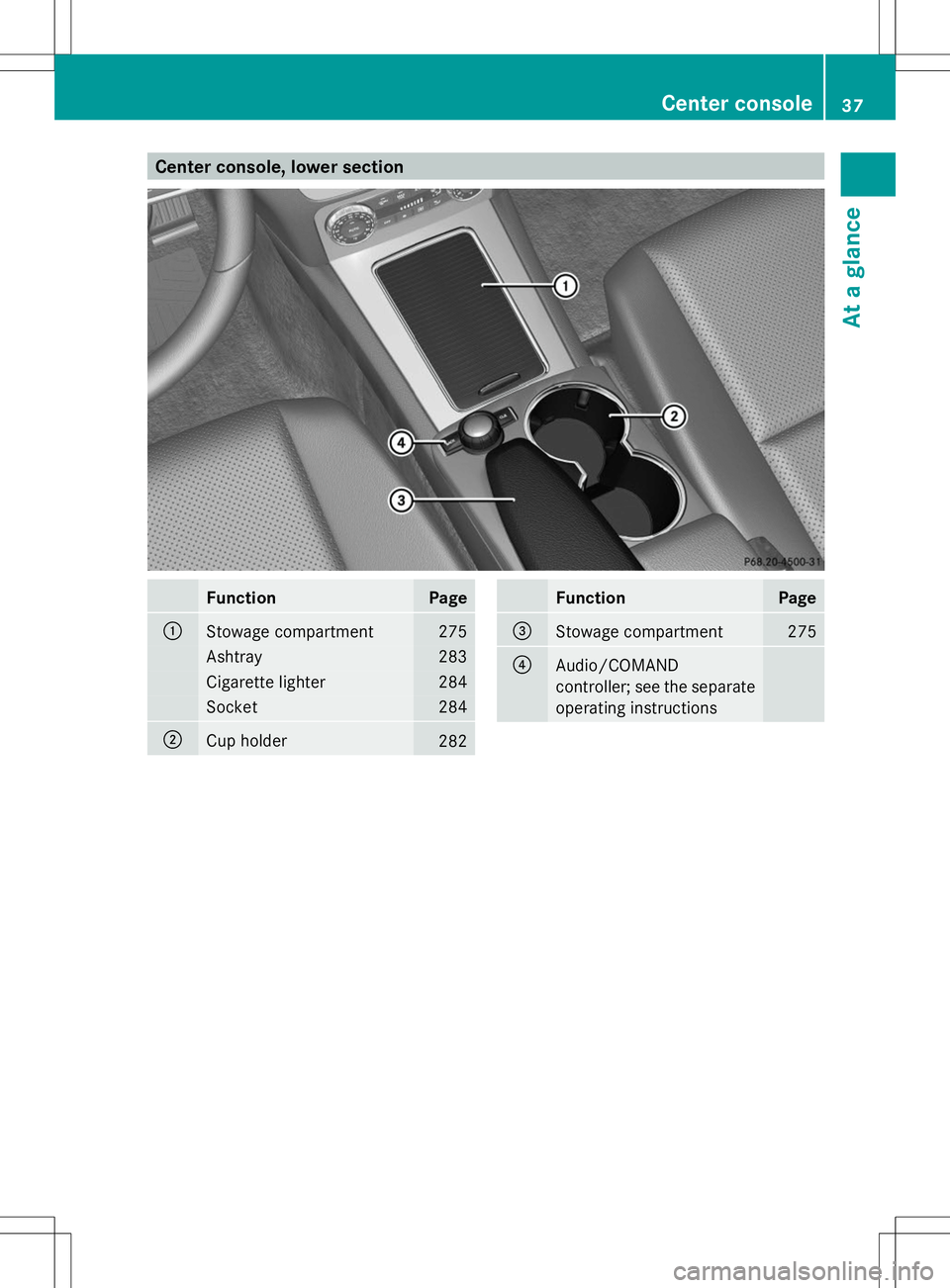
Center console, lower section
Function Page
:
Stowage compartment 275
Ashtray 283
Cigarette lighter 284
Socket 284
;
Cup holder
282 Function Page
=
Stowage compartment 275
?
Audio/COMAND
controller; see the separate
operating instructions Center console
37At a glance
Page 40 of 384
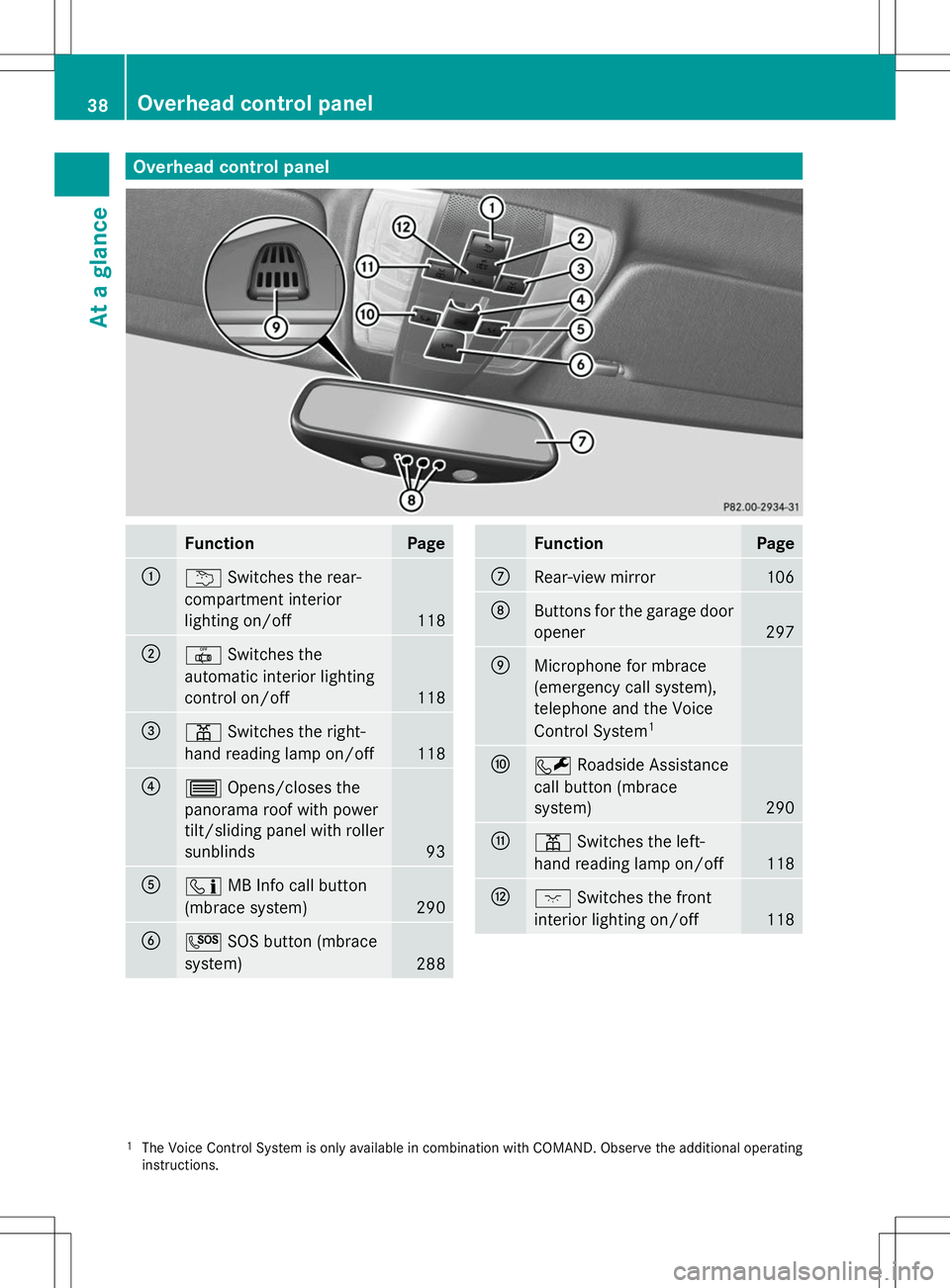
Overhead control panel
Function Page
:
u
Switches the rear-
compartment interior
lighting on/off 118
;
|
Switches the
automatic interior lighting
control on/off 118
=
p
Switches the right-
hand reading lamp on/off 118
?
3
Opens/closes the
panorama roof with power
tilt/sliding panel with roller
sunblinds 93
A
ï
MB Info call button
(mbrace system) 290
B
G
SOS button (mbrace
system) 288 Function Page
C
Rear-view mirror 106
D
Buttons for the garage door
opener
297
E
Microphone for mbrace
(emergency call system),
telephone and the Voice
Control System
1 F
F
Roadside Assistance
call button (mbrace
system) 290
G
p
Switches the left-
hand reading lamp on/off 118
H
c
Switches the front
interior lighting on/off 118
1
The Voice Control System is only available in combination with COMAND. Observe the additional operating
instructions. 38
Overhead control panelAt a glance
Page 44 of 384
Useful information
i This Operator's Manual describes all
models and all standard and optional
equipment of your vehicle available at the
time of publication of the Operator's
Manual. Country-specific differences are
possible. Please note that your vehicle may
not be equipped with all features
described. This also applies to safety-
related systems and functions.
i Read the information on qualified
specialist workshops: (Y page 27).Panic alarm
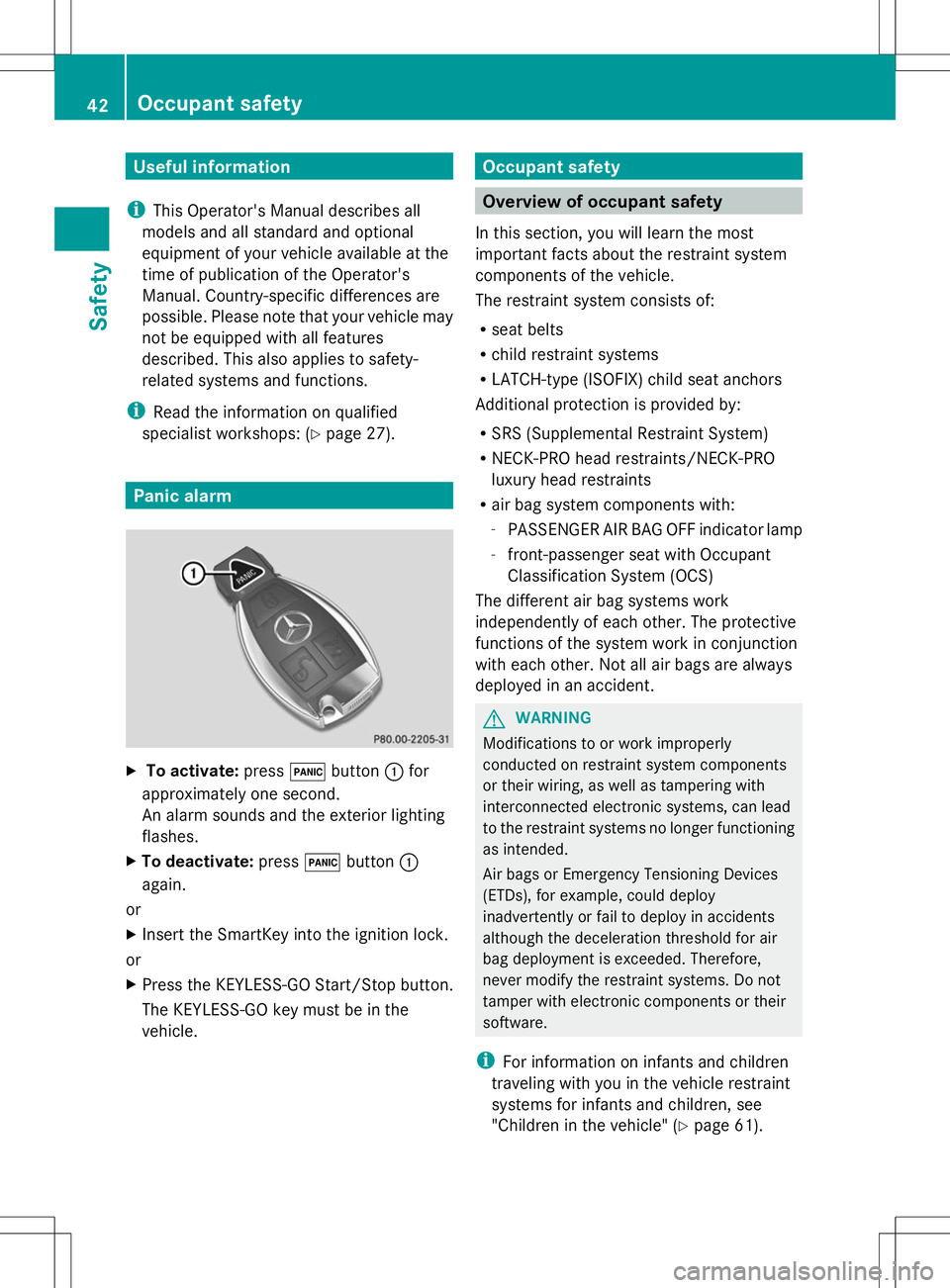
X
To activate: press!button :for
approximately one second.
An alarm sounds and the exterior lighting
flashes.
X To deactivate: press!button :
again.
or
X Insert the SmartKey into the ignition lock.
or
X Press the KEYLESS-GO Start/Stop button.
The KEYLESS-GO key must be in the
vehicle. Occupant safety
Overview of occupant safety
In this section, you will learn the most
important facts about the restraint system
components of the vehicle.
The restraint system consists of:
R seat belts
R child restraint systems
R LATCH-type (ISOFIX) child seat anchors
Additional protection is provided by:
R SRS (Supplemental Restraint System)
R NECK-PRO head restraints/NECK-PRO
luxury head restraints
R air bag system components with:
-PASSENGER AIR BAG OFF indicator lamp
- front-passenger seat with Occupant
Classification System (OCS)
The different air bag systems work
independently of each other. The protective
functions of the system work in conjunction
with each other. Not all air bags are always
deployed in an accident. G
WARNING
Modifications to or work improperly
conducted on restraint system components
or their wiring, as well as tampering with
interconnected electronic systems, can lead
to the restraint systems no longer functioning
as intended.
Air bags or Emergency Tensioning Devices
(ETDs), for example, could deploy
inadvertently or fail to deploy in accidents
although the deceleration threshold for air
bag deployment is exceeded. Therefore,
never modify the restraint systems. Do not
tamper with electronic components or their
software.
i For information on infants and children
traveling with you in the vehicle restraint
systems for infants and children, see
"Children in the vehicle" (Y page 61).42
Occupant safetySafety
Page 45 of 384
SRS (Supplemental Restraint System)
Introduction SRS consists of:
R
The 6 SRS warning lamp
R Air bags
R Air bag control unit (with crash sensors)
R Emergency Tensioning Devices
R Belt force limiters
SRS reduces the risk of occupants coming
into contact with the vehicle's interior in the
event of an accident. It can also reduce the
effect of the forces to which occupants are
subjected during an accident.
SRS warning lamp G
WARNING
If SRS is malfunctioning, child restraint
system components may be triggered
unintentionally or might not be triggered at all
in the event of an accident with a high rate of
vehicle deceleration. There is an increased
risk of injury, possibly even fatal.
Have SRS checked and repaired immediately
at a qualified specialist workshop.
SRS functions are checked regularly when
you switch on the ignition and when the
engine is running. Therefore, malfunctions
can be detected in good time.
The 6 SRS warning lamp in the instrument
cluster lights up when the ignition is switched
on. It goes out no later than a few seconds
after the engine is started.
The SRS components are in operational
readiness when the 6SRS warning lamp
goes out while the engine is running. There is a malfunction if:
R
the 6 SRS warning lamp does not light
up when the ignition is switched on
R the engine is running and the 6SRS
warning lamp does not go out after a few
seconds
R the engine is running and the 6SRS
warning lamp lights up again
Safety guidelines for seat belts,
Emergency Tensioning Devices (ETDs)
and air bags G
WARNING
R Damaged seat belts or seat belts that have
been subjected to stress in an accident
must be replaced. Their anchoring points
must also be checked. Only use seat belts
installed or supplied by an authorized
Mercedes-Benz Center.
R Air bags and pyrotechnic Emergency
Tensioning Devices (ETDs) contain
perchlorate material, which may require
special handling and regard for the
environment. Check your national disposal
guidelines. California residents, see
www.dtsc.ca.gov/HazardousWaste/
Perchlorate/index.cfm .
R Air bags and ETDs are designed to function
on a one-time-only basis. An air bag or ETD
that has deployed must be replaced.
R Do not pass seat belts over sharp edges.
They could tear.
R Do not make any modification that could
change the effectiveness of the seat belts.
R Do not bleach or dye seat belts as this may
severely weaken them. In a crash they may
not be able to provide adequate protection.
R No modifications of any kind may be made
to any components or wiring of the SRS.
R Do not change or remove any component
or part of the SRS.
R Do not install additional trim material, seat
covers, badges, etc. over the steering
wheel hub, front-passenger front air bag Occupant safety
43Safety
Z
Page 48 of 384
i
After an air bag has been deployed, have
the vehicle towed to the nearest qualified
specialist workshop, even if your vehicle is
ready to drive.
Front air bags The front air bags increase protection for the
driver's and front passenger's head and
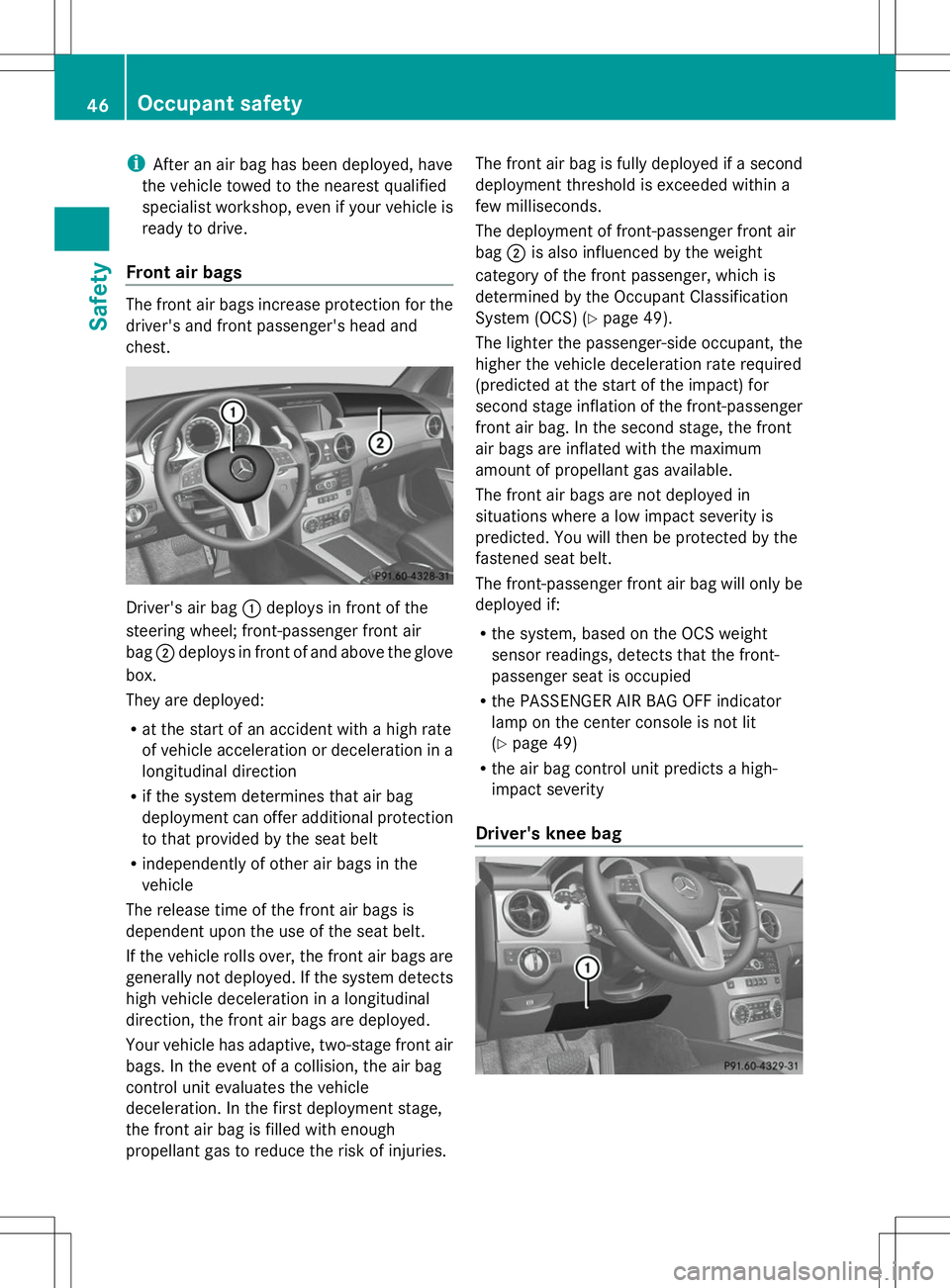
chest. Driver's air bag
:deploys in front of the
steering wheel; front-passenger front air
bag ;deploys in front of and above the glove
box.
They are deployed:
R at the start of an accident with a high rate
of vehicle acceleration or deceleration in a
longitudinal direction
R if the system determines that air bag
deployment can offer additional protection
to that provided by the seat belt
R independently of other air bags in the
vehicle
The release time of the front air bags is
dependent upon the use of the seat belt.
If the vehicle rolls over, the front air bags are
generally not deployed. If the system detects
high vehicle deceleration in a longitudinal
direction, the front air bags are deployed.
Your vehicle has adaptive, two-stage front air
bags. In the event of a collision, the air bag
control unit evaluates the vehicle
deceleration. In the first deployment stage,
the front air bag is filled with enough
propellant gas to reduce the risk of injuries. The front air bag is fully deployed if a second
deployment threshold is exceeded within a
few milliseconds.
The deployment of front-passenger front air
bag ;is also influenced by the weight
category of the front passenger, which is
determined by the Occupant Classification
System (OCS) (Y page 49).
The lighter the passenger-side occupant, the
higher the vehicle deceleration rate required
(predicted at the start of the impact) for
second stage inflation of the front-passenger
front air bag. In the second stage, the front
air bags are inflated with the maximum
amount of propellant gas available.
The front air bags are not deployed in
situations where a low impact severity is
predicted. You will then be protected by the
fastened seat belt.
The front-passenger front air bag will only be
deployed if:
R the system, based on the OCS weight
sensor readings, detects that the front-
passenger seat is occupied
R the PASSENGER AIR BAG OFF indicator
lamp on the center console is not lit
(Y page 49)
R the air bag control unit predicts a high-
impact severity
Driver's knee bag 46
Occupant safetySafety
Page 53 of 384
front-passenger front air bag in your vehicle
when the system senses the weight of a
typical 12-month-old child or less along
with the weight of a standard appropriate
child restraint on the front-passenger seat.
R A child in a rear-facing child restraint on the
front-passenger seat will be seriously
injured or even killed if the front-passenger
front air bag inflates in a collision which
could occur under some circumstances,
even with the air bag technology installed
in your vehicle. The only means to eliminate
this risk completely is never to place a child
in a rear-facing child restraint in the front-
passenger seat. We therefore strongly
recommend that you always place a child
in a rear-facing child restraint on the rear
seat.
R If you install a rear-facing child restraint on
the front-passenger seat, make sure the
45 indicator lamp is illuminated,
indicating that the front-passenger front air
bag is deactivated. Should the 45
indicator lamp not illuminate or go out while
the restraint is installed, please check
installation. Periodically check the
45 indicator lamp while driving to
make sure that the 45indicator
lamp is illuminated. If the 45
indicator lamp goes out or remains out, do
not transport a child on the front-passenger
seat until the system has been repaired.
A child in a rear-facing child restraint on the
front-passenger seat will be seriously
injured or even killed if the front-passenger
front air bag inflates. R
If you place a child in a forward-facing child
restraint on the front-passenger seat:
-move the seat as far back as possible
- use the proper child restraint
recommended for the age, size and
weight of the child
- secure child restraint with the vehicle's
seat belt according to the child seat
manufacturer's instructions
R For children larger than the typical 12-
month-old child, the front-passenger front
air bag may or may not be activated.
If the driver's air bag deploys, this does not
mean that the front-passenger front air bag
will also deploy.
The OCS may have detected that the seat:
R is empty or occupied by the weight of a
typical child up to twelve months old,
seated in a child restraint system.
R is occupied by a small individual, such as a
young teenager or a small adult.
R is occupied by a child in a child restraint
system whose weight is greater than that
of a typical twelve month old child.
These are examples of when the OCS
deactivates the front-passenger front air bag.
Deactivation takes place although the
collision fulfills the criteria for deploying the
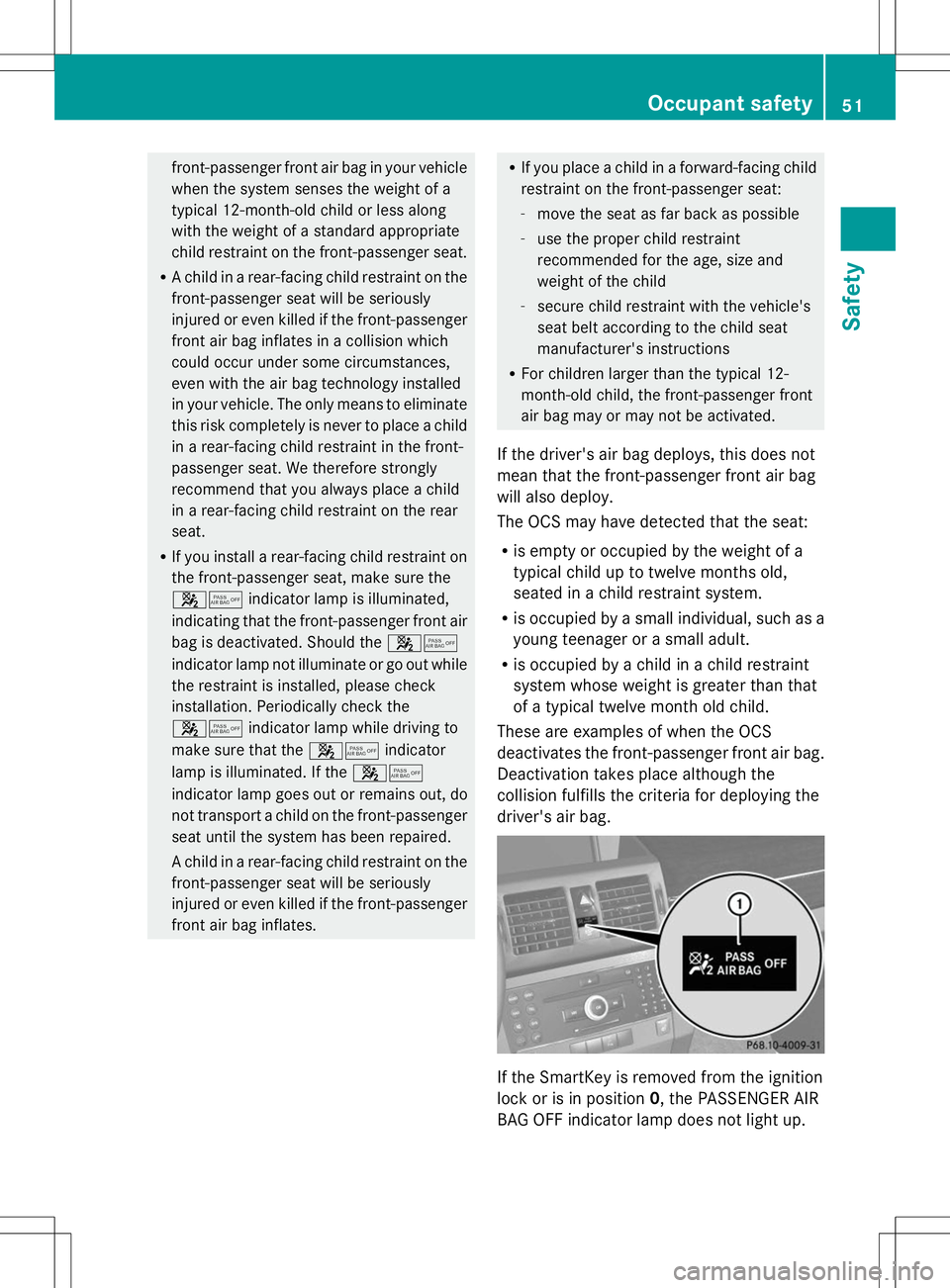
driver's air bag. If the SmartKey is removed from the ignition
lock or is in position
0, the PASSENGER AIR
BAG OFF indicator lamp does not light up. Occupant safety
51Safety Z