dimensions MERCEDES-BENZ GLK-CLASS SUV 2015 User Guide
[x] Cancel search | Manufacturer: MERCEDES-BENZ, Model Year: 2015, Model line: GLK-CLASS SUV, Model: MERCEDES-BENZ GLK-CLASS SUV 2015Pages: 386, PDF Size: 26 MB
Page 339 of 386
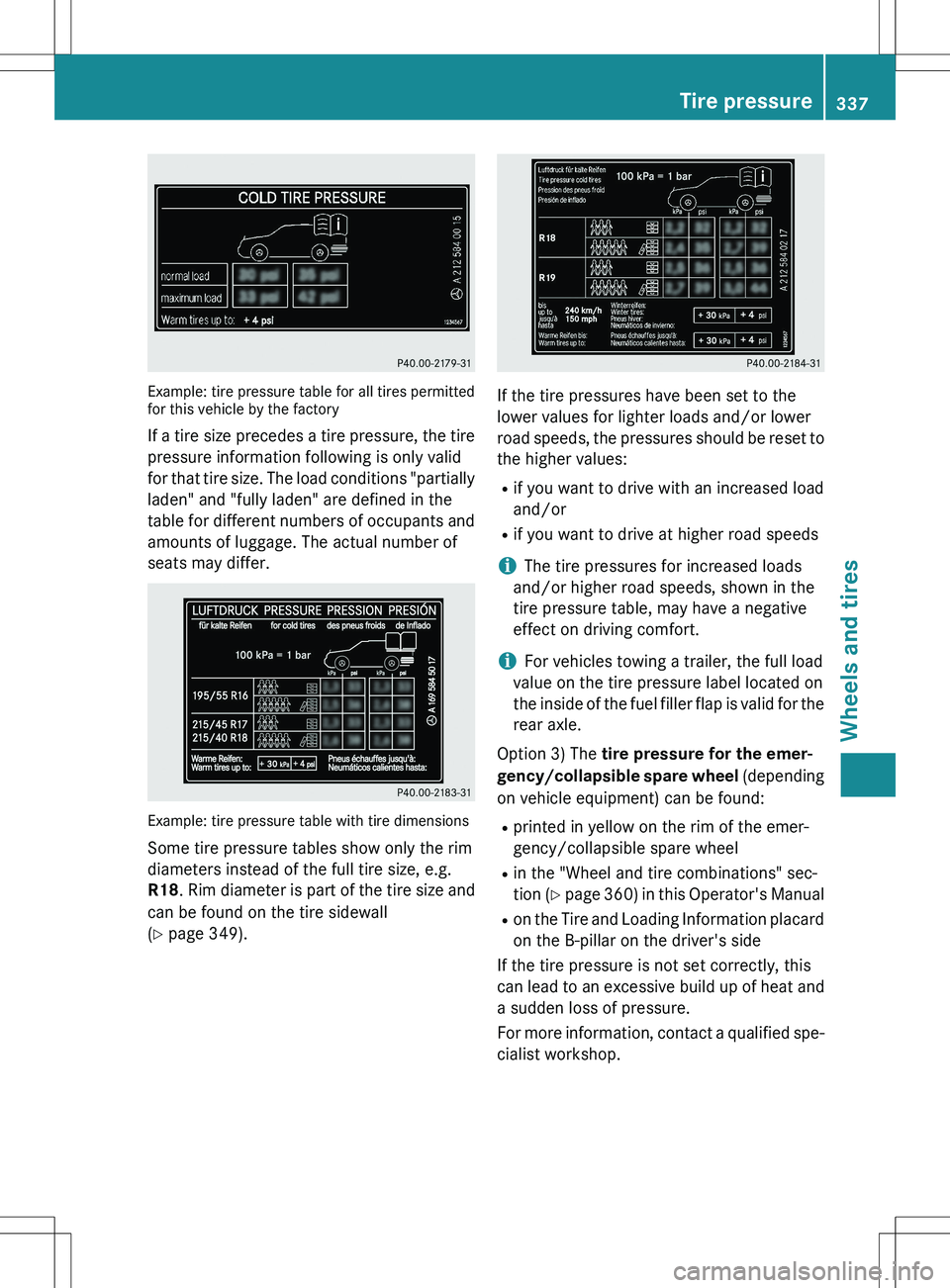
Example: tire pressure table for all tires permitted
for this vehicle by the factory
If a tire size precedes a tire pressure, the tirepressure information following is only valid
for that tire size. The load conditions "partially
laden" and "fully laden" are defined in the
table for different numbers of occupants and amounts of luggage. The actual number of
seats may differ.
Example: tire pressure table with tire dimensions
Some tire pressure tables show only the rim
diameters instead of the full tire size, e.g.
R18 . Rim diameter is part of the tire size and
can be found on the tire sidewall
( Y page 349).
If the tire pressures have been set to the
lower values for lighter loads and/or lower
road speeds, the pressures should be reset to
the higher values:
R if you want to drive with an increased load
and/or
R if you want to drive at higher road speeds
iThe tire pressures for increased loads
and/or higher road speeds, shown in the
tire pressure table, may have a negative
effect on driving comfort.
iFor vehicles towing a trailer, the full load
value on the tire pressure label located on
the inside of the fuel filler flap is valid for the rear axle.
Option 3) The tire pressure for the emer-
gency/collapsible spare wheel (depending
on vehicle equipment) can be found:
R printed in yellow on the rim of the emer-
gency/collapsible spare wheel
R in the "Wheel and tire combinations" sec-
tion ( Y page 360) in this Operator's Manual
R on the Tire and Loading Information placard
on the B-pillar on the driver's side
If the tire pressure is not set correctly, this
can lead to an excessive build up of heat and
a sudden loss of pressure.
For more information, contact a qualified spe- cialist workshop.
Tire pressure337
Wheels and tires
Z
Page 357 of 386
Treadwear indicators
Narrow bars (tread wear bars) that are dis-
tributed over the tire tread. If the tire tread islevel with the bars, the wear limit of á in
(1.6 mm) has been reached.
Occupant distribution
The distribution of occupants in a vehicle at
their designated seating positions.
Total load limit
Nominal load and luggage load plus 68 kg
(150 lbs) multiplied by the number of seats in the vehicle.
Changing a wheel
Flat tire
You can find information on what to do in theevent of a flat tire in the "Flat tire" section
( Y page 314).
Information on driving with MOExtended tires
in the event of a flat tire can be found under
"MOExtended tires (tires with run-flat char-
acteristics" ( Y page 315).
Rotating the wheels
GWARNING
Interchanging the front and rear wheels may
severely impair the driving characteristics if
the wheels or tires have different dimensions.
The wheel brakes or suspension components
may also be damaged. There is a risk of acci-
dent.
Rotate front and rear wheels only if the wheels and tires are of the same dimensions.
! On vehicles equipped with a tire pressure
monitor, electronic components are loca-
ted in the wheel. Tire-mounting tools should not be used
near the valve. This could damage the elec-
tronic components.
Only have tires changed at a qualified spe-cialist workshop.
Always observe the instructions and safety
notes in the "Mounting a wheel" section
( Y page 356).
The wear patterns on the front and rear tires
differ, depending on the operating conditions.
Rotate the wheels before a clear wear pattern has formed on the tires. Front tires typically
wear more on the shoulders and the rear tires in the center.
If your vehicle's tire configuration allows, you can rotate the wheels according to the inter-
vals in the tire manufacturer's warranty book
in your vehicle documents. If no warranty
book is available, the tires should be rotated
every 3,000 to 6,000 miles (5,000 to
10,000 km), or earlier if tire wear requires. Do
not change the direction of wheel rotation.
Clean the contact surfaces of the wheel and
the brake disc thoroughly every time a wheel
is rotated. Check the tire pressure and reac-
tivate the tire pressure monitor if necessary.
Information on changing tires and mounting
the spare wheel ( Y page 355).
Direction of rotation
Tires with a specified direction of rotation
have additional benefits, e.g. if there is a risk
of hydroplaning. These advantages can only
be gained if the tires are installed correspond- ing to the direction of rotation.
An arrow on the sidewall of the tire indicates
its correct direction of rotation.
Storing wheels
Store wheels that are not being used in a cool,
dry and preferably dark place. Protect the
tires from oil, grease, gasoline and diesel.
Changing a wheel355
Wheels and tires
Z
Page 368 of 386
Emergency spare wheel
Important safety notes
GWARNING
The wheel or tire size as well as the tire type ofthe spare wheel or emergency spare wheel
and the wheel to be replaced may differ.
Mounting an emergency spare wheel may
severely impair the driving characteristics.
There is a risk of an accident.
To avoid hazardous situations:
R adapt your driving style accordingly and
drive carefully.
R never mount more than one spare wheel or
emergency spare wheel that differs in size.
R only use a spare wheel or emergency spare
wheel of a different size briefly.
R do not switch ESP ®
off.
R have a spare wheel or emergency spare
wheel of a different size replaced at the
nearest qualified specialist workshop.
Observe that the wheel and tire dimensions
as well as the tire type must be correct.
When using an emergency spare wheel or
spare wheel of a different size, you must not
exceed the maximum speed of 50 mph
(80 km/h).
Snow chains must not be mounted on emer-
gency spare wheels.
General notes
You should regularly check the pressure of
the emergency spare wheel, particularly prior
to long trips, and correct the pressure as nec-
essary ( Y page 336). The applicable value can
be found on the wheel or under "Technical
data" ( Y page 360).
iWhen you are driving with the emergency
spare wheel mounted, the tire pressure
monitor cannot function reliably. Only
restart the tire pressure monitor when the
defective wheel has been replaced with a
new wheel. If an emergency spare wheel is mounted,
the system may continue to show the tire
pressure of the wheel that has been
removed for a few minutes. The value dis-
played for the mounted emergency spare
wheel is not the same as the current tire
pressure of the emergency spare wheel.
An emergency spare wheel may also be
mounted against the direction of rotation.
Observe the time restriction on use as well as
the speed limitation specified on the emer-
gency spare wheel.
Replace the tires after six years at the latest, regardless of wear. This also applies to the
emergency spare wheel.
Collapsible spare wheel
Removing the collapsible spare wheel
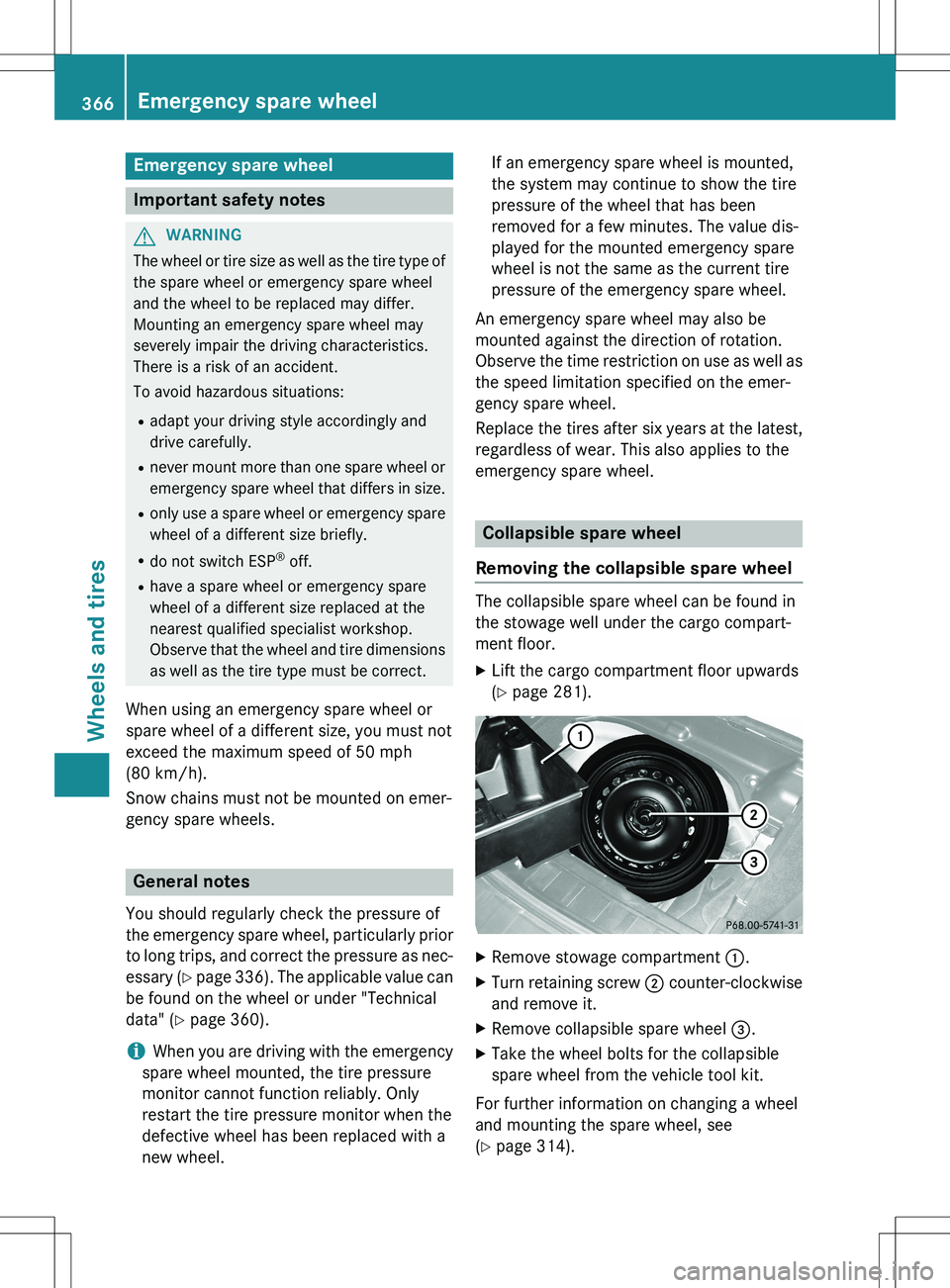
The collapsible spare wheel can be found in
the stowage well under the cargo compart-
ment floor.
X Lift the cargo compartment floor upwards
(Y page 281).
X
Remove stowage compartment :.
X Turn retaining screw ; counter-clockwise
and remove it.
X Remove collapsible spare wheel =.
X Take the wheel bolts for the collapsible
spare wheel from the vehicle tool kit.
For further information on changing a wheel
and mounting the spare wheel, see
( Y page 314).
366Emergency spare wheel
Wheels and tires
Page 382 of 386
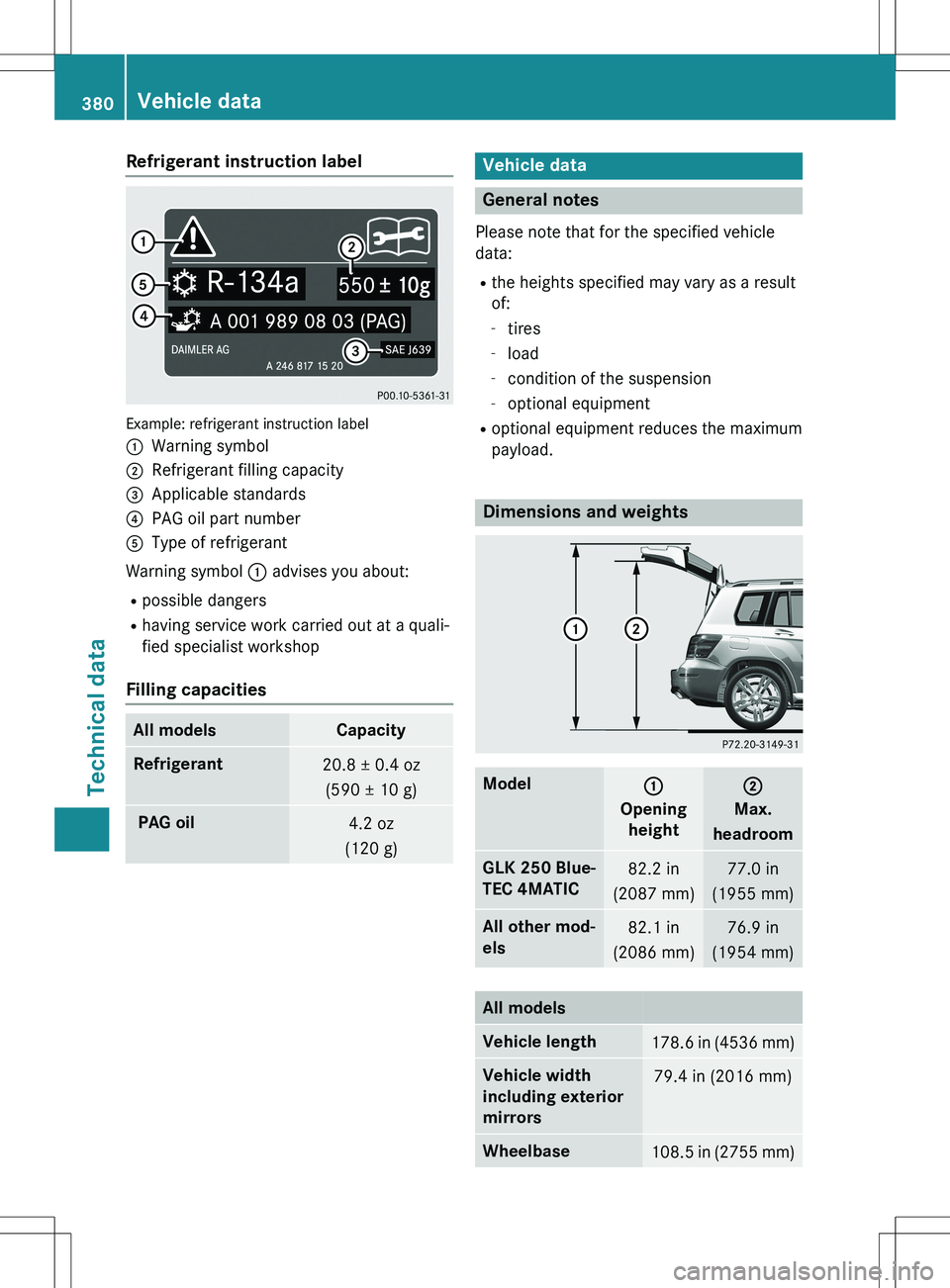
Refrigerant instruction label
Example: refrigerant instruction label :
Warning symbol
;Refrigerant filling capacity
=Applicable standards
?PAG oil part number
AType of refrigerant
Warning symbol : advises you about:
R possible dangers
R having service work carried out at a quali-
fied specialist workshop
Filling capacities
All modelsCapacity
Refrigerant20.8 ± 0.4 oz
(590 ± 10 g)
PAG oil4.2 oz
(120 g)
Vehicle data
General notes
Please note that for the specified vehicle
data:
R the heights specified may vary as a result
of:
- tires
- load
- condition of the suspension
- optional equipment
R optional equipment reduces the maximum
payload.
Dimensions and weights
Model:
Opening
height
;
Max.
headroom
GLK 250 Blue-
TEC 4MATIC82.2 in
(2087 mm)77.0 in
(1955 mm)
All other mod-
els82.1 in
(2086 mm)76.9 in
(1954 mm)
All models
Vehicle length178.6 in (4536 mm)
Vehicle width
including exterior
mirrors79.4 in (2016 mm)
Wheelbase108.5 in (2755 mm)
380Vehicle data
Technical data
Page 383 of 386
All models
Turning radius38.2 ft (11.65 m)
Maximum roof load165 lb (75 kg)
ModelVehicle height
GLK 250 BlueTEC
4MATIC66.7 in (1694 mm)
All other models66.7 in (1693 mm)
ModelGround clearance
GLK 250 BlueTEC
4MATIC8.0 in (204 mm)
All other models8.2 in (208 mm)
Trailer tow hitch
Mounting dimensions
!
If you have a trailer tow hitch retrofitted,
changes to the engine cooling system and
drive train may be necessary, depending on
the vehicle type.
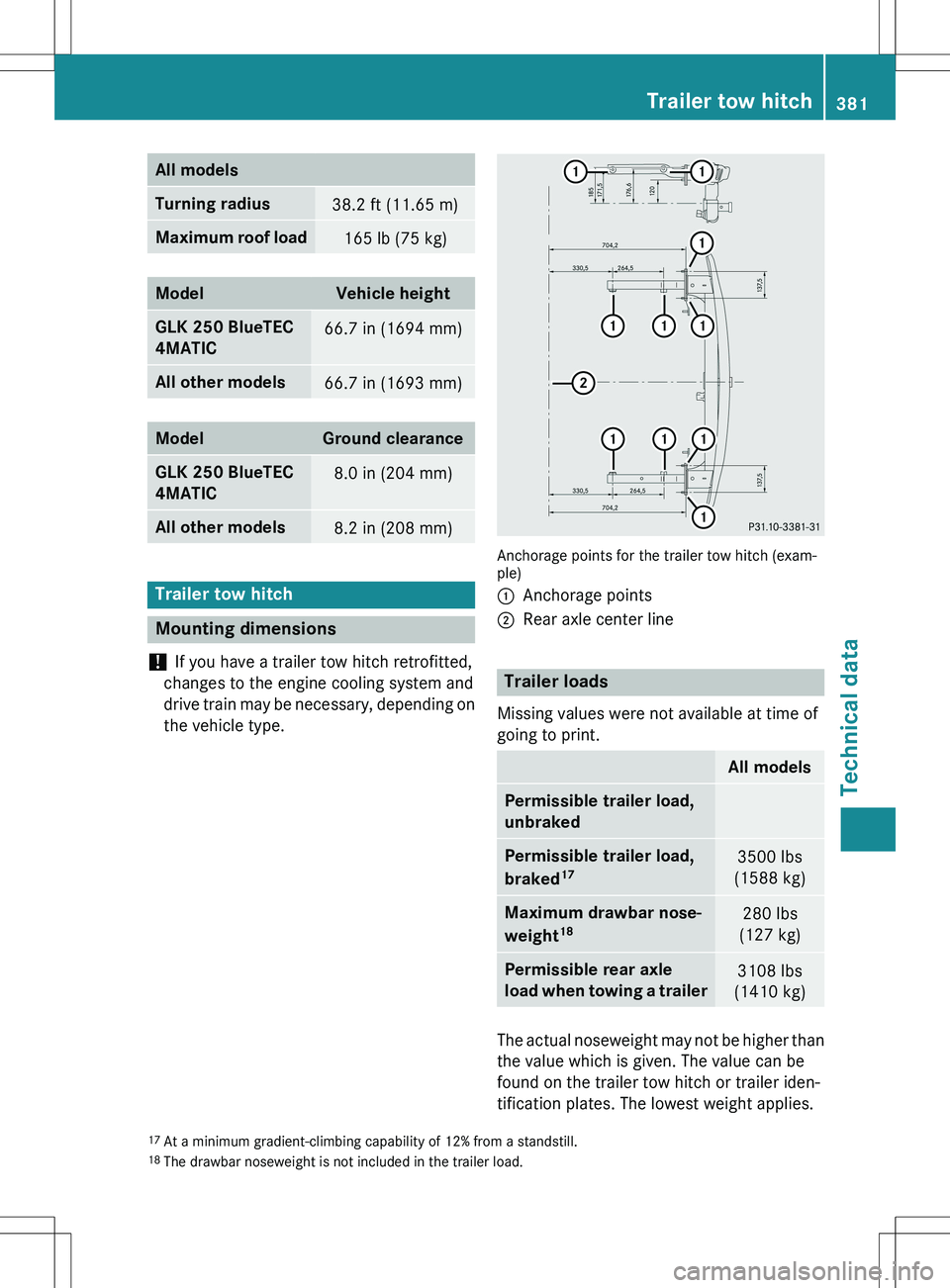
Anchorage points for the trailer tow hitch (exam-
ple) :
Anchorage points
;Rear axle center line
Trailer loads
Missing values were not available at time of
going to print.
All models
Permissible trailer load,
unbraked
Permissible trailer load,
braked 173500 lbs
(1588 kg)
Maximum drawbar nose-
weight 18280 lbs
(127 kg)
Permissible rear axle
load when towing a trailer3108 lbs
(1410 kg)
The actual noseweight may not be higher than
the value which is given. The value can be
found on the trailer tow hitch or trailer iden-
tification plates. The lowest weight applies.
17 At a minimum gradient-climbing capability of 12% from a stan dstill.
18 The drawbar noseweight is not included in the trailer load.
Trailer tow hitch381
Technical data
Z