dimensions MERCEDES-BENZ GLK-CLASS SUV 2015 Owners Manual
[x] Cancel search | Manufacturer: MERCEDES-BENZ, Model Year: 2015, Model line: GLK-CLASS SUV, Model: MERCEDES-BENZ GLK-CLASS SUV 2015Pages: 386, PDF Size: 26 MB
Page 19 of 386
Selecting the unit of measure-
ment .............................................. 230
see Instrument cluster
SRS (Supplemental Restraint Sys-
tem)
Display message ............................ 239
Introduction ..................................... 43
Warning lamp ................................. 266
Warning lamp (function) ................... 43
Standing lamps
Changing bulbs .............................. 124
Display message ............................ 245
Switching on/off ........................... 118
Start/stop function
see ECO start/stop function
Starting (engine) ................................ 151
Steering (display message) .............. 258
Steering wheel
Adjusting (electrically) ................... 107
Adjusting (manually) ...................... 106
Button overview ............................... 35
Buttons (on-board computer) ......... 221
Cleaning ......................................... 31 1
Important safety notes .................. 106
Paddle shifters ............................... 160
Steering wheel heating .................. 107
Storing settings (memory func-
tion) .............................................. . 112
Steering wheel heating
Problem (malfunction) ................... 108
Switching on/off ........................... 107
Steering wheel paddle shifters ........ 160
Stowage areas ................................... 275
Stowage compartments
Armrest (under) ............................. 275
Cup holders ................................... 282
Glove box ....................................... 275
Important safety information ......... 275
Rear ............................................... 276
Stowage net ................................... 276
Stowage net ....................................... 276
Summer tires ..................................... 334
Sun visor ............................................ 283
Surround lighting (on-board com-
puter) .................................................. 2 31
SUV
(Sport Utility Vehicle) ....................... 25 Switching air-recirculation mode
on/off
................................................. 14 3
T
Tachometer ........................................ 220
Tail lamps
Display message ............................ 244
Tailgate
Display message ............................ 257
Emergency unlocking ....................... 91
Important safety notes .................... 87
Limiting the opening angle ............... 90
Opening dimensions ...................... 380
Opening/closing (automatically
from inside) ...................................... 90
Opening/closing (automatically
from outside) ................................... 88
Opening/closing (from outside) ....... 88
Tank
see Fuel tank
Tank content
Fuel gauge ....................................... 33
Technical data
Capacities ...................................... 373
Emergency spare wheel ................. 369
Information .................................... 372
Tires/wheels ................................. 360
Trailer loads ................................... 381
Vehicle data ................................... 380
TELEAID
Call priority .................................... 291
Downloading destinations
(COMAND) ..................................... 291
Downloading routes ....................... 294
Emergency call .............................. 288
General notes ................................ 287
Geo fencing ................................... 294
Locating a stolen vehicle ............... 293
MB info call button ........................ 290
Remote vehicle locking .................. 292
Roadside Assistance button .......... 289
Search & Send ............................... 292
Self-test ......................................... 28 8
Speed alert .................................... 294
System .......................................... 288
Triggering the vehicle alarm ........... 295
Vehicle Health Check .................... 293
Index17
Page 21 of 386
TIN (Tire Identification Number)
(definition) ..................................... 354
Tire bead (definition) ...................... 354
Tire pressure (definition) ................ 354
Tire pressures (recommended) ...... 352
Tire size (data) ............................... 360
Tire size designation, load-bearing capacity, speed rating .................... 349
Tire tread ....................................... 333
Tire tread (definition) ..................... 354
Total load limit (definition) ............. 355
Traction ......................................... 34 7
Traction (definition) ....................... 354
Tread wear ..................................... 347
TWR (permissible trailer drawbar
noseweight) (definition) ................. 354
Uniform Tire Quality Grading
Standards ...................................... 347
Uniform Tire Quality Grading
Standards (definition) .................... 352
Wear indicator (definition) ............. 355
Wheel and tire combination ........... 362
Wheel rim (definition) .................... 352
see Flat tire
Top Tether ............................................ 65
Tow-starting
Emergency engine starting ............ 328
Important safety notes .................. 325
Towing a trailer
Active Parking Assist ..................... 193
Cleaning the trailer tow hitch ......... 310
Coupling up a trailer ...................... 214
Decoupling a trailer ....................... 216
Driving tips .................................... 212
Important safety notes .................. 212
Installing the ball coupling ............. 214
Lights display message .................. 243
Mounting dimensions .................... 381
Power supply ................................. 217
Removing the ball coupling ............ 217
Storing the ball coupling ................ 217
Trailer loads ................................... 381
Towing away
Important safety guidelines ........... 325
Installing the towing eye ................ 326
Removing the towing eye ............... 326
With both axles on the ground ....... 327
With the rear axle raised ................ 327 Trailer coupling
see Towing a trailer
Trailer loads and drawbar nose-
weights ............................................... 216
Trailer towing
Active Blind Spot Assist ................. 209
Active Lane Keeping Assist .... 206, 212
Blind Spot Assist ............................ 205
PARKTRONIC ................................. 188
Permissible trailer loads and
drawbar noseweights ..................... 216
Transfer case ..................................... 162
Transmission
see Automatic transmission
Transmission position display ......... 157
Transmission position display
(DIRECT SELECT lever) ...................... 157
Transporting the vehicle .................. 327
Trim pieces (cleaning instruc-
tions) .................................................. 3 11
Trip computer (on-board com-
puter) .................................................. 2 23
Trip odometer
Calling up ....................................... 223
Resetting (on-board computer) ...... 224
Turn signals
Changing bulbs (front) ................... 124
Display message ............................ 244
Switching on/off ........................... 118
TWR (Tongue Weight Rating) (defi-
nition) ................................................. 35 4
Type identification plate
see Vehicle identification plate
U
UnlockingEmergency unlocking ....................... 86
From inside the vehicle (central
unlocking button) ............................. 85
V
Vanity mirror (in the sun visor) ........ 283
Vehicle
Correct use ...................................... 27
Data acquisition ............................... 28
Display message ............................ 257
Index19
Page 22 of 386
Emergency locking ........................... 86
Emergency unlocking ....................... 86
Equipment ....................................... 23
Individual settings .......................... 230
Limited Warranty ............................. 28
Loading .......................................... 343
Locking (in an emergency) ............... 86
Locking (SmartKey) .......................... 78
Lowering ........................................ 359
Maintenance .................................... 24
Parking for a long period ................ 169
Pulling away ................................... 152
Raising ........................................... 35 7
Reporting problems ......................... 27
Securing from rolling away ............ 356
Towing away .................................. 325
Transporting .................................. 327
Unlocking (in an emergency) ........... 86
Unlocking (SmartKey) ...................... 78
Vehicle data ................................... 380
Vehicle data ....................................... 380
Vehicle dimensions ........................... 380
Vehicle emergency locking ................ 86
Vehicle identification number
see VIN
Vehicle identification plate .............. 372
Vehicle maintenance
see ASSYST PLUS
Vehicle tool kit .................................. 314
Video (DVD) ........................................ 227
VIN ................................................... ... 372
W
Warning and indicator lamps
ABS ................................................ 262
Brakes ........................................... 26 2
Check Engine ................................. 267
Coolant .......................................... 26 8
Distance warning ........................... 270
DISTRONIC PLUS ........................... 270
ESP ®
.............................................. 264
ESP ®
OFF ....................................... 265
Fuel tank ........................................ 267
Overview .......................................... 34
PASSENGER AIRBAG OFF ................ 49
Reserve fuel ................................... 267
Seat belt ........................................ 260 SRS ................................................
266
Tire pressure monitor .................... 271
Warranty .............................................. 23
Washer fluid
Display message ............................ 258
Wheel and tire combination
see Tires
Wheel bolt tightening torque ........... 359
Wheel chock ...................................... 356
Wheels
Changing a wheel .......................... 355
Checking ........................................ 333
Cleaning ......................................... 30 7
Emergency spare wheel ................. 366
General notes ................................ 360
Important safety notes .................. 332
Information on driving .................... 332
Interchanging/changing ................ 355
Mounting a new wheel ................... 358
Mounting a wheel .......................... 356
Removing a wheel .......................... 358
Storing ........................................... 3 55
Tightening torque ........................... 359
Wheel size/tire size ....................... 360
Window curtain air bag
Display message ............................ 240
Operation ......................................... 49
Windows
see Side windows
Windshield
Defrosting ...................................... 141
Windshield washer fluid
see Windshield washer system
Windshield washer system .............. 303
Notes ............................................. 37 9
Windshield wipers
Problem (malfunction) ................... 129
Rear window wiper ........................ 127
Replacing the wiper blades ............ 127
Switching on/off ........................... 126
Winter driving
Important safety notes .................. 334
Slippery road surfaces ................... 174
Snow chains .................................. 335
Winter tires
M+S tires ....................................... 335
Wiper blades
Cleaning ......................................... 30 8
20Index
Page 89 of 386
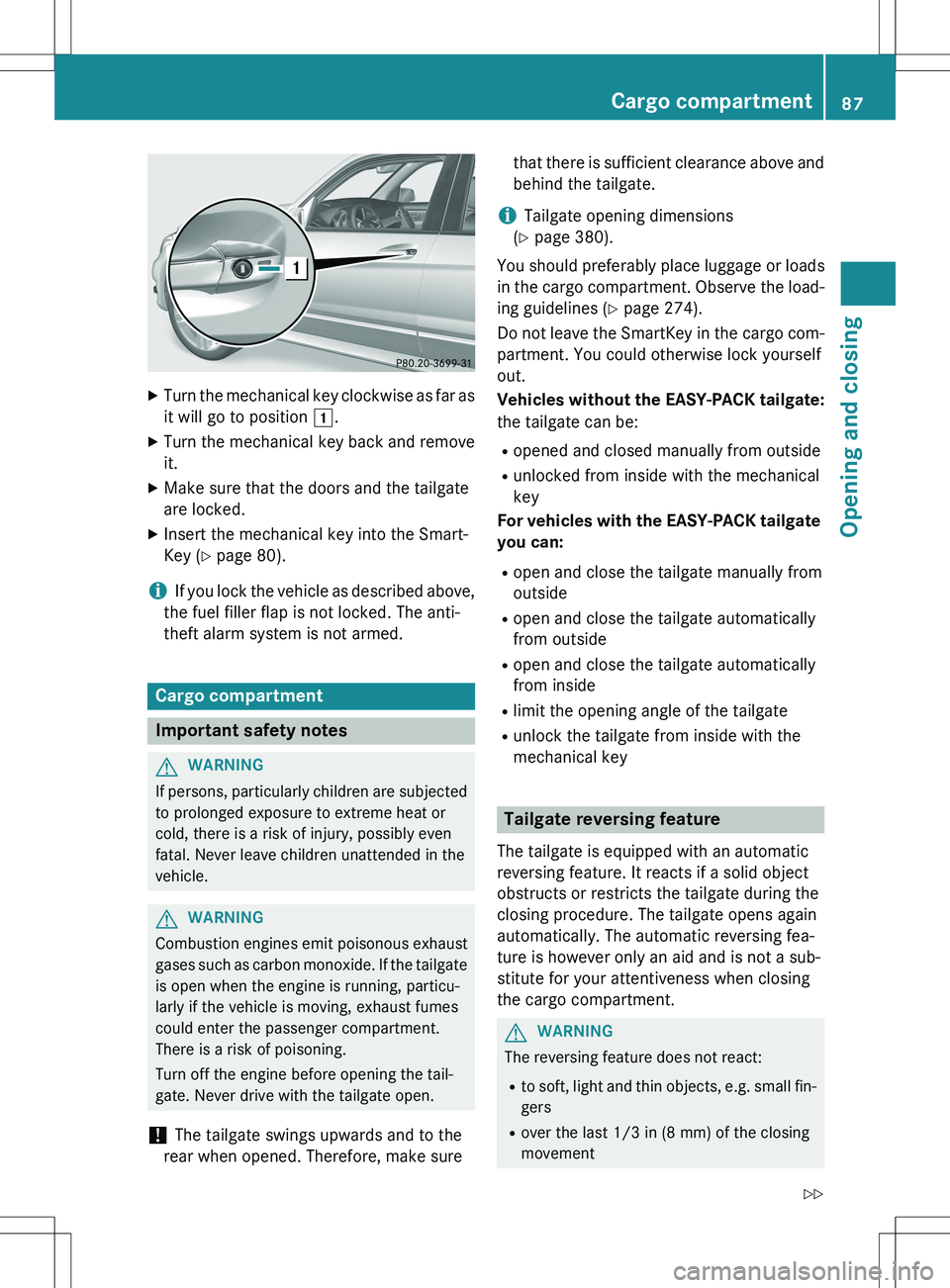
XTurn the mechanical key clockwise as far as
it will go to position 1.
X Turn the mechanical key back and remove
it.
X Make sure that the doors and the tailgate
are locked.
X Insert the mechanical key into the Smart-
Key ( Y page 80).
iIf you lock the vehicle as described above,
the fuel filler flap is not locked. The anti-
theft alarm system is not armed.
Cargo compartment
Important safety notes
GWARNING
If persons, particularly children are subjected to prolonged exposure to extreme heat or
cold, there is a risk of injury, possibly even
fatal. Never leave children unattended in the
vehicle.
GWARNING
Combustion engines emit poisonous exhaust
gases such as carbon monoxide. If the tailgateis open when the engine is running, particu-
larly if the vehicle is moving, exhaust fumes
could enter the passenger compartment.
There is a risk of poisoning.
Turn off the engine before opening the tail-
gate. Never drive with the tailgate open.
! The tailgate swings upwards and to the
rear when opened. Therefore, make sure that there is sufficient clearance above and
behind the tailgate.
iTailgate opening dimensions
( Y page 380).
You should preferably place luggage or loads
in the cargo compartment. Observe the load-
ing guidelines ( Y page 274).
Do not leave the SmartKey in the cargo com- partment. You could otherwise lock yourself
out.
Vehicles without the EASY-PACK tailgate:
the tailgate can be:
R opened and closed manually from outside
R unlocked from inside with the mechanical
key
For vehicles with the EASY-PACK tailgate you can:
R open and close the tailgate manually from
outside
R open and close the tailgate automatically
from outside
R open and close the tailgate automatically
from inside
R limit the opening angle of the tailgate
R unlock the tailgate from inside with the
mechanical key
Tailgate reversing feature
The tailgate is equipped with an automatic
reversing feature. It reacts if a solid object
obstructs or restricts the tailgate during the
closing procedure. The tailgate opens again
automatically. The automatic reversing fea-
ture is however only an aid and is not a sub-
stitute for your attentiveness when closing
the cargo compartment.
GWARNING
The reversing feature does not react:
R to soft, light and thin objects, e.g. small fin-
gers
R over the last 1/3 in (8 mm) of the closing
movement
Cargo compartment87
Opening and closing
Z
Page 91 of 386
GWARNING
Combustion engines emit poisonous exhaust
gases such as carbon monoxide. If the tailgateis open when the engine is running, particu-
larly if the vehicle is moving, exhaust fumes
could enter the passenger compartment.
There is a risk of poisoning.
Turn off the engine before opening the tail-
gate. Never drive with the tailgate open.
! The tailgate swings upwards and to the
rear when opened. Therefore, make sure
that there is sufficient clearance above and behind the tailgate.
iTailgate opening dimensions
( Y page 380).
Opening
You can open the tailgate automatically with
the SmartKey or the handle in the tailgate.
Open or close the tailgate fully using the auto-
matic door function if you have stopped the
tailgate in an intermediate position.
X Press and hold the F button on the
SmartKey until the tailgate opens.
or
X If the tailgate is unlocked, pull the handle
and let it go again immediately.
iYou can also close the tailgate manually if
it is fully opened.
! If you have opened the tailgate automat-
ically, you should wait a moment before
closing the tailgate manually.
Closing
GWARNING
Parts of the body could become trapped dur-
ing automatic closing of the tailgate. More-
over, people, e.g. children, may be standing in the closing area or may enter the closing area
during the closing process. There is a risk of
injury.
Make sure that nobody is in the vicinity of theclosing area during the closing process.
Use one of the following options to stop the
closing process:
R press the F button on the SmartKey.
R pull or press the remote operating switch
on the driver's door.
R press the closing or locking button on the
tailgate.
R pull the handle on the tailgate.
You can close the tailgate automatically using the SmartKey, the closing button 2
or the lock-
ing button 3
.
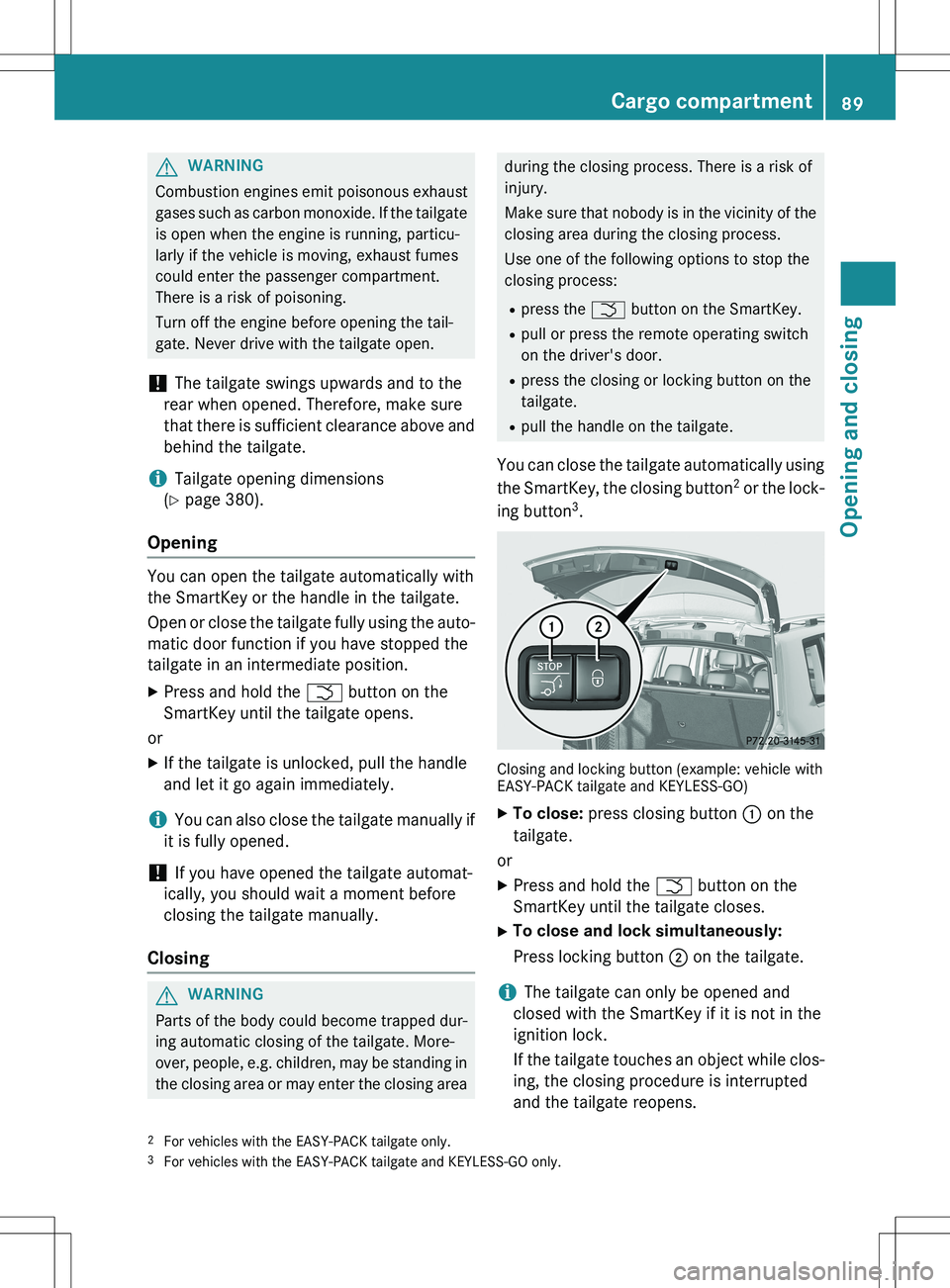
Closing and locking button (example: vehicle with
EASY-PACK tailgate and KEYLESS-GO)
X To close: press closing button : on the
tailgate.
or X Press and hold the F button on the
SmartKey until the tailgate closes.
X To close and lock simultaneously:
Press locking button ; on the tailgate.
iThe tailgate can only be opened and
closed with the SmartKey if it is not in the
ignition lock.
If the tailgate touches an object while clos-
ing, the closing procedure is interrupted
and the tailgate reopens.
2 For vehicles with the EASY-PACK tailgate only.
3 For vehicles with the EASY-PACK tailgate and KEYLESS-GO only.
Cargo compartment89
Opening and closing
Z
Page 92 of 386
iIf you leave a KEYLESS-GO key in the
cargo compartment, the tailgate will not
lock.
The tailgate is not closed unless a KEY-
LESS-GO key is detected.
Opening/closing automatically from
inside
GWARNING
Parts of the body could become trapped dur-
ing automatic closing of the tailgate. More-
over, people, e.g. children, may be standing in the closing area or may enter the closing area
during the closing process. There is a risk of
injury.
Make sure that nobody is in the vicinity of theclosing area during the closing process.
Use one of the following options to stop the
closing process:
R press the F button on the SmartKey.
R pull or press the remote operating switch
on the driver's door.
R press the closing or locking button on the
tailgate.
R pull the handle on the tailgate.
GWARNING
Combustion engines emit poisonous exhaust
gases such as carbon monoxide. If the tailgate
is open when the engine is running, particu-
larly if the vehicle is moving, exhaust fumes
could enter the passenger compartment.
There is a risk of poisoning.
Turn off the engine before opening the tail-
gate. Never drive with the tailgate open.
! The tailgate swings upwards and to the
rear when opened. Therefore, make sure
that there is sufficient clearance above and behind the tailgate.
iTailgate opening dimensions
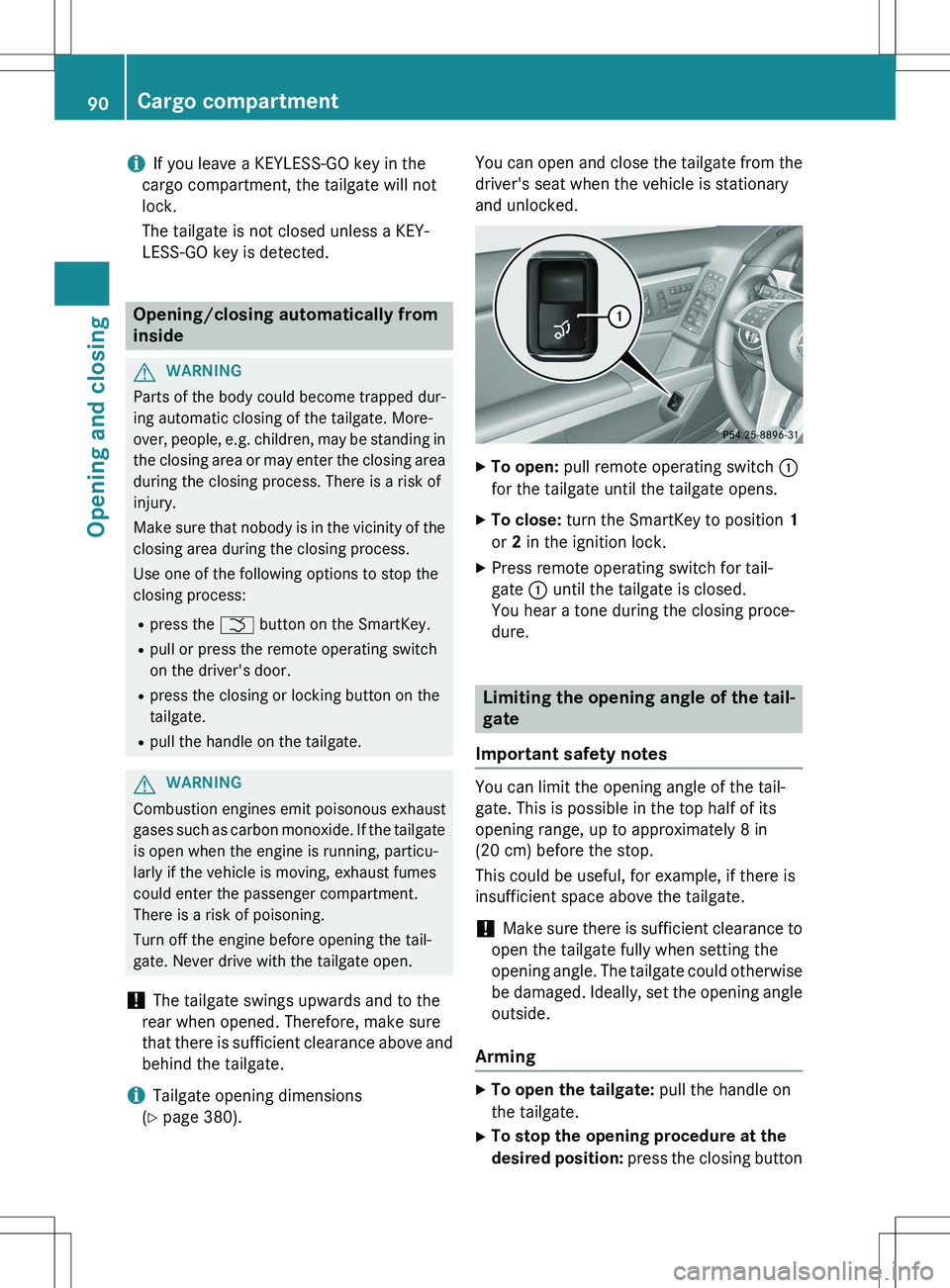
( Y page 380). You can open and close the tailgate from the
driver's seat when the vehicle is stationary
and unlocked.
X To open: pull remote operating switch :
for the tailgate until the tailgate opens.
X To close: turn the SmartKey to position 1
or 2 in the ignition lock.
X Press remote operating switch for tail-
gate : until the tailgate is closed.
You hear a tone during the closing proce-
dure.
Limiting the opening angle of the tail-
gate
Important safety notes
You can limit the opening angle of the tail-
gate. This is possible in the top half of its
opening range, up to approximately 8 in
(20 cm) before the stop.
This could be useful, for example, if there is
insufficient space above the tailgate.
! Make sure there is sufficient clearance to
open the tailgate fully when setting the
opening angle. The tailgate could otherwise be damaged. Ideally, set the opening angleoutside.
Arming
X To open the tailgate: pull the handle on
the tailgate.
X To stop the opening procedure at the
desired position: press the closing button
90Cargo compartment
Opening and closing
Page 93 of 386
(Y page 88) in the tailgate or pull the handle
on the outside of the tailgate again.
X To store the position: press and hold the
closing button in the tailgate until you hear a short tone.
The opening angle limiter is activated. The
tailgate will now stop in the stored positionwhen opening.
iTo open the tailgate fully, pull the handle
on the outside of the tailgate again after it
has stopped automatically. This does not
delete the stored position.
Deactivating
X Press and hold the closing button
(Y page 88) in the tailgate until you hear
two short tones.
Tailgate emergency release
Important safety notes
! The tailgate swings upwards and to the
rear when opened. Therefore, make sure
that there is sufficient clearance above and behind the tailgate.
If the tailgate can no longer be opened from
outside the vehicle, use the emergency
release on the inside of the tailgate.
iTailgate opening dimensions
( Y page 380).
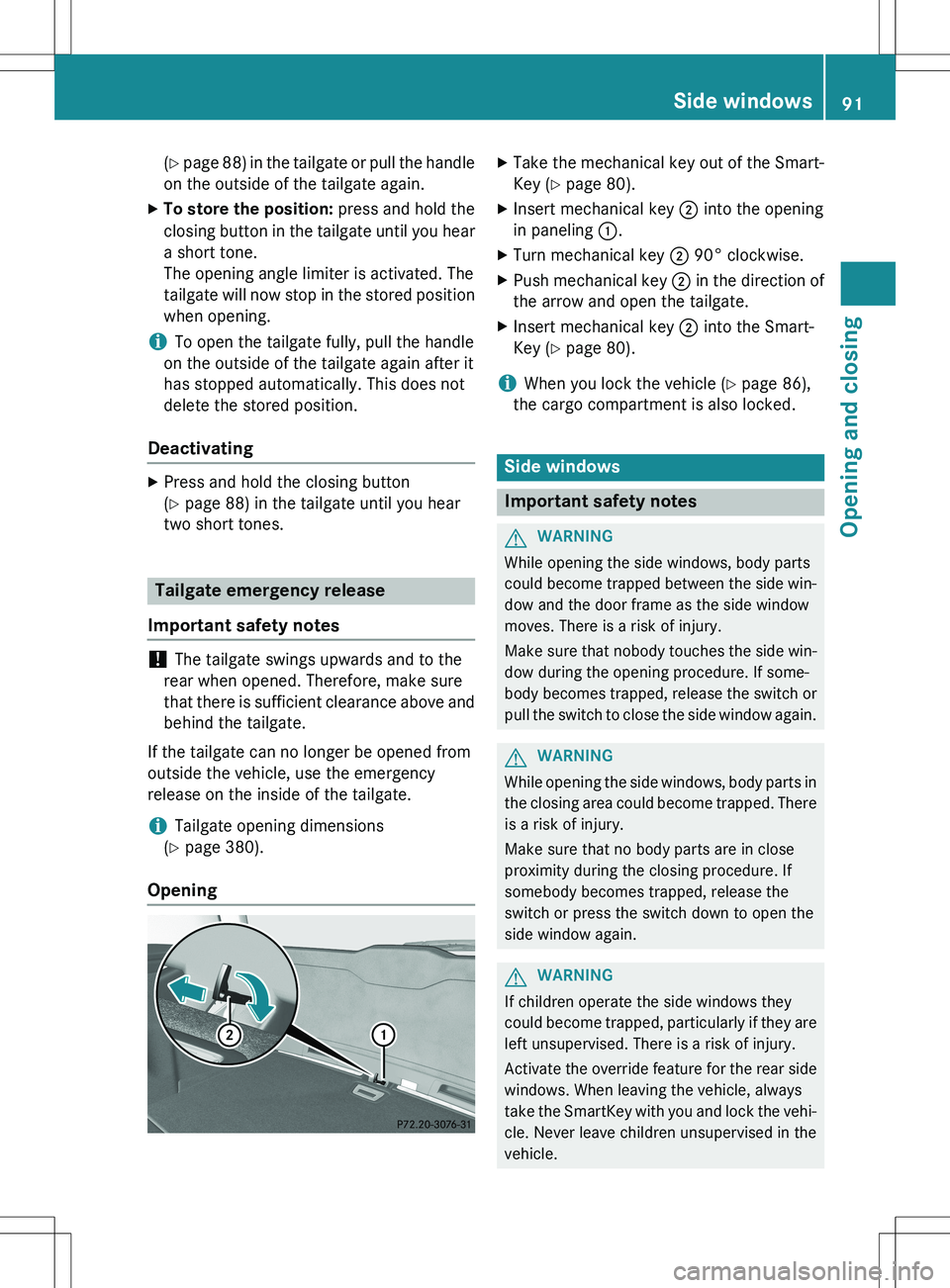
Opening
X
Take the mechanical key out of the Smart-
Key ( Y page 80).
X Insert mechanical key ; into the opening
in paneling :.
X Turn mechanical key ; 90° clockwise.
X Push mechanical key ; in the direction of
the arrow and open the tailgate.
X Insert mechanical key ; into the Smart-
Key ( Y page 80).
iWhen you lock the vehicle ( Y page 86),
the cargo compartment is also locked.
Side windows
Important safety notes
GWARNING
While opening the side windows, body parts
could become trapped between the side win- dow and the door frame as the side window
moves. There is a risk of injury.
Make sure that nobody touches the side win-
dow during the opening procedure. If some-
body becomes trapped, release the switch or pull the switch to close the side window again.
GWARNING
While opening the side windows, body parts in
the closing area could become trapped. There is a risk of injury.
Make sure that no body parts are in close
proximity during the closing procedure. If
somebody becomes trapped, release the
switch or press the switch down to open the
side window again.
GWARNING
If children operate the side windows they
could become trapped, particularly if they are left unsupervised. There is a risk of injury.
Activate the override feature for the rear side
windows. When leaving the vehicle, always
take the SmartKey with you and lock the vehi-
cle. Never leave children unsupervised in the
vehicle.
Side windows91
Opening and closing
Z
Page 215 of 386
The applicable permissible values, which
must not be exceeded, can be found:
R in the vehicle documents
R on the identification plates of the trailer tow
hitch, the trailer and the vehicle
If the values differ, the lowest value applies.
You will find the values approved by the man-
ufacturer on the vehicle identification plates
and those for the towing vehicle under "Tech- nical data" ( Y page 381).
When towing a trailer, your vehicle's handling
characteristics will be different in comparison with when driving without a trailer.
The vehicle/trailer combination:
R is heavier
R is restricted in its acceleration and gradi-
ent-climbing capability
R has an increased braking distance
R is affected more by strong crosswinds
R demands more sensitive steering
R has a larger turning radius
This could impair the handling characteris-
tics.
When towing a trailer, always adjust your
speed to the current road and weather con-
ditions. Do not exceed the maximum permis- sible speed for your vehicle/trailer combina-
tion.
General notes
R Do not exceed the legally prescribed max-
imum speed for vehicle/trailer combina-
tions in the relevant country.
This lowers the risk of an accident.
R Only install an approved trailer coupling on
your vehicle.
Further information on availability and on
installation is available from any authorized
Mercedes-Benz Center.
R The bumpers of your vehicle are not suita-
ble for installing detachable trailer cou-
plings. R
Do not install hired trailer couplings or
other detachable trailer couplings on the
bumpers of your vehicle.
R To reduce the risk of damage to the ball
coupling, remove it from the ball coupling
recess when not in use.
iWhen towing a trailer, set the tire pres-
sure on the rear axle of the towing vehicle
for a maximum load; see the tire pressure
table in the fuel filler flap ( Y page 352).
Please note that when towing a trailer,
PARKTRONIC ( Y page 186) is only available
with limitations or not at all.
iOn vehicles without level control, the
height of the ball coupling will alter accord-
ing to the load placed on the vehicle. If nec- essary, use a trailer with a height-adjusta-
ble drawbar.
You will find installation dimensions and loads
under "Technical data" ( Y page 381).
Driving tips
iObserve the notes on ESP ®
trailer stabi-
lization ( Y page 72).
The maximum permissible speed for vehicle/
trailer combinations depends on the type of
trailer. Before beginning the journey, check
the trailer's documents to see what the max- imum permissible speed is. Observe the
legally prescribed maximum speed in the rel-evant country.
For certain Mercedes-Benz vehicles, the max-
imum permissible rear axle load is increased
when towing a trailer. Refer to the "Technical
data" section to find out whether this applies
to your vehicle.
If you utilize any of the added maximum rear
axle load when towing a trailer, the vehicle/
trailer combination may not exceed a maxi-
mum speed of 60 mph (100 km/h) for rea-
sons concerning the operating permit. This
also applies in countries in which the permis-
sible maximum speed for vehicle/trailer com- binations is above 60 mph (100 km/h).
Towing a trailer213
Driving and parking
Z
Page 216 of 386
When towing a trailer, your vehicle's handling
characteristics will be different in comparison with when driving without a trailer.
Use the left-hand paddle shifter to shift into a
lower gear in good time on long and steep
downhill gradients.
iThis also applies if you have activated
cruise control.
This will use the braking effect of the engine,
so that less braking will be required to main-
tain the speed. This relieves the load on the
brake system and prevents the brakes from
overheating and wearing too quickly. If you
need additional braking, depress the brake
pedal repeatedly rather than continuously.
Driving tips
R Maintain a greater distance from the vehi-
cle in front than when driving without a
trailer.
R Avoid braking abruptly. If possible, brake
gently at first to allow the trailer to run on.
Then, increase the braking force rapidly.
R The values given for gradient-climbing
capabilities from a standstill refer to sea
level. When driving in mountainous areas,
note that the power output of the engine
and, consequently, the vehicle's gradient-
climbing capability, decreases with
increasing altitude.
If the trailer swings from side to side:
X Do not accelerate.
X Do not counter-steer.
X Brake if necessary.
Installing the ball coupling
GWARNING
If the ball coupling is not installed and secured
correctly the trailer may come loose. There is
a risk of an accident.
Install and secure the ball coupling as descri-
bed in the ball coupling installation instruc-
tions. Make sure that the ball coupling is
installed and secured correctly before every
journey.
! Mercedes-Benz recommends that you
only use ball couplings that have been tes- ted and approved by Mercedes-Benz. This
helps to avoid damage to the vehicle.
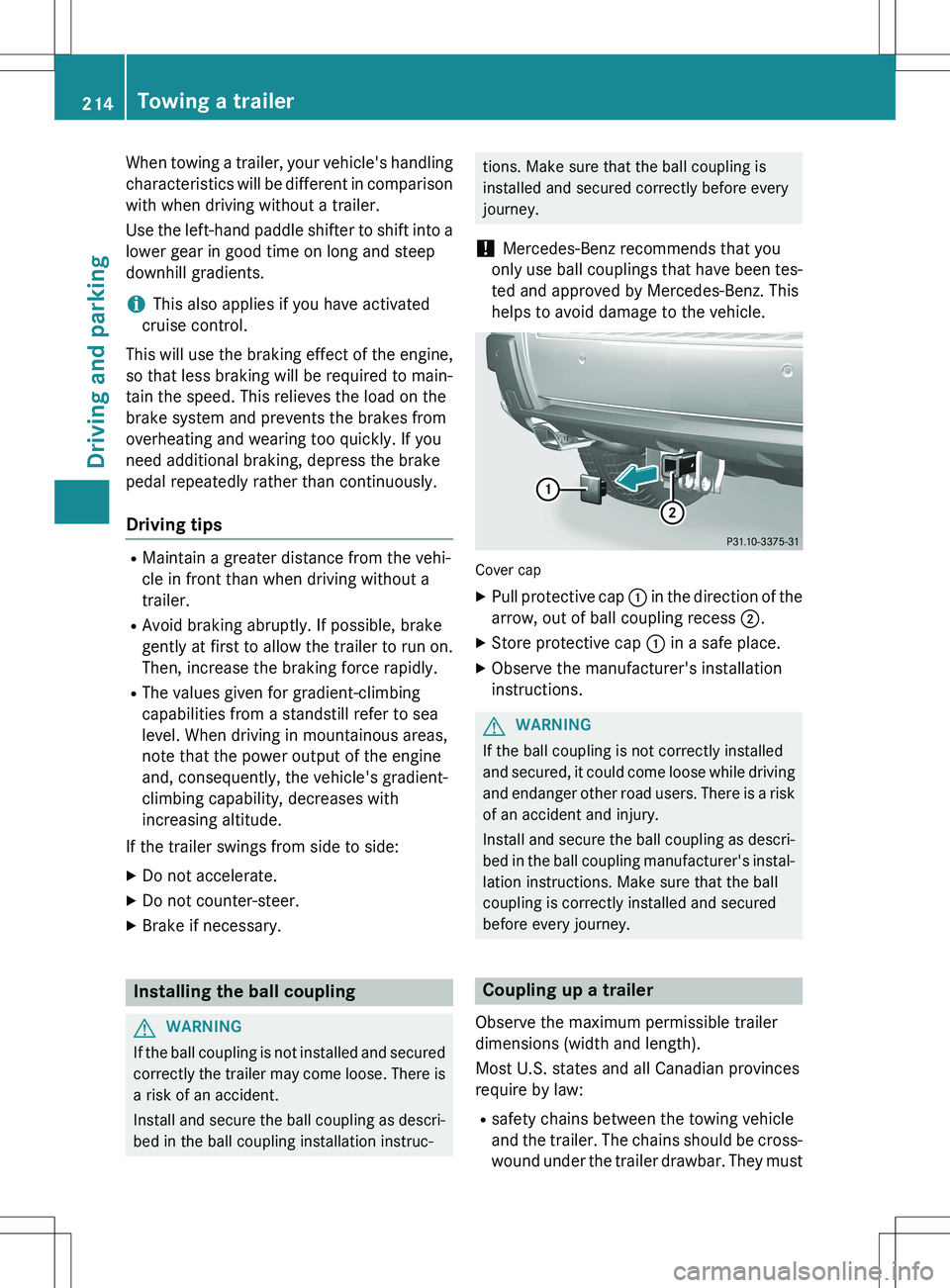
Cover cap
X Pull protective cap : in the direction of the
arrow, out of ball coupling recess ;.
X Store protective cap : in a safe place.
X Observe the manufacturer's installation
instructions.
GWARNING
If the ball coupling is not correctly installed
and secured, it could come loose while driving
and endanger other road users. There is a risk
of an accident and injury.
Install and secure the ball coupling as descri-
bed in the ball coupling manufacturer's instal- lation instructions. Make sure that the ball
coupling is correctly installed and secured
before every journey.
Coupling up a trailer
Observe the maximum permissible trailer
dimensions (width and length).
Most U.S. states and all Canadian provinces
require by law:
R safety chains between the towing vehicle
and the trailer. The chains should be cross-
wound under the trailer drawbar. They must
214Towing a trailer
Driving and parking
Page 218 of 386
gradients, shift to a lower gear using the
left-hand steering wheel paddle shifter.
A lower gear and lower speed reduce the
risk of engine failure.
R When driving downhill, shift to a lower gear
to utilize the engine's braking effect.
Avoid continuous brake application as this
may overheat the vehicle brakes and, if
installed, the trailer brakes.
R If the coolant temperature increases dra-
matically while the air-conditioning system
is switched on, switch off the air-condition-
ing system.
Coolant heat can additionally be dissipated
by opening the windows and by setting the blower fan and the interior temperature to
maximum.
R When overtaking, pay particular attention
to the extended length of your vehicle/
trailer combination.
Due to the length of the vehicle/trailer
combination, you require additional road
space in relation to the vehicle you are
overtaking, before you can change back to
the original lane.
Decoupling a trailer
GWARNING
If you uncouple a trailer with the overrun
brake engaged, you could trap your hand
between the vehicle and the trailer drawbar.
There is a risk of injury.
Do not uncouple a trailer if the overrun brake is engaged.
! Do not disconnect a trailer with an
engaged overrun brake. Otherwise, your
vehicle could be damaged by the rebound- ing of the overrun brake.
X Make sure that the automatic transmission
is set to position P.
X Apply the vehicle's parking brake. X
Close all doors and the tailgate.
X Apply the trailer's parking brake.
X Remove the trailer cable and decouple the
trailer.
Permissible trailer loads and drawbar
loads
Weight specifications
The gross trailer weight is calculated by add-
ing the weight of the trailer to the weight of
the load and equipment on the trailer.
You will find installing dimensions and loads
under "Technical data" ( Y page 381).
Loading a trailer
R
When loading the trailer, make sure that
neither the permissible gross weight of the
trailer nor the gross vehicle weight is
exceeded. The permissible gross vehicle
weight is indicated on the identification
plate on the B-pillar on the driver's side of
the vehicle.
You can find the maximum permissible val-
ues on the type plates of your vehicle and
the trailer. When calculating how much
weight the vehicle and trailer may carry,
pay attention to the respective lowest val-
ues.
R The trailer drawbar load on the ball coupling
must be added to the rear axle load to avoid exceeding the permissible gross axle
weight. The permissible gross vehicle
weight is indicated on the identification
plate on the B-pillar on the driver's side of
the vehicle.
iMercedes-Benz recommends a trailer
load where the trailer drawbar noseweight
accounts for 8% to 15% of the trailer's per-
missible gross weight.
216Towing a trailer
Driving and parking