tailgate MERCEDES-BENZ GLK SUV 2008 User Guide
[x] Cancel search | Manufacturer: MERCEDES-BENZ, Model Year: 2008, Model line: GLK SUV, Model: MERCEDES-BENZ GLK SUV 2008Pages: 261, PDF Size: 8.67 MB
Page 139 of 261
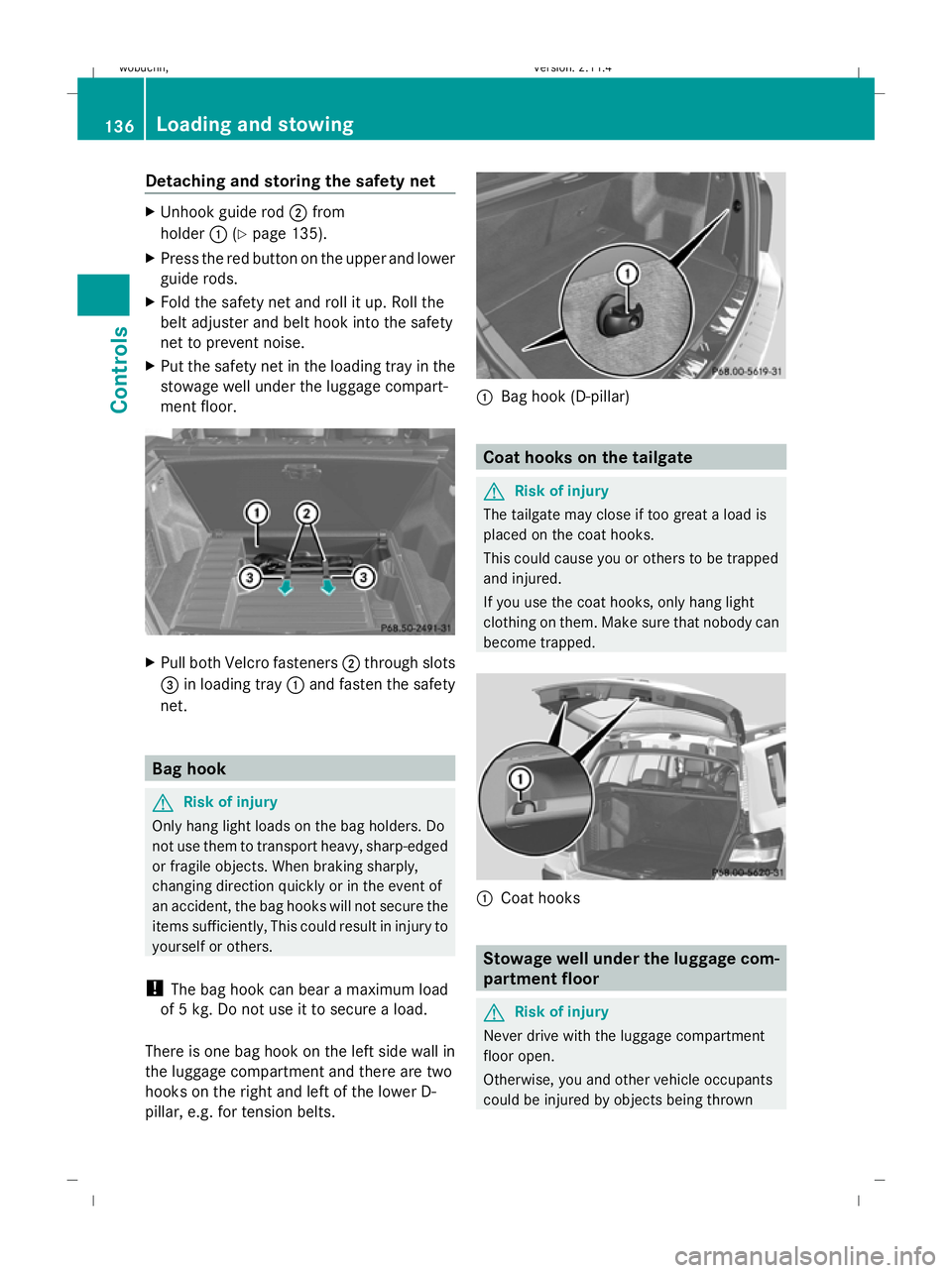
Detaching and storing the safety net
X
Unhook guide rod ;from
holder :(Ypage 135).
X Press the red button on the upper and lower
guide rods.
X Fold the safety net and roll it up. Roll the
belt adjuster and belt hook into the safety
net to prevent noise.
X Put the safety net in the loading tray in the
stowage well under the luggage compart-
ment floor. X
Pull both Velcro fasteners ;through slots
= in loading tray :and fasten the safety
net. Bag hook
G
Risk of injury
Only hang light loads on the bag holders. Do
not use them to transport heavy, sharp-edged
or fragile objects. When braking sharply,
changing direction quickly or in the event of
an accident, the bag hooks will not secure the
items sufficiently, This could result in injury to
yourself or others.
! The bag hook can bear a maximum load
of 5 kg. Do not use it to secure a load.
There is one bag hook on the left side wall in
the luggage compartment and there are two
hooks on the right and left of the lower D-
pillar, e.g. for tension belts. :
Bag hook (D-pillar) Coat hooks on the tailgate
G
Risk of injury
The tailgate may close if too great a load is
placed on the coat hooks.
This could cause you or others to be trapped
and injured.
If you use the coat hooks, only hang light
clothing on them. Make sure that nobody can
become trapped. :
Coat hooks Stowage well under the luggage com-
partment floor
G
Risk of injury
Never drive with the luggage compartment
floor open.
Otherwise, you and other vehicle occupants
could be injured by objects being thrown 136 Loading and stowingCont
rols
X204_AKB; 1; 5, en-GB
wobuchh, Version: 2.11.4 2008-10-15T13:20:56+02:00 - Seite 136Dateiname: 6515_0671_02_buchblock.pdf; preflight
Page 140 of 261

around the vehicle in the event of sharp brak-
ing, a sudden change in direction or an acci-
dent.
The safety net*, the ball coupling *, the col-
lapsible spare tyre* etc. are stowed beneath
the luggage compartment floor. X
To open: open the tailgate.
X Holding the ribbing, press handle :down-
wards ;.
Handle :folds upwards.
X Swing the luggage compartment floor
upwards using handle :until it rests
against the luggage compartment cover.
i A hook with a strap is attached to the
underside of the luggage compartment
floor. This hook can be used to attach the
luggage compartment floor to the roof for
easier loading and unloading of the stow-
age well beneath the luggage compartment
floor. The hook is a loading aid only, as the
stowage well beneath the luggage com-
partment floor must be closed while driv-
ing.
X To close: fold the luggage compartment
floor down.
X Press the luggage compartment floor
down ;until it engages. Roof rack system*
G
Risk of accident and injury
An incorrectly secured roof rack, ski rack or
load could become detached from the vehi-
cle. These objects may be thrown around and
can injure you or others, or cause an accident.
Follow the roof rack/ski rack manufacturer's
installation instructions and special instruc-
tions for use.
The roof load raises the vehicle's centre of
gravity, thereby affecting vehicle handling.
You must always observe the maximum roof
load of 75 kg. Always adapt your driving style
to the prevailing road, traffic and weather
conditions and drive with particular care if the
roof is laden.
! Mercedes-Benz recommends that you
only use roof rack systems which have
been tested and approved for Mercedes-
Benz vehicles. This helps to prevent dam-
age to the vehicle.
Position the load on the roof rack in such a
way that the vehicle will not sustain dam-
age even when it is in motion.
Ensure that, depending on the vehicle's
equipment, you can raise the panorama
sliding sunroof* fully and open the tailgate
fully.
X Secure the roof rack to the roof rails*.
Observe the manufacturer's installation
instructions. Features
Sun visors
G
Risk of accident
Keep the mirrors in the sun visors covered
while driving. Otherwise, you could be daz-
zled, impairing your view of traffic conditions.
As a result, you could cause an accident. Features
137Controls
* optional
X204_AKB; 1; 5, en-GB
wobuchh, Version: 2.11.4 2008-10-15T13:20:56+02:00 - Seite 137 ZDateiname: 6515_0671_02_buchblock.pdf; preflight
Page 178 of 261
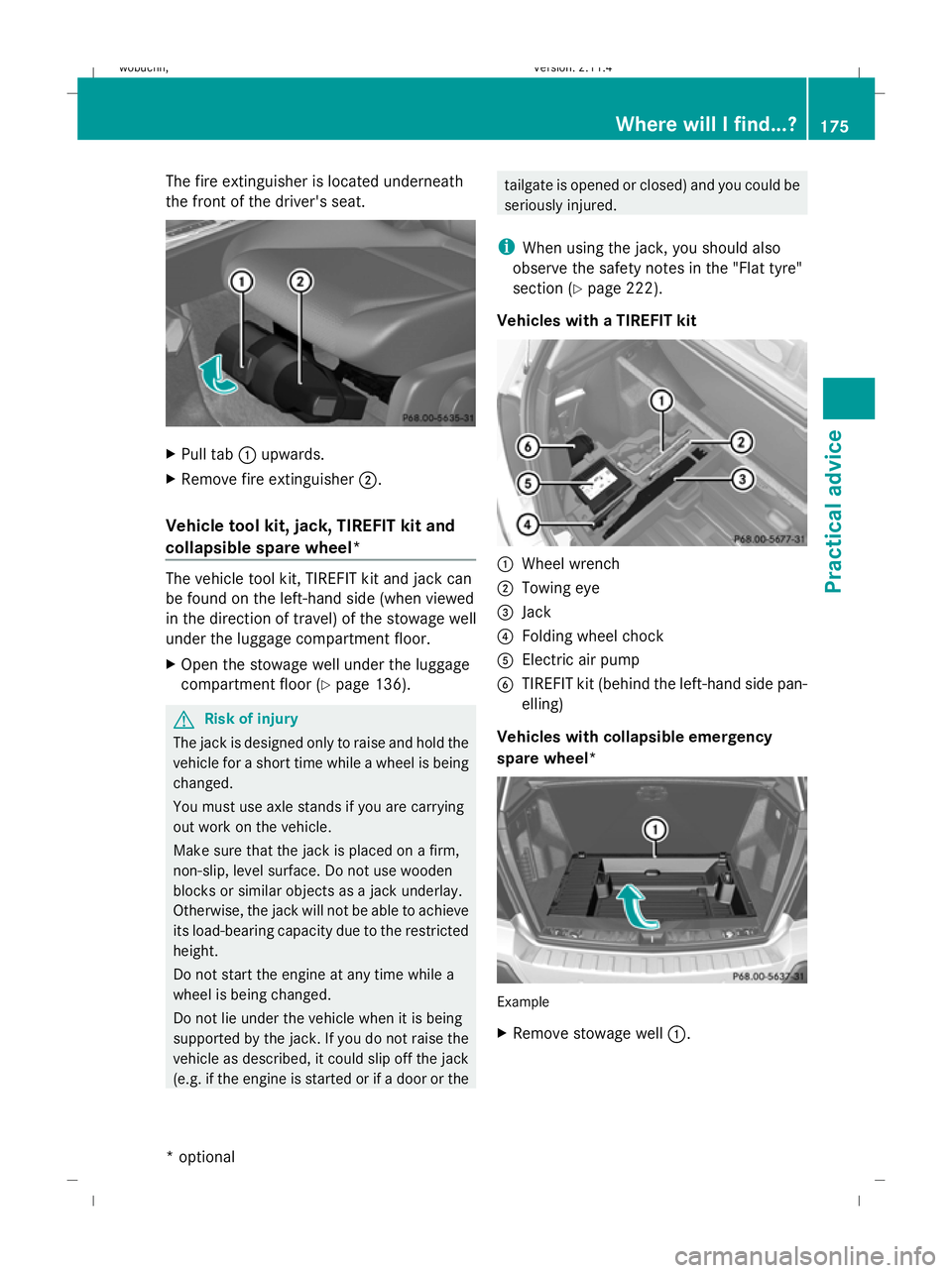
The fire extinguisher is located underneath
the front of the driver's seat.
X
Pull tab :upwards.
X Remove fire extinguisher ;.
Vehicle tool kit, jack, TIREFIT kit and
collapsible spare wheel* The vehicle tool kit, TIREFIT kit and jack can
be found on the left-hand side (when viewed
in the direction of travel) of the stowage well
under the luggage compartment floor.
X
Open the stowage well under the luggage
compartment floor (Y page 136). G
Risk of injury
The jack is designed only to raise and hold the
vehicle for a short time while a wheel is being
changed.
You must use axle stands if you are carrying
out work on the vehicle.
Make sure that the jack is placed on a firm,
non-slip, level surface. Do not use wooden
blocks or similar objects as a jack underlay.
Otherwise, the jack will not be able to achieve
its load-bearing capacity due to the restricted
height.
Do not start the engine at any time while a
wheel is being changed.
Do not lie under the vehicle when it is being
supported by the jack. If you do not raise the
vehicle as described, it could slip off the jack
(e.g. if the engine is started or if a door or the tailgate is opened or closed) and you could be
seriously injured.
i When using the jack, you should also
observe the safety notes in the "Flat tyre"
section (Y page 222).
Vehicles with a TIREFIT kit :
Wheel wrench
; Towing eye
= Jack
? Folding wheel chock
A Electric air pump
B TIREFIT kit (behind the left-hand side pan-
elling)
Vehicles with collapsible emergency
spare wheel* Example
X
Remove stowage well :. Where will I find...?
175Practical advice
* optional
X204_AKB; 1; 5, en-GB
wobuchh,
Version: 2.11.4
2008-10-15T13:20:56+02:00 - Seite 175 ZDateiname: 6515_0671_02_buchblock.pdf; preflight
Page 186 of 261
Benz recommends that you use a Mercedes-Benz Service Centre for this purpose. In particular,
work relevant to safety or on safety-related systems must be carried out at a qualified specialist
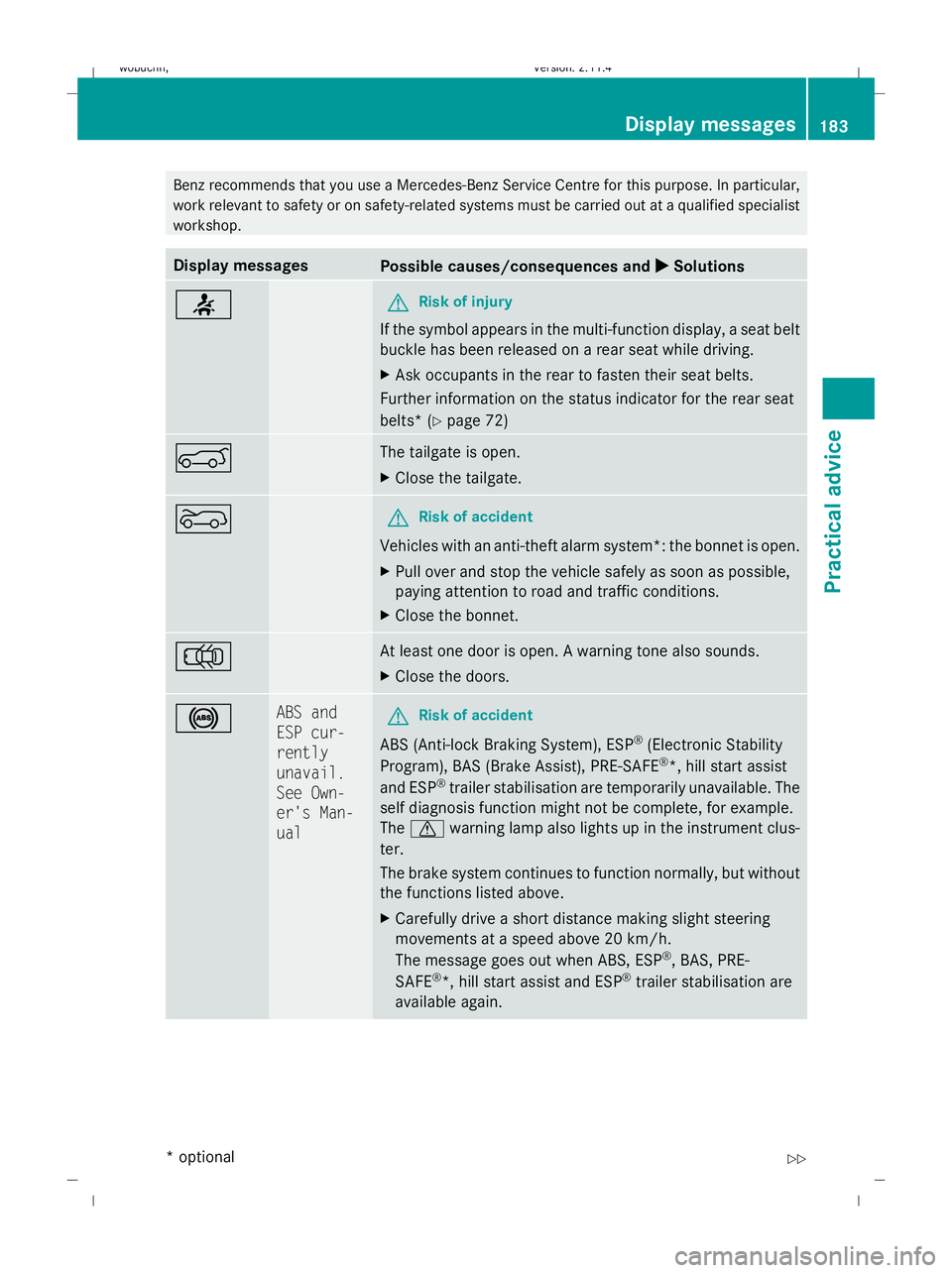
workshop. Display messages
Possible causes/consequences and
X
X Solutions 7 G
Risk of injury
If the symbol appears in the multi-function display, a seat belt
buckle has been released on a rear seat while driving.
X Ask occupants in the rear to fasten their seat belts.
Further information on the status indicator for the rear seat
belts* (Y page 72) A The tailgate is open.
X
Close the tailgate. ? G
Risk of accident
Vehicles with an anti-theft alarm system*: the bonnet is open.
X Pull over and stop the vehicle safely as soon as possible,
paying attention to road and traffic conditions.
X Close the bonnet. ; At least one door is open. A warning tone also sounds.
X
Close the doors. ! ABS and
ESP cur-
rently
unavail.
See Own-
er's Man-
ual
G
Risk of accident
ABS (Anti-lock Braking System), ESP ®
(Electronic Stability
Program), BAS (Brake Assist), PRE-SAFE ®
*, hill start assist
and ESP ®
trailer stabilisation are temporarily unavailable. The
self diagnosis function might not be complete, for example.
The d warning lamp also lights up in the instrument clus-
ter.
The brake system continues to function normally, but without
the functions listed above.
X Carefully drive a short distance making slight steering
movements at a speed above 20 km/h.
The message goes out when ABS, ESP ®
, BAS, PRE-
SAFE ®
*, hill start assist and ESP ®
trailer stabilisation are
available again. Display messages
183Practical advice
* optional
X204_AKB; 1; 5, en-GB
wobuchh
,V ersion: 2.11.4
2008-10-15T13:20:56+02:00 - Seite 183 ZDateiname: 6515_0671_02_buchblock.pdf; preflight
Page 209 of 261
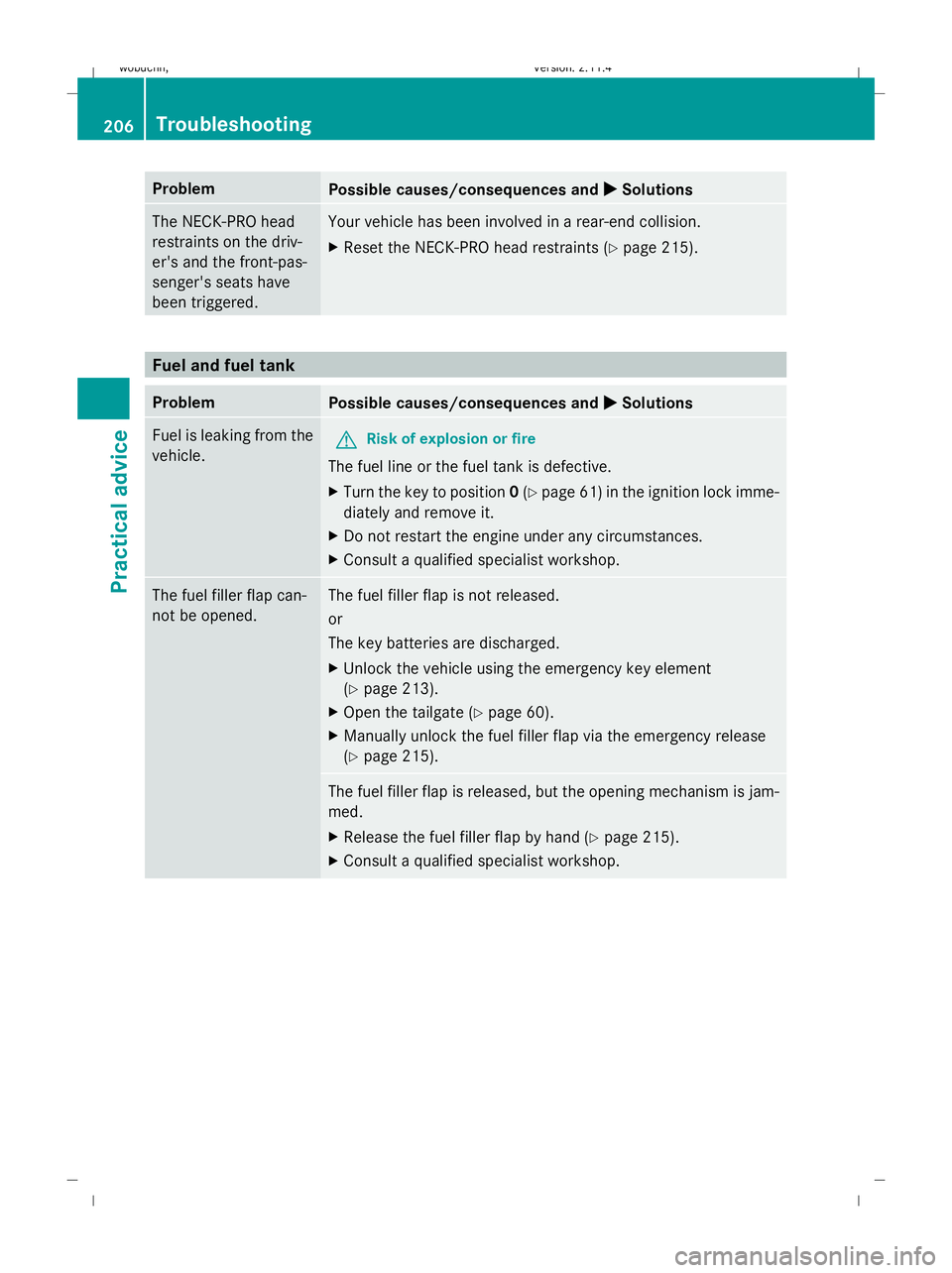
Problem
Possible causes/consequences and
X XSolutions The NECK-PRO head
restraints on the driv-
er's and the front-pas-
senger's seats have
been triggered. Your vehicle has been involved in a rear-end collision.
X
Reset the NECK-PRO head restraints (Y page 215).Fuel and fuel tank
Problem
Possible causes/consequences and
X XSolutions Fuel is leaking from the
vehicle.
G
Risk of explosion or fire
The fuel line or the fuel tank is defective.
X Turn the key to position 0(Y page 61) in the ignition lock imme-
diately and remove it.
X Do not restart the engine under any circumstances.
X Consult a qualified specialist workshop. The fuel filler flap can-
not be opened. The fuel filler flap is not released.
or
The key batteries are discharged.
X
Unlock the vehicle using the emergency key element
(Y page 213).
X Open the tailgate (Y page 60).
X Manually unlock the fuel filler flap via the emergency release
(Y page 215). The fuel filler flap is released, but the opening mechanism is jam-
med.
X
Release the fuel filler flap by hand (Y page 215).
X Consult a qualified specialist workshop. 206 TroubleshootingPractical advice
X204_AKB; 1; 5, en-GB
wobuchh,
Version: 2.11.4 2008-10-15T13:20:56+02:00 - Seite 206Dateiname: 6515_0671_02_buchblock.pdf; preflight
Page 217 of 261
X
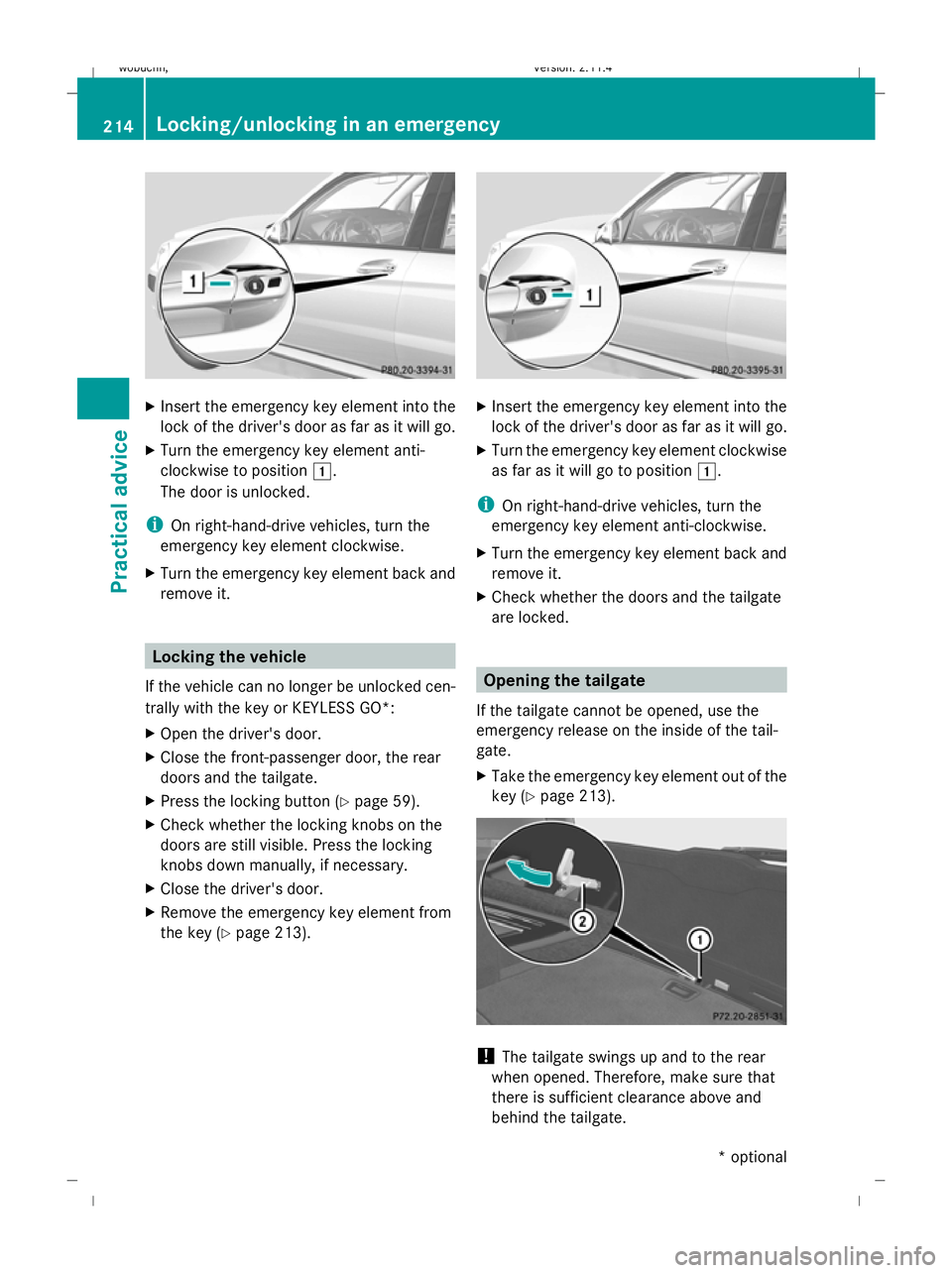
Insert the emergency key element into the
lock of the driver's door as far as it will go.
X Turn the emergency key element anti-
clockwise to position 1.
The door is unlocked.
i On right-hand-drive vehicles, turn the
emergency key element clockwise.
X Turn the emergency key element back and
remove it. Locking the vehicle
If the vehicle can no longer be unlocked cen-
trally with the key or KEYLESS GO*:
X Open the driver's door.
X Close the front-passenger door, the rear
doors and the tailgate.
X Press the locking button (Y page 59).
X Check whether the locking knobs on the
doors are still visible. Press the locking
knobs down manually, if necessary.
X Close the driver's door.
X Remove the emergency key element from
the key (Y page 213). X
Insert the emergency key element into the
lock of the driver's door as far as it will go.
X Turn the emergency key element clockwise
as far as it will go to position 1.
i On right-hand-drive vehicles, turn the
emergency key element anti-clockwise.
X Turn the emergency key element back and
remove it.
X Check whether the doors and the tailgate
are locked. Opening the tailgate
If the tailgate cannot be opened, use the
emergency release on the inside of the tail-
gate.
X Take the emergency key element out of the
key (Y page 213). !
The tailgate swings up and to the rear
when opened. Therefore, make sure that
there is sufficient clearance above and
behind the tailgate. 214 Locking/unlocking in an emergencyPractical advice
* optional
X204_AKB; 1; 5, en-GB
wobuchh,
Version: 2.11.4 2008-10-15T13:20:56+02:00 - Seite 214Dateiname: 6515_0671_02_buchblock.pdf; preflight
Page 218 of 261
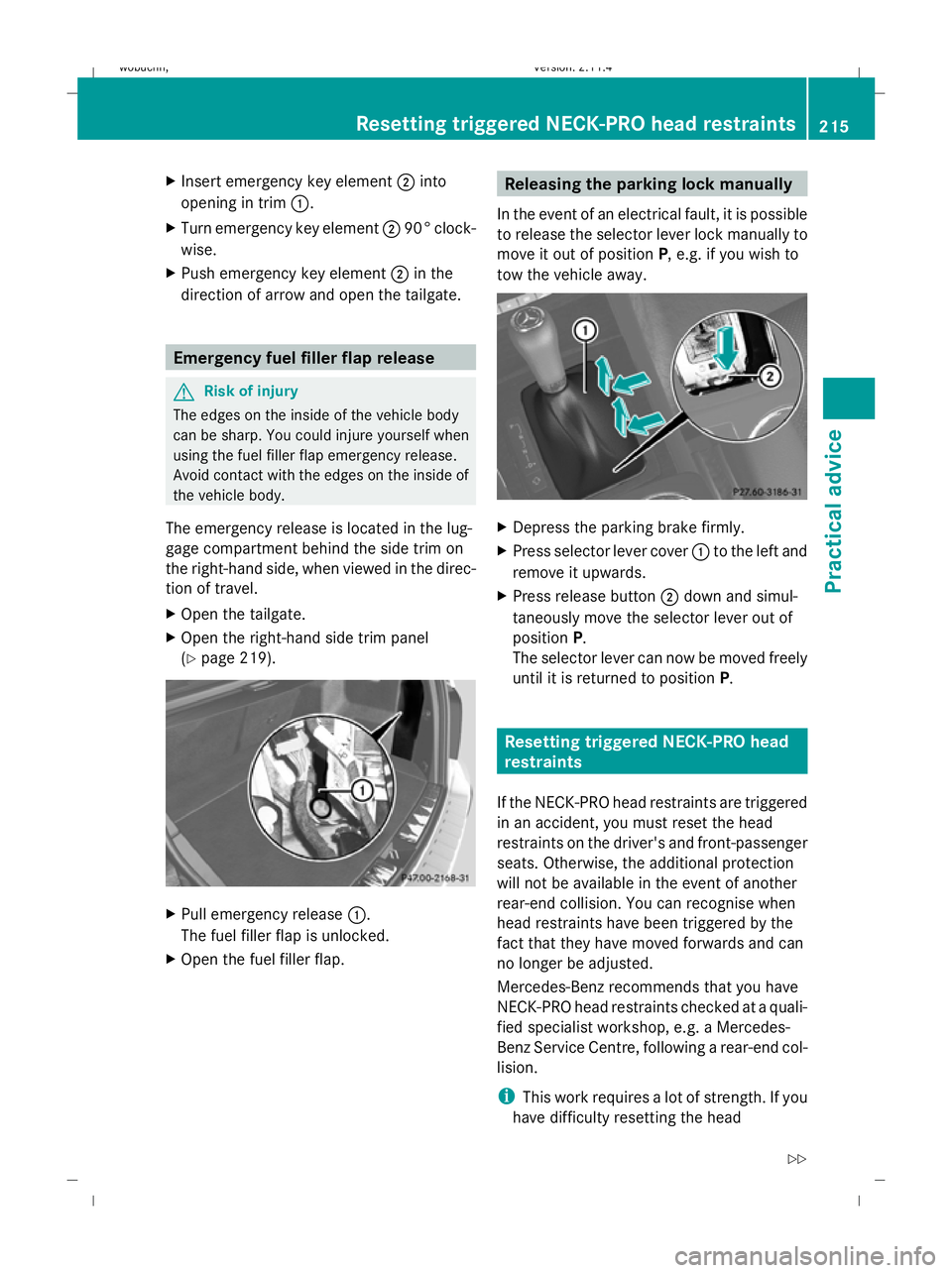
X
Insert emergency key element ;into
opening in trim :.
X Turn emergency key element ;90° clock-
wise.
X Push emergency key element ;in the
direction of arrow and open the tailgate. Emergency fuel filler flap release
G
Risk of injury
The edges on the inside of the vehicle body
can be sharp. You could injure yourself when
using the fuel filler flap emergency release.
Avoid contact with the edges on the inside of
the vehicle body.
The emergency release is located in the lug-
gage compartment behind the side trim on
the right-hand side, when viewed in the direc-
tion of travel.
X Open the tailgate.
X Open the right-hand side trim panel
(Y page 219). X
Pull emergency release :.
The fuel filler flap is unlocked.
X Open the fuel filler flap. Releasing the parking lock manually
In the event of an electrical fault, it is possible
to release the selector lever lock manually to
move it out of position P, e.g. if you wish to
tow the vehicle away. X
Depress the parking brake firmly.
X Press selector lever cover :to the left and
remove it upwards.
X Press release button ;down and simul-
taneously move the selector lever out of
position P.
The selector lever can now be moved freely
until it is returned to position P. Resetting triggered NECK-PRO head
restraints
If the NECK-PRO head restraints are triggered
in an accident, you must reset the head
restraints on the driver's and front-passenger
seats. Otherwise, the additional protection
will not be available in the event of another
rear-end collision. You can recognise when
head restraints have been triggered by the
fact that they have moved forwards and can
no longer be adjusted.
Mercedes-Benz recommends that you have
NECK-PRO head restraints checked at a quali-
fied specialist workshop, e.g. a Mercedes-
Benz Service Centre, following a rear-end col-
lision.
i This work requires a lot of strength. If you
have difficulty resetting the head Resetting triggered NECK-PRO head restraints
215Practical advice
X204_AKB; 1; 5, en-GB
wobuchh,Version: 2.11.4 2008-10-15T13:20:56+02:00 - Seite 215 ZDateiname: 6515_0671_02_buchblock.pdf; preflight
Page 223 of 261
X
To close: insert side trim panel ;and turn
catch :90° in the opposite direction to
the arrow.
Changing the tail lamps X
Switch off the lights.
X Open the luggage compartment.
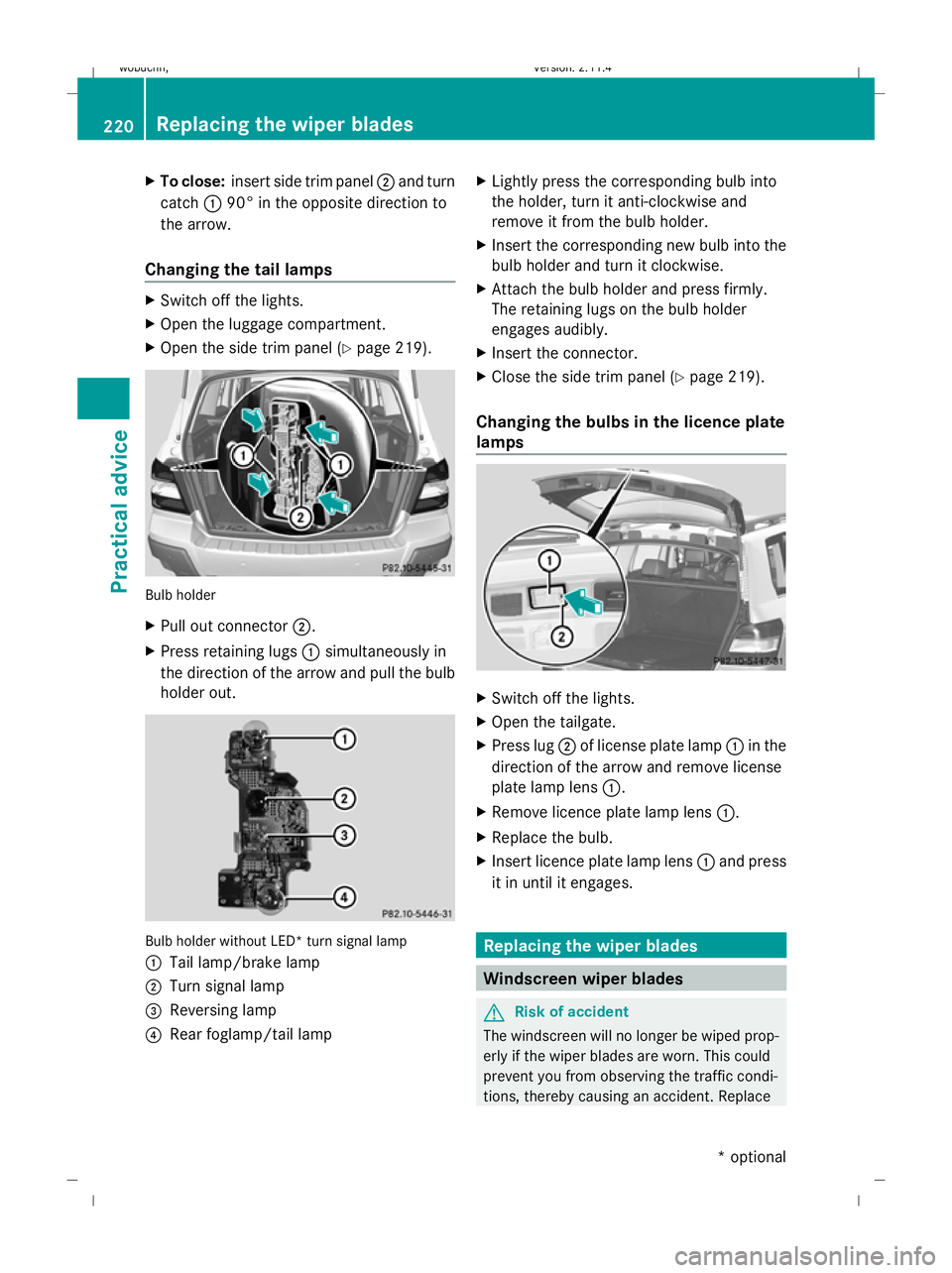
X Open the side trim panel (Y page 219).Bulb holder
X
Pull out connector ;.
X Press retaining lugs :simultaneously in
the direction of the arrow and pull the bulb
holder out. Bulb holder without LED* turn signal lamp
: Tail lamp/brake lamp
; Turn signal lamp
= Reversing lamp
? Rear foglamp/tail lamp X
Lightly press the corresponding bulb into
the holder, turn it anti-clockwise and
remove it from the bulb holder.
X Insert the corresponding new bulb into the
bulb holder and turn it clockwise.
X Attach the bulb holder and press firmly.
The retaining lugs on the bulb holder
engages audibly.
X Insert the connector.
X Close the side trim panel (Y page 219).
Changing the bulbs in the licence plate
lamps X
Switch off the lights.
X Open the tailgate.
X Press lug ;of license plate lamp :in the
direction of the arrow and remove license
plate lamp lens :.
X Remove licence plate lamp lens :.
X Replace the bulb.
X Insert licence plate lamp lens :and press
it in until it engages. Replacing the wiper blades
Windscreen wiper blades
G
Risk of accident
The windscreen will no longer be wiped prop-
erly if the wiper blades are worn. This could
prevent you from observing the traffic condi-
tions, thereby causing an accident. Replace 220 Replacing the wiper bladesPractical advice
* optional
X204_AKB; 1; 5, en-GB
wobuchh
,V ersion: 2.11.4
2008-10-15T13:20:56+02:00 - Seite 220 Dateiname: 6515_0671_02_buchblock.pdf; preflight
Page 231 of 261
X
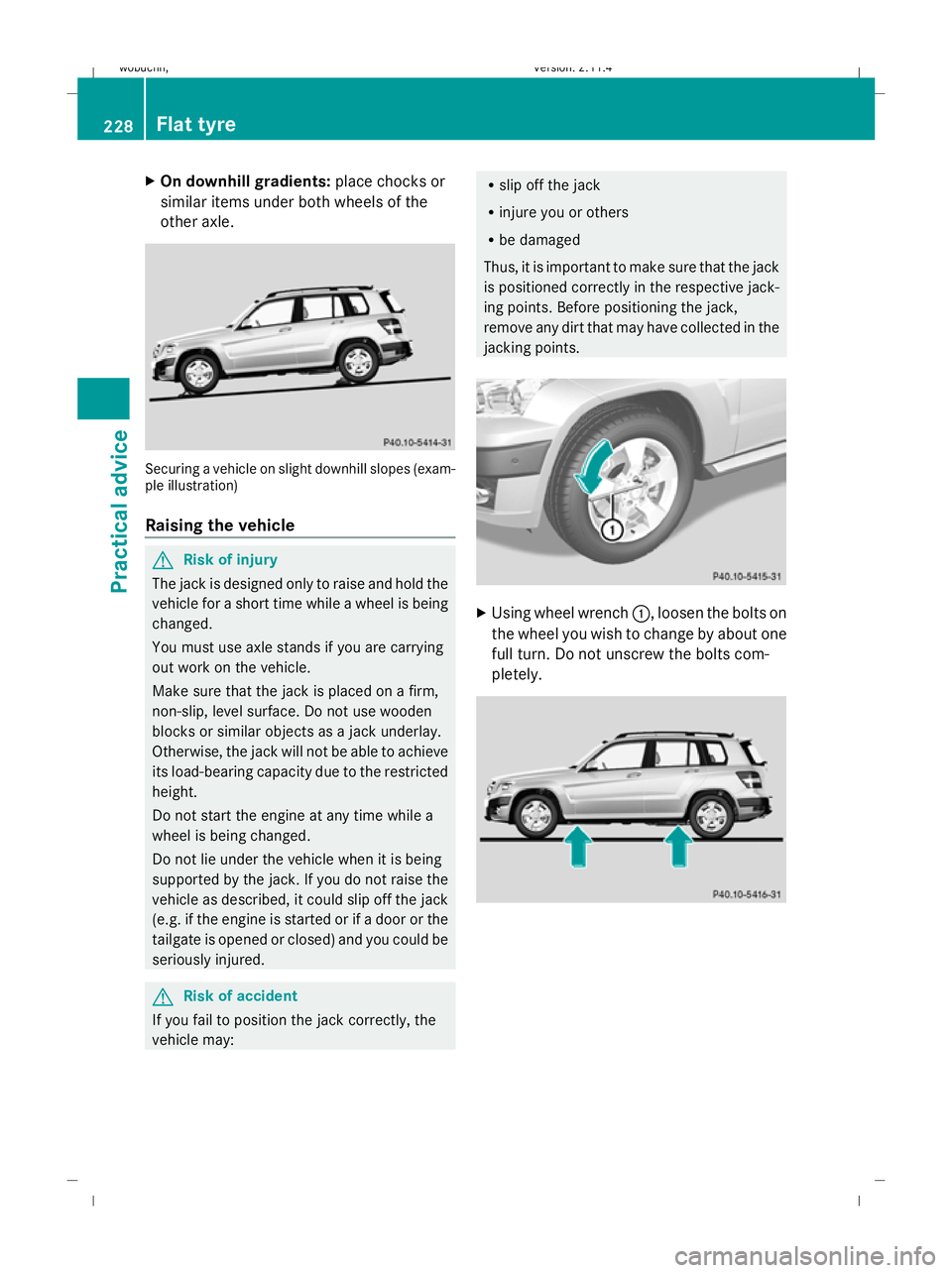
On downhill gradients: place chocks or
similar items under both wheels of the
other axle. Securing a vehicle on slight downhill slopes (exam-
ple illustration)
Raising the vehicle G
Risk of injury
The jack is designed only to raise and hold the
vehicle for a short time while a wheel is being
changed.
You must use axle stands if you are carrying
out work on the vehicle.
Make sure that the jack is placed on a firm,
non-slip, level surface. Do not use wooden
blocks or similar objects as a jack underlay.
Otherwise, the jack will not be able to achieve
its load-bearing capacity due to the restricted
height.
Do not start the engine at any time while a
wheel is being changed.
Do not lie under the vehicle when it is being
supported by the jack. If you do not raise the
vehicle as described, it could slip off the jack
(e.g. if the engine is started or if a door or the
tailgate is opened or closed) and you could be
seriously injured. G
Risk of accident
If you fail to position the jack correctly, the
vehicle may: R
slip off the jack
R injure you or others
R be damaged
Thus, it is important to make sure that the jack
is positioned correctly in the respective jack-
ing points. Before positioning the jack,
remove any dirt that may have collected in the
jacking points. X
Using wheel wrench 1, loosen the bolts on
the wheel you wish to change by about one
full turn. Do not unscrew the bolts com-
pletely. 228 Flat tyrePractical advice
X204_AKB; 1; 5, en-GB
wobuchh,
Version: 2.11.4 2008-10-15T13:20:56+02:00 - Seite 228Dateiname: 6515_0671_02_buchblock.pdf; preflight
Page 243 of 261
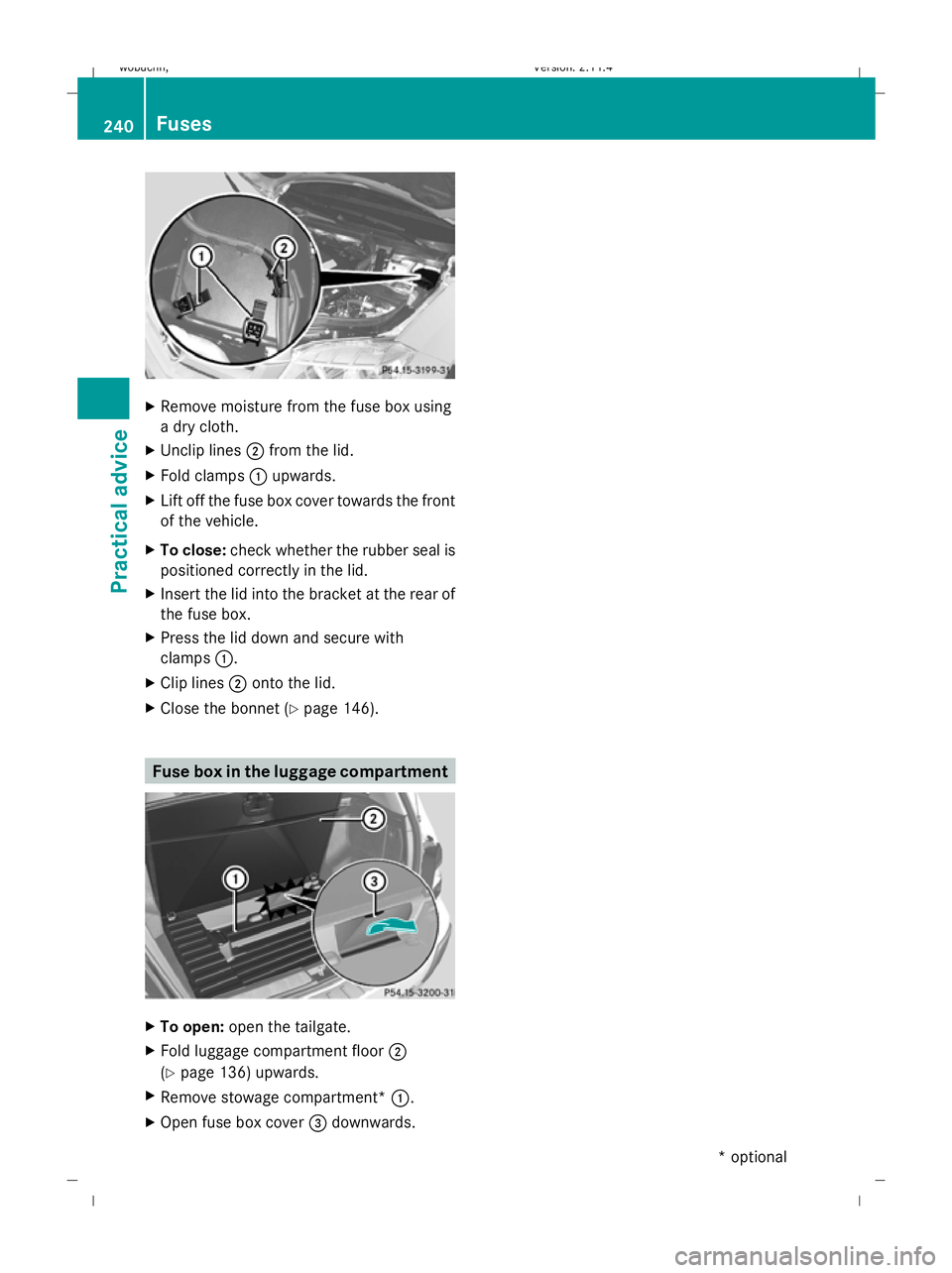
X
Remove moisture from the fuse box using
a dry cloth.
X Unclip lines ;from the lid.
X Fold clamps :upwards.
X Lift off the fuse box cover towards the front
of the vehicle.
X To close: check whether the rubber seal is
positioned correctly in the lid.
X Insert the lid into the bracket at the rear of
the fuse box.
X Press the lid down and secure with
clamps :.
X Clip lines ;onto the lid.
X Close the bonnet (Y page 146). Fuse box in the luggage compartment
X
To open: open the tailgate.
X Fold luggage compartment floor ;
(Y page 136) upwards.
X Remove stowage compartment* :.
X Open fuse box cover =downwards. 240 FusesPractical advice
* optional
X204_AKB; 1; 5, en-GB
wobuchh,
Version: 2.11.4 2008-10-15T13:20:56+02:00 - Seite 240Dateiname: 6515_0671_02_buchblock.pdf; preflight