technical data MERCEDES-BENZ GLK SUV 2008 User Guide
[x] Cancel search | Manufacturer: MERCEDES-BENZ, Model Year: 2008, Model line: GLK SUV, Model: MERCEDES-BENZ GLK SUV 2008Pages: 261, PDF Size: 8.67 MB
Page 155 of 261
Direction of rotation
Tyres with a specified direction of rotation
have additional benefits, e.g. if there is a risk
of aquaplaning. You will only gain these ben-
efits if the correct direction of rotation is
observed.
An arrow on the sidewall of the tyre indicates
its correct direction of rotation.
i An emergency spare wheel* may also be
fitted against the direction of rotation. Tyre tread
G
Risk of accident
Bear in mind that:
R tyre grip decreases rapidly on wet roads
when the tread depth is less than 3 mm.
Thus, you should replace tyres that have
insufficient tread.
R winter tyres should be replaced when the
tread depth is 4 mm or less as they will no
longer provide adequate grip.
R the tread on a tyre may not wear evenly.
Thus, you should regularly check the tread
depth and the condition of the tread across
the entire width of all tyres. If necessary,
turn the steering wheel so that you can see
the tyre tread more easily.
Otherwise, you could lose control of the vehi-
cle and cause an accident due to the reduced
grip of the tyres on the road. Tyre pressures
i You will find a table of tyre pressures for
various operating conditions on the inside
of your vehicle's fuel filler flap.
The valid value for the "Minispare" emer-
gency spare wheel* is stated on the spare
wheel and in the technical data section. G
Risk of accident
Tyre pressure that is either too high or too low
has a negative effect on the vehicle’s driving
safety, which could lead you to cause an acci-
dent. Therefore, you should regularly check
the pressure of all the tyres, particularly prior
to long trips, and correct the pressure as nec-
essary.
To test tyre pressure, use a suitable pressure
gauge. The outer appearance of a tyre does
not permit any reliable conclusion about the
tyre pressure. G
Risk of accident
Should the tyre pressure drop repeatedly:
R check the tyre for foreign bodies.
R check whether the wheel is losing air or the
valve is leaking.
R make sure that only a valve cap approved
by Mercedes-Benz has been fitted on the
tyre valve.
Tyre pressure that is too low has a negative
effect on the vehicle’s active safety, which
could lead to your causing an accident.
If possible, you should only correct tyre pres-
sures when the tyres are cold. Depending on
the ambient temperature, the speed you are
driving at and the load on the tyres, the tyre
temperature and thus the tyre pressure may
change by approximately 0.1 bar per 10 °C.
Take this into account when checking the
pressure of warm tyres and only correct it if
it is too low for the current operating condi-
tions.
Driving with tyre pressure that is too high or
too low can:
R shorten the service life of the tyres
R increase the likelihood of tyre damage
R have a negative effect on handling charac-
teristics (e.g. by causing aquaplaning) 152 Ty
res and wheelsOperation
* optional
X204_AKB; 1; 5, en-GB
wobuchh
,V ersion: 2.11.4
2008-10-15T13:20:56+02:00 - Seite 152 Dateiname: 6515_0671_02_buchblock.pdf; preflight
Page 167 of 261
removed, remove the ball coupling and clean
it.
If the ball coupling can still not be fitted
(locked) after it has been cleaned, remove the
ball coupling. The trailer coupling must then
not be used to tow a trailer, as safe operation
is not guaranteed.
Have the entire trailer coupling checked at a
qualified specialist workshop. Mercedes-
Benz recommends that you use a Mercedes-
Benz Service Centre for this purpose. In par-
ticular, work relevant to safety or on safety-
related systems must be carried out at a quali-
fied specialist workshop. Notes on towing a trailer
G
Risk of accident
When reversing the vehicle towards the
trailer, make sure there is nobody between
the trailer and the vehicle.
Couple and uncouple the trailer carefully. If
you do not couple the trailer to the towing
vehicle correctly, the trailer could become
detached.
Make sure that the following values are not
exceeded:
R the permissible trailer drawbar noseweight
R the permissible trailer load
R the permissible rear axle load of the towing
vehicle
R the maximum permissible gross vehicle
weight of both the towing vehicle and the
trailer
You will find the applicable permissible val-
ues, which must not be exceeded, in the vehi-
cle documents.
You will find the values approved by the man-
ufacturer on the vehicle identification plates
and those for the towing vehicle in the "Tech-
nical data" section. You will find installation dimensions and loads
in the "Technical data" section
(Y page 253).
The maximum drawbar load of the trailer
drawbar on the ball coupling is 80 kg. How-
ever, the actual noseweight must not exceed
the value given on the trailer coupling and
trailer identification plates. The lowest weight
applies.
! Use a noseweight as close as possible to
the maximum permissible noseweight. Do
not use a noseweight of less than 50 kg,
otherwise the trailer may come loose.
Bear in mind that the payload and the rear
axle load are reduced by the actual nose-
weight.
i The height of the ball coupling changes
with the load of the vehicle. If necessary,
use a trailer with a height-adjustable trailer
drawbar.
Coupling up a trailer G
Risk of injury
Do not disconnect a trailer with an engaged
overrun brake. Otherwise, your hand could
become trapped between the bumper and
trailer drawbar.
! Do not disconnect a trailer with an
engaged overrun brake. Otherwise, your
vehicle could be damaged by the rebound-
ing of the overrun brake.
X Position the trailer level behind the vehicle.
X Couple up the trailer.
X Establish the electrical connection
between the vehicle and the trailer.
Driving tips i
Observe the notes on ESP ®
trailer stabi-
lisation (Y page 53).
In Germany, the maximum permitted speed
for vehicle/trailer combinations is 80 km/h. 164
Trailer towing*Operation
* optional
X204_AKB; 1; 5, en-GB
wobuchh,
Version: 2.11.4 2008-10-15T13:20:56+02:00 - Seite 164Dateiname: 6515_0671_02_buchblock.pdf; preflight
Page 244 of 261
Notes on the technical data.............242
Genuine Mercedes-Benz parts .........242
Vehicle electronics ...........................243
Vehicle identification plates ............244
Service products and capacities .....245
Vehicle data, GLK 280 4MATIC ........249
Vehicle data, GLK 350 4MATIC ........249
Vehicle data, GLK 320 CDI 4MATIC .250
Tyres and wheels .............................. 251
Trailer coupling* ............................... 253
241
Technical data
X204_AKB; 1; 5, en-GB
wobuchh, Version: 2.11.4
2008-10-15T13:20:56+02:00 - Seite 241 Dateiname: 6515_0671_02_buchblock.pdf; preflight
Page 245 of 261
Notes on the technical data
i The technical data was determined in
accordance with EU directives. All data
applies to the vehicle's standard equip-
ment. Therefore, the data may differ for
vehicles with optional equipment. You can
obtain further information from a
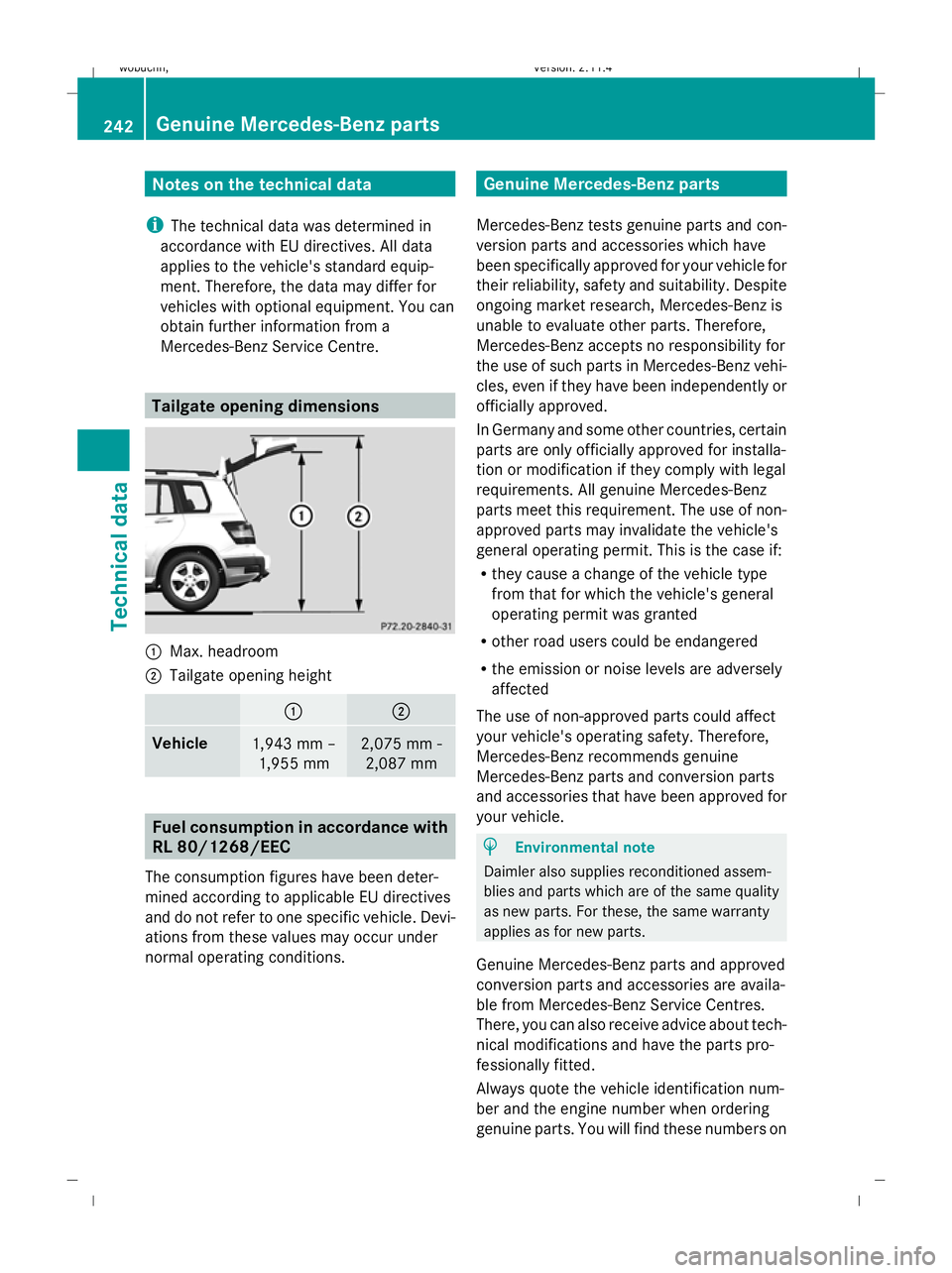
Mercedes-Benz Service Centre. Tailgate opening dimensions
:
Max. headroom
; Tailgate opening height : ;
Vehicle
1,943 mm –
1,955 mm 2,075 mm -
2,087 mm Fuel consumption in accordance with
RL 80/1268/EEC
The consumption figures have been deter-
mined according to applicable EU directives
and do not refer to one specific vehicle. Devi-
ations from these values may occur under
normal operating conditions. Genuine Mercedes-Benz parts
Mercedes-Benz tests genuine parts and con-
version parts and accessories which have
been specifically approved for your vehicle for
their reliability, safety and suitability. Despite
ongoing market research, Mercedes-Benz is
unable to evaluate other parts. Therefore,
Mercedes-Benz accepts no responsibility for
the use of such parts in Mercedes-Benz vehi-
cles, even if they have been independently or
officially approved.
In Germany and some other countries, certain
parts are only officially approved for installa-
tion or modification if they comply with legal
requirements. All genuine Mercedes-Benz
parts meet this requirement. The use of non-
approved parts may invalidate the vehicle's
general operating permit. This is the case if:
R they cause a change of the vehicle type
from that for which the vehicle's general
operating permit was granted
R other road users could be endangered
R the emission or noise levels are adversely
affected
The use of non-approved parts could affect
your vehicle's operating safety. Therefore,
Mercedes-Benz recommends genuine
Mercedes-Benz parts and conversion parts
and accessories that have been approved for
your vehicle. H
Environmental note
Daimler also supplies reconditioned assem-
blies and parts which are of the same quality
as new parts. For these, the same warranty
applies as for new parts.
Genuine Mercedes-Benz parts and approved
conversion parts and accessories are availa-
ble from Mercedes-Benz Service Centres.
There, you can also receive advice about tech-
nical modifications and have the parts pro-
fessionally fitted.
Always quote the vehicle identification num-
ber and the engine number when ordering
genuine parts. You will find these numbers on 242 Genuine Mercedes-Benz partsTechnical data
X204_AKB; 1; 5, en-GB
wobuchh
,V ersion: 2.11.4
2008-10-15T13:20:56+02:00 - Seite 242 Dateiname: 6515_0671_02_buchblock.pdf; preflight
Page 247 of 261
Frequency range Maximum trans-
mission output
(watts)
Short wave
(<50 MHz) 100
4 m waveband 20
2 m waveband 50
70 cm waveband 35
25 cm waveband 10
!
If electrical or electronic equipment
which does not comply with the above
installation conditions is operated inside
the vehicle, the vehicle's operating permit
may be invalidated (EU Directive
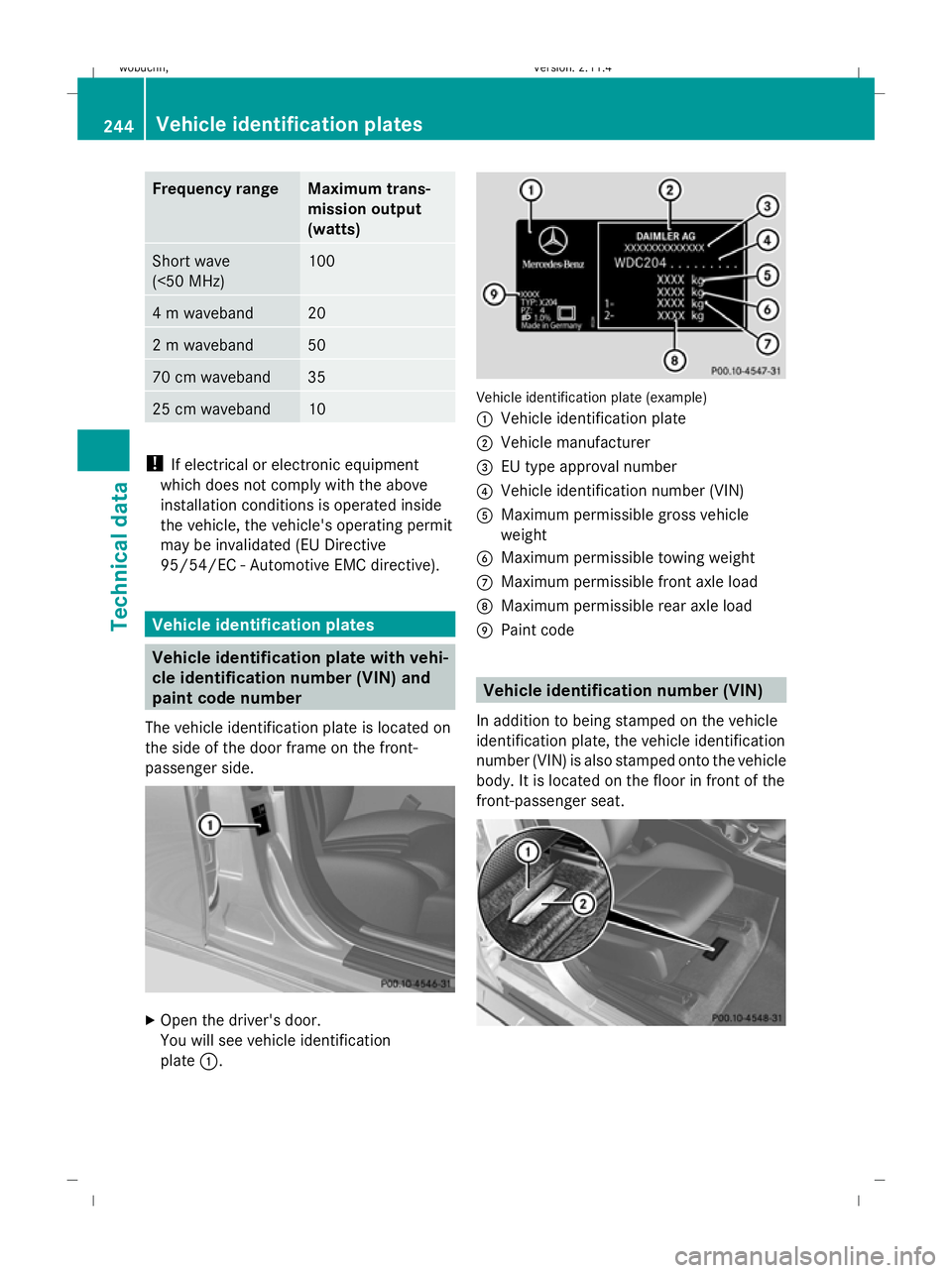
95/54/EC - Automotive EMC directive). Vehicle identification plates
Vehicle identification plate with vehi-
cle identification number (VIN) and
paint code number
The vehicle identification plate is located on
the side of the door frame on the front-
passenger side. X
Open the driver's door.
You will see vehicle identification
plate :. Vehicle identification plate (example)
: Vehicle identification plate
; Vehicle manufacturer
= EU type approval number
? Vehicle identification number (VIN)
A Maximum permissible gross vehicle
weight
B Maximum permissible towing weight
C Maximum permissible front axle load
D Maximum permissible rear axle load
E Paint code Vehicle identification number (VIN)
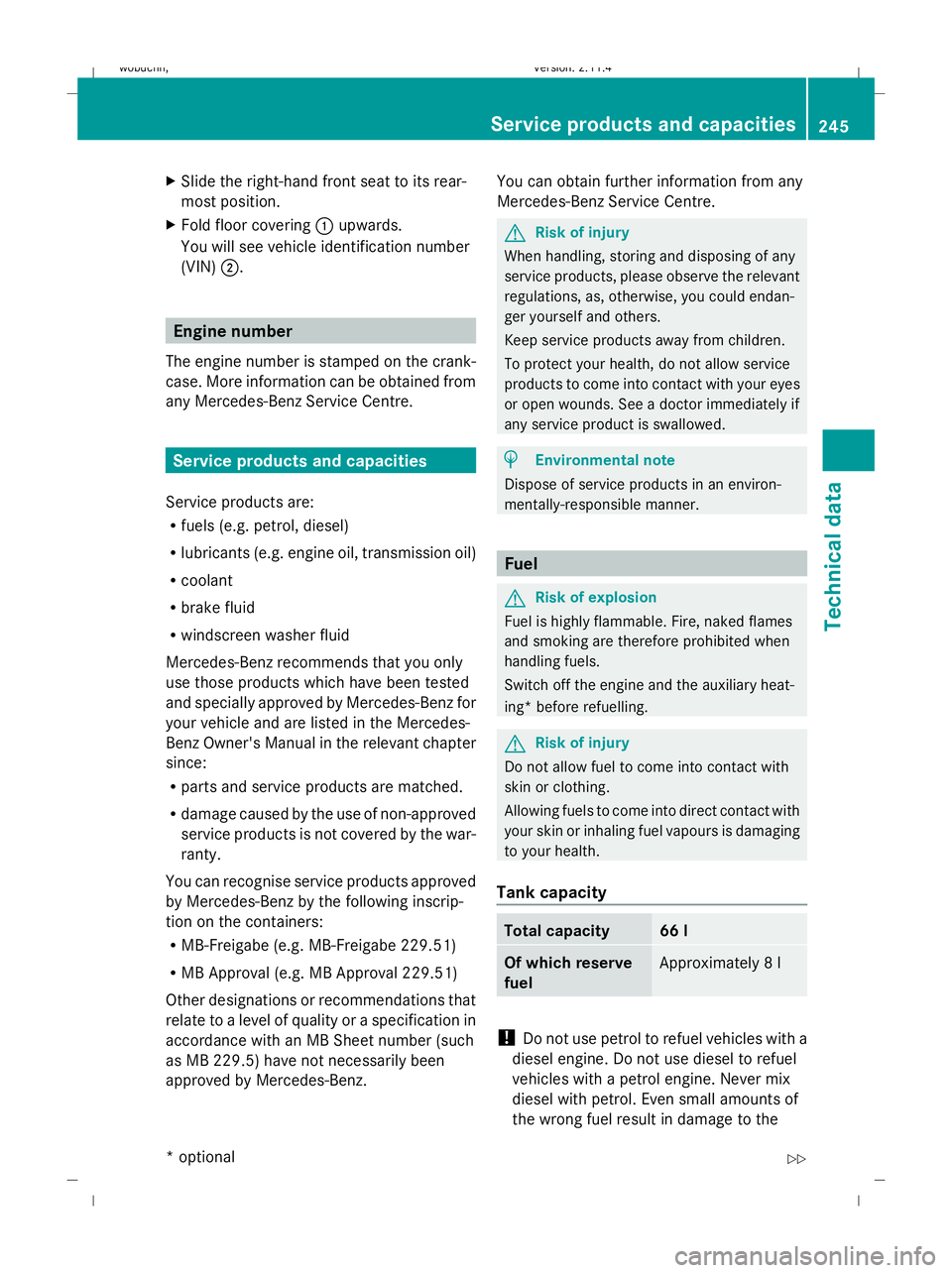
In addition to being stamped on the vehicle
identification plate, the vehicle identification
number (VIN) is also stamped onto the vehicle
body. It is located on the floor in front of the
front-passenger seat. 244 Vehicle identification platesTechnical data
X204_AKB; 1; 5, en-GB
wobuchh,
Version: 2.11.4 2008-10-15T13:20:56+02:00 - Seite 244Dateiname: 6515_0671_02_buchblock.pdf; preflight
Page 248 of 261
X
Slide the right-hand front seat to its rear-
most position.
X Fold floor covering :upwards.
You will see vehicle identification number
(VIN) ;. Engine number
The engine number is stamped on the crank-
case. More information can be obtained from
any Mercedes-Benz Service Centre. Service products and capacities
Service products are:
R fuels (e.g. petrol, diesel)
R lubricants (e.g. engine oil, transmission oil)
R coolant
R brake fluid
R windscreen washer fluid
Mercedes-Benz recommends that you only
use those products which have been tested
and specially approved by Mercedes-Benz for
your vehicle and are listed in the Mercedes-
Benz Owner's Manual in the relevant chapter
since:
R parts and service products are matched.
R damage caused by the use of non-approved
service products is not covered by the war-
ranty.
You can recognise service products approved
by Mercedes-Benz by the following inscrip-
tion on the containers:
R MB-Freigabe (e.g. MB-Freigabe 229.51)
R MB Approval (e.g. MB Approval 229.51)
Other designations or recommendations that
relate to a level of quality or a specification in
accordance with an MB Sheet number (such
as MB 229.5) have not necessarily been
approved by Mercedes-Benz. You can obtain further information from any
Mercedes-Benz Service Centre. G
Risk of injury
When handling, storing and disposing of any
service products, please observe the relevant
regulations, as, otherwise, you could endan-
ger yourself and others.
Keep service products away from children.
To protect your health, do not allow service
products to come into contact with your eyes
or open wounds. See a doctor immediately if
any service product is swallowed. H
Environmental note
Dispose of service products in an environ-
mentally-responsible manner. Fuel
G
Risk of explosion
Fuel is highly flammable. Fire, naked flames
and smoking are therefore prohibited when
handling fuels.
Switch off the engine and the auxiliary heat-
ing* before refuelling. G
Risk of injury
Do not allow fuel to come into contact with
skin or clothing.
Allowing fuels to come into direct contact with
your skin or inhaling fuel vapours is damaging
to your health.
Tank capacity Total capacity 66 l
Of which reserve
fuel
Approximately 8 l
!
Do not use petrol to refuel vehicles with a
diesel engine. Do not use diesel to refuel
vehicles with a petrol engine. Never mix
diesel with petrol. Even small amounts of
the wrong fuel result in damage to the Service products and capacities
245Technical data
* optional
X204_AKB; 1; 5, en-GB
wobuchh,
Version: 2.11.4 2008-10-15T13:20:56+02:00 - Seite 245 ZDateiname: 6515_0671_02_buchblock.pdf; preflight
Page 249 of 261
injection system. Damage resulting from
adding the wrong fuel is not covered by the
warranty.
Further information on refuelling and on fuels
(Y page 144).
Notes on fuel consumption The vehicle will use more fuel than usual in
the following situations:
R at very low temperatures
R in urban traffic
R on short trips
R when towing a trailer
R in mountainous terrain
The consumption figures have been deter-
mined in accordance with EU Directive
RL 80 /1268 /EEC.
i Only for certain countries: the respective
current consumption and emission values
of your vehicle can be found in the COC
papers (EC CERTIFICATE OF CONFORM-
ITY). These documents are supplied when
the vehicle is delivered.
! Do not use any special additives, as they
can cause malfunctions and engine dam-
age. Damage resulting from the use of such
additives is not covered by the Mercedes-
Benz warranty. H
Environmental note
CO 2(carbon dioxide) is the gas which scien-
tists believe to be principally responsible for global warming (the greenhouse effect). Your
vehicle's CO
2emissions are directly related
to fuel consumption and therefore depend on:
R efficient use of the fuel by the engine
R driving style
R other non-technical factors, such as envi-
ronmental influences or road conditions
You can minimise your vehicle's CO 2emis-
sions by driving carefully and having it serv-
iced regularly. Engine oil
Only Mercedes-Benz approved engine oils
may be used in Mercedes-Benz engines.
A list of the engine oils tested and approved
in accordance with the Mercedes-Benz Spec-
ifications for Service Products can be called
up by visiting http:\\bevo.daimler.co m and
en tering the MB Sheet number. Further infor-
mation on tested and approved engine oils
can be obtained from any Mercedes-Benz
Service Centre. Engine oils which have been
approved by Mercedes-Benz have the MB
Sheet number indicated on the oil container
under the "MB approval" notice. The table
shows which MB Sheet number applies to
which engine: GLK 280 4MATIC
GLK 350 4MATIC GLK 320 CDI
4MATIC GLK 320 CDI
4MATIC 33 MB Sheet number
229.3/229.5 229.31/229.51 229.3/229.31
229.5/229.51
i
In the event that the:
33 Vehicles without diesel particle filter. 246 Service products and capacitiesTechnical data
X204_AKB; 1; 5, en-GB
wobuchh
,V ersion: 2.11.4
2008-10-15T13:20:56+02:00 - Seite 246 Dateiname: 6515_0671_02_buchblock.pdf; preflight
Page 250 of 261
R
engine oil brand
R grade (MB Sheet number)
R SAE classification (viscosity)
is not available, you can use another min-
eral or synthetic engine oil which has been
approved by Mercedes-Benz. You must
then have an oil change carried out at the
earliest possible opportunity.
Mixing oils reduces the benefits of high-
grade engine oil.
! Do not use lubricant additives as they can
lead to increased wear and damage to
mechanical assemblies. The use of lubri-
cant additives will result in a restriction of
your warranty.
! Engine oils for vehicles without a diesel
particle filter may also be used temporarily
in vehicles with a diesel particle filter if the
engine oil listed is not available. You must
then have an oil change carried out as soon
as possible.
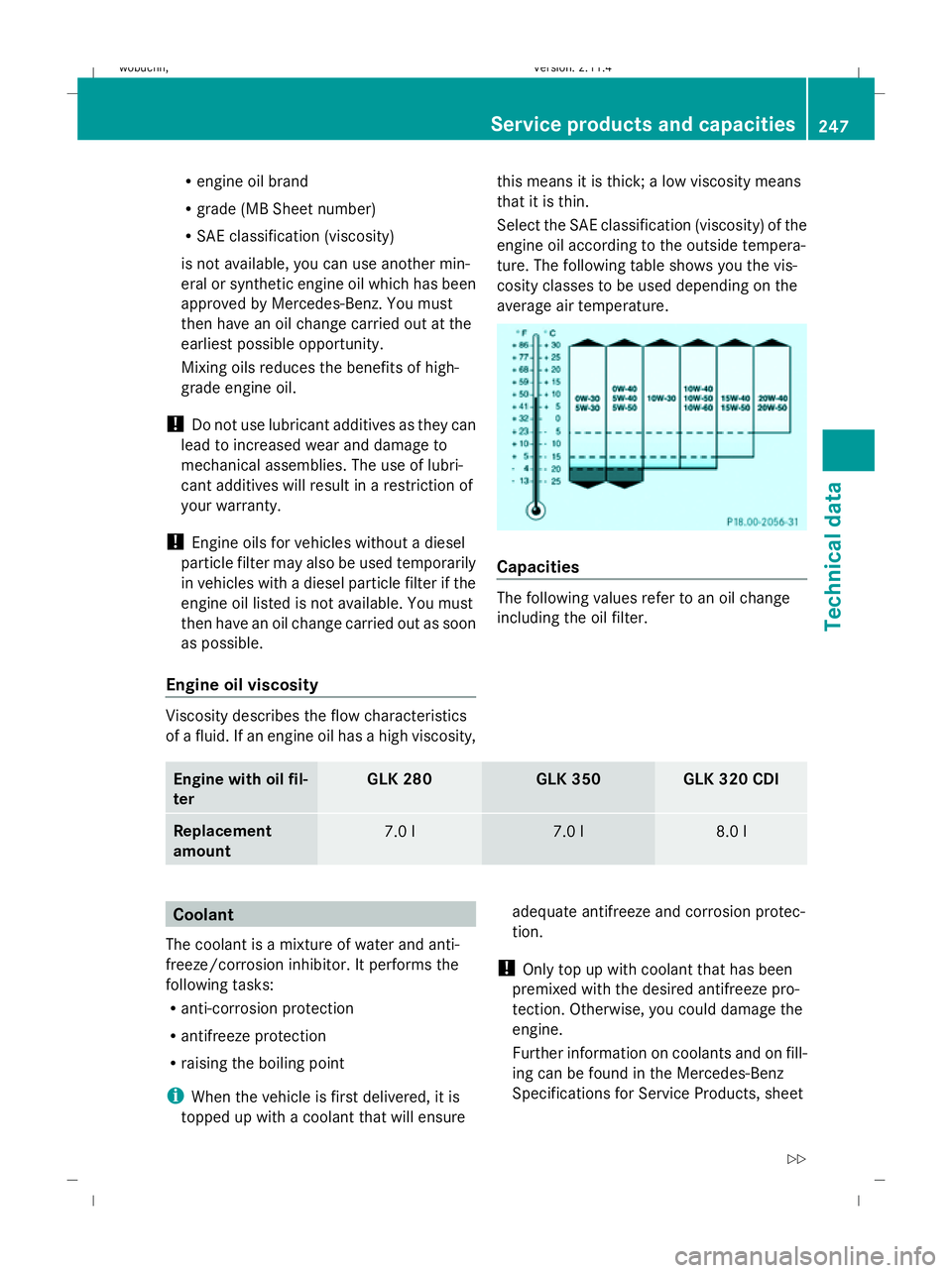
Engine oil viscosity Viscosity describes the flow characteristics
of a fluid. If an engine oil has a high viscosity, this means it is thick; a low viscosity means
that it is thin.
Select the SAE classification (viscosity) of the
engine oil according to the outside tempera-
ture. The following table shows you the vis-
cosity classes to be used depending on the
average air temperature. Capacities
The following values refer to an oil change
including the oil filter.
Engine with oil fil-
ter GLK 280 GLK 350 GLK 320 CDI
Replacement
amount
7.0 l 7.0 l 8.0 l
Coolant
The coolant is a mixture of water and anti-
freeze/corrosion inhibitor. It performs the
following tasks:
R anti-corrosion protection
R antifreeze protection
R raising the boiling point
i When the vehicle is first delivered, it is
topped up with a coolant that will ensure adequate antifreeze and corrosion protec-
tion.
! Only top up with coolant that has been
premixed with the desired antifreeze pro-
tection. Otherwise, you could damage the
engine.
Further information on coolants and on fill-
ing can be found in the Mercedes-Benz
Specifications for Service Products, sheet Service products and capacities
247Technical data
X204_AKB; 1; 5, en-GB
wobuchh, Version: 2.11.4 2008-10-15T13:20:56+02:00 - Seite 247 ZDateiname: 6515_0671_02_buchblock.pdf; preflight
Page 251 of 261
310.1, or at any Mercedes-Benz Service
Centre.
! Always use a suitable coolant mixture,
even in countries where high temperatures
prevail.
Otherwise, the cooling system will not be
sufficiently protected from corrosion, and
the boiling point will be too low.
If antifreeze/corrosion inhibitor is present in
the correct concentration, the boiling point of
the coolant will be around 130 °C.
The antifreeze/corrosion inhibitor concentra-
tion in the cooling system should:
R be at least 50%. This will protect the cooling
system against freezing down to around
–37 °C.
R not exceed 55% concentration (antifreeze
protection down to –45 °C); otherwise,
heat will not be effectively dissipated. If the vehicle has lost coolant, top it up with
equal amounts of water and antifreeze/cor-
rosion inhibitor. Mercedes-Benz recom-
mends an antifreeze/corrosion inhibitor
which has been approved for Mercedes-Benz.
!
The cooling system contains a supply
which must be renewed after 15 years, or
after 250, 000 km at the latest.
The warranty is only valid if you top up with
an antifreeze/corrosion inhibitor which
has been approved by Mercedes-Benz and
the recommended mixture ratio is
observed.
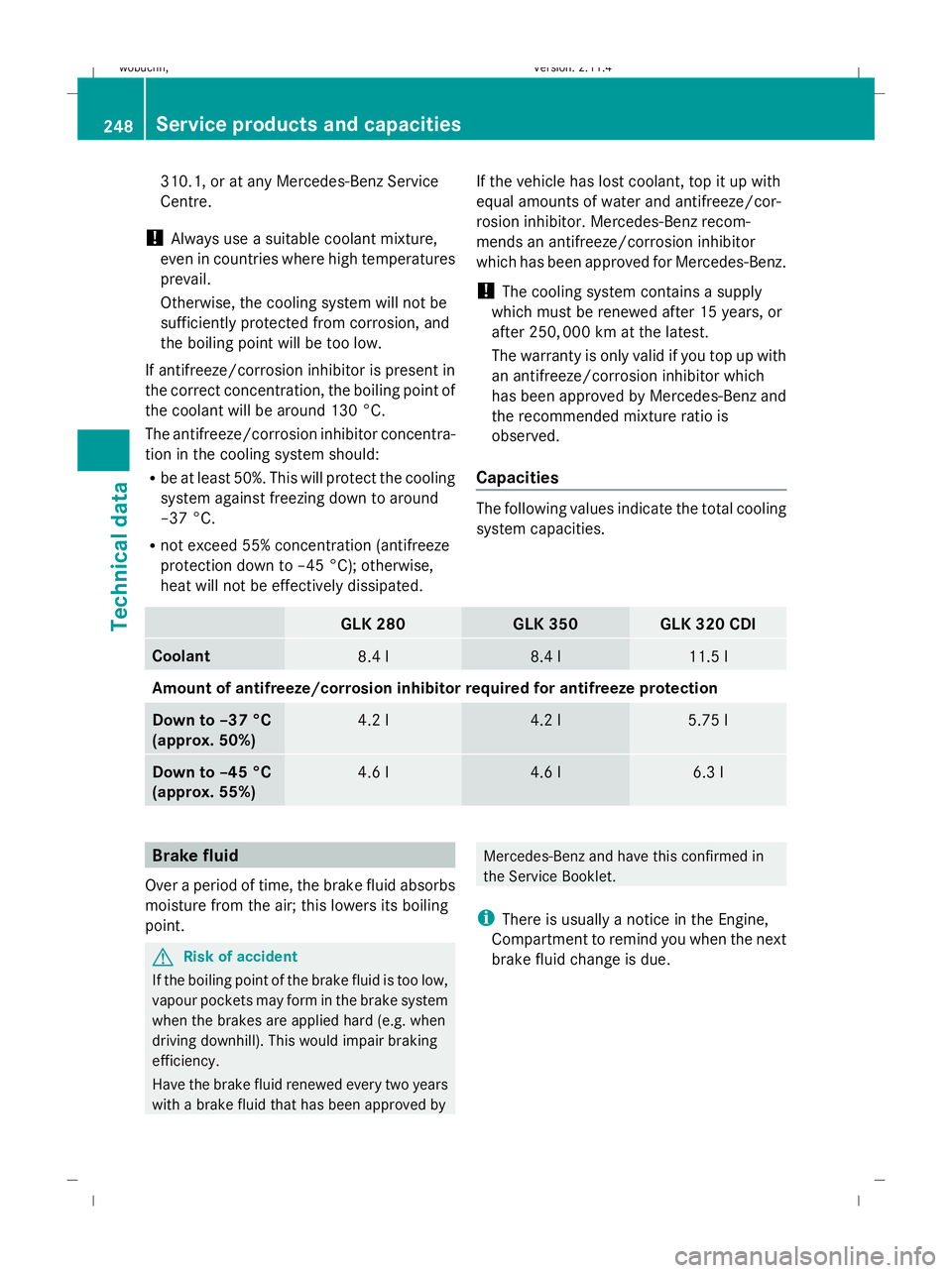
Capacities The following values indicate the total cooling
system capacities.
GLK 280 GLK 350 GLK 320 CDI
Coolant
8.4 l 8.4 l 11.5 l
Amount of antifreeze/corrosion inhibitor required for antifreeze protection
Down to –37 °C
(approx. 50%)
4.2 l 4.2 l 5.75 l
Down to –45 °C
(approx. 55%)
4.6 l 4.6 l 6.3 l
Brake fluid
Over a period of time, the brake fluid absorbs
moisture from the air; this lowers its boiling
point. G
Risk of accident
If the boiling point of the brake fluid is too low,
vapour pockets may form in the brake system
when the brakes are applied hard (e.g. when
driving downhill). This would impair braking
efficiency.
Have the brake fluid renewed every two years
with a brake fluid that has been approved by Mercedes-Benz and have this confirmed in
the Service Booklet.
i There is usually a notice in the Engine,
Compartment to remind you when the next
brake fluid change is due. 248 Service products and capacitiesTechnical data
X204_AKB; 1; 5, en-GB
wobuchh,
Version: 2.11.4 2008-10-15T13:20:56+02:00 - Seite 248Dateiname: 6515_0671_02_buchblock.pdf; preflight
Page 252 of 261
Windscreen washer system
The washer fluid reservoir holds approxi-
mately 6.0 litres.
The headlamp cleaning system* and wind-
screen washer system are both supplied from
the washer fluid reservoir.
Further information on windscreen washer
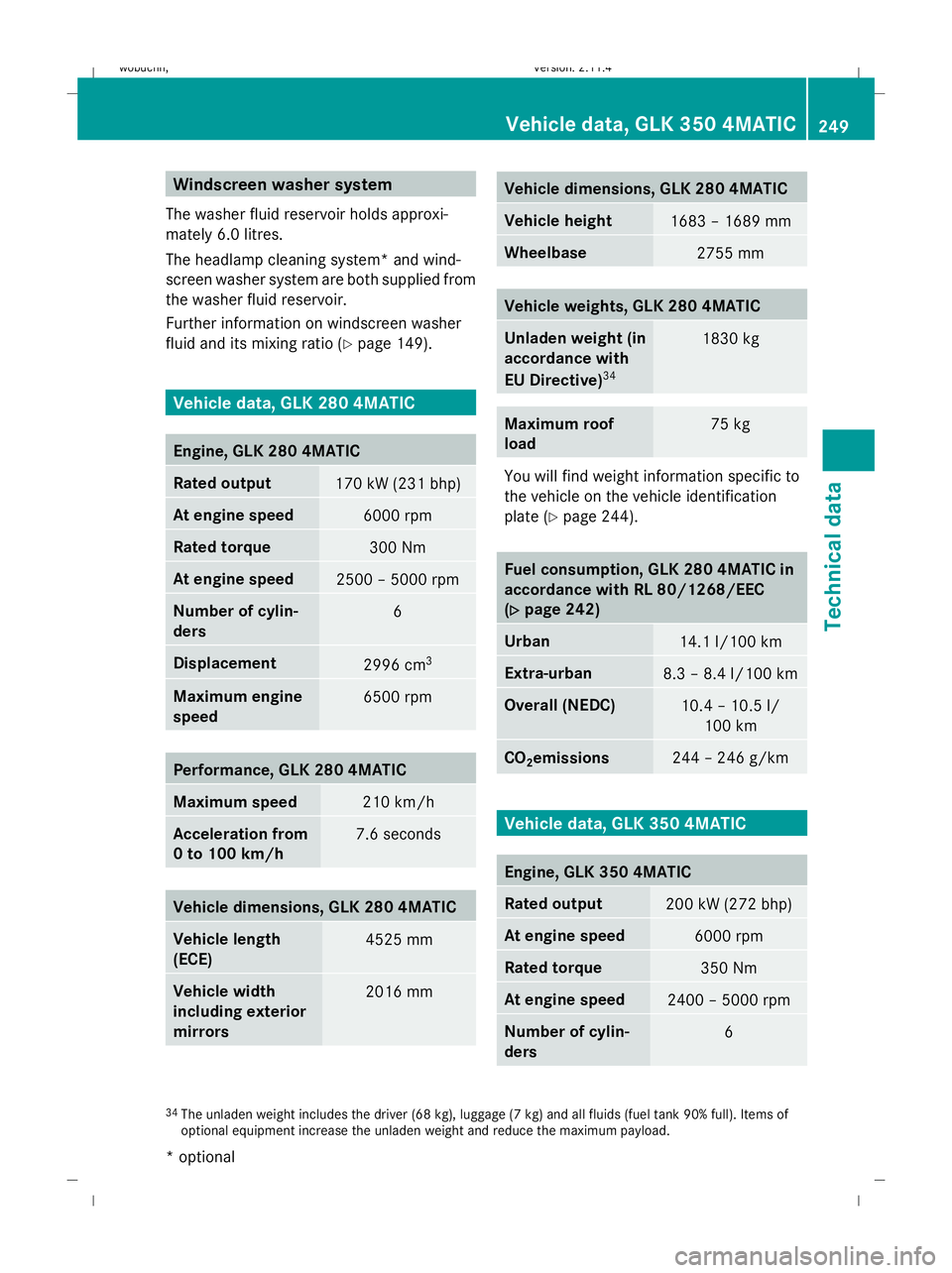
fluid and its mixing ratio (Y page 149).Vehicle data, GLK 280 4MATIC
Engine, GLK 280 4MATIC
Rated output
170 kW (231 bhp)
At engine speed
6000 rpm
Rated torque
300 Nm
At engine speed
2500 – 5000 rpm
Number of cylin-
ders
6
Displacement
2996 cm
3 Maximum engine
speed
6500 rpm
Performance, GLK 280 4MATIC
Maximum speed
210 km/h
Acceleration from
0 to 100 km/h
7.6 seconds
Vehicle dimensions, GLK 280 4MATIC
Vehicle length
(ECE)
4525 mm
Vehicle width
including exterior
mirrors
2016 mm Vehicle dimensions, GLK 280 4MATIC
Vehicle height
1683 – 1689 mm
Wheelbase
2755 mm
Vehicle weights, GLK 280 4MATIC
Unladen weight (in
accordance with
EU Directive)
34 1830 kg
Maximum roof
load
75 kg
You will find weight information specific to
the vehicle on the vehicle identification
plate (Y
page 244). Fuel consumption, GLK 280 4MATIC in
accordance with RL 80/1268/EEC
(Y
Y page 242) Urban
14.1 l/100 km
Extra-urban
8.3 – 8.4 l/100 km
Overall (NEDC)
10.4 – 10.5 l/
100 km CO
2emissions 244 – 246 g/km
Vehicle data, GLK 350 4MATIC
Engine, GLK 350 4MATIC
Rated output
200 kW (272 bhp)
At engine speed
6000 rpm
Rated torque
350 Nm
At engine speed
2400 – 5000 rpm
Number of cylin-
ders
6
34
The unladen weight includes the driver (68 kg), luggage (7 kg) and all fluids (fuel tank 90% full). Items of
optional equipment increase the unladen weight and reduce the maximum payload. Vehicle data, GLK 350 4MATIC
249Technical data
* optional
X204_AKB; 1; 5, en-GB
wobuchh,
Version: 2.11.4 2008-10-15T13:20:56+02:00 - Seite 249 ZDateiname: 6515_0671_02_buchblock.pdf; preflight