run flat MERCEDES-BENZ GLK SUV 2008 Owners Manual
[x] Cancel search | Manufacturer: MERCEDES-BENZ, Model Year: 2008, Model line: GLK SUV, Model: MERCEDES-BENZ GLK SUV 2008Pages: 261, PDF Size: 8.67 MB
Page 10 of 261
Door
Automatic locking. ............................ 59
Display message (luxury multi-
function steering wheel) .........183, 196
Display message (multi-function
steering wheel). ......................181, 183
Emergency locking .........................214
Emergency unlocking...................... 213
Opening (from the inside). ................58
Door control panel
Overview. .......................................... 32
Drinks holder
see Cup holder
Drive program
Manual.. ............................................ 88
Driver's airbag...................................... 38
Driver's knee airbag............................. 39
Driver's seat position........................... 73
Driving abroad.................................... 162
Driving information Fording .................................. 157, 161
Off-road .......................................... 158
Tyre ruts. ........................................ 162
Driving safety system.......................... 51
ABS. .................................................. 51
Adaptive brake lamps. ......................52
BAS. .................................................. 52
EBV. .................................................. 54
Driving safety systems
ESP ®
................................................ 52
Driving system................................... 108
Cruise control. ................................ 108
Parktronic. ...................................... 113
Speedtronic. ................................... 110
Driving systems
Reversing camera. ..........................115
Driving tip
Braking ........................................... 156
Trailer towing. ................................. 164
Winter ............................................. 156
Driving tips
Driving abroad ............................... 162
Driving on wet roads ......................157
DSR (Downhill Speed Regulation) ....105
DSR (Downhill Speed Regulation)
(vehicles with off-road engineering
package).............................................. 105 E
Easy-entry/exit feature On-board computer (luxury multi-
function steering wheel) .................104
EASY-ENTRY feature............................. 67
EASY-EXIT feature................................ 67
EBV (electronic brake force distri-
bution)................................................... 54
Display message (luxury multi-
function steering wheel) .................185
Display message (multi-function
steering wheel). .............................. 179
Electrical/electronic equipment
Retrofitting ..................................... 243
Electronic brake-force distribution
see EBV
Electronic Stability Program
see ESP ®
Electronic Traction Support see ETS
e mark................................................. 243
Emergency key element Lost. ............................................... 212
Emergency locking
Vehicle............................................ 214
Emergency release
Fuel filler fla p.................................. 215
Emergency running mode
Automatic transmission ..................209
Emergency spare wheel
Assembly. ....................................... 227
Storage location. ............................ 175
see Flat tyre
Emergency unlocking
Tailgate ........................................... 214
Vehicle............................................ 213
Engine.................................................. 249
Running irregularl y.......................... 208
Starting problems ...................207, 208
Starting with the key......................... 83
Switching off ..................................... 85
Engine diagnostics warning lamp
............................................................. 203
Engine electronics .............................. 243
Malfunction..................................... 207
Engine number................................... 245 Index
7 X204_AKB; 1; 5, en-GB
wobuchh,
Version: 2.11.4
2008-10-15T13:20:56+02:00 - Seite 7 Dateiname: 6515_0671_02_buchblock.pdf; preflight
Page 38 of 261
Never tamper with electronic components
and their software.
SRS (Supplemental Restraint System)
The SRS reduces the risk of occupants com-
ing into contact with the vehicle's interior in
the event of an accident. It can also reduce
the forces to which occupants are subjected
during an accident.
The SRS consists of:
R the 6 SRS warning lamp
R belt tensioners
R belt force limiters
R airbags
The 6 6SRS warning lamp The SRS functions are checked regularly
when you turn on the ignition and when the
engine is running. Therefore, malfunctions
can be detected in good time.
The
6 warning lamp in the instrument
cluster lights up when the ignition is switched
on. It goes out no later than a few seconds
after the engine is started. G
Risk of injury
If SRS is malfunctioning, individual systems
may be activated unintentionally or not be
deployed in the event of an accident with
heavy braking.
A malfunction has occurred if the 6warn-
ing lamp:
R does not light up when you switch on the
ignition
R does not go out after the engine has been
running for a few seconds
R lights up again once the engine is running
In this case, have SRS checked immediately
at a qualified specialist workshop. Triggering of belt tensioners, belt force
limiters and airbags In the event of a collision, the sensor in the
airbag control unit evaluates important phys-
ical data such as duration, direction and force
of the vehicle deceleration or acceleration.
Based on the evaluation of this data and
depending on the vehicle's rate of longitudi-
nal deceleration in a collision, in the first
stage the airbag control unit pre-emptively
triggers the belt tensioners.
i
The front belt tensioners can only be trig-
gered if the belt tongue is correctly
engaged in the seat belt buckle.
The front airbags are only deployed if there is
an even higher rate of vehicle deceleration in
a longitudinal direction.
Your vehicle has adaptive, dual stage front
airbags. When the first activation threshold is
reached, the front airbag is filled with enough
propellant gas to reduce the risk of injuries.
The front airbag is only fully inflated if a sec-
ond threshold is reached within a few milli-
seconds, due to the control unit having detec-
ted further deceleration.
Criteria for triggering belt tensioners and
airbags
In the first stage of a collision, the airbag con-
trol unit evaluates the duration and direction
of vehicle acceleration or deceleration in
order to determine whether it is necessary to
trigger the belt tensioner and/or airbag.
The belt tensioner and airbag triggering
thresholds are variable and are adapted to the
rate of deceleration of the vehicle. This proc-
ess is pre-emptive in nature as the airbag
must be deployed during – and not at the end
of – the collision.
i Airbags are not deployed in all types of
accidents. They are controlled by complex
sensor technology and evaluation logic.
This process is pre-emptive in nature as
airbag deployment must take place during
the impact and must be adapted to provide Occupant safety
35Safety
X204_AKB; 1; 5, en-GB
wobuchh,V ersion: 2.11.4
2008-10-15T13:20:56+02:00 - Seite 35 ZDateiname: 6515_0671_02_buchblock.pdf; preflight
Page 42 of 261
(Y
page 43). This means that there is not a
child restraint system with automatic child
seat recognition* fitted to the front-
passenger seat or that a child restraint sys-
tem with automatic child seat recognition*
has been fitted to the front-passenger seat
incorrectly.
Driver's knee airbag
i The driver's knee airbag is only available
in certain countries.
The driver's knee airbag can help reduce the
risk of injury to the knees, thighs and lower
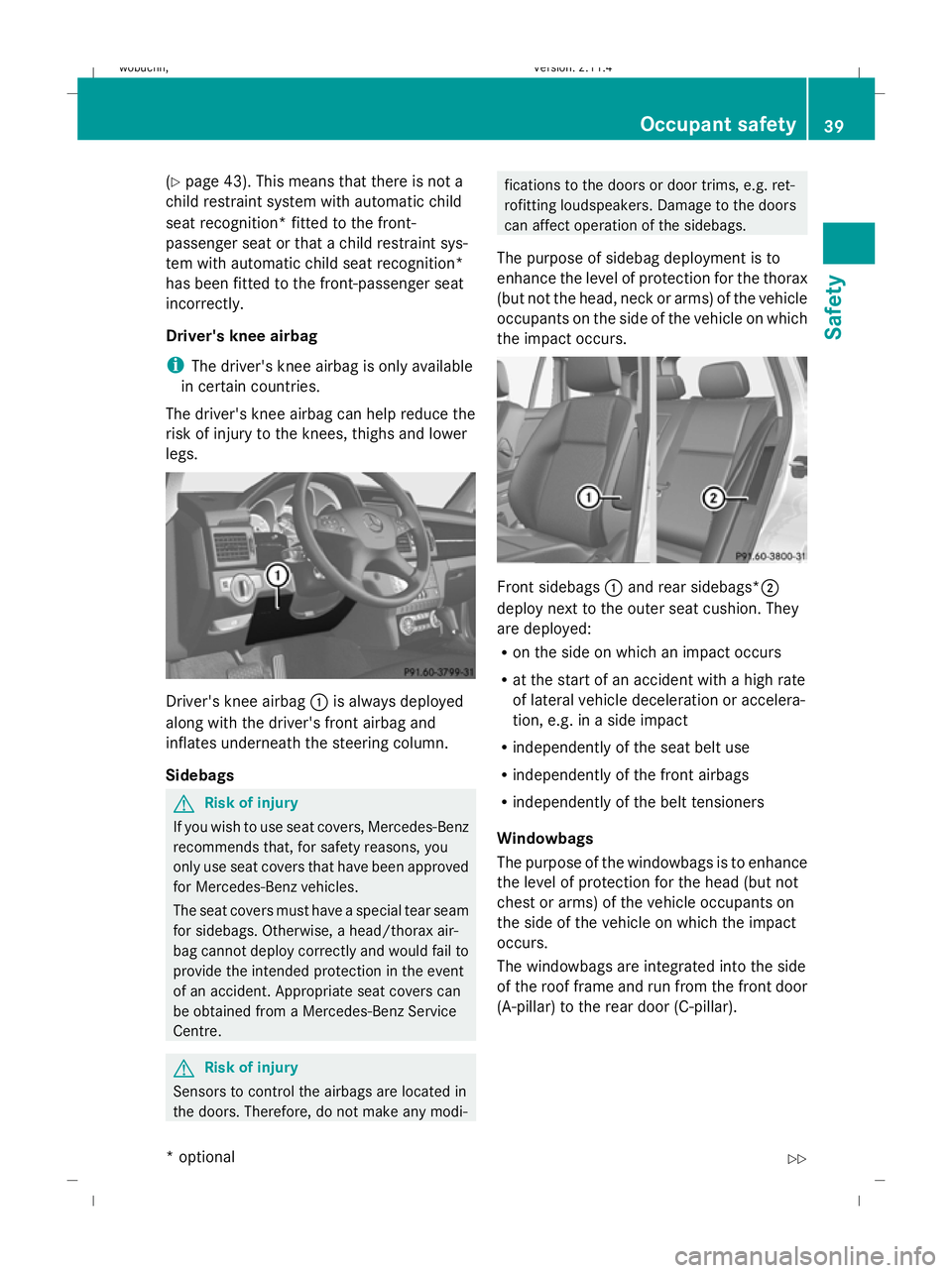
legs. Driver's knee airbag
:is always deployed
along with the driver's front airbag and
inflates underneath the steering column.
Sidebags G
Risk of injury
If you wish to use seat covers, Mercedes-Benz
recommends that, for safety reasons, you
only use seat covers that have been approved
for Mercedes-Benz vehicles.
The seat covers must have a special tear seam
for sidebags. Otherwise, a head/thorax air-
bag cannot deploy correctly and would fail to
provide the intended protection in the event
of an accident. Appropriate seat covers can
be obtained from a Mercedes-Benz Service
Centre. G
Risk of injury
Sensors to control the airbags are located in
the doors. Therefore, do not make any modi- fications to the doors or door trims, e.g. ret-
rofitting loudspeakers. Damage to the doors
can affect operation of the sidebags.
The purpose of sidebag deployment is to
enhance the level of protection for the thorax
(but not the head, neck or arms) of the vehicle
occupants on the side of the vehicle on which
the impact occurs. Front sidebags
:and rear sidebags*;
deploy next to the outer seat cushion. They
are deployed:
R on the side on which an impact occurs
R at the start of an accident with a high rate
of lateral vehicle deceleration or accelera-
tion, e.g. in a side impact
R independently of the seat belt use
R independently of the front airbags
R independently of the belt tensioners
Windowbags
The purpose of the windowbags is to enhance
the level of protection for the head (but not
chest or arms) of the vehicle occupants on
the side of the vehicle on which the impact
occurs.
The windowbags are integrated into the side
of the roof frame and run from the front door
(A-pillar) to the rear door (C-pillar). Occupant safety
39Safety
* optional
X204_AKB; 1; 5, en-GB
wobuchh, Version: 2.11.4
2008-10-15T13:20:56+02:00 - Seite 39 ZDateiname: 6515_0671_02_buchblock.pdf; preflight
Page 157 of 261
Yes+ Cancel-
To confirm the restart of the tyre pressure
loss warning system:
X Press the +button.
The following appears in the multi-function
display: Run Flat Indicator restar-
ted.
After a teach-in period, the tyre pressure
loss warning system will monitor the set
tyre pressures of all four tyres.
or
To cancel the restart of the tyre pressure
loss warning system:
X Press the -button.
The previous settings will not be changed.
Configuring with the luxury multi-func-
tion steering wheel*
X Make sure that the key is in position 2in
the ignition lock.
X Press the (or& button to select the
Service menu.
X Press the $or% button to select
Tyre pressure.
X Press #.
The following appears in the multi-function
display: Run Flat Indicator active
Restart with OK
X Press #.
The following appears in the multi-function
display: Tyre press. now OK?
To confirm the restart of the tyre pressure
loss warning system:
X Press $or% to select Yes.
X Press #.
The following appears in the multi-function
display: Run Flat Indicator restarted
After a teach-in period, the tyre pressure
loss warning system will monitor the set
tyre pressures of all four tyres.
or
To cancel the restart of the tyre pressure
loss warning system: X
Press $or% to select Cancel.
X Press #.
The previous settings will not be changed. Interchanging the wheels
G
Risk of accident
Interchange the front and rear wheels only if
they have the same dimensions: for example
size, offset, etc.
After every wheel interchange/change, have
the tightening torque checked at a qualified
specialist workshop that has the necessary
specialist knowledge and tools to carry out
the work required. Mercedes-Benz recom-
mends that you use a Mercedes-Benz Service
Centre for this purpose. In particular, work
relevant to safety or on safety-related sys-
tems must be carried out at a qualified spe-
cialist workshop.
The wheels could work loose if they are not
tightened to a torque of 150 Nm.
For safety reasons, Mercedes-Benz recom-
mends that you only use wheel bolts of the
correct size which have been approved for
Mercedes-Benz vehicles.
The wear patterns on the front and rear tyres
differ, depending on the operating conditions.
Interchange the wheels before a clear wear
pattern has formed on the tyres. Front tyres
typically wear more on the shoulders and the
rear tyres in the centre.
Interchange the wheels every 5,000 km to
10,000 km depending on the degree of tyre
wear, provided that the vehicle has the same
size front and rear tyres. Do not reverse the
direction of tyre rotation.
Clean the contact surfaces of the wheel and
the brake disc thoroughly every time a wheel
is interchanged. Check the tyre pressure and,
if necessary, restart the tyre pressure loss
warning system. 154 Tyres and wheelsOperation
* optional
X204_AKB; 1; 5, en-GB
wobuchh,
Version: 2.11.4 2008-10-15T13:20:56+02:00 - Seite 154Dateiname: 6515_0671_02_buchblock.pdf; preflight
Page 184 of 261
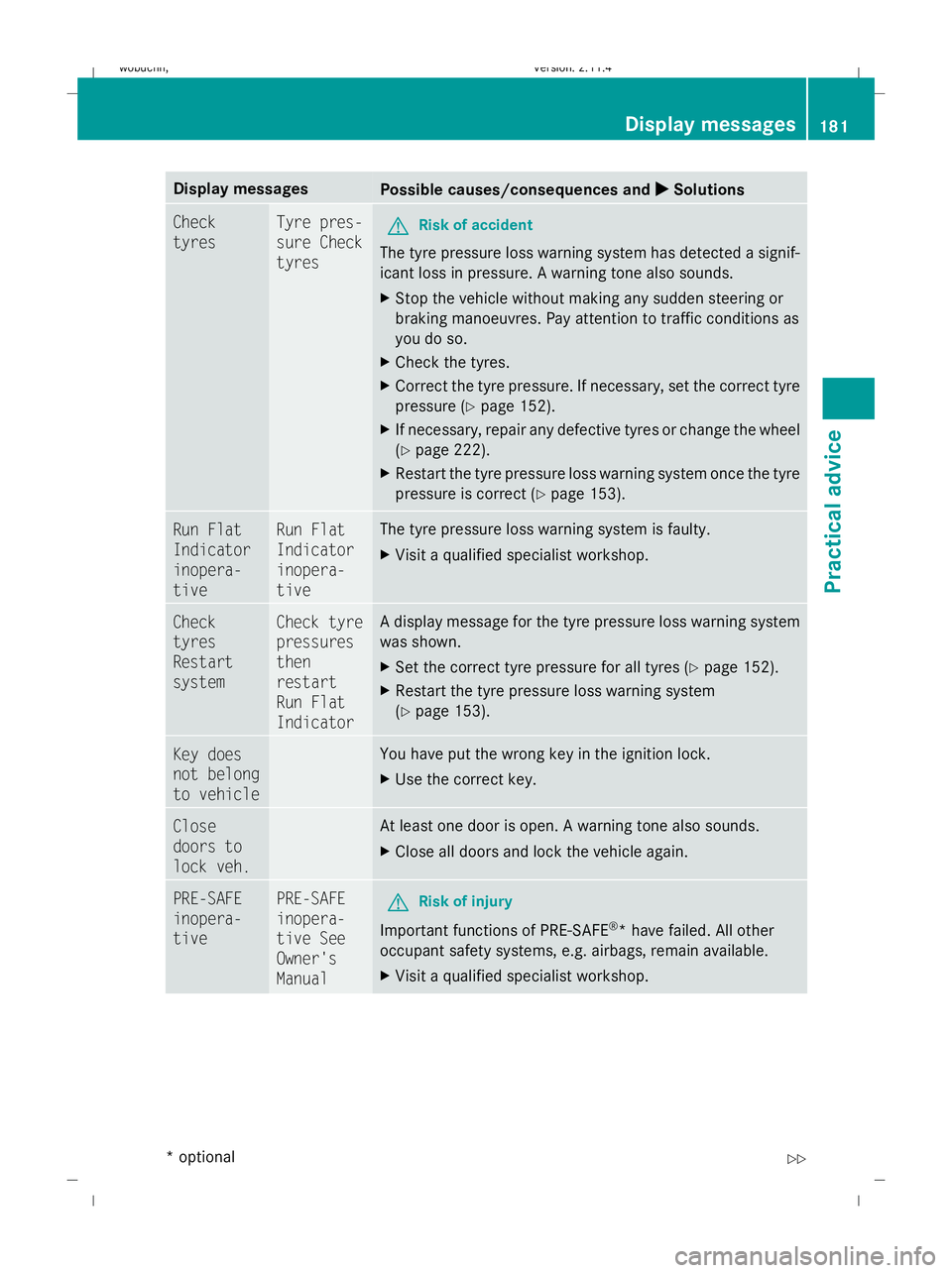
Display messages
Possible causes/consequences and
X
X Solutions Check
tyres Tyre pres-
sure Check
tyres
G
Risk of accident
The tyre pressure loss warning system has detected a signif-
icant loss in pressure. A warning tone also sounds.
X Stop the vehicle without making any sudden steering or
braking manoeuvres. Pay attention to traffic conditions as
you do so.
X Check the tyres.
X Correct the tyre pressure. If necessary, set the correct tyre
pressure ( Ypage 152).
X If necessary, repair any defective tyres or change the wheel
(Y page 222).
X Restart the tyre pressure loss warning system once the tyre
pressure is correct (Y page 153). Run Flat
Indicator
inopera-
tive Run Flat
Indicator
inopera-
tive The tyre pressure loss warning system is faulty.
X
Visit a qualified specialist workshop. Check
tyres
Restart
system Check tyre
pressures
then
restart
Run Flat
Indicator A display message for the tyre pressure loss warning system
was shown.
X
Set the correct tyre pressure for all tyres (Y page 152).
X Restart the tyre pressure loss warning system
(Y page 153). Key does
not belong
to vehicle You have put the wrong key in the ignition lock.
X
Use the correct key. Close
doors to
lock veh. At least one door is open. A warning tone also sounds.
X
Close all doors and lock the vehicle again. PRE-SAFE
inopera-
tive PRE-SAFE
inopera-
tive See
Owner's
Manual
G
Risk of injury
Important functions of PRE-SAFE ®
* have failed. All other
occupant safety systems, e.g. airbags, remain available.
X Visit a qualified specialist workshop. Display
messages
181Practical advice
* optional
X204_AKB; 1; 5, en-GB
wobuchh
,V ersion: 2.11.4
2008-10-15T13:20:56+02:00 - Seite 181 ZDateiname: 6515_0671_02_buchblock.pdf; preflight
Page 227 of 261
X
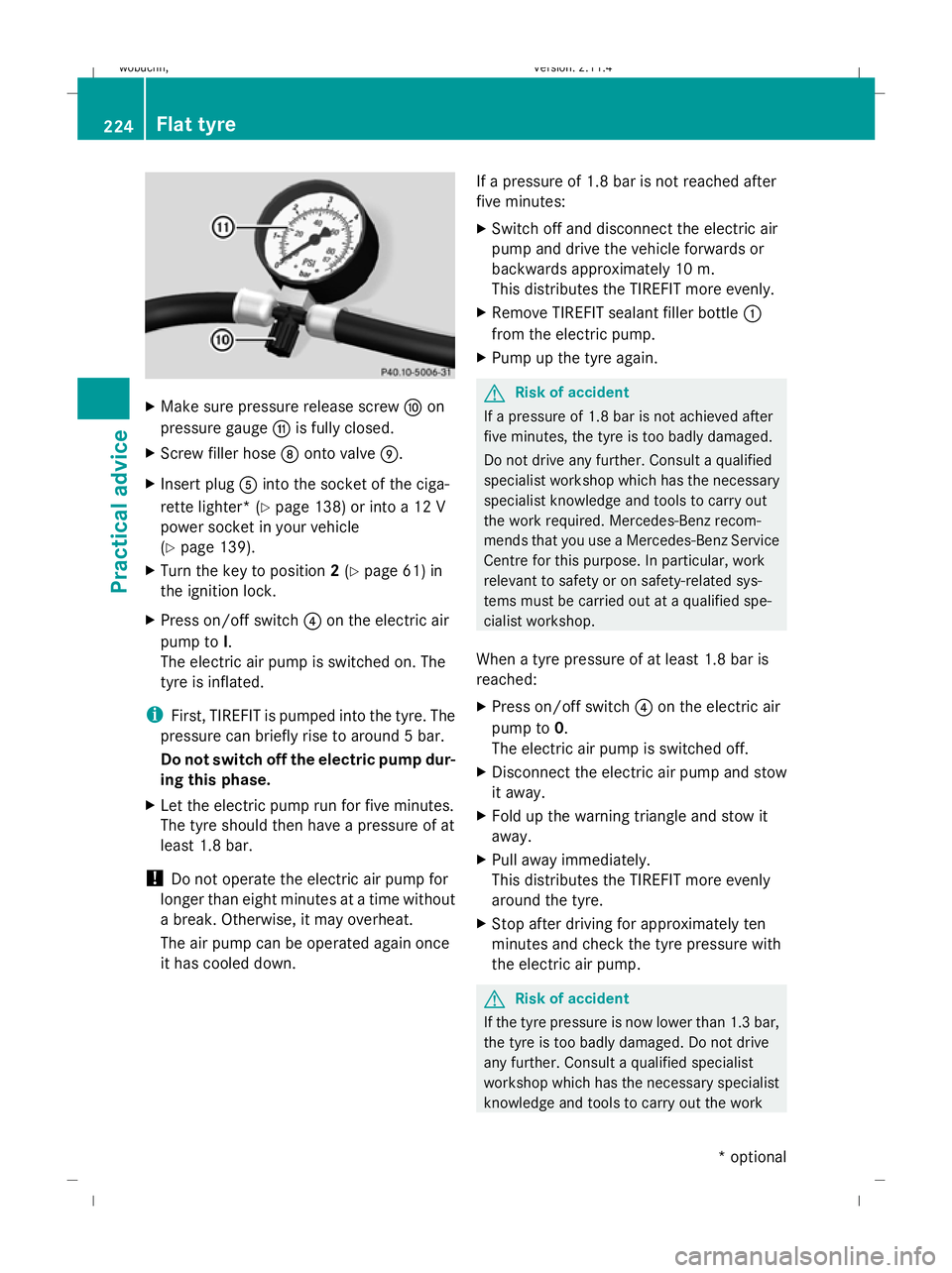
Make sure pressure release screw Fon
pressure gauge Gis fully closed.
X Screw filler hose Donto valve E.
X Insert plug Ainto the socket of the ciga-
rette lighter* (Y page 138) or into a 12 V
power socket in your vehicle
(Y page 139).
X Turn the key to position 2(Y page 61) in
the ignition lock.
X Press on/off switch ?on the electric air
pump to I.
The electric air pump is switched on. The
tyre is inflated.
i First, TIREFIT is pumped into the tyre. The
pressure can briefly rise to around 5 bar.
Do not switch off the electric pump dur-
ing this phase.
X Let the electric pump run for five minutes.
The tyre should then have a pressure of at
least 1.8 bar.
! Do not operate the electric air pump for
longer than eight minutes at a time without
a break. Otherwise, it may overheat.
The air pump can be operated again once
it has cooled down. If a pressure of 1.8 bar is not reached after
five minutes:
X
Switch off and disconnect the electric air
pump and drive the vehicle forwards or
backwards approximately 10 m.
This distributes the TIREFIT more evenly.
X Remove TIREFIT sealant filler bottle :
from the electric pump.
X Pump up the tyre again. G
Risk of accident
If a pressure of 1.8 bar is not achieved after
five minutes, the tyre is too badly damaged.
Do not drive any further. Consult a qualified
specialist workshop which has the necessary
specialist knowledge and tools to carry out
the work required. Mercedes-Benz recom-
mends that you use a Mercedes-Benz Service
Centre for this purpose. In particular, work
relevant to safety or on safety-related sys-
tems must be carried out at a qualified spe-
cialist workshop.
When a tyre pressure of at least 1.8 bar is
reached:
X Press on/off switch ?on the electric air
pump to 0.
The electric air pump is switched off.
X Disconnect the electric air pump and stow
it away.
X Fold up the warning triangle and stow it
away.
X Pull away immediately.
This distributes the TIREFIT more evenly
around the tyre.
X Stop after driving for approximately ten
minutes and check the tyre pressure with
the electric air pump. G
Risk of accident
If the tyre pressure is now lower than 1.3 bar,
the tyre is too badly damaged. Do not drive
any further. Consult a qualified specialist
workshop which has the necessary specialist
knowledge and tools to carry out the work 224 Flat tyrePractical advice
* optional
X204_AKB; 1; 5, en-GB
wobuchh,
Version: 2.11.4 2008-10-15T13:20:56+02:00 - Seite 224Dateiname: 6515_0671_02_buchblock.pdf; preflight
Page 229 of 261
X
Press on/off switch =on the electric air
pump to I.
The electric air pump is switched on. The
tyre is inflated.
i First, TIREFIT is pumped into the tyre. The
pressure can briefly rise to around 5 bar.
Do not switch off the electric pump dur-
ing this phase.
X Let the electric pump run for five minutes.
The tyre should then have a pressure of at
least 1.8 bar.
! Do not operate the electric air pump for
longer than eight minutes at a time without
a break. Otherwise, it may overheat.
The air pump can be operated again once
it has cooled down.
If a pressure of 1.8 bar is not reached after
five minutes:
X Switch off and disconnect the electric air
pump and drive the vehicle forwards or
backwards approximately 10 m.
This distributes the TIREFIT more evenly.
X Remove TIREFIT sealant filler bottle :
from the electric pump.
X Pump up the tyre again. G
Risk of accident
If a pressure of 1.8 bar is not achieved after
five minutes, the tyre is too badly damaged.
Do not drive any further. Consult a qualified
specialist workshop which has the necessary
specialist knowledge and tools to carry out
the work required. Mercedes-Benz recom-
mends that you use a Mercedes-Benz Service
Centre for this purpose. In particular, work
relevant to safety or on safety-related sys-
tems must be carried out at a qualified spe-
cialist workshop. When a tyre pressure of at least 1.8 bar is
reached:
X
Press on/off switch =on the electric air
pump to 0.
The electric air pump is switched off.
X Disconnect the electric air pump and stow
it away.
X Fold up the warning triangle and stow it
away.
X Pull away immediately.
This distributes the TIREFIT more evenly
around the tyre.
X Stop after driving for approximately ten
minutes and check the tyre pressure with
the electric air pump. G
Risk of accident
If the tyre pressure is now lower than 1.3 bar,
the tyre is too badly damaged. Do not drive
any further. Consult a qualified specialist
workshop which has the necessary specialist
knowledge and tools to carry out the work
required. Mercedes-Benz recommends that
you use a Mercedes-Benz Service Centre for
this purpose. In particular, work relevant to
safety or on safety-related systems must be
carried out at a qualified specialist workshop. X
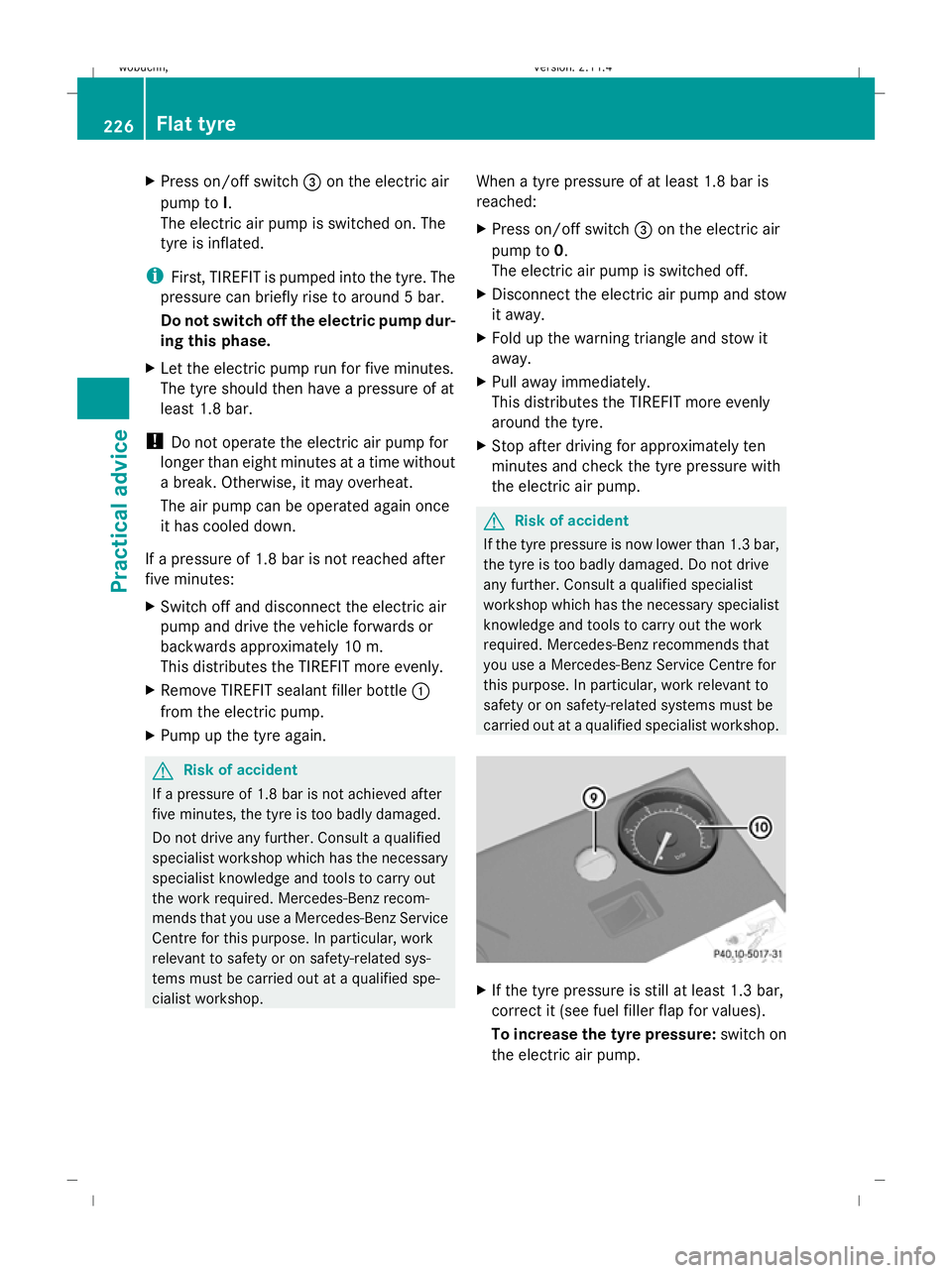
If the tyre pressure is still at least 1.3 bar,
correct it (see fuel filler flap for values).
To increase the tyre pressure: switch on
the electric air pump. 226 Flat tyrePractical advice
X204_AKB; 1; 5, en-GB
wobuchh,
Version: 2.11.4 2008-10-15T13:20:56+02:00 - Seite 226Dateiname: 6515_0671_02_buchblock.pdf; preflight