ESP MERCEDES-BENZ GLS 2018 Owners Manual
[x] Cancel search | Manufacturer: MERCEDES-BENZ, Model Year: 2018, Model line: GLS, Model: MERCEDES-BENZ GLS 2018Pages: 398, PDF Size: 5.73 MB
Page 363 of 398
a corresponding warning message will appear in
the multifunction display.
You can recognize the tire pressure loss warning
by the Run Flat Indicator Active Press
'OK' to Restart message which appears in
the Service menu of the multifunction display.
Information on the message display can be
found in the "Restarting the tire pressure loss
warning system" section ( Y
page 361).
Important safety notes The tire pressure warning system does not warn
you of an incorrectly set tire pressure. Observe
the notes on the recommended tire pressure
( Y
page 357).
The tire pressure loss warning does not replace
the need to regularly check the tire pressure. An
even loss of pressure on several tires at the
same time cannot be detected by the tire pres-
sure loss warning system.
The tire pressure monitor is not able to warn you
of a sudden loss of pressure, e.g. if the tire is
penetrated by a foreign object. In the event of a
sudden loss of pressure, bring the vehicle to a
halt by braking carefully. Avoid abrupt steering
movements.
The function of the tire pressure loss warning
system is limited or delayed if: R
snow chains are mounted on your vehicle's
tires. R
road conditions are wintry. R
you are driving on sand or gravel. R
you adopt a very sporty driving style (corner-
ing at high speeds or driving with high rates of
acceleration). R
you are driving with a heavy load (in the vehi-
cle or on the roof).
Restarting the tire pressure loss warn-
ing system Restart the tire pressure loss warning system if
you have: R
changed the tire pressure R
changed the wheels or tires R
mounted new wheels or tires X
Before restarting, make sure that the tire
pressures are set properly on all four tires for
the respective operating conditions.
The recommended tire pressure can be found
on the Tire and Loading Information placard on the B-pillar. Additionally, a tire pressure
table is attached to the fuel filler flap. The tire
pressure loss warning system can only give
reliable warnings if you have set the correct
tire pressure. If an incorrect tire pressure is
set, these incorrect values will be monitored. X
Also observe the notes in the section on tire
pressures ( Y
page 357). X
Make sure that the SmartKey is in position H
in the ignition lock ( Y
page 140).X
Press the Y or e button on the steering
wheel to select the Service menu.X
Press the c or d button to select
Tire Pressure . X
Press the v button.
The Run Flat Indicator Active Press
'OK' to Restart message appears in the
multifunction display.
If you wish to confirm the restart: X
Press the v button.
The Tire Pressure Now OK? message
appears in the multifunction display. X
Press the c or d button to select Yes .X
Press the v button.
The Run Flat Indicator Restarted mes-
sage appears in the multifunction display.
After a teach-in period, the tire pressure loss
warning system will monitor the set tire pres-
sures of all four tires.
If you wish to cancel the restart: X
Press the 8 button.
or X
When the Tire Pressure Now OK? message
appears, press the c or d button to
select Cancel . X
Press the v button.
The tire pressure values stored at the last
restart will continue to be monitored.
Tire pressure monitor
General notes
If a tire pressure monitor is installed, the vehi-
cle's wheels have sensors that monitor the tire
pressures in all four tires. The tire pressure mon-
itor warns you if the pressure drops in one or
more of the tires. The tire pressure monitor only
functions if the corresponding sensors are
installed in all wheels. Tire pressure 361
Wheels and tires Z
Page 364 of 398
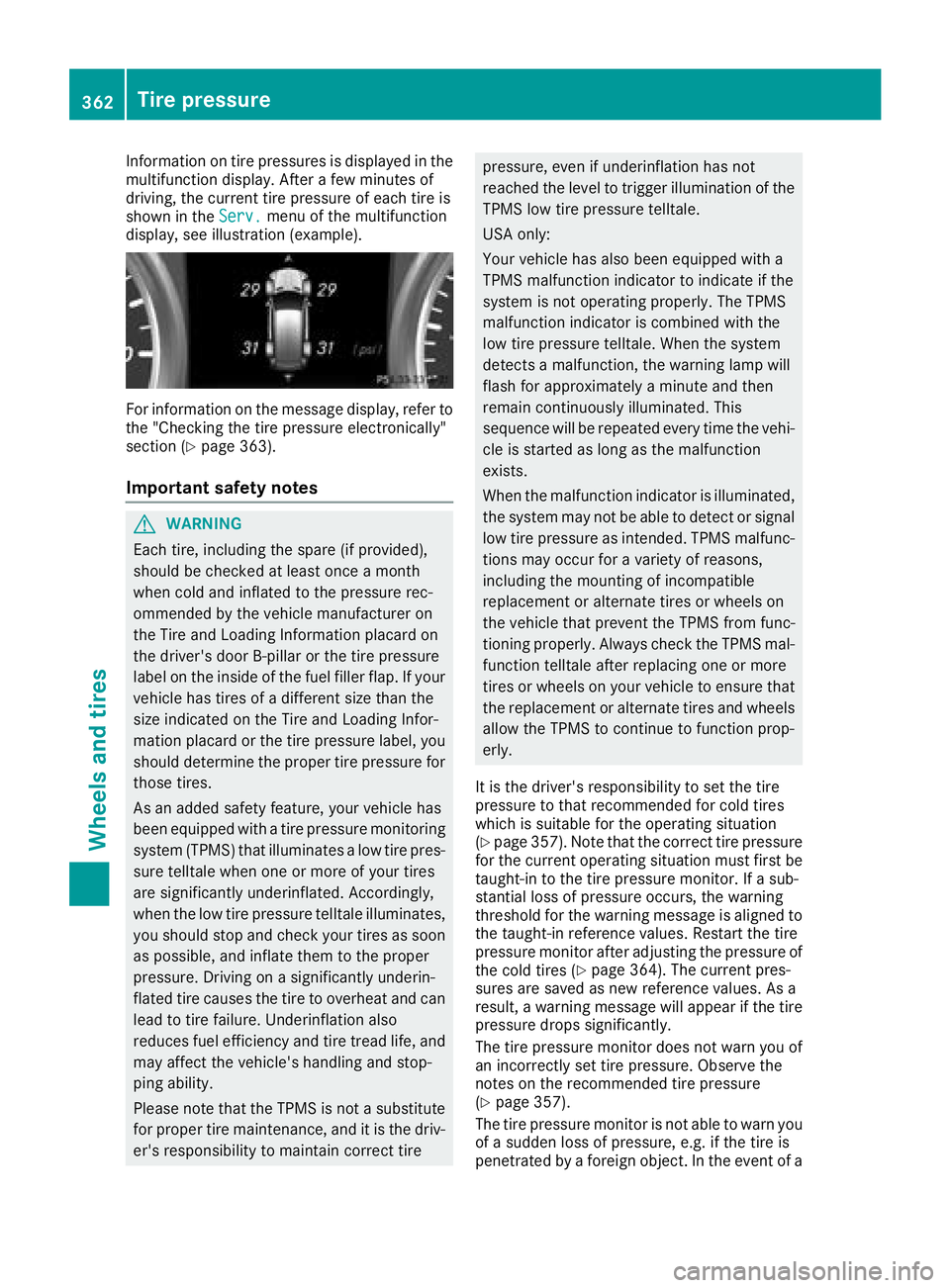
Information on tire pressures is displayed in the
multifunction display. After a few minutes of
driving, the current tire pressure of each tire is
shown in the Serv. menu of the multifunction
display, see illustration (example).
For information on the message display, refer to
the "Checking the tire pressure electronically"
section ( Y
page 363).
Important safety notes
G WARNING
Each tire, including the spare (if provided),
should be checked at least once a month
when cold and inflated to the pressure rec-
ommended by the vehicle manufacturer on
the Tire and Loading Information placard on
the driver's door B-pillar or the tire pressure
label on the inside of the fuel filler flap. If your
vehicle has tires of a different size than the
size indicated on the Tire and Loading Infor-
mation placard or the tire pressure label, you
should determine the proper tire pressure for
those tires.
As an added safety feature, your vehicle has
been equipped with a tire pressure monitoring
system (TPMS) that illuminates a low tire pres-
sure telltale when one or more of your tires
are significantly underinflated. Accordingly,
when the low tire pressure telltale illuminates,
you should stop and check your tires as soon
as possible, and inflate them to the proper
pressure. Driving on a significantly underin-
flated tire causes the tire to overheat and can
lead to tire failure. Underinflation also
reduces fuel efficiency and tire tread life, and
may affect the vehicle's handling and stop-
ping ability.
Please note that the TPMS is not a substitute
for proper tire maintenance, and it is the driv-
er's responsibility to maintain correct tire pressure, even if underinflation has not
reached the level to trigger illumination of the
TPMS low tire pressure telltale.
USA only:
Your vehicle has also been equipped with a
TPMS malfunction indicator to indicate if the
system is not operating properly. The TPMS
malfunction indicator is combined with the
low tire pressure telltale. When the system
detects a malfunction, the warning lamp will
flash for approximately a minute and then
remain continuously illuminated. This
sequence will be repeated every time the vehi-
cle is started as long as the malfunction
exists.
When the malfunction indicator is illuminated,
the system may not be able to detect or signal
low tire pressure as intended. TPMS malfunc-
tions may occur for a variety of reasons,
including the mounting of incompatible
replacement or alternate tires or wheels on
the vehicle that prevent the TPMS from func-
tioning properly. Always check the TPMS mal-
function telltale after replacing one or more
tires or wheels on your vehicle to ensure that
the replacement or alternate tires and wheels
allow the TPMS to continue to function prop-
erly.
It is the driver's responsibility to set the tire
pressure to that recommended for cold tires
which is suitable for the operating situation
( Y
page 357). Note that the correct tire pressure
for the current operating situation must first be
taught-in to the tire pressure monitor. If a sub-
stantial loss of pressure occurs, the warning
threshold for the warning message is aligned to
the taught-in reference values. Restart the tire
pressure monitor after adjusting the pressure of
the cold tires ( Y
page 364). The current pres-
sures are saved as new reference values. As a
result, a warning message will appear if the tire
pressure drops significantly.
The tire pressure monitor does not warn you of
an incorrectly set tire pressure. Observe the
notes on the recommended tire pressure
( Y
page 357).
The tire pressure monitor is not able to warn you
of a sudd en loss of pressure, e.g. if the tire is
penetra ted
by a foreign object. In the event of a362
Tire pressure
Wheels and tires
Page 366 of 398
Restarting the tire pressure monitor When you restart the tire pressure monitor, all
existing warning messages are deleted and the
warning lamps go out. The monitor uses the cur-
rently set tire pressures as the reference values
for monitoring. In most cases, the tire pressure
monitor will automatically detect the new refer-
ence values after you have changed the tire
pressure. However, you can also set reference
values manually as described here. The tire
pressure monitor then monitors the new tire
pressure values. X
Set the tire pressure to the value recommen-
ded for the corresponding driving situation on
the Tire and Loading Information placard on
the driver's side B-pillar ( Y
page 357).
You can find more tire pressure values for
various operating conditions in the tire pres-
sure table inside the fuel filler flap
( Y
page 358).X
Make sure that the tire pressure is correct on
all four wheels. X
Make sure that the SmartKey is in position H
in the ignition lock. X
Press the Y or e button on the steering
wheel to select the Serv. menu.X
Press the c or d button to select
Tire Pressure .X
Press v .
The multifunction display shows the current
tire pressure for the individual tires or the
Tire pressure will be displayed
after driving a few minutes message.X
Press the d button.
The Use Current Pressures as New Ref‐
erence Values message appears in the mul-
tifunction display.
If you wish to confirm the restart: X
Press the v button.
The Tire Press. Monitor Restarted mes-
sage appears in the multifunction display.
After driving for a few minutes, the system
checks whether the current tire pressures are
within the specified range. The new tire pres-
sures are then accepted as reference values
and monitored.
If you wish to cancel the restart: X
Press the 8 button.
The tire pressure values stored at the last
restart will continue to be monitored. Radio type approval for the tire pres-
sure monitor Country Radio type approval number
USA FCC ID: MRXMW2433A
FCC ID: MRXGG4
FCC ID: MRXMC34MA4
Canada IC: 2546A-MW2433A
IC: 2546A-GG4
IC: 2546A-MC34MA4
Loading the vehicle
Instruction labels for tires and loads
G WARNING
Overloaded tires can overheat, causing a
blowout. Overloaded tires can also impair the
steering and driving characteristics and lead
to brake failure. There is a risk of accident.
Observe the load rating of the tires. The load
rating must be at least half of the GAWR of
your vehicle. Never overload the tires by
exceeding the maximum load.
Two instruction labels on your vehicle show the
maximum possible load.
(1) The Tire and Loading Information placard is
on the B-pillar on the driver's side. The Tire
and Loading Information placard shows the
maximum permissible number of occu-
pants and the maximum permissible vehicle
load. It also contains details of the tire sizes
and corresponding pressures for tires
mounted at the factory.
(2) The vehicle identification plate is on the B-
pillar on the driver's side. The vehicle iden-
tification plate informs you of the gross
vehicle weight rating. It is made up of the
vehicle weight, all vehicle occupants, the
fuel and the cargo. You can also find infor-
mation about the maximum gross axle
weight rating on the front and rear axle.
The maximum gross axle weight rating is
the maximum weight that can be carried by
one axle (front or rear axle). Never exceed
the maximum load or the maxi mum g ross
a
xle weight rating for the front or rear axle.364
Loading the vehicle
Wheels and tires
Page 377 of 398
be required earlier. Do not change the direction
of wheel rotation.
Clean the contact surfaces of the wheel and the
brake disc thoroughly every time a wheel is rota-
ted. Check the tire pressure and, if necessary,
restart the tire pressure loss warning system or
the tire pressure monitor ( Y
page 361).
Direction of rotation Tires with a specified direction of rotation have
additional benefits, e.g. if there is a risk of hydro-
planing. These advantages can only be gained if
the tires are installed corresponding to the
direction of rotation.
An arrow on the sidewall of the tire indicates its
correct direction of rotation.
Storing wheels Store wheels that are not being used in a cool,
dry and preferably dark place. Protect the tires
from oil, grease, gasoline and diesel.
Mounting a wheel
Preparing the vehicle X
Vehicle with emergency spare wheel:
when mounting the emergency spare wheel in
the event of a flat tire, follow the additional
notes on vehicle preparation under "Flat tire"
( Y
page 339). X
Stop the vehicle on solid, non-slippery and
level ground. X
Apply the electric parking brake manually. X
Bring the front wheels into the straight-ahead
position. X
Vehicles with automatic transmission:
shift the transmission to position ] .X
Vehicles with the AIRMATIC package:
make sure that the normal vehicle level is
selected ( Y
page 190).X
Vehicles with the Off-Road Engineering
package: make sure that the normal level is
selected ( Y
page 184).X
Switch off the engine. X
Vehicles without KEYLESS-GO: remove the
SmartKey from the ignition lock. X
Vehicles with KEYLESS-GO: open the driv-
er's door.
The vehicle electronics are now in position
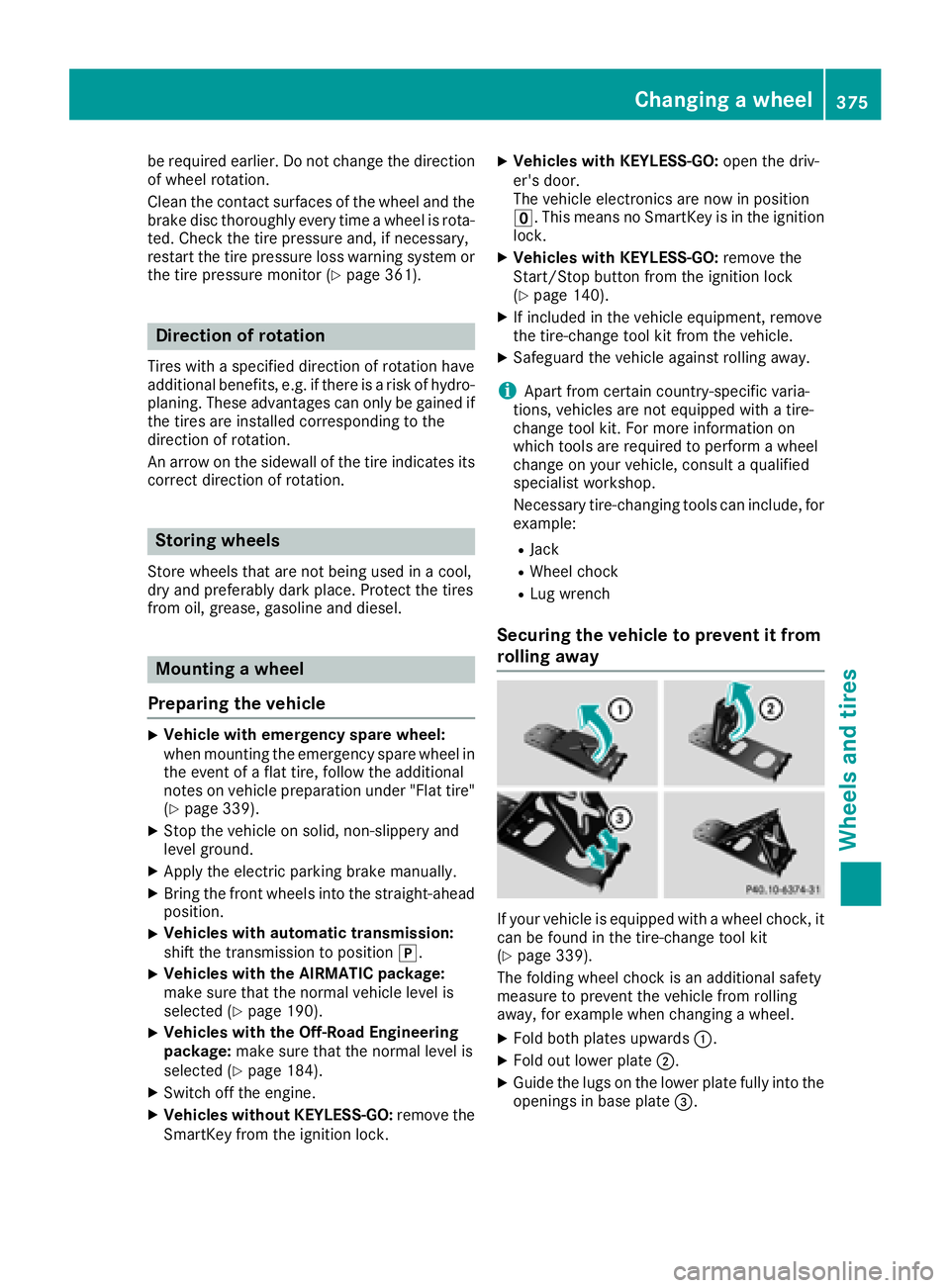
Page 380 of 398
G WARNING
If you tighten the wheel bolts or wheel nuts
when the vehicle is raised, the jack could tip
over. There is a risk of injury.
Only tighten the wheel bolts or wheel nuts
when the vehicle is on the ground.
! To prevent damage to the paintwork, hold
the wheel securely against the wheel hub
while screwing in the first wheel bolt.
Always pay attention to the instructions and
safety notes in the "Changing a wheel" section
( Y
page 374).
Only use wheel bolts that have been designed
for the wheel and the vehicle. For safety rea-
sons, Mercedes-Benz recommends that you
only use wheel bolts which have been approved
for Mercedes-Benz vehicles and the respective
wheel.
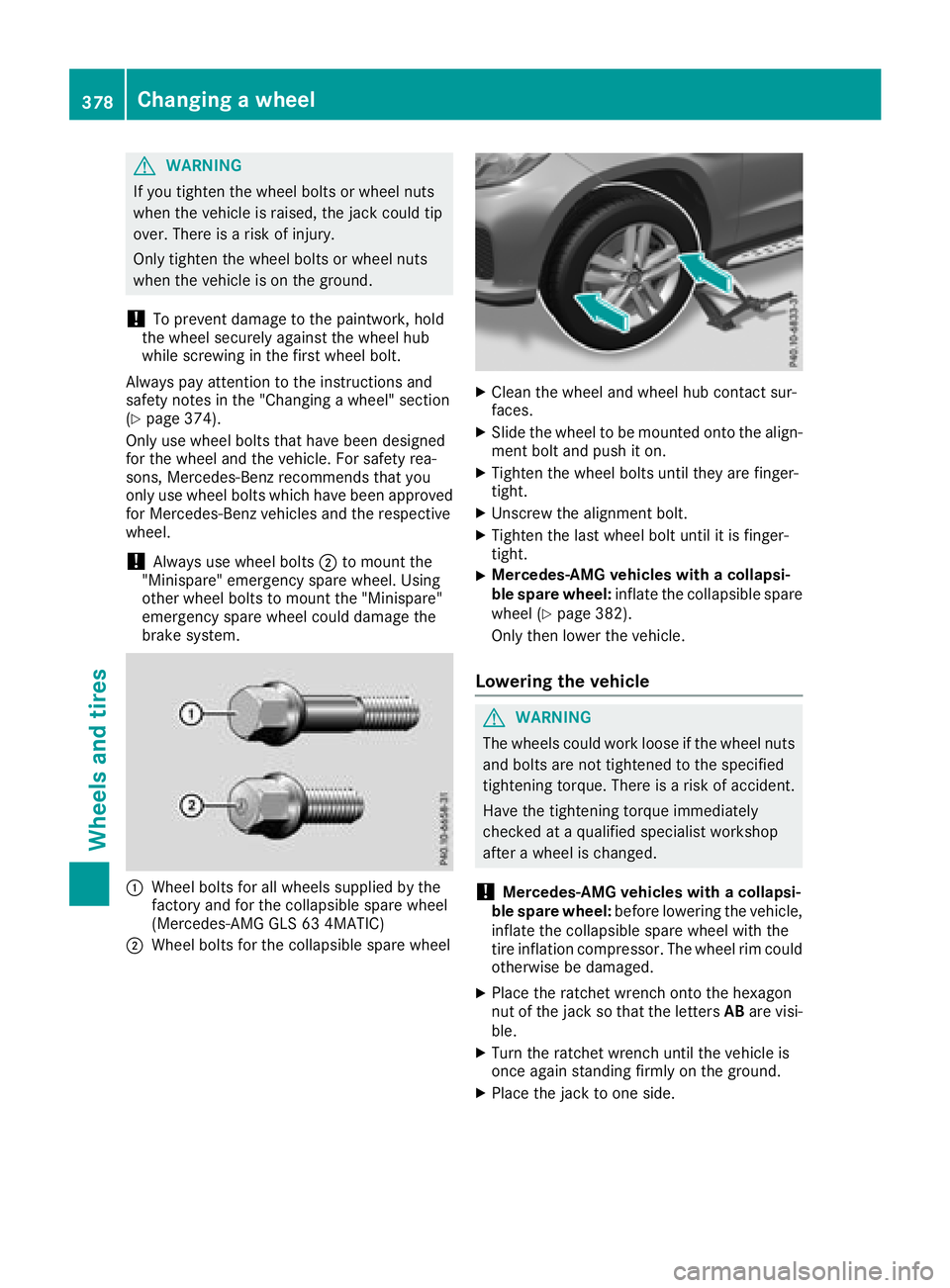
! Always use wheel bolts D to mount the
"Minispare" emergency spare wheel. Using
other wheel bolts to mount the "Minispare"
emergency spare wheel could damage the
brake system.
C
Wheel bolts for all wheels supplied by the
factory and for the collapsible spare wheel
(Mercedes-AMG GLS 63 4MATIC)
D
Wheel bolts for the collapsible spare wheel X
Clean the wheel and wheel hub contact sur-
faces. X
Slide the wheel to be mounted onto the align-
ment bolt and push it on. X
Tighten the wheel bolts until they are finger-
tight. X
Unscrew the alignment bolt. X
Tighten the last wheel bolt until it is finger-
tight. X
Mercedes-AMG vehicles with a collapsi-
ble spare wheel: inflate the collapsible spare
wheel ( Y
page 382).
Only then lower the vehicle.
Lowering the vehicle
G WARNING
The wheels could work loose if the wheel nuts
and bolts are not tightened to the specified
tightening torque. There is a risk of accident.
Have the tightening torque immediately
checked at a qualified specialist workshop
after a wheel is changed.
! Mercedes-AMG vehicles with a collapsi-
ble spare wheel: before lowering the vehicle,
inflate the collapsible spare wheel with the
tire inflation compressor. The wheel rim could
otherwise be damaged. X
Place the ratchet wrench onto the hexagon
nut of the jack so that the letters AB are visi-
ble. X
Turn the ratchet wrench until the vehicle is
once again standing firmly on the ground. X
Place the jack to one side.378
Changing a wheel
Wheels and tires
Page 382 of 398
Notes on the vehicle equipment – always equip
the vehicle: R
with tires of the same size on a given axle (left
and right) R
with the same type of tires at a given time
(summer tires, winter tires, MOExtended
tires)
i Vehicles equipped with MOExtended tires
are not equipped with a TIREFIT kit at the fac-
tory. It is therefore recommended that you
additionally equip your vehicle with a TIREFIT
kit if you mount tires that do not feature run-
flat properties, e.g. winter tires. A TIREFIT kit
may be obtained from a qualified specialist
workshop.
Emergency spare wheel
Important safety notes
G WARNING
The wheel or tire size as well as the tire type of
the spare wheel or emergency spare wheel
and the wheel to be replaced may differ.
Mounting an emergency spare wheel may
severely impair the driving characteristics.
There is a risk of an accident.
To avoid hazardous situations: R
adapt your driving style accordingly and
drive carefully. R
never mount more than one spare wheel or
emergency spare wheel that differs in size. R
only use a spare wheel or emergency spare
wheel of a different size briefly. R
do not switch ESP ®
off.R
have a spare wheel or emergency spare
wheel of a different size replaced at the
nearest qualified specialist workshop.
Observe that the wheel and tire dimensions
as well as the tire type must be correct.
! Mercedes-AMG vehicles with
"Minispare" emergency spare wheel: only
use the "Minispare" emergency spare wheel
on the rear axle . If you mount the
"Minispare" emergency spare wheel on the
front axle, this could result in damage to the
brake system. If a tire on the front axle is defective, an intact
wheel from the rear axle must first be
replaced with the "Minispare" emergency
spare wheel. The damaged wheel on the front
axle can then be replaced by the undamaged
wheel from the rear axle.
Make sure to note the placard on the
"Minispare" emergency spare wheel.
When using an emergency spare wheel or spare
wheel of a different size, you must not exceed
the maximum speed of 50 mph (80 km/h).
You should regularly check the pressure of the
emergency spare wheel, particularly prior to
long trips, and correct the pressure as neces-
sary ( Y
page 357). The value on the wheel is
valid.
Snow chains must not be mounted on emer-
gency spare wheels.
General notes Information regarding permitted emergency
spare wheels can be found at an authorized
Mercedes-Benz Center.
Mounting the emergency spare wheel is descri-
bed under "Mounting a wheel" ( Y
page 375).
An emergency spare wheel may also be moun-
ted against the direction of rotation. Observe
the time restriction on use as well as the speed
limitation specified on the emergency spare
wheel.
Replace the tires after six years at the latest,
regardless of wear. This also applies to the
emergency spare wheel.
When you are driving with the collapsible spare
wheel mounted, the tire pressure loss warning
system or the tire pressure monitor cannot func-
tion reliably. Only restart the tire pressure loss
warning system or tire pressure monitor when
the defective wheel has been replaced with a
new wheel.
Vehicles with tire pressure monitor: after
mounting an emergency spare wheel, the sys-
tem may still display the tire pressure of the
removed wheel for a few minutes. The value dis-
played for the mounted emergency spare wheel
is not the same as the current tire pressure of
the emergency spare wheel.380
Emergency spare wheel
Wheels and tires
Page 386 of 398
Information regarding technical data
i The dat a state d her e specifically refers to a
vehicl e wit h standard equipment. Consult an
authorize d Mercedes-Ben z Cente r for th e
dat a for all vehicl e variants and trim levels.
Vehicle electronics
Installing two-way radios and mobile
phones (RF transmitters)
G WARNIN G
The electromagneti c radiation from two-way
radios can interfere wit h th e vehicl e electron -
ics if two-way radios are manipulated or ret -
rofitte d incorrectly. This could jeopardiz e th e
operating safet y of th e vehicle. Ther e is a ris k
of an accident.
You should hav e all wor k on electrical and
electronic component s carried out at a quali-
fie d specialist workshop.
G WARNIN G
If you incorrectl y operate two-way radios in
th e vehicle, th e electromagneti c radiation
may interfere wit h th e vehicl e electronics , for
exampl e if:R
th e two-way radi o is no t connecte d to an
exterio r antennaR
th e exterio r antenna is no t correctl y moun -
te d or is no t low-reflection
This could jeopardiz e th e operating safet y of
th e vehicle. Ther e is a ris k of an accident.
Hav e th e low-reflection exterio r antenna
installed at a qualified specialist workshop.
Always connec t two-way radios to th e low-
reflection exterio r antenna when operating in
th e vehicle.
! The operating permit may be invalidated if
th e instruction s for installation and use of
two-way radios are no t observed. In particular, th e followin g condition s must be
complied with: R
only approve d wavebands may be used R
observ e th e maximum permissible output
in these wavebands R
only approve d antenna position s may be
used
Excessiv e levels of electromagneti c radiation
may caus e damag e to your healt h and th e healt h
of others. Using an exterio r antenna takes int o
accoun t curren t scientific discussion s relating
to th e possible healt h hazards that may result
from electromagneti c fields.
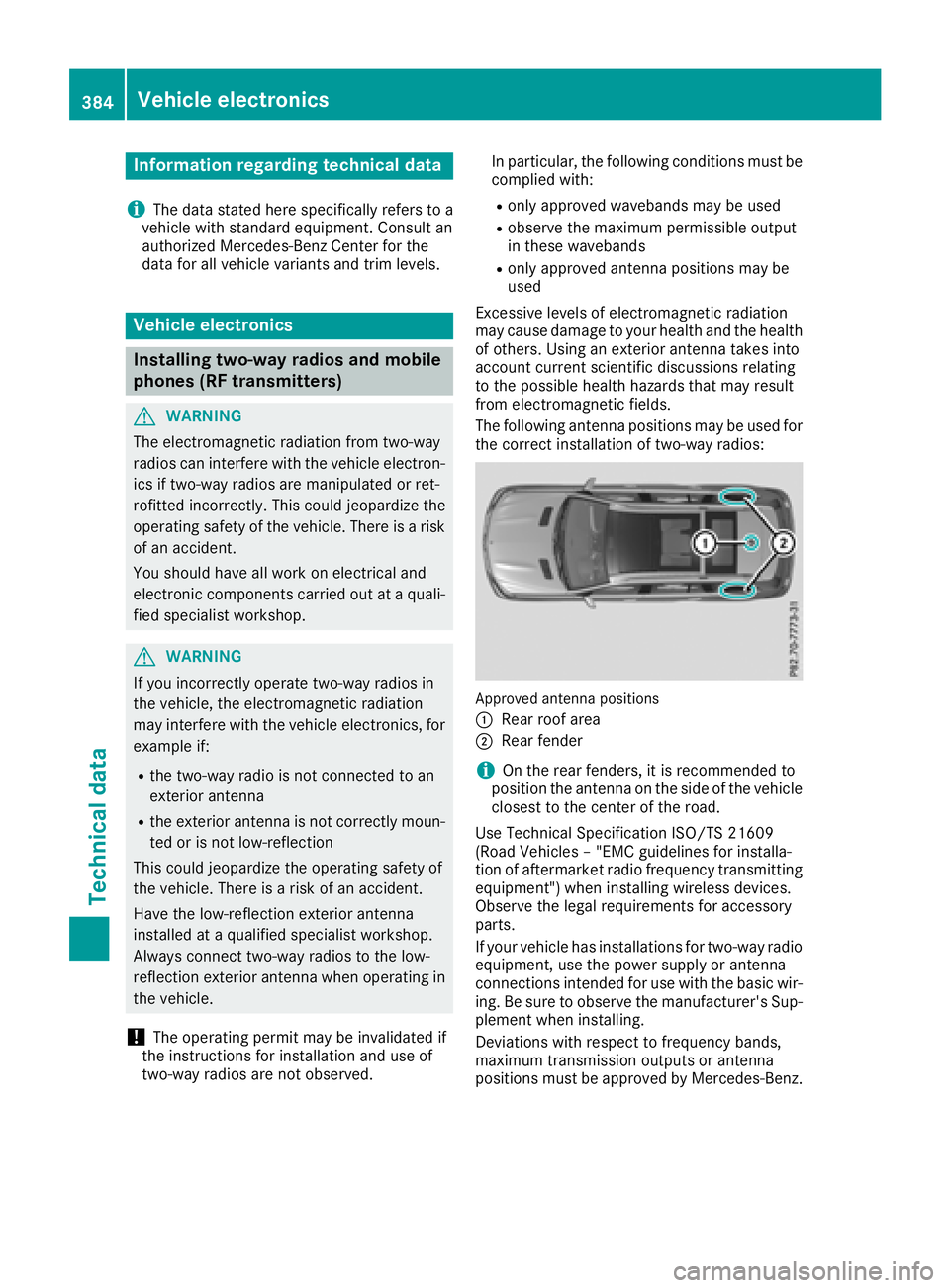
The fo llowin g a
ntenna position s may be used for
th e correc t installation of two-way radios:
Approved antenna position s
C
Rear roo f areaD
Rear fender
i On th e rear fenders, it is recommended to
position th e antenna on th e side of th e vehicl e
closes t to th e center of th e road .
Use Technical Specification ISO/TS 2160 9
(Road Vehicles – "EM C guidelines for installa-
tion of aftermarket radi o frequency transmitting
equipment") when installin g wireless devices.
Observ e th e legal requirements for accessory
parts.
If your vehicl e has installation s for two-way radi o
equipment, use th e power suppl y or antenna
connection s intended for use wit h th e basic wir-
ing . Be sur e to observ e th e manufacturer' s Sup -
plemen t when installing.
Deviation s wit h respec t to frequency bands,
maximum transmission output s or antenna
position s must be approve d by Mercedes-Benz.384
Vehicle electronics
Technical data
Page 391 of 398
DEF
Important safet y notesComply wit h th e important safet y note s fo r ser -
vic e products when handlin g DE F ( Y
page 386).
DE F is a water-soluble flui d fo r th e exhaus t gas
aftertreatmen t of diesel engines. It is:R
no t poisonousR
colorles s and odorlessR
no t flammable
Whe n you ope n th e DE F container, small
amount s of ammonia vapor may be released.
Ammoni a vapor s hav e a pungen t odo r and are
particularly irritatin g to th e skin , to mucous
membrane s and to th e eyes . You may experi-
ence a burning sensation in your eyes , nose and
throat . Coughin g and watering of th e eyes are
possible.
Do no t inhale ammonia vapors. Fil l th e DE F tank
only in well-ventilated areas.
Low outsid e temperaturesDE F freezes at a temperature of approximately
12 ‡ (-11 †). The vehicle is delivered from th e
factory equipped wit h a DE F preheatin g system.
Winte r operation can thus be guaranteed eve n
at temperature s belo w 12 ‡ (-11 †).
Additives
! Only use DE F in accordance wit h IS O
22241. Do no t use additive s wit h DE F and do
no t dilut e DE F wit h water. Thi s may destroy
th e BlueTE C exhaus t gas aftertreatmen t sys -
tem.
Purity
! Impurities in DE F (e.g. due to other servic e
products , cleanin g agents or dust ) lead to :R
increase d emission valuesR
damage to th e catalytic converterR
engin e damageR
malfunction s in th e BlueTE C exhaus t gas
aftertreatmen t syste m
Assurin g th e purit y of DE F is particularly impor -
tant wit h respec t to avoidin g malfunction s in th e
BlueTE C exhaus t gas aftertreatmen t system.
If DE F is pumped out of th e DE F tank , e.g. durin g
repair work, it mus t no t be returned to th e tank . The purit y of th e flui d can no longer be guaran-
teed.
Filling capacities Model Tota l capacity
GLS 350 d 4MATIC
10.2 US gal
(38.7 l)
Engin e oil
General notes
! Do no t use engin e oil or an oil filte r wit h
specification s deviatin g from those expressl y
require d fo r th e prescribed servic e intervals.
Do no t chang e th e engin e oil or oil filte r in
order to set replacement intervals longer than
those prescribed. Thi s could otherwise cause
damage to th e engin e or exhaus t gas after-
treatment.
Follow th e instruction s on th e servic e interval
display fo r changin g th e engin e oil. Thi s could
otherwise cause damage to th e engin e or
exhaus t gas aftertreatment.
Whe n handlin g engin e oil, observ e th e important
safet y note s on servic e products ( Y
page 386).
The engin e oils are matched to th e performanc e
of Mercedes-Ben z engines and servic e intervals.
You should therefore only use engin e oils and oil
filters that are approved fo r vehicles wit h main -
tenance systems .
Fo r a list of approved engin e oils and oil filters ,
consult an authorized Mercedes-Ben z Center.
Alternatively, visit th e websit e
http://bevo.mercedes-benz.com .
The table shows whic h engin e oils hav e bee n
approved fo r your vehicle.Service products and filling capacities 389
Technical data Z
Page 393 of 398
The coolant is a mixture of water and anti-
freeze/corrosion inhibitor. It is responsible for
the following: R
anti-corrosion protection R
antifreeze protection R
raising the boiling point
If the coolant has antifreeze protection down to
-35 ‡ (-37 †), the boiling point of the coolant
during operation is approximately 266 ‡
(130 †).
The antifreeze concentrate/corrosion inhibitor
concentration in the engine cooling system
should: R
be at least 50%. This will protect the engine
cooling system against freezing down to
approximately -35 ‡ (-37 †). R
not exceed 55% (antifreeze protection down
to -49 ‡[ -45 †]) . Otherwise , hea t will no t be
dissipated as effectively.
Mercedes-Ben z recommends an antifreeze/
corrosion inhibitor concentrat e in accordance
wit h MB Specification s fo r Servic e Products
310.1.
i Whe n th e vehicle is first delivered, it is filled
wit h a coolan t mixture that ensures adequat e
antifreez e an d anti-corrosio n protection .
i The coolan t is checke d at specifie d intervals
at a qualifie d specialis t workshop .
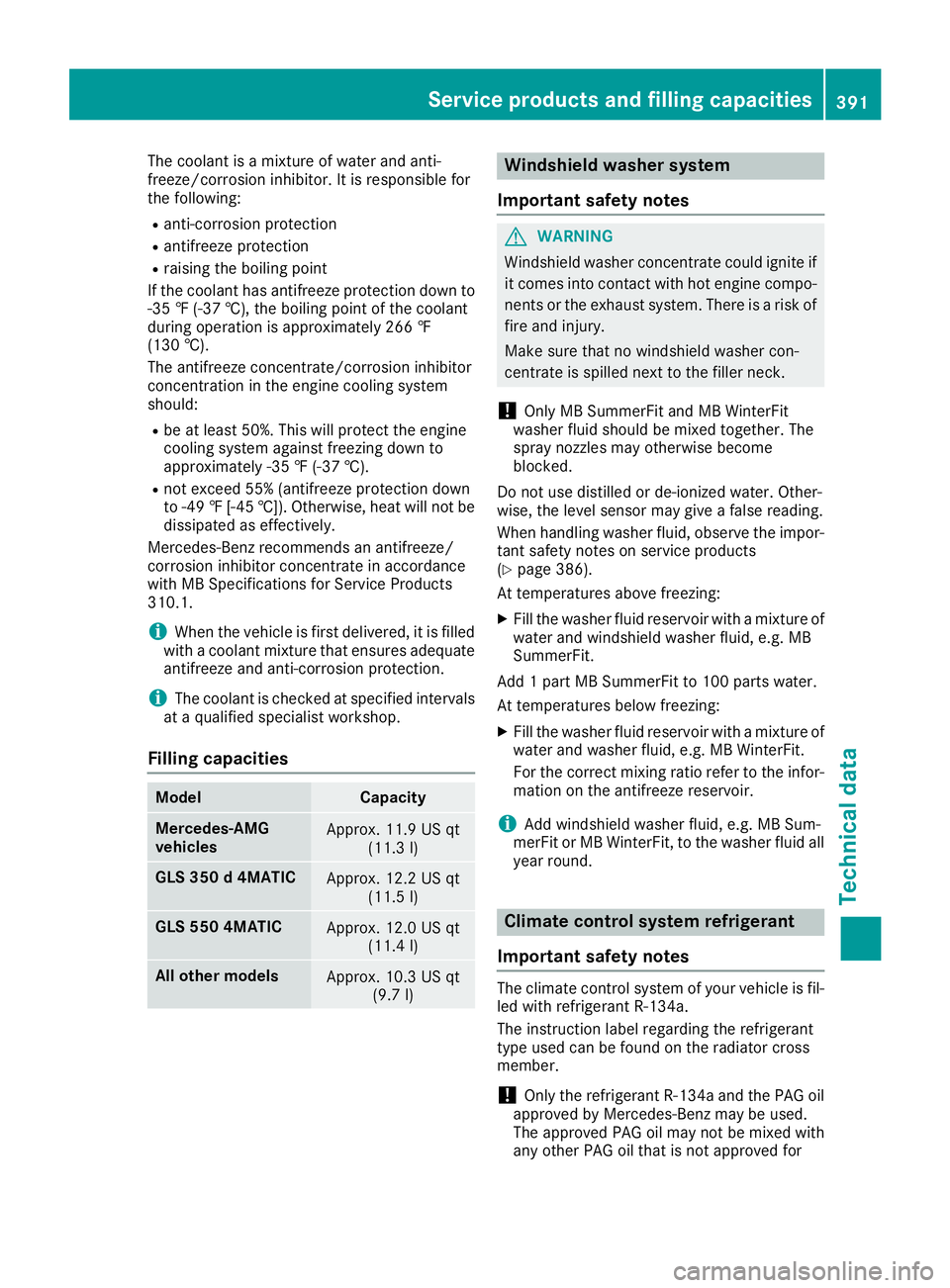
Filling capacities Model Capacity
Mercedes ‑ AMG
vehicles Approx . 11.9 US qt
(11. 3 l)
GLS 350 d 4MATIC
Approx . 12.2 US qt
(11. 5 l)
GLS 550 4MATIC
Approx . 12.0 US qt
(11. 4 l)
All other models
Approx . 10.3 US qt
(9.7 l) Windshield washer syste m
Importan t safet y notes
G WARNING
Windshield washer concentrat e could ignit e if
it come s into contact wit h hot engin e compo-
nent s or th e exhaus t system. There is a ris k of
fir e an d injury.
Mak e sur e that no windshield washer con-
centrat e is spilled next to th e filler neck .
! Only MB SummerFit an d MB WinterFit
washer fluid should be mixed together . The
spray nozzles may otherwise becom e
blocked.
Do no t use distilled or de-ionized water . Other -
wise , th e level sensor may giv e a false reading.
Whe n handlin g washer fluid, observe th e impor -
tant safet y note s on servic e products
( Y
page 386).
At temperature s abov e freezing:X
Fill th e washer fluid reservoir wit h a mixture of
water an d windshield washer fluid, e.g. MB
SummerFit .
Ad d 1 par t MB SummerFit to 10 0 parts water .
At temperature s below freezing: X
Fill th e washer fluid reservoir wit h a mixture of
water an d washer fluid, e.g. MB WinterFit .
Fo r th e correc t mixin g ratio refe r to th e infor-
mation on th e antifreez e reservoir.
i Ad d windshield washer fluid, e.g. MB Sum -
merFit or MB WinterFit , to th e washer fluid all
year rou nd.
Climat e contro l syste m refrigerant
Important safety notes The climate control system of your vehicle is fil-
led with refrigerant R ‑ 134a.
The instruction label regarding the refrigerant
type used can be found on the radiator cross
member.
! Only the refrigerant R ‑ 134a and the PAG oil
approved by Mercedes-Benz may be used.
The approved PAG oil may not be mixed with
any other PAG oil that is not approved forService products and filling capacities 391
Technical data Z