roof MERCEDES-BENZ GLS 2019 Owner's Guide
[x] Cancel search | Manufacturer: MERCEDES-BENZ, Model Year: 2019, Model line: GLS, Model: MERCEDES-BENZ GLS 2019Pages: 398, PDF Size: 7.3 MB
Page 374 of 398
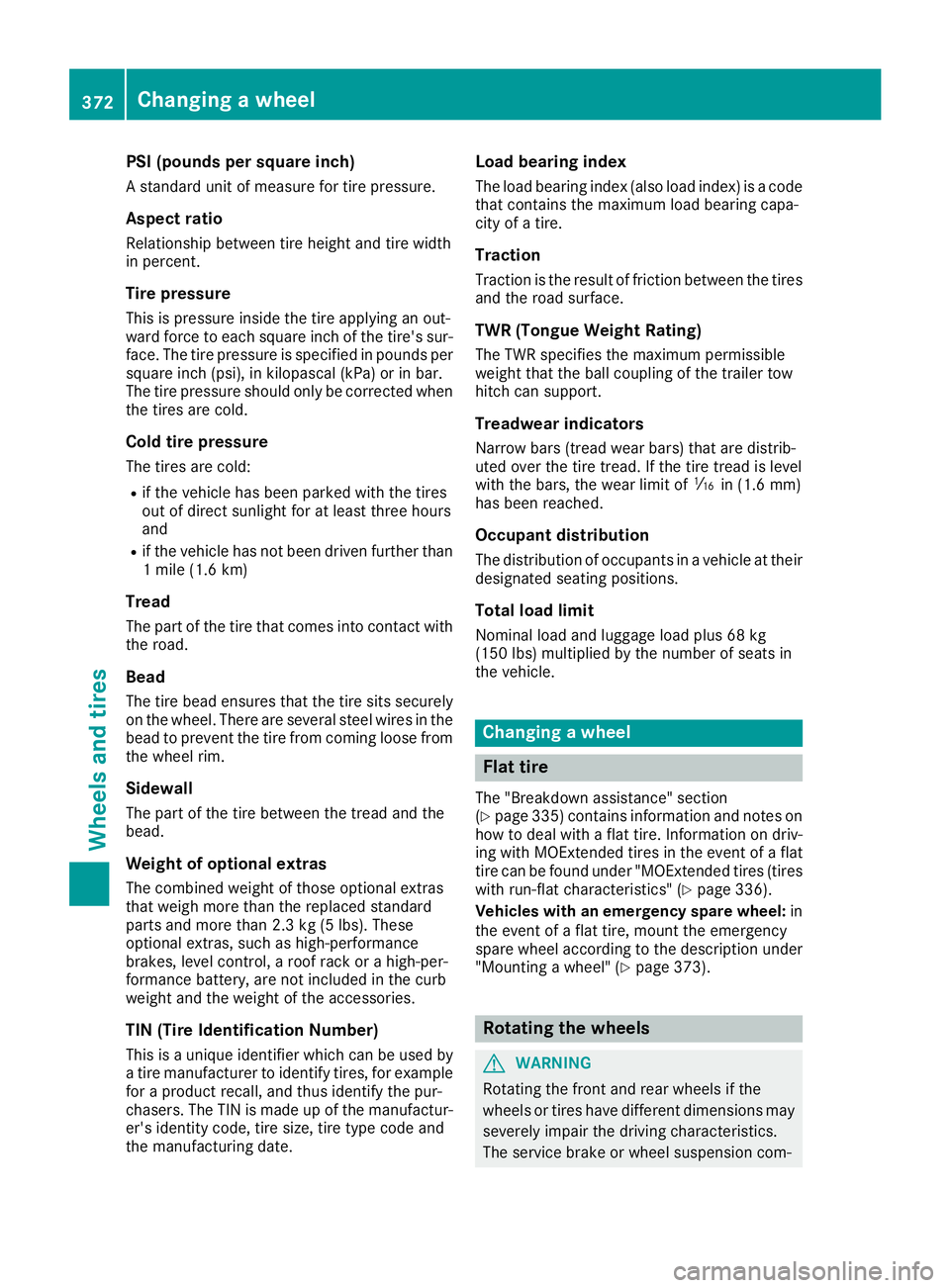
PSI (pounds per square inch)
A standard unit of measure for tire pressure.
Aspect ratio
Relationship between tire height and tire width
in percent.
Tire pressure
This is pressure inside the tire applying an out-
ward force to each square inch of the tire's sur-
face. The tire pressure is specified in pounds per
square inch (psi), in kilopascal (kPa) or in bar.
The tire pressure should only be corrected when
the tires are cold.
Cold tire pressure
The tires are cold:
R if the vehicle has been parked with the tires
out of direct sunlight for at least three hours
and
R if the vehicle has not been driven further than
1 mile (1.6 km)
Tread
The part of the tire that comes into contact with
the road.
BeadThe tire bead ensures that the tire sits securely
on the wheel. There are several steel wires in the
bead to prevent the tire from coming loose from the wheel rim.
Sidewall The part of the tire between the tread and the
bead.
Weight of optional extras The combined weight of those optional extras
that weigh more than the replaced standard
parts and more than 2.3 kg (5 lbs). These
optional extras, such as high-performance
brakes, level control, a roof rack or a high-per-
formance battery, are not included in the curb
weight and the weight of the accessories.
TIN (Tire Identification Number) This is a unique identifier which can be used by
a tire manufacturer to identify tires, for example for a product recall, and thus identify the pur-
chasers. The TIN is made up of the manufactur-
er's identity code, tire size, tire type code and
the manufacturing date. Load bearing index
The load bearing index (also load index) is a code that contains the maximum load bearing capa-
city of a tire.
Traction
Traction is the result of friction between the tires and the road surface.
TWR (Tongue Weight Rating)
The TWR specifies the maximum permissible
weight that the ball coupling of the trailer tow
hitch can support.
Treadwear indicators Narrow bars (tread wear bars) that are distrib-
uted over the tire tread. If the tire tread is level
with the bars, the wear limit of 00CDin (1.6 mm)
has been reached.
Occupant distribution
The distribution of occupants in a vehicle at their designated seating positions.
Total load limit Nominal load and luggage load plus 68 kg
(150 lbs) multiplied by the number of seats in
the vehicle. Changing a wheel
Flat tire
The "Breakdown assistance" section
(Y page 335) contains information and notes on
how to deal with a flat tire. Information on driv-
ing with MOExtended tires in the event of a flat
tire can be found under "MOExtended tires (tires with run-flat characteristics" (Y page 336).
Vehicles with an emergency spare wheel: in
the event of a flat tire, mount the emergency
spare wheel according to the description under "Mounting a wheel" (Y page 373). Rotating the wheels
G
WARNING
Rotating the front and rear wheels if the
wheels or tires have different dimensions may severely impair the driving characteristics.
The service brake or wheel suspension com- 372
Changing a wheelWheels and tires
Page 384 of 398
Information regarding technical data
i The data stated here specifically refers to a
vehicle with standard equipment. Consult an
authorized Mercedes-Benz Center for the
data for all vehicle variants and trim levels. Vehicle electronics
Installing wireless devices and mobile
phones G
WARNING
The electromagnetic radiation from two-way
radios can interfere with the vehicle electron-
ics if two-way radios are manipulated or ret-
rofitted incorrectly. This could jeopardize the
operating safety of the vehicle. There is a risk of an accident.
You should have all work on electrical and
electronic components carried out at a quali-
fied specialist workshop. G
WARNING
If you incorrectly operate two-way radios in
the vehicle, the electromagnetic radiation
may interfere with the vehicle electronics, for example if:
R the two-way radio is not connected to an
exterior antenna
R the exterior antenna is not correctly moun-
ted or is not low-reflection
This could jeopardize the operating safety of
the vehicle. There is a risk of an accident.
Have the low-reflection exterior antenna
installed at a qualified specialist workshop.
Always connect two-way radios to the low-
reflection exterior antenna when operating in the vehicle.
! The operating permit may be invalidated if
the instructions for installation and use of
two-way radios are not observed. In particular, the following requirements must
be complied with:
R only approved wavebands may be used
R observe the maximum permissible output
in these wavebands
R only approved antenna positions may be
used
Excessive levels of electromagnetic radiation
may cause damage to your health and the health of others. Using an exterior antenna takes into
account current scientific discussions relating
to the possible health hazards that may result
from electromagnetic fields.
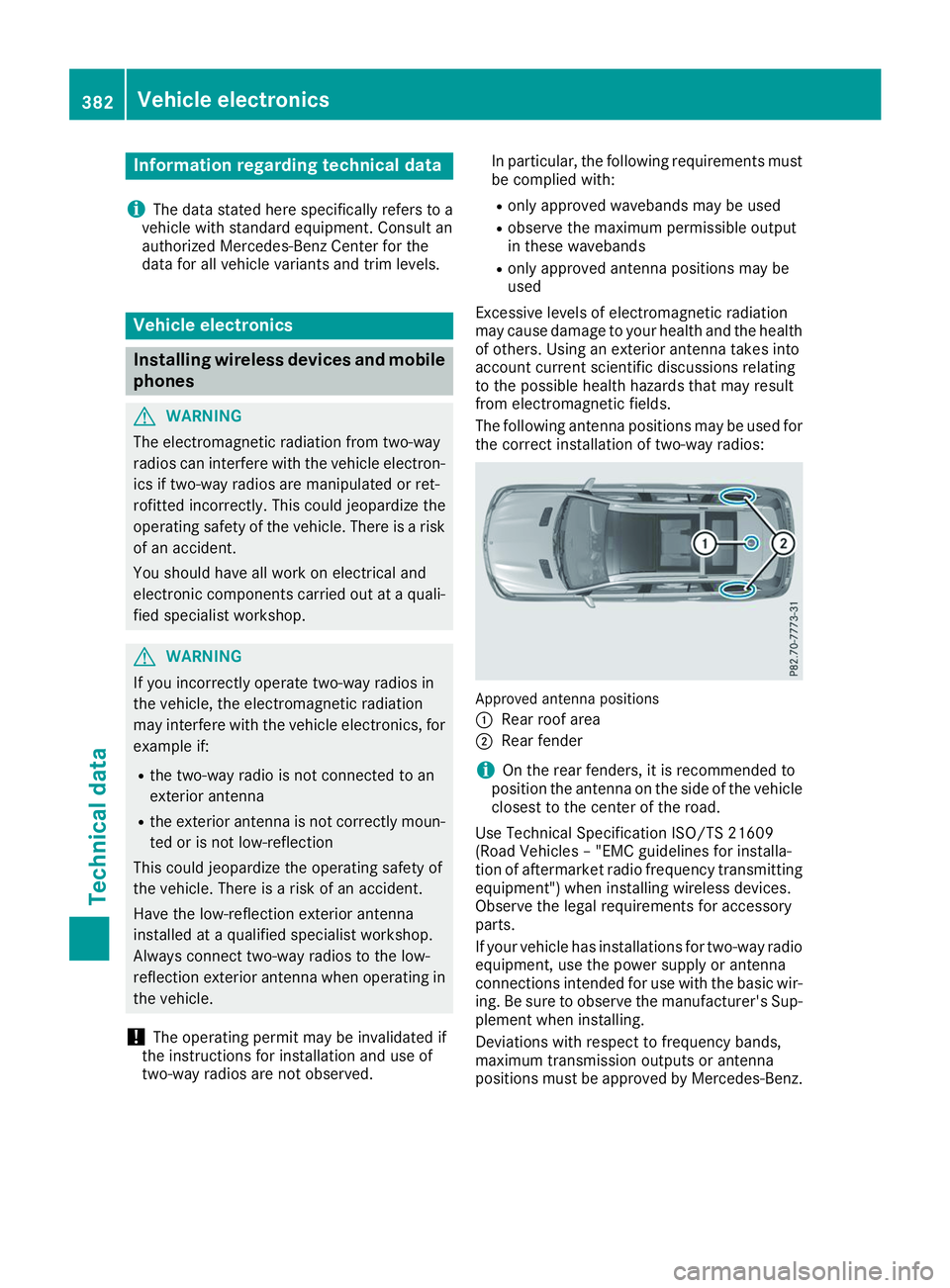
The following antenna positions may be used for
the correct installation of two-way radios: Approved antenna positions
0043
Rear roof area
0044 Rear fender
i On the rear fenders, it is recommended to
position the antenna on the side of the vehicle
closest to the center of the road.
Use Technical Specification ISO/TS 21609
(Road Vehicles – "EMC guidelines for installa-
tion of aftermarket radio frequency transmitting
equipment") when installing wireless devices.
Observe the legal requirements for accessory
parts.
If your vehicle has installations for two-way radio
equipment, use the power supply or antenna
connections intended for use with the basic wir-
ing. Be sure to observe the manufacturer's Sup- plement when installing.
Deviations with respect to frequency bands,
maximum transmission outputs or antenna
positions must be approved by Mercedes-Benz. 382
Vehicle electronicsTechnical data
Page 392 of 398
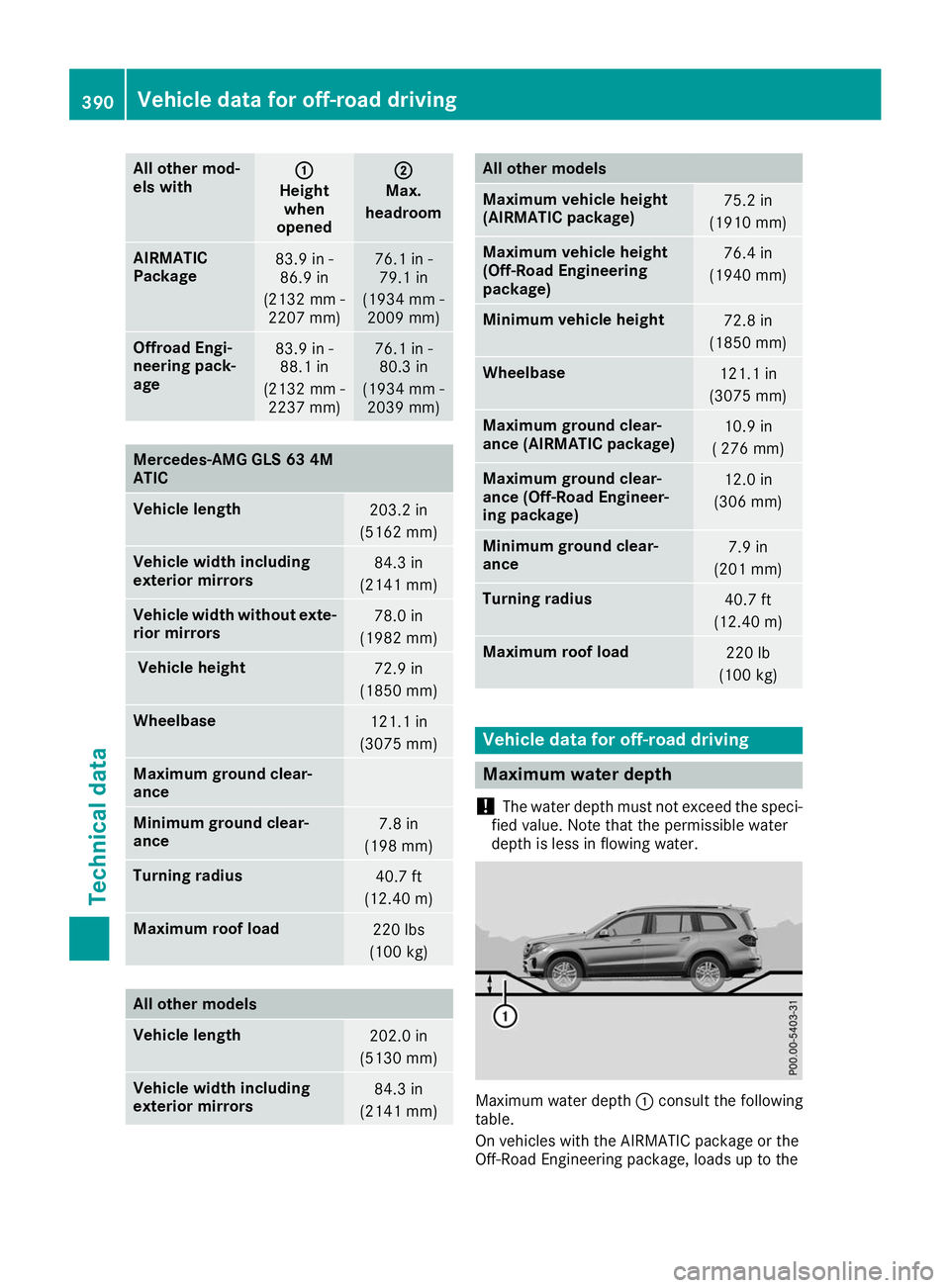
All other mod-
els with 0043
0043
Height when
opened 0044
0044
Max.
headroom AIRMATIC
Package
83.9 in -
86.9 in
(2132 mm - 2207 mm) 76.1 in -
79.1 in
(1934 mm - 2009 mm) Offroad
Engi-
neering pack-
age 83.9 in -
88.1 in
(2132 mm - 2237 mm) 76.1 in -
80.3 in
(1934 mm - 2039 mm) Merc
edes‑AMG GLS 63 4M
ATIC Vehicle length
203.2 in
(5162 mm) Vehicle width including
exterior mirrors
84.3 in
(2141 mm) Vehicle width without exte-
rior mirrors 78.0 in
(1982 mm) Vehicle height
72.9 in
(1850 mm) Wheelbase
121.1 in
(3075 mm) Maximum ground clear-
ance
Minimum ground clear-
ance
7.8 in
(198 mm) Turning radius
40.7 ft
(12.40 m) Maximum roof load
220 lbs
(100 kg) All other models
Vehicle length
202.0 in
(5130 mm) Vehicle width including
exterior mirrors
84.3 in
(2141 mm) All other models
Maximum vehicle height
(AIRMATIC package)
75.2 in
(1910 mm) Maximum vehicle height
(Off-Road Engineering
package) 76.4 in
(1940 mm) Minimum vehicle height
72.8 in
(1850 mm) Wheelbase
121.1 in
(3075 mm) Maximum ground clear-
ance (AIRMATIC package)
10.9 in
( 276 mm) Maximum ground clear-
ance (Off-Road Engineer-
ing package)
12.0 in
(306 mm) Minimum ground clear-
ance
7.9 in
(201 mm) Turning radius
40.7 ft
(12.40 m) Maximum roof load
220 lb
(100 kg) Vehicle data for off-road driving
Maximum water depth
! The water depth must not exceed the speci-
fied value. Note that the permissible water
depth is less in flowing water. Maximum water depth
0043consult the following
table.
On vehicles with the AIRMATIC package or the
Off-Road Engineering package, loads up to the 390
Vehicle data for off-road drivingTechnical data