Winter MERCEDES-BENZ GLS-Class SUV 2017 X166 Owner's Manual
[x] Cancel search | Manufacturer: MERCEDES-BENZ, Model Year: 2017, Model line: GLS-Class SUV, Model: MERCEDES-BENZ GLS-Class SUV 2017 X166Pages: 390, PDF Size: 9.71 MB
Page 5 of 390
Care .....................................................324
Breakdown assistance .....................331
Where will I find...? .............................. 331
Flat tire ................................................ 331
Battery (vehicle) .................................. 336
Jump-starting ....................................... 338
Towing and tow-starting ......................3 41
Fuses ................................................... 343
Wheels and tires ............................... 346
Important safety notes ........................ 346
Operation ............................................ 346
Winter operation .................................. 348
Tire pressure ....................................... 349
Loading the vehicle .............................. 356
All about wheels and tires ................... 359
Changing a wheel ................................ 366
Wheel and tire combinations ...............3 71
Emergency spare wheel ....................... 372
Technical data ................................... 376
Information regarding technical data ... 376
Vehicle electronics .............................. 376
Identification plates .............................3 77
Service products and filling capaci-
ties ...................................................... 378
Vehicle data ......................................... 384
Vehicle data for off-road driving .......... 385
Trailer tow hitch ................................... 387
Contents3
Page 12 of 390
HOLD function ............................... 185
Lane Keeping Assist ...................... 209
Level control (vehicle with the Off-
Road Engineering package) ........... 182
Rear view camera .......................... 197
Traffic Sign Assist .......................... 206
Driving tips
Automatic transmission ................. 149
Brakes ........................................... 164
Break-in period .............................. 137
Distance Pilot DISTRONIC ............. 180
Downhill gradient ........................... 164
Drinking and driving ....................... 163
Driving in winter ............................. 167
Driving on flooded roads ................ 166
Driving on sand .............................. 170
Driving on wet roads ...................... 166
Driving over obstacles ................... 170
Exhaust check ............................... 163
Fuel ................................................ 162
General .......................................... 162
Hydroplaning ................................. 166
Icy road surfaces ........................... 167
Limited braking efficiency on sal-
ted roads ....................................... 165
Off-road driving .............................. 168
Off-road fording ............................. 167
Snow chains .................................. 348
The first 1000 miles (1500 km) ..... 137
Tire ruts ......................................... 170
Towing a trailer .............................. 222
Traveling uphill ............................... 171
Wet road surface ........................... 165
DSR (Downhill Speed Regulation)
Display message ............................ 263
Function/notes ............................. 216
DVD video
Operating (on-board computer) ..... 235
see also Digital Operator's Man-
ual .................................................. 287
DYNAMIC SELECT controller
Automatic transmission ................. 145
E
EASY-ENTRY featureActivating/deactivating ................. 240
Function/notes ............................. 106 EASY-EXIT feature
Crash-responsive ........................... 107
Function/notes ............................. 106
Switching on/off ........................... 240
EBD (electronic brake force distri-
bution)
Display message ............................ 247
Function/notes ................................ 69
ECO display
Function/notes ............................. 163
On-board computer ....................... 232
ECO start/stop function
Automatic engine start .................. 143
Automatic engine switch-off .......... 142
Deactivating/activating ................. 143
General information ....................... 142
Important safety notes .................. 142
Introduction ................................... 142
Electronic Stability Program
see ESP
®(Electronic Stability Program)
Emergency
Automatic measures after an acci-
dent ................................................. 56
Emergency release
Driver's door .................................... 81
Vehicle ............................................. 81
Emergency spare wheel
General notes ................................ 372
Important safety notes .................. 372
Removing ....................................... 373
Storage location ............................ 373
Stowing .......................................... 373
Emergency Tensioning Devices
Activation ......................................... 53
Emergency unlocking
Tailgate ............................................ 85
Emissions control
Service and warranty information .... 26
Engine
Check Engine warning lamp ........... 283
Display message ............................ 257
ECO start/stop function ................ 142
Engine number ............................... 378
Irregular running ............................ 144
Jump-starting ................................. 338
Starting (important safety notes) ... 139
Starting problems .......................... 144
10Index
Page 22 of 390
SocketsCenter console .............................. 306
General notes ................................ 306
Luggage compartment ...................3 07
Rear compartment ......................... 306
Sound
Switching on/off ........................... 288
Special seat belt retractor .................. 57
Specialist workshop ............................ 29
Speed, controlling
see Cruise control
Speedometer
Digital ............................................ 233
In the Instrument cluster ................. 34
Segments ...................................... 229
Selecting the display unit ...............2 38
Standing lamps
Display message ............................ 256
Switching on/off ........................... 113
Start/Stop button
Starting the engine ........................ 140
Start/stop function
see ECO start/stop function
Starting (engine) ................................ 139
STEER CONTROL .................................. 72
Steering
Display message ............................ 272
Steering Pilot
Activating/deactivating ................. 237
Display message ............................ 267
Steering wheel
Adjusting (electrically) ................... 106
Adjusting (manually) ...................... 105
Button overview ............................... 35
Buttons (on-board computer) ......... 230
Cleaning ......................................... 329
Important safety notes .................. 105
Steering wheel heating .................. 106
Storing settings (memory func-
tion) ............................................... 110
Steering wheel heating
Problem (malfunction) ................... 106
Switching on/off ........................... 106
Steering wheel paddle shifters ........ 150
Stopwatch (RACETIMER) ................... 241
Stowage areas ................................... 294 Stowage compartments
Armrest (under) ............................. 295
Center console .............................. 296
Center console (rear) ..................... 296
Cup holders ................................... 302
Eyeglasses compartment ............... 296
Glove box ....................................... 295
Important safety information ......... 294
Stowage net ................................... 296
Stowage ne t
....................................... 296
Summe
r tires
In winter ........................................ 348
Sun visor ............................................ 304
Suspension setting
AMG adaptive sport suspension
system ........................................... 189
Suspension settings
SETUP (on-board computer) .......... 241
SUV
(Sport Utility Vehicle) ....................... 28
Switching air-recirculation mode
on/off ................................................. 133
Switching on media mode
Via the device list .......................... 292
T
Tachometer ........................................ 229
Tailgate
Display message ............................ 271
Emergency unlocking ....................... 85
Important safety notes .................... 81
Limiting the opening angle ............... 85
Opening dimensions ...................... 384
Opening/closing (automatically
from inside) ...................................... 84
Opening/closing (automatically
from outside) ................................... 83
Opening/closing (from outside) ....... 82
Power closing .................................. 81
Tank
see Fuel tank
Tank content
Fuel gauge ....................................... 34
Technical data
Capacities ...................................... 378
Information .................................... 376
Tires/wheels ................................. 371
20Index
Page 24 of 390
Labeling (overview) ........................ 361
Load bearing index (definition) ...... 366
Load index .....................................363
Load index (definition) ................... 365
M+S tires ....................................... 348
Maximum load on a tire (defini-
tion) ............................................... 365
Maximum loaded vehicle weight
(definition) ..................................... 365
Maximum permissible tire pres-
sure (definition) .............................3 65
Maximum tire load ......................... 363
Maximum tire load (definition) ....... 365
MOExtended tires .......................... 348
Optional equipment weight (defi-
nition) ............................................ 366
PSI (pounds per square inch) (def-
inition) ...........................................3 65
Replacing ....................................... 366
Service life ..................................... 347
Sidewall (definition) ....................... 366
Snow chains .................................. 348
Speed rating (definition) ................ 365
Storing ...........................................3 67
Structure and characteristics
(definition) ..................................... 364
Summer tires in winter .................. 348
Temperature .................................. 360
TIN (Tire Identification Number)
(definition) ..................................... 366
Tire bead (definition) ......................3 65
Tire pressure (definition) ................ 365
Tire pressures (recommended) ...... 364
Tire size (data) ............................... 371
Tire size designation, load-bearing
capacity, speed rating .................... 361
Tire tread ....................................... 347
Tire tread (definition) ..................... 365
Total load limit (definition) ............. 366
Traction ......................................... 360
Traction (definition) ....................... 366
Tread wear ..................................... 360
TWR (permissible trailer drawbar
noseweig ht) (
definition) ................. 366
Uniform Tire Quality Grading
Standards ...................................... 359
Uniform Tire Quality Grading
Standards (definition) .................... 364 Wear indicator (definition) ............. 366
Wheel and tire combination ........... 371
Wheel rim (definition) .................... 364
see Flat tire
Tool
see Vehicle tool kit
Top Tether ............................................ 60
Tow-starting
Emergency engine starting ............ 343
Important safety notes .................. 341
Towing a trailer
Axle load, permissible .................... 387
Cleaning the trailer tow hitch ......... 329
Coupling up a trailer ...................... 225
Decoupling a trailer ....................... 226
Driving tips .................................... 222
ESP
®(Electronic Stability Pro-
gram) ............................................... 68
Important safety notes .................. 221
Installing the ball coupling ............. 223
Lights display message .................. 256
Mounting dimensions .................... 387
Parking Assist PARKTRONIC .......... 190
Power supply ................................. 227
Pulling away with a trailer .............. 141
Removing the ball coupling ............ 227
Trailer loads ................................... 387
Towing away
Important safety guidelines ........... 341
Installing the towing eye ................ 342
Notes for 4MATIC vehicles ............ 343
Removing the towing eye ............... 342
Transporting the vehicle ................ 343
With both axles on the ground ....... 342
Towing eye ......................................... 331
Traffic reports
see also Digital Operator's Man-
ual .................................................. 287
Traffic Sign Assist
Display message ............................ 264
Function/notes ............................. 206
Important safety notes .................. 206
Instrument cluster display ............. 206
Trailer coupling
see Towing a traile r
Trai
ler loads and drawbar nose-
weights ............................................... 227
22Index
Page 26 of 390
VideoOperating the DVD ......................... 235
see also Digital Operator's Man-
ual .................................................. 287
VIN ...................................................... 377
Seat ............................................... 378
Type plate ...................................... 377
W
Warning and indicator lamps ABS ................................................ 277
Brakes ........................................... 276
Check Engine ................................. 283
Coolant .......................................... 283
Distance Pilot DISTRONIC ............. 285
Distance warning ........................... 285
ESP
®.............................................. 279
ESP®OFF ....................................... 280
Fuel tank ........................................ 283
Overview .......................................... 34
Parking brake ................................ 282
PASSENGER AIR BAG ...................... 42
Reserve fuel ................................... 283
Restraint system ............................ 282
Seat belt ........................................ 275
Tire pressure monitor .................... 286
Warranty .............................................. 26
Washer fluid
Display message ............................ 273
Weather display (COMAND)
see also Digital Operator's Man-
ual .................................................. 287
Wheel and tire combinations
Tires ............................................... 371
Wheel bolt tightening torque ........... 370
Wheel chock ...................................... 367
Wheels
Changing a wheel .......................... 366
Checking ........................................ 346
Cleaning ......................................... 326
Emergency spare wheel ................. 372
Important safety notes .................. 346
Information on driving .................... 346
Interchanging/changing ................ 366
Mounting a new wheel ................... 369
Mounting a wheel .......................... 367
Overview ........................................ 346 Removing a wheel .......................... 369
Snow chains .................................. 348
Storing ........................................... 367
Tightening torque ........................... 370
Wheel size/tire size ....................... 371
Window curtain air bag
Display message ............................ 253
Operation ......................................... 48
Windows
see Side windows
Windshield
Defrosting ...................................... 132
Windshield washer fluid
see Windshield washer system
Windshield washer system
Adding washer fluid ....................... 322
Important safety notes .................. 383
Windshield wipers
Problem (malfunction) ................... 122
Rear window wiper ........................ 120
Replacing the wiper blades ............ 120
Switching on/off ........................... 119
Winter drivin
g
Slippery road surfaces ................... 167
Winter operation
Overview ........................................ 348
Radiator cover ............................... 320
Winter tires
M+S tires ....................................... 348
Wiper blades
Cleaning ......................................... 327
Replacing ....................................... 120
Replacing (rear window) ................ 121
Replacing (windshield) ................... 121
Wooden trim (cleaning instruc-
tions) .................................................. 330
Workshop
see Qualified specialist workshop
Z
ZONE functionSwitching on/off ........................... 132
24Index
Page 46 of 390
cle. The child restraint system must be appro-
priate to the age, weight and size of the child
Ralways observe the instructions and safety
notes on "Children in the vehicle"
(
Ypage 57) in addition to the child restraint
system manufacturer's installation and oper-
ating instructions
Rbe sure to observe the instructions and safety
notes on the "Occupant classification system
(OCS)" (
Ypage 48)
GWARNING
The seat belts may not perform their intended protective function if:
Rthey are damaged, modified, extremely
dirty, bleached or dyed
Rthe seat belt buckle is damaged or
extremely dirty
Rthe Emergency Tensioning Devices, belt
anchorages or inertia reels have been modi-
fied.
Seat belts may be damaged in an accident,
although the damage may not be visible, e.g.
due to splinters of glass. Modified or damaged
seat belts may tear or fail, e.g. in an accident.
Modified Emergency Tensioning Devices
could accidentally trigger or fail to deploy
when necessary. This poses an increased risk
of injury or even fatal injury.
Never modify the seat belts, Emergency Ten-
sioning Devices, belt anchorages and inertia
reels. Make sure that the seat belts are
undamaged, not worn out and clean. Follow-
ing an accident, have the seat belts checked
immediately at a qualified specialist work-
shop.
Only use seat belts that have been approved for
your vehicle by Mercedes-Benz.
Proper use of the seat belts
Observe the safety notes on the seat belt
(Ypage 43).
All vehicle occupants must be wearing the seat
belt correctly before beginning the journey. Also
make sure that all vehicle occupants are always
wearing the seat belt correctly while the vehicle
is in motion. When fastening the seat belt, always make sure
that:
Rthe seat belt tongue is only inserted to the belt
buckle belonging to that seat.
Rthe seat belt is tight across your body.
Avoid wearing bulky clothing, e.g. a winter
coat.
Rthe seat belt is not twisted.
Only then can the forces which occur be dis-
tributed over the area of the belt.
Rthe shoulder section of the belt is always
routed across the center of your shoulder.
The shoulder section of the belt must not
come into contact with your neck or be routed
under your arm. Where possible, adjust the
seat belt to the appropriate height.
Rthe lap belt passes tightly and as low down as
possible across your lap.
The lap belt must always be routed across
your hip joints and not across your abdomen.
This applies particularly to pregnant women.
If necessary, push the lap belt down to your
hip joint and pull it tight using the shoulder
section of the belt.
Rthe seat belt is not routed across sharp, poin-
ted or fragile objects.
If you have su
ch i
tems located on or in your
clothing, e.g. pens, keys or eyeglasses, store
these in a suitable place.
Ronly one person is using a seat belt at a time.
Infants and children must never travel sitting
on the lap of a vehicle occupant. In the event of an accident, they could be crushed
between the vehicle occupant and seat belt.
Robjects are never secured with a seat belt if
the seat belt is also being used by one of the
vehicle's occupants.
Also ensure that there are never objects
between a person and the seat, e.g. cushions.
Seat belts are only intended to secure and
restrain vehicle occupants. Always observe the
"Loading guidelines" for securing objects, lug-
gage or loads (
Ypage 294).
Fastening and adjusting the seat belts
Observe the safety notes on the seat belt
(Ypage 43) and the notes on correct use of seat
belts (Ypage 44).
44Occupant safety
Safety
Page 65 of 390
Never leave animals unattended in the vehi-
cle. Always secure animals properly during
the journey, e.g. use a suitable animal trans-
port box.
Driving safety systems
Overview of driving safety systems
In this section, you will find information about
the following driving safety systems:
RABS (Anti-lock Braking System)
(Ypage 63)
RBAS ( Brake Assist System) (Ypage 64)
RActive Brake Assist (Ypage 64)
RESP®(Electronic StabilityProgram)
(Ypage 67)
REBD ( Electronic Brake force Distribution)
(Ypage 69)
RADAPTIVE BRAKE (Ypage 69)
RActive Brake Assist with cross-traffic function (Ypage 69)
RSTEER CONTROL (Ypage 72)
Important safety notes
If you fail to adapt your driving style or if you are
inattentive, the driving safety systems can nei-
ther reduce the risk of an accident nor overridethe laws of physics. Driving safety systems are
merely aids designed to assist driving. You are
responsible for maintaining the distance to the
vehicle in front, for vehicle speed, for braking in
good time, and for staying in lane. Always adapt
your driving style to suit the prevailing road and
weather conditions and maintain a safe distance
from the vehicle in front. Drive carefully.
The driving safety systems described only work
as effectively as possible when there is ade-
quate contact between the tires and the road
surface. Pay particular attention to the informa-
tion regarding tires, recommended minimum
tire tread depths etc. in the "Wheels and tires"
section (
Ypage 346).
In wintry driving conditions, always use winter
tires (M+S tires) and if necessary, snow chains.
Only in this way will the driving safety systems
described in this section work as effectively as
possible.
ABS (Anti-lock Braking System)
General information
ABS regulates brake pressure in such a way that
the wheels do not lock when you brake. This
allows you to continue steering the vehicle when
braking.
The ! ABS warning lamp in the instrument
cluster lights up when the ignition is switched
on. It goes out when the engine is running.
ABS works from a speed of about 5 mph
(8 km/h), regardless of road-surface conditions.
ABS works on slippery surfaces, even when you
only brake gently.
Important safety notes
iObserve the "Important safety notes" sec-
tion (Ypage 63).
GWARNING
If ABS is faulty, the wheels could lock when
braking. The steerability and braking charac-
teristics may be severely impaired. Addition-
ally, further driving safety systems are deac-
tivated. There is an increased danger of skid-
ding and accidents.
Drive on carefully. Have ABS checked imme-
diately at a qualified specialist workshop.
When ABS is malfunctioning, other systems,
including driving safety systems, will also
become inoperative. Observe the information
on the ABS warning lamp (
Ypage 277) and dis-
play messages which may be shown in the
instrument cluster (
Ypage 245).
Braking
XIf ABS intervenes: continue to depress the
brake pedal vigorously until the braking sit-
uation is over.
XTo make a full brake application: depress
the brake pedal with full force.
If ABS intervenes when braking, you will feel a
pulsing in the brake pedal.
The pulsating brake pedal can be an indication
of hazardous road conditions, and functions as a reminder to take extra care while driving.
Driving safety systems63
Safety
Z
Page 169 of 390
Off-road fording
!Under no circumstances should you accel-
erate before entering the water. The bow
wave could cause water to enter and damage
the engine and other assemblies.
!Do not open any of the vehicle's doors while
fording. Otherwise, water could get into the
vehicle interior and damage the vehicle's
electronics and interior equipment.
REstablish how deep the water is and the char-
acteristics of the body of water before ford-
ing.
RSelect the highest possible vehicle level.
RShift to a lower gear using the left-hand steer-
ing wheel paddle shifter.
RAvoid high engine speeds.
REnter and exit the water at a flat place and at
a steady walking pace.
RDrive slowly and at an even speed through the
water.
REnsure that a bow wave does not form as you
drive.
RDo not stop and do not switch off the engine.
Water offers a high degree of resistance, and
the ground is slippery and in some cases
unstable. Therefore, it is difficult and danger-
ous to pull away in the water.
RClean any mud from the tire tread after ford-
ing.
RApply the brakes to dry them after fording.
Always observe the fording depth values
(
Ypage 385).
Winter driving
GWARNING
If you shift down on a slippery road surface in an attempt to increase the engine's braking
effect, the drive wheels could lose their grip.
There is an increased danger of skidding and
accidents.
Do not shift down for additional engine brak-
ing on a slippery road surface.
GDANGER
If the exhaust pipe is blocked or adequate
ventilation is not possible, poisonous gases
such as carbon monoxide (CO) may enter the vehicle. This is the case, e.g. if the vehicle
becomes trapped in snow. There is a risk of
fatal injury.
If you leave the engine or the auxiliary heating
running, make sure the exhaust pipe and area
around the vehicle are clear of snow. To
ensure an adequate supply of fresh air, open a
window on the side of the vehicle that is not
facing into the wind.
Have your vehicle winter-proofed at a qualified
specialist workshop at the onset of winter.
Drive particularly carefully on slippery road sur-
faces. Avoid sudden acceleration, steering and
braking maneuvers. Do not use cruise control or
Distance Pilot DISTRONIC.
If the vehicle threatens to skid or cannot be
stopped when moving at low speed:
XShift the transmission to position N.
When driving in snow with or without snow
chains, select driving program Slippery
(
Ypage 145).
iVehicles with a diesel engine: do not
cover the radiator, e.g. with a protective
cover. The measuring function of the on-
board diagnosis system may otherwise pro-
vide inaccurate values. Some of these values
are required by law and must therefore always be accurate.
The outside temperature indicator is not
designed to serve as an ice-warning device and
is therefore unsuitable for that purpose.
Changes in the outside temperature are dis-
played after a short delay.
Indicated temperatures just above the freezing
point do not guarantee that the road surface is
free of ice. The road may still be icy, especially in
wooded areas or on bridges. You should pay
special attention to road conditions when tem-
peratures are around the freezing point.
For more information on driving with snow
chains, see (
Ypage 348).
For more information on driving with summer
tires, see (
Ypage 348).
Observe the notes in the "Changing a wheel"
section (
Ypage 366).
Driving tips167
Driving and parking
Z
Page 218 of 390
!A function or performance test should only
be carried out on a two-axle dynamometer.
Before you operate the vehicle on such a
dynamometer, please consult a qualified
workshop. You could otherwise damage the
drive train or the brake system.
iIn wintry driving conditions, the maximum
effect of 4MATIC can only be achieved if you
use winter tires (M+S tires), with snow chains
if necessary.
Further information about "Driving off-road"
(
Ypage 168).
DSR (Downhill Speed Regulation)
General notes
DSR is an aid to assist you when driving down-
hill. It keeps the speed of travel at the speed
selected on the on-board computer. The steeper
the downhill gradient, the greater the DSR brak- ing effect on the vehicle. When driving on flat
stretches of road or on an uphill gradient, the
DSR braking effect is minimal or nonexistent.
DSR controls the vehicle’s speed when it is acti-
vated and the transmission is in position D,Ror
N. You can drive at a higher or a lower speed
than that set on the on-board computer at any
time by accelerating or braking.
Important safety notes
GWARNING
If the speed driven and the set speed deviate and you activate DSR on a slippery road sur-
face, the wheels may lose traction. There is an
increased danger of skidding and accidents.
Before switching DSR on, please take into
consideration the road surface and the differ- ence between driving speed and the set
speed.
If you fail to adapt your driving style, DSR can
neither reduce the risk of accident nor override the laws of physics. DSR cannot take account of
road, weather and traffic conditions. DSR is only
an aid. You are responsible for the distance to
the vehicle in front, for vehicle speed, for brak-
ing in good time and for staying in your lane.
You are always responsible for keeping control
of the vehicle and for assessing whether the
downhill gradient can be managed. DSR may not always be able to keep to the set speed, depend- ing on road surface and tire conditions. Select a
set speed suitable for the prevailing conditions
and when necessary, apply the brakes manually.
Activating DSR
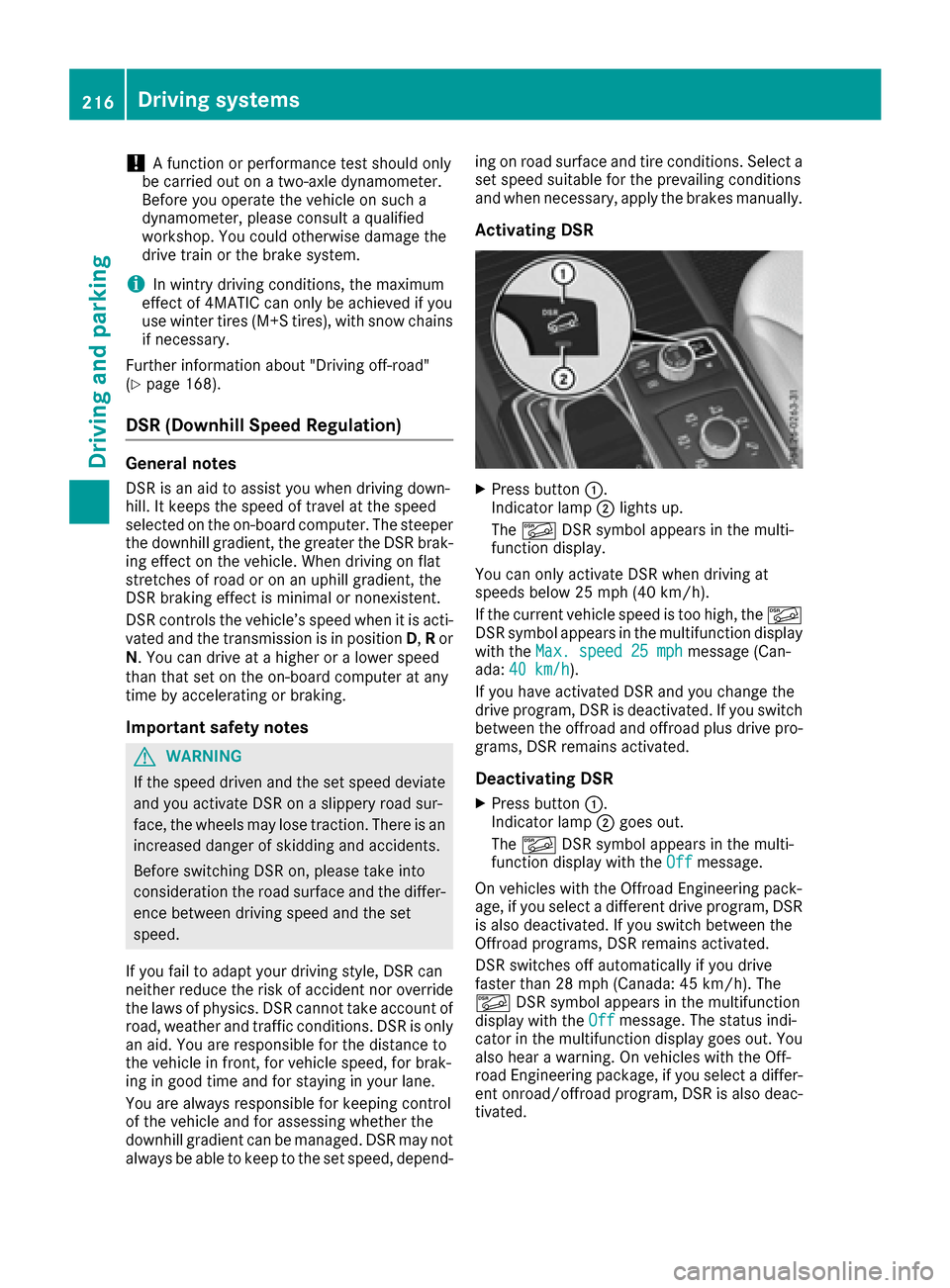
XPress button
:.
Indicator lamp ;lights up.
The à DSR symbol appears in the multi-
function display.
You can only activate DSR when driving at
speeds below 25 mph (40 km/h).
If the current vehicle speed is too high, the Ã
DSR symbol appears in the multifunction display
with the Max. speed 25 mph
message (Can-
ada: 40 km/h).
If you have activated DSR and you change the
drive program, DSR is deactivated. If you switch
between the offroad and offroad plus drive pro-
grams, DSR remains activated.
Deactivating DSR
XPress button :.
Indicator lamp ;goes out.
The à DSR symbol appears in the multi-
function display with the Off
message.
On vehicles with the Offroad Engineering pack-
age, if you select a different drive program, DSR is also deactivated. If you switch between the
Offroad programs, DSR remains activated.
DSR switches off automatically if you drive
faster than 28 mph (Canada: 45 km/h). The
à DSR symbol appears in the multifunction
display with the Off
message. The status indi-
cator in the multifunction display goes out. You
also hear a warning. On vehicles with the Off-
road Engineering package, if you select a differ-
ent onroad/offroad program, DSR is also deac-
tivated.
216Driving systems
Driving and parking
Page 322 of 390
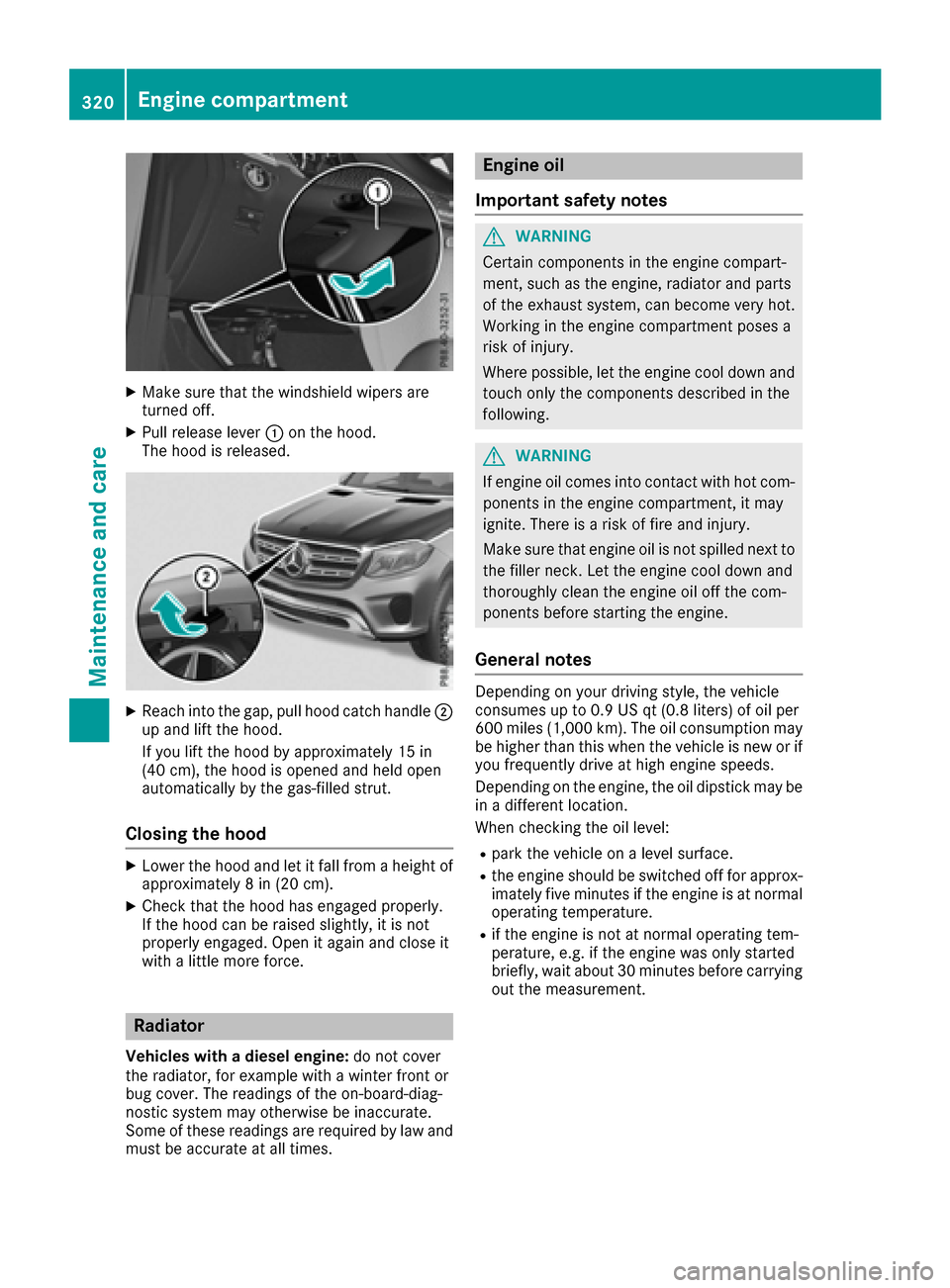
XMake sure that the windshield wipers are
turned off.
XPull release lever:on the hood.
The hood is released.
XReach into the gap, pull hood catch handle ;
up and lift the hood.
If you lift the hood by approximately 15 in
(40 cm), the hood is opened and held open
automatically by the gas-filled strut.
Closing the hood
XLower the hood and let it fall from a height of
approximately 8 in (20 cm).
XCheck that the hood has engaged properly.
If the hood can be raised slightly, it is not
properly engaged. Open it again and close it
with a little more force.
Radiator
Vehicles with a diesel engine: do not cover
the radiator, for example with a winter front or
bug cover. The readings of the on-board-diag-
nostic system may otherwise be inaccurate.
Some of these readings are required by law and
must be accurate at all times.
Engine oil
Important safety notes
GWARNING
Certain components in the engine compart-
ment, such as the engine, radiator and parts
of the exhaust system, can become very hot.
Working in the engine compartment poses a
risk of injury.
Where possible, let the engine cool down and touch only the components described in the
following.
GWARNING
If engine oil comes into contact with hot com- ponents in the engine compartment, it may
ignite. There is a risk of fire and injury.
Make sure that engine oil is not spilled next to
the filler neck. Let the engine cool down and
thoroughly clean the engine oil off the com-
ponents before starting the engine.
General notes
Depending on your driving style, the vehicle
consumes up to 0.9 US qt (0.8 liters) of oil per
600 miles (1,000 km). The oil consumption may
be higher than this when the vehicle is new or if
you frequently drive at high engine speeds.
Depending on the engine, the oil dipstick may be
in a different location.
When checking the oil level:
Rpark the vehicle on a level surface.
Rthe engine should be switched off for approx-
imately five minutes if the engine is at normal
operating temperature.
Rif the engine is not at normal operating tem-
perature, e.g. if the engine was only started
briefly, wait about 30 minutes before carrying
out the measurement.
320Engine compartment
Maintenance and care