engine MERCEDES-BENZ GLS SUV 2020 Owners Manual
[x] Cancel search | Manufacturer: MERCEDES-BENZ, Model Year: 2020, Model line: GLS SUV, Model: MERCEDES-BENZ GLS SUV 2020Pages: 549, PDF Size: 9.9 MB
Page 6 of 549
Light and sight
......................................... 15 6
Exterior lighting .......................................... 15 6
Interior lighting ...........................................1 63
Wi ndsc reen wipers and windscreen
wa sher sy stem ............................................ 16 5
Mir rors ........................................................ 17 0
Area pe rmeable toradio wav es on the
windscreen ................................................ .173
Infrared-reflective windscreen function ...... 173Climate control
......................................... 174
Overview of climate contro l systems ........... 174
Operating the climate control sy stem ......... 175 Driving and pa
rking ................................. 187
Driving ........................................................ 187
DY NA MIC SELECT switch ............................2 01
Au tomatic transmission .............................. 204
Tr ans fer case .............................................. 209
Fu nction of the 4MATIC ...............................2 11
Re fuelling .................................................... 211
Pa rking ........................................................ 217
Driving and driving sa fety sy stems .............2 24
Tr ailer hit ch................................................ 295 Bicycle
rack function .................................. 300
Ve hicle towing instructions ........................ .302 Instrument display and on-board
comp
uter.................................................. 304
No tes on the instrument display and on-
board computer .......................................... 304
Instrument display overview ...................... .305
Overview of the buttons on thesteering
wheel ..........................................................3 06
Operating the on-board computer .............. 306
Overview of what is shown on the multi‐
function display .......................................... 308
Head-up display .......................................... 308 MBUX multimedia sy
stem ....................... 311
Overview and operation .............................. 311
Sy stem settings .......................................... 320
Na vigation .................................................. 324
Te lephone .................................................. .330
Mercedes me and apps .............................. 333
Mercedes-Benz emer gency call sy stem ...... 342
Ra dio, media & TV...................................... 349
Sound settings ........................................... 355 Main
tenance and care ............................. 357
ASS YST PLUS service inter val display ........ 357
Engine compartment .................................. 358
Cleaning and care ...................................... .364 Breakdown assistance
............................372
Emergency ................................................. .372
Flat tyre ...................................................... 374
Battery (vehicle) ......................................... 380
To w- starting or towing away ....................... 385
Electrical fuses ........................................... 390 Wheels and tyres
..................................... 393
No tes on noise or unusual handling char‐
acteristics .................................................. .393
No tes on regular lyinspecting wheels and
tyres .......................................................... .393
No tes on snow chains ................................ 393
Ty re pressure .............................................. 394
Wheel change ............................................ .397
Emergency spare wheel .............................. 407
Collapsible spare wheel .............................. 409 Contents
3
Page 7 of 549
Te
ch nical data ........................................... 413
No tes on tech nical da ta.............................. 413
On-board electronics ................................... 413
Ra dio operating permits forve hicle com‐
ponents .......................................................4 15
Ve hicle identification plate, VIN and
engine number overview ............................ .415
Operating fluids .......................................... .417
Ve hicle data ................................................ 426
Tr ailer hit ch................................................ 430 Displ
aymessages and warning/indi‐
cator lamps .............................................. 433
Display messages ...................................... .433
Wa rning and indicator lamps ...................... 490 Index
......................................................... 5064
Contents
Page 14 of 549
1
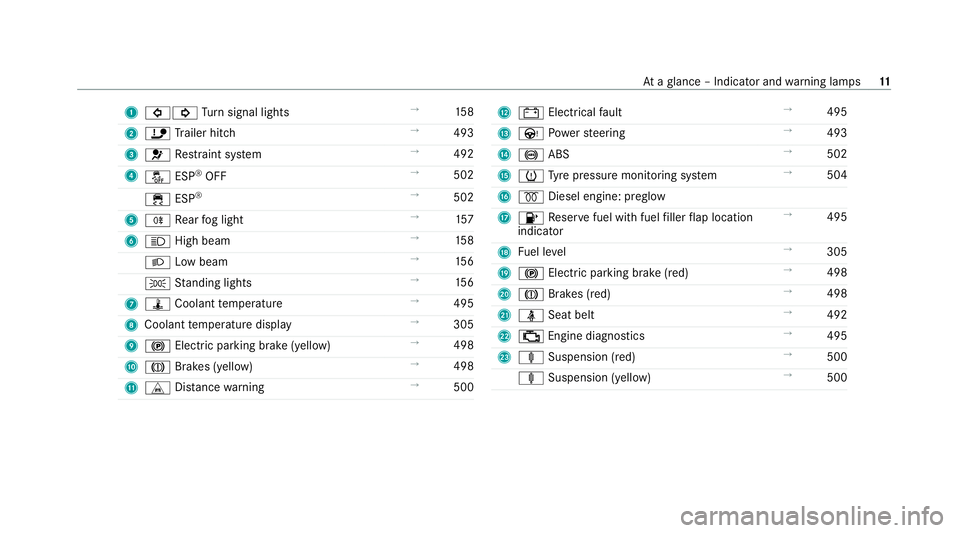
#! Turn signal lights →
15 8
2 ï Trailer hit ch →
493
3 6 Restra int sy stem →
492
4 å ESP®
OFF →
502
÷ ESP®
→
502
5 R Rear fog light →
157
6 K High beam →
15 8
L Low beam →
15 6
T Standing lights →
15 6
7 ÿ Coolant temp erature →
495
8 Coolant temp erature display →
305
9 ! Electric pa rking brake (yellow) →
498
A J Brakes (yellow) →
498
B L Distance warning →
500 C
# Electrical fault →
495
D Ù Powe rst eering →
493
E ! ABS →
502
F h Tyre pressure monitoring sy stem →
504
G % Diesel engine: preglow
H 8 Reser vefuel with fuel filler flap location
indicator →
495
I Fuel le vel →
305
J ! Electric parking brake (red) →
498
K J Brakes (red) →
498
L ü Seat belt →
492
M ; Engine diagnostics →
495
N ä Suspension (red) →
500
ä Suspension (yell ow) →
500 At
aglance – Indicator and warning lamps 11
Page 25 of 549
Pr
otection of the environment
+ ENVIRONMENTAL
NOTEEnvironmental
dama gedue tooperating conditions and
personal driving style The pollutant emission of
theve hicle is
directly related tothewa yyo u operate the
ve hicle.
Operate your vehicle in an environmentally
re sponsible manner tohelp pr otect the envi‐
ro nment. Please obser vethefo llowing rec‐
ommendations on ope rating conditions and
pe rsonal driving style.
Operating conditions: #
Make sure that the tyre pressure is cor‐
re ct. #
Do not car ryany unnecessary weight
(e.g. roof luggage rack s once you no
lon ger need them). #
Adhere tothe service inter vals.
A regularly serviced vehicle will contri b‐
ute toenvironmen tal pr otection. #
Alw ays ha vemaintenance workcar ried
out at a qualified specialist workshop.
Pe rsonal driving style: #
Do not depress the accelera tor pedal
when starting the engine. #
Do not warm upthe engine while the
ve hicle is stationar y. #
Drive carefully and maintain a suitable
di st ance from theve hicle in front. #
Avoid frequent, sudden acceleration
and braking. #
Change gear in good time and use each
ge ar on lyup toÔ of its maximum
engine speed. #
Switch off the engine in stationary traf‐
fi c, e.g. byusing the ECO start/ stop
function. #
Drive fuel-ef ficiently. Obser vethe ECO
display for a fuel-ef ficient driving style. Ta
ke -back of end-of-life vehicles
EU countries onl y:
Mercedes-Benz will take back your end-of-life
ve hicle for environment-friendly disposal in
accordance with the European Union(EU) End-
of-Life Vehicles Directive.
A network of vehicle take -ba ckpoints and dis‐
mantlers has been es tablished foryo uto return
yo ur vehicle. You can lea veit at any of these
points free of charge . This makes an impor tant
contribution toclosing there cycling circle and
conse rving resources.
Fo r fur ther information about there cycling and
disposal of end-of-li fevehicles, and theta ke-
back conditions, please visit the national
Mercedes-Benz website foryo ur count ry. 22
General no tes
Page 57 of 549

If an accident did not occur,
the pre-em ptive
measures that we retake n are reve rsed.
Sy stem limits
The sy stem will not initiate any action in thefo l‐
lowing situations:
R when reve rsing
or
R when theve hicle is towing a trailer and there
is a risk of a rear impact
The sy stem will not initiate any braking applica‐
tion in thefo llowing situations:
R whilst driving
or
R when entering or exiting a parking space
while using Active Parking Assist Fu
nction of PRE-SAFE ®
Impulse Side If an imminent side impact is de
tected, PRE-
SA FE®
Impulse Side can pre-emptively mo vethe
front seat vehicle occupant's upper body
to wa rdsth e cent reoftheve hicle. It does this by ra
pidly inflating an air cushion in the outer seat
side bols ter of the seat backrest on the side on
which the impact is anticipated. This increases
th e dis tance between the door and theve hicle
occupant.
If PRE-SAFE ®
Impulse Side has been deplo yed or
is faulty, thePRE-SAFE impulse side inoperative
See Owner's Manual( /page 434) display mes‐
sage appears. Au
tomatic measures af ter an accident
Depending on the type and se verity of the acci‐
dent, and depending on theve hicle's equipment,
th efo llowing measures can be implemen ted, for
ex ample:
R automatic braking (post-collision brake)
R activating the hazard warning lights
R triggering an automatic emer gency call
(/ page 344)
R switching off the engine
To restart theve hicle, switch the ignition off
and switch it back on (/ page188).
Depending on the type and se verity of the accident, it is possible
that theve hicle can
no longer be star ted.
R switching off the fuel supply
R unlocking theve hicle doors
R lowe ring the side windo ws
R displaying the emer gency guide in the multi‐
media sy stem display
R switching on the interior lighting
Fu nction of the post-collision brake
Depending on the accident situation, the post-
collision brake can minimise the se verity of a fur‐
th er collision or even avo id it.
If an accident is de tected, the post-collision
brake can implement automatic braking. When
th eve hicle has come toast andstill, the electric
parking brake is automatically applied.
The driver can cancel automatic braking bytak‐
ing thefo llowing actions:
R braking more stronglythan automatic brak‐
ing
R fully depressing the accelera tor pedal with
fo rce 54
Occupant saf ety
Page 89 of 549
R
Ifyo u are driving at a speed greaterth an
4 km/h.
If yo u ha veselected the automatic mode in the
multimedia sy stem and you manually extend the
ru nning boards when the doors are closed, the
ru nning boards will remain extended. Even if you
open a door and then close it again, theru nning
boards will remain extended. Automatic mode
will be reactivated on ly whenyou are driving at a
speed greater than 4 km/h. &
WARNING Risk of inju rywhen extending
or retracting theru nning boards
The running boards extend at the side during
ex tension. During retraction, theru nning
boards are integrated in the side skirt. Parts
of the body could become trapped. There
may be people in thera nge of mo vement.
There is a risk of injur y. #
Alw ays ensure that there are no people
within thera nge of mo vement of the
ru nning boards. *
NO
TEDama getotheru nning boards
du ring extension or retraction The
running boards extend at the side during
ex tension. During retraction, theru nning
boards are integrated in the side skirt. #
Make sure that there is suf ficient space
du ring extension and retraction. *
NO
TEDama getotheve hicle body or
underbody due tolow ground clearance The
running boards are attached totheve hi‐
cle body via the underbody. This limits the
ground clearance. #
Drive over obs tacles, su chaskerbs,
particula rly careful lyand slowl y. Obser
vethe cor responding display messages in
th e instrument clus ter (/ page 433). Extending and
retracting the running boards
via the multimedia sy stem Multimedia sy
stem:
4 © 5
Settings 5
Vehicle
5 SIDE RUNNING BOARD #
Select Extend orRetract .
Au tomatically extending and retracting the
ru nning boards #
Activate or deacti vate AUTOMATIC EXTEN-
SION .
% This equipment is available on lyfor
Mercedes-Maybach vehicles. Load compartment
Opening
the tailgate &
DANG ER Risk of exhaust gas poisoning
Combustion engines emit poisonous exhaust
ga ses such as carbon monoxide. Exhaust
ga ses can enter theve hicle interior if theta il‐ 86
Opening and closing
Page 90 of 549
gate
is open when the engine is running,
especially if theve hicle is in motion. #
Alw ays switch off the engine before
opening theta ilgate. #
Never drive with theta ilgate open. *
NO
TEDama getotheta ilgate caused by
obs tacles ab ovetheve hicle The
tailgate swings rear wa rds and upwards
when it is opened. #
Make sure that there is suf ficient space
behind and ab ovetheta ilgate. #
Ifth eta ilgate is unloc ked, pull theta ilgate
handle and release it again immediatel y.#
Vehicles with HANDS-FREE ACCESS: make
a kicking mo vement with your foot below the
bumper (/ page 89). #
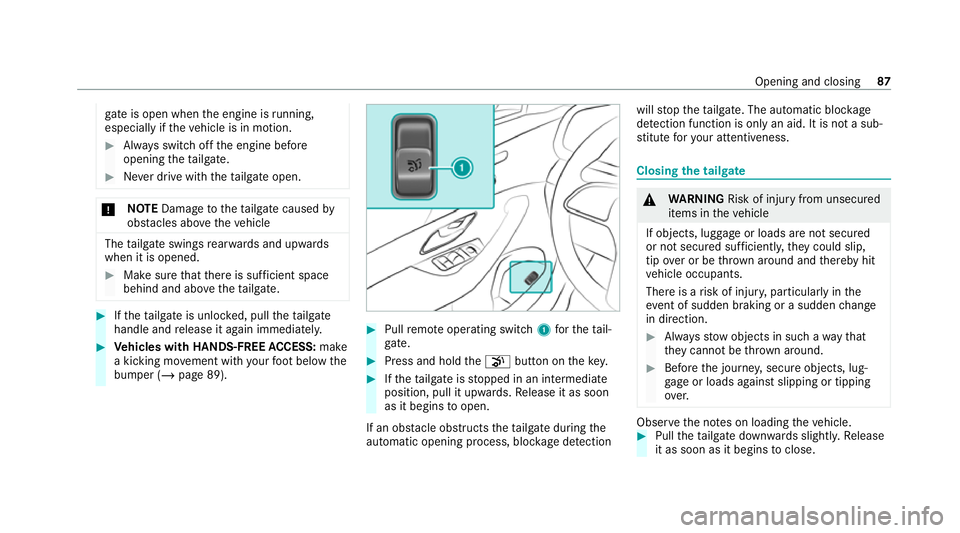
Pull remo teoperating switch 1forth eta il‐
ga te. #
Press and hold thep button on thekey. #
Ifth eta ilgate is stopped in an intermediate
position, pull it upwards. Release it as soon
as it begins toopen.
If an obs tacle obstructs theta ilgate during the
automatic opening process, bloc kage detection will
stop theta ilgate. The automatic bloc kage
de tection function is only an aid. It is not a sub‐
st itute foryo ur attentiveness. Closing
the tailgate &
WARNING Risk of inju ryfrom unsecu red
items in theve hicle
If objects, luggage or loads are not secured
or not secured suf ficientl y,they could slip,
tip ove r or be throw n around and thereby hit
ve hicle occupants.
There is a risk of injur y,particularly in the
ev ent of sudden braking or a sudden change
in direction. #
Alw aysstow objects in such a wayth at
th ey cannot be thro wn around. #
Before the journe y,secure objects, lug‐
ga ge or loads against slipping or tipping
ove r. Obser
vethe no tes on loading theve hicle. #
Pull theta ilgate down wards slightly. Release
it as soon as it begins toclose. Opening and closing
87
Page 108 of 549
Note
s onthe cor rect driver's seat position &
WARNING Risk of accident due to
adjusting vehicle settings while theve hi‐
cle is in motion
Yo u could lose cont rol of theve hicle in the
fo llowing situations in particular:
R Ifyo u adjust the driver's seat, the head
re stra ints, thesteering wheel or the mir‐
ro r while theve hicle is in motion.
R Ifyo ufast enyour seat belt while theve hi‐
cle is in motion. #
Before starting the engine: adjust the
driver's seat, the head restra ints, the
st eering wheel and the mir ror and fas‐
te nyo ur seat belt. Ensure
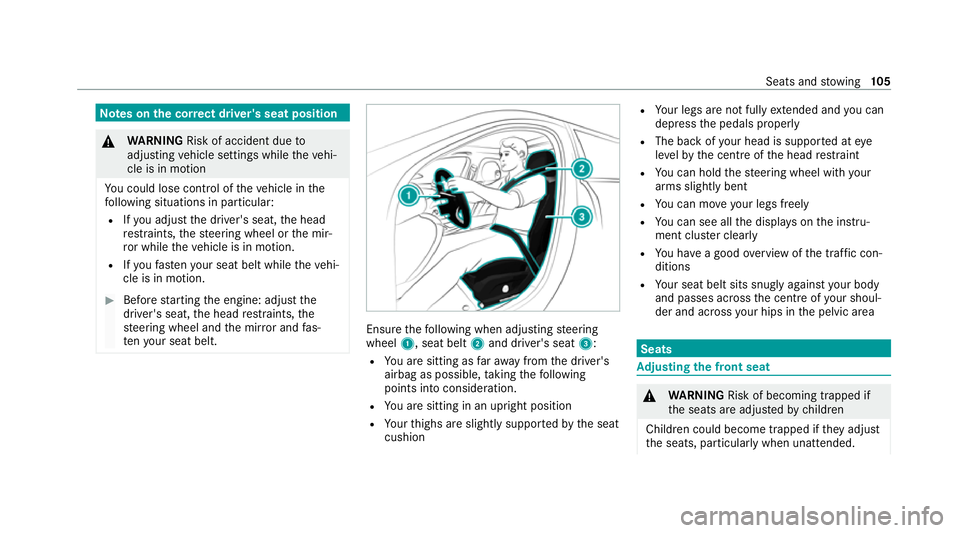
thefo llowing when adjusting steering
wheel 1, seat belt 2and driver's seat 3:
R You are sitting as faraw ay from the driver's
airbag as possible, taking thefo llowing
points into consideration.
R You are sitting in an upright position
R Your thighs are slight lysuppor tedby the seat
cushion R
Your legs are not fully extended and you can
depress the pedals properly
R The back of your head is suppo rted at eye
le ve lby the cent reofthe head restra int
R You can hold thesteering wheel with your
arms slightly bent
R You can mo veyour legs freely
R You can see all the displa yson the instru‐
ment clus ter clea rly
R You ha vea good overview of the tra ffic con‐
ditions
R Your seat belt sits snug lyagainst your body
and passes across the cent reofyour shoul‐
der and across your hips in the pelvic area Seats
Ad
justing the front seat &
WARNING Risk of becoming trapped if
th e seats are adjus tedby children
Children could become trapped if they adjust
th e seats, particular lywhen unat tended. Seats and
stowing 105
Page 109 of 549
#
When leaving theve hicle, alw aysta ke
th eke y with you and lock theve hicle. #
Never lea vechildren unat tended in the
ve hicle. Yo
u can adjust the seats when the ignition is
switched off. &
WARNING Risk of becoming trapped
du ring seat adjustment
When you adjust a seat, you or other vehicle
occupants could become trapped, e.g. on the
seat guide rail. #
Make sure when adjusting a seat that
no one has any body parts in the sweep
of the seat. Obser
vethe saf ety no tes on "Airbags" and "Chil‐
dren in theve hicle". &
WARNING Risk of accident due to
adjusting vehicle settings while theve hi‐
cle is in motion
Yo u could lose cont rol of theve hicle in the
fo llowing situations in particular:
R Ifyo u adjust the driver's seat, the head
re stra ints, thesteering wheel or the mir‐
ro r while theve hicle is in motion.
R Ifyo ufast enyour seat belt while theve hi‐
cle is in motion. #
Before starting the engine: adjust the
driver's seat, the head restra ints, the
st eering wheel and the mir ror and fas‐
te nyo ur seat belt. &
WARNING Risk of becoming trapped if
th e seat height is adjus ted carelessly
If yo u adjust the seat height carelessly, you
or other vehicle occupants could be trapped
and thereby injured. Children in particular could acciden
tally
press the electrical seat adjustment buttons
and become trapped. #
While moving the seats, make sure that
hands or other body parts do not get
under the le ver assembly of the seat
adjustment sy stem. &
WARNING Risk of inju rydue tohead
re stra ints not being fitted or being adjus‐
te d incor rectly
If head restra ints ha venot been ins talled or
ha ve not been adjus ted cor rectly, there is an
increased risk of injury in the head and neck
area, e.g. in theev ent of an accident or when
braking. #
Alw ays drive with the head restra ints
fi tted. #
Before driving off, ma kesure forev ery
ve hicle occupant that the cent reofthe
head restra int supports the back of the
head at about eye le vel. 106
Seats and stowing
Page 118 of 549
th
ird row of seats and hold it down until the
re ar seat audibly engages.
The rear seat will tip down wards and mo ve
bac k.The seat backrests and head restra int
will then mo veinto a suitable seat position
automaticall y.
If a seat on the second rowof seats is not
engaged, this will be shown on the multifunc‐
tion display on the instrument clus ter. #
Tointer rupt thefo lding procedure before
engagement, let go of button 1.Tocontinue
th efo lding procedure, press and hold button
1 again.
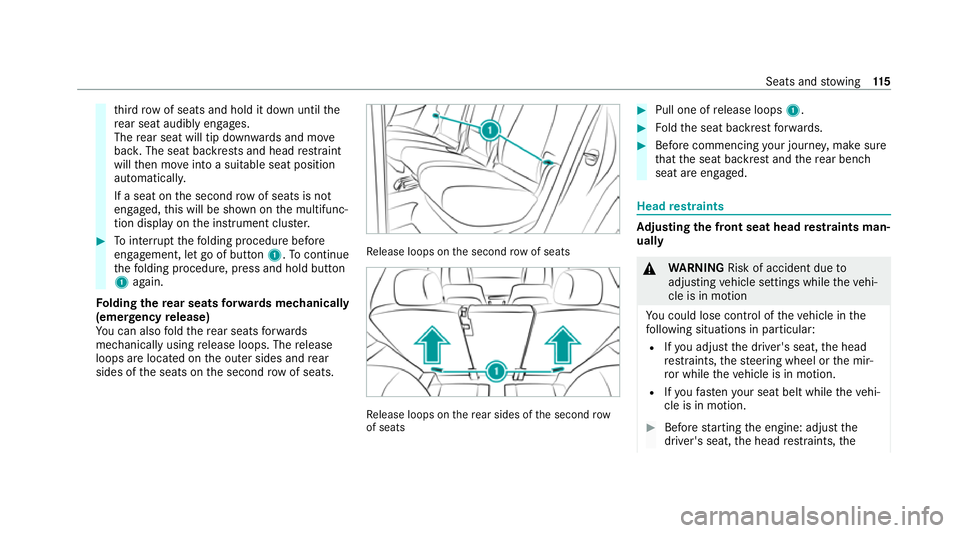
Fo lding there ar seats forw ards mechanically
(eme rgency release)
Yo u can also fold there ar seats forw ards
mechanically using release loops. The release
loops are located on the outer sides and rear
sides of the seats on the second rowof seats. Re
lease loops on the second row of seats Re
lease loops on there ar sides of the second row
of seats #
Pull one of release loops 1. #
Foldthe seat backrest forw ards. #
Before commencing your journe y,make sure
th at the seat backrest and there ar ben ch
seat are engaged. Head
restra ints Ad
justing the front seat head restra ints man‐
ually &
WARNING Risk of accident due to
adjusting vehicle settings while theve hi‐
cle is in motion
Yo u could lose cont rol of theve hicle in the
fo llowing situations in particular:
R Ifyo u adjust the driver's seat, the head
re stra ints, thesteering wheel or the mir‐
ro r while theve hicle is in motion.
R Ifyo ufast enyour seat belt while theve hi‐
cle is in motion. #
Before starting the engine: adjust the
driver's seat, the head restra ints, the Seats and
stowing 11 5