Display MERCEDES-BENZ M-Class 2012 W166 User Guide
[x] Cancel search | Manufacturer: MERCEDES-BENZ, Model Year: 2012, Model line: M-Class, Model: MERCEDES-BENZ M-Class 2012 W166Pages: 396, PDF Size: 14.48 MB
Page 33 of 396
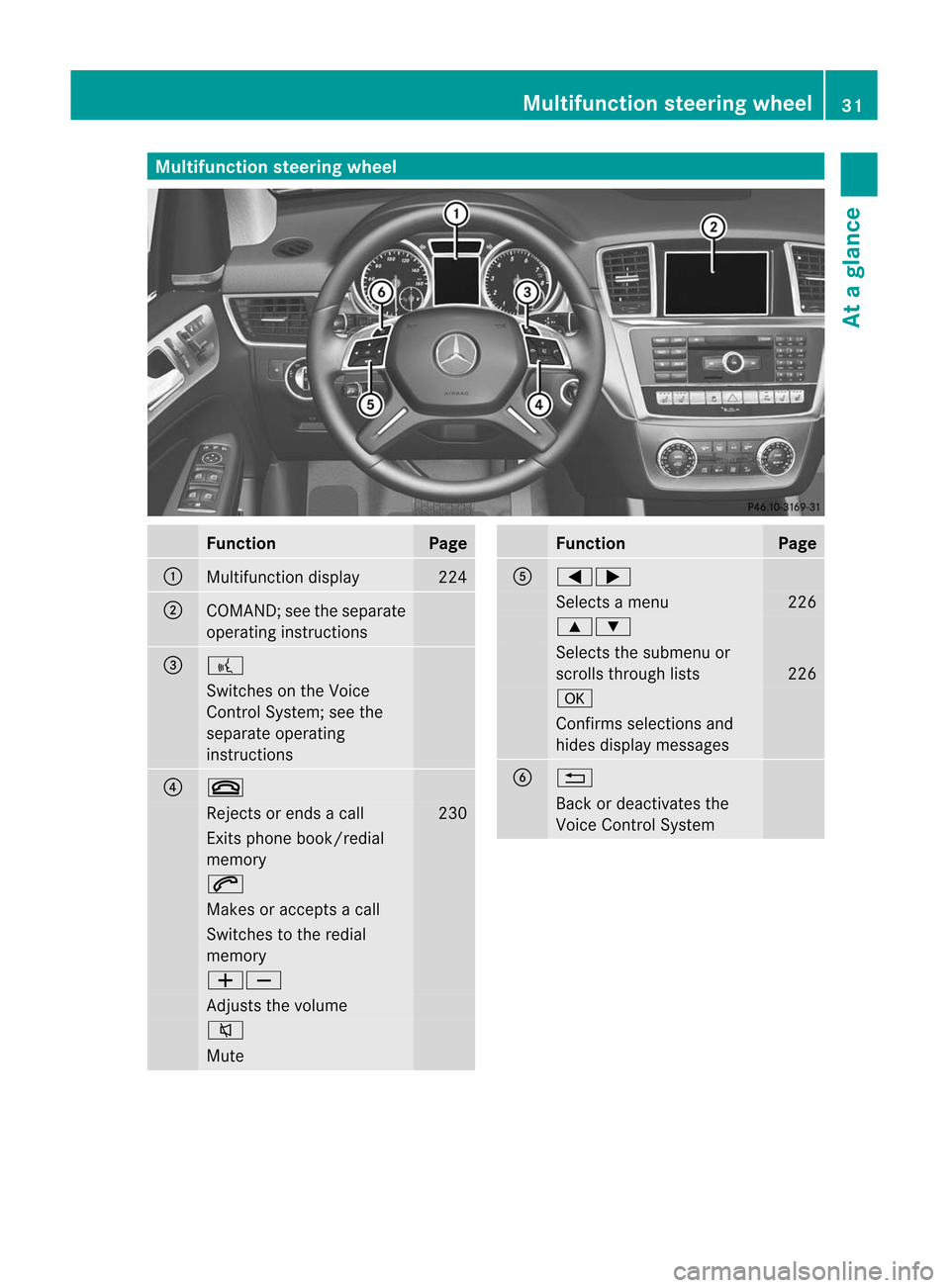
Multifunc
tionsteering wheel Func
tion Page
:
Mul
tifunction display 224
;
COMAND;
seethesepa rate
opera tinginstructions =
?
Switches
onthe Voice
Control System; seethe
sepa rateopera ting
instructions ?
~
Rejects
orends acall 230
Exits
phone book/red ial
memory 6
Makes
oraccepts acall Switches
tothe redial
memory WX
Adjusts
thevolu me 8
Mute Func
tion Page
A
=;
Selects
amenu 226
9:
Selects
thesubmenu or
scroll sthrough lists 226
a
Confirm
ssele ctions and
hide sdisp laymessa ges B
%
Back
ordea ctivates the
Voice Control System Multifunc
tionsteering wheel
31At a glance
Page 47 of 396
G
WARNING If
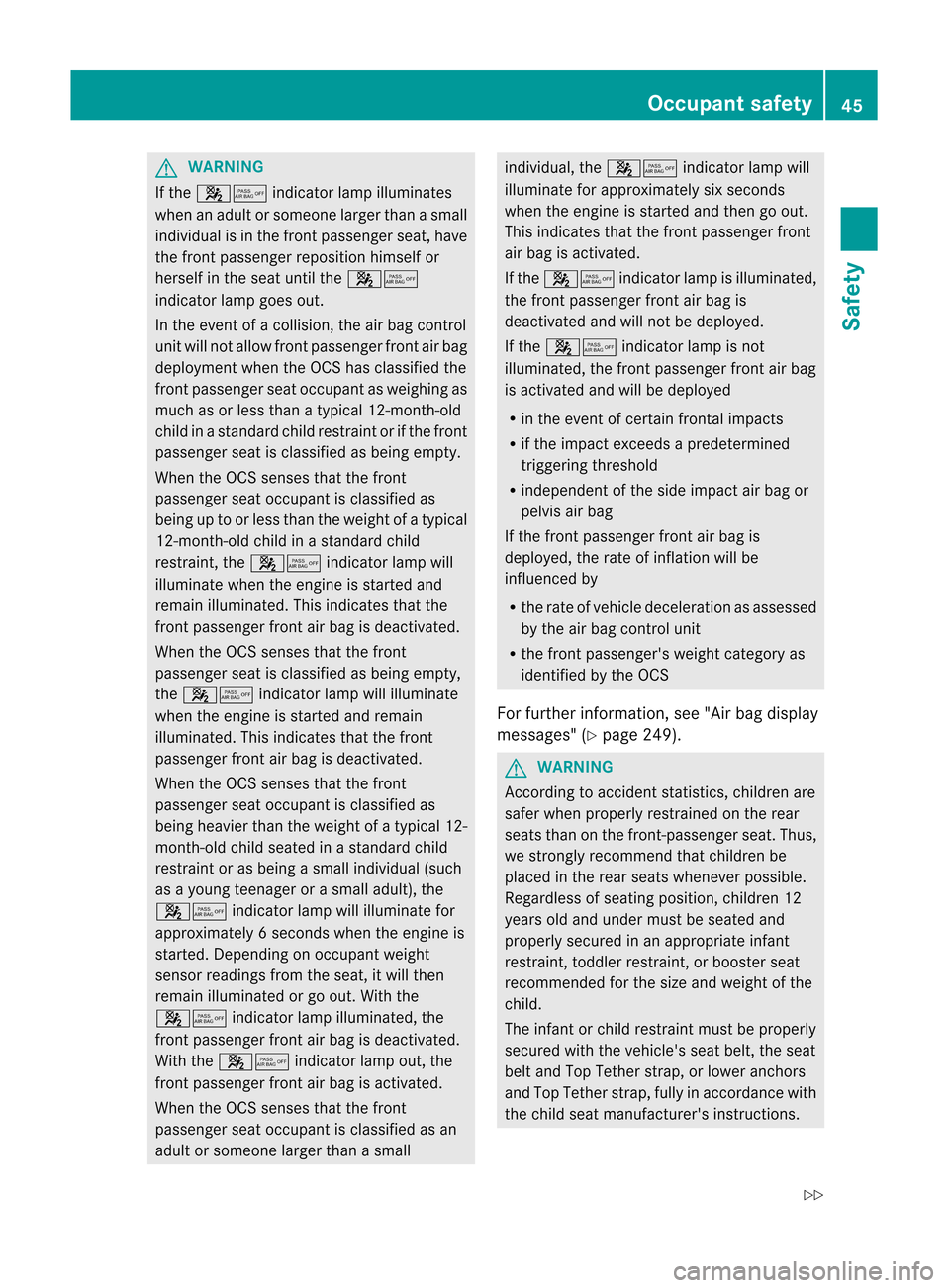
the 45 indicatorlamp illumina tes
when anadu ltor someone largerthan asmal l
indivi dualis in the front passenger seat,have
the front passenger repositionhimse lfor
hersel fint he seat until the45
indicator lampgoesout.
In the event ofacollision, theairbag cont rol
unit willnotallow frontpassenger frontairbag
deploy mentwhen theOCS hasclassified the
front passenger seatoccupant asweighing as
much asorless than atypical 12-month-old
child inastandard childrestraint orifthe front
passenger seatisclassified asbeing empty.
When theOCS senses thatthefront
passenger seatoccupant isclassified as
being uptoor less than theweight ofatypical
12-m onth-oldchild inastandard child
restraint ,the 45 indicatorlampwill
illu minate whentheengine isstarted and
remain illuminated. Thisindicates thatthe
front passenger frontairbag isdeactivated.
When theOCS senses thatthefront
passenger seatisclassified asbeing empty,
the 45 indicatorlampwillilluminate
when theengine isstarted andremain
illu minated. Thisindicates thatthefront
passenger frontairbag isdeactivated.
When theOCS senses thatthefront
passenger seatoccupant isclassified as
being heavier thantheweight ofatypical 12-
mont h-old childseated inas tand ardchi ld
res traint oras being asma llind ividu al(such
as ayo ung teenag eror as mall adult),the
45 indicatorlamp willill umina tefor
app roximatel y6s econ dswhen theengine is
start ed.Depen dingonoccupant weight
sensor readings fromtheseat, itwill then
remain illuminated orgo out. With the
45 indicatorlamp illuminated, the
fron tpassen gerfron ta irbag isdeact ivated.
With the45 indicatorlamp out,the
fro ntpassen gerfrontair bag isact ivate d.
When theOCS senses that thefront
passen gerseat occupant isclassif iedasan
adult orsomeo nelarger thanasmall indiv
idual, the45 indicatorlamp will
illuminat efor approx imatelysix seco nds
when theengin eis star ted and thengoout.
This indicates thatthefront passenger front
air bag isactivated.
If the 45 indicatorlampisilluminated,
the front passenger frontairbag is
deactivated andwillnotbedeployed.
If the 45 indicatorlampisnot
illuminated, thefront passenger frontairbag
is activated andwillbedeployed
R in the event ofcert ainfront alimpacts
R ifthe impact exceeds apredetermin ed
triggering threshold
R independent ofthe side impact airbag or
pelvis airbag
If the front passenger frontairbag is
deployed, therate ofinflation willbe
influenced by
R the rate ofvehicle deceleration asassessed
by the airbag cont rolunit
R the front passenger's weightcategory as
identified bythe OCS
For further informat ion,see"Air bag display
messages" (Ypage 249). G
WARNING Acc
ording toaccident statistics,children are
safer when properly restrained onthe rear
seats thanonthe front -passenger seat.Thus,
we stron glyrecommen dthat children be
placed inthe rear seats whenever possible.
Regardless ofseating position, children12
years oldand under mustbeseated and
properly securedinan appropriate infant
restraint ,toddler restraint ,or booster seat
recommen dedforthe size andweight ofthe
child.
The infant orchild restraint mustbeproperly
secured withthevehicle's seatbelt, theseat
belt andTopTether strap,orlower anchors
and TopTether strap,fullyinaccordanc ewith
the child seatmanufacturer' sinstr uctions. Occupant
safety
45Safety
Z
Page 50 of 396
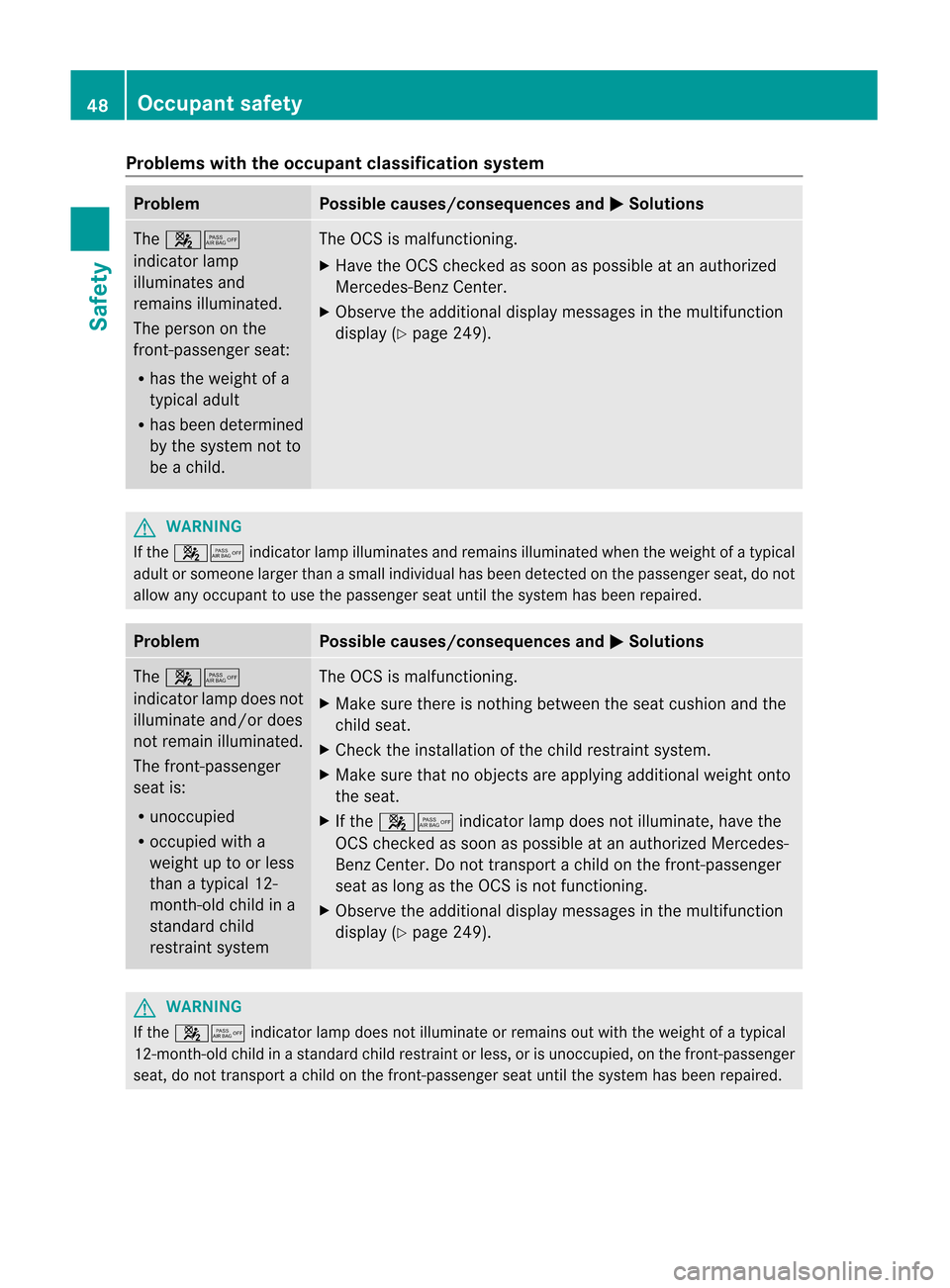
Problems
withtheoccupant classific ationsystem Problem Possible
causes/co nsequences andM Solutions
The
45
indicator lamp
illu minates and
remains illuminated.
The person onthe
front -passenger seat:
R has theweight ofa
typical adult
R has been determined
by the system notto
be achild. The
OCS ismalfunction ing.
X Have theOCS check edassoon aspossible atan authorized
Mercedes-B enzCenter.
X Observe theadditional displaymessages inthe multifunct ion
display (Ypage 249). G
WARNING If
the 45 indicatorlampilluminates andremains illuminated whentheweight ofatypical
adult orsomeone largerthanasmall individual hasbeen detect edon the passenger seat,donot
allow anyoccupant touse thepassenger seatuntil thesystem hasbeen repaired. Problem Possible
causes/co nsequences andM Solutions
The
45
indicator lampdoesnot
illu minate and/or does
not remain illuminated.
The front -passenger
seat is:
R unoccupied
R occupied witha
weight uptoor less
than atypical 12-
mont h-old childina
standard child
restraint system The
OCS ismalfunction ing.
X Make surethere isnothin gbetween theseat cushion andthe
child seat.
X Check theinstallation ofthe child restraint system.
X Make surethatnoobject sareapp lying add itiona lwei ght onto
the seat.
X Ifthe 45 indicatorlamp doesnotillumina te,have the
OCS checked assoon aspossi bleatan authorized Mercede s-
Benz Center. Donot transport achild onthe front-passenge r
seat aslong asthe OCS isnot functioning.
X Observe theadditiona ldisp laymessa gesinthe multi function
disp lay(Ypag e249). G
WARNING If
the 45 indicatorlamp doesnotillumina teor remai nsout with theweight ofatypi cal
12-month-old childinastandard childrestrai ntor less, orisunoccup ied,on the front-passenge r
seat, donot transport achild onthe front -passenger seatuntil thesystem hasbeen repaired. 48
Occ
upant safetySafety
Page 63 of 396
R
PRE-S AFE®
Brake
R Steering assistant STEERCONTROL Impor
tantsafety notes
If you failtoadapt yourdriving style,the
driving safetysystems canneither reducethe
risk ofaccident noroverride thelaws of
physics. Drivingsafety systems aremerely
aids designed toassist driving. Youare
responsible forthe distanc eto the vehicle in
fron t,for vehicle speedandforbraking in
good time. Always adaptyourdriving styleto
suit theprevailing road/weather conditions,
as well asthe traff iccondit ionsandmaintain
a safe distanc eto the vehicle infron t.Drive
carefully. i
Please
notethat thedriving safety
systems described onlywork aseffect ively
as possible whenthereisadequa tecont act
between thetires andtheroad surface. Pay
particular attentiontothe inform ation
regarding tires,recomm endedminimum
tire tread depths etc.inthe "Wheels and
tires" section(Ypage 350).
In wintry driving conditions,alway suse
winter tires(M+S tires)andifnecess ary,
snow chains. Onlyinthis way willthe
driving safetysystems described inthis
sect ionwork aseffect ivelyaspossible. ABS
(Anti-lock Braking System )
Impor tantsafety notes i
Observe
the"Importan tsafet yno tes"
sec tion(Ypage 61).
AB Sr egulates brakepressure insuch away
that thewheels donot lock when youbrake.
This allows youtocon tinue steer ingthe
vehicle whenbrakin g.
AB Sw orks from aspeed ofabout
5m ph(8 km/ h)upwards, regardless ofroad-
surface condition s.AB Sw orks onslippery
surfaces, evenwhen youonly brake gently. G
WARNIN
G If
the ABS malfunct ions,other driving systems
such asthe BAS orthe ESP ®
are also switched
off. Observe indicator andwarning lampsthat
may come onaswell asmessages inthe
multifunct iondisplay thatmay appear.
If the ABS malfunct ions,thewheels maylock
during hardbraking, reducing thesteering
capability andexten dingthebraking distance.
The ! warning lampinthe instr ument
cluster lightsupwhen theignition isswitched
on. Itgoes outwhen theengine isrunnin g.
Br aking If
ABS intervenes whenbraking, youwillfeel
a pulsing inthe brake pedal.
X IfABS intervenes: continue todepress the
brake pedalwithforce untilthebraking
situation isover.
X To mak eafull brake application:
depress thebrake pedalwithfullforce.
The pulsating brakepedalcanbean
indication ofhazardous roadcondit ions,and
funct ionsasareminder totake extracare
while driving. G
WARNIN
G Do
not pump thebrake pedal. Usefirm, steady
brake pedalpressure instead.Pumping the
brake pedaldefeats thepurpose ofthe ABS
and significant lyreduces braking
effect iveness. BAS
(BrakeAssist System) i
Observe
the"Important safetynotes"
section (Ypage 61).
BAS operates inemergenc ybraking
situations. Ifyou depress thebrake pedal
quickly, BASautomatically booststhebraking
force, thusshorten ingthe stopping distance.
X Keep thebrake pedalfirmly depressed until
the emergenc ybraking situation isover.
ABS prevent sthe wheels fromlockin g. Driving
safetysystems
61Safety Z
Page 67 of 396
In
this situa tion, ESP®
assi stsyou and can
detect ifthe vehicle /trailer combination
begi nstolurch. ESP®
slow sthe vehicle down
by braking andlimiting theengine outputuntil
the vehicle/tra iler comb inationh as
st abiliz ed.
Trail erstabiliz ationisactive fromaspeed of
approximately 37mph(60 km/h). G
WARNING The
system willnotbeable toassist whenthe
trailer jackknifes
R ifthe ESP ®
has switched offdue toa
malfunction
R on wet oricy roads
R on roads withslippery surface
R in sand orgravel
Trailers withahigh centerofgravity maytip
over before thesystem recognizes swayingof
the trailer.
Traile rstab iliza tiond oes notwork ifESP ®
is
deactivated ordisabled becauseofa
malfunct ion. EBD
(elec tronic brake force
distr ibution) i
Observe
the"Important safetynotes"
section (Ypage 61).
EBD monit orsand cont rolsthebrake
pressure onthe rear wheels toimprove
driving stability whilebraking. G
WARNIN
G If
EBD hasmalfunct ioned,thebraking system
remains availablewith fullbrake boosting
effect .However, therear wheels canstilllock,
e.g. under fullbraking. Thiscould cause you
to lose controlofyour vehicle andcause an
accident .You should therefor eadapt your
driving styletothe different handling
character istics. X
Observe thenoteson warning andindicator
lamps (Ypage 272)aswell asdisplay
messages (Ypage 241). ADA
PTIVE BRAKE
AD APTIVE BRAKEenhancesbraking safety
and offers increased brakingcomfort.In
addition tothe braking function,ADAPTIVE
BRAKE alsohastheHOLD function
(Y page 179)andhillstart assist
(Y page 142). Forfurther informat ion,see
Drivin gtips (Ypage 159). PRE-SAFE
®
Br ake
PRE-S AFE®
Brake isonly availa bleinvehicles
with DISTRONIC PLUS. i
Observe
the"Important safetynotes"
section (Ypage 61).
PRE-S AFE®
Brake canhelp youtominimize
the risk ofafront alcollision withavehicle
ahead orreduce theeffect sofsuch a
co llisio n.IfPRE -SAF E®
Br ake hasdetecteda
ris ko fcollision, youwillbewarned visually
and acoustically aswell asby automatic
braking. PRE-SAFE®
Brake cannotprevent a
collision withoutyourintervention.
At speeds aboveapproximately
20 mph (30km/ h),this funct ionwarns you
when youarerapidly approaching thevehicle
in front .An interm ittentwarning tonewill
then sound andthe· distance warning
lamp inthe instr ument cluster willlight up.
X Brake immediately inorder toincrease the
distance fromthevehicle infront .
or
X Take evasive actionprovided itis safe todo
so. Driving
safetysystems
65Safety Z
Page 69 of 396
G
WARNING PRE-SAFE
®
Brake cannot alwaysdetect
comple xtraffic situations prope rly.
In these cases, PRE-SAFE(R) Brakemay:
R give anunnecessa rywarni ngand then
brake thevehicl e
R neither giveawarni ngnor intervene
There isarisk ofan accide nt.Alwa yspay
particu larattention tothe traffic situationand
be read yto brake, especiallyif PRE-SAFE(R)
Brake warns you.Termina tethe intervention
in anon-critical drivingsitua tion.
In particu lar,the detection ofobstacl escan
be impa iredifthere is:
R dirt onthe sensors oranythi ngelse
covering thesensors
R snow orheavy rain
R interference byother radarsources
R the possibility ofstron gradar reflect ions,
for example inparking garages
R anarrow vehicle traveling infront ,e.g. a
motorbik e
R avehicle traveling infront onadifferent line G
WARNIN
G PRE-S
AFE®
Brake doesnotreact:
R to people oranimals
R to oncom ingvehicles
R to crossin gtraffic
R in curves
As aresult, PRE-SAFE®
Brake cannot
interv eneincritic alsituations. Thereisarisk
of an accident .Always paycaref ulatt ent ion
to the traffic situat ionand beready tobrak e.
In order tomaint ainthe appropr iatedistance
to the vehic lein fro ntand thus preventa
collisio n,you must apply thebrak esyourself .X
To act ivat e/deact ivate:act ivate or
deact ivatePRE-SAFE®
Brak ein the on-
board computer (Ypage 232).
The Ä symbol appears inthe
multif unction display aslong asthe HOL D
func tion isnot activate d(Ypage 179).
On vehicles withActive Parkin gAssist ,the
Ä symbol isdisplayed when
tran smission positionPis select edorifyou
drive faster than22mph(35 km/h).
For PRE-S AFE®
Brak eto assist youwhen
drivin g,the radar senso rsyst em mus tbe
switched on(Ypage 236)andoperational.
Following damagetothe front endofthe
vehicle, havetheconfiguration andoperation
of the radar sensors checked ataqual ified
speciali stworkshop. Thisalso appli esto
collisions atlow speeds wherethereisno
visible damage tothe front ofthe vehicle. STEER
CONTROL
The steering assistant STEERCONTROL helps
you bytransmitt inganoticeable steering
force tothe steering wheelinthe direction
required forvehicle stabilization.
This steering assistance isprovided in
particular if:
R both right wheels orboth leftwheels areon
a wet orslippe ryroad surface whenyou
brake
R the vehicle startstoskid
You have controlover thesteering atall
times. G
WARNING If
the ESP ®
is malfunctioning, youwillnot
receive steering assistance fromtheSTEE R
CONTROL. Thepower steering function,
however, remainsavailable. Driving
safetysystems
67Safety Z
Page 129 of 396
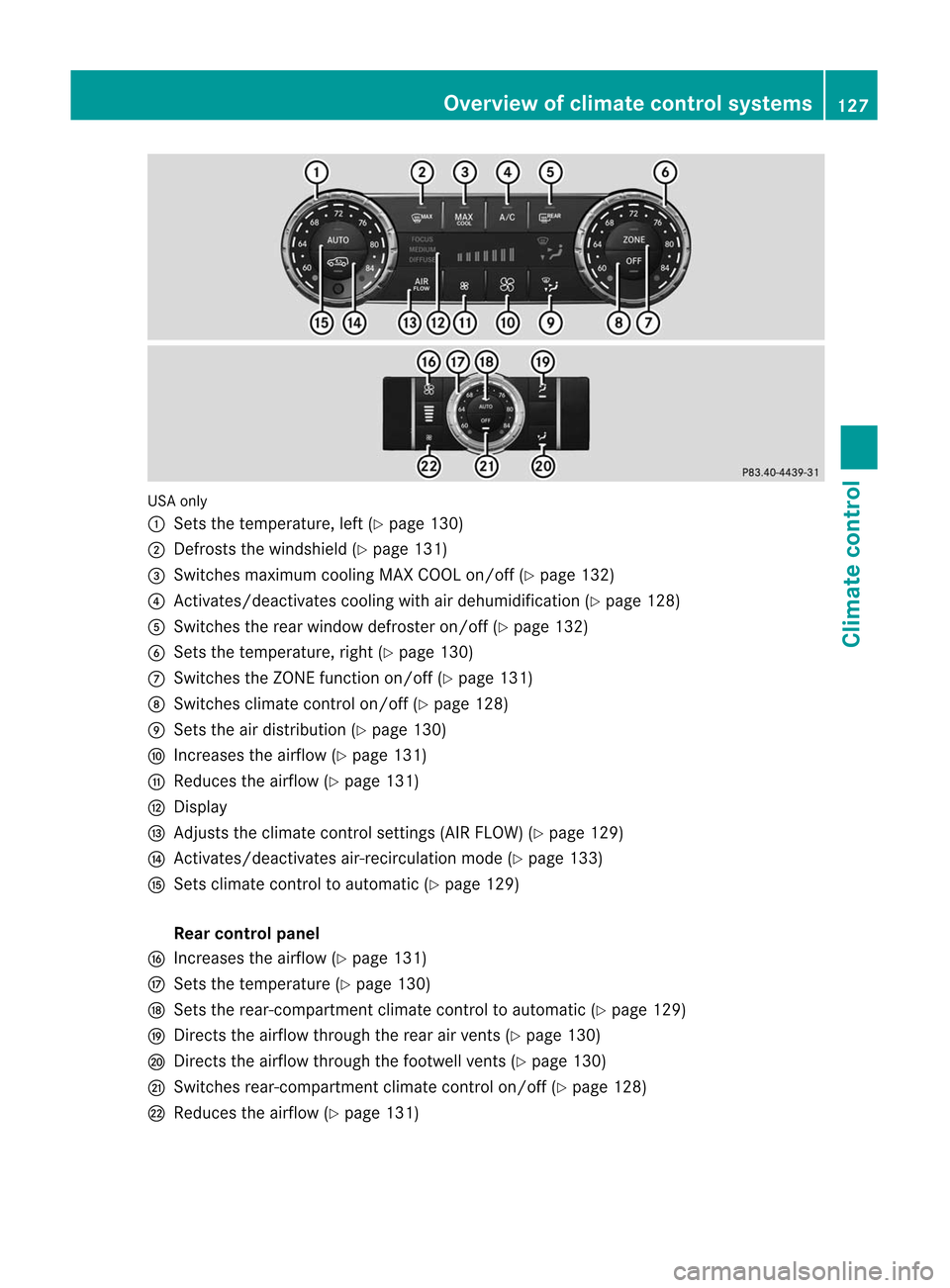
USA
only
: Sets thetemperature, left(Ypage 130)
; Defrosts thewindshiel d(Y page 131)
= Switches maximum coolingMAXCOOL on/off (Ypage 132)
? Activates/deactivates coolingwithairdehumid ification(Ypage 128)
A Switches therear window defroster on/off(Ypage 132)
B Sets thetemperature, right(Ypage 130)
C Switches theZONE function on/off(Ypage 131)
D Switches climatecontrolon/off (Ypage 128)
E Sets theairdistribution (Ypage 130)
F Increases theairflow (Ypage 131)
G Redu cestheairflow (Ypage 131)
H Display
I Adjusts theclimate controlsettings (AIRFLOW) (Ypage 129)
J Activates/deactivates air-recirculationmode(Ypage 133)
K Sets climate controltoautomatic (Ypage 129)
Rear control panel
L Increases theairflow (Ypage 131)
M Sets thetemperature (Ypage 130)
N Sets therear-compartment climatecontroltoautomatic (Ypage 129)
O Directs theairflow through therear airvents (Ypage 130)
P Directs theairflow through thefootwell vents(Ypage 130)
Q Switches rear-compartment climatecontrolon/off (Ypage 128)
R Redu cestheairflow (Ypage 131) Overview
ofclimat econ trol systems
127Climate control Z
Page 132 of 396
X
Turn theSmart Keytoposition 2in the
ignition lock.
X Press theà button .
X Press theñ button repeatedly untilthe
desired climatemodeappears inthe
display . Setting
thetemp erature
Climate control Differ
enttemperat urescanbeset forthe
driver's andfront-passenger sides.
X Turn theSmart Keytoposition 2in the
ignition lock.
X To increase/reduce: turncontrols:and
B clock wiseorcount erclock wise
(Y page 123).
Only change thetemperat uresettingin
small increm ents.Start at72 ‡(22 †).
3-zone automat icclimate control Automat
icclimate controlzones
You canselect different temperat uresett ings
for the driver's andfront-passenger sidesas
well asfor the rear compart ment.
X Turn theSmart Keytoposition 2in the
ignition lock.
X To increase/reduce thetemp eraturein
the front :turn controls:and B clock
wiseorcount erclock wise
(Y page 126).
Only change thetemperat uresettingin
small increm ents.Start at72 ‡(22 †).
X To increase/reduce thetemp eraturein
the rear compar tment using thefront
control panel:presstheá button .
The indicator lampinthe á button goes
out.
X Turn control: clock wiseor
count erclock wise(Ypage 126).
Only change thetemperat uresettingin
small increm ents.Start at72 ‡(22 †).
The temperat uresettingforthe driver's
side isadopted forthe rear compart ment
and thefron t-passenger side.
X To increase/decrease therear
compar tment temp eratureusing the
rear control panel:turncontrolM onthe
rear controlpanel clockwiseor
count erclock wise(Ypage 126).
Only change thetemperat uresettingin
small increm ents.Start at72 ‡(22 †). Setting
theairdistr ibution
Front control unit:
P Directsair through thecent ervent s.
O Directsthe airflow through the
footwell airvent s
S Directsthe airflow through thecent er
and footwell vents.
¯ Directsthe airflow through the
defrost ervent s
b Directsthe airflow through the
defrost erand cent ervent s10
a Directsthe airflow through the
footwell anddefrost ervent s
_ Directsthe airflow through the
defrost er,cent erand footwell air
vent s10
10 For Canada only. 130
Opera
tingtheclimate controlsystemClimate control
Page 133 of 396
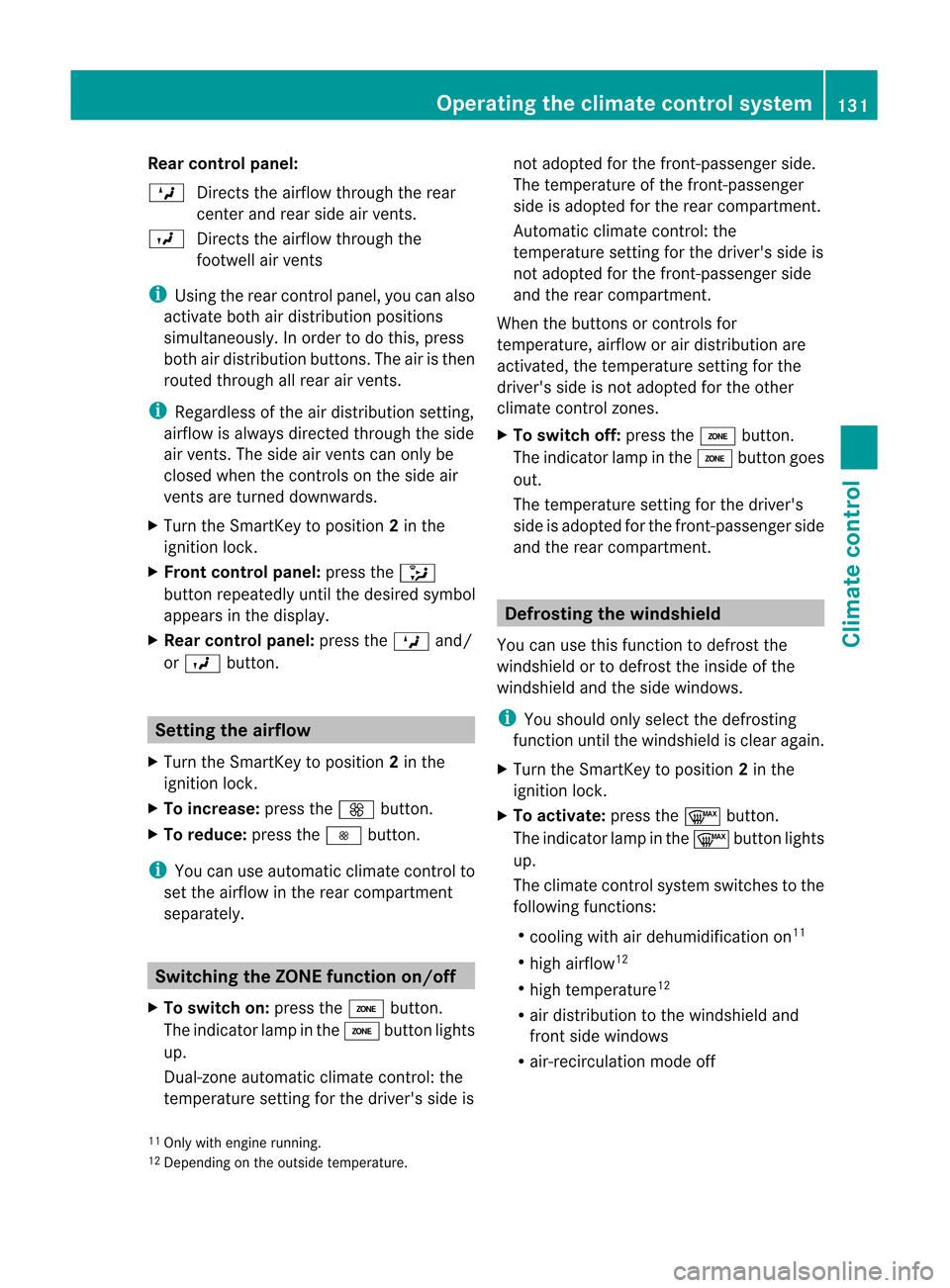
Rear
control panel:
M Directsthe airflo wthrou ghthe rear
center andrearsid eairvents.
O Directsthe airflo wthrou ghthe
footw ellai rv ent s i
Using
therear control panel, youcan also
activat eboth airdistribut ionposition s
simultaneously. Inorder todo this, press
both airdistribut ionbutton s.The airisthen
routed through allrear airvent s. i
Regardless
ofthe airdistribut ionsett ing,
airflow isalway sdirect edthrough theside
air vent s.The side airvent scan only be
closed whenthecontrols onthe side air
vent sare turn eddownwards.
X Turn theSmart Keytoposition 2in the
ignition lock.
X Front control panel:pressthe_
button repeatedly untilthedesired symbol
appears inthe display.
X Rear control panel:presstheM and/
or O button . Sett
ingthe airflow
X Turn theSmart Keytoposition 2in the
ignition lock.
X To increase: presstheK button .
X To redu ce:press theI button . i
You
canuseautomatic climatecontrol to
set the airflow inthe rear compart ment
separately. Switching
theZONE function on/off
X To switch on:press theá button .
The indicat orlamp inthe á button lights
up.
Dual-z oneautomatic climatecontrol: the
temper aturesettingforthe driver's sideis not
adopted forthe fron t-passenger side.
The temper atureofthe fron t-passenger
side isadopted forthe rear compart ment.
Autom aticclimate control: the
temper aturesettingforthe driver's sideis
not adopted forthe fron t-passenger side
and therear compart ment.
When thebutton sor con trols for
temper ature,airflow orair distribut ionare
activat ed,the temper aturesettingforthe
driver's sideisnot adopted forthe other
climate control zones.
X To switch off:press theá button .
The indicat orlamp inthe á button goes
out.
The temper aturesettingforthe driver's
side isadopted forthe fron t-passenger side
and therear compart ment. Defrosting
thewindshield
You canusethis func tion todefrost the
windshield ortodefrost theinside ofthe
windshield andtheside windows. i
You
should onlyselect thedefrost ing
func tion until thewindshield isclear again.
X Turn theSmart Keytoposition 2in the
ignition lock.
X To activa te:press the¬ button .
The indicat orlamp inthe ¬ button lights
up.
The climate control system switchestothe
following functions:
R cooling withairdehumidification on11
R high airflow 12
R high temper ature12
R air distribut iontothe windshield and
fron tside windows
R air-r ecirculat ionmode off
11 Only withenginerunn ing.
12 Depe ndingon the outs idetem perat ure. Oper
ating theclima tecontr olsyst em
131Climate control Z
Page 134 of 396
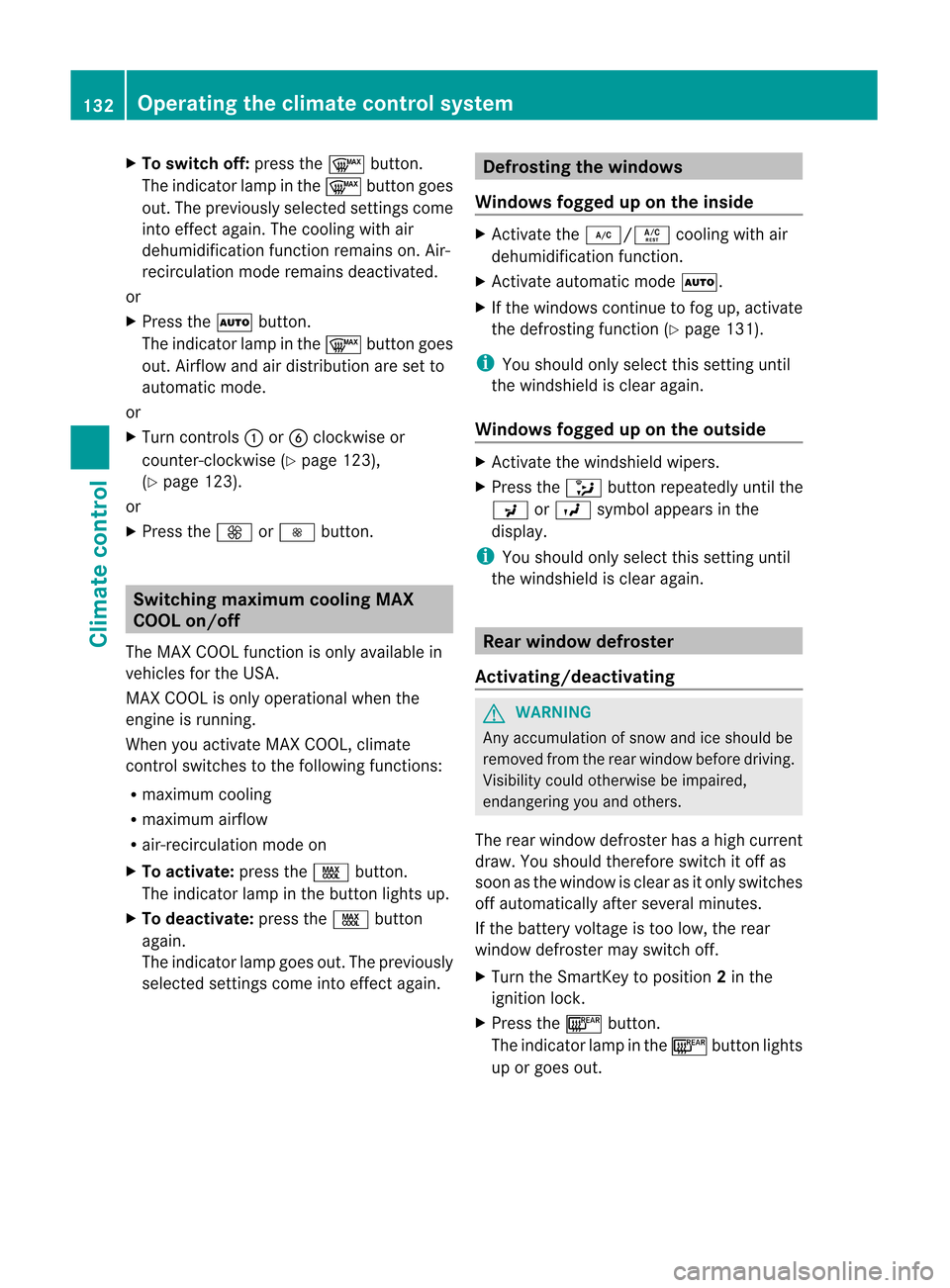
X
To switchof f:pre ssthe ¬ button.
The indicator lamp inthe ¬ button goes
ou t.The previouslysel ecte dsettings come
int oeffec tagain. Thecooling withair
dehumidification functionremains on.Air-
recirculation moderemains deactivated.
or
X Press theà button .
The indicator lampinthe ¬ button goes
out. Airflow andairdistribution aresetto
automatic mode.
or
X Turn controls:orB clock wiseor
count er-clockwise (Ypage 123),
(Y page 123).
or
X Press theK orI button . Switching
maximumcool ingMAX
COOL on/off
The MAX COOL functionisonly availa blein
vehicles forthe USA .
MAX COOL isonly operational whenthe
engine isrunnin g.
When youactivate MAXCOOL, climate
cont rolswitches tothe following functions:
R maximum cooling
R maximum airflow
R air-recirc ulationmodeon
X To activat e:press theÙ button .
The indicator lampinthe button lightsup.
X To deactivat e:press theÙ button
again.
The indicator lampgoesout.Thepreviously
selected settings come intoeffect again. Defrosting
thewindows
Windows foggeduponthe inside X
Act ivate the¿/Á coolingwithair
dehumidification function.
X Act ivate automatic modeÃ.
X Ifthe windows continue tofog up,activate
the defrostin gfunct ion(Ypage 131). i
You
should onlyselect thissettinguntil
the windshield isclear again.
Windows foggeduponthe outside X
Act ivate thewindshield wipers.
X Press the_ button repeatedly untilthe
P orO symbol appears inthe
display . i
You
should onlyselect thissettinguntil
the windshield isclear again. Rear
window defroster
Activating/deactivat ing G
WARNING Any
accumulation ofsnow andiceshould be
removed fromtherear window beforedriving.
Visibility couldotherwise beimpaired,
endangering youand others.
The rear window defroster hasahigh current
draw. Youshould therefor eswitch itoff as
soon asthe window isclear asitonly switches
off automatically afterseveral minutes.
If the battery voltage istoo low, therear
window defroster mayswitch off.
X Turn theSmart Keytoposition 2in the
ignition lock.
X Press the¤ button .
The indicator lampinthe ¤ button lights
up orgoes out. 132
Opera
tingtheclimate controlsystemClimate control