ESP MERCEDES-BENZ M-Class 2012 W166 User Guide
[x] Cancel search | Manufacturer: MERCEDES-BENZ, Model Year: 2012, Model line: M-Class, Model: MERCEDES-BENZ M-Class 2012 W166Pages: 396, PDF Size: 14.48 MB
Page 34 of 396
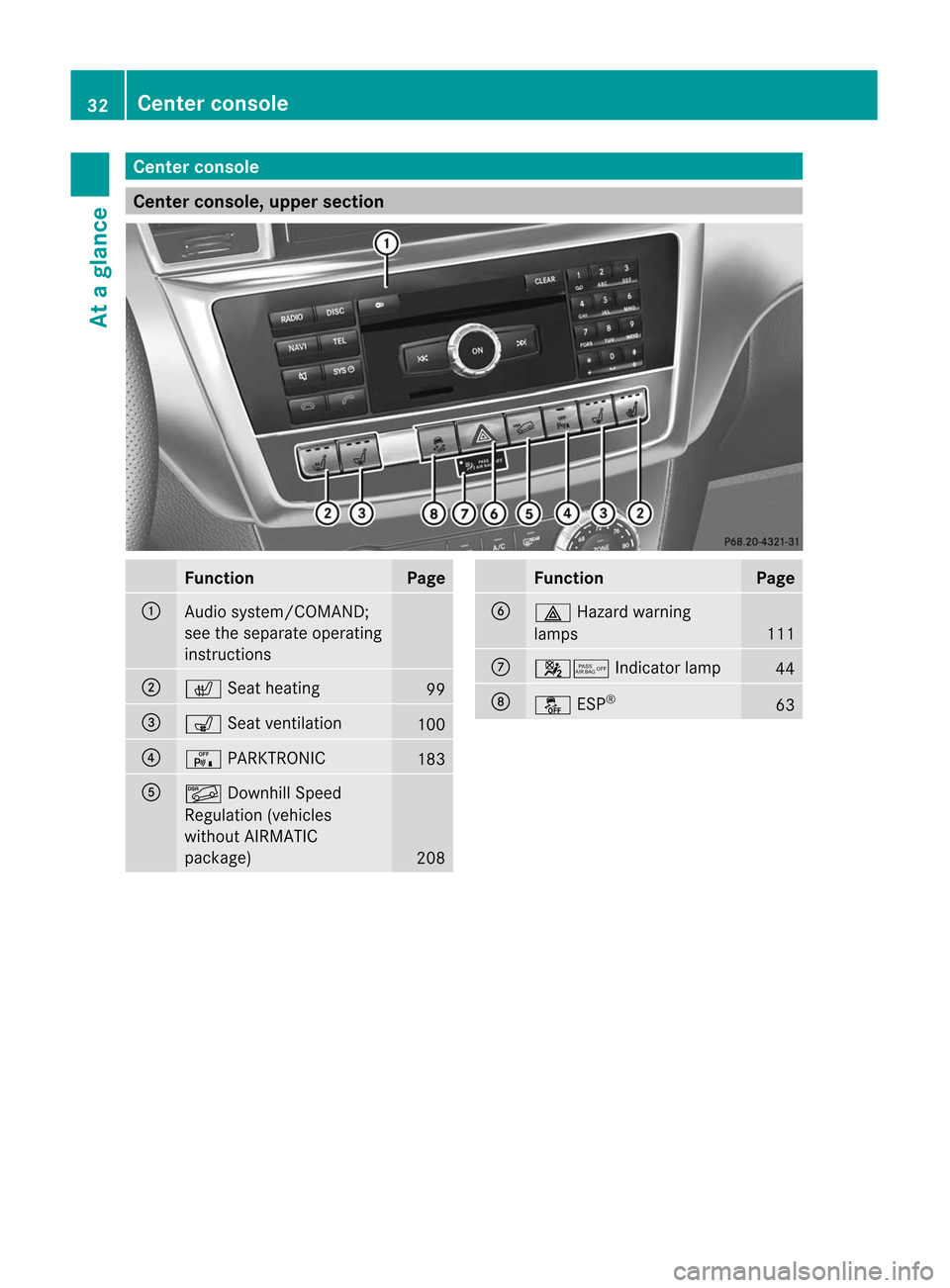
Cent
erconsole Cent
erconsole, upper sect ion Funct
ion Pag
e :
Audi
osyst em/ COMA ND;
see thesepar ateoper ating
ins truct ions ;
c
Seatheating 99
=
s
Seatventilatio n 10
0 ?
c
PARKTRO NIC 18
3 A
Ã
Downh illSpe ed
Regulat ion(veh icles
wit hout AIRMA TIC
pack age) 20
8 Funct
ion Pag
e B
£
Hazard warn ing
lamps 11
1 C
45
Indic ato rlamp 44
D
å
ESP® 6332
Cent
erconsoleAt a glance
Page 43 of 396
Since
theairb ag inflate swithcon siderable
speed andforce, aproper seatingposit ion
and correctposit ioningof the hands onthe
ste erin gwheel willhelp tokeep youatasafe
dist ancefro mt heair bag. Occupants whoare
not wearing theirseatbelt, arenot seated
properly orare too close tothe airbag canbe
seriously injuredorkilled byan air bag asit
inflates withgreat forceinstant aneously :
R Sit with theseat beltproperly fastened ina
position thatisas upright aspossible with
your back against theseat backrest.
R Move thedriver's seatasfar back as
possible, stillpermittin gproper operation
of vehicle controls. Thedistance fromthe
cent erofthe driver's chesttothe cent erof
the airbag cover onthe steering wheel
must beatleast 10inches (25cm) ormore.
You should beable toaccomplish thisby
adjusting theseat andsteering wheel.If
you have anydifficulties, pleasecontactan
authorized Mercedes-Ben zCent er.
R Do not lean your head orchest closetothe
steerin gwheel ordashboard.
R Only holdthesteerin gwheel bythe rim.
Placing handsandarms inside therim can
incr ease therisk and poten tialseverit yof
hand/arm injurywhenthedriver frontair
bag inflates .
R Adj ust the fron t-passenger seatasfar back
as possible fromthedashboard whenthe
seat isoccupied.
R Occ upants, especially children,should
never placetheirbodies orlean their heads
in the area ofthe door where theside
impact airbag inflates .This could result in
serious injuries ordeath should theside
impact airbag bedeploy ed.Always sitas
upright aspossible, weartheseat belt
properly anduseanappropriately sized
child restraint ,infant restraint orbooster
seat recommen dedforthe size andweight
of the child.
Failure tofollow theseinstruct ionscanresult
in severe injuries toyou orother occupants. If
you sellyour vehicle, itis important thatyou
make thebuyer aware ofthis safety
information. Besure togive thebuyer this
Operator's Manual. G
WARNING Acc
ident research showsthatthesafest place
for children inan automobile isin arear seat.
As ide impact airbag relat edinjury may occur
if occ upant s,espec iallychildr en,are not
proper lyseate dor rest raine dwhen next toa
side impact airbag which needs todeploy
rapidly inaside impact inorder todo itsjob.
To help avoid thepossibili tyof injury, please
follow theseguidelines:
(1) Always sitasupright aspossible
and usetheseat belts properly.
Make surethatchildren 12years
old and under useanappropriately
sized childrestraint ,infant
restraint ,or booster seat
recommen dedforthe size and
weight ofthe child.
(2) Always wearseatbelts properly.
The airbags areonly deploy edifthe airbag
cont rolunit detects theneed fordeploy ment.
Only inthe event ofsuch asituation willthey
provide theirsupplemental protection.
The driver andpassenger shouldalwayswear
their seatbelts. Otherwise, itis not possible
for the airbags toprovide theirsupplemental
protect ion.
In the event ofother types ofimpacts and
impacts belowairbag deploy ment
thresholds, theairbags willnotdeploy .The
driver andpassengers willthen beprotect ed
to the exten tpossible byaproperly fastened
seat belt. Aproperl yfastened seatbeltisalso
needed toprovide thebest possible
protect ioninarollover.
Air bags provide additional protection;they
are not, however, asubstitute forseat belts.
All vehicle occupants mustfasten theirseat
belts regardless ofwhether yourvehicle is
equip pedwith airbags ornot. Occ
upant safety
41Safety Z
Page 48 of 396
Occupants,
especiallychildren, shouldalways
sit asupright aspossible ,wear theseat belt
properly anduseanappropria telysized infant
restraint, toddlerrestraint, orbooster seat
recommended forthe size andweight ofthe
child.
Child rencan bekilled orseriousl yinjured by
an inflating airbag. Note thefollowi ng
important information whencircumstances
require youtoplace achild inthe front -
passenger seat:
R Your vehicle isequip pedwith airbag
technology designedtodeactivate the
front -passenger frontairbag inyour vehicle
when thesystem sensestheweight ofa
typical 12-mon th-oldchildorless along
with theweight ofastandard appropria te
child restraint onthe front -passenger seat.
R Ac hild inarear-facing childrestraint onthe
front -passenger seatwillbeseriously
injured oreven killed ifthe front -passenger
front airbag inflates inacollision which
could occur under somecircumstan ces,
even withtheairbag techn ology installed
in your vehicle. Theonly means toeliminate
this riskcompletely isnever toplace achild
in arear-facing childrestraint inthe front -
passenger seat.Wetherefore strongly
recommen dthat youalwa ysplace achild
in arear-facing childrestraint onthe rear
seat.
R Ifyou install arear-facing childrestraint on
the front -passenger seat,make surethe
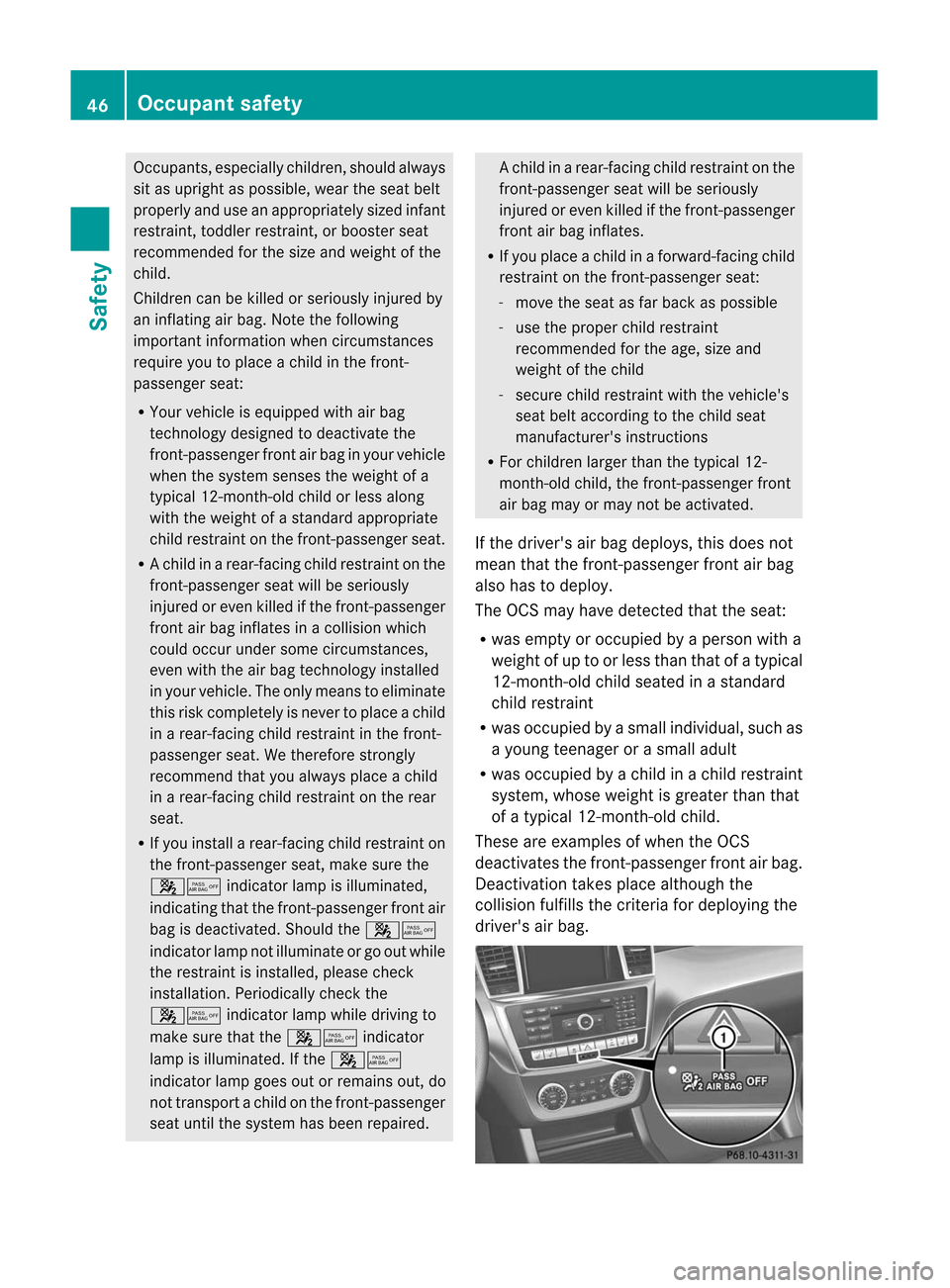
45 indicatorlampisillu minated,
indicating thatthefront -passenger frontair
bag isdeactivated. Shouldthe45
indicator lampnotilluminate orgo out while
the restraint isinstalled, pleasecheck
installation. Periodicallycheck the
45 indicatorlampwhile driving to
make surethatthe45 indicator
lamp isillu minated. Ifthe 45
indicator lampgoesoutorremains out,do
not transport achild onthe front -passenger
seat until thesystem hasbeen repaired. Ac
hild inarear-facing childrestraint onthe
front -passenger seatwillbeseriously
injured oreven killed ifthe front -passenger
front airbag inflates.
R Ifyou place achild inaforward-facing child
restraint onthe front -passenger seat:
- move theseat asfar back aspossible
- use theproper childrestraint
recommen dedforthe age, sizeand
weight ofthe child
- secure childrestraint withthevehicle's
seat beltaccording tothe child seat
manufacturer's instructions
R For children largerthanthetypical 12-
mont h-old child, thefront -passenger front
air bag may ormay notbeactivated.
If the driver's airbag deploy s,this does not
mean thatthefront -passenger frontairbag
also hastodeploy .
The OCS mayhave detected thattheseat:
R was empty oroccupied byaperson witha
weight ofup toor less than thatofatypical
12-m onth-oldchild seated inastandard
child restraint
R was occupied byasmall individua l,such as
a young teenager orasmall adult
R was occupied byachild inachild restraint
system, whoseweight isgreater thanthat
of atypical 12-month-oldchild.
These areexamples ofwhen theOCS
deactivates thefront -passenger frontairbag.
Deactivation takesplacealthough the
collision fulfillsthecriteria fordeploy ingthe
driver's airbag. 46
Occ
upant safetySafety
Page 51 of 396
PRE-SAFE
®
(preventat iveocc upant
prot ection) G
WARNING The
PRE-SA FE®
system reduces theimpact of
an accident onvehicle occupants, aslong as
their seatbelts havebeen fastened correctly.
Although yourvehicle isequippe dwith aPRE-
SAF E®
system, thepossibility ofinjury inthe
event ofan accident cannotberuled out.You
should therefore alwaysdrive carefully and
adapt yourdriving styletothe prevailing road,
weather andtraffic condition s.
PRE-SA FE®
takes preemptive measuresto
protect occupants incertain hazardous
situations.
PRE-SA FE®
interv enes:
R in emergency brakingsituations, e.g.ifBAS
is activated or,invehicles withDISTRONIC
PLUS, BASPLUS intervenespowerfully
R ifthe radar sensor system detectsan
imminent dangerofcollision incertain
situations (onvehicles withDISTRONIC
PLUS)
R in critic aldriving situations, e.g.when
physical limitsareexceed andthevehicle
understeers oroversteers severely
PRE-SA FE®
takes thefollowing measures
depending onthe hazardous situation
detect ed:
R the front seatbelts arepre-ten sioned.
R on vehicles withmemory functionforthe
front -passenger seat:thefront -passenger
seat isadjusted ifit is in an unfavorable
position.
R ifthe vehicle skids,thesliding sunroof/
panorama roofwith power tilt/sliding
panel andtheside windows areclosed so
that only asmall gapremains.
If the sliding sunroof, panorama roofwith
power tilt/sliding paneloraside window is
obstruct edduring closing, theclosing
procedure isstopped. Theobstruct edsliding
sunroof, panorama roofwith power tilt/ sliding
panelorside window opensagain
slightly.
If the hazardous situationpasseswithout
resulting inan accident, PRE-SAFE®
slackens
the belt pretension ing.Allsettin gsmade by
PRE-SA FE®
can then bereversed.
If the seat belts arenot released:
X Move thebackrest orseat back slightly, but
only when thevehicle isstationary.
The belt pretension ingisreduced andthe
locking mechanism isreleased. G
WARNING Make
surethatnobody canbecome trapped
as you adjust theseat.
! Make surethatthere arenoobject sin the
footwell orbehind theseats when resett ing
the seats. Thereisarisk that theseats
and/or theobject scould bedamaged.
More information aboutseat-belt
adjustment ,a conv enience function
integrated intoPRE-SA FE®
,can befound in
the "Seat-belt adjustment "section
(Y page 52). Seat
belts
Import antsafety notes The
useofseat belts andinfant andchild
restraint systemsisrequired bylaw inall 50
states, theDistr ictofColumbi a,the U.S.
territ ories andallCanadia nprovinces.
Even where thisisnot thecase, allvehicl e
occupa ntsshou ldhave theirseatbelts
fastened whenthevehicl eis in motion. i
For
further informati ononinfants and
child rentraveli nginthe vehicl eand on
infant andchild restrai ntsystems ,see
"C hildren inthe vehicl e"(Y pag e54). G
WARNING Alwa
ysfasten yourseat belt before driving off.
Always makesureallofyour passengers are Occupant
safety
49Safety
Z
Page 53 of 396
ribs
orabd omen, whichcould severel y
injure internal organssuchasyou rliver or
spleen .
Adj ust the seat beltsothat theshoulder
sect ionislocat edasclos eas possible to
the middle ofthe shoulder .Its hould not
touch theneck .Never pass theshoulder
portion ofthe seat beltunder yourarm. For
this purpose, youcan adjust theheight of
the seat beltoutlet.
R Position thelapbelt aslow aspossible on
your hipsandnotacross theabdomen. If
the lapbelt isposition edacross your
abdomen, itcould cause serious injuries in
a crash.
R Never wearseatbelts overrigid or
breakable objectsinor on your clothing,
such aseyeglasses, pens,keysetc.,as
these might cause injuries.
R Make suretheseat beltisalway sfitt ed
snugly. Takespecial careofthis when
wearing looseclothing.
R Never useaseat beltformore thanone
person atatime. Donot fasten aseat belt
around aperson andanoth erperson or
other objectsat the same time.
R Seat belts should notbeworn twisted. Ina
crash, youwould nothave thefullwidth of
the seat belttodistribut eimpact forces.
The twisted seatbeltagainst yourbody
could cause injuries.
R Pregnant womenshouldalsoalway suse a
lap-shoulder belt.Thelapbelt portion
should bepositioned aslow aspossible on
the hips toavoid anypossible pressure on
the abdomen.
R Place theseat backrest inaposition thatis
as upright aspossible.
R Check yourseatbeltduring traveltomake
sure itis properly positioned.
R Never placeyourfeetonthe instr ument
panel, dashboard, oron the seat. Always keep
bothfeetonthe floor infront ofthe
seat.
R When usingaseat belttosecure infant
restraint s,toddler restraint s,or children in
booster seats,alwaysfollow thechild seat
manufacturer' sinstr uctions. G
WARNING Do
not pass seatbelts oversharp edges. They
could tear.
Do not allow theseat belttoget caught inthe
door orinthe seat adjustmen tmechanism.
This could damage theseat belt.
Never attempt tomake modifications toseat
belts. Thiscould impair theeffect iveness of
the seat belts.
Fastening seatbelts G
WARNING Acc
ording toaccident statistics,children are
safer when properly restrained onthe rear
seats thanonthe front -passenger seat.Thus,
we stron glyrecommen dthat children be
placed inthe rear seat whenever possible.
Regardless ofseating position, children12
years oldand under mustbeseated and
properly securedinan appropriately sized
child restraint systemorbooster seat
recommen dedforthe size andweight ofthe
child. Foradditional information,seethe
"Child reninthe vehicle" section.
Ac hild's riskofserious orfatal injuries is
significantly increasedifthe child restraint s
are not properly securedinthe vehicle and/
or the child isnot properly securedinthe child
restraint . Occ
upant safety
51Safety Z
Page 57 of 396
recommende
dfor the size andweight ofthe
child .The infant orchild restraint system
must beproperly securedinaccordance with
the manufacturer's instructions.Allinfant or
child restraint systemsmustmeet U.S.
Federal MotorVehicle SafetyStandards 213
and 225 andCanadia nMotor Vehicle Safety
Stan dards 213and210. 2.
An inform ationlabelonthe child restraint
system indicates whetheritmeets these
standards. Thisinform ationisalso provided
in the installation instructions supplied with
the child restraintsystem.
Always readandfollow themanufacturer 's
instr uctions whenusinganinfant orchild
restr aintsystem orbooster seat.
Observe allwarning signsinthe vehicle
inter iorand onthe infant orchild restraint. G
WARNIN
G Acc
ording toaccident statistics,children are
safer when properly restrained inthe rear
seating positions thaninthe front seating
position. Thus,westron glyrecommen dthat
children beplaced inthe rear seats whenever
possible. Regardless ofseating position,
children 12years oldand under mustbe
seated andproperly securedinan appropriate
infant restraint ,toddler restraint ,or booster
seat recommen dedforthe size andweight of
the child.
The infant orchild restraint mustbeproperly
secured withthevehicle's seatbelt, theseat
belt andtopteth erstrap, orlower anchors and
top teth erstrap, fullyinaccordanc ewith the
child seatmanufacturer 'sinstr uctions.
Occupant s,especially children,shouldalways
sit asupright aspossible, weartheseat belt
properly anduseanappropriately sizedinfant
restraint ,toddler restraint ,or booster seat
recommen dedforthe size andweight ofthe
child. Children
canbekilled orseriously injuredby
an inflating airbag. Note thefollowing
important informationwhen circumst ances
require youtoplace achild inthe front
passenger seat:
R Your vehicle isequipped withairbag
techn ology designed todeactivate thefront
passenger frontairbag inyour vehicle
when thesystem sensestheweight ofa
typical 12-mont h-old childorless along
with theweight ofastandard appropriate
child restraint onthe front passenger seat.
R For children largerthanthetypical
12- mont h-old child, thefront passenger
front airbag may ormay notbeactivated.
Always makesurethe45indicat or
lamp isilluminat ed,indic atingthat thefront
passen gerfrontair bag isdeact ivated.
R Ac hild inarear-facing childrestraint onthe
front passenger seatwillbeseriously
injured oreven killed ifthe front passenger
front airbag inflates inacollision which
could occur under somecircumstan ces,
even withtheairbag techn ology installed
in your vehicle. Theonly means to
completely eliminatethisriskisto never
place achild inarear-facing childrestraint
in the front seat. Wetherefore strongly
recommen dthat youalwa ysplace achild
in arear-facing childrestraint inabackseat.
R Ifyou must install arear-facing child
restraint onthe front passenger seat
because circumstan cesrequire youtodo
so, make surethe45indic ator
lamp isilluminat ed,indic atingthat thefront
passen gerfrontair bag isdeact ivated.
Should the45indic atorlamp not
illuminat eor go out while therest raint is
inst alled, please checkinsta llati on.
Pe rio dical lyche ckthe 45indicat or
lamp while drivingto make surethe4
5 indicatorlamp isilluminat ed.Ifthe
45indic atorlamp goesoutor
remain sout, donot transpo rtachild onthe
fro ntpassen gerseat untilthe syst emhas
been repaire d. Childr
eninthevehicle
55Safety
Z
Page 58 of 396
Ac
hild inarear-facing childrestraint onthe
front passenger seatwillbeseriously
injured oreven killed ifthe front passenger
front airbag inflates.
R Ifyou have toplace achild inaforward-
facing childrestraint onthe front passenger
seat, move theseat asfar back aspossible,
use theproper childrestraint
recommen dedforthe age, sizeandweight
of the child, andsecure childrestraint with
the vehicle's seatbeltaccording tothe
child seatmanufacturer's instructions. G
WARNING Infant
sand small children shouldnevershare
a seat beltwith another occupant. Duringan
accident, theycould becrushed between the
occupant andseat belt.
Ac hild's riskofserious orfatal injuries is
significantly increasedifthe child restraint s
are not properly securedinthe vehicle and/
or the child isnot properly securedinthe child
restraint .
Children toobigforatoddler restraint must
ride inseats usingregular seatbelts. Position
the shoulder beltacross thechest and
shoulder, notface orneck .Abooster seat
may benecessary toachieve properseatbelt
positioning forchildren over41lb(18 kg)until
they reach aheight wherealap/shoulder belt
fits properly withoutabooster.
When thechild restraint isnot inuse, remove
it from thevehicle orsecure itwith theseat
belt toprevent thechild restraint from
becoming aproject ileinthe event ofan
accident .
If an infant orchild istraveling inthe vehicle:
X Secure theinfant orchild withan
appropriate infantorchild restraint
recommen dedforthe child's ageand
weight.
X Make surethattheinfant orchild is
properly securedatall times whilethe
vehicle isin motion . G
WARNING When
leaving thevehicle, alwaysremove the
Smart Keyfrom theignition lock.Always take
the Smart Keywith youand lock thevehicle.
Do not leave children unattendedinthe
vehicle, evenifthey aresecured inachild
restraint system,orwith access toan
unlocked vehicle.Achild's unsupervised
access toavehicle couldresult inan accident
and/or serious personal injury.Thechildren
could:
R injure themselves onparts ofthe vehicle
R be seriously orfatally injured through
excessive exposuretoextrem eheat orcold
R injure themselves orcause anaccident with
vehicle equipment thatcanbeoperated
even ifthe SmartKey isremoved fromthe
ignition lockorremoved fromthevehicle,
such asseat adjustment ,steering wheel
adjustment ,or the memory function
If children openadoor, theycould injure other
persons orget out ofthe vehicle andinjure
themselves orbe injured byfollowing traffic.
Do not expose thechild restraint systemto
direct sunlight. Thechild restraint system's
metal parts, forexample, couldbecome very
hot, andthechild could beburned onthese
parts. G
WARNING Do
not carry heavy orhard object sin the
passenger compartmen tortrunk unles sthey
are firmly secure din pla ce.
Unsecured orimprop erlypositioned cargo
increase sa child 'srisk ofinjury inthe event
of
R strong braking maneuvers
R sudd enchanges ofdirectio n
R an accide nt
Spec ialseat beltretr act or All
seat beltsexc ept thed river's seatbeltare
equ ipped with aspeci alseat beltretrac tor.
When activated, thespecial seatbelt 56
Childr
eninthevehicleSafety
Page 59 of 396
retractor
ensuresthe seat beltw illnot
slack enonc ethe child restraint systemhas
been secured.
In st alling achild restraint system:
X Always complywith themanuf acturer' s
inst allation instruct ions .
X Pull theseat beltsmoo thlyfromt heinertia
reel.
X Engage theseat belttongue inthe belt
buckle.
Act ivating thespecial seatbeltretract or:
X Pull theseat beltoutfully andletthe inertia
reel retract itagain.
While theseat beltisretract ing,youshould
hear aratchet ingsound. Thespecial seat
belt retract orisenabled.
X Push down onthe child restraint systemto
take upany slack.
Removing achild restraint system/
deactivating thespecial seatbeltretract or:
X Always comply withthemanufacturer's
installation instructions.
X Press theseat beltrelease buttonand
guide thebelt tongue tothe belt outlet.
The special seatbeltretract oris
deactivated. G
WARNING Never
release theseat beltbuckle whilethe
vehicle isin motion, sincethespecial seatbelt
retract orwill bedeactivated.
LATCH-type (ISOFIX)child seatanchors
in the rear G
WARNING Children
thataretoo large forachild restraint
must travel inseats usingnormal seatbelts.
Position shoulder beltacross thechest and
shoulder, notface orneck .
In order toattain thecorrect seating position
for children weighing over41lb(18 kg), itmay
be necessary touse abooster seatuntil they
reach aheight whereanormal lap/should er seat
beltliesproperly acrosstheirbodies
without theneed forabooster seat.
Inst allthe child restraint systemaccording to
the manufacturer's instructions.
The child restraint systemmustbeinstalled
firmly onboth brackets.
An incorrec tlyinstalled childrestraint system
can come looseinthe event ofan accident,
causing thechild tobe severely orfatally
injured.
Child restraint systems/child restraint
retaining bracketsthataredamaged orhave
suffered damageduetoan impact mustbe
replaced.
LATCH-t ype(ISOFIX) isastandardized
securing systemforspecially designed child
restraint systemsonthe rear seats. Securing
rings fortwo LATCH-t ype(ISOFIX) child
restraint systemsareinstalled onthe left and
right ofthe rear seats.
Secure nonLATCH-t ype(ISOFIX) child
restraint systemsusingthevehicle's seatbelt
system. Alwaysinstallchildrestraint systems
according tothe manufacturer's instructions.
! When installing thechild restraint system,
make surethattheseat beltforthe cent er
seat does notgettrapped. Otherwise, the
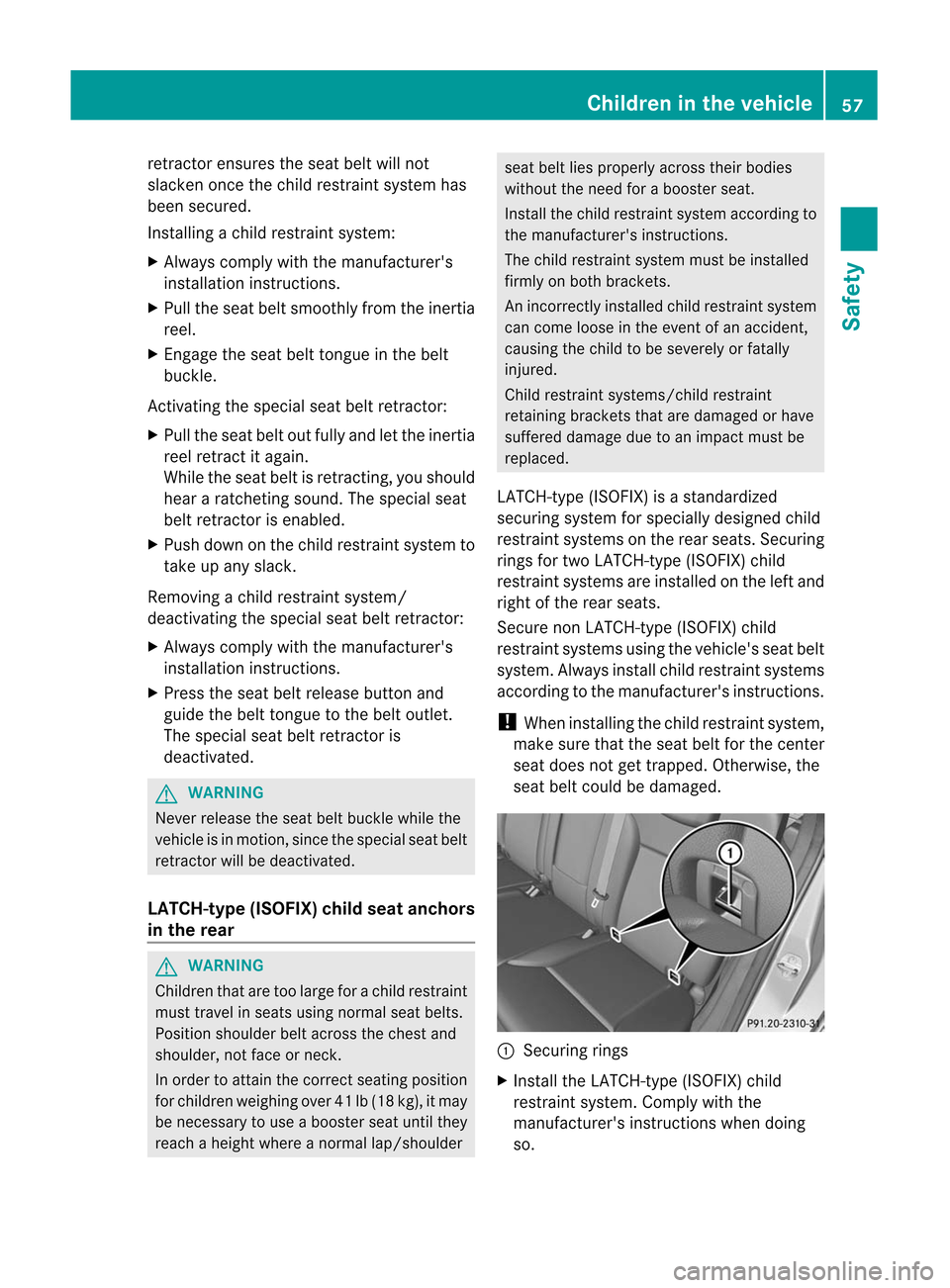
seat beltcould bedamaged. :
Securing rings
X Inst allthe LATCH-t ype(ISOFIX) child
restraint system.Complywiththe
manufacturer's instructionswhen doing
so. Children
inthe vehicl e
57Safety Z
Page 62 of 396
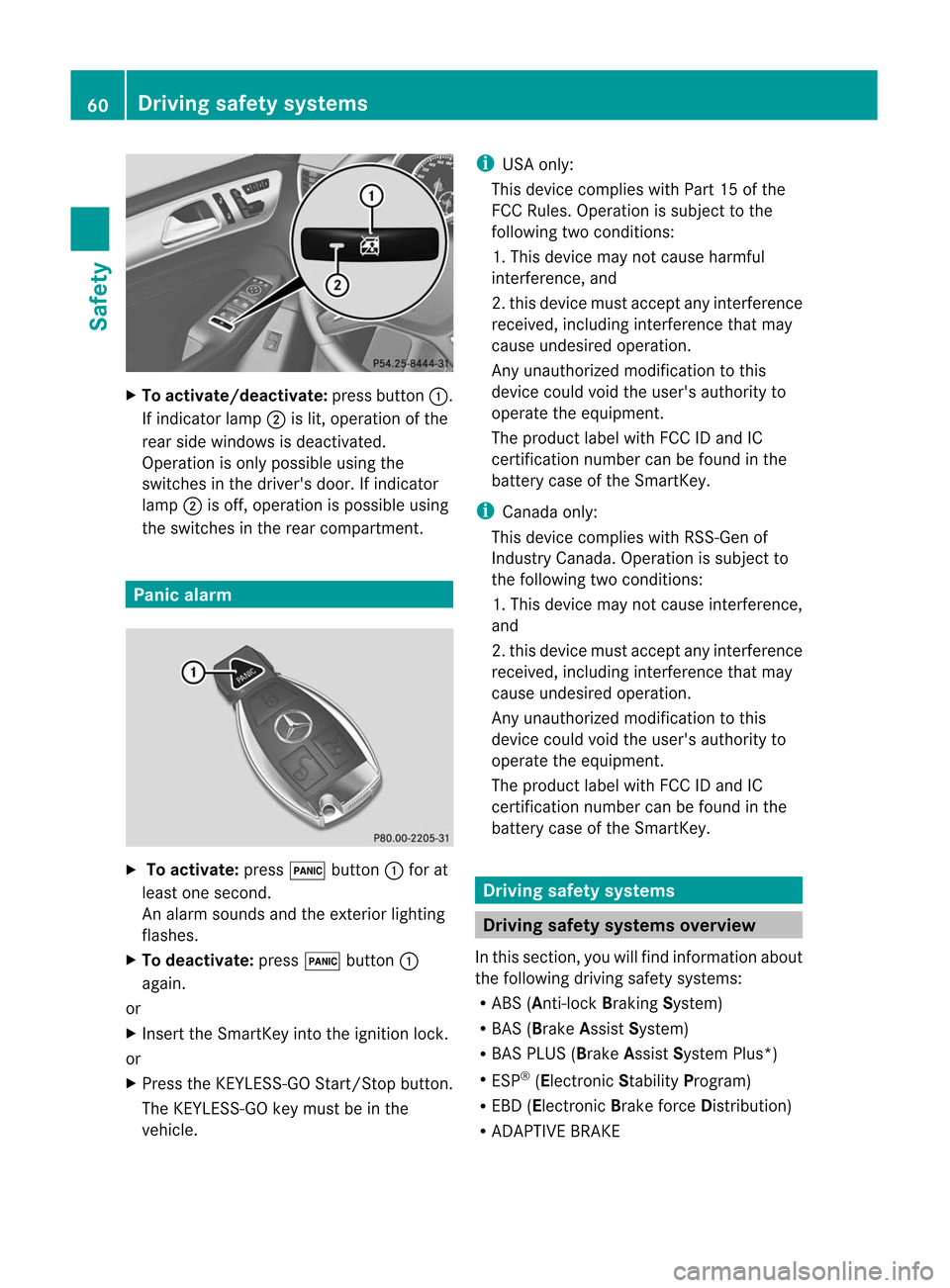
X
To acti vate /deacti vate :pre ssbutton :.
If ind icator lamp ;islit, op era tiono fthe
rear side windows isdeactivated.
Operation isonly possible usingthe
switches inthe driver's door.Ifindicator
lamp ;isoff, operation ispossible using
the switches inthe rear compartmen t. Panic
alarm X
To activate: press!button :for at
least onesecond.
An alarm sounds andtheexterior lighting
flashes.
X To deactivate: press!button :
again.
or
X Insert theSmartK eyinto theignition lock.
or
X Press theKEYLE SS-GO Start /Stopbutton.
The KEYLE SS-GO key must beinthe
vehicle. i
USA
only:
This device complies withPart15ofthe
FCC Rules. Operation issubject tothe
following twocondition s:
1. This device maynotcause harmful
interfer ence,and
2. this device mustaccept anyinterfer ence
received, includinginterferencethatmay
cause undesired operation.
Any unauthorized modificationtothis
device couldvoidtheuser's authority to
operate theequipment.
The product labelwithFCCIDand IC
certific ationnumber canbefound inthe
battery caseofthe SmartK ey. i
Canada
only:
This device complies withRSS-Gen of
Industry Canada.Operation issubjec tto
the followi ng two cond itions :
1. Thisde vice ma ynot causeinte rferenc e,
and
2. thi sde vice mu stacc eptany inte rference
rece ived,incl uding inte rference thatm ay
caus eunde sired oper ation.
An yunaut horizedmod ificatio ntothis
device couldvoidtheuser's authority to
operate theequipment.
The product labelwithFCCIDand IC
cert ification numbercanbefound inthe
battery caseofthe Smart Key. Driving
safetysystems Driving
safetysystems overview
In this section ,you willfind informat ionabout
the following drivingsafetysystems:
R ABS (Anti-lock BrakingSystem)
R BAS (Brake AssistSystem)
R BAS PLUS (Brake Assist System Plus*)
R ESP ®
(Electr onicStability Program)
R EBD (Electr onicBrake forceDistribution)
R AD APTIVE BRAKE 60
Driving
safetysystemsSafety
Page 63 of 396
R
PRE-S AFE®
Brake
R Steering assistant STEERCONTROL Impor
tantsafety notes
If you failtoadapt yourdriving style,the
driving safetysystems canneither reducethe
risk ofaccident noroverride thelaws of
physics. Drivingsafety systems aremerely
aids designed toassist driving. Youare
responsible forthe distanc eto the vehicle in
fron t,for vehicle speedandforbraking in
good time. Always adaptyourdriving styleto
suit theprevailing road/weather conditions,
as well asthe traff iccondit ionsandmaintain
a safe distanc eto the vehicle infron t.Drive
carefully. i
Please
notethat thedriving safety
systems described onlywork aseffect ively
as possible whenthereisadequa tecont act
between thetires andtheroad surface. Pay
particular attentiontothe inform ation
regarding tires,recomm endedminimum
tire tread depths etc.inthe "Wheels and
tires" section(Ypage 350).
In wintry driving conditions,alway suse
winter tires(M+S tires)andifnecess ary,
snow chains. Onlyinthis way willthe
driving safetysystems described inthis
sect ionwork aseffect ivelyaspossible. ABS
(Anti-lock Braking System )
Impor tantsafety notes i
Observe
the"Importan tsafet yno tes"
sec tion(Ypage 61).
AB Sr egulates brakepressure insuch away
that thewheels donot lock when youbrake.
This allows youtocon tinue steer ingthe
vehicle whenbrakin g.
AB Sw orks from aspeed ofabout
5m ph(8 km/ h)upwards, regardless ofroad-
surface condition s.AB Sw orks onslippery
surfaces, evenwhen youonly brake gently. G
WARNIN
G If
the ABS malfunct ions,other driving systems
such asthe BAS orthe ESP ®
are also switched
off. Observe indicator andwarning lampsthat
may come onaswell asmessages inthe
multifunct iondisplay thatmay appear.
If the ABS malfunct ions,thewheels maylock
during hardbraking, reducing thesteering
capability andexten dingthebraking distance.
The ! warning lampinthe instr ument
cluster lightsupwhen theignition isswitched
on. Itgoes outwhen theengine isrunnin g.
Br aking If
ABS intervenes whenbraking, youwillfeel
a pulsing inthe brake pedal.
X IfABS intervenes: continue todepress the
brake pedalwithforce untilthebraking
situation isover.
X To mak eafull brake application:
depress thebrake pedalwithfullforce.
The pulsating brakepedalcanbean
indication ofhazardous roadcondit ions,and
funct ionsasareminder totake extracare
while driving. G
WARNIN
G Do
not pump thebrake pedal. Usefirm, steady
brake pedalpressure instead.Pumping the
brake pedaldefeats thepurpose ofthe ABS
and significant lyreduces braking
effect iveness. BAS
(BrakeAssist System) i
Observe
the"Important safetynotes"
section (Ypage 61).
BAS operates inemergenc ybraking
situations. Ifyou depress thebrake pedal
quickly, BASautomatically booststhebraking
force, thusshorten ingthe stopping distance.
X Keep thebrake pedalfirmly depressed until
the emergenc ybraking situation isover.
ABS prevent sthe wheels fromlockin g. Driving
safetysystems
61Safety Z