ESP MERCEDES-BENZ M-Class 2012 W166 Workshop Manual
[x] Cancel search | Manufacturer: MERCEDES-BENZ, Model Year: 2012, Model line: M-Class, Model: MERCEDES-BENZ M-Class 2012 W166Pages: 396, PDF Size: 14.48 MB
Page 148 of 396
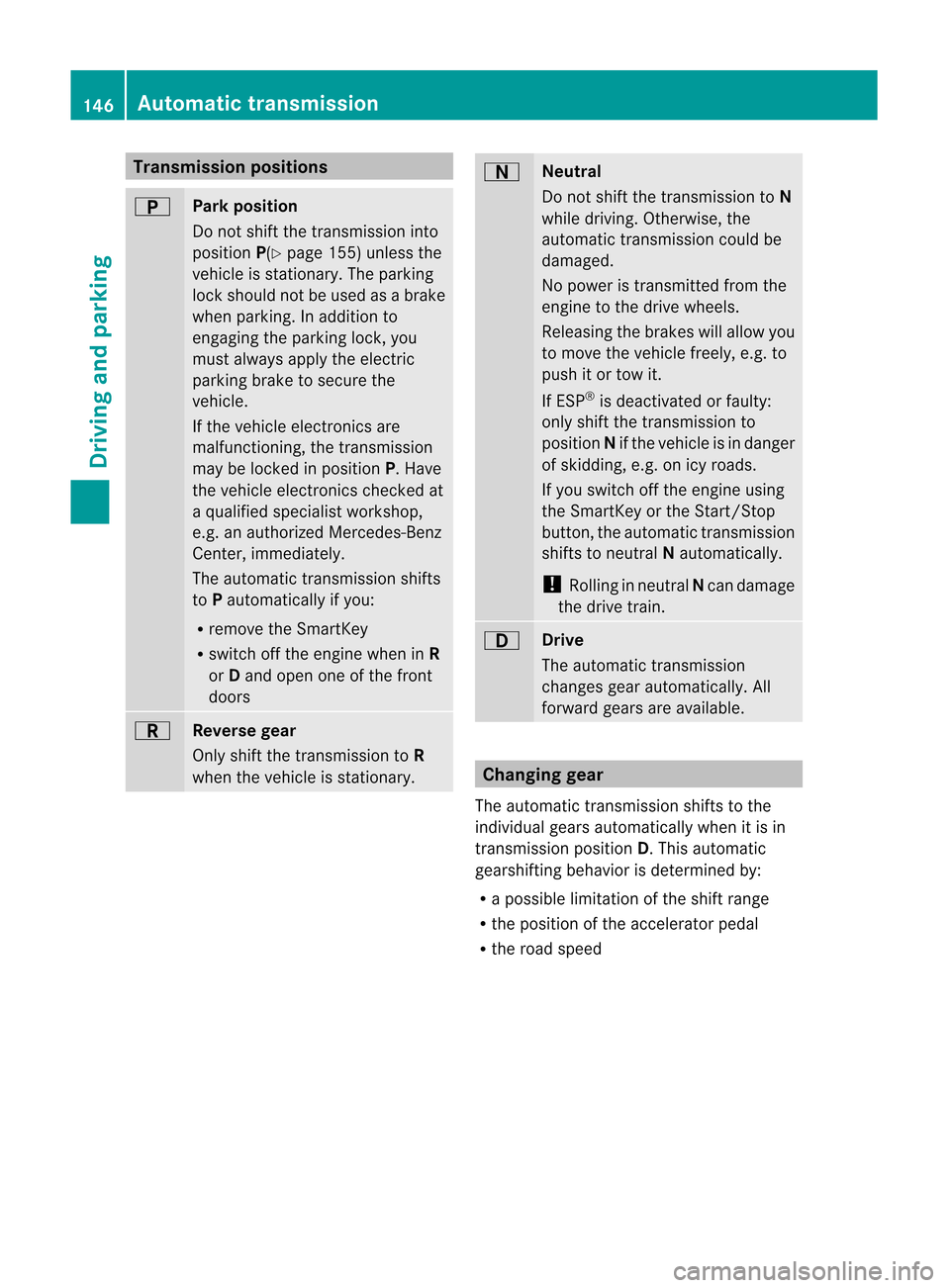
Trans
mission pos ition s B
Park
position
Do not shiftthe transmi ssion into
po sitio nP(Y page 155) unless the
veh icleis sta tionar y.The parking
lo ck sho uld not beused asabra ke
wh en parking .In additio nto
eng aging the parking lock, you
mu stalwa ysapplythe electri c
pa rking braketosec urethe
veh icle.
If the vehicleelectro nicsare
ma lfunctio ning,the transmi ssion
ma ybe locked inpo sitio nP. Hav e
the vehicleelectro nicschecked at
a qu alifi ed speci alistw orkshop,
e.g. anauthorized Mercedes-B enz
Center, immediately.
The automatic transmission shifts
to Pautomatically ifyou:
R remove theSmart Key
R switch offthe engine wheninR
or Dand open oneofthe front
doors C
Reverse
gear
Only shiftthetrans mission toR
when thevehicle isstation ary. A
Neut
ral
Do not shift thetrans mission toN
while driving. Otherwise, the
automatic transmission couldbe
damaged.
No power istrans mittedfrom the
engine tothe drive wheels.
Releasi ngthe brakes willallow you
to move thevehicle freely,e.g.to
push itor tow it.
If ESP ®
is deactivated orfaulty:
only shift thetrans mission to
position Nifthe vehicle isin danger
of skidding, e.g.onicy roads.
If you switch offthe engine using
the Smart Keyorthe Start /Stop
button ,the automatic transmission
shifts toneutral Nautomatically.
! Rolling inneutral Ncan damage
the drive train. 7
Drive
The
automatic transmission
changes gearautomatically. All
forward gearsareavaila ble. Changing
gear
The automatic transmission shiftstothe
individual gearsautomatically whenitis in
trans mission position D.Thisautomatic
gearshifting behaviorisdetermined by:
R apossible limitation ofthe shift range
R the position ofthe accelerator pedal
R the road speed 146
Automat
ictransmissionDriving and parking
Page 150 of 396
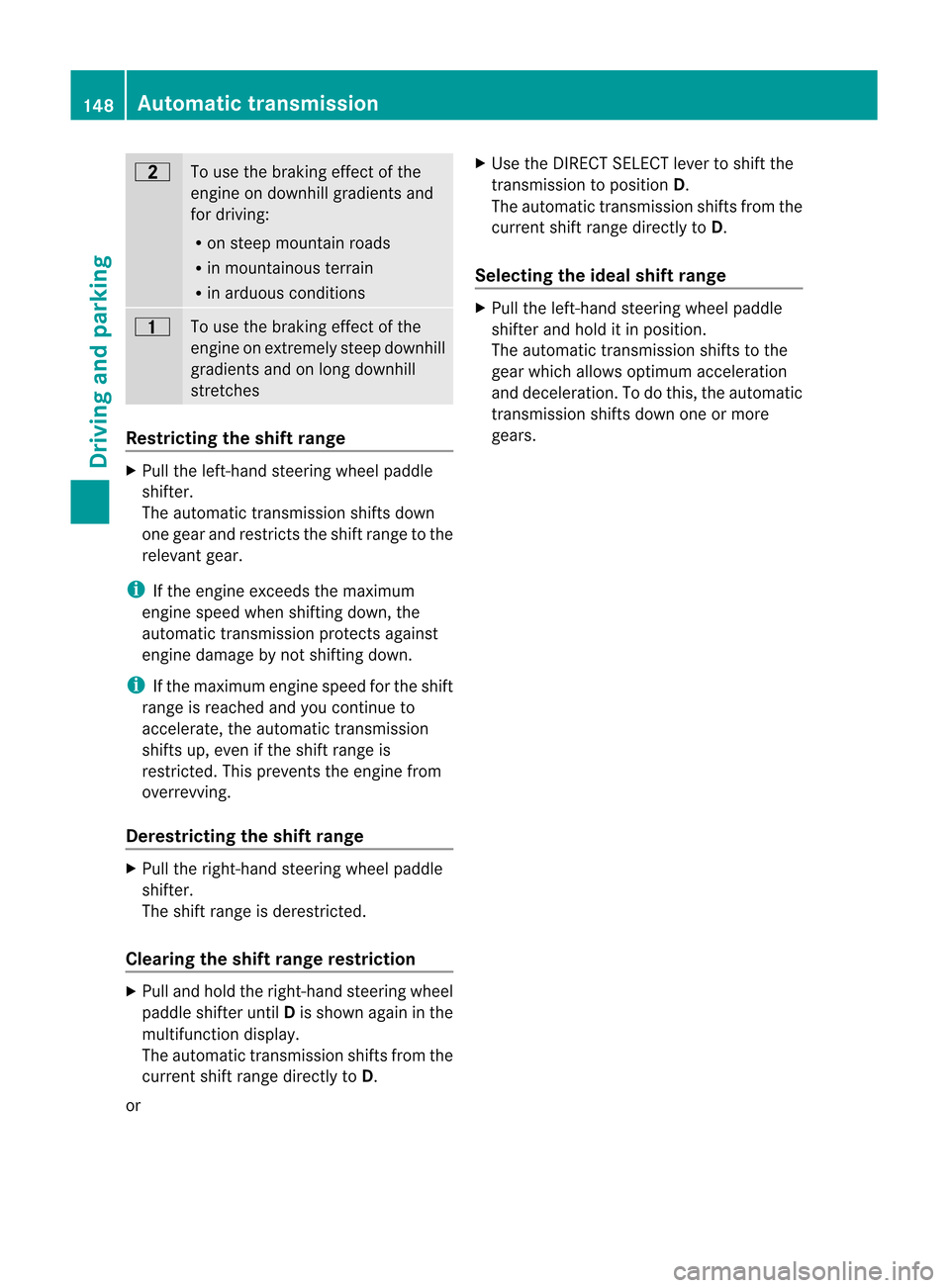
5
To
use thebraking effectofthe
engine ondownhill gradients and
for driving:
R on steep mountain roads
R in mountain ousterrain
R in arduous conditions 4
To
use thebraking effectofthe
engine onextr emely steepdownhill
gradients andonlong downhill
stret ches Restr
icting theshift range X
Pull theleft- hand steerin gwheel paddle
shifter.
The automatic transmission shiftsdown
one gear andrestrict sthe shift range tothe
relevant gear. i
If
the engine exceeds themaximum
engine speedwhenshifting down,the
automatic transmission protectsagainst
engine damage bynot shifting down. i
If
the maximum enginespeedforthe shift
range isreached andyoucont inue to
accelerate, theautomatic transmission
shifts up,even ifthe shift range is
restrict ed.This prevents theengine from
overrevving.
Derestricting theshift range X
Pull theright-hand steeringwheelpaddle
shifter.
The shift range isderestrict ed.
Clearing theshift range restriction X
Pull and hold theright-hand steeringwheel
paddle shifteruntilDis shown againinthe
multifunction display.
The automatic transmission shiftsfromthe
current shiftrange directly toD.
or X
Use theDIRECT SELECT lever toshift the
transmission toposition D.
The automatic transmission shiftsfromthe
current shiftrange directly toD.
Selec tingtheideal shiftrange X
Pull theleft-hand steeringwheelpaddle
shifter andhold itin position.
The automatic transmission shiftstothe
gear which allowsoptimum acceleration
and deceleration. Todo this, theautomatic
transmission shiftsdownoneormore
gears. 148
Automat
ictransmissionDriving and parking
Page 153 of 396
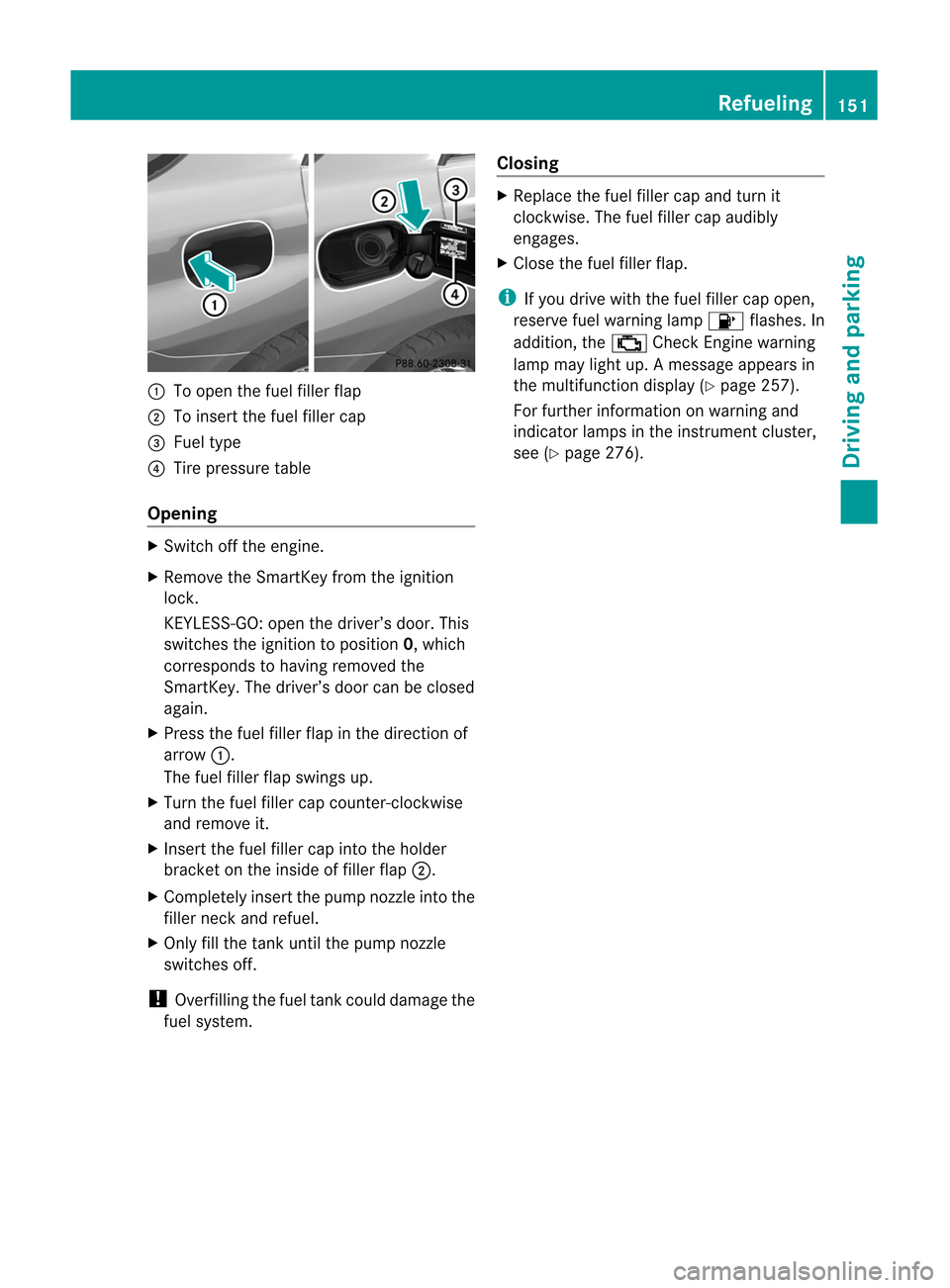
:
Toopen thefuel filler flap
; Toinsert thefuel filler cap
= Fuel type
? Tire pressure table
Opening X
Switc hoff the engine.
X Remove theSmart Keyfrom theignition
lock.
KEYLE SS-GO: open thedriver’s door.This
switches theignition toposition 0,which
correspon dstohaving removed the
Smart Key.Thedriver’s doorcanbeclosed
again.
X Press thefuel filler flapinthe direction of
arrow :.
The fuel filler flapswings up.
X Turn thefuel filler capcount er-clockwise
and remove it.
X Insert thefuel filler capinto theholder
bracket onthe inside offiller flap;.
X Completely insertthepump nozzleinto the
filler neck andrefuel.
X Only fillthe tank untilthepump nozzle
switches off.
! Overfilling thefuel tank could damage the
fuel system. Closing X
Replace thefuel filler capand turn it
clock wise. Thefuel filler capaudibl y
engages.
X Close thefuel filler flap. i
If
you drive withthefuel filler capopen,
reserve fuelwarning lamp8 flashes. In
addition, the; Check Engine warning
lamp maylight up.Am essage appears in
the multifunc tiondisplay (Ypage 257).
For furth erinfor mation onwarning and
indicat orlamps inthe instrument cluster,
see (Ypage 276). Refueling
151Driving and parking Z
Page 162 of 396
Limi
tedbraking performa nce onsalt -
tr eat edroa ds G
WAR
NING The
layer ofsalt ontheb rake discs andthe
brake pads/linings maycauseadelay inthe
brakin geffec t,resultin gin asignific antly
longer brakingdistanc e,which couldleadto
an acciden t.
To avoid thisdanger, youshould:
R occ asionally brakecarefully, without
puttin gother roadusers atrisk, when you
are driving onsalted roads. Thishelps to
remov eany salt that may have startedto
build upon the brake discsandthebrake
pads/linin gs.
R maint ainagreater distancetothe vehicle
ahead anddrive withparticular care.
R carefully applythebrakes atthe end ofa
trip and immediately aftercommen cinga
new trip,sothat saltresidues areremoved
from thebrake discs.
Servicing thebrakes !
Ifthe red brake warning lamplights upin
the instr ument cluster andyouhear a
warning tonewhile theengine isrunnin g,
the brake fluidlevel maybetoo low.
Observe additional warningmessages in
the multifunct iondisplay .
The brake fluidlevel maybetoo low due to
brake padwear orleaking brakelines.
Have thebrake system checked
immediately. Thiswork should becarried
out atan authorized Mercedes-B enz
Center.
All check sand mainten ancework onthe
brake system mustbecarried outata
quali fiedspecialist workshop only.Have this
work carried outatan authorized Mercedes-
Benz Center.
Have thebrake padsreplaced andthebrake
fluid renewed ataquali fiedspecialist
workshop, e.g.anauthorized Mercedes-B enz
Center. G
WARNING If
brake padsorbrake fluidother thanthose
recommen dedareused, thebraking
properties ofthe vehicle canbedegraded to
an exten tthat safe braking issubstantially
impaired. Thiscould result inan accident.
! Afunct ionorperformance testshould
only becarried outona2 -axl e
dy nam ome ter.Ifyo uar eplanni ngtohave
the vehicleteste don such ady nam ome ter,
conta ctan author izedMer cedes-B enz
Ce nter toobtainfu rthe rinfo rma tionfir st.
Othe rwise, youcou ldda ma gethe drive
trai nor the brakesystem .
! Asthe ESP ®
sy stem opera tes
au toma tically, the engineand theigniti on
mu stbe switch edoff (Sma rtKeyin po sitio n
0 or 1in the igniti onlock orStar t/Stop
bu tton inpo sitio n0 or 1) wh ile the electri c
pa rking brakeisbe ing teste don abra ke
dy nam ome ter(ma ximu m10secon ds).
Brak ingtrigger edautomatic allybyESP®
may seriously damagethebrake system.
If your brake system issubject onlyto
moderate loads,youshould testthe
func tionality ofyour brakes atregular
int ervals bypressing firmlyonthe brake pedal
at high speeds. Thisimproves thegrip ofthe
brake pads. G
WARN
ING Make
surethatyoudonot endanger other
road users whenyouapply thebrakes.
You canfind adescript ionofBrak eAssist
(BAS )on (Ypage 61)orofBA SPLUS on
(Y page 62). 160
Driving
tipsDriving and parking
Page 164 of 396
Winter
driving
Gene ralnote s G
WARNING If
the vehicl ebecome strappe din snow,
ensure thatsnow iskept away from the
exhau stpip eand from aroundthe vehicl eas
long asthe engine isrunning. Otherwise,
poi sonou scarbo nmonoxide (CO)mayenter
the vehicle, resulting inloss ofconsc iousness
and even death.
To assure sufficient freshairvent ilation, open
a window slightlyonthe side ofthe vehicle
not facing thewind.
At the onset ofwinter, haveyourvehicle
winterproof edataquali fiedspecialist
workshop, e.g.atan authorized Mercedes-
Benz Center. i
Vehicles
withadiesel engine: donot
cover theradiator, e.g.with aprotec tive
cover. Themeasuring functionofthe
Onboard Diagnosis Systemmayotherwise
provide inaccurate values.Someofthese
values arerequired bylaw and must
therefor ealwa ysbe accurate.
Driving withsumm ertires Observe
thenotesinthe "Winter operation"
section (Ypage 352).
Slippery roadsurfa ces G
WARNING The
outside temperature indicatorisnot
designed toserve asan ice-warnin gdevice
and istherefor eunsuitable forthat purpose.
Indicated temperatures justabove the
freezin gpoint donot guarantee thattheroad
surface isfree ofice. The road maystillbeicy,
especially inwooded areasoron bridges. G
WARNING On
slippery roadsurfaces, neverdownshift in
order toobtain braking action.Thiscould result
indrive wheel slipand reduced vehicle
cont rol.Your vehicle's ABSwillnotprevent
this type ofloss ofcont rol.
Drive particularly carefullyonslippery road
surfaces. Avoidsudden acceleration, steering
and braking maneuvers. Donot use thecruise
cont rolorDIS TRONIC PLUS.
If the vehicle threaten sto skid orcann otbe
stopped whenmoving atlow speed:
X Shift thetrans mission toposition N. i
For
more informat ionondriving with
snow chains, see(Ypage 353). G
WARNING Make
surethatyoudonot endanger other
road users whenyouapply thebrakes. Off-r
oaddriving
Import antsafety notes G
WARNING Grains
ofsand, particles ofdirt and other
abrasive materials canenter thebrake
system. Thiscanlead toexcessive wearand
unpredictable brakingefficienc y.
Aft erthe brakes havebeen exposed todirty
condit ions,havethem check edand cleaned
at aquali fiedspecialist workshop, e.g.an
authorized Mercedes-B enzCenter.
Otherwise, thereisarisk that braking power
may beinsufficient inthe event ofan
emergenc y,or that thebraking effectmaybe
unpredictable. G
WARNING Do
not load items onthe basic carrier bars.It
may cause instability duringsomemaneuvers
which couldresult inan accident .
Drive slowly inunkn ownterrain. Thiswill
make iteasier torecogn izeunexpect ed
obstacles andavoid damage tothe vehicle.
To help avoid thevehicle rollingover,never
turn itaround onsteep inclines. Ifthe vehicle 162
Driving
tipsDriving and parking
Page 165 of 396
cannot
complete the attem ptedclimb, back it
dow ninr everse gear.
Do not drive along theside ofaslope. The
vehicle mightotherwiserollover. Ifin doing so
the vehicle beginstoshow aten dency toroll,
immediately steerintoaline ofgravity
(straight upordownhill).
Never letthe vehicle rollbackwards inidle.
You may losecontrol ofthe vehicle ifyou use
only theservic ebrake. Forinfor mation on
driving downhill, see"Drivin gdownhill". G
WARN
ING Vehicles
withairsuspension program:Please
be aware thatbyraising thevehicle level,the
cent erofgravity alsorises. Therefor e,alway s
ensure thatthevehicle levelisas low as
possible. Withhigher rideheight theESP®
may activat eearlier incert ainsituation s. G
WARN
ING Do
not reduce thetire inflation pressure
before driving through sand. However, ifyou
do so, remember tocorr ectthe tire inflation
pressure beforecontinuin gyour trip.Drivin g
with reduced tireinflation pressure increases
the risk oflosing control ofthe vehicle and
rolling over.
General notes Read
thissect ioncarefully beforedriving your
vehicle off-road. Practicebydriving overmore
gent leoff- road terrainfirst .
Familiarize yourselfwiththecharact eristics
of your vehicle andthegear shiftoperation
before driving through difficult terrain.
The following drivingsystems arespecially
adapted tooff- road driving:
R Off- road ABS(Ypage 61)
R AIRMA TICpackage (vehiclelevel)
(Y page 180)
R DS R(Downh illSpeed Regulation)
(Y page 208) Observe
thefollowing notes:
R Stop the vehicle beforestartingtodrive
along anoff- road route.
R For vehicles withAIRMA TICpackage:
select avehicle levelthatissuitable forthe
off- road terrain. Make surethere isalway s
sufficien tground clearanc eto preven t
damage tothe vehicle.
R Check thatitems ofluggage andloads are
stowed safelyandarewell secured
(Y page 288).
R Always keeptheengine runningand ingear
when driving onadownhill gradient.
Ac tivat eDS R(Ypage 208).
R Always keepthedoors, tailgate, windows
and sliding sunroof closedwhiledriving.
R Adapt yourspeed tothe terrain. The
rougher, steeperormore rutsonthe
terr ain, theslower yourspeed should be.
R Driv eslowly andatan even speed through
the water. Ensure thatabow wave doesnot
form asyou drive.
R Driv ewith extreme careonunkn ownoff-
road routes wherevisibility ispoor. For
safety reasons ,get out ofthe vehicle first
and survey theoff-road route.
R Look outforobstac lessuch asrock s,holes,
tree stumps andfurrows.
R Check thedepth ofwater before fording
rivers andstreams.
R When fording,do not stop anddonot
switc hoff the engin e.
R On sand, drivequickly tooverc omethe
rolling resistance. Otherwise, thevehicle
could digitself intothe sand.
R Do not jump withthevehicle asthis will
int errupt thevehicle's propulsion.
R Always keeptheengin erunn ingand ingear
when drivingon aslope.
R Do not shift theautomatic transmission to
tran smission positionN. Driving
tips
163Driving and parking Z
Page 167 of 396
nece
ssary.F oreign objectscan disturb the
balance andcause vibrations.
Driving onsand G
WARNIN
G Do
not reduce thetire inflation pressure
before driving through sand.However, ifyou
do so, remember tocorrec tthe tire inflation
pressure beforecontinuing yourtrip.Drivin g
with reduced tireinflation pressure increases
the risk oflosing controlofthe vehicle and
rolling over.
Observe thefollowing ruleswhen driving on
sand:
R vehicles withtheAIRMATIC package:
select araised vehicle level.
R avoid highengine speeds.
R select ashift range appropriate tothe
terrain.
R drive quickly toovercom ethe rolling
resistance. Otherwise,thevehicle coulddig
itself intothesand.
R drive inthe track sof other vehicles if
possible. Makesurethattheruts arenot
too deep, thatthesand isfirm enough and
that your vehicle hassufficient ground
clearance.
Rut sand gravel roads Observe
thefollowing ruleswhen driving
along rutsinoff-r oad terrain oron roads with
loose gravel:
! Check thattheruts arenot too deep and
that your vehicle hassufficient clearance.
Otherwise, yourvehicle couldbedamaged
or bottom outand getstuck.
R for vehicles withAIRMATIC package:select
an increased vehiclelevel.
R avoid highengine speeds.
R select shiftrange 1. R
drive slowly .
R where rutsaretoo deep, drivewiththe
wheels ofone side onthe cent ergrassy
area, ifpossible.
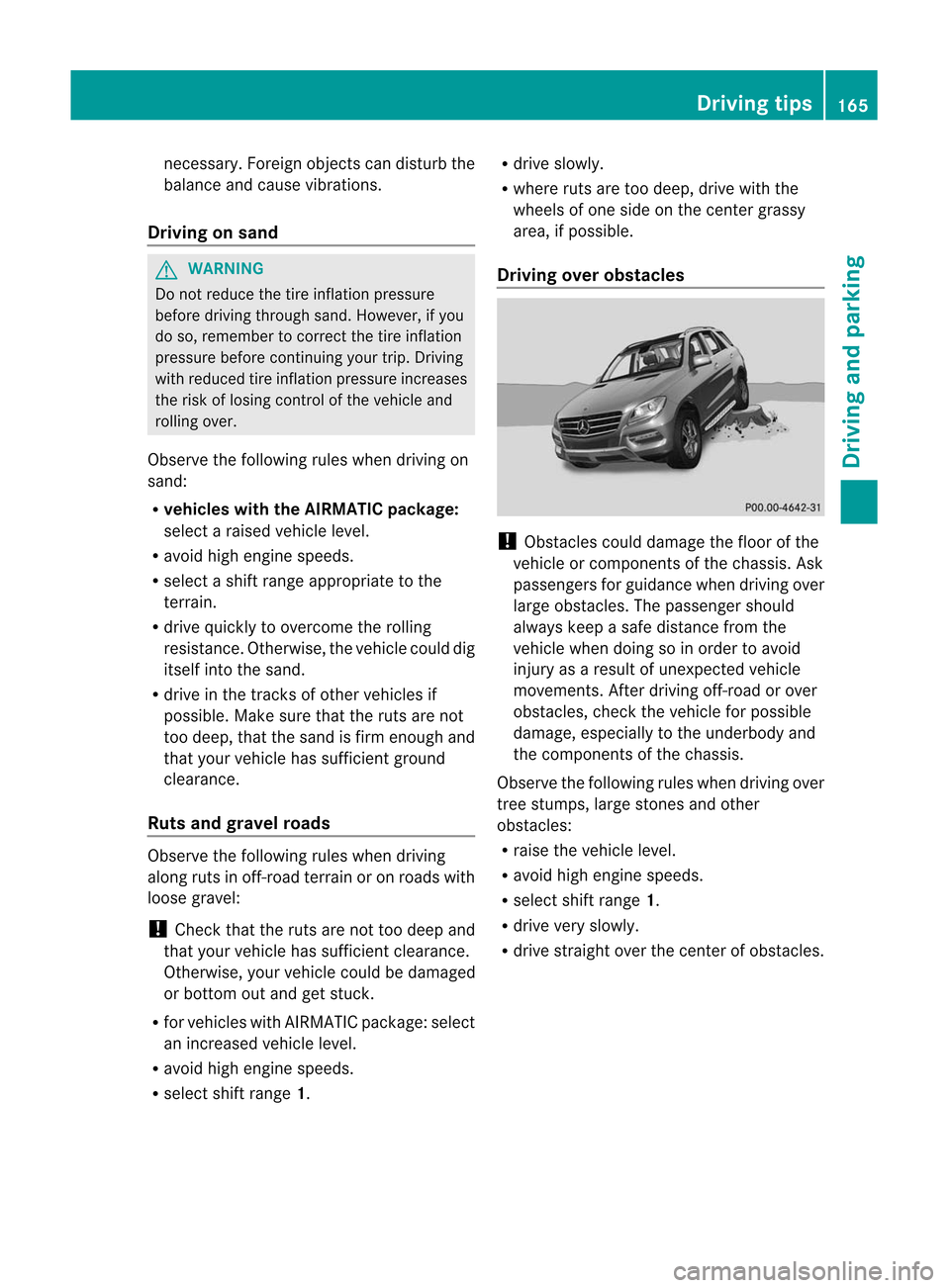
Driving overobstacles !
Obstacles coulddamage thefloor ofthe
vehicle orcomponen tsof the chassis. Ask
passengers forguida ncewhen driving over
large obstacles. Thepassenger should
alwa yskeep asafe distance fromthe
vehicle whendoing soinorder toavoid
injury asaresult ofunexpect edvehicle
movement s.Aft erdriving off-road orover
obstacles, checkthevehicle forpossible
damage, especiallyto the underbody and
the componen tsof the chassis.
Observe thefollowing ruleswhen driving over
tree stumps, largestones andother
obstacles:
R raise thevehicle level.
R avoid highengine speeds.
R select shiftrange 1.
R drive veryslowly .
R drive straight overthecent erofobstacles. Driving
tips
165Driving and parking Z
Page 168 of 396
Trave
ling uphi ll
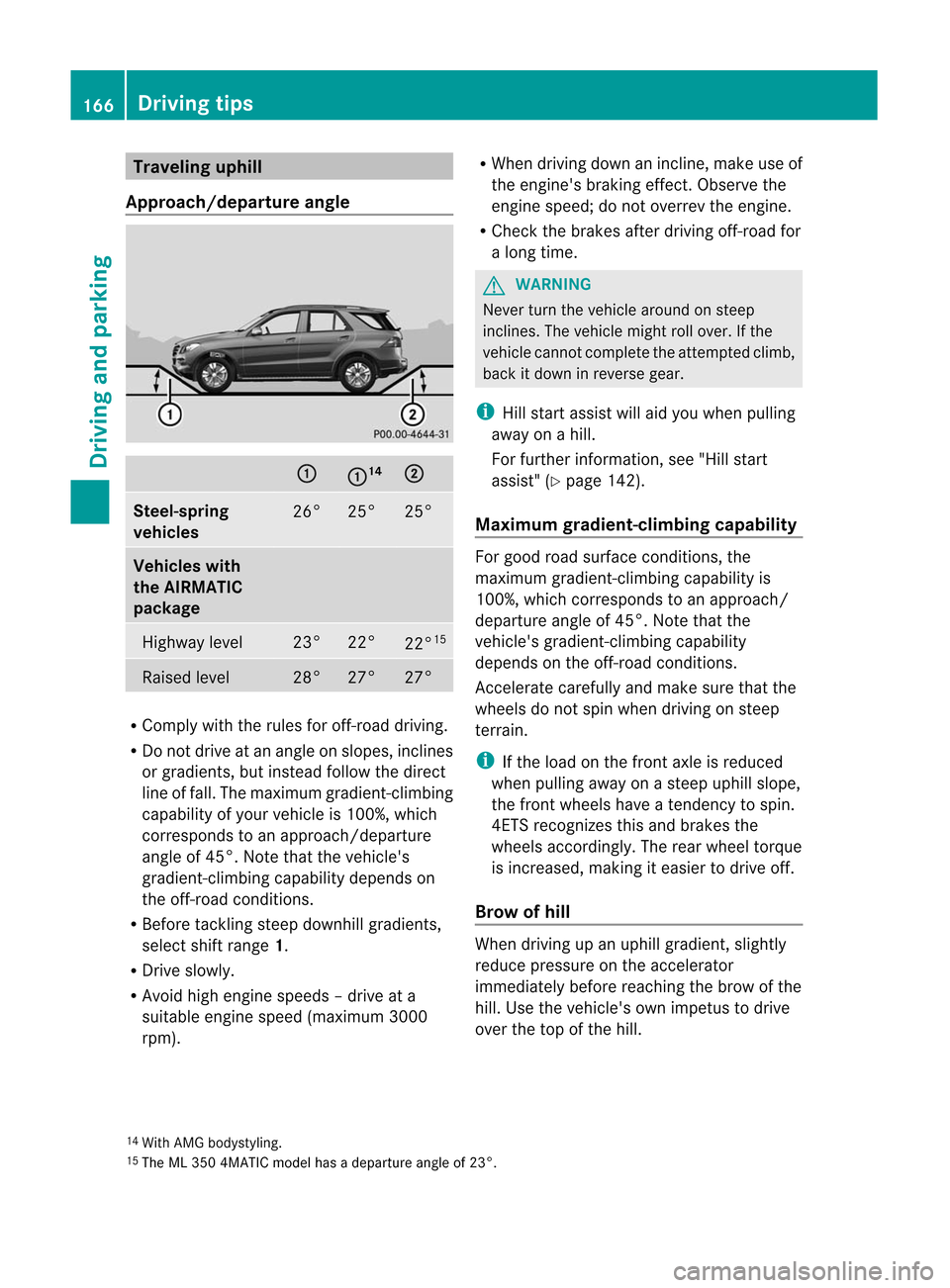
App roac h/depa rture angle :
: 14
;
Ste
el-spri ng
ve hic les 26° 25° 25°
Veh
icle swi th
the AIRMA TIC
pac kag e Hig
hway level 23° 22°
22°
15 Ra
ised level 28° 27° 27°
R
Co mpl ywi th the rulesfor off-roaddri ving .
R Do not drive atan ang leon slop es,incl ines
or gra dients, butinstea dfol low the direct
li ne offall.T he maximum gradient-climbing
capabil ityofyour vehicle is100%, which
corresponds toan approach/departure
angle of45°. Note thatthevehicle's
gradient-c limbingcapabilitydepends on
the off-r oad condition s.
R Before tackling steepdownhill gradients,
select shiftrange 1.
R Drive slowly .
R Avoid highengine speeds –drive ata
sui table engine speed(maxi mum 3000
rpm). R
When drivingdow nanincli ne, makeuseof
the engine'sbra king effect. Observethe
eng inespeed;do not overrevthe engine.
R Check thebrakes afterdriving off-road for
a long time. G
WARNING Never
turnthevehicle around onsteep
inclines. Thevehicle mightrollover. Ifthe
vehicle cannotcomplete theattempt edclimb,
back itdown inreverse gear. i
Hill
start assist willaidyou when pulling
away onahill.
For further information ,see "Hill start
assist" (Ypage 142).
Maximum gradient-climbing capability For
good roadsurface condition s,the
maximum gradient-climbingcapabilityis
100%, whichcorresponds toan approach/
departure angleof45°. Note thatthe
vehicle's gradient-c limbingcapability
depends onthe off-r oad condition s.
Acc elerate carefully andmake surethatthe
wheels donot spin when driving onsteep
terrain. i
If
the load onthe front axleisreduced
when pullingaway onasteep uphillslope,
the front wheels haveatenden cytospin.
4ETS recogniz esthis and brakes the
wheels accordingly. Therear wheel torque
is increased, makingiteasier todrive off.
Brow ofhill When
driving upanuphill gradient, slightly
reduce pressure onthe accelerator
immediately beforereaching thebrow ofthe
hill. Use thevehicle's ownimpetus todrive
over thetop ofthe hill.
14 With AMG bodystyling.
15 166
Driving
tipsDriving and parking
The ML 350 4MATIC model has a departure angle of 23°.
Page 169 of 396
This
style ofdriving prevent s:
R the vehicle fromlifting offthe ground onthe
brow ofahill
R the vehicle fromtraveling tooquickly down
the other side
Driving downhill R
Drive slowly.
R Do not drive atan angle down steep
inclines. Steer into theline offall and drive
with thefron twheels aligned straight.
Otherwise, thevehicle couldslipsidewa ys,
tip and rollover.
R Before tackling steepdownhill gradients,
select shiftrange 1.
R Act ivate DSR. Ifthis isnot sufficient, brake
gently. Whendoingso,make surethatthe
vehicle isfacing inthe direction ofthe line
of fall.
R Check thatthebrakes areworking normally
after along downhill stretch. i
The
special off-road ABS settin genables
a precise, briefandrepeated lockingofthe
front wheels, causing themtodig into the
loose earth. Beaware thatthefront wheels
easily skidacross theground surface if
completely brakedandtherefore losetheir
abili tyto steer. Driving
systems Cruise
control
Import antsafety notes G
WARNING The
cruise controlisaconven iencesystem
designed toassist thedriver during vehicle
operation. Thedriver isand must always
remain responsible forthe vehicle's speed
and forsafe brake operation.
Only usethecruise controlifthe road, traffic,
and weather condition smake itadvisabl eto
travel ataconst antspeed. R
The useofthe cruise controlcan be
dangerous onwinding roadsorinheavy
traffic because condition sdo not allow safe
driving ataconst antspeed.
R The useofthe cruise controlcan be
dangerous onslippery roads.Rapid
changes intire tract ioncan result inwheel
spin andloss ofcont rol.
R Deactivate thecruise controlwhen driving
in fog.
The "Resu me"funct ionshould onlybe
operated ifthe driver isfully aware ofthe
previously setspeed andwishes toresume
this particular presetspeed. G
WARNING The
cruise controlbrakes automatically so
that thesetspeed isnot exceeded.
General notes Cruise
controlmaintains aconst antroad
speed foryou. Itbrakes automatically inorder
to avoid exceeding thesetspeed. Onlong and
steep downhill gradients, especiallyif the
vehicle isladen ortowing atrailer, youmust
select shiftrange 1,2or 3in good time. By
doing so,you willmake useofthe braking
effect ofthe engine, whichrelieves theload
on the brake system andprevents thebrakes
from overheating andwearing tooquickly.
Use cruise controlonly ifroad andtraffic
condition smake itappropriate tomaintain a
steady speedforaprolonged period.Youcan
set any road speed above20mph
(30 km/h). i
Cruise
controlshould notbeactivated
during off-road driving. Driving
systems
167Driving and parking Z
Page 170 of 396
Cru
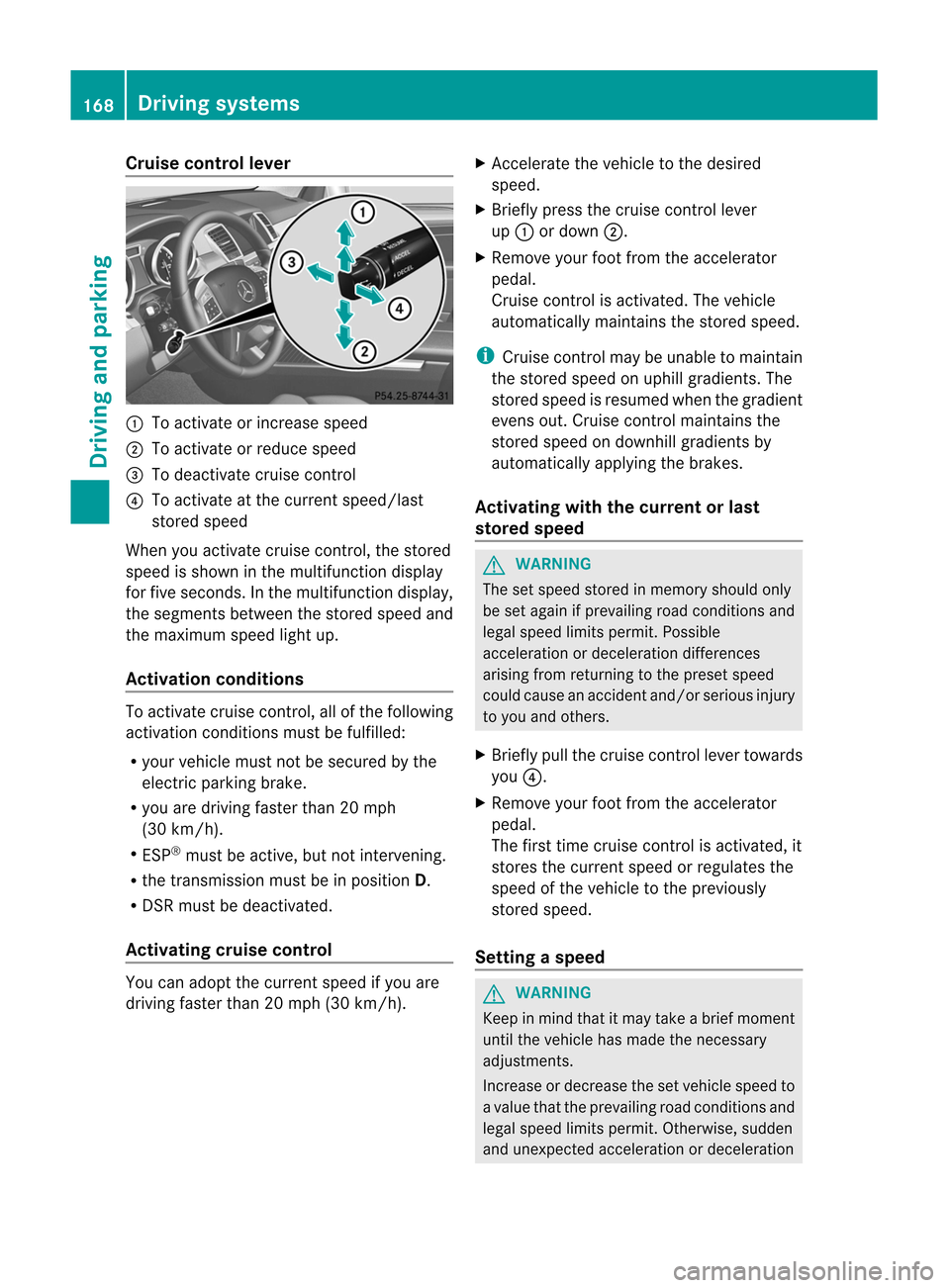
isecont rollever :
Toact ivat eor inc reas espee d
; Toact ivat eor reduc espee d
= Todeac tivate cruise control
? Toact ivat eat thecur ren tspeed/last
stor edspeed
When youactiv atecruise control,the stor ed
speed isshown inthe multifun ction display
for five secon ds.Inthe multifun ction display,
the segmen tsbetween thestor edspeed and
the maximum speedlightup.
Activat ionconditions To
activ atecruise control,all ofthe following
activ ation condition smust befulfilled:
R your vehicle mustnotbesecured bythe
elect ricparkin gbrake.
R you aredrivin gfaster than20mph
(30 km/ h).
R ES P®
must beactiv e,but not interven ing.
R the tran smission mustbeinposition D.
R DS Rmust bedeactiv ated.
Activat ingcruise control You
canadopt thecurren tspeed ifyou are
drivin gfaster than20mph (30km/ h). X
Ac celerat ethe vehicle tothe desired
speed.
X Brief lypress thecruise controllever
up : ordown ;.
X Remove yourfootfrom theacceler ator
pedal.
Cruise controlis activ ated. Thevehicle
automatic allymaint ainsthestor edspeed. i
Cruise
controlmay beunable tomaint ain
the stor edspeed onuphill gradient s.The
stor edspeed isresumed whenthegradient
evens out.Cruise controlm aint ains the
st ore dspee don down hillgrad ientsby
auto maticall yapplyin gth ebrak es.
Activ ating with thecur ren tor last
st ored speed G
WAR
NING The
setspee dstore din mem oryshould only
be set again ifpre vailin groad condi tions and
legal speedlimit sper mit.Possible
acceleration ordeceleration differences
arising fromreturn ingtothe preset speed
could cause anaccident and/orserious injury
to you and others.
X Briefly pullthecruise controllever towards
you ?.
X Remove yourfootfrom theaccelerator
pedal.
The first time cruise controlisactivated, it
stores thecurrent speedorregulates the
speed ofthe vehicle tothe previously
stored speed.
Setting aspee d G
WARNI
NG Kee
pin mind thatitm aytak eabrie fmoment
until thevehicle hasmade thenecessary
adjustmen ts.
Inc rease ordecrease thesetvehicle speedto
a value thattheprevailing roadcondit ionsand
legal speed limitspermit. Otherwise, sudden
and unexpect edacceleration ordeceleration 168
Driving
systemsDriving and parking