tailgate MERCEDES-BENZ M-Class 2012 W166 User Guide
[x] Cancel search | Manufacturer: MERCEDES-BENZ, Model Year: 2012, Model line: M-Class, Model: MERCEDES-BENZ M-Class 2012 W166Pages: 396, PDF Size: 14.48 MB
Page 184 of 396
For
safety reasons, thevehi clecan only be
low ered with alldoo rsand thetailga teclos ed.
Low ering isinterru ptedifadoo rorthe tailgate
is opened andwillcont inue after thedoor is
closed again.
! When driving onextrem elyrough terrain,
select ahigh vehicle levelingood time.
Make surethatthere isalwa yssufficient
ground clearance toprevent damage tothe
vehicle.
! Remove thekey from theignition before
raising oneormore wheels withthe
appropria teequipment.
For information aboutdriving off-road, see
(Y page 162).
Basic settings
The exten ttowhich thevehicle israised or
lowered depends onthe basic setting
selected. Selectraisedlevelforoff-road
driving orhighway /high-speed levelfor
normal roads.
The individual vehiclelevelsdifferfrom
highway levelasfollows:
R +/- 0in (+/- 0mm) atthe highway level
R –0.6 in(–15 mm)atthe high-speed level
R +2. 3in (+ 60 mm) atthe raised level
Raised level
Only select raised levelwhen thisis
appropriate forthe road condit ions.
Otherwise, fuelconsumpt ionmay increase
and handling maybeaffect ed. X
Start theengine. If
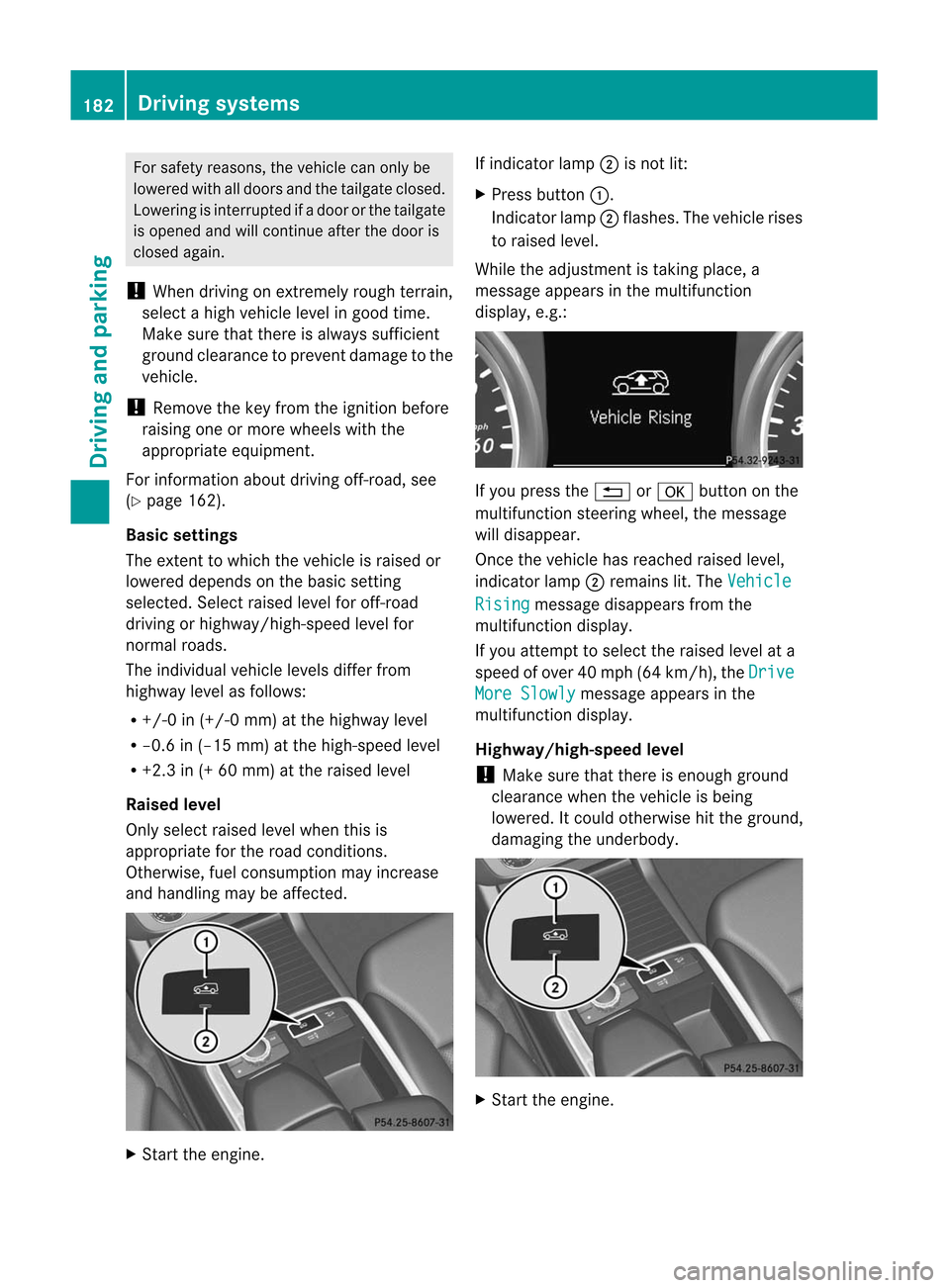
indicator lamp;isnot lit:
X Press button :.
Indicat orlamp ;flashes. Thevehicle rises
to raised level.
While theadjustmen tistaking place,a
message appearsinthe multifunction
displa y,e.g.: If
you press the% ora button onthe
multifunction steeringwheel,themessage
will disapp ear.
Once thevehicle hasreached raisedlevel,
indicator lamp;remains lit.The Vehicle
Rising message
disappearsfrom the
multifunction display.
If you attempt toselect theraised levelata
speed ofover 40mph (64km/h), the Drive
More
Slowly message
appearsinthe
multifunction display.
Highway/high-speed level
! Make surethatthere isenough ground
clearance whenthevehicle isbeing
lowered. Itcould otherwise hitthe ground,
damagi ngthe underbody . X
Start theengine. 182
Driving
systemsDriving and parking
Page 192 of 396
Rear
viewcame ra
Impo rtant safetynotes The
rearview came raisan opt ical park ingand
mane uverin gaid. Itshows thearea behin d
your vehic lewith guide linesinthe COMA ND
display. G
WARN
ING Make
surethatnoperso nsoranimals arein
the mane uverin grang e.Oth erwise, they
could beinjured.
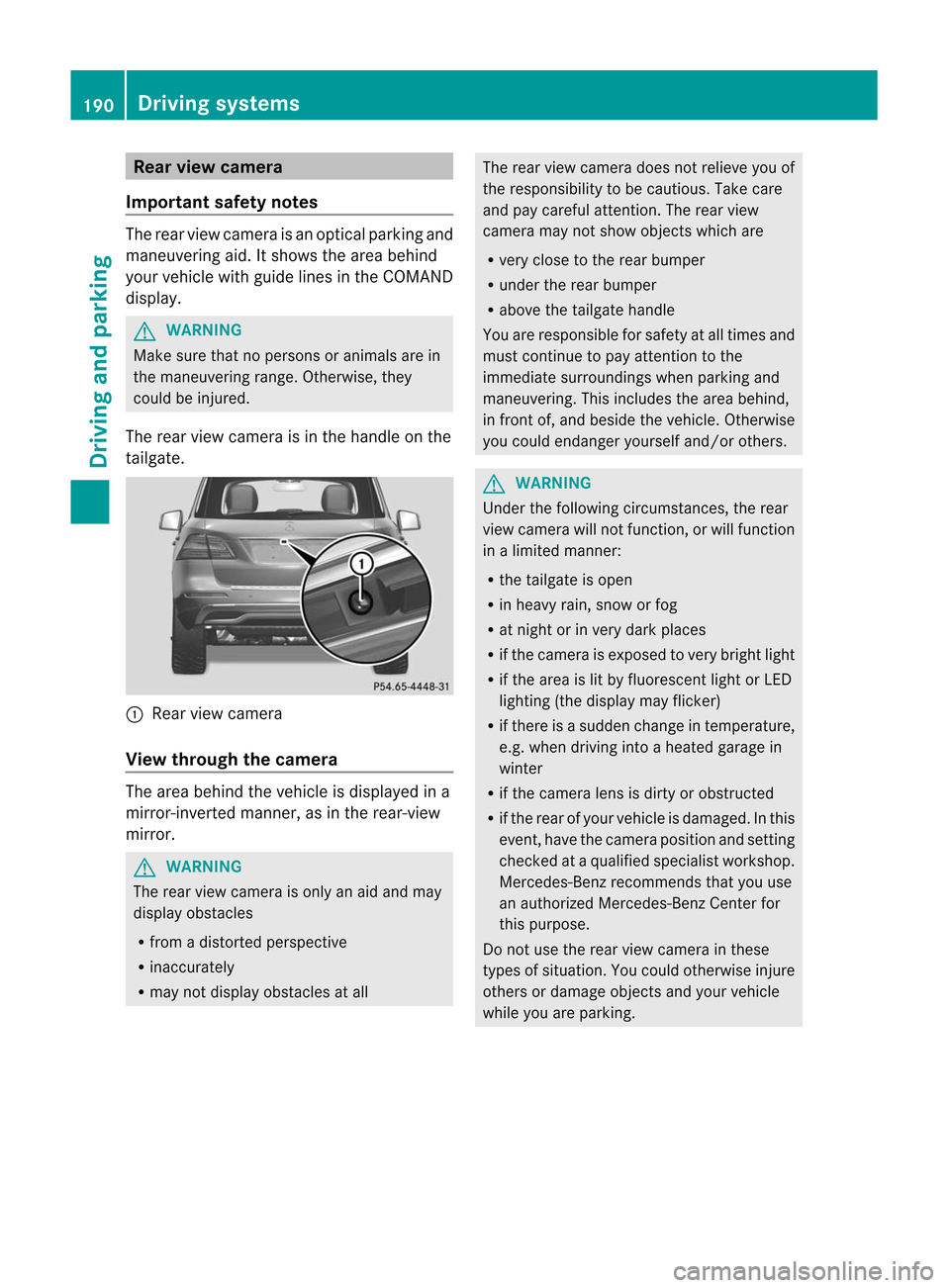
The rear view came raisin the handle onthe
tailgat e. :
Rear viewcame ra
View throu ghthecam era The
area behin dthe vehic leisdisplayed ina
mirr or-inv erted mann er,asinthe rear- view
mirr or. G
WARN
ING The
rear view came raisonly anaid and may
display obstacles
R fro madistort edperspect ive
R inacc urately
R may notdisplay obstaclesatall The
rear view camera doesnotrelieve youof
the respon sibility tobe cautious. Takecare
and paycareful attention. Therear view
camera maynotshow objectswhich are
R very close tothe rear bumper
R under therear bumper
R above thetailgate handle
You arerespon sibleforsafety atall times and
must continue topay attention tothe
immediate surroundingswhen parkin gand
maneuver ing.This includes thearea behind,
in fron tof,and besidethe vehicl e.Otherwi se
you couldendange ryourself and/or others. G
WARNING Under
thefollowing circumstances,therear
view camera willnotfunct ion,orwill funct ion
in alimited manner :
R the tailgate isopen
R in heavy rain,snow orfog
R at night orinvery dark places
R ifthe camera isexposed tovery bright light
R ifthe area islit by fluorescent lightorLED
lighting (thedisplay mayflicker)
R ifthere isasudden changeintemperature,
e.g. when driving intoaheated garagein
winter
R ifthe camera lensisdirty orobstruct ed
R ifthe rear ofyour vehicle isdamaged. Inthis
event ,have thecamera position andsetting
check edataquali fiedspecialist workshop.
Mercedes-B enzrecommen dsthat youuse
an authorized Mercedes-B enzCenter for
this purpose.
Do not use therear view camera inthese
types ofsituation. Youcould otherwise injure
others ordamage objectsand your vehicle
while youareparking. 190
Driving
systemsDriving and parking
Page 217 of 396
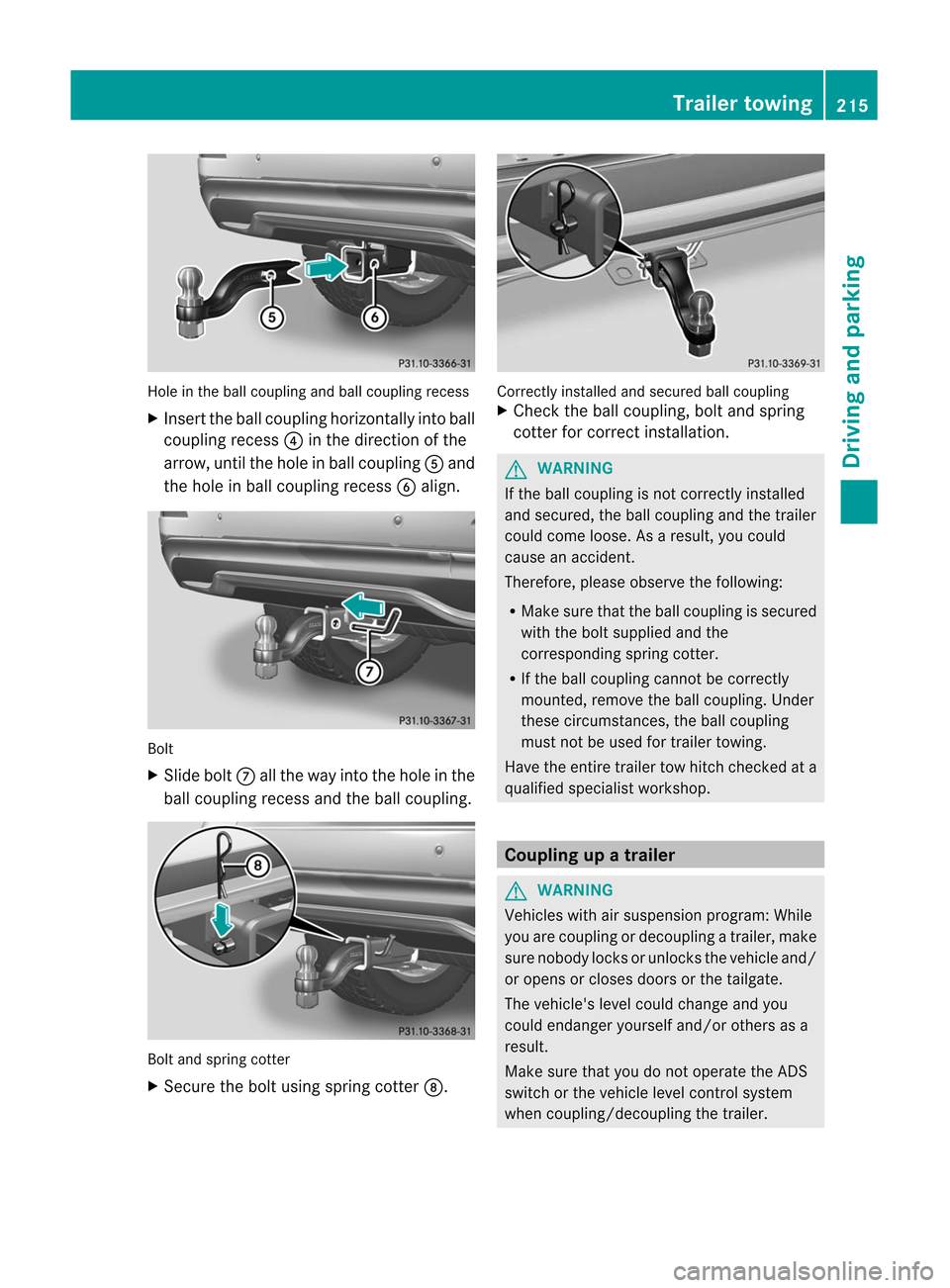
Hole
inthe ballcoup lingand ballcoup lingreces s
X Insert theballcoup ling hori zontall yinto ball
coup ling reces s? inthe direction ofthe
arro w,until theholein ba llcoup ling A and
the holein ba llcoup ling reces sB align. Bolt
X
Slid ebol tC allthe wayinto theholein the
ba llcoup ling reces sand theballcoup ling. Bolt
andspringcotter
X Secure theboltusing spring cotterD. Correctly
installedandsecured ballcoupling
X Check theball coupling, boltandspring
cott erfor correct installation. G
WARNING If
the ball coupling isnot correct lyinstalled
and secured, theball coupling andthetrailer
could come loose. Asaresult, youcould
cause anaccident.
Therefore, pleaseobserve thefollowi ng:
R Make surethattheball coupling issecured
with thebolt suppli edand the
corresponding springcotter.
R Ifthe ball coupling cannotbecorrect ly
mounted, removetheball coupling. Under
these circumstanc es,the ball coupling
must notbeused fortrailer towing.
Have theentire trailer towhitch checked ata
qual ified speciali stworkshop. Coupling
upatra iler G
WARNING Vehicles
withairsuspension program:While
you arecoupling ordecoupli ngatrailer, make
sure nobody locksorunlocks thevehicle and/
or opens orcloses doorsorthe tailgate.
The vehicle's levelcould change andyou
could endanger yourselfand/o rothe rsas a
res ult.
Ma kesure tha tyou do not operate theADS
switch orthe vehicle levelcontrolsystem
when coupling/decoupling thetrailer. Tr
ailer towing
215Driving and parking Z
Page 218 of 396
G
WARNING Do
not disconnect atrail erwith anengag ed
overru nbrake. Otherwi se,you rhand could
bec ome trapped between thebumpe rand
trai lerd rawb ar.
Observe themaximu mpermissible trailer
dimension s(width andlengt h).
Most federal statesand allCanadian
provin cesrequire bylaw:
R safety chains between thetowing vehicle
and thetrailer. Thechains should becross -
wound underthetrailer drawbar. Theymust
be fasten edtothe vehicle's trailer
coupling, nottothe bumper orthe axle.
Allow forenough playinthe chains to
facilitat eturn ingtight corners.
R aseparate brakesystem forcert aintypes
of trailer.
R asafety switch forbraked trailers. Check
the specific legalrequirement sapplicable
to your federal state.
If the trailer detaches fromthetowing
vehicle, thesafety switch applies the
trailer's brakes.
! Donot connectthe trailer's brakesystem
(if featured) tothe hydrau licbrake system
of the towing vehicle, asthe latter is
equipp edwith ananti-lock brakesystem.
Doing sowill result inaloss offunct ionof
the brake systems ofboth thevehicle and
the trailer.
X Make surethattheautomatic transmission
is set toposition P.
X Apply thevehicle's electricparking brake.
X Start theengine.
X Vehicles withtheAIRMATIC package:
select highway level.
X Vehicles withtheadaptive damping
system: setADS toAUTO orCOMF.
X Switch offthe engine.
X Close alldoors andthetailgate.
X Coupl eup the trailer.
X Est ablish allelectrical connections. i
Vehicles
withtheAIRMATIC package:
if you couple upatrailer, thevehicle always
remains athighway level.When coupling up
a trailer, please observe thefollowing:
R ifhighway levelhasnotbeen set
manually ,the vehicle willautomatically
sink tohighway levelassoon asit
reaches aspeed of5m ph(8km/ h).
R high-spe edlevel isnot available.
These restrictions apply toall access ories
powered through acon nection tothe trailer
power socketofyour vehicle, e.g.abicycle
carrier . Towing
atrail er
Th ere arenum erouslega lreq uirem ents
conce rning the towingofatra iler, e.g.speed
rest rictions. Make surethatyour vehicle/
trailer combin ationcomplies withthelocal
requiremen tsnot only inyour areaof
residen cebut also atany location towhich
you aretrav eling. Thepolice andlocal
authorit iescan provide reliableinformation .
Please observe thefollowing whentowinga
trailer:
R To acquaint yourselfwithdrivin gwith a
trailer andwith theresultin gchang esto
handling, youshould practicecorn ering,
stoppin gand backin gup inatraf fic-free
location .
R Befor edrivin g,chec k:
- the trailer towhitch
- the safety switchfor braked trailers
- the safety chains
- the elect ricalconnection s
- the lights
- the wheels
R Adj ust the exterior mirror sto provide an
unobst ructedview ofthe rear sectionofthe
trailer.
R Ifthe trailer features electronic ally
con trolled brakes, pullaway thevehicle/
trailer combin ationcarefully, manually 216
Tr
ailer towingDriving and parking
Page 219 of 396
brake
usingthebrake controller, andchec k
the brakes forcorr ectfunc tion.
R Sec ureany objec tson the trailer topreven t
the cargo fromslipping whenthevehicle is
in mot ion.
R Ifyou couple upatrailer, regularly check
the cargo forsecure fasteningand make
sure thatthetrailer lamps and(if
applicable) thetrailer brakes are
func tioningcorr ectly.
R Bear inmind thatthehandling willbeless
stable whentowingatrailer thanwhen
drivin gwithout one.Avoid sudden steering
movem ents.
R The vehicle/ trailercombin ationisheavier,
acceler atesmore slowly, hasadecreased
gradient climbingcapability andalonger
brakin gdistan ce.
It is more suscept ibletoside winds and
requires morecareful steering.
R Ifpossible, avoidabrupt braking.Depres s
the brake pedalmoderat elyatfirst ,so that
the trailer canactiv ateitsown brakes. Then
incr ease thepressure onthe brake pedal.
R Ifthe automatic transmission continues to
shift back andforthbetween twogears
when drivingup ordownhill, restrict the
shift range. Selectshiftrange 4,3,2,or 1.
Al ower gearandlower speed reduce the
risk ofengine failure.
R On long andsteep gradients thatare
difficult todrive down inshift range 1,
switch tothe off-road program orengage
the LOW GEAR off-road gear.
R When driving downhill, shifttoalower gear
to utilize theengine's brakingeffect.
Avoid continuous brakeapplication asthis
may overheat thevehicle brakesand,if
installed, thetrailer brakes.
R Ifthe coolant temperat ureincreases
dramatically whiletheair-con ditioning
system isswitched on,switch offthe air-
condit ioning system.
Coolant heatcanadditionally bedissipated
by opening thewindows andbysett ingthe blower
fanand theinterior temperat ureto
maximum.
R When overtak ing,payparticular attention
to the exten dedlength ofyour vehicle/
trailer combinat ion.
Due tothe length ofyour vehicle/t railer
combinat ion,youwillhave totravel an
additional distancebeyondthevehicle you
are overtak ingbefore returningtothe
previous lane. Deco
upling atrail er G
WA
RNI NG Ve
hicle swi th airs uspen sionprogram :While
you arecoupling ordecoupling atrailer, make
sure nobody locksorunlocks thevehicle and/
or opens orcloses doorsorthe tailgate.
The vehicle's levelcould change andyou
could endanger yourselfand/orothersasa
result.
Make surethatyoudonot operate theADS
switch orthe vehicle levelcontrolsystem
when coupling/decoupling thetrailer.
! Donot disconnec ta trailer withan
engaged overrunbrake.Otherwise, your
vehicle couldbedamaged bythe
rebounding ofthe overrun brake.
X Make surethattheautomatic transmission
is set toposition P.
X Apply thevehicle's electricparking brake.
X Start theengine.
X Close alldoors andthetailgate.
X Apply thetrailer's parkingbrake. G
WARNING Vehicles
withairsuspension program:As
soon asyou disconnec tthe electrical
conn ection between thetrailer andthe
vehicle, thevehicle willlower. Tohelp avoid
personal injury,makesurenoone isnear the
wheel housing orunderneath thevehicle
before theelectrical connection is
disconnec ted. Tr
ailer towing
217Driving and parking
Z
Page 268 of 396
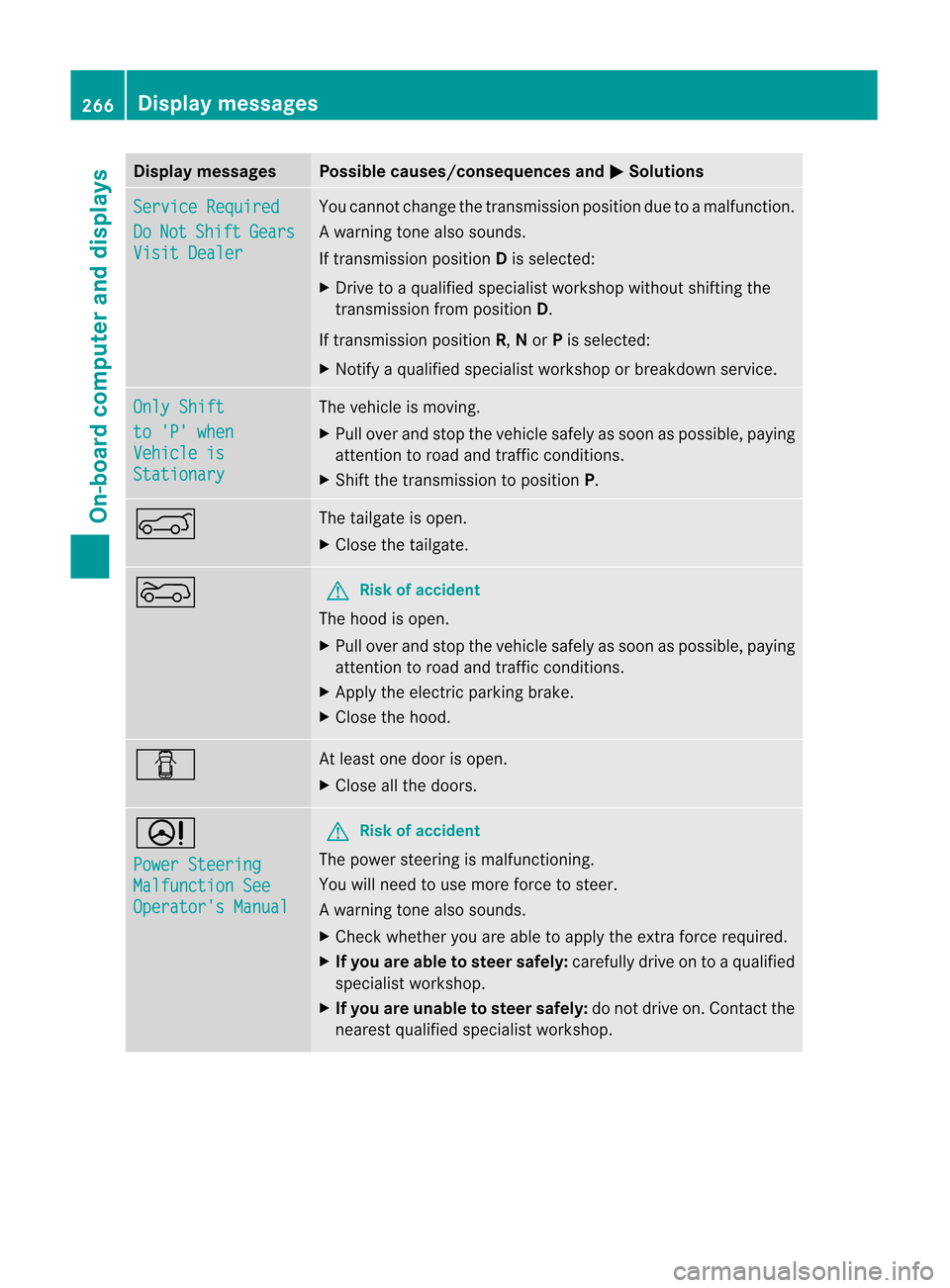
Disp
laymessa ges Poss
iblecauses/c onseq uences and M Solu
tions Ser
viceReq uired Do Not Shi
ft Gea
rs Vis
itDealer You
cannotchange thetransmission positionduetoamalfunction.
Aw arning tone also soun ds.
If trans mis sion positionD is selec ted:
X Dr ive toaqualifi edspec ialist workshopwit hout shiftingth e
tr ans mis sion from posi tionD.
If trans mis sion positionR, Nor Pis selec ted:
X Not ifyaqualifi edspec ialist workshopor break down service. Onl
yShi ft to
'P' when Veh
icleis Sta
tionary The
vehicle ismov ing.
X Pull overand stop thevehiclesa fel yas soo naspossible ,pay ing
attent iontoroad andtraffic conditions.
X Shift thetransmission toposition P. A The
tailgate isopen.
X Close thetailgate. ? G
Risk
ofaccident The
hood isopen.
X Pull over andstop thevehicle safelyassoon aspossible ,pay ing
attent iontoroad andtraffic conditions.
X Apply theelectric parking brake.
X Close thehood. C At
least onedoor isopen.
X Close allthe doors. D
Power
Steering Malfunction
See Operator's
Manual G
Risk
ofaccident The
power steering ismalfunctioning.
You willneed touse more forcetosteer.
Aw arning tone also soun ds.
X Chec kwhether youareable toapply theextr aforce required.
X Ifyou areable tosteer safely: carefully driveontoaqual ified
specialist workshop.
X Ifyou areunable tosteer safely: donot drive on.Contact the
nearest qualified specialist workshop. 266
Display
messagesOn-board computer and displays
Page 286 of 396
Useful
information
i This
Operat or'sManual describesall
models andallstan dard andoption al
equipment ofyour vehicle available atthe
time ofpublication ofthe Operat or's
Manual. Country-specificdiffer encesare
possible. Pleasenotethat your vehicle may
not beequipped withallfeature s
descr ibed. Thisalso applies tosafet y-
related systemsand func tions. i
Please
readtheinfor mation onqualified
specialist workshops(Ypage 25). Loading
guidelines G
WARN
ING Always
fastenitems being carriedas secur ely
as possi ble. Use cargotie-do wn rings and
fa ste ning materi alsap pro priate forthe weight
and size ofthe load .
In an acc ident, durin gh ard brak ingorsudden
man euver s,loos eite ms will bethrown aroun d
ins ide theveh icle.This can cause injuryto
vehicle occupants unlesstheitems are
securely fastened inthe vehicle.
To help avoid personal injuryduring acollision
or sudden maneuver, exercisecarewhen
transport ingcargo. Donot pile luggag eor
cargo higher thantheseat backrests.
The cargo compartmen tist he preferred place
to carry object s.Always usecargo tie-down
rings, andifso equipp ed,alwa ysuse thecargo
net when transport ingcargo.
Never driveavehicle withthetailgate open.
Deadly carbon monoxide (CO)gases may
enter vehicle interior resulting in
unconsc iousness anddeath.
The gross vehicle weight(GVW)isthe vehicle
weight including fuel,vehicle toolkit,spare
wheel, installed accessories, vehicle
occupants andlugga ge/cargo.
The gross loadlimit andthegross vehicle
weight rating(GVWR) foryour vehicle must never
beexceeded. Thegross loadlimit and
the GVWR arespecified onthe vehicle
identification plateonthe B-pillar ofthe
driver's door(Ypage 362).
The load must alsobedistributed sothat the
weight oneach axlenever exceeds thegross
axle weight rating(GAWR) forthe front and
rear axles. Thespecifications forGVWR and
GAWR areonthe vehicle identification plate
on the B-pillar ofthe driver's door
(Y page 362).
Further information canbefound inthe
"Loadi ngthe vehicle" section(Ypage 362).
The handling characterist icsofaladen
vehicle aredependent onthe distribution of
the load within thevehicle. Forthis reason,
you should observe thefollowing noteswhen
transport ingaload:
R position heavyloadsasfar forwards as
possible andaslow down inthe cargo
compartmen taspossible .
R the load must notprotrude abovetheupper
edge ofthe seat backrests.
R alwa ysplace theload againstthe rear or
front seatbackrests. Makesurethatthe
seat backrests aresecurely lockedinto
place.
R hook inthe cargo netwhen loading.
R alwa ysplace theload behind unoccupied
seats ifpossible .
R secure theload withsufficiently strongand
wear-resistant tiedown. padsharp edges
for protect ion. Stowage
areas Stowage
compartments
Importa ntsafety notes G
WARNING To
help avoid personal injuryduring acollision
or sudden maneuver, exercisecarewhen
storing objects inthe vehicle. Putlugga geor
cargo inthe cargo compartment ifpossible . 284
Stowage
areasStowing and features
Page 289 of 396
X
Push cover =forward untilitis lying onthe
rear seat armrest . Cargo
compar tment enlargement
Impor tantsafety notes G
WARNIN
G When
expanding thecargo volume, always
fully foldthecorres ponding seatsand,ifso
equipped, alwaysuse thecargo netwhen
tran sportin gcargo.
Unless youaretran sportin gcargo ,th eseat
back restsmust remainprop erlylockedin the
uprig htposit ion.
In an acc iden t,durin ghard brak ingorsudden
man euver s,loos eite ms will bethrown aroun d
ins ide theveh icle.This can cause injuryto
vehicle occupants unlesstheitems are
securely fastened inthe vehicle.
Always usethecargo tie-down rings. G
WARNING Never
driveavehicle withthetailgate open.
Deadly carbon monoxide (CO)gases may
enter vehicle interior resulting in
unconsc iousness anddeath.
! Fold theseat cushion upwardsbefore
folding therear bench seatforward.
Otherwise, thebackrests maybedamaged.
When thebackrest isfolded forwards, the
front seats should notbemoved totheir
rearmost position.Otherwise, thefront
seats andtherear bench seatcould be
damaged.
The left-hand andright-hand rearseat
backrests canbefolded forwards separately
to increase thecargo compartmen tcapaci ty. Foldi
ngtherea rbench seatforwar ds i
If
th edriv er'sor fron t-passe nger seat is
set foralarge rpers on,it may notbe
poss ibletofold therear benchseat
for wards .Int his case, move thefront seats
as far forward aspossible.
X Move thehead restraint sto the lowest
position (Ypage 97).
X Fold seatcushion :upwa rds. X
Pull release catch;upwa rdsinthe
direction ofthe arrow untilthebackrest is
completely unlocked.
! The backrest isheavy. Therefore, take
care when folding itdown. Makesurethat
the head restraint sare pushed allthe way
in so that thebackrests andseat cushions
are not damaged.
X Fold thebackrest forwards untilitreaches
the cargo compartmen tposition. Stowage
areas
287Stowing and features Z
Page 292 of 396
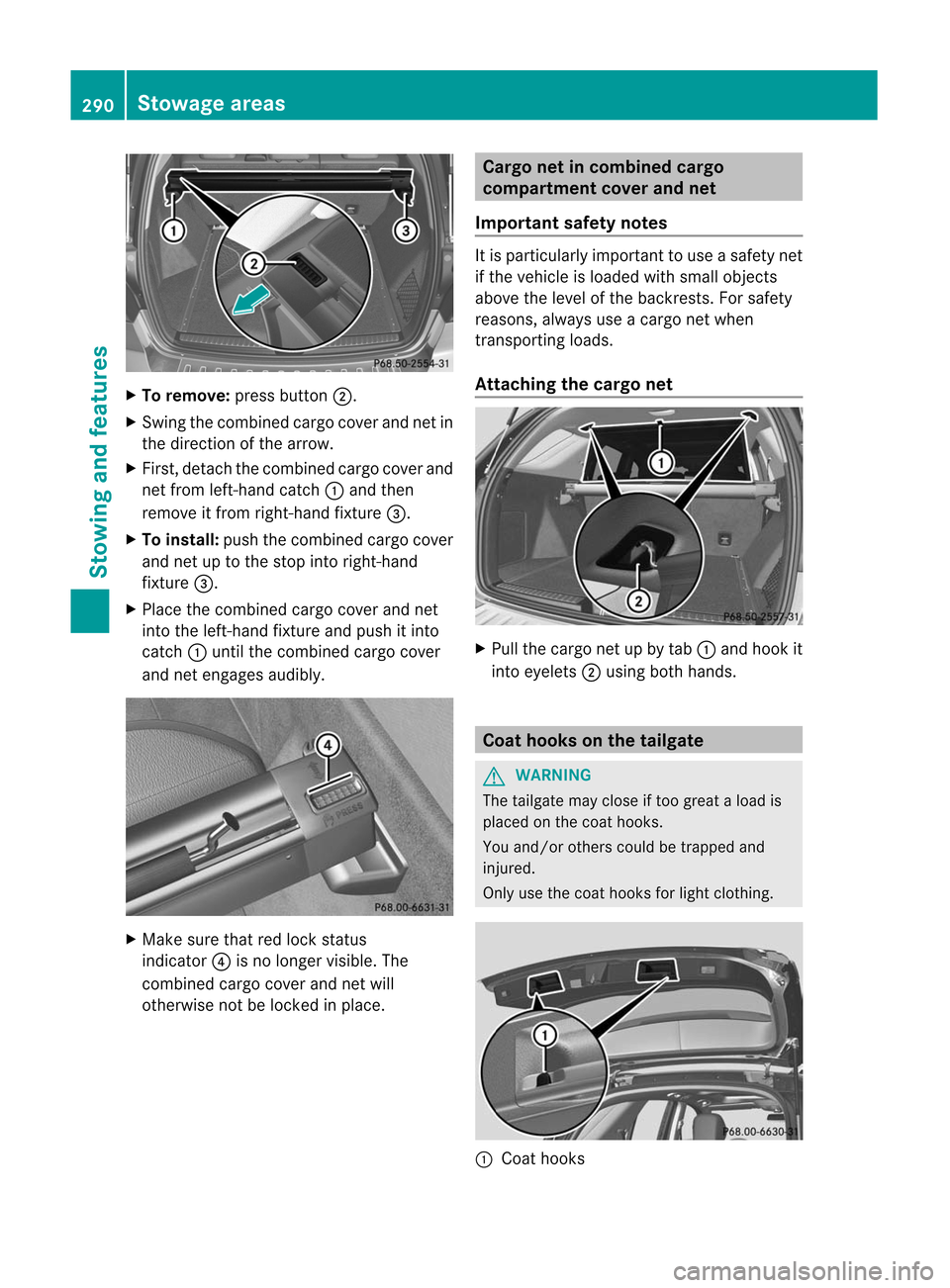
X
To remo ve:pre ssbutton ;.
X Swi ngthe comb inedcar gocove rand net in
the directi onofthe arrow .
X Fir st, detach thecomb inedcar gocove rand
net from left-ha ndcatch :and then
rem ove itfrom right-ha ndfixtu re=.
X To instal l:pu sh the comb inedcar gocove r
and netuptothe stop intoright-ha nd
fixtu re=.
X Place thecomb inedcar gocove rand net
into theleft-ha ndfixtu reand push itinto
catch :unti lthe comb inedcar gocove r
and netengages audibl y. X
Ma kesure tha tred lock status
indicat or? isno longer visible. The
combin edcargo coverandnetwill
other wisenotbelocked inplace. Cargo
netincombined cargo
compa rtment cover andnet
Impor tantsafet ynotes It
is particularly importanttouse asafety net
if the vehicle isloaded withsmall objects
above thelevel ofthe backr ests.Forsafety
reasons, alwaysuse acargo netwhen
tran sport ingloads.
Atta ching thecargo net X
Pull thecargo netupbytab :and hook it
int oeyelets ;using bothhands. Coat
hooks onthe tailga te G
WARN
ING The
tailgate mayclose iftoo great aload is
placed onthe coat hooks.
You and/or otherscould betrapped and
injur ed.
Only usethecoat hooks forlight cloth ing. :
Coat hooks 290
Stowage
areasStowing and features
Page 294 of 396
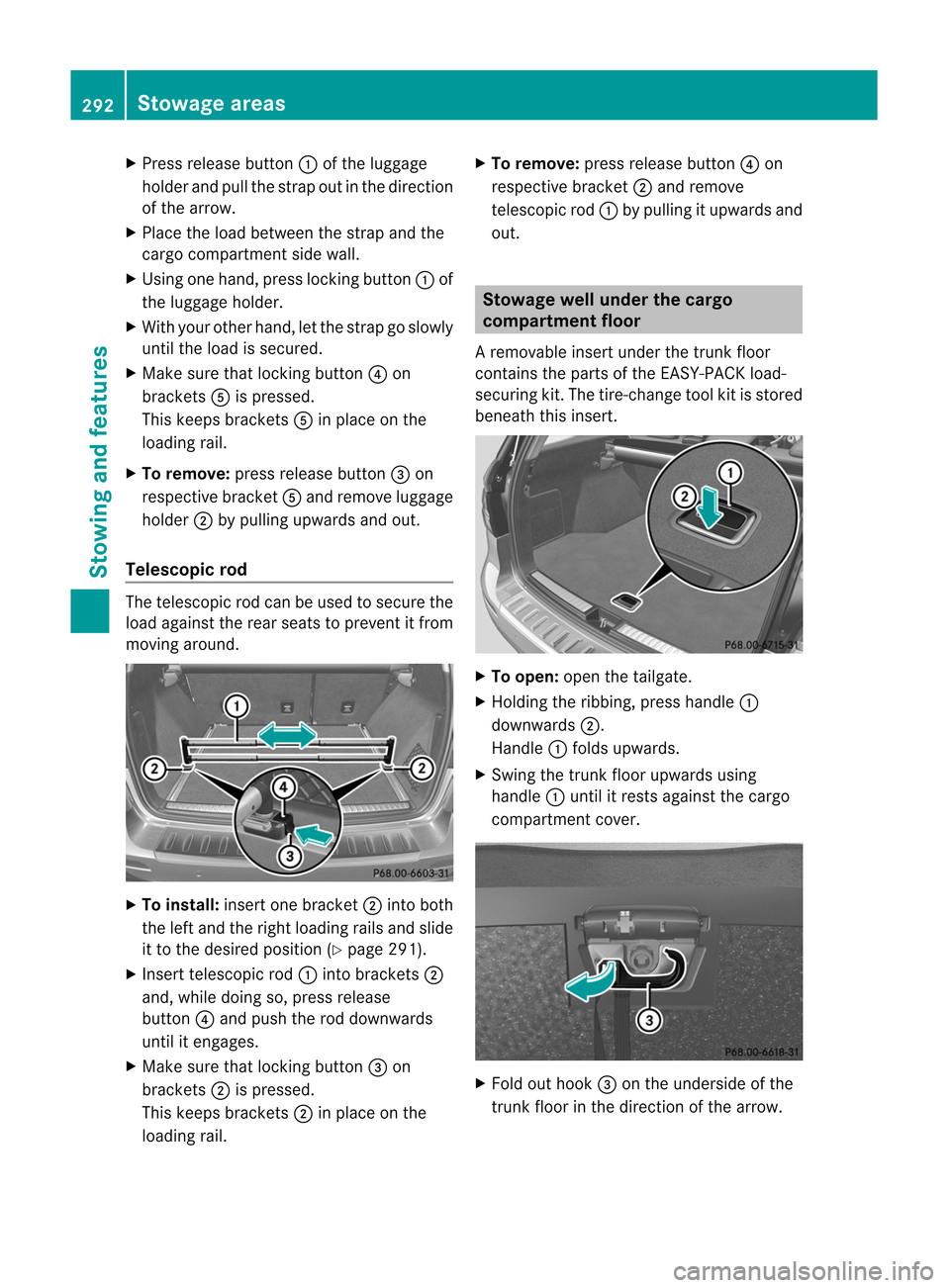
X
Press release button:ofthe luggage
holder andpullthestrap outinthe direction
of the arrow.
X Place theload between thestrap andthe
cargo compart mentsidewall.
X Using onehand, presslockingbutton :of
the luggage holder.
X With yourother hand, letthe strap goslowly
until theload issecured.
X Make surethatlockin gbutton ?on
bracket sA ispressed.
This keeps bracket sA inplace onthe
loading rail.
X To remove: pressrelease button=on
respect ivebracket Aand remove luggage
holder ;bypulling upwards andout.
Telescopic rod The
telescopic rodcan beused tosecure the
load against therear seats toprevent itfrom
moving around. X
To install: insertonebracket ;into both
the left and theright loading railsandslide
it to the desired position (Ypage 291).
X Inser ttelescopic rod:intobrack ets;
and, while doing so,press release
button ?and push therod downwards
until itengages.
X Make surethatlockin gbutton =on
brack ets;ispressed.
This keeps brackets;inplace onthe
loading rail. X
To rem ove: press release button?on
respect ivebrack et; and remove
telesc opicrod:bypulling itupwards and
out. Stowage
wellunder thecargo
compa rtment floor
A removable insertunder thetrun kfloor
con tains theparts ofthe EASY-PA CKload-
securin gkit .The tire-c hange toolkitisstored
beneath thisinsert. X
To open: openthetailgate.
X Holding theribbing, presshandle :
downwards ;.
Handle :folds upwards.
X Swing thetrunk floorupwa rdsusing
handle :until itrests against thecargo
compartmen tcover. X
Fold outhook =onthe underside ofthe
trunk floorinthe direction ofthe arrow. 292
Stowage
areasStowing and features