dimensions MERCEDES-BENZ M-Class 2013 W166 User Guide
[x] Cancel search | Manufacturer: MERCEDES-BENZ, Model Year: 2013, Model line: M-Class, Model: MERCEDES-BENZ M-Class 2013 W166Pages: 458, PDF Size: 6.24 MB
Page 400 of 458
Useful information
i This Operator's Manual describes all
models and all standard and optional
equipment of your vehicle available at the
time of publication of the Operator's
Manual. Country-specific differences are
possible. Please note that your vehicle may
not be equipped with all features
described. This also applies to safety-
related systems and functions.
i Read the information on qualified
specialist workshops: (Y page 27).Important safety notes
G
WARNING
If wheels and tires of the wrong size are used,
the wheel brakes or suspension components
may be damaged. There is arisk of an
accident.
Always replace wheels and tires with those
that fulfill the specifications of the original
part.
When replacing wheels, make sure to use the
correct:
R designation
R model
When replacing tires, make sure to use the
correct:
R designation
R manufacturer
R model G
WARNING
Af lat tire severely impairs the driving,
steering and braking characteristics of the
vehicle. There is a risk of accident.
Tires without run-flat characteristics:
R do not drive with aflat tire.
R immediately replace the flat tire with your
emergency spare wheel or spare wheel, or
consult a qualified specialist workshop. Tires with run-flat characteristics:
R
pay attention to the information and
warning notices on MOExtended tires (tires
with run-flat characteristics).
Accessories that are not approved for your
vehicle by Mercedes-Ben zorare not being
used correctly can impair the operating
safety.
Before purchasing and using non-approved
accessories, visi taqualified specialist
workshop and inquire about:
R suitability
R legal stipulations
R factory recommendations
Information on the dimensions and types of
wheels and tires for your vehicle can be found
in the "Wheel/tire combinations" section
(Y page 426).
Information on air pressure for the tires on
your vehicle can be found:
R on the vehicle's Tire and Loading
Information placard on the B-pillar
(Y page 410)
R on the tire pressure label on the fuel filler
flap (Y page 174)
R in the "Tire pressure" section
R under "Tire pressure" (Y page 402) Operation
Information on driving
If the vehicle is heavily loaded, chec kthe tire
pressures and correct them if necessary.
While driving, pay attention to vibrations,
noises and unusual handling characteristics,
e.g. pulling to one side. This may indicate that
the wheels or tires are damaged. If you
suspect that a tire is defective, reduce your
speed immediately. Stop the vehicle as soon
as possible to check the wheels and tires for
damage. Hidden tire damage could also be
causing the unusual handling characteristics.
If you find no signs of damage, have the tires 398
OperationWheels and tires
Page 405 of 458
The tire pressure table contains the
recommended pressures for cold tires for
various operating conditions, i.e. differing
load and speed conditions. Example: tire pressure table with tire dimensions
If a tire size precedes a tire pressure, the tire
pressure information following is only valid
for that tire size. The load conditions "partially
laden" and "fully laden" are defined in the
table for different numbers of occupants and
amounts of luggage. The actual number of
seats may differ. Some tire pressure tables show only the rim
diameters instead of the full tire size, e.g.
R18. The rim diameter is part of the tire size
and can be found on the tire sidewall
(Y page 415).
If the tire pressures have been set to the
lower values for lighter loads and/or lower
road speeds, the pressures should be reset
to the higher values:
R if you want to drive with an increased load
and/or
R if you want to drive at higher road speeds. i
The tire pressures for increased loads
and/or higher road speeds, shown in the
tire pressure table, may have a negative
effect on driving comfort.
If the tire pressure is not set correctly, this
can lead to an excessiv ebuild up of heat and
a sudde nloss of pressure.
For more information, contact a qualified
specialist workshop. Important notes on tire pressure
G
WARNING
If the tire pressure drops repeatedly, the
wheel, valve or tire may be damaged. Tire
pressure that is too low may result in a tire
blow-out. There is a risk of an accident.
R Check the tire for foreign objects.
R Check whether the wheel is losing air or the
valve is leaking.
If you are unable to rectify the damage,
contact a qualified specialist workshop. G
WARNING
If you fit unsuitable accessories onto tire
valves, the tire valves may be overloaded and
malfunction, which can cause tire pressure
loss. Due to their design, retrofitted tire
pressure monitors keep the tire valve open.
This can also result in tire pressure loss. There
is a risk of an accident.
Only screw the standard valve cap or other
valve caps approved by Mercedes-Benz for
your vehicle onto the tire valve.
Use a suitable pressure gauge to check the
tire pressure. The outer appearance of a tire
does not permit any reliable conclusion about
the tire pressure. On vehicles equipped with
the electronic tire pressure monitoring
system, the tire pressure can be checked
using the on-board computer.
The tire temperature and pressure increase
when the vehicle is in motion .This is
dependent on the driving speed and the load. Tire pressure
403Wheels and tires Z
Page 423 of 458
Traction
Traction is the result of friction between the
tires and the road surface.
TWR (Tongue Weight Rating)
The TWR specifies the maximu mpermissible
weight that the ball coupling of the trailer tow
hitch can support.
Treadwear indicators
Narrow bars (tread wear bars) that are
distributed over the tire tread. If the tire tread
is level with the bars, the wear limit of 0008in
(1.6 mm) has been reached.
Occupant distribution
The distribution of occupants in a vehicle at
their designated seating positions.
Total load limit
Rated cargo and luggage load plus
68 kilograms (150 lb) multiplied by the
number of seats in the vehicle. Changing
awheel Flat tire
You can find information on wha tto do in the
event of a flat tire in the "Breakdown
assistance" section (Y page 381).
Information on driving with MOExtended tires
in the event of a flat tire can be found under
"MOExtended tires (tires with run-flat
characteristics" (Y page 382).
The "Breakdown assistance" section
(Y page 381) contains information and notes
on how to deal with a flat tire. Information on
driving with MOExtended tires in the event of
a flat tire can be found under "MOExtended
tires (tires with run-flat characteristics"
(Y page 382).
Vehicles with an emergency spare
wheel: in the event of a flat tire, mount the
emergency spare wheel according to the
description under "Mounting a wheel"
(Y page 422). Rotating the wheels
G
WARNING
Interchanging the front and rear wheels may
severely impair the driving characteristics if
the wheels or tires have different dimensions.
The wheel brakes or suspension components
may also be damaged. There is a risk of
accident.
Rotate front and rear wheels only if the wheels
and tires are of the same dimensions.
! On vehicles equipped with a tire pressure
monitor, electronic components are
located in the wheel.
Tire-mounting tools should not be used
near the valve. This could damage the
electronic components.
Only have tires changed at a qualified
specialist workshop.
Always observe the instructions and safety
notes in the "Mounting awheel" section
(Y page 422).
The wear patterns on the front and rear tires
differ, depending on the operating conditions.
Rotate the wheels before a clear wear pattern
has formed on the tires. Front tires typically
wear more on the shoulders and the rear tires
in the center.
If your vehicle's tire configuration allows, you
can rotate the wheels according to the
intervals in the tire manufacturer's warranty
book in your vehicle documents. If this is not
available, the tires should then be rotated
every 3000 to 6000 miles (5000 to
10,000 km), or earlier if the tire wear requires
this. Do not change the direction of wheel
rotation.
Cleant he contact surfaces of the wheel and
the brake disc thoroughly every time a wheel
is interchanged. Check the tire pressure and,
if necessary, restart the tire pressure loss
warning system or the tire pressure monitor. Changing
awheel
421Wheels and tires Z
Page 438 of 458
ML 63 AMG 4MATIC
Summer tires
R 20
Tires Alloy wheels
BA: 265/45 ZR 20 108 Y XL
4 BA: 9.0 J x 20 H2
Wheel offset: 1.61 in (41 mm)
R 21
Tires Alloy wheels
BA: 295/35 ZR 21 107 Y XL
4 BA: 10.0 J x 21 H2
Wheel offset: 2.21 in (56 mm)
Winter tires
R 20
Tires Alloy wheels
BA: 255/45 R 20 105 V XL M+S
0002 BA: 9.0 J x 20 H2
Wheel offset: 1.61 in (41 mm)
R 21
Tires Alloy wheels
BA: 295/35 R 21 107 V XL M+S
00024 BA: 10.0 J x 21 H2
Wheel offset: 2.21 in (56 mm)
Emergency spare wheel
Important safety notes
G
WARNING
The wheel or tire size as well as the tire type
of the spare wheel or emergency spare wheel
and the wheel to be replaced may differ.
Mounting an emergency spare wheel may
severely impair the driving characteristics.
There is a risk of an accident. To avoid hazardous situations:
R
adapt you rdriving style accordingly and
drive carefully.
R never mount more than one spare wheel or
emergency spare wheel that differs in size.
R only use a spare wheel or emergency spare
wheel of a different size briefly.
R do not switch ESP ®
off.
R have a spare wheel or emergency spare
wheel of a different size replaced at the
nearest qualified specialist workshop.
Observe that the wheel and tire dimensions
as well as the tire type must be correct.
4 Use of snow chains not permitted .Observe the notes under "Snow chains". 436
Emergency spare wheelWheels and tires
Page 455 of 458
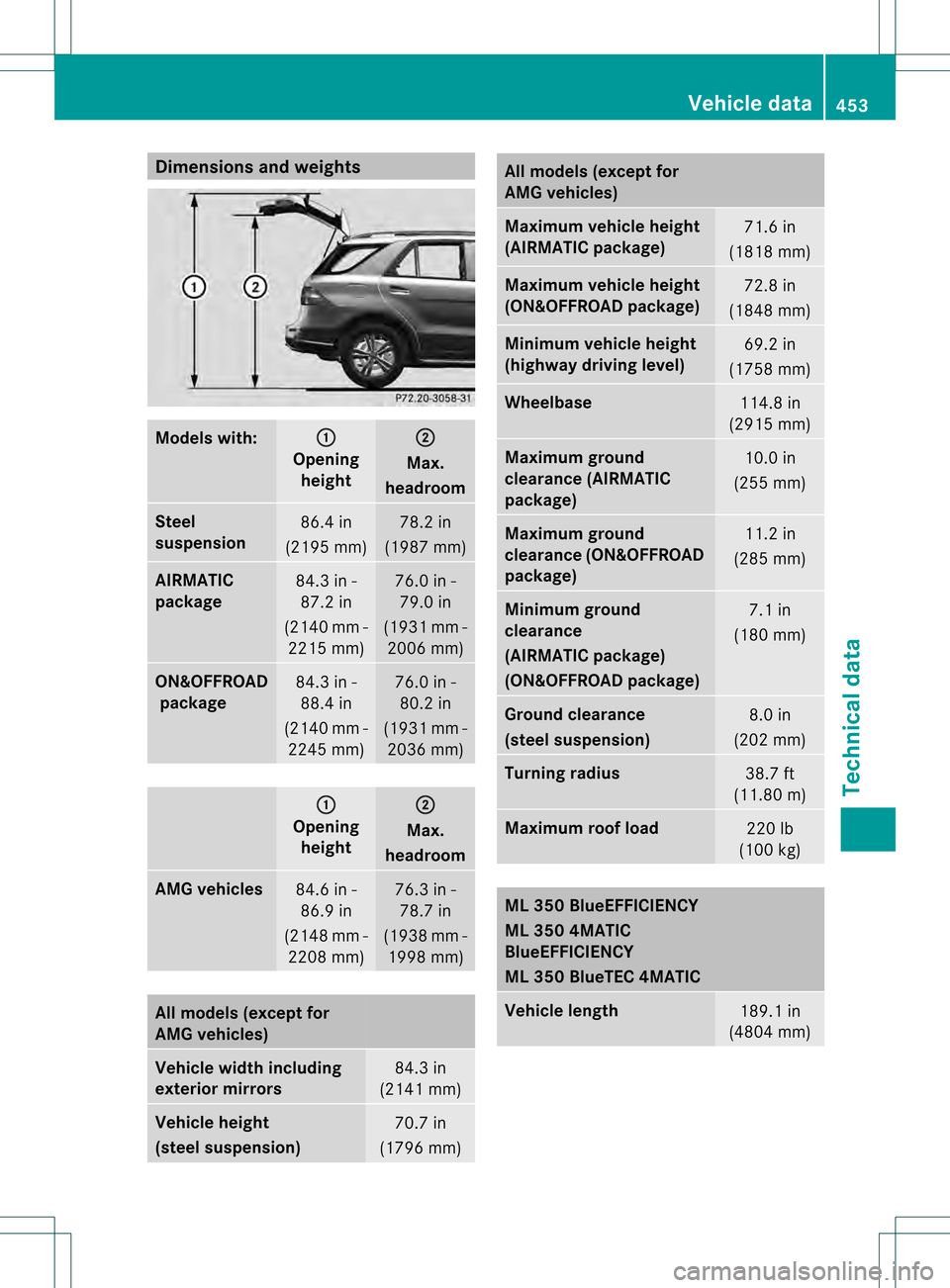
Dimensions an
dweights Models with: 0002
Opening
height 0003
Max.
headroom Steel
suspension
86.4 in
(2195 mm) 78.2 in
(1987 mm) AIRMATIC
package
84.3 in -
87.2 in
(2140 mm - 2215 mm) 76.0 in -
79.0 in
(1931 mm - 2006 mm) ON&OFFROAD
package 84.3 in -
88.4 in
(2140 mm - 2245 mm) 76.0 in -
80.2 in
(1931 mm - 2036 mm) 0002
Opening
height 0003
Max.
headroom AMG vehicles
84.6 in -
86.9 in
(2148 mm - 2208 mm) 76.3 in -
78.7 in
(1938 mm - 1998 mm) All models (excep
tfor
AMG vehicles) Vehicle widt
hincluding
exterior mirrors 84.3 in
(2141 mm) Vehicle height
(steel suspension)
70.7 in
(1796 mm) All models (except for
AMG vehicles)
Maximum vehicle height
(AIRMATIC package)
71.6 in
(1818 mm) Maximum vehicle height
(ON&OFFROAD package)
72.8 in
(1848 mm) Minimum vehicle height
(highway driving level)
69.2 in
(1758 mm) Wheelbase
114.8 in
(2915 mm) Maximum ground
clearance (AIRMATIC
package)
10.0 in
(255 mm) Maximum ground
clearance (ON&OFFROAD
package)
11.2 in
(285 mm) Minimum ground
clearance
(AIRMATIC package)
(ON&OFFROAD package)
7.1 in
(180 mm) Ground clearance
(steel suspension)
8.0 in
(202 mm) Turning radius
38.7 ft
(11.80 m) Maximum roof load
220 lb
(100 kg) ML 350 BlueEFFICIENCY
ML 350 4MATIC
BlueEFFICIENCY
ML 350 BlueTEC 4MATIC
Vehicle length
189.1 in
(4804 mm) Vehicle data
453Technical data Z
Page 456 of 458
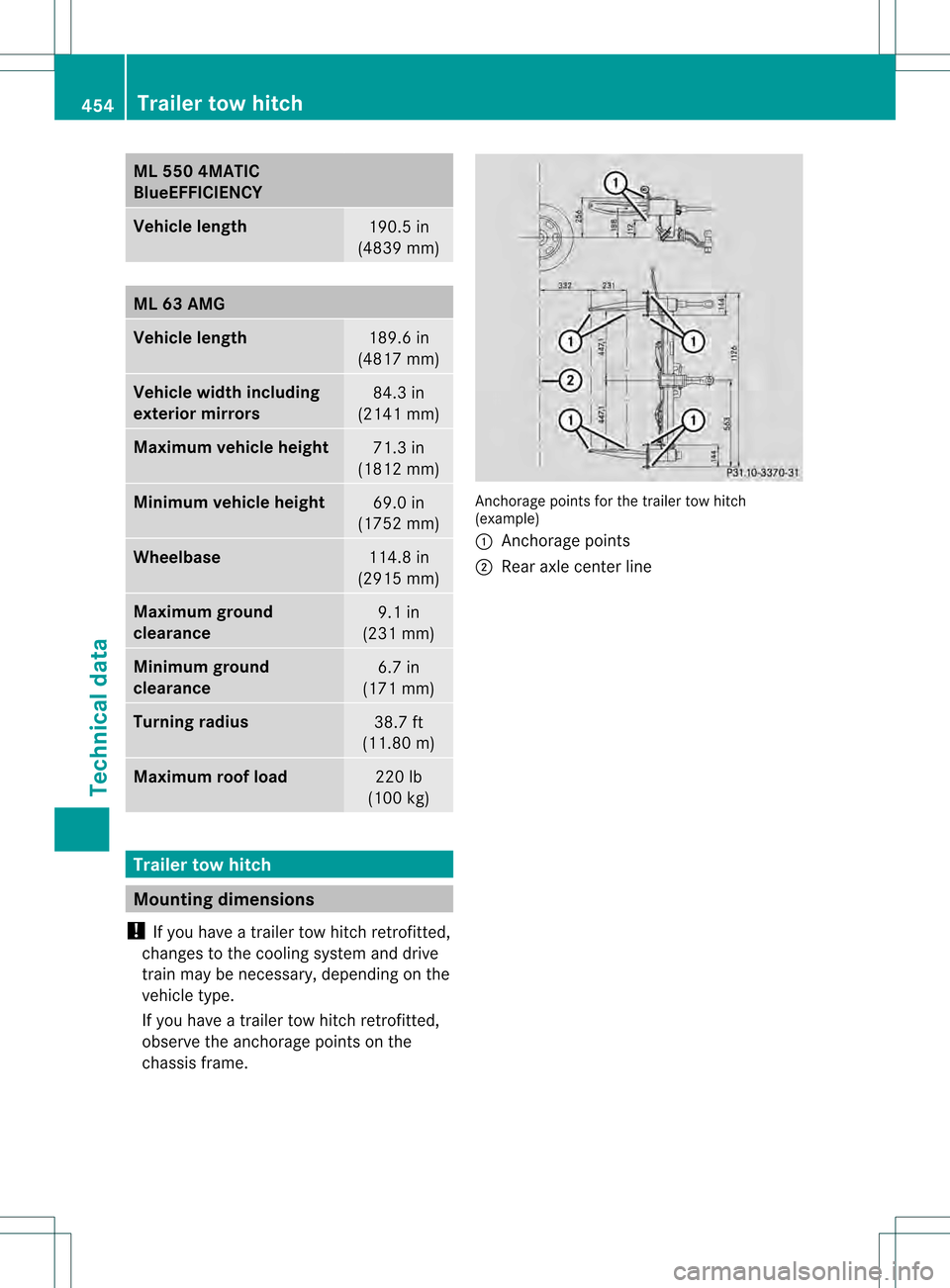
ML 550 4MATIC
BlueEFFICIENCY Vehicle length
190.5 in
(4839 mm) ML 63 AMG
Vehicle length
189.6 in
(4817 mm) Vehicle width including
exterior mirrors 84.3 in
(2141 mm) Maximum vehicle height
71.3 in
(1812 mm) Minimum vehicle height
69.0 in
(1752 mm) Wheelbase
114.8 in
(2915 mm) Maximum ground
clearance
9.1 in
(231 mm) Minimum ground
clearance
6.7 in
(171 mm) Turning radius
38.7 ft
(11.80 m) Maximum roof load
220 lb
(100 kg) Trailer tow hitch
Mounting dimensions
! If you have a trailer tow hitch retrofitted,
changes to the cooling system and drive
train may be necessary, depending on the
vehicle type.
If you have a trailer tow hitch retrofitted,
observe the anchorage points on the
chassis frame. Anchorage points for the trailer tow hitch
(example)
0002
Anchorage points
0003 Reara xle cente rline 454
Trailer tow hitchTechnical data
Page 458 of 458
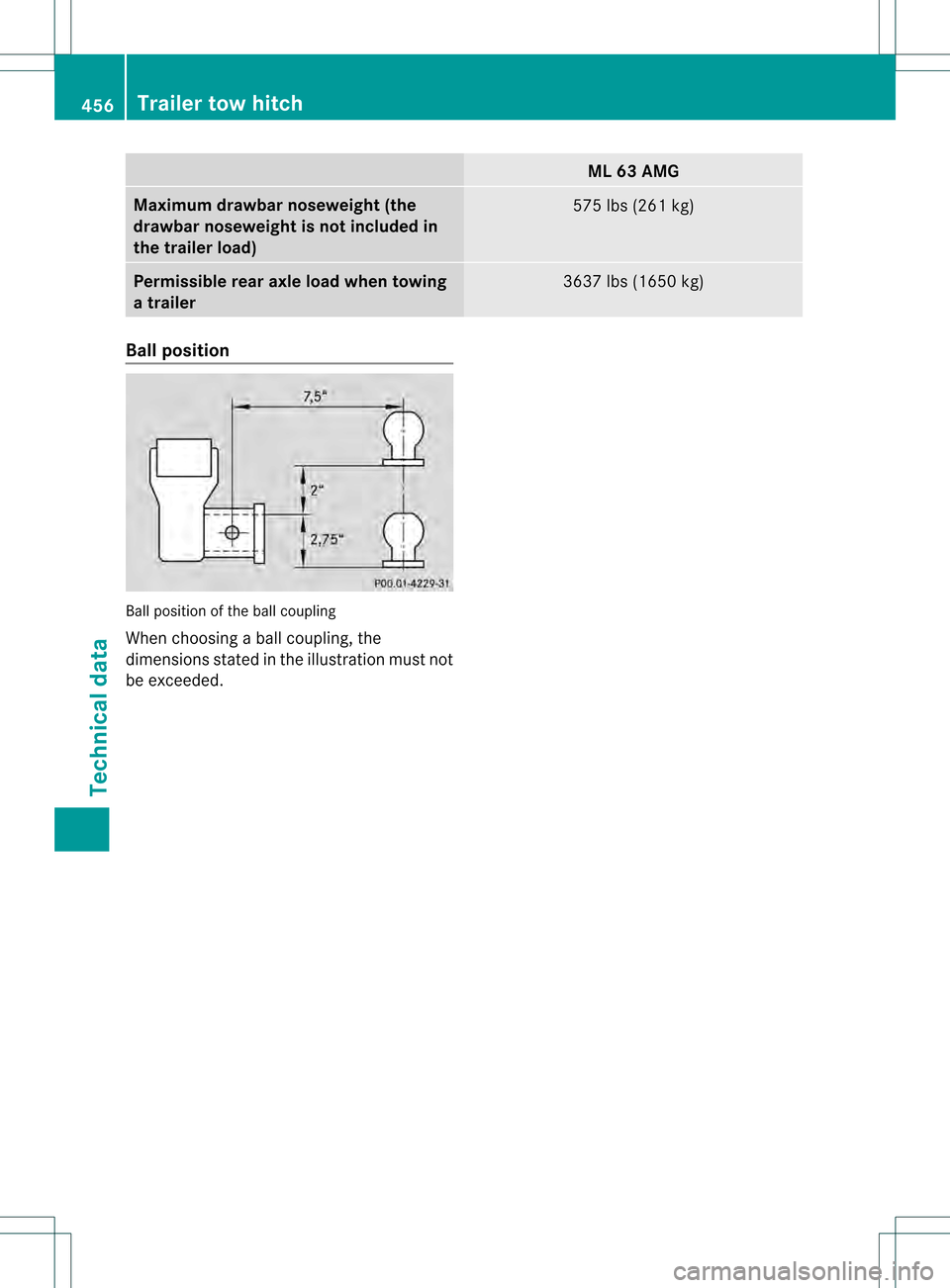
ML 63 AMG
Maximum drawbar noseweight (the
drawbar noseweight is not included in
the trailer load)
575 lbs (261 kg)
Permissible rear axle load when towing
a trailer
3637 lbs (1650 kg)
Ball position
Ball position of the ball coupling
When choosing a ball coupling, the
dimensions stated in the illustration must not
be exceeded. 456
Trailer tow hitchTechnical data