flex MERCEDES-BENZ M-Class 2013 W166 Owner's Manual
[x] Cancel search | Manufacturer: MERCEDES-BENZ, Model Year: 2013, Model line: M-Class, Model: MERCEDES-BENZ M-Class 2013 W166Pages: 458, PDF Size: 6.24 MB
Page 13 of 458
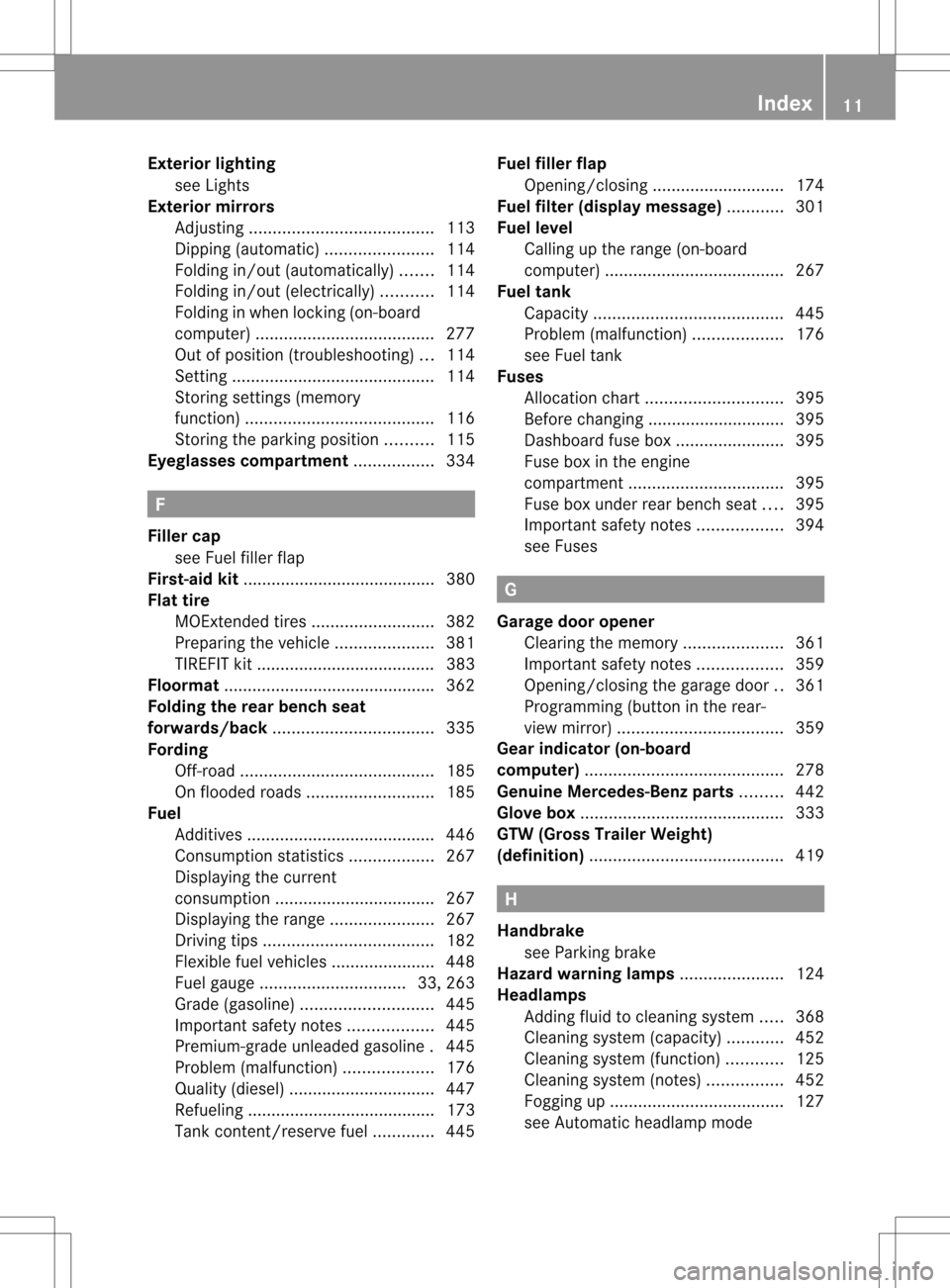
Exterior lighting
see Lights
Exterior mirrors
Adjusting ....................................... 113
Dipping (automatic) .......................114
Folding in/ou t(automatically) .......114
Folding in/ou t(electrically) ...........114
Folding in whe nlocking (on-board
computer) ...................................... 277
Out of position (troubleshooting) ...114
Setting ........................................... 114
Storing settings (memory
function) ........................................ 116
Storing the parking position ..........115
Eyeglasses compartment .................334 F
Fille rcap
see Fuel filler flap
First-aid kit ......................................... 380
Flat tire MOExtended tires ..........................382
Preparing the vehicle .....................381
TIREFIT kit ...................................... 383
Floormat ............................................ .362
Folding the rear bench seat
forwards/back .................................. 335
Fording Off-road ......................................... 185
On flooded road s........................... 185
Fuel
Additives ........................................ 446
Consumption statistics ..................267
Displaying the current
consumption .................................. 267
Displaying the range ......................267
Driving tips .................................... 182
Flexible fuel vehicles ......................448
Fuel gauge ............................... 33, 263
Grade (gasoline) ............................ 445
Important safety notes ..................445
Premium-grade unleaded gasoline .445
Problem (malfunction) ...................176
Quality (diesel )............................... 447
Refueling ........................................ 173
Tank content/reserve fuel .............445Fuel filler flap
Opening/closing ............................ 174
Fuel filte r(display message) ............301
Fuel level Calling up the range (on-board
computer) ...................................... 267
Fuel tank
Capacity ........................................ 445
Problem (malfunction) ...................176
see Fuel tank
Fuses
Allocation chart ............................. 395
Before changing ............................. 395
Dashboard fuse box .......................395
Fuse box in the engine
compartment ................................. 395
Fuse box unde rrear bench seat ....395
Important safety notes ..................394
see Fuses G
Garage door opener Clearing the memory .....................361
Important safety notes ..................359
Opening/closing the garage door ..361
Programming (button in the rear-
view mirror) ................................... 359
Gear indicator (on-board
computer) .......................................... 278
Genuine Mercedes-Benz parts .........442
Glove box ........................................... 333
GTW (Gross Trailer Weight)
(definition) ......................................... 419 H
Handbrake see Parking brake
Hazard warning lamps ......................124
Headlamps Adding fluid to cleaning system .....368
Cleaning system (capacity )............ 452
Cleaning system (function) ............125
Cleaning system (notes) ................452
Fogging up ..................................... 127
see Automatic headlamp mode Index
11
Page 176 of 458

If you or others come into contact with fuel,
observe the following:
R
Wash away fuel from skin immediately
using soap and water.
R If fuel comes into contact with your eyes,
immediately rinse them thoroughly with
clean water. Seek medica lassistance
without delay.
R If fuel is swallowed, seek medical
assistance without delay.Don ot induce
vomiting.
R Immediately change out of clothing which
has come into contact with fuel. G
WARNING
Electrostatic buildup can create sparks and
ignite fuel vapors. There is a risk of fire and
explosion.
Always touch the vehicle body before opening
the fuel filler flap or touching the fuel pump
nozzle. Any existing electrostatic buildup is
thereby discharged. G
WARNING
Vehicles with a diesel engine:
If you mix diesel fuel with gasoline, the flash
point is lower than that of pure diesel fuel.
When the engine is running, exhaust system
components could overheat without being
noticed. There is a risk of fire.
Never refuel with gasoline. Never mix gasoline
with diesel fuel.
! Do not use gasoline to refuel vehicles with
a diesel engine. Do not use diesel to refuel
vehicles with a gasoline engine. Do not
switch on the ignition if you accidentally
refuel with the wrong fuel. Otherwise, the
fuel will enter the fuel system. Even small
amounts of the wrong fuel could result in
damage to the fuel system and the engine.
The repair costs are high. Notify a qualified
specialist workshop and have the fuel tank
and fuel lines drained completely. !
Overfilling the fuel tank could damage the
fuel system.
! Take care not to spill any fuel on painted
surfaces. You could otherwise damage the
paintwork.
! Use a filter when refueling from a fuel can.
Otherwise, the fuel lines and/or injection
system could be blocked by particles from
the fuel can.
Do not get into the vehicle again during the
refueling process. Otherwise, electrostatic
charge could build up again.
If you overfill the fuel tank, fuel could spray
out when the fuel pump nozzle is removed.
i Flexible Fuel vehicles can be recognized
by the Ethanol up to E85 sticker on the
inside of the fuel filler flap.
For further information on fuel and fuel quality
(Y page 445). Refueling
Opening/closing the fuel filler flap 0002
To open the fuel filler flap
0003 To insert the fuel filler cap
001F Fuel type to be used
001E Tire pressure table
The fuel filler flap is unlocked or locked
automatically when you open or close the
vehicle with the SmartKey or with KEYLESS-
GO. 174
RefuelingDriving and parking
Page 184 of 458
Parking the vehicle for
along period
If you leave the vehicle parked for longer than
four weeks, the battery may be damaged by
exhaustive discharging.
X Connecting a trickle charger.
i You can obtain information about trickle
chargers from a qualified specialist
workshop.
If you leave the vehicle parked for longer than
six weeks, the vehicle may suffer damage as
a result of lack of use.
X Visit a qualified specialist workshop and
seek advice. Driving tips
General notes
Important safety notes G
WARNING
If you switch off the ignitio nwhile driving,
safety-relevant functions are only available
with limitations, or not at all. This could affect,
for example, the power steering and the brake
boosting effect.Y ou will require considerably
more effort to steer and brake. There is a risk
of an accident.
Do not switch off the ignition while driving. G
WARNING
If you operate mobile communication
equipment while driving, you will be
distracted from traffic conditions. You could
also lose control of the vehicle. There is a risk
of an accident.
Only operate this equipment when the vehicle
is stationary.
Observe the legal requirements for the
country in which you are driving. Some
jurisdictions prohibit the driver from using a
mobile phone while driving a vehicle.
If you make a call while driving, always use
hands-free mode. Only operate the telephone when the traffic situation permits. If you are
unsure, pull over to a safe location and stop
before operating the telephone.
Bear in mind that at a speed of only 30 mph
(approximately 50 km/h), the vehicle covers
a distance of 44 feet (approximately 14 m)
per second.
Drive sensibly
–save fuel Observe the following tips to save fuel:
X
The tires should always be inflated to the
recommended tire pressure.
X Remove unnecessary loads.
X Remove roof carriers whe nthey are not
needed.
X Warm up the engine at low engine speeds.
X Avoid frequent acceleration or braking.
X Have all maintenance work carried out as
indicated by the service intervals in the
Maintenance Booklet or by the service
interval display.
Fuel consumption also increases when
driving in cold weather, in stop-start traffic
and in hilly terrain.
Drinking and driving G
WARNING
Drinking and driving and/or taking drugs and
driving are very dangerous combinations.
Even a small amount of alcohol or drugs can
affect your reflexes, perceptions and
judgment.
The possibility of a serious or even fatal
accident are greatly increased when you drink
or take drugs and drive.
Do not drink or take drugs and drive or allow
anyone to drive who has been drinking or
taking drugs.
Emission control G
WARNING
Combustion engines emit poisonous exhaust
gases such as carbon monoxide. Inhaling 182
Driving tipsDriving and parking
Page 450 of 458
Flexible Fuel vehicles
Important safety notes
G
WARNING
Fuel is highly flammable. If you handle fuel
incorrectly, there is a risk of fire and
explosion.
You must avoid fire, open flames, creating
sparks and smoking. Switch off the engine
and, if applicable, the auxiliary heating before
refueling. G
WARNING
Fuel is poisonous and hazardous to health.
There is a ris kofinjury.
You must make sure tha tfuel does no tcome
into contact with your skin, eyes or clothing
and that it is not swallowed. Do not inhale fuel
vapors. Keep fuel away from children.
If you or others come into contact with fuel,
observe the following:
R Wash away fuel from skin immediately
using soap and water.
R If fuel comes into contact with your eyes,
immediately rinse them thoroughly with
clean water. Seek medical assistance
without delay.
R If fuel is swallowed, seek medical
assistance without delay. Do not induce
vomiting.
R Immediately change out of clothing which
has come into contact with fuel.
Flexible Fuel vehicles can be refueled with the
following fuel types:
R premium-grade unleaded gasoline
R E85 fuel
R a mixture of E85 fuel and premium-grade
unleaded gasoline
i Flexible Fuel vehicles can be recognized
by the Ethanol up to E85 sticker on the
inside of the fuel filler flap. Fuel consumption
The energy content of E85 fuel is less than
that of the same amount of premium-grade
gasoline. The amount of fuel consumed when
operating the vehicle with E85 fuel is
therefore higher than with premium-grade
gasoline.
Maintenance
Informy
our authorized Mercedes-Benz
Center that you are operating or have
operated the vehicle with E85 fuel.
Low outside temperatures
If the outside temperature is below 32 ‡
(0 †) the starting procedure can take
noticeably longer when operating with E85
fuel.
E85 fuel is not suitable for use at outside
temperatures under -4 ‡ (-20 †). DEF
Important safety notes Comply with the important safety notes for
service products when handling DEF
(Y
page 444).
DEFi s a water-soluble fluid for the exhaust
gas aftertreatmentofd iesel engines.Itis:
R not poisonous
R colorless and odorless
R not flammable
When you open the DEF container, small
amounts of ammonia vapor may be released.
Ammonia vapors have a pungent odor and are
particularly irritating to the skin, to mucous
membranes and to the eyes. You may
experience a burning sensation in your eyes,
nose and throat. Coughing and watering of
the eyes are possible.
Do not inhale ammonia vapors. Fill the DEF
tank only in well-ventilated areas. 448
Service products and filling capacitiesTechnical data